Skip to content

Women’s Day: ESET’s Women in Cybersecurity Scholarship


Cybersecurity, traditionally a male-dominated industry, is gradually changing. According to a recent Women in Cybersecurity report, women accounted for 25% of the global cybersecurity workforce in 2022. The report suggests that the percentage could rise to 35% by 2031. 

ESET recognizes that women remain underrepresented in the cybersecurity industry, and the company has been making significant efforts to help close the gender gap in science, technology, engineering, and mathematics (STEM). Since 2016, ESET has been awarding scholarships to  women in the United States who are pursuing studies in cybersecurity or related fields. The program is currently running at ESET’s offices in the United States (offering two $10,000 USD scholarships), and Canada (offering two $5,000 CAD scholarships), and is launching this year in the United Kingdom and Australia.

Australia is launching their Women in Cybersecurity Scholarship on March 8,2024. The scholarship value is AUD 5,000, and is supported by the Australian Minister for Home Affairs and Cyber Security, Clare O’Neil.


Applicants are evaluated on their passion for cybersecurity, academic achievement, leadership, community involvement, and potential for future success. This scholarship offers a fantastic opportunity for women who are passionate about cybersecurity. It provides not only financial support but also a network of motivated women already working in STEM.

Remember, International Women’s Day is not only about celebrating the achievements of women but also about taking action to create a more equal future.  Diversity, Equity and Inclusion (DEI) matters to us at ESET because we believe different experiences and views enable us to drive innovation, efficiency and creativity.

Watch this video to find out more about the global program and about the employee resource groups created at ESET to support women working at the company.

About Version 2 Digital

Version 2 Digital is one of the most dynamic IT companies in Asia. The company distributes a wide range of IT products across various areas including cyber security, cloud, data protection, end points, infrastructures, system monitoring, storage, networking, business productivity and communication products.

Through an extensive network of channels, point of sales, resellers, and partnership companies, Version 2 offers quality products and services which are highly acclaimed in the market. Its customers cover a wide spectrum which include Global 1000 enterprises, regional listed companies, different vertical industries, public utilities, Government, a vast number of successful SMEs, and consumers in various Asian cities.

About ESET
For 30 years, ESET® has been developing industry-leading IT security software and services for businesses and consumers worldwide. With solutions ranging from endpoint security to encryption and two-factor authentication, ESET’s high-performing, easy-to-use products give individuals and businesses the peace of mind to enjoy the full potential of their technology. ESET unobtrusively protects and monitors 24/7, updating defenses in real time to keep users safe and businesses running without interruption. Evolving threats require an evolving IT security company. Backed by R&D facilities worldwide, ESET became the first IT security company to earn 100 Virus Bulletin VB100 awards, identifying every single “in-the-wild” malware without interruption since 2003.

Keeping encryption secure from BitLocker sniffing

Recently, the YouTube channel stacksmashing uploaded a video on breaking the built-in encryption in Windows, essentially bypassing Windows Disk Encryption on most devices using Microsoft’s globally dominant operating system with a cheap $10 tool.

This all in just 43 seconds – record time. And while encryption has often been the poster child for efficient and secure data protection, now it seems like encryption, too, has its holes, despite relying on advanced features such as Trusted Platform Modules (TPM), which are now also required by the newest Windows OS.

But can this security hole be properly navigated? Thankfully, the solution is relatively easy and also does not cost as much as a full data breach would.

Exploring BitLocker sniffing

The method bypassing encryption has been dubbed “BitLocker sniffing,” named after the built-in Windows encryption tool BitLocker. Essentially, data from the TPM is exposed on the bus, and if anything is using the TPM, one can then “sniff” out the data that gets exposed on the bus at some point during the de-encryption process. This can happen on older machines, specifically those whose TPM is not integrated into the CPU.

The exploit on BitLocker relies on the fact that it is not using a password or any other secondary authentication method alongside the TPM. In the case presented in the video, the PC boots automatically with only the TPM providing access to the Disk Encryption Key (also known as Volume Master Key – VMK). While switching on the machine, the BitLocker automatically uses the TPM to decrypt the VMK and boots to Windows login almost immediately. So, the VMK is available in the plain on the bus as the system is booting up.

Simply put, the communication between the TPM and the computer’s processor is exposed during startup, meaning that the encryption key can be read by someone snooping on the signal between the TPM and the CPU, which can be done with a cheap tool and some firmware.

This might remind someone familiar with cybersecurity of how in some cases man-in-the-middle attacks can “eavesdrop” on a person’s internet connection/Bluetooth/RFID signal while trying to connect to somewhere or something. This occurs because the data stream can become exposed while traveling to a receiver, unless there’s some form of additional security involved, like using a VPN while connected to public Wi-Fi, ensuring a protected hidden connection. Basically, adding another security layer on top is required to mask the data transfer.

Is encryption not enough?

This new piece of research is very interesting, especially since using a TPM security module or chip is now a requirement of the Windows 11 OS, which is why many older processors that might not have satisfied the requirement were barred from having the eligibility to install the OS.

The issue is not whether encryption is enough of an incentive for someone to want the newest OS features, but the fact that, so far, it’s always been a signal of added security. However, with BitLocker sniffing, it seems like encryption might be just another redundant security function…or is it?

Truthfully, encryption is a necessary – no, a compulsory – security measure for any user that has to ensure their data remains safe and securely stored, limiting potential access opportunities even after a device gets stolen. What’s more, as an added security layer, it makes activities that much harder for crooks, as it delays their potential breach time, giving more time to security responders.

Every company security strategy has to include encryption, as this is also required for regulatory compliance and cyber insurance, where the trend sees compulsory standards raised every year.

To answer the headline then: No, encryption is not enough, as multiple security layers are needed for any strategy to work against malicious threats, but it is a necessary component; businesses must include it for better protection. However, encryption does not need to be as it is, a singular security layer, and there are ways to protect it even against BitLocker sniffing.

It’s all about the layers

Was it Shrek who described how ogres are layered like onions? Well, like ogres, successful cybersecurity apps and measures are layered too. At ESET, the PROTECT Platform is one example of that, since in and of itself, it contains multiple layers of technologies that protect against threats, be they zero-days that have never seen the light of day or known malware trying its best to avoid detection with newer evasion techniques.

As such, ESET can also guarantee better encryption thanks to a simple thing – a password. It might seem like a simple layer, but it is very powerful, as thanks to its inclusion within ESET Full Disk Encryption (EFDE) and ESET Endpoint Encryption (EEE), it protects against techniques such as BitLocker sniffing, as that technique relies on unprotected communication between a discrete TPM chip and a CPU. Thus, any secondary authentication that happens before the process starts prevents the encryption key from being out in the open.

In normal operation with EFDE and EEE, the user is required to enter their password upon booting up their computer. Essentially, the password is used in conjunction with other data and the TPM encryption to decrypt the VMK. So, without the user’s password, the correct VMK cannot be obtained. Yes, at some point the data decrypted by the TPM will be available in the plain; however, this cannot take place without knowing the user’s password first.

Powerful encryption, secure systems

In the end, cybersecurity will always need to keep evolving, just as threats do. However, sometimes simple security measures can demonstrate quite an impact.

Passwords have always been the first line of defense against external compromise (as gaining access to a single account can cause a chain reaction), and this will probably continue into the future.

However, a reminder needs to be said – never pick weak passwords, never reuse a single password across your accounts or encryption, and in general, be mindful of cybersecurity. And for businesses in general, consider what level of security you require – as just a single product, or a single additional measure like a strong password for your encryption, can make a difference.

About Version 2 Digital

Version 2 Digital is one of the most dynamic IT companies in Asia. The company distributes a wide range of IT products across various areas including cyber security, cloud, data protection, end points, infrastructures, system monitoring, storage, networking, business productivity and communication products.

Through an extensive network of channels, point of sales, resellers, and partnership companies, Version 2 offers quality products and services which are highly acclaimed in the market. Its customers cover a wide spectrum which include Global 1000 enterprises, regional listed companies, different vertical industries, public utilities, Government, a vast number of successful SMEs, and consumers in various Asian cities.

About ESET
For 30 years, ESET® has been developing industry-leading IT security software and services for businesses and consumers worldwide. With solutions ranging from endpoint security to encryption and two-factor authentication, ESET’s high-performing, easy-to-use products give individuals and businesses the peace of mind to enjoy the full potential of their technology. ESET unobtrusively protects and monitors 24/7, updating defenses in real time to keep users safe and businesses running without interruption. Evolving threats require an evolving IT security company. Backed by R&D facilities worldwide, ESET became the first IT security company to earn 100 Virus Bulletin VB100 awards, identifying every single “in-the-wild” malware without interruption since 2003.

What is a PSYOP, and how can it be used in hybrid war?


ESET Research recently discovered a new disinformation campaign, Operation Texonto, aiming to break the spirits of Ukrainian people close to the second anniversary of Russia’s full-scale invasion of Ukraine.

The notion that war is only physical and happens exclusively in the real world has long been disproven. Many believe that Stuxnet was the first indicator that international conflict had moved to a hybrid setting, in which digital actions could impact physical outcomes. Today we see a different digital dimension to conflicts: psychological operations that are being carried out online and aim to demoralize and break the spirit of targeted communities and, in this latest case, ultimately trying to convince participants that Russia holds the upper hand.

Stuxnet is a malicious computer worm, first identified in 2010, that targets industrial control systems and was responsible for causing substantial damage to Iran’s nuclear program. Unlike typical malware, Stuxnet does not just steal information but is designed to sabotage systems and cause real-world physical effects, marking a significant evolution in cyber warfare tactics.

Operation Texonto, a new component to the already hybrid war between Russia and Ukraine – in addition to numerous DDoS attacks and cyber threats involving malware – is a PSYOP.

A PSYOP is a psychological operation with the goal of conveying selected information and indicators to certain audiences to influence their motives, objective reasoning, and behaviors. This can be aimed at countries, organizations, and groups of power. In this case, it is to raise doubts in the minds of Ukrainians (and citizens of other European countries).

PSYOPs are not only confined to kinetic warzones but are also being sophisticatedly deployed to interfere in electoral processes, influence public opinion, and undermine democratic governments in countries that are not at war. They leverage new technologies to amplify their impact and reach, marking a new era in psychological warfare.

PSYOP almost three years into the war
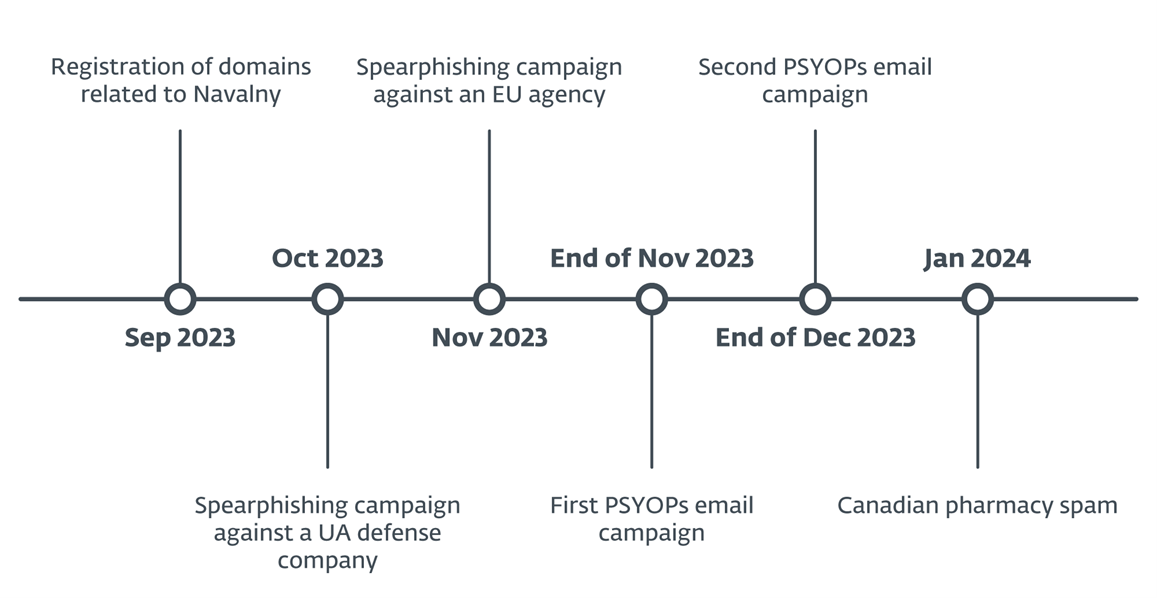
Operation Texonto, which is the name given to the campaign by ESET Research, mostly consists of spam emails. ESET detected two different waves of this attack: the first in November 2023 and the second at the end of December 2023.
In the first wave, which seemed to be more elaborate, ESET detected a wave of emails delivered to hundreds of Ukrainians’ mailboxes (people working in government, energy companies, individuals, etc.) with a PDF attachment.
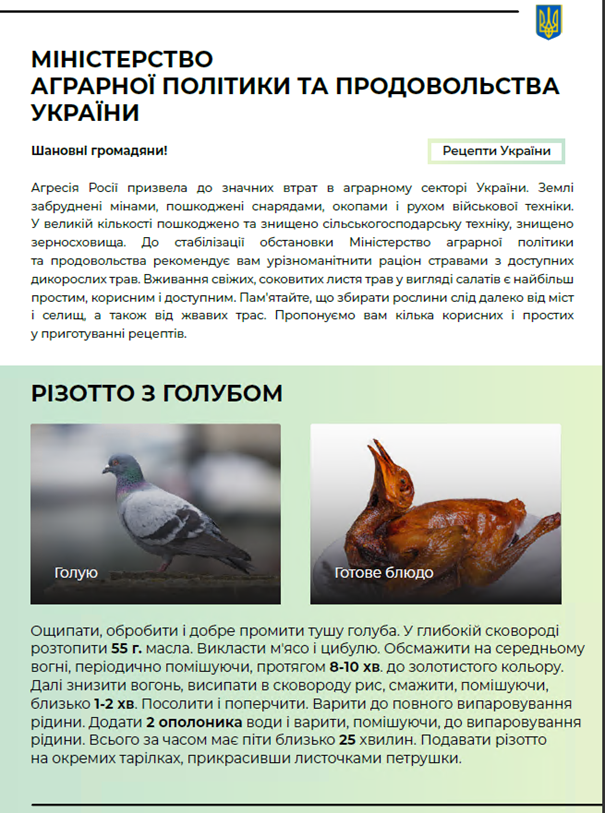
The goal of this email was to demoralize and sow doubt in the minds of Ukrainians. One of the emails suggested that there might be “heating interruptions this winter.” Another was allegedly from the Ukraine Ministry of Health, claiming that there was a shortage of medicine available. Another suggested that people eat “pigeon risotto,” giving instructions on its preparation, claiming a shortage of food in the country.

Figure 5. PDF allegedly from the Ministry of Agriculture 

The aim of these was most likely to instill fear and demoralize Ukrainians in an effort to destabilize communities and the resolve of Ukrainian citizens. This campaign also shares some similarities with campaigns using social engineering; however, none of these emails included malicious links or urged people to give up their personal information. The techniques used here align with common Russian propaganda themes. They are trying to make Ukrainian people believe they won’t have enough resources and heat as a result of Russian aggression.

Social engineering is a tactic used by cybercriminals to manipulate people into sharing information they normally wouldn´t share, download malicious software, or send money to a perpetrator. This tactic is used on individuals and businesses alike.

The second wave appeared a little less elaborate or even ill-prepared but was much darker in its messaging. The emails included disturbing messaging, with the attackers pretending to be Ukrainian citizens urging other Ukrainians to mutilate themselves to avoid military deployment. Sadly, this is a textbook wartime PSYOP campaign.
Spearphishing in the wild
In addition to the misinformation campaign, ESET Research also detected spearphishing campaigns targeting a Ukrainian defense company in October 2023 and an EU agency in November 2023. Both aimed to steal Microsoft Office 365 account credentials. These campaigns share similarities with the abovementioned PSYOPs; thus, ESET researchers believe these are connected.

Spearphishing is a highly tailored campaign through which attackers use social engineering techniques to urge the victims to click on a malicious link or an attachment. The goal is to steal sensitive information and/or enter a network undetected.

ESET Reserach also revealed that the domain names used as part of Operation Texonto related to internal Russian topics, such as Alexei Navalny, a well-known Russian opposition leader. Navalny was recently declared dead while serving jail time in Russia.
Those domains include:
•    navalny-votes[.]net
•    navalny-votesmart[.]net
•    navalny-voting[.]net

From the mentioned domains, researchers believe that it’s possible that the operation also included spearphishing or information operations targeting Russian dissidents.

A new layer of complexity to the war
The emergence of PSYOPs on the digital landscape of warfare has added a new layer to the already complex and ongoing hybrid war between Russia and Ukraine. Since the start of the Russian invasion, Russia-aligned groups, such as Sandworm, have been busy disrupting Ukrainian infrastructure using wipers. Operation Texonto is yet another use of technology to try to influence the outcome of the war. It underscores the shifting battlegrounds, from physical to psychological, aiming to demoralize and destabilize communities through disinformation campaigns.
It is crucial for nations, organizations, and individuals to stay vigilant, prioritize cybersecurity, and promote accurate information dissemination to counter such threats. As we circle back to the initial concept of PSYOPs, it’s evident that while the tactic has been in use for a long time, its modern incarnations are more sophisticated and insidious. This underscores the importance of understanding and recognizing PSYOPs as part of the broader spectrum of hybrid warfare tactics, a component that is likely to become increasingly prevalent in future conflicts.
To read more from ESET Research, head over to WeLiveSecurity.com.

About Version 2 Digital

Version 2 Digital is one of the most dynamic IT companies in Asia. The company distributes a wide range of IT products across various areas including cyber security, cloud, data protection, end points, infrastructures, system monitoring, storage, networking, business productivity and communication products.

Through an extensive network of channels, point of sales, resellers, and partnership companies, Version 2 offers quality products and services which are highly acclaimed in the market. Its customers cover a wide spectrum which include Global 1000 enterprises, regional listed companies, different vertical industries, public utilities, Government, a vast number of successful SMEs, and consumers in various Asian cities.

About ESET
For 30 years, ESET® has been developing industry-leading IT security software and services for businesses and consumers worldwide. With solutions ranging from endpoint security to encryption and two-factor authentication, ESET’s high-performing, easy-to-use products give individuals and businesses the peace of mind to enjoy the full potential of their technology. ESET unobtrusively protects and monitors 24/7, updating defenses in real time to keep users safe and businesses running without interruption. Evolving threats require an evolving IT security company. Backed by R&D facilities worldwide, ESET became the first IT security company to earn 100 Virus Bulletin VB100 awards, identifying every single “in-the-wild” malware without interruption since 2003.

I am not sorry for wasting your time: Lessons to learn from Texonto PSYOPs targeting Ukraine


Since the invasion started, ESET has both investigated and prevented a significant number of attacks launched by Russia-aligned groups against Ukraine.

In 1998, one of the most annoying things IT-equipped employees needed to deal with, SPAM, made it into the New Oxford Dictionary of English. Prior to 1998, the word “spam” only referenced a variety of processed canned meat produced by the Hormel Foods Corporation

“It’s sort of unfortunate that we’ve gotten this far,” John Mozena, then board member of the U.S.-based Coalition Against Unsolicited Commercial Email commented in the news. And that was just the beginning. More than 20 years later, spam messages accounted for over 45 percent of 333 billion emails sent and received daily around the world in 2022.

The latest ESET research about Operation Texonto highlights a scheme targeting Ukrainian citizens with a combination of spam and phishing messages. This situation reminds us that spam not only frustrates employees, but can also serve as a vehicle for disinformation, psychological operations, and data theft attempts against businesses and institutions.

These cyber incidents may look simple, but just the sheer volume of unsolicited emails coming on a daily basis can be so overwhelming that the situation begs for a professional solution. Especially now, that businesses are moving to the cloud.

After the full-scale invasion of Ukraine two years ago, all critical institutions and operators of critical infrastructure in Ukraine were offered a free upgrade to ESET’s highest-grade solution. When it comes to spam and phishing, for example, ESET Cloud Office Security (ECOS) offers broad coverage with advanced protection for Microsoft 365 and Google Workspace applications.

Constant pressure

The use of spam as a popular term for unsolicited email, comes from an episode of the 1970s TV show Monty Python’s Flying Circus. In one episode, a couple tries to order food in a cafe, but every course of the meal contains spam. To make things even more irritating, a group of Vikings sitting nearby are passionately singing about spam. The word “spam” is uttered at least 132 times.

While Monty Python was clearly trying to mock annoying things in people’s lives, their “spam” numbers were no match for the number of today’s spam emails. We are talking about a staggering 150 billion unsolicited emails sent and received daily. Well, that’s annoying, right?

With this influx of emails, it is no surprise that 2022 data showed that up to 80 person-hours a year ago in vain just with filtering spam messages.

Moreover, this problem is not only about getting rid of unwanted emails but also avoiding being caught on the hooks of phishing attacks, the most common type of cyberthreat.

According to the latest government survey in the United Kingdom, one third of businesses identified a data breach in 2022, and 79 percent of those attacks were phishing. Similarly, in the US, the FBI received more than 300,000 phishing complaints in 2022, making it to the top of the bureau’s cybercrime victim list. To compare, personal data breach was the second most reported cybercrime with almost 59,000 victims.

ESET Telemetry confirms that trend. According to the latest ESET H2 2023 Threat Report, spam has increased by 6 percent and malicious HTML files sending victims to phishing websites (HTML/Phishing.Agent trojan) are still by far the most detected email threat. Overall, these email attacks comprise almost a quarter (23.4 percent) of all cyber threats detected by ESET.

According to the latest government survey in the United Kingdom, one third of businesses identified a data breach during 2022, and 79% percent of those attacks were phishing. Similarly, in the US, the FBI received more than 300,000 phishing complaints in 2022, making it to the top of the bureau’s cybercrime victim list. To compare, personal data breach was the second most reported cybercrime with almost 59,000 victims.

ESET Telemetry confirms the trend. According to the latest ESET H2 2023 Threat Report, spam has increased by 6 percent and malicious HTML files sending victims to phishing websites (HTML/Phishing.Agent trojan) are still by far the most detected email threat. Overall, these email attacks comprise almost a quarter (23.4%) of all cyber threats detected by ESET.

Lessons from Ukraine

Operation Texonto in Ukraine shows what such a campaign combining spam emails and phishing can look like.

At the end of 2023, Russia-aligned threat actors tried to demoralize Ukrainian citizens with two waves of spam emails. Additionally, ESET detected a spear phishing campaign conducted by the same group and within the same time period.

Employees working at a major Ukrainian defense company received a phishing email in October 2023, purportedly coming from their IT department.

It was an old-fashioned but still popular phishing message claiming that the employee’s email account was about to expire and they needed to fill in their login details on a given website to keep the account alive. The attached link sent victims to a phishing website posing as a legitimate Microsoft login page, but in reality, trying to steal credentials for Microsoft Office 365 accounts.

To deal with such threats, companies need to not only focus on employee awareness training but also have reliable anti-spam and anti-phishing protection.

Mitigating the threat

If you want to know more about spotting phishing attacks, you can check this blog, but let’s now focus more on a technical solutions implemented in the ESET Cloud Office Security such as Antispam which consecutively won spam filtering tests by Virus Bulletin, a leading security testing authority, and received the VBSpam+ certification for several years.

The ECOS Antispam technology has high catch rates and being a cloud-based service, allows for prompt data updates that provide quicker reaction times when new spam emerges. This essential component filters all spam emails and keeps user mailboxes free of unsolicited or undesired messages.

ECOS Anti-Phishing prevents users from accessing web pages that are known to be phishing sites. Because phishing emails often contain links leading victims to phishing webpages, ESET Cloud Office Security searches the message body and the subject of incoming email messages to identify such links (URLs). The links are compared against the phishing database, which is being constantly updated.

Combining these powerful tools together with anti-malware scanning, ultimate zero-day threat defense, and an easy-to-use cloud management console, ECOS helps to protect companies’ communications, collaboration, and cloud applications.

Conclusion

When looking at spam and phishing data, it is clear that no one has come up with a definitive answer for these threats, but that doesn’t mean you should give up the fight. Quite the contrary. You need professional protection in order not to be overwhelmed by tons of emails both soaking up employees’ time and trying to sneak some phishing messages into corporate mailboxes.

How ESET helps:

• ESET products and threat intelligence have been protecting Ukrainian IT infrastructure for years. Since the start of the full-scale war in February 2022, ESET have prevented and investigated a significant number of attacks launched by Russia-aligned groups such as HermeticWiper and Industroyer2.

• As the leading endpoint protection platform vendor headquartered in the European Union, ESET also announced that it has stopped all sales to any individuals, businesses, and organizations in Russia and Belarus.

• ESET offered critical institutions and operators of critical infrastructure in Ukraine a free upgrade to ESET’s highest-grade solution.

• Between March and May 2022, ESET automatically extended expiring licenses for consumers in Ukraine at no cost.

• On top of that, ESET Foundation has allocated 1,277,700 euros for humanitarian relief in Ukraine.

About Version 2 Digital

Version 2 Digital is one of the most dynamic IT companies in Asia. The company distributes a wide range of IT products across various areas including cyber security, cloud, data protection, end points, infrastructures, system monitoring, storage, networking, business productivity and communication products.

Through an extensive network of channels, point of sales, resellers, and partnership companies, Version 2 offers quality products and services which are highly acclaimed in the market. Its customers cover a wide spectrum which include Global 1000 enterprises, regional listed companies, different vertical industries, public utilities, Government, a vast number of successful SMEs, and consumers in various Asian cities.

About ESET
For 30 years, ESET® has been developing industry-leading IT security software and services for businesses and consumers worldwide. With solutions ranging from endpoint security to encryption and two-factor authentication, ESET’s high-performing, easy-to-use products give individuals and businesses the peace of mind to enjoy the full potential of their technology. ESET unobtrusively protects and monitors 24/7, updating defenses in real time to keep users safe and businesses running without interruption. Evolving threats require an evolving IT security company. Backed by R&D facilities worldwide, ESET became the first IT security company to earn 100 Virus Bulletin VB100 awards, identifying every single “in-the-wild” malware without interruption since 2003.

Russian-made PSYOPs in Ukraine: Operation Texonto targets Ukrainians with war-related disinformation, ESET Research discovers

  • A Russian-aligned aligned threat actor spread war-related disinformation to Ukrainian readers via spam emails. 
  • The spearphishing campaign targeted a Ukrainian defense company and an EU agency.
  • Due to the similarities in the network infrastructure used in these PSYOPs and phishing operations, ESET research can say with high confidence that they are linked.
  • Operation Texonto loosely resembles Russia-aligned Callisto APT group activities; however, ESET Research does not have enough evidence to attribute the operations to any specific group.
  • In the first wave of disinformation emails in November 2023, the Russia-aligned threat actors tried to influence and demoralize Ukrainian citizens with disinformation messages about war-related topics. The second wave in December 2023 was even darker in tone.

BRATISLAVA, MONTREAL — February 21, 2024 — ESET Research recently discovered Operation Texonto, a disinformation/psychological operations (PSYOPs) campaign using spam emails as the main distribution method. Via messages sent in two waves of PSYOPs, the Russia-aligned threat actors tried to influence and demoralize Ukrainian citizens with disinformation messages about war-related topics. The first wave took place in November 2023 and the second one at the end of December 2023. The contents of the emails were about heating interruptions, drug shortages, and food shortages, which are typical themes of Russian propaganda. Additionally, in October 2023, ESET detected a spearphishing campaign that targeted a Ukrainian defense company, and one targeting an EU agency in November 2023 utilizing standard-looking fake Microsoft login pages. The goal of both was to steal credentials for Microsoft Office 365 accounts. Due to the similarities in the network infrastructure used in these PSYOPs and phishing operations, ESET research can say with high confidence that they are linked.

“Since the start of the war in Ukraine, Russia-aligned groups such as Sandworm have been busy disrupting Ukrainian IT infrastructure using wipers. In recent months, we have observed an uptick in cyberespionage operations, especially by the infamous Gamaredon group. Operation Texonto shows yet another use of technologies to try to influence the war,” says ESET researcher Matthieu Faou, who discovered Operation Texonto.

“The strange brew of espionage, information operations, and fake pharma messages can only remind us of Callisto, a well-known Russia-aligned cyberespionage group, some members of which were the subject of an indictment by the U.S. Department of Justice in December 2023. Callisto targets government officials, staff in think tanks, and military-related organizations via spearphishing websites designed to mimic common cloud providers. The group has also run disinformation operations such as a document leak just ahead of the 2019 UK general election. Finally, pivoting on its old network infrastructure leads to fake pharma domains,” continues Faou. However, he concludes: “While there are several high-level points of similarity between Operation Texonto and Callisto operations, we haven’t found any technical overlap, and we currently do not attribute Operation Texonto to a specific threat actor. However, given the TTPs, targeting, and the spread of messages, we attribute the operation with high confidence to a group that is Russia aligned.”

An email server, operated by the attackers and used to send the PSYOPs emails, was reused two weeks later to send typical Canadian pharmacy spam. This category of illegal business has been very popular within the Russian cybercrime community for a long time. A few more pivots also revealed domain names that are part of Operation Texonto and related to internal Russian topics, such as Alexei Navalny, the well-known Russian opposition leader who was in jail and died on 2024-02-16. This means that Operation Texonto probably includes spearphishing or information operations targeting Russian dissidents and supporters of the late opposition leader.

The goal of the first wave of disinformation emails was to sow doubt in the minds of Ukrainians; for instance, one email says “There may be heating interruptions this winter.” Others purportedly from the Ministry of Health talk about medicine shortages. It doesn’t seem that there were any malicious links or malware in this specific wave, only disinformation. One domain masquerading as the Ministry of Agrarian Policy and Food of Ukraine recommended replacing unavailable medicine with herbs. In yet another email “from” the Ministry, they suggest eating “pigeon risotto” a photo of a live pigeon and a cooked pigeon. Those documents were purposely created in order to rile up and demoralize the readers. Overall, these fake messages align with common Russian propaganda themes. They are trying to make Ukrainian people believe they won’t have drugs, food, and heating because of the Russia-Ukraine war.

About a month after the first wave, ESET detected a second PSYOPs email campaign targeting not only Ukrainians, but also people in other European countries. The targets are somewhat random, ranging from the Ukrainian government to an Italian shoe manufacturer. According to ESET telemetry, a few hundred people received emails in this wave. The second wave was darker in its messaging, with the attackers suggesting people amputate a leg or an arm to avoid military deployment. Overall, it has all the characteristics of PSYOPs during wartime.

ESET products and research have been protecting Ukrainian IT infrastructure for many years. And since the start of the Russian invasion in February 2022, ESET Research has prevented and investigated a significant number of attacks launched by Russia-aligned groups.

For more technical information about Operation Texonto, check out the blogpost “Operation Texonto: Information operation targeting Ukrainian speakers in the context of the war” on WeLiveSecurity.com. Make sure to follow ESET Research on Twitter (today known as X) for the latest news from ESET Research.

Timeline of Operation Texonto
About Version 2 Digital

Version 2 Digital is one of the most dynamic IT companies in Asia. The company distributes a wide range of IT products across various areas including cyber security, cloud, data protection, end points, infrastructures, system monitoring, storage, networking, business productivity and communication products.

Through an extensive network of channels, point of sales, resellers, and partnership companies, Version 2 offers quality products and services which are highly acclaimed in the market. Its customers cover a wide spectrum which include Global 1000 enterprises, regional listed companies, different vertical industries, public utilities, Government, a vast number of successful SMEs, and consumers in various Asian cities.

About ESET
For 30 years, ESET® has been developing industry-leading IT security software and services for businesses and consumers worldwide. With solutions ranging from endpoint security to encryption and two-factor authentication, ESET’s high-performing, easy-to-use products give individuals and businesses the peace of mind to enjoy the full potential of their technology. ESET unobtrusively protects and monitors 24/7, updating defenses in real time to keep users safe and businesses running without interruption. Evolving threats require an evolving IT security company. Backed by R&D facilities worldwide, ESET became the first IT security company to earn 100 Virus Bulletin VB100 awards, identifying every single “in-the-wild” malware without interruption since 2003.

×

Hello!

Click one of our contacts below to chat on WhatsApp

×