
Skip to content

How XDR and MDR help secure your tomorrow against ransomware

Locating XDR and MDR in a prevention-first approach to security.

“How could this happen?”

This is what both executives and Security Operations Center (SOC) teams of enterprises might keep asking themselves after a successful ransomware attack.

The story is often the same – a random phishing email finds its way into the inbox of an employee, who then proceeds to provide personally identifiable information, including work account details, to a seemingly legitimate-looking entity.

Social engineering and email scams remain some of the top threats facing businesses worldwide, with ESET Research finding phishing and fraud trojans at the top of email threat detections.

Recently, Insomniac Games, a subsidiary of PlayStation Studios, was compromised by the Rhysida ransomware, ending up with terabytes of leaked data, as the studio refused to pay the ransom asked of them (which, despite the result, is a legitimate strategy, since threat actors are not the most trustworthy of entities).

Is there an approach to security that could have prevented an attack like this? Let’s explore a prevention-first approach employing Extended Detection and Response (XDR) or Managed Detection and Response (MDR).

Persistent threats persistently threaten established businesses

Just as fairy tales tell of big villains that kidnap princesses and valiant heroes running to save them, the same is true for ransomware and cyberattacks in general.

However, instead of dragons trying to burn down castles, we’re discussing dangerous forms of malware deployed to penetrate and occupy them. Valiant heroes, in the form of security specialists, then try to hold what was supposed to be a rather secure castle with all the defensive bells and whistles available … apart from that big gaping hole right under the north-facing castle walls, obscured by a green bush.
Perhaps the metaphor went a bit too far, but the idea is clear – there will always be certain vulnerabilities, unprotected threat surfaces/vectors, or gaps in defenses that might not be as obvious at first sight as we would assume.

Threat actors will always try to gain entry to a business’s internal systems because that’s where to find the most important access rights/files/data that are dear to the managers and CEOs. That value can be enumerated in millions and in some cases even billions of (dollars, Euros/other). And crooks know that, so they will keep trying their best to pull the chair from under the people tasked with securing businesses.

Consider the SolarWinds and the MOVEit supply chain attacks, for example. The former happened in 2020 because of understated and poorly communicated vulnerabilities, while the latter, in 2023, was caused by hackers exploiting a flaw within the file transfer software, gaining access to sensitive customer data.

The result of the MOVEit hack? According to Emsisoft’s estimate, USD 15 billion in damages. This after having impacted around 2,726 organizations. They say you can’t put a price on many things, like health and safety … however, this is not the case for cybersecurity.

Regarding both attacks, it didn’t matter whether a particular business was targeted, since due to the nature of a supply-chain attack, any partner/client can sustain collateral damage, often having their information accessed and leaked as a result. Therefore, it can be said that as far as a supply-chain attack is concerned, no one in it is safe … unless they take some specific precautions, such as by investing in XDR or an MDR service.

Vulnerabilities in and out

Now, zero-day vulnerabilities are tough to prevent, since they usually crop up due to flaws in software that not even the developer may know about – hence the name.

Vulnerabilities can be disclosed, and subsequently recorded, by organizations like MITRE, which maintains the registry of common vulnerabilities and exposures (CVEs).

One way to prevent the exploitation of vulnerabilities is to always keep systems and apps up to date, such as with security updates, or by patching vulnerabilities through patch management functions, which are often a requirement of cyber insurance nowadays.
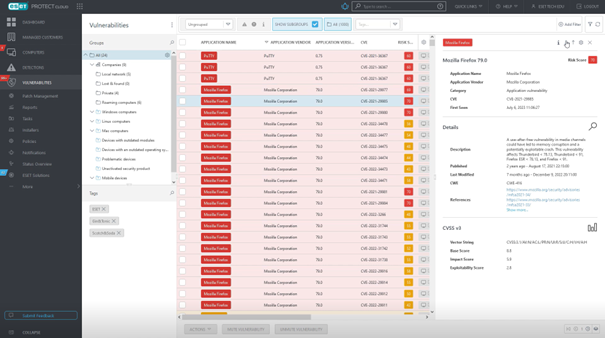
The reason vulnerabilities are so important in the grand scheme of things is that successful patching and updates are make or break for the management of a company’s threat surfaces. Security admins have to demonstrate effectiveness here, both in the office and for employees working hybrid or fully remotely. This is true regardless of how device use expands beyond the limits of company premises and must even extend security to areas and activities security admins may not see. This brings with it a whole slew of problems, including potential new vulnerabilities, the resulting incidents, and users being targeted who have access to critical internal networks and data through their computers, phones, or tablets.

This fact is driven home, especially as cloud-based tools become the norm. As a result, cloud security has become a key component of prevention, since most companies now use products like SharePoint or other cloud-powered internal data repositories and sharing networks. And what’s more, both the benefits and the risks trickle down to cloud-powered apps like Office 365 or Google Workspace Suite, meaning that the more connection there is between an internal server and an external user, the more opportunities there are for exploitation. This is very evident when we look at cases where, for example, Microsoft Teams was used to share malware through external accounts that did not even belong to the targeted organization.

Monitoring an extended network

Cloud security is important, but it is not enough, especially from the perspective of a security admin who might want to have a deeper understanding of their company network, with specific alerts, rules, and triggers that would highlight and specify issues arising during crucial moments – like when an attacker is trying to exploit one of the company’s assets.

Skilled admins would probably pick an XDR solution to gain an understanding of their environment, with access to quick remediation of potential incidents. This is all well and nice – when an organization has the necessary resources to purchase and maintain such a solution.

Sure, XDR tasks can be made easier by employing effective and intuitive software solutions like the ones offered via ESET Inspect, which makes the lives of security admins easier by coming pre-loaded with certain rules, with further enhancement being rather easy to configure thanks to its elegant interface. But that takes time, and it also asks the admin to know their environment enough to recognize which rules need to be configured, customized, and set up in a prioritized manner.
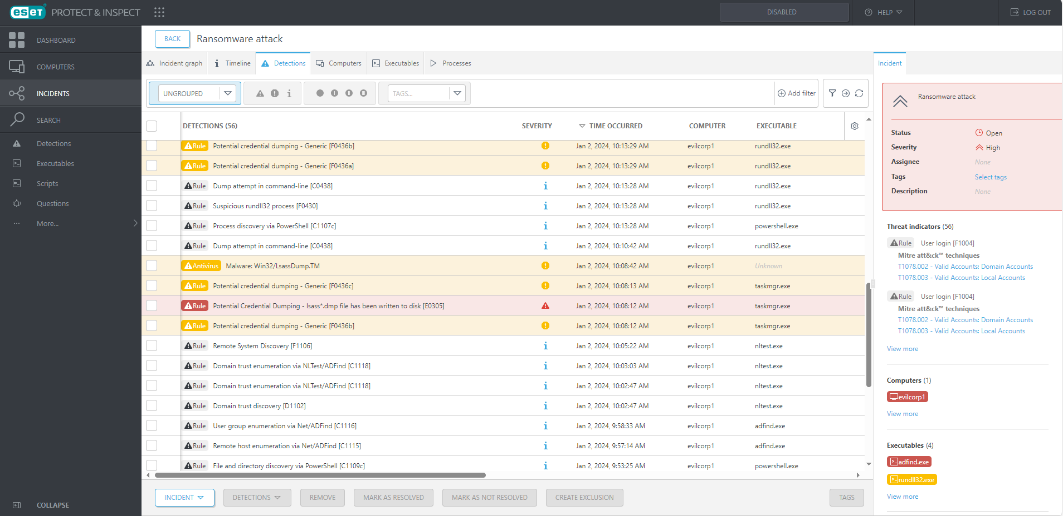
From there, capabilities like the automatic incident creator found in ESET Inspect can work wonders to speed up incident remediation, giving the admin more time and room to focus on other important matters.
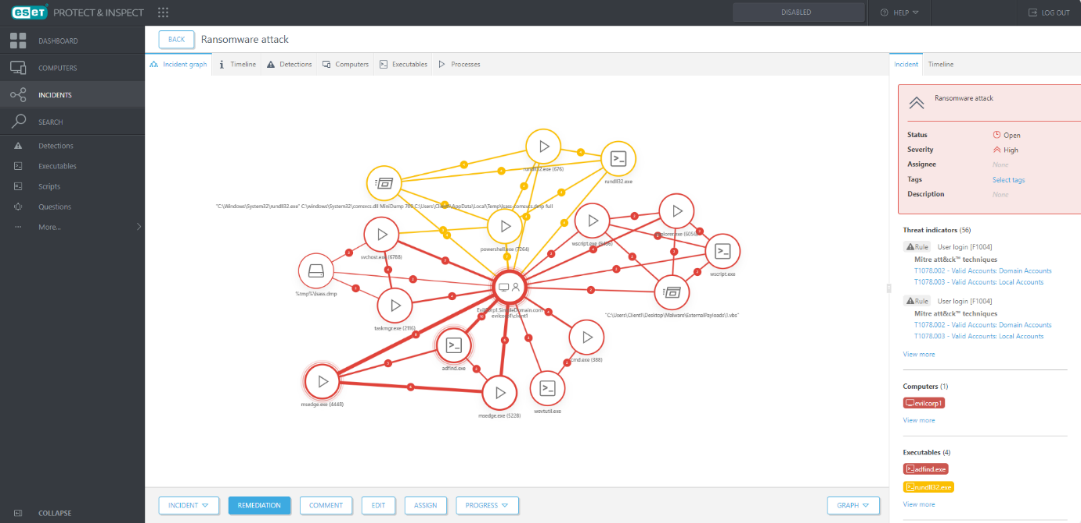
But is that enough? Can XDR prevent ransomware attacks such as the one that targeted the above-mentioned game studio?

Time to stop ransomware

Indeed, while using XDR is one way to stop the execution of ransomware, the admins need to be fast enough to respond on time, stopping the threat in all locations, and killing it as soon as possible by knowing where the breach occurred.

XDR can help with that, as it offers a granular view of a company’s environment. During the MOVEit saga, for example, ESET Inspect managed to detect the compromise and supply admins with logs pertaining to it.

And if that is not enough, or a company requires more professional help to rapidly address mitigation and remediation needs, services including a larger capacity of security experts supplied with professional software –MDR solutions – are where it’s at.

MDR is a lot like XDR, but it adds another dimension – it is a service that also employs real-life experts to manage company cybersecurity. While XDR is a great pick for businesses with enough personnel, institutional knowledge, and capacity to tackle complex threats, MDR pushes security to greater heights as it supplies experts with deep knowledge of both the security tool at hand (XDR) and the threat environment.

This means high-level support in case of an incident, be it a random weekday, holiday, or weekend, as MDR is a 24/7/365 service. So, in case a ransomware attack happens when most of a business is out, the MDR team can still immediately respond to a threat despite the lack of in-house staff.

This rings true even for small and medium-size businesses (SMBs), which can lack such staff by design, due to limited resources. Regardless, SMBs face the same threats as large enterprises, including ransomware. And in such cases, quick action is always necessary.

Closing time

It’s one thing to stop an ongoing incident, but it’s an entirely different thing to proactively prevent an incident from happening in the first place.

XDR and MDR are both excellent choices in the fight against ransomware and related threats, as they empower companies to be on the lookout for even the most insidious threats.

And while all the components of a security platform such as ESET PROTECT help in protecting specific environments, a detection and response solution, whether in-house or as a service, combines all of this into a single view. It provides a refined and clear understanding of the security apparatus of a company, giving admins the right tools to respond and remediate on time.

About Version 2 Digital

Version 2 Digital is one of the most dynamic IT companies in Asia. The company distributes a wide range of IT products across various areas including cyber security, cloud, data protection, end points, infrastructures, system monitoring, storage, networking, business productivity and communication products.

Through an extensive network of channels, point of sales, resellers, and partnership companies, Version 2 offers quality products and services which are highly acclaimed in the market. Its customers cover a wide spectrum which include Global 1000 enterprises, regional listed companies, different vertical industries, public utilities, Government, a vast number of successful SMEs, and consumers in various Asian cities.

About ESET
For 30 years, ESET® has been developing industry-leading IT security software and services for businesses and consumers worldwide. With solutions ranging from endpoint security to encryption and two-factor authentication, ESET’s high-performing, easy-to-use products give individuals and businesses the peace of mind to enjoy the full potential of their technology. ESET unobtrusively protects and monitors 24/7, updating defenses in real time to keep users safe and businesses running without interruption. Evolving threats require an evolving IT security company. Backed by R&D facilities worldwide, ESET became the first IT security company to earn 100 Virus Bulletin VB100 awards, identifying every single “in-the-wild” malware without interruption since 2003.

Even legitimate websites can become traps, and small/home offices need to be prepared

One’s personal digital life may be a threat to business. Small offices and home offices need proper prevention. 

Heads of small or home offices most likely know how difficult it is to set boundaries between work and their personal lives. One minute you are doing taxes, and the next, you are browsing the internet looking for leisure-time activities for your family. 

Having basic cybersecurity knowledge, you also probably know that sometimes you need to be careful out there. Clicking URLs mentioned in unfamiliar emails could bring trouble, and downloading new apps from unknown sources with no background information isn’t a good idea either.

But, what if a legitimate website that you or your employees have been regularly visiting gets compromised? How do you secure your cherished small office when downloading a legitimate application, or when its update suddenly turns out to be malicious?

ESET researchers have recently discovered such a campaign, which abused several legitimate websites to spread spyware which targeting a wide group of users coming from India, Taiwan, Hong Kong, Australia, and the United States. Facing such elaborate attacks, small offices and home offices need to take a prevention-first approach.

Interesting target

While, compared with large enterprises, small offices and home offices do not work with such large amounts of data or money, unfortunately, this can create the false impression that they are not interesting targets for cybercriminals. But the opposite is true.

Considering the massive numbers of small offices and home offices globally, in combination with their limited budgets for cybersecurity, they make appealing targets for threat actors who aim campaigns at indistinct groups of people or businesses, rather than some corporate giant.

Therefore, it is no surprise that 31% of businesses with fewer than 10 employees surveyed in the UK during the winter of 2022 – 2023 experienced a cyberattack or a security breach in the past 12 months.

There are 5.28 million such businesses in the UK, which means that, theoretically, 1.64 million small offices and home offices experienced a cyber incident within a single year.

Multi-staged attacks

ESET researchers discovered a cyberespionage campaign well-suited to paint the picture. Since at least September 2023, cybercriminals have been victimizing Tibetans through a multi-staged attack that combines several techniques in order to install spyware on victims’ devices. Researchers attribute this campaign to the China-aligned Evasive Panda APT group.

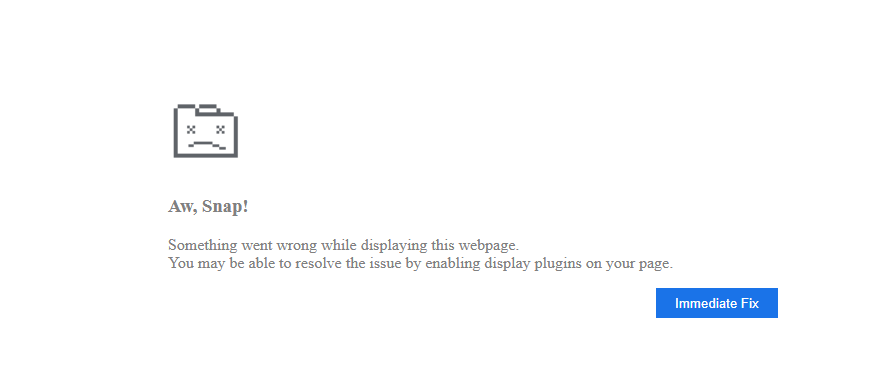
Shortly before the 2024 Kagyu Monlam Festival, which is held annually by Tibetan Buddhists in India, cybercriminals abused a website that belongs to the Kagyu International Monlam Trust. Expecting a higher visitor rate ahead of the upcoming festival, the attackers placed a malicious script on the site which showed a fake error page to users. This enticed them to download an “Immediate Fix.” However, the file was in fact a malicious downloader for both Windows and macOS.

The same threat actors also compromised a website belonging to a software development company, based in India, that produces Tibetan language translation software. The attackers placed several trojanized installers there for legitimate software that deployed the same malicious downloaders.

These malicious downloaders were designed to download and install backdoors, which can avoid normal authentication procedures and allow access to a system.

When successful, the downloaders compromised devices with a malware capable of receiving commands to collect information about files and running processes and sending them to attackers.

Small offices dealing with big attacks

For average users, these advanced multi-staged attacks will be most likely difficult to spot. It is not hard to imagine a user clicking on a link that is part of a warning message coming from a trusted website. And there is no possibility for humans to discover that a legitimate software they are about to download was trojanized.

Considering their limited options in such situations, small offices and home offices need to be smart about their safety.

This means protecting your business as much as possible, and leaving the rest to professional tools that can minimize the threat landscape in a way that average Joes cannot.

Here are preemptive measures that businesses can take:

Educate yourself and your employees – Some attacks are difficult to spot, but it does not mean that awareness training is useless. There are plenty of threats in cyberspace that can be easily avoided if you and your employees stay vigilant.

Use strong passwords or passphrases – Minimum length should be 12 characters, with a wide variety of letters, special characters, lower/upper cases, etc. Hard to remember? Switch to passphrases! They are longer, yet easier to remember.

Stay on top of software updates – For cybercriminals it is not uncommon to exploit previously known vulnerabilities simply because users do not update their software.

Split your network into segments – For small offices and home offices, network segmentation does not have to be difficult. For example, use a guest Wi-Fi for devices that only need the internet to operate, then use VLANs to split a network into two segments – private and work.

Back up your data – If everything fails and your systems get compromised, it is essential to have an effective backup strategy to run your business without unnecessary delays.

Professional protection

Adopting the previous measures, you can cover some attack vectors, such as brute-force attacks against passwords or exploitation of known vulnerabilities. But the threat landscape is way bigger.

To cover all small office and home office needs, ESET now delivers its new all-in-one protection, ESET Small Business Security

ESET Small Business Security offers: 

  • Reliable, easy-to-use security, with a minimum system footprint
  • Multi-OS protection, including Windows, Android, MacOS and Windows Server
  • Safe Banking
  • Safe Browsing
  • Password Manager
  • VPN
  • Ransomware Shield
  • Anti-Theft
  • Botnet Protection
  • Network Inspector
  • Safe Server – Protection of company and customer data stored on a file server running on Windows Server OS, automatically scans all inserted USB flash drives, memory cards, and CDs/DVDs
  • Support for up to 25 devices

The number of features that one person needs to manage may look scary, but do not worry. ESET Small Business Security runs on ESET HOME, a complete security management platform that turns home admin duties into a walk in the park.

Never let your guard down

When average users browse trusted websites or download software from trusted sources, they often let their guard down, and it’s quite understandable. Heads of small offices or home offices already have enough problems just running their businesses and taking care of their families.

With comprehensive solutions, such as ESET Small Business Security, you can be sure that your business is protected, even when facing similar threats.

About Version 2 Digital

Version 2 Digital is one of the most dynamic IT companies in Asia. The company distributes a wide range of IT products across various areas including cyber security, cloud, data protection, end points, infrastructures, system monitoring, storage, networking, business productivity and communication products.

Through an extensive network of channels, point of sales, resellers, and partnership companies, Version 2 offers quality products and services which are highly acclaimed in the market. Its customers cover a wide spectrum which include Global 1000 enterprises, regional listed companies, different vertical industries, public utilities, Government, a vast number of successful SMEs, and consumers in various Asian cities.

About ESET
For 30 years, ESET® has been developing industry-leading IT security software and services for businesses and consumers worldwide. With solutions ranging from endpoint security to encryption and two-factor authentication, ESET’s high-performing, easy-to-use products give individuals and businesses the peace of mind to enjoy the full potential of their technology. ESET unobtrusively protects and monitors 24/7, updating defenses in real time to keep users safe and businesses running without interruption. Evolving threats require an evolving IT security company. Backed by R&D facilities worldwide, ESET became the first IT security company to earn 100 Virus Bulletin VB100 awards, identifying every single “in-the-wild” malware without interruption since 2003.

ESET Launches a New Solution for Small Office/Home Office Businesses

ESET launches a new global ESET Small Business Security (ESBS) offering, specifically addressing the needs of small office/home office businesses to keep the company and customer data safe.
The new ESBS solution is easy to use and offers diverse features tailored to safeguard online transactions, lock and locate devices in case of loss or theft, manage passwords, protect servers, encrypt sensitive data, and counter phishing scams.
ESBS includes ESET HOME, a complete security management platform with information about the user’s security status, devices, subscriptions, and used features.

BRATISLAVA — April 09, 2024 —ESET, a global leader in digital security, is pleased to announce the introduction of the ESET Small Business Security (ESBS) offering, specifically designed to meet the cybersecurity needs of small office/home office (SOHO) business owners. This comprehensive security solution is engineered to provide seamless, user-friendly protection, enabling SOHO customers to thrive in an increasingly digital landscape.

ESBS is a testament to ESET’s commitment to innovation and its dedication to supporting the growth and security of SOHO businesses globally. The solution can support from five to 25 devices (depending on the country) and offers an array of features tailored to safeguard online transactions and browsing, secure devices, manage passwords, protect Windows servers, encrypt sensitive data, and counter phishing scams. Furthermore, ESBS facilitates safe and anonymous browsing alongside unlimited VPN security where applicable, ensuring both work and personal devices are shielded from cyber threats.

Considering the launch, Viktória Ivanová, Vice President of Consumer and IoT Segment at ESET, stated, “At ESET, we are aware of the unique needs of our small office/home office customers, which lie in between consumer and business. With the launch of ESET Small Business Security, we aim to provide small office/home office business owners with a simple yet powerful solution for their businesses that is easily manageable, highly reliable, and tailored to their needs and that empowers them to focus on their growth without compromising on security.”

ESBS includes the ESET HOME security management platform, which enables the user to have complete security management and offers the customer a convenient space with information about security status, devices, subscriptions, and used features. ESET HOME is available via a web portal and a mobile application, allowing users to have security of their devices under control anywhere they go.

ESBS guarantees reliable security with a minimal system footprint, ensuring efficient protection that is effortless to manage and compatible across multiple operating systems, including Windows, Android, and macOS. Customers benefit from an all-encompassing security solution, including unlimited VPN, Safe Banking, a Browser Privacy & Security extension, a Password Manager, Safe Server (for file servers running on Windows Server), Anti-Theft, Ransomware Shield, and more. This solution represents a significant stride in cybersecurity management, offering unparalleled convenience and control to SOHO business owners.

This announcement marks a pivotal step forward in the provision of targeted cybersecurity solutions for the SOHO market, reinforcing ESET’s position as a forward-thinking, customer-centric organization in the digital security domain.

For more detailed information about ESET and its ESBS offering, please read here.

About Version 2 Digital

Version 2 Digital is one of the most dynamic IT companies in Asia. The company distributes a wide range of IT products across various areas including cyber security, cloud, data protection, end points, infrastructures, system monitoring, storage, networking, business productivity and communication products.

Through an extensive network of channels, point of sales, resellers, and partnership companies, Version 2 offers quality products and services which are highly acclaimed in the market. Its customers cover a wide spectrum which include Global 1000 enterprises, regional listed companies, different vertical industries, public utilities, Government, a vast number of successful SMEs, and consumers in various Asian cities.

About ESET
For 30 years, ESET® has been developing industry-leading IT security software and services for businesses and consumers worldwide. With solutions ranging from endpoint security to encryption and two-factor authentication, ESET’s high-performing, easy-to-use products give individuals and businesses the peace of mind to enjoy the full potential of their technology. ESET unobtrusively protects and monitors 24/7, updating defenses in real time to keep users safe and businesses running without interruption. Evolving threats require an evolving IT security company. Backed by R&D facilities worldwide, ESET became the first IT security company to earn 100 Virus Bulletin VB100 awards, identifying every single “in-the-wild” malware without interruption since 2003.

Set and protect. A cybersecurity road map for small and home offices

In the evolving world of cyberthreats, small and home offices share a single need: a reliable security solution.

If you’re leading a small office, you are likely no stranger to working 12 hours a day. It might even feel like 24/7, doing taxes, communicating with clients, and marketing your business on social media platforms.

You likely have also personally installed a firewall on your laptop, but still, one day, you find out that your bank account got breached or your business data has been compromised. This might mean losing money or the trust of your clients, and it definitely means losing precious time to put the wheels back on your business. 

Today, basic protection doesn’t just mean having a firewall; it requires endpoint security with scanning tools, a password manager, and data encryption. Simply put, many businesses who invested into separate products over time to address basic risks just aren’t equipped to handle today’s threats.

This is the reality for a massive number of small offices/home offices around the world that face growing risks from digital threats.  For example, 31% of businesses with fewer than 10 employees surveyed in the UK during the winter of 2022-2023 experienced a cyber-attack or a security breach. To understand the full scope of the situation, there are 5.28 million such businesses in the UK.

These cyberthreats leave users facing a diversity of complex security challenges – challenges for which individual solutions like firewalls, well-suited to block malicious traffic, are simply not built to counter. Today’s online tools and business processes require cybersecurity solutions that layer multiple advanced technologies for detection, browsing protection, anti-phishing, and botnet protection, as well as exploitation, ransomware, and network protections supported by artificial intelligence and machine learning to stop threats.

The backbone of the economy makes for an interesting target

The small offices and home offices discussed in this blog are tiny when taken individually, but collectively, they comprise a massive workforce. For example, according to the latest data gathered back in 2019, 78.5% of U.S. businesses had 1-9 employees.

The situation is similar elsewhere. Businesses with 1-9 employees make up 74.1% of Canadian businesses and 82% of all UK businesses.

This makes these small offices/home offices sit nicely in the sweet spot user group for ESET’s Small Business Security offering; they’re the second largest source of wealth, right behind home equity. This also means that this group is substantial enough to factor into cybercriminal campaigning and simultaneously poses easy targets even for what have become common risks like simple password spraying attacks.

These businesses are often easy targets for cybercriminals because:

• They do not believe they are an interesting target for cybercrime because they are too small.

• They believe they cannot afford comprehensive high-tech security solutions.

• They often use outdated and unsupported software.

• Heads of small offices/home offices often don’t have IT education, don’t have time for cybersecurity awareness trainings, and lack finances to hire IT staff.

What threats are out there?

The complexity and scale of these threats are global, but let’s take Australian farmers as an example. In the first half of 2022, farmers fell victim to a series of cyberattacks with an accumulated loss of AUD 1.2 million (USD 792,026).

Some of those farmers fell victim to fake livestock sellers on Facebook or phishing websites pretending to sell machinery, while in reality farmers were sending money for nothing.

Here are some of the most common attacks threatening small offices and home offices:

  • (Banking) Data breaches – Losing sensitive data, especially banking and payment information, is the most feared cyberattack among small offices/home offices participating in an ESET internal survey. This can often happen due to phishing or an account breach.     
  • Compromised personal devices – Attackers can abuse employees’ personal devices to compromise business systems. According to the Samsung 2023 survey, 48% of organizations with a Bring Your Own Device (BYOD) policy witnessed malware introduced through an employee’s personal phone.
  • Physical theft – Almost 60% of small offices/home offices participating in an ESET internal survey expressed concerns about lost devices and data. Over 2 million laptops are reported stolen each year in the U.S., with the associated data losses estimated at over $7 billion.

Setting up defenses

Such a long list of threats can be a headache considering how much should be done to protect your business: backing up your data, protecting servers, having a good password policy ideally combined with MFA, installing endpoint protection on all your devices, an anti-theft solution, and taking cybersecurity awareness training to identify common red flags for prevalent scams.

However, alongside their normal duties and responsibilities, it is quite understandable that small offices/home offices don’t find time to worry about cyberattacks. And trying to deal with all these threats by setting up a VPN, password manager, firewall, mobile security solution, data encryption, and banking protection in a piecemeal fashion is unsustainable.

Some of those businesses openly admit this: “We’re a small company. The biggest issue is trying to survive on a week-by-week basis. We can’t afford to allocate sums to cybersecurity. I’ll spend it as and when I have it, or when I need to,” said a participating managing director surveyed by the UK Department for Science, Innovation & Technology in 2023.

But there is a better way. Digital security doesn’t have to mean a long and complicated shopping list composed of individual cyber defenses. You can get one affordable subscription that covers them all.

ESET Small Business Security presents an all-in-one solution coming with ESET HOME as the complete security management platform and support that won a 2023 SC Award for delivering best-in-class customer support and services.

ESET Small Business Security offers:

  • Reliable, easy-to-use security, with a minimum system footprint
  • Multi-OS protection including Windows, Android, MacOS and Windows Server
  • Safe Banking
  • Safe Browsing
  • Password Manager
  • VPN
  • Ransomware Shield
  • Anti-Theft
  • Botnet Protection
  • Network Inspector
  • Safe Server – The protection of company and customer data stored on a file server running on Windows Server operating system; it also automatically scans all inserted USB flash drives, memory cards, and CDs/DVDs
  • Support for 5 up to 25 devices

Let someone else put in the effort

Considering the previously mentioned surveys, it is safe to say that globally, millions of small offices/home offices fall victim to cybercrime every year. And it looks like some of those people just accept their fate. The truth is that when businesses put effort into cybersecurity, it is rarely ever appreciated. However, when something goes wrong, that failure is always criticized.

However, there is a way to mitigate those cyber risks without spending too much time and money. ESET can put in the effort instead of you with its reliable and multilayered functionalities all packed in one solution. Simple, isn’t it?

About Version 2 Digital

Version 2 Digital is one of the most dynamic IT companies in Asia. The company distributes a wide range of IT products across various areas including cyber security, cloud, data protection, end points, infrastructures, system monitoring, storage, networking, business productivity and communication products.

Through an extensive network of channels, point of sales, resellers, and partnership companies, Version 2 offers quality products and services which are highly acclaimed in the market. Its customers cover a wide spectrum which include Global 1000 enterprises, regional listed companies, different vertical industries, public utilities, Government, a vast number of successful SMEs, and consumers in various Asian cities.

About ESET
For 30 years, ESET® has been developing industry-leading IT security software and services for businesses and consumers worldwide. With solutions ranging from endpoint security to encryption and two-factor authentication, ESET’s high-performing, easy-to-use products give individuals and businesses the peace of mind to enjoy the full potential of their technology. ESET unobtrusively protects and monitors 24/7, updating defenses in real time to keep users safe and businesses running without interruption. Evolving threats require an evolving IT security company. Backed by R&D facilities worldwide, ESET became the first IT security company to earn 100 Virus Bulletin VB100 awards, identifying every single “in-the-wild” malware without interruption since 2003.

Cybersecurity firm ESET welcomes new member of the Board

BRATISLAVA — March 27, 2024 —  ESET, a global leader in digital security for more than 30 years, today announces that Jan Hrubý has joined the company’s Board of Shareholders, effective March 11, 2024, representing the joint ownership interests of himself and sister Elena Hrubá. Mr. Hrubý takes the seat after his father ESET co-founder Rudolf Hrubý who sadly passed away in December 2023. 

“We warmly welcome Jan to the ESET Board of Shareholders at an exciting time for the company,” said Peter Paško, Chair of the Board. “As consumers, businesses and governments alike are increasingly reliant on security solutions to enable them to focus on their own progress and innovation, ESET continues to expand its offering accordingly, with growth expected for years to come.”

ESET, a privately held company, is guided by the Board of Shareholders which is comprised of the company’s owners: Miroslav Trnka, Peter Paško, Maros Grund, Richard Marko, Anton Zajac and, now, Jan Hrubý and Elena Hrubá.

About Version 2 Digital

Version 2 Digital is one of the most dynamic IT companies in Asia. The company distributes a wide range of IT products across various areas including cyber security, cloud, data protection, end points, infrastructures, system monitoring, storage, networking, business productivity and communication products.

Through an extensive network of channels, point of sales, resellers, and partnership companies, Version 2 offers quality products and services which are highly acclaimed in the market. Its customers cover a wide spectrum which include Global 1000 enterprises, regional listed companies, different vertical industries, public utilities, Government, a vast number of successful SMEs, and consumers in various Asian cities.

About ESET
For 30 years, ESET® has been developing industry-leading IT security software and services for businesses and consumers worldwide. With solutions ranging from endpoint security to encryption and two-factor authentication, ESET’s high-performing, easy-to-use products give individuals and businesses the peace of mind to enjoy the full potential of their technology. ESET unobtrusively protects and monitors 24/7, updating defenses in real time to keep users safe and businesses running without interruption. Evolving threats require an evolving IT security company. Backed by R&D facilities worldwide, ESET became the first IT security company to earn 100 Virus Bulletin VB100 awards, identifying every single “in-the-wild” malware without interruption since 2003.

×

Hello!

Click one of our contacts below to chat on WhatsApp

×