Skip to content

Delivering business security with extended prevention

Essential security can take care of most threats – but for businesses with larger networks, it might be time to extend the security envelope.

We’ve written before about how multilayered security is key to protection success. Each layer represents a dimension of protection, tackling specific threats or attack vectors. 

The best security solution should tackle all of this behind the scenes, only requiring human attention during setup, audits, or incidents. Security should be comprehensive, yes, but not too complicated, worsening the protective power of security operations.

To learn how complicated security tools can impact a business’s cybersecurity protection, read our blog on alert fatigue-induced burnout.

Moreover, the larger such an operation is, the harder it is to cover. Thankfully, some measures can alleviate such issues easily – such as automatic extended protection.

What do we mean by extended protection?

Let’s start from the bottom – the core of a security operation: endpoint protection, covering computers, mobile devices, and servers. Such points of convergence between users and digital networks are prime targets for threat actors, necessitating constant safeguarding.

Baseline endpoint protection should serve the smallest businesses, but larger ones might find that this is just not enough to cover their use of various cloud and mail apps, authentication, or a potential cyber insurance ask in the form of advanced encryption. Furthermore, larger businesses also require advanced threat defenses, somewhere beyond stand-alone endpoint security. This could be a protective sandbox set up to catch any incoming malicious samples, such as zero-day threats, before they hit the endpoint itself, or vulnerability and patch management to take care of exploitable gaps before they become an issue.

At ESET, we call all this extended protection – as it extends beyond endpoint security, adding additional protective layers, extending prevention efforts.

Why should a business want extended security tech?

The easy answer to why a business should seek extended protection is that their involvement in commerce is enough of an incentive for threat actors to have them in their sights. Based on various reports, cracking the security of SMBs and larger businesses is the most likely goal rather than well-defended enterprises (a business with fewer than 100 employees could face 350% more attacks than enterprises).

Ransomware, a threat likely faced by every business entity, has seen a 32% rise in H1 2024 compared to H2 2023, based on ESET threat telemetry, with most detections present in the US, Mexico, the UK, and Germany.

Moreover, similar trends are seen in remote desktop protocol (RDP) password-guessing attempts (a rise of 33%), with numerous detections in additional countries like the US, Brazil, Spain, France, Italy, Germany, Czechia, and Poland. Shockingly, despite numerous return-to-office mandates, the now common use of RDP for remote employees in hybrid work has seen the incidence of attacks continue to rise.

ESET telemetry also highlights the diversity of popular vulnerable external network intrusion vectors. While password guessing is highly represented statistically, it is followed by Log4j, Struts, and various other vulnerabilities, targeting RDP or VPN apps.

Márk Szabó

Most of the represented intrusion vectors concern key business apps that are used globally. Additionally, a majority of the represented Common Vulnerabilities and Exposures (CVEs) have patches. Despite this, they are still being actively exploited – meaning that businesses are not patching their tools, creating major opportunities for threat actors.

How to ensure extended protection

To ward off threat actors abusing a diversity of vectors, let’s tackle extended network needs step by step:

Advanced threat defense

To give additional protection against new and unknown threats, advanced defense is a good idea. In this case, it is done by adding a cloud filter on top of endpoint security, creating a sandboxed environment, such as with ESET LiveGuard Advanced, that can perform in-depth behavioral analyses to prevent targeted attacks, such as ransomware or attacks via the supply chain. This effectively places defenses outside a corporate network, preventing threats from executing inside.

Cloud and mail

Think of the sort of collaborative cloud and mail apps you use (Teams, OneDrive, Gmail, SharePoint), and consider how they enhance a network and connect it to points outside the premises of your organization – leading to extended collaboration opportunities.

As explained by ESET Security Writer Roman Cuprik, large cloud platforms have seen rapid growth, accounting for as much as 280 million users – inviting malicious actors to abuse them for gain. For example, GIFShell enabled threat actors to misuse MS Teams for phishing, executing commands to steal data using GIFs.

Therefore, protecting the cloud and mail through solutions such as ESET Cloud Office Security and ESET Mail Security is an easy way to prevent abuse, as they actively scans all files at all points of their life in the cloud – stopping spam, malware, phishing, and other threats early.

Authentication

It was previously mentioned that password-guessing attacks are quite common. Passwords themselves are often not enough to ensure account security, either because they have been leaked as part of a security breach or because of their simplicity, becoming easily brute-forced.

Thus, secure authentication adds a layer on top, preventing password misuse from letting attackers gain access to user accounts. This is very useful also in the case of RDP and VPN security, as those are also easily compromised through credential misuse. With authentication, though, security is ensured by the provision of one-time-use, time-limited codes or tokens, as attackers would need access to this factor to verify their access attempt.

Encryption

A basic compliance and cyber-insurance ask is encryption. Most often associated with data at rest (storage), encryption prevents physical exploitation of endpoint devices in case a computer, for example, is stolen. Encryption also minimizes risk stemming from data breaches, as specific solutions such as ESET Full Disk Encryption make sure that data are protected at all times.

Vulnerability and patch management (V&PM)

Known vulnerabilities (CVEs) present a major exploitable attack vector, open to abuse by malicious actors. CVEs can be present both in apps and OSs, which is why security updates exist to tackle any vulnerability gaps.

However, some businesses forget or don’t do this, leading to data breaches due to negligence. This can be followed by denied insurance claims and compliance-induced fines for not dealing with known security gaps. To prevent such cases comprehensively, think about obtaining a V&PM solution with automatic updates that satisfies this need in the background.

(Ex)tending your security

Extended security doesn’t mean extending security resources. Most of the previous solutions don’t require manual adjustments apart from initial setup, as the greatest thing about automation these days is its quiet but significant impact.

Think of it as a cardboard box – while the foil and soft particles (multilayered security) inside protect the integrity of your purchased product (endpoint), extended protection plugs any voids (vulnerabilities), tapes over the edges (encryption) and puts a cargo truck between the box and the outside world (advanced threat defense) to protect it from direct damage. As for authentication, every delivery must be signed for. 🙂

For more information on how multilayered endpoint security serves as a powerful core of business protection, read our blog posts on Fileless malware and UEFI bootkits.
About ESET
For 30 years, ESET® has been developing industry-leading IT security software and services for businesses and consumers worldwide. With solutions ranging from endpoint security to encryption and two-factor authentication, ESET’s high-performing, easy-to-use products give individuals and businesses the peace of mind to enjoy the full potential of their technology. ESET unobtrusively protects and monitors 24/7, updating defenses in real time to keep users safe and businesses running without interruption. Evolving threats require an evolving IT security company. Backed by R&D facilities worldwide, ESET became the first IT security company to earn 100 Virus Bulletin VB100 awards, identifying every single “in-the-wild” malware without interruption since 2003.

About Version 2 Digital

Version 2 Digital is one of the most dynamic IT companies in Asia. The company distributes a wide range of IT products across various areas including cyber security, cloud, data protection, end points, infrastructures, system monitoring, storage, networking, business productivity and communication products.

Through an extensive network of channels, point of sales, resellers, and partnership companies, Version 2 offers quality products and services which are highly acclaimed in the market. Its customers cover a wide spectrum which include Global 1000 enterprises, regional listed companies, different vertical industries, public utilities, Government, a vast number of successful SMEs, and consumers in various Asian cities.

ESET Threat Report: Social media flooded with deepfake scams; Formbook now the No. 1 infostealer

  • ESET H2 Threat Report released, summarizing the threat landscape from June through November 2024.
  • Among infostealers, long-dominant Agent Tesla malware was replaced by Formbook; Lumma Stealer has increased by almost 400%. 
  • Company-branded and deepfake scams increasingly target social media users with fraudulent investment schemes, as they increased by 335%.
  • RansomHub grew significantly and is now the dominant ransomware-as-a-service (RaaS) player.
  • Cryptocurrency wallet data was one of the prime targets of malicious actors; the increase was most dramatic on macOS.

BRATISLAVADecember 16, 2024 — ESET has released its latest Threat Report, which summarizes threat landscape trends seen in ESET telemetry and from the perspective of both ESET threat detection and research experts, from June through November 2024. Infostealers are one of the threat categories to experience a reshuffle, with the long-dominant Agent Tesla malware dethroned by Formbook – a well-established threat designed to steal a wide variety of sensitive data. Lumma Stealer too is becoming increasingly sought after by cybercriminals, appearing in several notable malicious campaigns in H2 2024. Its detections shot up by 369% in ESET telemetry. Social media saw a flood of new scams cropping up, using deepfake videos and company-branded posts to lure victims into fraudulent investment schemes. These scams, tracked by ESET as HTML/Nomani, saw a 335% increase in detections between reporting periods. Countries with the most detections were Japan, Slovakia, Canada, Spain, and Czechia.

“The second half of 2024 seems to have kept cybercriminals busy finding security loopholes and innovative ways to expand their victim pool, in the usual cat-and-mouse game with defenders. As a result, we’ve seen new attack vectors and social engineering methods, new threats skyrocketing in our telemetry, and takedown operations leading to shake-ups of previously established ranks,” says ESET Director of Threat Detection Jiří Kropáč.

Among infostealers, notorious “infostealer-as-a-service” Redline Stealer was taken down by international authorities in October 2024. But it is expected that Redline Stealer’s demise will lead to the expansion of other similar threats. The ransomware landscape was reshaped by the takedown of former leader LockBit, creating a vacuum to be filled by other actors. RansomHub, a ransomware-as-a-service, stacked up hundreds of victims by the end of H2 2024, establishing itself as the new dominant player. China-aligned, North Korea-aligned, and Iran-aligned APT groups have been getting more involved in ransomware attacks.

With cryptocurrencies reaching record values in H2 2024, cryptocurrency wallet data was one of the prime targets of malicious actors. In our telemetry, this was reflected in a rise in cryptostealer detections across multiple platforms. The increase was the most dramatic on macOS, where so-called Password-Stealing Ware – heavily targeting cryptocurrency wallet credentials – more than doubled compared to H1. AMOS (also known as Atomic Stealer), malware designed to collect and exfiltrate sensitive data from Mac devices, was a significant contributor to this increase. Android financial threats, targeting banking apps as well as cryptocurrency wallets, grew by 20%.

For more information, check out the ESET Threat Report H2 2024 on WeLiveSecurity.com. Make sure to follow ESET Research on Twitter (today known as X) for the latest news from ESET Research.

About ESET
For 30 years, ESET® has been developing industry-leading IT security software and services for businesses and consumers worldwide. With solutions ranging from endpoint security to encryption and two-factor authentication, ESET’s high-performing, easy-to-use products give individuals and businesses the peace of mind to enjoy the full potential of their technology. ESET unobtrusively protects and monitors 24/7, updating defenses in real time to keep users safe and businesses running without interruption. Evolving threats require an evolving IT security company. Backed by R&D facilities worldwide, ESET became the first IT security company to earn 100 Virus Bulletin VB100 awards, identifying every single “in-the-wild” malware without interruption since 2003.

About Version 2 Digital

Version 2 Digital is one of the most dynamic IT companies in Asia. The company distributes a wide range of IT products across various areas including cyber security, cloud, data protection, end points, infrastructures, system monitoring, storage, networking, business productivity and communication products.

Through an extensive network of channels, point of sales, resellers, and partnership companies, Version 2 offers quality products and services which are highly acclaimed in the market. Its customers cover a wide spectrum which include Global 1000 enterprises, regional listed companies, different vertical industries, public utilities, Government, a vast number of successful SMEs, and consumers in various Asian cities.

ESET publishes 2023 Carbon Footprint Report: A commitment to sustainability and transparency

NOTE: The views and opinions expressed in this blogpost are those of ESET and do not necessarily reflect the views or positions of MITRE Engenuity.

In this year’s Enterprise edition of the ATT&CK® Evaluations, MITRE set up three attack scenarios: a Democratic People’s Republic of Korea (DPRK) scenario to test cyberespionage activity against a macOS system, a Cl0p scenario to test a ransomware attack against a Windows system, and a LockBit scenario to test a ransomware attack against a corporate environment containing both a Linux server and Windows workstations and servers.

ESET Inspect demonstrated good visibility in each scenario, detecting every step while keeping the total number of detections (or volume) low. The detections generated from the attacks were automatically correlated into incidents by ESET Inspect’s Incident Creator, giving our security analysts a focused view of the attacks and thus a clear understanding of how they happened step-by-step.

To get a better idea of how ESET fared, we will go over some of the methodological changes introduced by MITRE and then look at how Incident Creator streamlined the view and workflow of the security analysts sitting at the ESET Inspect dashboard.

Methodology

This evaluation brought several well-thought-out changes to the methodology of the Detection scenarios that we believe better reflect the security analyst’s work of dealing with real-world cyberattacks.

First, Telemetry is no longer a detection category, meaning that it is not sufficient merely to show that an event occurred. The lowest detection category is now General, requiring a detection to indicate that an event occurred and is suspicious or malicious in some way. It’s important to point out that an event occurring in a sandbox does not qualify as an event occurring in the environment under evaluation. As indicated in its description, a General detection must answer the what, where, when, and who as related to the tested environment, and these cannot be answered from external sandbox execution.

Second, some benign substeps have been baked in as a test for false positives rather than for detections. This is a welcome change because it discourages a “detect everything” approach, which can otherwise create a lot of noise and needless work for the security analyst, and drive up data storage costs to boot. Another benefit of this change is that it allows calculating a precision score, indicating how many of the detections made correspond to actually malicious or suspicious substeps.

Third, some substeps are included but not evaluated. The reason for including such substeps is to better simulate a real-world cyberattack by avoiding illogical jumps in the progression of the attack.

Finally, a volume metric was introduced that records the number of detections shown in the dashboard. This is yet another way of discouraging a “detect everything” approach, dissuading vendors from allowing their dashboards to be populated sometimes with millions of detections. We welcome this adjustment too.

The volume metric also records the severity of detections, using five levels: critical, high, medium, low, and info. Since ESET Inspect has three incident severity levels of high, medium, and low, and three detection severity levels of threat, warning, and info, we agreed with the MITRE Engenuity team on the mapping shown in Table 1.

Table 1. Mapping between ATT&CK Evaluation and ESET Inspect severity levels

ATT&CK Evaluation

ESET Inspect

Critical

High-severity incident

High

Threat-severity detection correlated to any incident

Medium

Warning-severity detection correlated to any incident

Low

Info-severity detection with score > 22, correlated to any incident

Info

Info-severity detection with score <=22, correlated to any incident


It is worth pointing out why we chose a severity score of 22 to divide the low and info severity levels. As noted in our documentation:

Rules with severity 22 and below are telemetry rules. They are usually used only as additional information for investigating an incident and can often be triggered by legitimate behavior. If some of these rules generate too much traffic in your environment, you may consider turning them off.

From here on out, we will refer to severity levels only as used by ESET Inspect.

An important consequence of using this mapping is that detections not correlated to an incident are out of scope in the evaluation. This largely reflects the intended usage of ESET Inspect in the real world: incidents populated by correlated detections are the primary focus for security analysts. Additional detailed information and detections not correlated to incidents, which could be of value in some cases, are secondary.

Since dashboards inevitably have various parts that show detections and other information in detailed, summary, or graphical forms, vendors were allowed to indicate for the evaluation the standard view that security operators are expected to use for handling attacks. Only information presented via this view is eligible for consideration as a detection or false positive, and for measuring volume. In ESET Inspect, the standard view for security analysts is Incidents.

Incidents

The Incidents view is the primary place that security operators should use to manage their workflow. Incidents are automatically populated into this view in two ways:

  • ESET Incident Creator, which uses an AI-based engine to correlate detections into a single incident.
  • ESET Inspect, which currently has over 100 rules that create an incident as a response to being triggered, aggregating detections into a single incident by affected computers, a period of time, or both.

Operators are recommended to use the following workflow:

  1. Investigate each incident.
  2. Investigate threat-severity detections not correlated to any incident, if time allows.

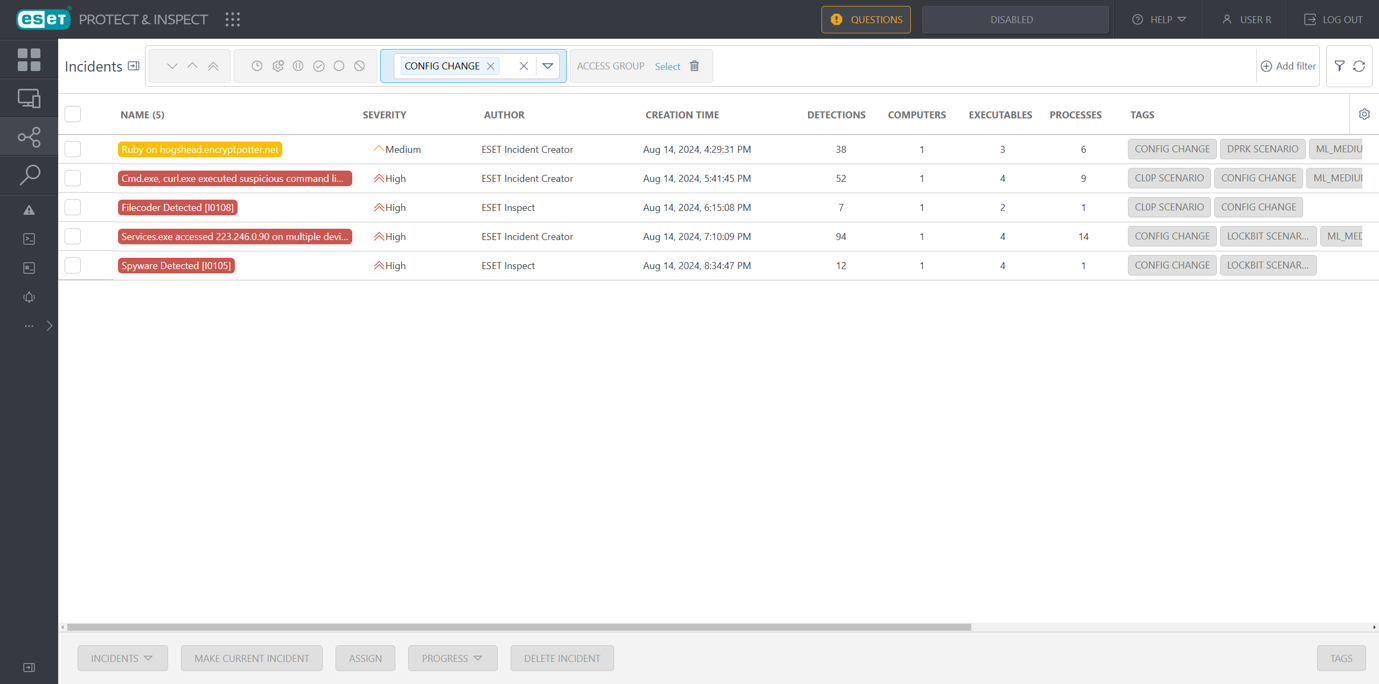
Just as last year’s evaluation, each attack scenario was run twice. Vendors were allowed to make config changes for the second run to try to increase visibility, decrease false positives, and reduce volume. Figure 1 shows the Incidents view after the config change run.

Incident Creator did not generate any false positive incidents during the evaluation. On the contrary, only one or two incidents were created per scenario in the config change run and nearly all relevant detections available in ESET Inspect were correlated to an incident.

Scenario highlights

In the following sections, we will go over highlights from ESET’s results in each scenario.

DPRK

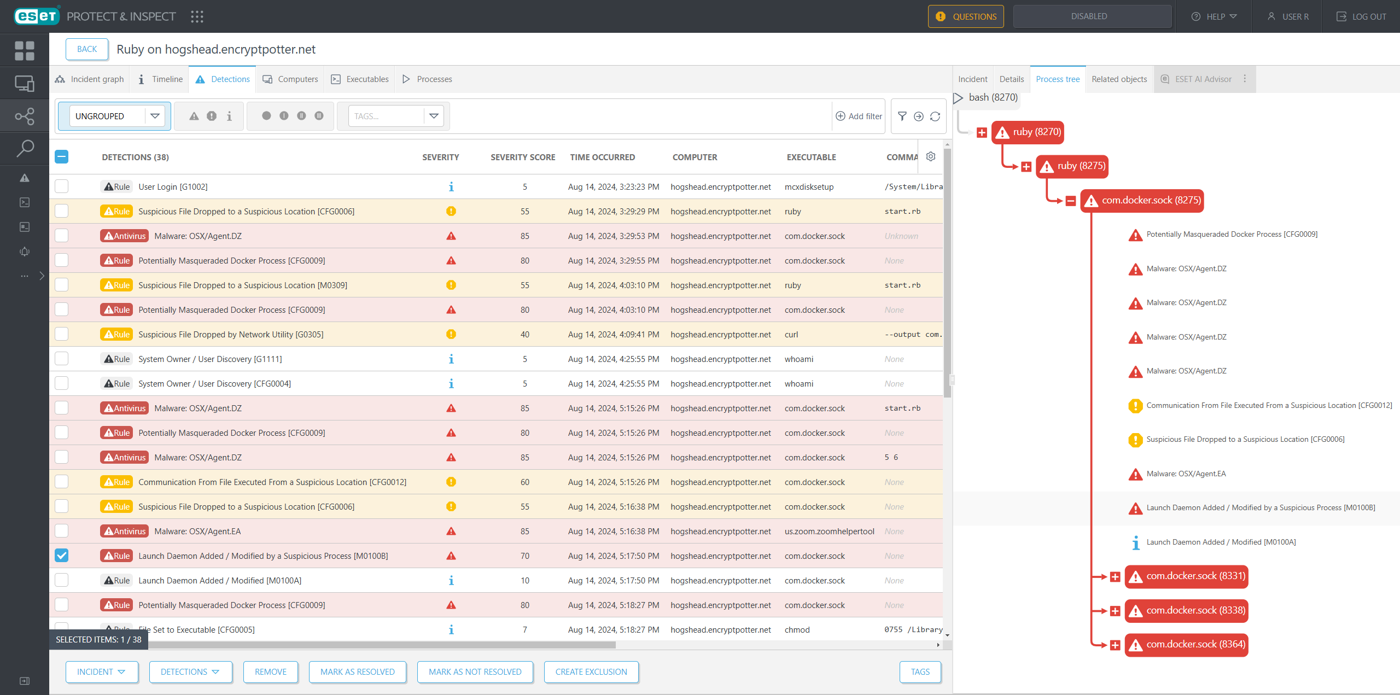
ESET Inspect automatically handled the DRPK scenario as a medium-severity incident created by Incident Creator. Highlights from ESET’s results in this scenario include detection of the two backdoors being dropped to suspicious locations, the backdoor processes masquerading as Docker and Zoom, the theft from keychain files, and no false positives.

Figure 2 shows a part of the incident for the detections correlated to this attack, highlighting a detection for the FULLHOUSE.DOORED backdoor installing persistence for a second-stage backdoor, STRATOFEAR, as a launch daemon.

Cl0p

In the config change run, ESET Inspect automatically handled the Cl0p scenario as two high-severity incidents, one created by Incident Creator and another by a rule that monitors for endpoint detections of filecoders.

Highlights from ESET’s results in this scenario include detection of loading of the SDBbot installer and loader DLLs, modification of a registry key to achieve persistence for the SDBbot RAT, deletion of shadow copies, disabling of Windows recovery after boot failure, and Cl0p ransomware execution.

Figure 3 shows a part of the incident for the detections correlated to this attack, highlighting a detection for file writes or file renames of canary files for early detection of ransomware execution. The triggered rule not only kills the offending process but also creates an incident in the Incidents view.

LockBit

In the config change run, ESET Inspect automatically handled the LockBit scenario as two high-severity incidents, one created by Incident Creator and another by a rule that monitors for endpoint detections of spyware.

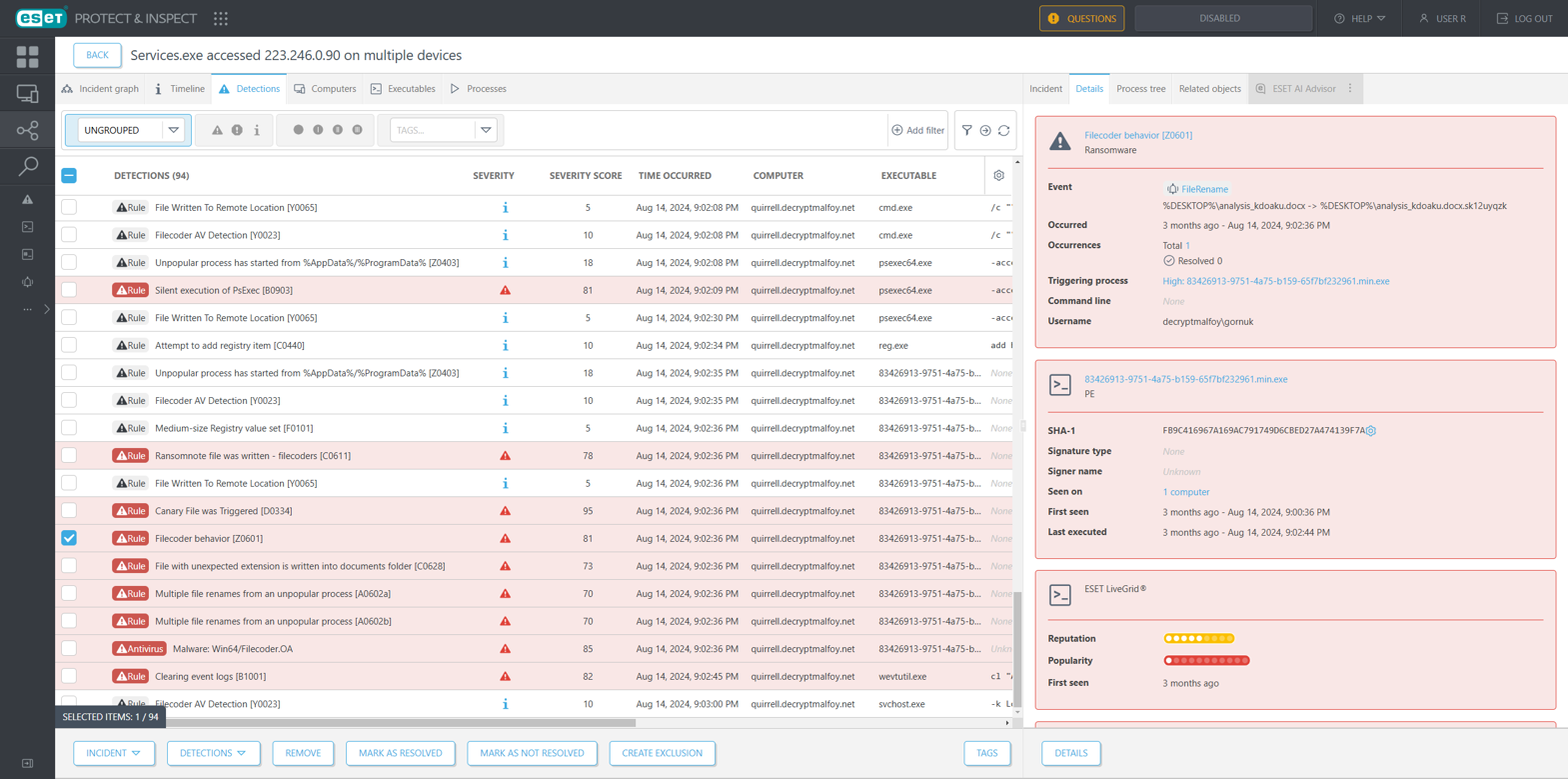
Highlights from ESET’s results in this scenario include detection of the attacker logging in via VNC, modification of a registry value to enable automatic login, using SSH to connect to a Linux server in the internal network, spreading LockBit ransomware to other machines in the network via PsExec, the execution of LockBit, and clearing of Windows event logs to hide intrusion activity.

Figure 4 shows a part of the incident for the detections correlated to this attack, highlighting a detection for a suspicious process writing or renaming files with specific, so-called double extensions – typical filecoder behavior.

Final words

We believe that the summary above paints the best picture of our approach in designing ESET Inspect. It indicates that security analysts can be highly confident that they are efficiently handling real threats whenever ESET Inspect brings an incident with correlated detections to their attention.

Once again, we would like to highlight that the MITRE team has professionally executed another evaluation round, bringing a number of changes to goad vendors into better preparing for the diversity of tactics and techniques played out in the real world rather than for being a “winner” of a competition that does not exist.

On our part, although we are certainly looking to improve ESET Inspect in a few areas to detect additional true positive substeps, this has to be balanced against the risk that dramatically increasing coverage could lower precision and increase volume, all of which would hobble our approach, bringing less and less value for more and more cost. 

In short, we hope that ESET’s perspectives on this year’s evaluation has sparked your curiosity to explore our results further on the evaluation page provided by MITRE ATT&CK Evaluations.

About ESET
For 30 years, ESET® has been developing industry-leading IT security software and services for businesses and consumers worldwide. With solutions ranging from endpoint security to encryption and two-factor authentication, ESET’s high-performing, easy-to-use products give individuals and businesses the peace of mind to enjoy the full potential of their technology. ESET unobtrusively protects and monitors 24/7, updating defenses in real time to keep users safe and businesses running without interruption. Evolving threats require an evolving IT security company. Backed by R&D facilities worldwide, ESET became the first IT security company to earn 100 Virus Bulletin VB100 awards, identifying every single “in-the-wild” malware without interruption since 2003.

About Version 2 Digital

Version 2 Digital is one of the most dynamic IT companies in Asia. The company distributes a wide range of IT products across various areas including cyber security, cloud, data protection, end points, infrastructures, system monitoring, storage, networking, business productivity and communication products.

Through an extensive network of channels, point of sales, resellers, and partnership companies, Version 2 offers quality products and services which are highly acclaimed in the market. Its customers cover a wide spectrum which include Global 1000 enterprises, regional listed companies, different vertical industries, public utilities, Government, a vast number of successful SMEs, and consumers in various Asian cities.

ESET publishes 2023 Carbon Footprint Report: A commitment to sustainability and transparency

BRATISLAVADecember 4, 2024ESET, a global leader in cybersecurity solutions, is proud to announce the publication of its 2023 Carbon Footprint Report. This comprehensive report underscores ESET’s dedication to transparency, accountability, and environmental sustainability, reflecting the company’s ongoing efforts to mitigate its environmental impact and progress toward a net-zero future.

The report reveals that ESET Group’s total carbon footprint for 2023 is 8,146.34 tonnes CO2e using the location-based method and 7,835.06 tonnes CO2e using the market-based method. Greenhouse gas (GHG) emissions per employee amount to 3.38 tonnes CO2e. The majority of the total carbon footprint comes from indirect emissions within ESET Group’s value chain (Scope 3), representing 79% of all emissions.

Compared to 2022, ESET Group’s total GHG emissions increased by 25%, with GHG emissions per employee rising by 16%. The increase is attributed to the inclusion of additional offices previously excluded from data collection, increased business travel attributed to the significant and lasting changes in how businesses operate, driven by the adaptations made during the COVID-19 pandemic, an increase in the number of employees (by 7%), as well as a return to offices in most locations, and more accurate data collection overall year on year.

Despite these increases, ESET has made significant strides in reducing emissions from stationary combustion and fugitive emissions, thanks to implementing various measures to ensure efficient use of heating and cooling through timers, thermostats, and zoning in many offices. That has resulted in an 11% decrease in emissions from stationary combustion, which is due to the use of natural gas and CNG for heating, an 82% decrease in fugitive emissions for A/C unit leakages, and only a 1% increase in purchased heat emissions.

Palo Luka, ESET’s Global COO, said: “We remain committed to our Global Environmental Strategy and will continue to work tirelessly toward reducing our environmental impact. We plan to do this by increasing the use of renewable energy, enhancing energy efficiency, and promoting sustainable practices across all our operations, individually through employees, business partners, and throughout our supply chain. Our ultimate goal is to leave the planet in a better state for future generations.”

According to Luka, the use of renewable energy helps create demand for more sustainable technologies, and the company’s hope is that, where possible, they can contribute toward influencing more options and higher-quality renewable energy sources. In 2023, 36% of electricity consumed in our offices around the world is from renewable sources, with emissions from purchased electricity category contributing the most to the company’s Scope 2 emissions (87%). Furthermore, although energy consumption in our external data centers has increased by 17% between 2022 and 2023, the emissions from external data centers are almost zero as ESET is using responsible providers and 100% renewable energy. 

Read the full report here.

Read about ESET’s commitment to environmental sustainability here.

About ESET
For 30 years, ESET® has been developing industry-leading IT security software and services for businesses and consumers worldwide. With solutions ranging from endpoint security to encryption and two-factor authentication, ESET’s high-performing, easy-to-use products give individuals and businesses the peace of mind to enjoy the full potential of their technology. ESET unobtrusively protects and monitors 24/7, updating defenses in real time to keep users safe and businesses running without interruption. Evolving threats require an evolving IT security company. Backed by R&D facilities worldwide, ESET became the first IT security company to earn 100 Virus Bulletin VB100 awards, identifying every single “in-the-wild” malware without interruption since 2003.

About Version 2 Digital

Version 2 Digital is one of the most dynamic IT companies in Asia. The company distributes a wide range of IT products across various areas including cyber security, cloud, data protection, end points, infrastructures, system monitoring, storage, networking, business productivity and communication products.

Through an extensive network of channels, point of sales, resellers, and partnership companies, Version 2 offers quality products and services which are highly acclaimed in the market. Its customers cover a wide spectrum which include Global 1000 enterprises, regional listed companies, different vertical industries, public utilities, Government, a vast number of successful SMEs, and consumers in various Asian cities.

ESET named a Product and Market Leader in KuppingerCole’s Leadership Compass for MDR

BRATISLAVADecember 5, 2024ESET, a global leader in cybersecurity solutions, is proud to announce its recognition as a Product and Market Leader in KuppingerCole’s Leadership Compass for Managed Detection & Response (MDR). This report prepared by KuppingerCole Analysts AG evaluates the most influential players in the Managed Detection & Response space, and once again acknowledges ESET’s commitment to delivering leading cybersecurity solutions tailored to the needs of organizations across industries.

KuppingerCole’s Leadership Compass recognizes ESET both as a Product and Market Leader for its ESET PROTECT MDR solution, emphasizing the benefits of its fully integrated, cloud-native platform with flexible and rapid deployment capabilities. The report highlights the service’s simple pricing model as well as the new standard tier tailored to the needs of small and medium enterprises (SMEs). ESET PROTECT MDR provides cross-industry, multi-regional insights, strong ransomware/extortion detection, and excellent blocking capabilities.

“ESET PROTECT MDR caters to organizations across the spectrum, from nimble startups to large enterprises,” said Warwick Ashford, Senior Analyst at KuppingerCole, and author of the report. “What sets this solution apart is its ability to deliver rapid response times, robust threat intelligence, and strong ransomware protection, all while offering strong compliance and localization support.”

Delivered via the ESET PROTECT Platform, it also stands out for its additional advantages as a 20-minute Mean Time to Respond (MTTR) and a generative AI assistant in the form of the ESET AI Advisor, for proactive security insight. These features make ESET a versatile and reliable solution for organizations of all sizes and maturity levels.

“Being named a Product and Market Leader in KuppingerCole’s Leadership Compass for MDR reflects our dedication to innovation and excellence in cybersecurity,” said Michal Jankech, Vice President, Enterprise & SMB/MSP at ESET. “Organizations are seeking solutions that provide both proactive detection and rapid response. ESET PROTECT MDR is designed to meet these demands, ensuring businesses stay resilient and protected,” he added.

The recognition comes at a time when MDR solutions are more critical than ever. As cyber threats grow in complexity and frequency, organizations face great challenges, including endpoint vulnerabilities, phishing attacks, and ransomware campaigns. Compounding these issues is a widespread cybersecurity skills shortage, which makes it increasingly difficult for businesses to manage threats internally. MDR solutions, particularly those leveraging advanced AI and machine learning technologies, are essential tools for combating these challenges. They provide critical support for organizations lacking in-house security capabilities, and offer advanced threat detection, rapid response, and proactive risk mitigation strategies to address evolving cyber risks.

ESET has also been named a Product and Innovation Leader in the recent KuppingerCole’s Leadership Compass report on Endpoint Protection Detection and Response (EPDR). The authoritative guide to the EPDR market segment acknowledged ESET for its robust and innovative ESET PROTECT Platform, which integrates the Extended Detection and Response (XDR) enabling ESET Inspect, and ESET Threat Intelligence, among many other modules.

For more information about ESET PROTECT MDR and the ESET PROTECT Platform, please visit www.eset.com.

About ESET
For 30 years, ESET® has been developing industry-leading IT security software and services for businesses and consumers worldwide. With solutions ranging from endpoint security to encryption and two-factor authentication, ESET’s high-performing, easy-to-use products give individuals and businesses the peace of mind to enjoy the full potential of their technology. ESET unobtrusively protects and monitors 24/7, updating defenses in real time to keep users safe and businesses running without interruption. Evolving threats require an evolving IT security company. Backed by R&D facilities worldwide, ESET became the first IT security company to earn 100 Virus Bulletin VB100 awards, identifying every single “in-the-wild” malware without interruption since 2003.

About Version 2 Digital

Version 2 Digital is one of the most dynamic IT companies in Asia. The company distributes a wide range of IT products across various areas including cyber security, cloud, data protection, end points, infrastructures, system monitoring, storage, networking, business productivity and communication products.

Through an extensive network of channels, point of sales, resellers, and partnership companies, Version 2 offers quality products and services which are highly acclaimed in the market. Its customers cover a wide spectrum which include Global 1000 enterprises, regional listed companies, different vertical industries, public utilities, Government, a vast number of successful SMEs, and consumers in various Asian cities.

×

Hello!

Click one of our contacts below to chat on WhatsApp

×