Skip to content

訊連科技將於「2020台灣機器人與智慧自動化展」中,展出整合口罩偵測及體溫感測的防疫解決方案

【2020年08月13日,台北訊】 全球頂尖AI臉部辨識領導廠商訊連科技 (5203.TW) 將參加2020年8月19-22日舉辦之「台灣機器人與智慧自動化展」,於「防疫專區」中,展出專為後防疫時代設計的多款解決方案,包含提供口罩偵測、臉部辨識及體溫量測的FaceMe® Health及整合智慧安控和口罩偵測的FaceMe® Security.

後防疫時代來臨,然各國COVID-19疫情仍然嚴峻。衛福部日前宣布進出八大類場所強制配戴口罩,體溫量測亦是進出各式辦公場所、公共運輸及公共場合不可或缺的環節。一般體溫量測站須由專人負責,使用額溫槍或熱感攝影機進行量測,除耗費人力外,亦隱藏潛在的接觸風險。

訊連科技全新推出之FaceMe® Health提供了口罩辨識、身分辨識、體溫量測及即時警訊的一站式健康量測解決方案。透過AI技術,FaceMe® Health可辨別訪客是否配戴口罩,或有口鼻露出、以手摀住口鼻等不當配戴或假冒情況,更可在配戴口罩時進行身分辨識,可達95%之辨識率。FaceMe® Health亦可支援體溫量測,搭配相容的熱感攝影機或具備體溫量測功能之IP攝影機,準確量測訪客之額溫。於偵測到未配戴口罩或發燒等狀況時,FaceMe® Health可透過U Alerts即時警訊功能通知保全人員進行處理,協助辦公場所及公共場合於入口處打造全方位的非接觸性健康偵測站。

FaceMe® Security為一款專為智慧安控設計的加值軟體,可運行於工作站、伺服器或VMS (video management systems)等多種環境。FaceMe® Security可在安控場景中偵測人臉,與資料庫比對,並於偵測到特定人物時,以即時通訊通知相關人員。於自動化展中,訊連科技將搶先公開FaceMe® Security的全新功能,可整合口罩偵測、身分辨識及體溫量測等資訊,為智慧辦公室、智慧製造、智慧零售等場域,打造整合安控、出勤及健康監控等多樣化功能之解決方案。

「後防疫時代來臨,配戴口罩及體溫量測是進出各式場所不可或缺的防疫作為。」訊連科技黃肇雄執行長表示:「訊連科技的FaceMe® Health及FaceMe® Security係採用全球頂尖之FaceMe® AI臉部辨識引擎打造,可有效偵測口罩配戴狀態、量測體溫,並可於戴口罩時進行準確的身分辨識,透過先進的AI技術讓健康量測之流程自動化,並減少接觸的風險。」

「台灣機器人與智慧自動化展」展會資訊

  • 時間:2020年8月19 – 22日
  • 訊連科技展位:南港展覽館一館一樓K510(防疫專區)
  • 預約會議:
    • 業務聯繫請洽FaceMe_TW@cyberlink.com
    • 媒體採訪請洽:Contact_PR_TW@cyberlink.com


FaceMe®產品訊息

About Version 2

Version 2 Digital is one of the most dynamic IT companies in Asia. The company distributes a wide range of IT products across various areas including cyber security, cloud, data protection, end points, infrastructures, system monitoring, storage, networking, business productivity and communication products. Through an extensive network of channels, point of sales, resellers, and partnership companies, Version 2 offers quality products and services which are highly acclaimed in the market. Its customers cover a wide spectrum which include Global 1000 enterprises, regional listed companies, different vertical industries, public utilities, Government, a vast number of successful SMEs, and consumers in various Asian cities.

關於CyberLink
訊連科技創立於1996年,擁有頂尖視訊與音訊技術的影音軟體公司,專精於數位影音軟體及多媒體串流應用解決方案產品研發,並以「抓準技術板塊,擴大全球行銷布局」的策略,深根台灣、佈局全球,展現亮麗的成績。訊連科技以先進的技術提供完美的高解析影音播放效果、以尖端的科技提供完整的高解析度擷取、編輯、製片及燒錄功能且完整支援各種高解析度影片及音訊格式。產品包括:「威力導演」、「PowerDVD」、「威力製片」、「威力酷燒」等。

Monitoring 802.1X EAP: What You Need to Know

First Thing’s First

As we’ve written about previously, the standard authentication protocol used on encrypted networks is Extensible Authentication Protocol (EAP), which provides a secure method to send identifying information for network authentication. 802.1x is the standard that is used for passing EAP over wired and wireless Local Area Networks (LAN), as it provides an encrypted EAP tunnel that prevents outside users from intercepting information. The EAP protocol can be configured for credential (EAP-TTLS/PAP and PEAP-MSCHAPv2) and digital certificate (EAP-TLS) authentication and is a highly secure method for protecting the authentication process.

Throughout this article, we will look at how to monitor 802.1X EAP and why doing so is important from a network security perspective.

MAC Authentication Bypass (MAB)

MAB enables port-based access control using the MAC address of the endpoint. A MAB-enabled port can be dynamically enabled or disabled based on the MAC address of the device that connects to it. The below diagram illustrates the default behavior of a MAB-enabled port.
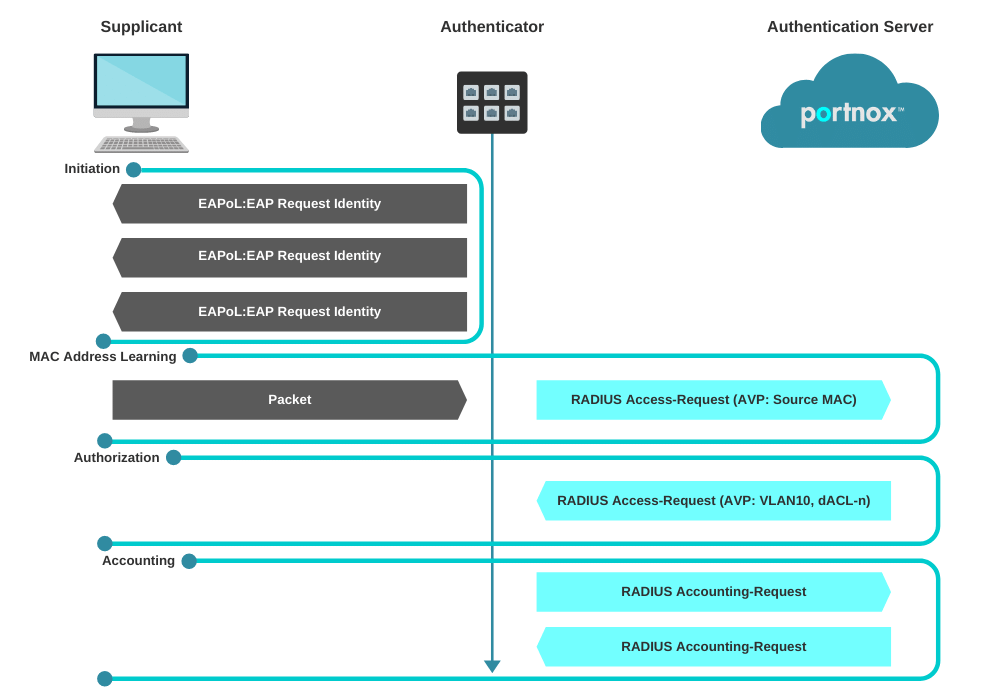
EAP MAC authentication bypass

Session Initiation

From the switch’s perspective, the authentication session begins when the switch detects link-up on a port. The switch will initiate authentication by sending an EAP Request-Identity message to the endpoint. If the switch does not receive a response, the switch will retransmit the request at periodic intervals. If no response is received after the maximum number of retries, the switch will let IEEE 802.1X time out and proceed to MAB.

MAC Address Learning

During the MAC address learning stage, the switch begins MAB by opening the port to accept a single packet from which it will learn the source MAC address of the endpoint. Packets sent before the port has fallen back to MAB (that is, during the IEEE 802.1X timeout phase) are discarded immediately and cannot be used to learn the MAC address.

The switch can use almost any Layer 2 and 3 packets to learn MAC addresses, with the exception of bridging frames such as Link Layer Discovery Protocol (LLDP), Spanning Tree Protocol, and Dynamic Trunking Protocol (DTP). 1

After the switch learns the source MAC address, it discards the packet. Then the switch crafts a RADIUS Access-Request packet. A sample MAB RADIUS Access-Request packet is shown in the snapshot below.

RADIUS Access-Request Packet for MAB

By default, the Access-Request message is a Password Authentication Protocol (PAP) authentication request, The request includes the source MAC address in three attributes: Attribute 1 (Username), Attribute 2 (Password), and Attribute 31 (Calling-Station-Id). Although the MAC address is the same in each attribute, the format of the address differs. This feature is important because different RADIUS servers may use different attributes to validate the MAC address. Some RADIUS servers may look at only Attribute 31 (Calling-Station-Id), while others will actually verify the username and password in Attributes 1 and 2.

Because MAB uses the MAC address as a username and password, you should make sure that the RADIUS server can differentiate MAB requests from other types of requests for network access. This precaution will prevent other clients from attempting to use a MAC address as a valid credential. Cisco switches uniquely identify MAB requests by setting Attribute 6 (Service-Type) to 10 (Call-Check) in a MAB Access-Request message. Therefore, you can use Attribute 6 to filter MAB requests at the RADIUS server.

Session Authorization

If the MAC address is valid, the RADIUS server will return a RADIUS Access-Accept message. This message indicates to the switch that the endpoint should be allowed access to the port. Optionally, the RADIUS server may include dynamic network access policy instructions (for example, a dynamic VLAN or access control list [ACL]) in the Access-Accept message. In the absence of dynamic policy instructions, the switch will simply open the port. No further authentication methods will be tried if MAB succeeds.

If the MAC address is not valid or is not allowed to access the network for policy reasons, the RADIUS server will return a RADIUS Access-Reject message. This message indicates to the switch that the endpoint should not be allowed access to the port based on the MAC address.

If no fallback authentication or authorization methods are configured, the switch will stop the authentication process and the port will remain unauthorized.

Session Accounting

If the switch can successfully apply the authorization policy, the switch can send a RADIUS Accounting-Request message to the RADIUS server with details about the authorized session.
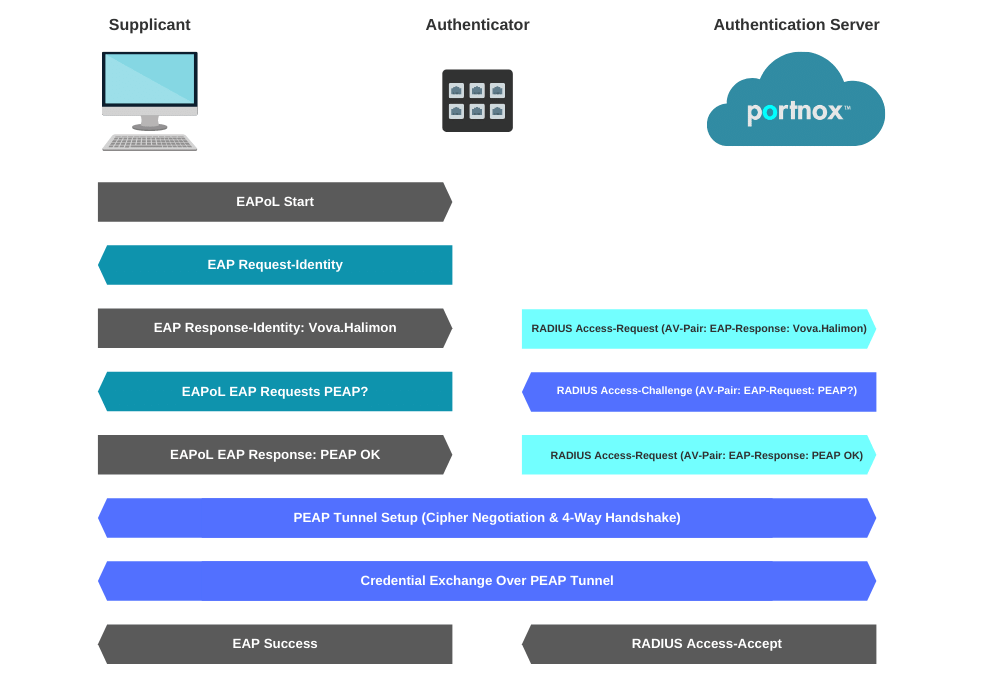
EAP Request Frame

In the diagram above, the first frame sent is an EAPOL-Start frame. This frame is not critical, and the process can be started by the authenticator sending the EAP-Request Frame.

Next, the supplicant responds with an EAP-Response. Messages from the Authenticator to the Radius server use the radius protocol (UDP 1812 for Authentication)When the authenticator receives an Access-Accept packet from the radius server it will authorize the port and allow access to the supplicant. If access is denied by the Radius server an Access-Reject message will be sent to the authenticator and the port will stay unauthorized.

The supplicant can terminate the authentication of the port by sending an EAPOL-logoff frame to the authenticator.

Supplicant to Authenticator (EAPoL)

This is the communication method utilized that provides the Authenticator and the Client a line of communication prior to network access. This is what the capture will look like:

EAPoL communication

The EAPoL portion of communication will vary depending on the authentication type. In my examples, we are using EAP-PEAP w/EAP-MsCHAPv2. This is a fairly standard form of authentication.

The useful portions that can usually be derived from a pcap are:
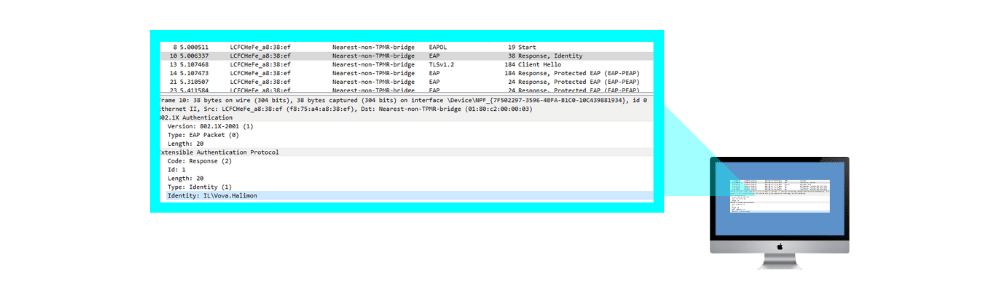
EAP-Identity Response

In this frame, you can see the Client’s (Supplicant) Identity being used of “Vova.Halimon“. This can be extremely useful when trying to determine if the supplicant is going to authenticate as the user or the machine account as well as what the user could be typing into the username prompt.

For more information on EAP types, visit the IANA EAP registry.

EAP-TLS (Certificate Example)

EAP Auth Method Negotiation and Credential Exchange:

EAP Auth Method

The first message in the above screenshot is the server’s proposal of EAP-PEAP (EAP-TLS, EAP-TTLS EAP-FAST, EAP-LEAP, EAP-MD5) then the client’s response with, “EAP-PEAP good for me” In some situations, depending on the RADIUS server configuration, the client may try to propose a method that is not permitted or supported by the server. This is where you would see that negotiation fail, and ultimately an Access-Reject / EAP-Failure.

EAP Success (Wired & Wireless) & 4-Way Handshake (Wireless):

EAP Success

EAP CodeType
1Request
2Response
3Success
4Failure

Once the client has been successfully authenticated and authorized, there is an EAP Success message sent back to signify the end of the process. If this is a wired client, the process is over, and the client is able to start transmitting and receiving data frames. If this is a wireless client, the station will utilize a few EAP attributes and the AP will utilize two MPPE (Microsoft Point-to-Point Encryption – key attributes in the RADIUS Access-Accept response to perform the 4-way handshake and create the encryption keys for secure communication.

Extensible Authentication Protocol (EAP) Authentication Types

  • MD5 isn’t typically used as it only does a one-way authentication, and perhaps even more importantly doesn’t support automatic distribution and rotation of WEP keys so does nothing to relieve the administrative burden of manual WEP key maintenance.
  • TLS, while very secure, requires client certificates to be installed on each Wi-Fi workstation. Maintenance of a PKI infrastructure requires additional administrative expertise and time in addition to that of maintaining the WLAN itself.
  • TTLS addresses the certificate issue by tunneling TLS, and thus eliminating the need for a certificate on the client side. Making this an often preferred option. Funk Software* is the primary promoter of TTLS, and there’s a charge for supplicant and authentication server software.
  • LEAP has the longest history, and while previously Cisco proprietary (works with Cisco Wi-Fi adapters only), Cisco has licensed LEAP to a variety of other manufacturers through their Cisco Compatible Extensions program. A strong password policy should be enforced when LEAP is used for authentication.
  • EAP-FAST is now available for enterprises that can’t enforce a strong password policy and don’t want to deploy certificates for authentication.

The more recent PEAP works similarly to EAP-TTLS in that it doesn’t require a certificate on the client side. PEAP is backed by Cisco and Microsoft and is available at no additional cost from Microsoft. If desired to transition from LEAP to PEAP, Cisco’s ACS authentication server will run both.

EAP-TLS Example
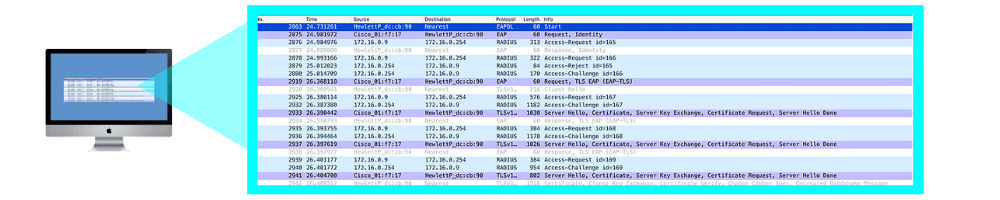
EAP-TLS example

However, in this graphic, you can see the client and server negotiate EAP-PEAP. Once that is completed, the server will present the client with its certificate. If the client does not trust the certificate from the server, and the user does not accept the certificate(The end-user might be presented with a dialog to trust this certificate), the exchange will fail after the first frame or two of the handshake.

In this situation, however, the client trusts the server certificate, and the two endpoints secure the medium with a TLS tunnel. Once secured you should notice that the protocol becomes purely TLS and since the traffic is encrypted, we can only see that the frames are “Application Data”. This is the point at which the client and server are exchanging inner authentication data such as EAP-MsCHAPv2 or EAP-TLS.

About Version 2 Digital

Version 2 Digital is one of the most dynamic IT companies in Asia. The company distributes a wide range of IT products across various areas including cyber security, cloud, data protection, end points, infrastructures, system monitoring, storage, networking, business productivity and communication products.

Through an extensive network of channels, point of sales, resellers, and partnership companies, Version 2 offers quality products and services which are highly acclaimed in the market. Its customers cover a wide spectrum which include Global 1000 enterprises, regional listed companies, different vertical industries, public utilities, Government, a vast number of successful SMEs, and consumers in various Asian cities.

About Portnox
Portnox provides simple-to-deploy, operate and maintain network access control, security and visibility solutions. Portnox software can be deployed on-premises, as a cloud-delivered service, or in hybrid mode. It is agentless and vendor-agnostic, allowing organizations to maximize their existing network and cybersecurity investments. Hundreds of enterprises around the world rely on Portnox for network visibility, cybersecurity policy enforcement and regulatory compliance. The company has been recognized for its innovations by Info Security Products Guide, Cyber Security Excellence Awards, IoT Innovator Awards, Computing Security Awards, Best of Interop ITX and Cyber Defense Magazine. Portnox has offices in the U.S., Europe and Asia. For information visit http://www.portnox.com, and follow us on Twitter and LinkedIn.。

後防疫時代來臨,訊連科技發表全新FaceMe® Health 打造非接觸的智慧健康量測解決方案

全球頂尖AI臉部辨識領導廠商訊連科技 (5203.TW) 發表全新智慧健康量測解決方案FaceMe® Health。FaceMe® Health可建置於各式場所之出入口,如:辦公大樓、零售店、車站等,透過AI技術,自動偵測口罩配戴狀況及量測體溫,或進行身分辨別。於偵測到未配戴口罩人士出入時,以即時訊息通知保全或相關人員,可協助各式場所打造後疫情時代的非接觸性健康偵測站。

後防疫時代來臨,配戴口罩,體溫量測仍是進出各式辦公場所、公共運輸及公共場合不可或缺的環節。一般體溫量測站須由專人負責,使用額溫槍或熱感攝影機進行量測,除耗費人力外,亦隱藏潛在的接觸風險。

訊連科技全新推出之FaceMe® Health提供了一站式的智慧健康量測解決方案,透過AI影像辨識技術,可辨別訪客是否配戴口罩,或有口鼻露出、以手摀住口鼻等不當配戴或假冒情況。更可在配戴口罩時進行身分辨識,可達95%之辨識率。FaceMe® Health亦整合了即時通訊功能,於偵測到發燒或未配戴口罩時,透過U Alerts即時通知相關人員進行應對。「訊連科技的FaceMe® Health係採用全球頂尖之FaceMe® AI臉部辨識引擎打造,可有效偵測口罩配戴狀態、量測體溫,並於戴口罩時進行準確的身分辨識。」訊連科技黃肇雄執行長表示:「透過先進的AI技術,可讓健康量測之流程自動化,並減少接觸的風險,快速打造各式公共場所的智慧健康量測站。」


FaceMe® Health可安裝於最低第八代Intel® Core i3處理器之電腦,如NUS迷你電腦等,可使用USB Webcam及FLIR C3熱感攝影機,或是特定型號、搭載熱感應攝影功能的IP攝影機,即可建置於公共場所出入口進行健康偵測,輕鬆打造非接觸性、自動化的智慧健康偵測站。 


About Version 2

Version 2 Digital is one of the most dynamic IT companies in Asia. The company distributes a wide range of IT products across various areas including cyber security, cloud, data protection, end points, infrastructures, system monitoring, storage, networking, business productivity and communication products. Through an extensive network of channels, point of sales, resellers, and partnership companies, Version 2 offers quality products and services which are highly acclaimed in the market. Its customers cover a wide spectrum which include Global 1000 enterprises, regional listed companies, different vertical industries, public utilities, Government, a vast number of successful SMEs, and consumers in various Asian cities.

關於CyberLink
訊連科技創立於1996年,擁有頂尖視訊與音訊技術的影音軟體公司,專精於數位影音軟體及多媒體串流應用解決方案產品研發,並以「抓準技術板塊,擴大全球行銷布局」的策略,深根台灣、佈局全球,展現亮麗的成績。訊連科技以先進的技術提供完美的高解析影音播放效果、以尖端的科技提供完整的高解析度擷取、編輯、製片及燒錄功能且完整支援各種高解析度影片及音訊格式。產品包括:「威力導演」、「PowerDVD」、「威力製片」、「威力酷燒」等。

Scale Computing Delivers High Availability, Increased Reliability and Ease of Use to Healthcare Organizations

INDIANAPOLIS, August 4, 2020 — Scale Computing, a market leader in edge computing, virtualization, and hyperconverged solutions, today announced it is experiencing increased demand for its HC3 virtualization platform across the healthcare industry.

The healthcare industry is consumed with the need to simplify the management of IT assets and reduce the time and effort expended on maintaining the current IT environment. Paris Community Hospital, Riverwood Healthcare Center, Costa Salud Community Health, and North Valley Hospital all faced significant IT challenges. These included a need to enable virtualization without complexity, improve availability of critical workloads, improve disaster recovery, and solve single vendor support of infrastructure, all while needing to meet an affordable price point.

Paris Community Hospital, part of Horizon Health, is a 25-bed critical-access hospital located in Paris, Illinois. It is a full-service provider that includes emergency medicine, surgery, rehabilitation services, radiology, diabetes education, and more. The company’s four-person IT team turned to Scale Computing to simplify the management of its IT assets and reduce the time and effort expended on maintaining the environment. Scale Computing HC3 provided a cost-effective way to simplify its IT infrastructure and VDI management as well as improved performance. It also delivered enhanced security and control and enabled rapid deployment of virtual desktops, cutting time-to-implementation from a week to two hours.

Edgar Weeks, information services manager, Paris Community Hospital, comments: “With the previous environment, the high cost of maintenance and replacement, as well as the overhead required to go through so many devices and workstations individually, was a serious issue for a small, lean organization like us. Scale Computing delivered a solution that has addressed all the challenges we faced more cost-effectively than all other options. We can add users faster, manage connections more effectively, provide better control over user access and deliver vastly improved security.”

Riverwood Healthcare Center has been providing care to residents of Aitkin County in Northern Minnesota for more than 60 years. Riverwood IT leadership turned to Scale Computing to help virtualize their operations and fortify their disaster recovery efforts with a single vendor. The Scale Computing HC3 solution simplified the center’s efforts, working across its entire infrastructure and reducing the time the Riverwood IT team spends managing its infrastructure by nearly 25%, and with a much smaller footprint.

Mike Kongsjord, IT administrator, Riverwood Healthcare Center, stated: “HC3 reduced time in implementation, making our response to requests more efficient, thus increasing satisfaction. Overall maintenance of the device is much less than supporting physical servers.”

Costa Salud Community Health is located in Rincon, Puerto Rico. The health center’s general practitioners provide comprehensive, continuous and primary healthcare services to patients. Costa Salud Community Health was looking for a single vendor solution to support its infrastructure and improve disaster recovery, all at an affordable cost. It turned to Scale Computing’s HC3 for hypervisor licensing renewal and to support higher uptime SLAs for critical workloads. Thanks to its built-in high availability, HC3 decreased the time spent recovering from a hardware failure running a critical workload from 1-8 hours to less than 10 minutes (an 83-97% reduction in recovery time). Scale Computing’s solution also reduced the time the IT staff spends managing infrastructure by more than 75% after deployment of HC3.

Ismael Ruiz, IT vice president, Costa Salud Community Health, commented: “The Scale Computing solution was very interesting from the beginning. Employees do not need certifications to use the platform. Also, we do not have to be constantly upgrading. One opportunity we saw apart from the cost was support. No matter the time, a service engineer always helps us by phone in a short time. In our case, we evaluated a lot of products and HC3 was the best suited for our operations.”

North Valley Hospital, located in Washington state, strives to provide quality patient care and education that enhances the health and well-being of its communities. While struggling to find availability to accompany its critical workloads and enable virtualization without complexity, North Valley Hospital looked to Scale Computing. Scale Computing’s HC3 not only addressed those issues, but also improved disaster recovery. The high availability built into HC3 allowed North Valley Hospital to decrease the recovery time needed for a hardware failure running a critical workload, from 8-24 hours to less than 10 minutes (97-99% reduction in recovery time). In addition, after deploying HC3, the amount of time the IT staff spends managing infrastructure was reduced by 50-74%.

Carlos Antuna, IT manager, North Valley Hospital, commented: “HC3 reduced complexity and increased availability.”

“When it comes to IT, healthcare organizations face many of the same challenges as any other organization, including limited budgets and scalability. Healthcare organizations also face challenges related to storing, managing and protecting critical patient data and research data and keeping systems available to handle critical care,” said Jeff Ready, CEO and co-founder, Scale Computing. “Healthcare organizations of all types have been choosing HC3 hyperconverged infrastructure from Scale Computing to serve their IT infrastructure needs. HC3 offers simplicity, scalability, availability, and affordability to organizations who need to streamline operations with a reliable solution. Whether a healthcare organization is specialized in emergency services, mental health, medical imaging, research or any other aspect of care, HC3 is the smart choice.”

About Version 2 Digital

Version 2 Digital is one of the most dynamic IT companies in Asia. The company distributes a wide range of IT products across various areas including cyber security, cloud, data protection, end points, infrastructures, system monitoring, storage, networking, business productivity and communication products.

Through an extensive network of channels, point of sales, resellers, and partnership companies, Version 2 offers quality products and services which are highly acclaimed in the market. Its customers cover a wide spectrum which include Global 1000 enterprises, regional listed companies, different vertical industries, public utilities, Government, a vast number of successful SMEs, and consumers in various Asian cities.

About Scale Computing 
Scale Computing is a leader in edge computing, virtualization, and hyperconverged solutions. Scale Computing HC3 software eliminates the need for traditional virtualization software, disaster recovery software, servers, and shared storage, replacing these with a fully integrated, highly available system for running applications. Using patented HyperCore™ technology, the HC3 self-healing platform automatically identifies, mitigates, and corrects infrastructure problems in real-time, enabling applications to achieve maximum uptime. When ease-of-use, high availability, and TCO matter, Scale Computing HC3 is the ideal infrastructure platform. Read what our customers have to say on Gartner Peer Insights, Spiceworks, TechValidate and TrustRadius.

ASRC 2020 年第二季電子郵件安全觀察

2020 年第二季,全球仍然籠罩在新冠肺炎的疫情中,且疫情的嚴重及影響程度已遠超第一季。許多企業採取分梯次在家上班的模式,以確保人員的健康以及組織的正常運作。然而,工作模式的改變加重了對網路的依賴,也因為人與人彼此見不到面,各種詐騙、資安破口就容易被攻擊者所利用。

ASRC 研究中心 (Asia Spam-message Research Center) 在2020年第二季觀察到幾個值得注意的郵件安全議題:

偽造釣魚郵件相較上季增加,出現不少偽冒企業管理者發送的釣魚郵件
第二季偽造企業組織通知、收貨確認通知…等釣魚郵件明顯增長,相較於上季大約成長了 24%,並且集中在六月份。

  • 為數最多的是偽造企業管理者發送郵件帳號密碼相關問題的釣魚郵件,會在收信者點擊連結後導向釣魚頁面,這個釣魚頁面通常寄宿於被入侵的 WordPress 網站;
  • 其次為假的語音與檔案遞送通知,這些通知除了部分寄宿於被入侵的 WordPress 網站,部分則是使用免費的表單或網站生成器做為釣魚頁面,還有少量直接夾帶惡意附件檔案;
  • 最後是假的貨物運送或商業交易確認,部分寄宿於被入侵的 WordPress 網站、部分則直接將釣魚頁面的 HTML 放在附件檔內試圖避開瀏覽器對網址的警示與檢查,還有一部分則是直接夾帶以 RAR 壓縮後的惡意執行檔。

釣魚頁面通常寄宿於被入侵的 WordPress 網站

病毒郵件數量明顯增加,夾帶惡意映像檔或壓縮格式檔案居多
病毒郵件同樣集中在六月份,數量較上一季成長約 60%,以夾帶惡意 .img 檔為最大宗,佔總量 1/3 以上。這些 .img 檔中包含一個惡意 .exe 可執行檔案,在 Windows 環境下被雙擊後,會自動掛載成為一個虛擬光碟,便可讀取其中的 .exe 檔;此外,網路上也有人教學如何以 7-Zip 解出映像檔內的內容,若收到此類惡意攻擊時缺乏資安意識,而以如何開啟該類檔案的目的在網路上尋找答案,也可能因此曝險!
在第二季,比較特別的是病毒郵件較常用的壓縮檔格是分別為 .ace 與 .rar,甚至比 Windows 內建能解壓縮的.zip壓縮格式還要多。WinRAR 自 2015 年即對中國個人用戶開放免費,許多中國的 PC 安裝完成後也會安裝免費的 WinRAR 作為預設的壓縮或解壓縮的工具;但是自 CVE-2018-20250、CVE-2018-20251、CVE-2018-20252、CVE-2018-20253 被揭露以來,常見的免費或可免費試用的解壓縮軟體諸如:WinRAR、7-Zip、Peazip …等,均已不再支援 .ace 的解壓縮,.ace 的病毒附件會不會是刻意面向某些族群?值得玩味。

夾帶 .ace 壓縮檔的病毒郵件仍四處散播

來自新域名的郵件,假藉口罩販售進行詐騙
全球第二季仍在新冠肺炎的籠罩之中,許多地區對於口罩的供應還是匱乏的,第二季我們發現有許多口罩銷售的電子郵件,指向一些新註冊的域名。這些域名被註冊的時間都在半年內,甚至更短,並且在一段時間後就無法拜訪,極可能是詐騙。這類郵件較上一季成長了約3.7倍,集中在六月份。

口罩銷售的電子郵件,指向一些新註冊的域名

漏洞利用在四月達到高峰,受國家資助的 APT 族群利用疫情發動郵件攻擊
附件使用已被揭露的 Office 漏洞的電子郵件攻擊,在四月份達到高峰。
受到國家資助支持的 APT 族群,也在5月份頻繁地嘗試以電子郵件發動攻擊,且大多假藉疫情的議題寄發公告通知、口罩相關資訊,或偽冒 CDC 免費分發防護設備,要求相關人員開啟並填寫附件調查表格,藉以誘導收件者開啟惡意附件!

假防疫設備支援名義,試圖攻擊相關業者

綜整了第二季惡意郵件社交工程特徵,其中一大部分是促使人「發急」,例如:很急的訂單、要求盡快回覆或查看附檔、電子信箱有狀況將被停用、被入侵了…等。因為很急,所以後續的作為就可能脫離原有的標準作業流程,加上遠距上班的因素,再確認的工作可能因此變得難以落實,就很容易落入攻擊者的陷阱。遠距上班的期間,別忘了「急事緩辦,事緩則圓」,對於任何有疑慮的來信都應當給予最小的信任,充分再確認才能免除後續資安危機。

About Version 2

Version 2 Digital is one of the most dynamic IT companies in Asia. The company distributes a wide range of IT products across various areas including cyber security, cloud, data protection, end points, infrastructures, system monitoring, storage, networking, business productivity and communication products. Through an extensive network of channels, point of sales, resellers, and partnership companies, Version 2 offers quality products and services which are highly acclaimed in the market. Its customers cover a wide spectrum which include Global 1000 enterprises, regional listed companies, different vertical industries, public utilities, Government, a vast number of successful SMEs, and consumers in various Asian cities.

關於中華數位科技 Softnext Technologies Corp.
創立於2000年8月。
秉持著【We Secure Your Content】的服務理念,以提供企業資訊應用管理服務及打造資訊內容安全防護為宗旨。專精於提供網路應用服務技術,根據市場需求推出多款資訊內容安全的解決方案及應用服務,能夠協助企業透過符合資安管理規範並遵循法規的方式進行資訊內容安全管理,以維護員工的生產力、提升企業經營績效。

關於 ASRC 垃圾訊息研究中心
ASRC 垃圾訊息研究中心 (Asia Spam-message Research Center),長期與中華數位科技合作,致力於全球垃圾郵件、惡意郵件、網路攻擊事件等相關研究事宜,並運用相關數據統計、調查、趨勢分析、學術研究、跨業交流、研討活動..等方式,促成產官學界共同致力於淨化網際網路之電子郵件使用環境。更多資訊請參考 www.asrc-global.com .
