Skip to content

Network segmentation: what it is and how to implement it

What is network segmentation, exactly?

Network segmentation is the practice of dividing a computer network into smaller subnetworks (also called “segments,” hence the term “segmented network”), each of which can function as a separate unit.

By following this architectural approach, you can define how traffic will flow between different parts of the network. This can be achieved by establishing specific security controls and policies for each segment.

The purpose of all this is to improve network performance, simplify management, and contain potential threats within a specific part of the network, preventing them from spreading to other areas.

How does network segmentation work?

Dividing a network into smaller, manageable parts is no simple task, especially when the network itself is quite expansive—it takes careful planning, IT know-how, and the right resources. The idea is to have elements like the client database, email servers, company website, guest Wi-Fi, and internal applications as independent parts of the network.

Enterprise network segmentation starts with figuring out how to divide the network based on criteria like function, security needs, or business requirements. After that, you use a mix of hardware (routers, switches, and firewalls) and software (virtual LANs, cloud technologies) to break the network into segments and control how traffic flows between them.

Once you’ve got the segments set up, the next step is to monitor and manage each of them, which can be made easier with tools like security information and event management (SIEM) solutions.

Network segmentation and zero trust

Network segmentation is key to how companies manage access to their digital resources. Back in the day, companies used to follow the “assumed trust” principle—the idea that everyone in the company was a good guy, and therefore, could be trusted with access to all company data and services.

However, after thousands of human errors and security breaches caused by bad actors, companies have shifted to the zero-trust model. This approach assumes that no one should automatically have full access to the company’s network and virtual assets. Instead, they must be verified and granted access only to the resources they actually need.

To make this a reality, companies use a few different strategies, with network segmentation being one of them. How so? Zero-trust network segmentation refers to IT teams creating dedicated subnetworks for specific groups of users, ensuring they cannot move beyond their designated limits. This adds an extra layer of defense and aligns with the “never trust, always verify” motto of zero trust. Each subnetwork functions as a secure zone, with access protected by authorization protocols.

And if you combine all of this with identity and access management (IAM) solutions to securely manage user credentials, and network access control (NAC) tools that restrict access based on user or device authentication, you’ve got yourself a solid system for keeping the network running smoothly while minimizing risk.

The benefits of network segmentation

At this point, you’ve probably got a good idea of the advantages that come with dividing your company network into smaller segments. However, if you’re not sure you’ve caught all of them, here’s a rundown of the best examples of network segmentation benefits for you:

Enhanced cybersecurity

Network segmentation helps prevent cyberattacks from spreading across the entire company network. For example, if malware infiltrates a subnetwork, it cannot easily spread to other parts of the network, thereby reducing the potential damage and facilitating a quicker response. Similarly, if someone makes an error and accidentally puts systems at risk, the problem remains confined to the parts of the network they had access to. This makes it much easier to identify the issue and resolve it.

Improved compliance

Complying with policies and regulations like HIPAA and GDPR can feel like a lot of work, but network segmentation can make things easier. By breaking up the network into smaller, more secure sections, businesses can isolate sensitive data in specific virtual environments—only accessible to the right people. Plus, by controlling how data moves between these subnetworks, it becomes a lot easier to demonstrate that you’re meeting compliance requirements during audits.

Increased performance

By dividing the network into smaller segments, a company can avoid network congestion, which occurs when a network carries more data than it can handle. This can lead to slow internet speeds, buffering during streams, video call glitches, and difficulty accessing company resources when needed—ultimately affecting employee performance. Keeping network congestion low helps ensure smoother online operations and prevents downtime.

Facilitated incident response

When dealing with smaller segments of the network, it becomes much easier to spot where an incident is happening. From there, that specific area can be isolated to keep the issue from spreading. Since the rest of the network stays secure and there’s a smaller scope to investigate, IT security teams can focus on the affected area and get to the root of the problem much faster.

How to implement network segmentation in your organization

Before you start breaking your company network into smaller segments, it’s a good idea to get familiar with some network segmentation best practices. That way, you’ll head into the project with confidence and a solid game plan—setting yourself up for a smoother process and better results. Here are a few key things to keep in mind.

Don’t oversegment or undersegment your network

As you read this article, you might get the impression that the more you segment your network, the better. But that’s not quite true. If you go too far, your employees will end up dealing with too many access points, leading to user fatigue, slower workflows, and traffic bottlenecks.

On the other hand, if you don’t segment enough—say, only into 3 or 4 subnetworks—you won’t get the security benefits we talked about. This means your attack surface will still be pretty wide. So, the key here is finding the right balance. Effective network segmentation is about finding that sweet spot in how many parts your company network really needs.

Follow the zero–trust principle

Like we mentioned earlier, keeping your network segmentation secure means sticking to a strict zero-trust policy. In simple terms, no one gets an easy pass—regardless of their role or how long they’ve been with the company. Everyone needs to go through proper authentication before accessing any resources. It may sound tough, but it’s one of the best ways to protect your network segmentation operations and stay in control of who can access what.

Minimize third-party entry points

Chances are, your organization relies on at least a few third-party tools and services to keep things running smoothly. Since these platforms are part of your IT ecosystem, they can also become entry points for cybercriminals if compromised. That’s why it’s important to keep their access limited. Don’t give third-party solutions more reach than they really need. A good way to do this is by setting up dedicated access points that connect them only to specific segments of your network. That way, even if something goes wrong on their end, the issue will not spread easily into your company network.

Protect all endpoints

As an employer, you’re providing your team with devices, business accounts, and access to company data. With that comes the responsibility of making sure what you provide can’t be used against your company, and that each employee’s device and account are properly protected.

That includes giving employees access to the right subnetworks—but it doesn’t stop there. You also need to use antivirus software and monitoring tools to ensure only authorized devices get through—so that, much like in Homer’s Iliad, you’re not inviting in modern-day Trojan horses, which could bring chaos once inside.

Monitor all your subnetworks

Segmenting your network is just the beginning—the real work begins after that. You’ve got to manage and monitor all those subnetworks carefully, making sure you have a big-picture view of the whole network while also keeping an eye on how each part is doing individually. For that, it’s a good idea to use modern monitoring tools to spot any unusual user behavior or get alerted if there’s a data breach, so you can quickly figure out which part of the network needs to be shut off.

How NordPass can help

While it is not software dedicated strictly to network segmentation, NordPass is a tool that can help your organization control access to company resources and secure multiple endpoints to minimize the risk of a cyberattack.

NordPass is more than just an encrypted password manager that allows teams to securely store, manage, and share business credentials, credit card details, and sensitive information—it is also a cybersecurity solution for managing user access to company resources and monitoring data breaches to determine if they involve company data. If you run a large enterprise, you can use NordPass to see what was shared, with whom, and for what purpose, and revoke access with ease when necessary.

The best part is that you can try NordPass before making any commitments—just use the free 14-day trial to see how it can improve your company’s cybersecurity and performance. It would be a shame not to use this opportunity.

About NordPass
NordPass is developed by Nord Security, a company leading the global market of cybersecurity products.

The web has become a chaotic space where safety and trust have been compromised by cybercrime and data protection issues. Therefore, our team has a global mission to shape a more trusted and peaceful online future for people everywhere.

About Version 2 Digital

Version 2 Digital is one of the most dynamic IT companies in Asia. The company distributes a wide range of IT products across various areas including cyber security, cloud, data protection, end points, infrastructures, system monitoring, storage, networking, business productivity and communication products.

Through an extensive network of channels, point of sales, resellers, and partnership companies, Version 2 offers quality products and services which are highly acclaimed in the market. Its customers cover a wide spectrum which include Global 1000 enterprises, regional listed companies, different vertical industries, public utilities, Government, a vast number of successful SMEs, and consumers in various Asian cities.

ESET launches integration with Wazuh

  • This integration provides seamless ingestion of ESET PROTECT, ESET Inspect, and ESET Cloud Office Security data into Wazuh’s security platform.
  • Wazuh’s open-source security platform is easy to deploy, and it offers cost-effective benefits, which the integration of ESET’s solutions boosts to further heights, benefiting our mutual customers.
  • The integration between ESET’s solutions and Wazuh helps SMBs and enterprises meet most of their security needs, irrespective of their maturity levels.

BRATISLAVA, SlovakiaApril 14, 2025 — ESET, a global leader in cybersecurity solutions, is continuing to increase its number of integrations, this time, by connecting with Wazuh, a popular open-source security platform.

Cybersecurity is becoming more complex and difficult. B2B organizations might find obstacles in adjusting to this new reality. Therefore, interoperability has become crucial, which is also why ESET has adopted an API-first approach. As a result, the provision of strong security is easier than ever, as those organizations that need to correlate vast amounts of data from multiple sources, across several vendors, can create more efficient security workflows.
The ESET Endpoint Management Platform (ESET PROTECT), including its Detection and Response capabilities (ESET Inspect), as well as ESET Cloud Office Security, integrates seamlessly with Wazuh, enabling organizations to consolidate security alerts, telemetry, and incidents in a single pane of glass. The integration works by using API-based integration – ESET provides REST APIs, allowing Wazuh to query and pull relevant security events, incidents, and telemetry directly.

Consequentially, this integration should empower any security-conscious organization or professional with cost-effective, open-source security monitoring and compliance solutions. For example, security analysts or incident responders can use Wazuh’s dashboards to correlate ESET’s endpoint detection events with other logs, perform threat hunting, and develop comprehensive incident response playbooks. In the same vein, IT administrators can utilize Wazuh to generate summary reports, do compliance checks, and monitor operational metrics across their entire security stacks, including ESET-supplied data. Effectively, with this integration, security teams can do more with fewer tools and less manual work.

“ESET provides security solutions that can protect one’s tomorrow today. With our integrations, we aim to lessen security burdens, and empower security operators with tools that create natural efficiencies, relieving many of their workflows. With data from ESET PROTECT, ESET Inspect, and ESET Cloud Office Security in Wazuh, they can cover the needs of an entire business environment from a single pane of glass,” said Michal Hájovský, Global Sales Lead at ESET.

Visit our ESET integrations page for more information.

Find out more about Wazuh’s open-source security platform.

Discover more about the power of comprehensive security on the ESET PROTECT Platform page.


About ESET
For 30 years, ESET® has been developing industry-leading IT security software and services for businesses and consumers worldwide. With solutions ranging from endpoint security to encryption and two-factor authentication, ESET’s high-performing, easy-to-use products give individuals and businesses the peace of mind to enjoy the full potential of their technology. ESET unobtrusively protects and monitors 24/7, updating defenses in real time to keep users safe and businesses running without interruption. Evolving threats require an evolving IT security company. Backed by R&D facilities worldwide, ESET became the first IT security company to earn 100 Virus Bulletin VB100 awards, identifying every single “in-the-wild” malware without interruption since 2003.

About Version 2 Digital

Version 2 Digital is one of the most dynamic IT companies in Asia. The company distributes a wide range of IT products across various areas including cyber security, cloud, data protection, end points, infrastructures, system monitoring, storage, networking, business productivity and communication products.

Through an extensive network of channels, point of sales, resellers, and partnership companies, Version 2 offers quality products and services which are highly acclaimed in the market. Its customers cover a wide spectrum which include Global 1000 enterprises, regional listed companies, different vertical industries, public utilities, Government, a vast number of successful SMEs, and consumers in various Asian cities.

Medical device cybersecurity: safeguarding patient safety in a digital age


Summary: Healthcare devices are targets for attacks that can disrupt care or expose data. Protect them with updates, strong access controls, and Zero Trust security.

As patient data becomes a prime target for data thieves, healthcare organizations are scrambling to counter numerous critical threats. Medical devices are now a cybersecurity frontier.

The medical devices we rely on to keep us healthy can fall victim to ransomware, identity theft, and DDoS botnets. Meanwhile, strict privacy regulations punish companies that don’t take data security seriously.

Healthcare providers, device manufacturers, insurers, and third-party service providers are all part of the healthcare cybersecurity challenge. This article will explore how to secure medical devices and safeguard patient safety in an increasingly dangerous environment.

Key takeaways

  • Proactive approaches are vital when securing medical devices. Companies must assess risks, monitor threats, and fix vulnerabilities before attacks occur.
  • Critical medical device risks include remote hacking, ransomware, data breaches, unpatched vulnerabilities, insider threats, and botnet attacks.
  • Regulatory compliance is essential. Device manufacturers must meet FDA standards, while users should comply with HIPAA and GDPR. NIST and ISO frameworks provide a roadmap to compliance.
  • Device security best practices include inventorying devices, segmentation, vendor collaboration, monitoring threats, and applying regular updates.
  • Medical device security is evolving. Expect advances in AI and machine learning to detect threats while 5G delivers speed and reliability improvements. New technology also enables the deployment of Zero Trust concepts to verify every device activity.

Why proactive cybersecurity is essential for patient safety

When we think about patient safety, medical competence, affordable care, and safe hospitals all come to mind. Cybersecurity risks aren’t always a top priority until data breaches expose private information to malicious actors.

However, Protected Health Information (PHI) breaches cause serious harm. Data thieves can use confidential details to steal identities or blackmail individuals. Data tampering can falsify records and lead to improper treatments, while information about health conditions can influence the decisions of employers or insurers.

The bottom line is that health data should always be secure. This includes data from medical devices like heart rate trackers, diabetes monitors, and wearable technology. These devices gather confidential data about the patient’s condition. They must also operate reliably – without downtime caused by cyberattacks.

Protecting medical devices demands a proactive cybersecurity approach. Security teams must assess each security risk and fix vulnerabilities before cyberattacks occur. Reactive security is too late. Healthcare providers need robust medical device cybersecurity systems that anticipate threats.

The cybersecurity risks medical devices face

Many people are not familiar with medical device cybersecurity risks. Let’s dive a bit deeper and explore how cyber criminals target consumer and professional healthcare devices.

6 cybersecurity risks for medical devices

Remote hacking

Many medical devices depend on network connectivity to transmit data, but these networks are not always secure. Hospital and home networks are vulnerable to remote hacking via unpatched software or weak passwords.

Criminals with unauthorized network access can theoretically control medical devices, adjusting dosages or pacemaker settings. That’s a terrifying prospect for professionals and patients.

Ransomware attacks

Medical devices, like all devices connected to the external internet, are vulnerable to ransomware infections. A quick exploration of the top ransomware attacks in 2024 shows that the infection risk is severe and growing.

These attacks deploy malicious software which encrypts devices and prevents legitimate access. This can have dangerous care implications if ransomware affects heart rate monitors or scanning equipment, although criminals usually relent when targets make crypto payments.

However, even if healthcare organizations make payments they may lose the data held by medical devices. Ransomware is a triple threat: affecting financial health, compromising critical systems, and exposing patient data.

Data breaches

Ransomware is not the only data breach risk linked to medical device cybersecurity. Cyber attackers may target monitoring tools and apps, gaining access to medical histories and current treatment programs.

Information about treatment is extremely valuable in the wrong hands. Criminals use it to launch insurance fraud scams, craft targeted phishing attacks, and even extract blackmail payments.


Exploits due to unpatched vulnerabilities

Medical device manufacturers may not update firmware or apps to address cybersecurity risks. This is a common issue with IoT technology that opens the door to exploit attacks leveraging outdated software.

Even worse, manufacturers often use proprietary software that is hard to update independently. And they sometimes delay patches due to complexity issues and concerns about compromising device functionality.

Healthcare providers often neglect updates in medical device cybersecurity strategies. However, when a single unpatched scanner can act as a network gateway, updating devices should be a priority.

Insider threats

Accidental errors and malicious employee activity can also compromise medical device security. For example, disgruntled staffers could use external drives to install malware on hospital systems or steal patient data for illegal purposes.

Negligent activity is equally damaging. Staff may ignore security protocols by sharing passwords, failing to encrypt laptops, or misusing physical access controls.

Botnet activity

Botnets pool large numbers of connected devices for criminal activities. For instance, bad actors could install malware on medical devices and use their computing power to mine cryptocurrency.

Lax medical device security also exposes healthcare organizations to DDoS attacks where attackers flood medical networks with traffic. These attacks take devices offline, disrupt care, and compromise security systems, opening the way to secondary attacks.


Medical device cybersecurity: What the regulations say

Governments have reacted to the growth in cyber threats against medical devices, passing many regulations to enforce data security. Organizations in the health sector must understand relevant regulations and use them to design security strategies.

Regulation or framework

Who must comply

Key requirements or recommendations

FDA

All medical device manufacturers in the US

Monitoring risks;
Ensuring device security and providing post-market patches

HIPAA

All healthcare providers in the US

Protection of patient data confidentiality, integrity, and availability

GPDR

All medical device companies operating in the EU

Protection of patient data and the need for a patient’s consent before using their data on medical devices

NIST

  • Not mandatory
  • Security guidelines for medical device manufacturers and patients

Suggests how to secure networks, manage cloud data risks, and ensure security measures meet healthcare professionals’ needs.

ISO/IEC 80001

Best practice for managing IT risks in medical devices

  • In the U.S., it’s not a legal requirement
  • In the EU, it aligns with MDR (Medical Device Regulation) requirements for risk management but is not explicitly required

It emphasizes risk management in medical IT networks to balance cybersecurity and patient data safety

FDA regulations for medical device manufacturers

Firstly, medical device manufacturers must comply with Food and Drug Administration (FDA) guidelines. The FDA regulates the safety of anything that “diagnoses, cures, mitigates, treats, or prevents [a] disease or condition.” In practice, FDA rules cover most medical devices.

Specifically, section 524B of the Federal Food, Drug, and Cosmetic Act requires medical device manufacturers to:

  • Create a plan to monitor and address medical device security risks (including exploits)
  • Ensure devices are “cybersecure” and provide post-market patches as appropriate
  • Submit a software bill of materials to the FDA detailing firmware and other components of medical device software

HIPAA and GDPR rules on safeguarding patient data

The Health Insurance Portability and Accountability Act (HIPAA) and the EU’s General Data Protection Regulation (GDPR) regulate how medical devices protect patient data.

HIPAA requires healthcare providers to protect data confidentiality, integrity, and availability. The law also suggests encrypting data on medical devices, controls on accessing patient data, and comprehensive audit logs.

GDPR protects patient privacy. It requires organizations to gain consent before using medical devices to gather data and the anonymization of patient data. Like HIPAA, GDPR’s “privacy-by-design” model encourages encryption and data minimization (only collecting essential medical data).

Both HIPAA and GDPR levy significant penalties for data breaches. Device security is a core aspect of both frameworks.

For instance, the University of Rochester Medical Center received a $3 million fine from the Department of Health and Human Services for losing a hard drive containing protected health data. In 2015, the Lahey Hospital and Medical Center was penalized for failing to secure a CT scanner workstation.

NIST cybersecurity frameworks

The National Institute of Science and Technology (NIST) offers cybersecurity guidelines for device manufacturers and users. While not enforceable by law, NIST’s cybersecurity framework explains how to:

  • Create secure and interoperable medical networks
  • Manage cybersecurity risks when storing medical data in the cloud
  • Apply quality control procedures in device manufacturing
  • Secure network communications within health settings
  • Ensure security measures meet the needs of healthcare professionals

ISO/IEC 80001: Managing device security risks

Similarly, ISO/IEC 80001 sets out an IT risk management framework for medical devices and is a valuable complement to NIST documents.

ISO recommends collaboration between device vendors and end users to assess and mitigate security risks. Device users should assess cybersecurity risks before deploying devices and apply continuous risk assessment throughout the product lifecycle. The risk management process includes proactively identifying and mitigating emerging data security threats.

The ISO approach works well because it balances cybersecurity standards with patient safety and performance. Systems should meet user needs while securing data and complying with relevant regulations.

Best practices for securing medical devices

The size of compliance penalties and the reputational harm caused by data breaches make cybersecurity solutions essential. But how should you secure medical devices against cybersecurity threats?

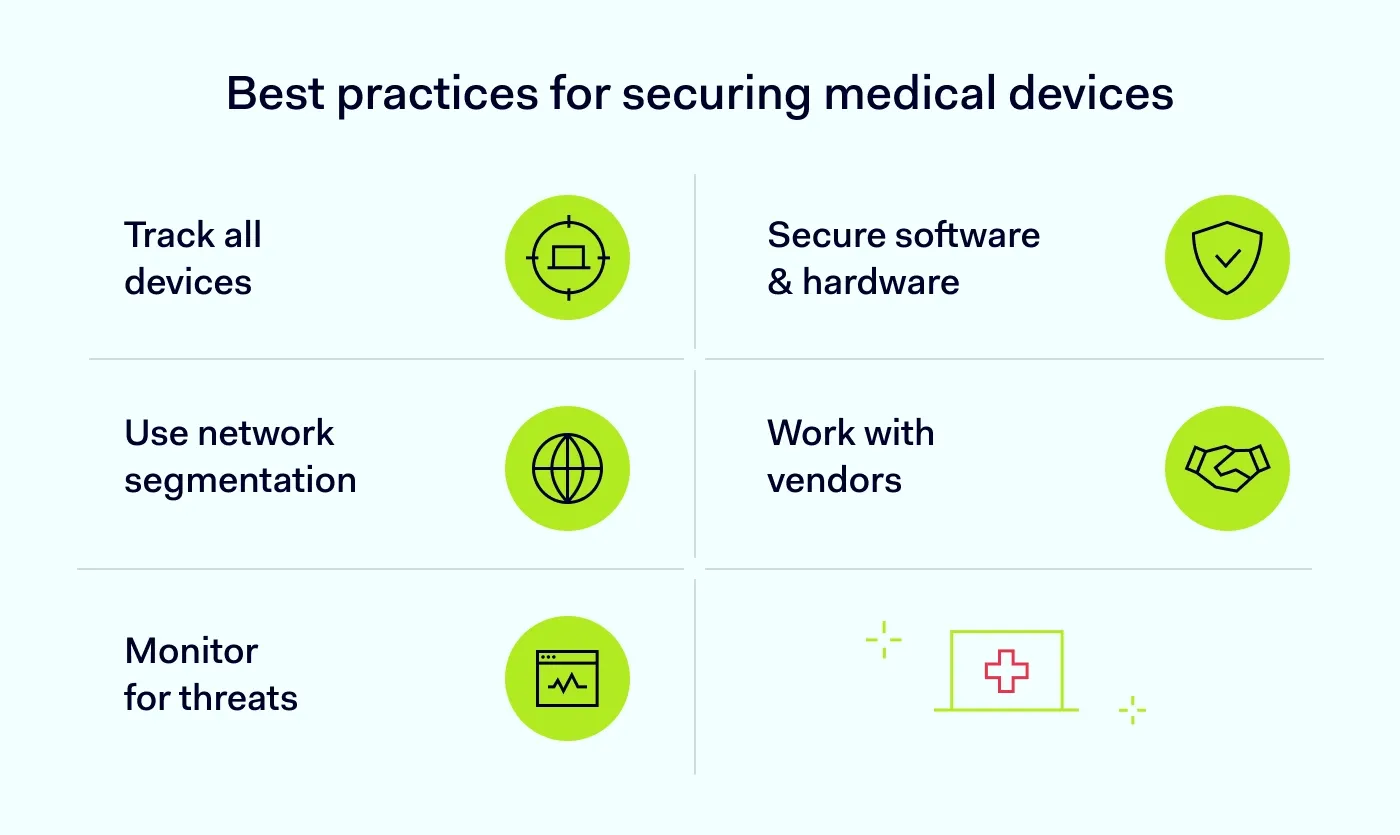
Best practices for securing medical devices

Security solutions vary between medical contexts. However, here are some general best practices for cybersecurity in medical devices:

Understand your device landscape

The number of medical devices used by a healthcare provider can rapidly grow, especially when patients take monitoring devices home. Every device is a potential endpoint and security risk. Each device needs security protection.

Start by creating a comprehensive device inventory. Create processes to update and audit the inventory, bringing all devices under your security umbrella.

Inventory software and hardware

Medical devices must be physically secure, with measures to prevent theft and unauthorized access. However, cybersecurity measures must also secure device firmware. Log current software versions and use automated tools to update medical device software as needed.

Check for end-of-life devices as well. Medical devices become obsolete as new technology appears. Older versions often create security risks and require prompt replacement.

Carry out a comprehensive risk assessment

When you have an accurate inventory, it’s vital to assess the risks posed by cyber threats. In this context, third-party risk assessment makes sense.

Cybersecurity experts with medical device experience understand the threats faced by healthcare organizations, how to prioritize risks, and suitable mitigation options.

Secure sensitive assets with network segmentation

Segmentation creates barriers between network assets. Placing sensitive data within protected segments ensures that attackers cannot access patient records if they gain access to devices.

Additionally, access controls and multi-factor authentication should protect patient information. Users should not be able to access protected information with just a username and password combination.

Work closely with vendors to understand device security

When sourcing medical devices, ask vendors to disclose security features and potential vulnerabilities. Consult vendors to execute a risk assessment for new devices and request a software bill of materials. This assists IT teams when securing device software and makes it easier to manage updates.

Monitor devices and detect threats

Apply intrusion detection systems (IDS) across all medical devices. Deploy continuous monitoring to detect malware or malicious user activity, and feed security alerts into a streamlined incident response plan.

The future of medical device cybersecurity

Medical device security is a dynamic field. Technology is evolving rapidly as medical internet-of-things (MIoT) devices proliferate, providing new ways to detect and counter cyber threats.

For instance, AI and machine learning can analyze network activity to track anomalies and identify attacks at an early stage. Speed increases offered by 5G connectivity supplement AI, enabling real-time activity tracking and reliable data transmission.

Our models for thinking about medical device security are also changing. Forward-thinking healthcare organizations now focus on Zero Trust concepts. Devices request verification for each user action and limit user capabilities according to least-privilege principles.

AI, 5G, and Zero Trust approaches are part of tomorrow’s cybersecurity toolkit. These technologies also reflect a trend toward enhanced collaboration between vendors, users, and regulators.

Work with NordLayer to secure your medical devices

Companies benefit from cloud-connected medical devices to learn about patients and deliver personalized treatment. But, as we’ve seen, medical devices bring security risks. Healthcare cybersecurity solutions are critical.

NordLayer can help you secure devices and serve patients securely and efficiently. Prevent unauthorized access with Identity and Access Management solutions and transfer data safely via Secure Remote Access. Conceal data in transit from attackers via AES 256 or ChaCha20 encryption, monitor 2FA adoption, and Share Gateway access in a centralized Control Panel dashboard.

Balance medical technology, ease of use, and cybersecurity. Contact the NordLayer team and solve your medical device security worries.


About NordLayer
NordLayer is an adaptive network access security solution for modern businesses – from the world’s most trusted cybersecurity brand, Nord Security.

The web has become a chaotic space where safety and trust have been compromised by cybercrime and data protection issues. Therefore, our team has a global mission to shape a more trusted and peaceful online future for people everywhere.

About Version 2 Digital

Version 2 Digital is one of the most dynamic IT companies in Asia. The company distributes a wide range of IT products across various areas including cyber security, cloud, data protection, end points, infrastructures, system monitoring, storage, networking, business productivity and communication products.

Through an extensive network of channels, point of sales, resellers, and partnership companies, Version 2 offers quality products and services which are highly acclaimed in the market. Its customers cover a wide spectrum which include Global 1000 enterprises, regional listed companies, different vertical industries, public utilities, Government, a vast number of successful SMEs, and consumers in various Asian cities.

他們覬覦你的資料:什麼是資訊竊取(Infostealer)軟件?你該如何確保安全?

在網絡犯罪的世界裡,資訊是達成目的的手段,而這個目的往往是為了牟利。這就是為什麼資訊竊取惡意軟件已成為身分詐欺、帳戶接管和數碼貨幣竊盜的主要驅動因素。但也有許多人,他們大部分的日常生活都在網絡上進行,卻仍能確保自身安全。關鍵在於了解如何有效地管理數碼風險。

以下是你需要了解的重點,以保護你的個人和財務資訊免遭危害。


資訊竊取軟件會竊取哪些資訊?

許多資訊竊取軟件可追溯其源頭至一個「指標性」的惡意軟件:名為 ZeuS 的銀行木馬程式,其設計目的是暗中竊取受害者的財務資訊,例如網絡銀行的登入憑證。當其原始碼於 2011 年外洩後,新變種便充斥於網絡犯罪黑市,促使資訊竊取產業蓬勃發展並正式成形,開發者不斷升級和客製化其功能。如今,從 Windows PC、macOS 電腦到 iOS 和 Android 裝置,幾乎每個運算平台都有其對應版本。

資訊竊取軟件覬覦的目標取決於其變種。登入憑證和會話 Cookie(可能讓黑客藉此繞過多重要素驗證 MFA)是主要目標之一。一份報告估計,去年被竊的 32 億筆憑證中,高達 75%(21 億筆)是透過資訊竊取軟件所收集。其他可能面臨風險的個人和財務資訊包括:

  • 支付卡、銀行帳戶和加密貨幣詳細資訊(例如:加密錢包金鑰)
  • 其他財務資訊,包括保險或政府福利(如社會安全)詳細資料
  • 瀏覽器資料,包括瀏覽紀錄和任何「已儲存表單」資料,其中可能包含支付細節和密碼
  • 你的電腦或裝置的系統資訊
  • 儲存在你的裝置 / 機器上的檔案,包括相片和文件
  • 其他個人資訊,包括姓名、電話號碼和地址


資訊竊取軟件如何運作?

這類惡意軟件的目的,是在你不知情的狀況下迅速找出裝置或電腦中的敏感資訊,然後將其竊取並傳送至攻擊者控制的伺服器。它會透過掃描網頁瀏覽器、電子郵件客戶端、加密錢包、檔案、應用程式以及作業系統本身來達成。其他技術包括:

  • 「表單擷取」(Form grabbing):在你將登入資訊輸入線上表單、傳送到安全伺服器之前,就先行攔截。
  • 「按鍵記錄」(Keylogging):惡意軟件記錄你所有的鍵盤輸入。
  • 螢幕截圖:擷取你的主畫面 / 桌面截圖,以防有敏感資訊顯示其上。
  • 剪貼簿竊取:竊取儲存在系統剪貼簿中的資訊。
  • 一旦資訊被傳回攻擊者的伺服器(過程通常僅需數秒),他們會將其打包成日誌(Logs),並在網絡犯罪黑市上販售。詐騙者接著會利用這些資訊來:
  • 劫持你的網上帳戶(如 Netflix、Uber),竊取內部儲存的資訊或將存取權限轉賣他人。
  • 進行身分詐欺,例如用你的名義申請貸款,或使用你的卡片 / 銀行帳戶消費。
  • 進行醫療 / 保險詐欺,用你的名義獲取醫療服務或藥物。
  • 進行稅務詐欺,用你的名義報稅並領取退稅款。
  • 向你的聯絡人發送釣魚訊息或垃圾郵件。
  • 盜領你金融帳戶中的資金。


我可能如何遭到資訊竊取軟件入侵?

要防範資訊竊取軟件,首要步驟是了解其散播途徑。常見的攻擊媒介包括:

  • 網絡釣魚郵件 / 短訊:典型的社交工程手法,誘騙收件人點擊惡意連結或開啟附件,從而觸發惡意軟件的暗中安裝。威脅行為者通常會冒充可信的個人、品牌或機構,甚至偽造寄件人網域並使用官方標誌。
  • 惡意網站:可能作為釣魚活動的一環,或是獨立的攻擊媒介。使用者可能被誘騙下載檔案或點擊連結,有時甚至只要造訪該網站就可能觸發「路過式下載」(Drive-by-Download)。威脅行為者可能利用黑帽 SEO 技術,人為提高這些惡意網站在搜尋引擎結果中的排名,讓你更容易在搜尋時點入。
  • 遭入侵的網站:有時黑客會入侵你可能瀏覽的合法網站,藉此植入惡意程式碼,例如利用瀏覽器漏洞或插入惡意廣告(Malvertising)。這兩種方式都可能導致資訊竊取軟件被安裝。
  • 惡意應用程式:看似合法的軟件或 App 在下載後可能內藏竊取資訊的惡意程式碼。對於防護通常不如電腦完善的流動裝置而言,風險尤其顯著。要特別留意熱門遊戲或其他軟件的盜版。
  • 社交媒體詐騙:詐騙者可能利用誘人的廣告或貼文(例如假冒名人或盜用他人帳號發文)誘騙你點擊。對於看起來好得不真實的優惠、抽獎或獨家內容應抱持懷疑。
  • 遊戲模組 / 作弊程式:非官方的遊戲修改檔或作弊工具可能夾帶資訊竊取惡意軟件。例如,ESET 研究人員曾發現,有 GitHub 儲存庫聲稱提供 Hamster Kombat 遊戲的輔助工具(如農場機器人、自動點擊器),實則暗藏 Lumma Stealer 變種病毒。


深入剖析威脅情勢

正如 ESET 在其 H2 2024 威脅報告中所揭示,資訊竊取軟件市場對網絡犯罪分子而言,利潤豐厚。「惡意軟件即服務」(MaaS)模式降低了取得多種資訊竊取軟件變種的門檻,這些變種在犯罪市集上隨處可見。部分網站甚至提供日誌解析服務,協助犯罪分子從原始日誌中提取可用或轉售的資料。

ESET 指出,這些惡意軟件持續演進。例如,自 2021 年即開始活躍的 Formbook,近期加入了更複雜的混淆技術,意圖增加安全研究人員進行樣本採集和分析的難度。雖然像 RedLine 這類的變種因執法機關的聯合打擊而銷聲匿跡,但其他如 Lumma Stealer 等變種則迅速填補空缺。根據 ESET 的研究,Lumma Stealer 在 H2 2024 的偵測數量年增率高達 369%。


如何遠離資訊竊取軟件?

那麼,該如何確保你的流動裝置或電腦不被資訊竊取軟件入侵呢?由於惡意軟件可透過多種途徑散播,你需要謹記以下幾項最佳防護措施:

  • 安裝並及時更新安全軟件:在所有裝置上都這樣做,能大幅提升你抵禦資訊竊取軟件及其他威脅的能力。
  • 具備釣魚防範意識:避免點擊任何不明訊息中的連結或開啟附件。若對訊息來源有疑慮,應透過其他管道獨立聯繫寄件人確認。有時,將滑鼠游標移至寄件人欄位上方,就能識破其真實來源是否被偽造。
  • 僅從官方應用程式商店下載軟件:雖然 Google Play 等官方商店偶爾也會出現惡意軟件,但通常能迅速下架,整體而言遠比第三方商店安全。切勿下載任何盜版或破解軟件,尤其是標榜免費的。
  • 維持作業系統與應用程式更新:務必將系統和應用程式更新至最新版本,因為最新版通常也修補了已知的安全漏洞。
  • 謹慎使用社交媒體:記住「好得不真實」的優惠通常是陷阱。若感到可疑,可先透過 Google 搜尋查證是否為已知騙局。同時要了解,朋友或名人的帳號也可能被盜用來散播詐騙訊息。避免點擊任何不明連結。
  • 強化登入安全:為每個帳戶設定強度高且獨一無二的密碼,並使用密碼管理器儲存。為所有支援的帳戶啟用多重要素驗證(MFA)。雖然 MFA 無法百分之百防堵所有資訊竊取手法(例如某些繞過方式),但能有效防禦按鍵記錄等攻擊。

關鍵在於多層次地部署這些防護措施,以縮減黑客可利用的攻擊破口。但同時也要記住,黑客會不斷尋找新的攻擊手法與漏洞,因此時刻保持警覺至關重要。

關於ESET
ESET成立於1992年,是一家面向企業與個人用戶的全球性的電腦安全軟件提供商,其獲獎產品 — NOD32防病毒軟件系統,能夠針對各種已知或未知病毒、間諜軟件 (spyware)、rootkits和其他惡意軟件為電腦系統提供實時保護。ESET NOD32佔用 系統資源最少,偵測速度最快,可以提供最有效的保護,並且比其他任何防病毒產品獲得了更多的Virus Bulletin 100獎項。ESET連續五年被評為“德勤高科技快速成長500 強”(Deloitte’s Technology Fast 500)公司,擁有廣泛的合作夥伴網絡,包括佳能、戴爾、微軟等國際知名公司,在布拉迪斯拉發(斯洛伐克)、布裏斯托爾(英國 )、布宜諾斯艾利斯(阿根廷)、布拉格(捷克)、聖地亞哥(美國)等地均設有辦事處,代理機構覆蓋全球超過100個國家。

關於 Version 2 Digital
Version 2 Digital is one of the most dynamic IT companies in Asia. The company distributes a wide range of IT products across various areas including cyber security, cloud, data protection, end points, infrastructures, system monitoring, storage, networking, business productivity and communication products. Through an extensive network of channels, point of sales, resellers, and partnership companies, Version 2 offers quality products and services which are highly acclaimed in the market. Its customers cover a wide spectrum which include Global 1000 enterprises, regional listed companies, different vertical industries, public utilities, Government, a vast number of successful SMEs, and consumers in various Asian cities.

Cyber Kill Chain: What Is It? Examples and Prevention

Organizations must predict and stop assaults before they become more severe in a time when cyber attacks are more advanced than ever. Developed by Lockheed Martin, the Cyber Kill Chain is still among the most often applied models for analyzing and reducing cyberattacks. By separating an attack into seven separate phases, this strategy gives cybersecurity professionals a methodical approach to identifying and countering attacks.

Following the Cyber Kill Chain model, cybercriminals keep improving their strategies in reaction to changing cybersecurity policies. From ransomware gangs to state-sponsored attackers, the approach is essentially the same. We will look at the seven phases of this approach and how businesses may protect against each level.

What is the Cyber Kill Chain?

The Cyber Kill Chain offers a methodical approach to studying cyberattacks. Breaking an attack into several phases helps security professionals identify weaknesses and stop hostile activity before it becomes more serious.

The methodology is especially successful against advanced persistent threats (APTs), in which cybercriminals or nation-state actors carry out prolonged, covert attacks to pilfer sensitive data or disturb operations.

The Seven Stages of the Cyber Kill Chain: How They Work

The seven steps that make up the Cyber Kill Chain each mark a crucial turning point in the development of an attack:

Step 1: Reconnaissance 

Attackers compile knowledge of their target in this phase. They find weak areas by scanning networks and examining publicly available data. Cybercriminals could employ methods including:

  • Open-source intelligence (OSINT) involves compiling from job ads, the internet, and social media.
  • Scanning tools for unpatched systems and obsolete software detection
  • Social engineering methods to gather login passwords from gullible staff members.

Prevention tips: To stop these attacks, companies should restrict public access to sensitive data, track network activity for reconnaissance efforts, and provide security awareness training.

Step 2: Weaponization 

Once the assailant has sufficient knowledge, they produce a hostile payload to exploit found weaknesses. This can encompass:

  • Development of malware—including ransomware, trojans, spyware.
  • Weaponized scripts or papers meant for attacking upon opening.
  • Modification of current malware to evade systems of detection.

Prevention tips: Security teams should routinely update software to fix vulnerabilities, apply robust email security solutions, and examine dubious data using sandboxing.

Step 3: Delivery 

During this phase, the attacker delivers the harmful payload to the target. Typical ways of delivery consist of:

  • Phishing emails loaded with dangerous attachments or links.
  • Drive-by downloads from either hostile or hacked websites.
  • USB devices or other external media corrupted with a virus.

Prevention tips: Email screening, online filtering, and staff training help businesses identify phishing efforts. Additionally, identifying and blocking corrupt files is an endpoint security solution.

Step 4: Exploitation 

Once the payload reaches the target, it uses system weaknesses to carry out destructive intent. One can experience exploitation via:

  • Software or operating system weaknesses.
  • Passwords, weak or recycled.
  • Human mistakes, including allowing macros in hostile papers.

Prevention tips: Strict access control policies, patch management, and frequent vulnerability analyses help to lower exploitation risk. Using multi-factor authentication (MFA) lends another degree of protection.

Step 5:  Installation 

The attacker installs malware at this point to stay on the hacked system. This could entail:

  • Putting trojans or backdoors for distant access.
  • Changing systems to stop detection.
  • Using rootkits to get thorough system access.

Prevention tips: Endpoint detection and response (EDR) systems help to spot and stop illegal installations. Organizations should also constantly monitor for unusual system behavior.

Step 6: Command and Control (C2) 

Through communication with the hacked system, the assailant enables orders, data theft, or network spread of malware. C2 servers streamline:

  • Remote control of compromised devices.
  • Lateral movement in the network.
  • Carrying out more hostile acts.

Prevention tips: Threat intelligence technologies, intrusion detection systems (IDS), and network segmentation can assist in identifying and stopping C2 communications. Additionally, blocking suspicious outbound traffic helps attackers to lose control.

Step 7: Actions on Objectives 

In this last phase, the assailant carries out their ultimate objective, maybe:

  • Data exfiltration—stealing private data for espionage or financial gain.
  • Encrypting files and requesting payment for decryption forms ransomware deployment.
  • System disturbance brought on by destructive attacks causes operational downtime.

Prevention tips: Strong encryption techniques, incident response strategies, and data loss prevention (DLP) solutions help reduce harm. Additionally, routine security audits help spot weaknesses before they are exploited.

🔐 Cyber Kill Chain – Cheat Sheet

StepWhat HappensExample
1. ReconnaissanceGather info on targetScanning for open ports or employee emails
2. WeaponizationCraft malware/exploit for specific vulnerabilitiesCreating a trojan-loaded PDF
3. DeliverySend malicious payload to targetPhishing email with malicious link
4. ExploitationActivate malware via a system vulnerabilityUser opens infected file
5. InstallationInstall backdoor or malware to maintain accessDropping a remote access trojan
6. Command & Control (C2)Connect back to attacker for remote controlMalware contacts attacker’s server
7. Actions on ObjectivesExecute mission (data theft, ransomware, etc.)Stealing data, encrypting files

Real-World Examples of Cyber Kill Chain Attacks

APT29, Russian State-sponsored Attack 

APT29, sometimes referred to as Cosy Bear, has been connected to cyber espionage efforts directed against businesses and government entities. This group uses the Cyber Kill Chain concept, which consists of:

  • Doing thorough target reconnaissance.
  • Delivering malware via emails sent under spear-phishing.
  • Keeping persistence and extracting data using cutting-edge methods.

WannaCry Ransomware Attack 

WannaCry sent ransomware all over using a weakness in Microsoft Windows. The attack followed the guidelines of the Cyber Kill Chain:

  • Reconnaissance: Looking for systems lacking SMB patches.
  • Distribution: Let self-replicating worms spread malware.
  • Exploitation: Encrypting important files and requesting a ransom payment marks exploitation.

These cases emphasize the need for proactive security policies to stop such assaults.

Preventive Techniques at Every Level 

Organizations should use a tiered security strategy to break the Cyber Kill Chain when disrupting every level of an attack:

  • Reconnaissance: Use threat intelligence tools and keep an eye on assets pointing outward.
  • Weaponization: Weaponizing tools from malware analysis help identify new dangers.
  • Delivery: Use cutting-edge email and web security systems.
  • Exploitation: Use regular software updates and strict access policies to prevent exploitation.
  • Installation: Install endpoint protection systems to find illegal programs.
  • Command and Control: Use network segmentation and anomaly detection under command and control to avoid correspondence in hostile servers.
  • Actions on Objectives: Real-time monitoring and data encryption will help stop system penetration and data theft.

Backup as a Response to Cyberattack

In the face of escalating cyber threats, robust backup and recovery solutions are essential for organizations to ensure data integrity and business continuity. Storware Backup and Recovery offers an enterprise-grade, agentless solution that caters to diverse environments, including virtual machines, containers, cloud instances, and applications. Its architecture emphasizes centralization and unification of backup management, providing a resilient defense against ransomware attacks and other cyber incidents.

Storware’s comprehensive feature set includes immutable backup storage, which prevents unauthorized modifications and enhances protection against ransomware. The solution supports snapshot management, enabling automated creation, retention, and recovery processes that reduce recovery time objectives (RTO) and recovery point objectives (RPO). Additionally, Storware offers policy-based automation for granular control over backup scheduling and retention policies, ensuring that organizations can tailor their data protection strategies to specific business needs.

By integrating advanced security features such as role-based access control (RBAC), audit logs, and data-at-rest encryption, Storware not only safeguards critical data but also aligns with regulatory compliance requirements. Its scalability and versatility make it suitable for organizations of all sizes, providing a reliable foundation for disaster recovery and operational resilience in the event of cyberattacks.

Final Thoughts

The Cyber Kill Chain is a useful structure for comprehending cyberattacks and improving defense plans. Knowing the several phases of an attack helps companies apply focused security protocols to prevent risks before they cause major damage.

Since hackers constantly modify their approach, organizations must be vigilant, aggressive, and adaptable in their cybersecurity activities. Modern security measures, constant personnel training, and comprehensive incident response plans are essential in the digital age.

About Version 2 Digital

Version 2 Digital is one of the most dynamic IT companies in Asia. The company distributes a wide range of IT products across various areas including cyber security, cloud, data protection, end points, infrastructures, system monitoring, storage, networking, business productivity and communication products.

Through an extensive network of channels, point of sales, resellers, and partnership companies, Version 2 offers quality products and services which are highly acclaimed in the market. Its customers cover a wide spectrum which include Global 1000 enterprises, regional listed companies, different vertical industries, public utilities, Government, a vast number of successful SMEs, and consumers in various Asian cities.

About Storware
Storware is a backup software producer with over 10 years of experience in the backup world. Storware Backup and Recovery is an enterprise-grade, agent-less solution that caters to various data environments. It supports virtual machines, containers, storage providers, Microsoft 365, and applications running on-premises or in the cloud. Thanks to its small footprint, seamless integration into your existing IT infrastructure, storage, or enterprise backup providers is effortless.

×

Hello!

Click one of our contacts below to chat on WhatsApp

×