Skip to content

Optimizing Your Cybersecurity Budget with Enterprise Zero Trust

The Opportunities and Obstacles of Zero Trust

The rapid evolution of digital threats demands a robust response, for enterprise zero trust efforts to fortify cybersecurity defenses. At its core, Zero Trust challenges traditional notions by assuming that threats can emerge both outside and inside an organization. This paradigm shift empowers businesses to enhance security by verifying every access request, thereby mitigating the risk of unauthorized access. However, this promising approach is not without its challenges. As of 2024, the majority of organizations have begun their journey towards a Zero Trust strategy, often collaborating with multiple security providers to lay the groundwork for implementation. This trend underscores the complexity and ambition involved in adopting Zero Trust.

Major Challenges in Implementing Zero Trust

Implementing Zero Trust at an enterprise level demands a meticulous approach due to the intricate nature of large-scale deployments. This endeavor can span several years, requiring significant resources and planning. Among the primary challenges is the constant need to update Zero Trust policies to keep pace with evolving business needs. This continuous adaptation can become a formidable task, necessitating sustained commitment and expertise.

Another critical issue is the impact on user experience. Strict security measures often introduce latency and perceived inconvenience, which can disrupt workflows and lead to resistance from employees. This resistance can undermine the overall effectiveness of the security strategy, making it crucial to strike a balance between robust protection and a seamless user experience.

Integration with existing infrastructure is another significant hurdle. Many organizations have complex, legacy systems that may not easily align with Zero Trust principles. Ensuring seamless interoperability between new Zero Trust solutions and established systems requires careful planning and execution. The necessity to maintain comprehensive visibility and control over network activity adds another layer of complexity, demanding advanced monitoring and management capabilities.

Moreover, the financial investment associated with Zero Trust implementation can be substantial. This includes not only the cost of new technologies but also the expenses related to training, change management, and ongoing maintenance. Organizations must be prepared to allocate sufficient budget and resources to support this transformative initiative.

Lastly, the rapidly changing threat landscape presents an ongoing challenge. As cyber threats become increasingly sophisticated, Zero Trust architectures must continually evolve to counter new tactics and vulnerabilities. This dynamic environment requires organizations to stay ahead of the curve, leveraging innovative solutions and strategies to maintain a robust security posture.

Navigating these challenges requires a strategic, well-coordinated effort. By addressing these complexities head-on, organizations can lay the groundwork for a resilient and effective Zero Trust architecture that meets both current and future security demands.

Selecting Products for Enterprise Zero Trust

Selecting products for an Enterprise Zero Trust strategy demands a discerning approach rooted in both technical requirements and strategic foresight. The first step is to evaluate the interoperability of potential solutions with existing infrastructure. Seamless integration is paramount, ensuring that new Zero Trust tools enhance rather than disrupt current operations. Solutions must offer robust capabilities for continuous authentication and micro-segmentation, providing granular control over user access.

It’s essential to prioritize products that deliver comprehensive visibility across the network. This visibility is crucial for monitoring and managing user activities, detecting anomalies, and responding swiftly to potential threats. Look for solutions that offer advanced analytics and real-time insights, enabling proactive security measures and informed decision-making.

Equally important is the consideration of scalability. As organizations grow and their needs evolve, the chosen Zero Trust products should be capable of adapting without requiring a complete overhaul. Scalable solutions allow enterprises to expand their security measures incrementally, aligning with both budgetary constraints and long-term objectives.

Adaptability is another critical factor. The cybersecurity landscape is ever-changing, and Zero Trust solutions must evolve to address new vulnerabilities and attack vectors. Products that offer regular updates, backed by a strong support ecosystem, will ensure the organization remains protected against emerging threats.

Another key aspect is ease of management. Solutions that simplify policy enforcement and reduce administrative overhead can significantly enhance operational efficiency. Automated features that facilitate continuous compliance and streamline incident response processes are highly beneficial, allowing security teams to focus on strategic initiatives rather than routine tasks.

Vendor reputation and support services should not be overlooked. Collaborating with reputable vendors who have a proven track record in Zero Trust can provide additional assurance of product reliability and effectiveness. Furthermore, strong vendor support can aid in overcoming implementation challenges, ensuring a smoother transition to a Zero Trust architecture.

By carefully considering these factors, organizations can select Zero Trust products that align with their security goals, operational needs, and future growth trajectories.

Mapping a Realistic Path Forward

Mapping a realistic path forward with Zero Trust begins with strategic planning and measured execution. A phased rollout strategy is essential, allowing organizations to gradually introduce Zero Trust principles without overwhelming existing systems and workflows. Initial efforts should concentrate on critical areas that provide significant security benefits and minimal disruption. This targeted approach helps in building momentum and demonstrating early successes.

Engaging all relevant stakeholders early in the process is crucial. Clear communication about the objectives, benefits, and operational changes can foster buy-in and mitigate resistance. Tailored training sessions and educational programs will empower employees, turning them into active participants in the security transformation.

A flexible technology stack is fundamental. Choose solutions that can adapt to evolving business needs and integrate seamlessly with current infrastructure. This adaptability ensures the Zero Trust model can scale and evolve as the organization grows and as new threats emerge.

Continuous monitoring and real-time analytics are key components. Implement tools that provide comprehensive visibility and facilitate proactive threat detection. By maintaining rigorous oversight, organizations can swiftly address vulnerabilities and adjust policies as necessary.

Another critical element is fostering a culture of continuous improvement. Regularly review and refine Zero Trust policies to align with the latest cybersecurity developments and organizational changes. This iterative process helps in maintaining a robust security posture while accommodating the dynamic nature of cyber threats.

Invest in strong vendor partnerships to leverage expert insights and support throughout the implementation journey. Reputable vendors with proven expertise in Zero Trust can provide invaluable guidance, ensuring smoother transitions and more effective solutions.

By embracing a structured, adaptable, and collaborative approach, organizations can successfully implement Zero Trust, achieving enhanced security and resilience against an increasingly sophisticated threat landscape.

Building a Resilient Cybersecurity Future with Zero Trust

Successfully optimizing your cybersecurity budget with an enterprise Zero Trust strategy requires more than just adopting new technologies—it demands a paradigm shift in how organizations approach security. By addressing challenges such as integration, user experience, and continuous adaptation, businesses can unlock the full potential of Zero Trust to protect critical assets and reduce vulnerabilities.

Through careful planning, strategic product selection, and fostering a culture of continuous improvement, organizations can establish a robust and scalable Zero Trust architecture. The result? A resilient cybersecurity framework that not only withstands current threats but also evolves to meet the demands of an ever-changing digital landscape.

About Portnox
Portnox provides simple-to-deploy, operate and maintain network access control, security and visibility solutions. Portnox software can be deployed on-premises, as a cloud-delivered service, or in hybrid mode. It is agentless and vendor-agnostic, allowing organizations to maximize their existing network and cybersecurity investments. Hundreds of enterprises around the world rely on Portnox for network visibility, cybersecurity policy enforcement and regulatory compliance. The company has been recognized for its innovations by Info Security Products Guide, Cyber Security Excellence Awards, IoT Innovator Awards, Computing Security Awards, Best of Interop ITX and Cyber Defense Magazine. Portnox has offices in the U.S., Europe and Asia. For information visit http://www.portnox.com, and follow us on Twitter and LinkedIn.。

About Version 2 Digital

Version 2 Digital is one of the most dynamic IT companies in Asia. The company distributes a wide range of IT products across various areas including cyber security, cloud, data protection, end points, infrastructures, system monitoring, storage, networking, business productivity and communication products.

Through an extensive network of channels, point of sales, resellers, and partnership companies, Version 2 offers quality products and services which are highly acclaimed in the market. Its customers cover a wide spectrum which include Global 1000 enterprises, regional listed companies, different vertical industries, public utilities, Government, a vast number of successful SMEs, and consumers in various Asian cities.

CISO Job Security Worries in Cybersecurity Roles

Rising Concerns About Job Stability for CISOs in Cybersecurity

CISO job security is becoming and increasingly worrisome topic among cyber professionals as the role is evolving into the cornerstone of an organization’s defense strategy, the expectations and pressures have grown exponentially. A recent survey of 200 US CISOs at companies with a minimum annual revenue of $500m produced some interesting results on the topics. Alarmingly, 99% of CISOs fear losing their jobs if a breach occurs, highlighting the immense stakes tied to their performance. Furthermore, 77% of CISOs express being very or extremely concerned about job loss following a major breach, reflecting the high levels of anxiety that pervade the profession.

These concerns are compounded by the challenges of navigating an ever-changing landscape filled with sophisticated cyber threats and rising compliance demands. Every CISO surveyed agrees that it’s impossible for even the most agile company to keep up to date with every regulation in a rapidly changing landscape. This underscores the pressures faced by cybersecurity leaders who are expected to excel despite the seemingly insurmountable complexities of their role.

Elements Leading to Job Instability for CISOs

The role of a CISO is fraught with challenges that can significantly impact job stability. The general C-suite tenure is 4.9 years making CISO job security a growing concern. Frequent high-profile breaches and ransomware attacks exert enormous pressure on cybersecurity leaders, placing their strategies and decisions under intense scrutiny. These events not only tarnish the reputation of the company but also spotlight any shortcomings in a CISO’s approach, thereby raising questions about their effectiveness.

Moreover, the escalating regulatory pressures and compliance mandates necessitate constant vigilance and adaptability to evolving standards. The ever-changing landscape of regulations demands that CISOs remain informed and responsive, a task that can be as daunting as it is essential. This adds another layer of complexity to an already demanding role.

Balancing stringent security measures with the need for operational efficiency is another critical challenge. Cybersecurity must integrate seamlessly with business operations, yet this integration often involves trade-offs that can affect the overall security posture. Stakeholders and boards expect swift, effective responses to cyber incidents, creating an environment where the margin for error is minimal.

Additionally, the pressure to secure sensitive data and uphold the company’s reputation intensifies job insecurity. One misstep in handling a security incident can have far-reaching consequences, making the CISO’s role precarious. The combination of these factors contributes to an environment where job stability is a continual concern, compelling CISOs to prove their value through strategic acumen, technical expertise, and effective communication.

Influence on Decision-Making Processes

The pervasive job insecurity is reshaping the decision-making landscape for CISOs. A notable shift towards proactive measures, beyond the traditional detection and response, is increasingly apparent. Emphasis on fundamental practices such as identity management and access control is gaining prominence, offering a vital layer of risk mitigation. Regulatory compliance has also become a primary focus, with significant attention devoted to new standards such as NIS2. This proactive stance not only strengthens the organization’s security posture but also provides a crucial buffer against the uncertainties that come with the role.

Additionally, CISOs are investing more in advanced threat intelligence to anticipate and neutralize potential risks before they materialize. This forward-thinking approach underscores the importance of staying ahead of evolving cyber threats, ensuring that defenses are always one step ahead. Stakeholder expectations are also influencing decision-making processes, driving the need for transparent communication and swift, effective responses to incidents. This heightened level of accountability demands a balance between robust security measures and operational efficiency, a delicate dance that requires both technical expertise and strategic insight.

Furthermore, the integration of cutting-edge technologies, such as machine learning and artificial intelligence, is playing a crucial role in enhancing decision-making capabilities. These technologies enable CISOs to analyze vast amounts of data in real-time, providing actionable insights that inform more precise and timely decisions. By embracing these innovative tools and methodologies, CISOs can better navigate the complex cybersecurity landscape and reinforce their indispensable value within their organizations.

Tactics for CISO Job Security

In an ever-evolving cybersecurity landscape, CISOs must deploy a range of tactics to fortify their job stability. One key strategy is to prioritize transparent and frequent communication with stakeholders, especially during security incidents. This not only builds trust but also showcases the CISO’s accountability and leadership. Another crucial element is the development and implementation of comprehensive incident response plans. Collaborating with third-party experts can offer additional perspectives and bolster the organization’s preparedness.

Investing in continuous education for both themselves and their teams is essential. This includes staying updated on emerging threats, new technologies, and evolving regulatory requirements. A proactive stance on cybersecurity through rigorous employee training programs ensures that the entire organization is aligned with the security goals.

Moreover, aligning cybersecurity initiatives with the broader business objectives can significantly enhance a CISO’s value proposition. This involves integrating security measures into the core operations of the company, making cybersecurity an integral part of the business strategy.

Utilizing cutting-edge technologies, such as machine learning and artificial intelligence, can also play a vital role. These advanced tools help in analyzing vast amounts of data, providing actionable insights that enhance decision-making capabilities. By adopting these innovative solutions, CISOs can demonstrate their commitment to maintaining a robust and adaptive security framework, thereby strengthening their position within the organization.

The Importance of Cutting-Edge Security Technologies

Modern security technologies are transforming the cybersecurity landscape, offering CISOs powerful tools to tackle complex challenges. Cloud-native Network Access Control (NAC) and Zero Trust Network Access (ZTNA) provide flexible, scalable solutions for securing today’s hybrid work environments. By implementing strict access policies based on user identity, these technologies significantly bolster an organization’s defense mechanisms. The ability to enforce granular controls ensures that only authorized users gain access to critical resources, reducing the risk of breaches.

Additionally, the rise of machine learning and artificial intelligence enhances threat detection and response capabilities. These technologies can analyze vast amounts of data in real-time, providing actionable insights that help CISOs stay ahead of emerging threats. By integrating these advanced tools, organizations can develop a more adaptive and resilient security posture. Embracing innovation is essential for maintaining robust defenses and demonstrating a proactive approach to cybersecurity. Cutting-edge technologies not only address current vulnerabilities but also future-proof the organization against evolving risks, reinforcing the pivotal role of the CISO in safeguarding the enterprise.

Approaches for Sustaining a Long-Term Career as a CISO

Navigating a long-term career as a CISO in today’s evolving cybersecurity landscape requires a blend of resilience, continuous learning, and strategic foresight. It’s essential to develop a diverse skill set that encompasses not only technical proficiency but also leadership, communication, and business acumen. This multifaceted expertise enables CISOs to engage effectively with stakeholders across the organization, promoting a culture of security and ensuring that cybersecurity is ingrained in the company’s strategic objectives.

Information security jobs are projected to grow by 32% between 2022 and 2032. Staying ahead of industry trends and emerging threats is vital. Regular participation in professional development opportunities, such as industry conferences, certifications, and workshops, keeps CISOs informed about the latest advancements and best practices. Networking with peers and thought leaders provides a platform for sharing insights and strategies, fostering a collaborative environment that can lead to innovative solutions.

Moreover, fostering a culture of security within the organization is crucial. This involves advocating for comprehensive employee training programs that emphasize the importance of cybersecurity at all levels. By doing so, CISOs can ensure that everyone within the organization is aligned with the overarching security goals, thereby creating a robust defense against potential threats.

Investing in cutting-edge technologies, such as machine learning and artificial intelligence, enhances the ability to anticipate and respond to cyber threats effectively. Leveraging these tools not only strengthens the security infrastructure but also demonstrates a proactive approach, reinforcing the CISO’s indispensable role in safeguarding the enterprise.

Securing the Future: Opportunities Amidst Challenges for CISOs

The role of a CISO is both demanding and pivotal. By adopting a proactive approach that emphasizes risk mitigation, transparent stakeholder communication, and the integration of cutting-edge technologies, CISOs can effectively navigate the complexities of their position. Strategic alignment with business objectives and continuous education are also crucial for demonstrating value and ensuring job stability. Emphasizing a culture of security within the organization further solidifies the CISO’s leadership role. While challenges are ever-present, embracing these strategies enables CISOs to not only fortify their organizations but also secure their professional futures. With visionary leadership, the path ahead, though challenging, offers immense opportunities for growth and impact.

About Portnox
Portnox provides simple-to-deploy, operate and maintain network access control, security and visibility solutions. Portnox software can be deployed on-premises, as a cloud-delivered service, or in hybrid mode. It is agentless and vendor-agnostic, allowing organizations to maximize their existing network and cybersecurity investments. Hundreds of enterprises around the world rely on Portnox for network visibility, cybersecurity policy enforcement and regulatory compliance. The company has been recognized for its innovations by Info Security Products Guide, Cyber Security Excellence Awards, IoT Innovator Awards, Computing Security Awards, Best of Interop ITX and Cyber Defense Magazine. Portnox has offices in the U.S., Europe and Asia. For information visit http://www.portnox.com, and follow us on Twitter and LinkedIn.。

About Version 2 Digital

Version 2 Digital is one of the most dynamic IT companies in Asia. The company distributes a wide range of IT products across various areas including cyber security, cloud, data protection, end points, infrastructures, system monitoring, storage, networking, business productivity and communication products.

Through an extensive network of channels, point of sales, resellers, and partnership companies, Version 2 offers quality products and services which are highly acclaimed in the market. Its customers cover a wide spectrum which include Global 1000 enterprises, regional listed companies, different vertical industries, public utilities, Government, a vast number of successful SMEs, and consumers in various Asian cities.

Inbox Overload: How to Prevent BEC Attacks

The holidays are over, and you know what that means? Your inboxes are full of emails. 

But some of those emails might contain malicious links or files disguised to appear from trusted colleagues or even the C-suite within your organization. Can you tell the difference between a business email compromise (BEC) attack and a legitimate email from your CEO?

In this blog, we’ll dive into what a BEC is, the different types of BEC attacks, and how MSPs can spot them effectively before they reach their employees’ or clients’ inboxes. 

What is Business Email Compromise (BEC)? 

A business email compromise (BEC) is a type of social engineering attack where scammers look to defraud targeted employees. What makes a BEC unique is that the messaging and tone appear to come from legit senders, typically from the CEO or other high-ranking executives.

What makes these emails even more effective is their sense of urgency, designed to pressure employees into taking immediate action. For example, a common BEC might contain a message from the CFO asking for a wire transfer to “pay a vendor invoice.” Without proper employee training, such as routine phishing simulations, an unsuspecting employee might comply without verifying the request or sender details. BEC attacks accounted for 14% of all impersonation attack activity in corporate inboxes

The open rates for these emails are alarmingly high. A study found that 28% of BEC emails are opened by employees with 15% of those emails receiving a reply.

BEC attacks have cost organizations over $50B in losses within the past decade. 

AI Making BEC Attacks Harder to Detect

Scammers have begun leveraging Generative AI in their emails with striking accuracy and high success rates.

BEC attacks skyrocketed 20% YoY in Q2 2024 thanks to the advancements in AI-based technology. Scammers can now mimic the precise tone and writing style of C-level executives quite convincingly. 

The finance department in particular remains a prime target for BEC attacks as they have the authority to approve wire transfers, pay invoices, and handle sensitive financial information. AI-generated BEC emails use familiar language that a CFO or controller might mistake for a legitimate payment request. 

BEC emails can bypass traditional security filters as they are personalized to the recipient and appear to come from a trusted source within the organization. Attackers also leverage obfuscation techniques such as URL spoofing, HTML tag manipulation, payload encryption, and embedding links within images to evade email security filters. 

Types of BEC Attacks

Here are 5 types of BEC attacks: 

CEO Fraud: Attackers impersonate the role of a C-level executive, generally the CEO, asking for an urgent transfer of funds or sensitive information. Attackers spend a great deal of effort researching the company, even the CEO’s writing style and typical communication patterns on social media platforms and PR/media sites. This helps them craft targeted emails using the CEO’s tone, terminology, and phrasing.

Account Compromise: Attackers gain unauthorized access to a legitimate employee’s email account, typically through phishing, and leverage the information to send fraudulent requests, such as payment approvals to colleagues or partners.

Attorney Impersonation: There is almost nothing quite as intimidating as receiving a legal letter from an attorney in your inbox. One common form of BEC involves scammers posing as lawyers, requesting immediate payment for services, and sending attachments that appear to be official documents the recipient might recognize.

Data Theft: Data is pure gold to an attacker. They can resell stolen information, such as passwords, accounts, credentials, and financial data, on the dark web for quick profit returns. 

Scammers may also use the stolen information later on for identity theft or to launch more targeted spear phishing campaigns.

False Invoice Scam: Attackers leverage compromised email accounts of legitimate vendors or suppliers to send fake invoices for services. To the untrained eye, these types of BEC emails are increasingly difficult to detect, especially for a busy financial controller who is managing a large number of unpaid invoices with balances due to a variety of vendors. The billing details will go to a fraudster’s bank account and may go unnoticed until the vendor actually reports the missed payment or threatens legal action. 

4 Ways to Spot a BEC

Here are a few red flags to be aware of the next time you log into your corporate inbox:

  1. Suspicious Email Header: Look for inconsistencies in the email header, such as unusual “Reply-To” or “From” addresses or email routing anomalies. BEC emails often contain disguised headers to hide their malicious offerings. Always verify the legitimacy of the sender. Check for DKIM, SPF, and DMARC authentication to ensure that the addresses come from trusted domains.
  1. Poor Grammar & Typos: BEC emails often contain misspellings, grammatical errors, and excessive punctuation, such as multiple exclamation marks (!!!) at the end of a sentence, designed to create a sense of urgency and prompt an employee to take immediate action. Poor grammar is a classic sign of a phishing attempt. Take the time to go over the email thoroughly.
  1. Email Context: Pay close attention to the body of the email itself. Any message asking you to “re-confirm” your personal details is a huge red flag. These keywords are usually accompanied by requests for processing a wire transfer or other financial transaction, such as an “unpaid supplier invoice” or “overdue balance.” Needless to say, you should never enter any sensitive financial details or PII without approval.
  2. Timing: Scammers try to catch people off guard, and the best time to do so is during a holiday such as Thanksgiving or Christmas, when phishing attempts peak. Scammers also time BEC emails for Fridays, when employees are more relaxed heading into the weekend and less likely to report suspicious emails.

Avoid responding to “urgent” emails received on a Friday without verifying the sender. If the email appears to be from the CEO or another executive, confirm its legitimacy through a direct message on Slack or a quick phone call. That extra step can help prevent a massive breach. 

And as always, whenever in doubt, just don’t open the email. 


Prevent BEC Attacks and Bolster Email Security with Guardz 

Guardz’s unified cybersecurity platform leverages advanced machine learning and AI to monitor email activity, detect suspicious patterns through detailed email header analysis, and automatically enforce DMARC policies.

With Guardz’s auto-remediation tool, malicious emails are intercepted and either deleted or marked as safe before they can reach your employees’ or clients’ inboxes. 

Take a proactive approach to email security and BEC prevention with Guardz. 

Speak with one of our experts today.

About Guardz
Guardz is on a mission to create a safer digital world by empowering Managed Service Providers (MSPs). Their goal is to proactively secure and insure Small and Medium Enterprises (SMEs) against ever-evolving threats while simultaneously creating new revenue streams, all on one unified platform.

About Version 2 Digital

Version 2 Digital is one of the most dynamic IT companies in Asia. The company distributes a wide range of IT products across various areas including cyber security, cloud, data protection, end points, infrastructures, system monitoring, storage, networking, business productivity and communication products.

Through an extensive network of channels, point of sales, resellers, and partnership companies, Version 2 offers quality products and services which are highly acclaimed in the market. Its customers cover a wide spectrum which include Global 1000 enterprises, regional listed companies, different vertical industries, public utilities, Government, a vast number of successful SMEs, and consumers in various Asian cities.

Cross-forest authentication with Thinfinity: secure multi-domain access

Introduction 

In modern enterprises, IT environments often span multiple Active Directory (AD) forests, hybrid cloud platforms, and external identity providers (IDPs) such as Azure Entra ID, Okta, and PingID. Securely managing authentication across these disparate environments is a critical challenge for CIOs, CISOs, and IT administrators.

Thinfinity provides a powerful Cross-Forest Authentication solution through Global Account Mapping, ensuring seamless user authentication across multiple domains while maintaining a Zero Trust Security Model. This article explores how Thinfinity achieves secure cross-domain authentication, leveraging 2FA, external IDPs, and directory federation.


What is cross-forest authentication?

Defining active directory (AD) forests

An Active Directory forest is the highest-level security boundary in a Windows Server environment. Multiple forests can exist within an organization due to:

  • Mergers & Acquisitions: Different companies with separate AD infrastructures.
  • Security Segmentation: Isolating user groups or business units.
  • Geographic Distribution: Multiple regional offices managing separate IT infrastructures.
 

Challenges in cross-forest authentication

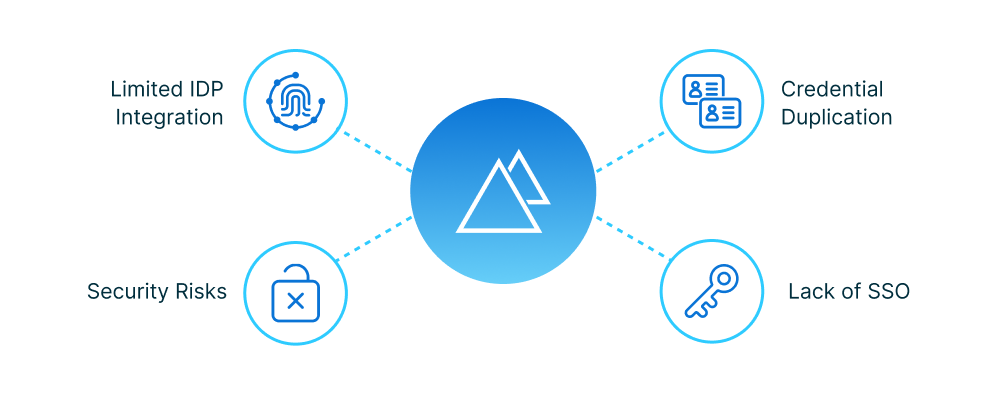
Cross-forest authentication becomes a challenge when users need to access resources outside their native AD forest. The main obstacles include:

  1. Credential Duplication: Users often require separate accounts for each domain.
  2. Lack of SSO (Single Sign-On): Logging into multiple domains requires multiple authentications.
  3. Security Risks: Traditional authentication mechanisms expose organizations to credential theft and privilege escalation attacks.
  4. Limited Integration with Modern IDPs: Many enterprises are moving to Azure Entra ID, Okta, and other cloud IDPs but still require legacy on-premises AD integration.

Cross-Forest Authentication Challenges

Cross-forest authentication challenges: credential duplication, lack of SSO, security risks, and limited IDP integration (Azure Entra ID, Okta)

The need for a secure cross-forest solution

To address these issues, organizations require:

  • A unified authentication mechanism that works across AD forests.
  • Seamless integration with cloud IDPs like Azure Entra ID, Okta, OneLogin, and ForgeRock.
  • Zero Trust Network Access (ZTNA) principles that ensure users only access authorized resources.

This is where Thinfinity’s Global Account Mapping comes into play.

Thinfinity’s global account mapping: How it works

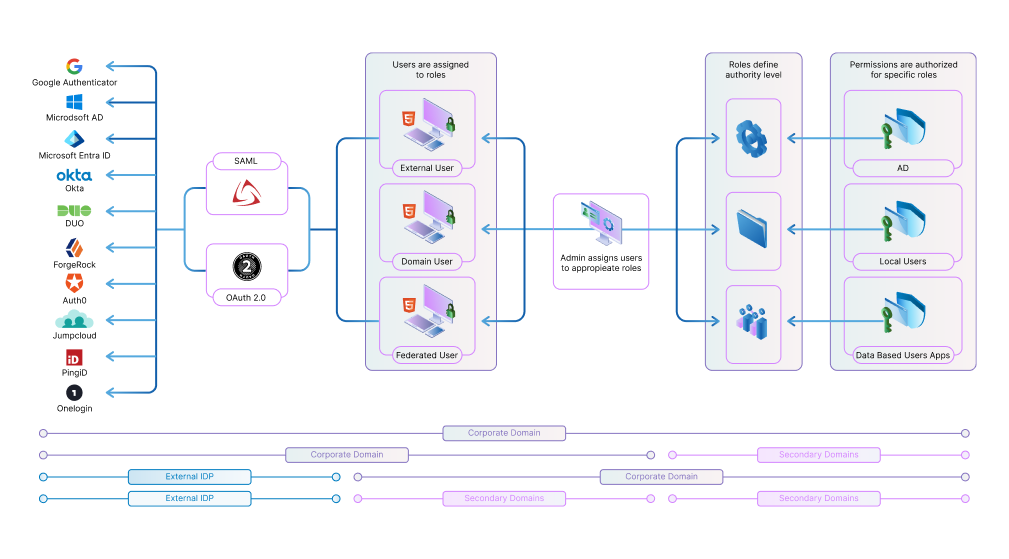
Thinfinity simplifies cross-forest authentication by implementing Global Account Mapping, which associates external user identities with Thinfinity accounts and resource identities.

Step-by-Step Process of Thinfinity’s cross-forest authentication

1. External authentication via IDPs & Federation services

  • Thinfinity supports authentication from Google, Microsoft AD, Azure Entra ID, Okta, DUO, Auth0, ForgeRock, JumpCloud, PingID, and OneLogin. 
  • Supports SAML and OAuth 2.0 for federated authentication.
  • Thinfinity validates the user’s identity against their primary domain.

2. Global mapping of user identities

  • Thinfinity maps the authenticated user from an external domain to the internal AD forest account.
  • This ensures that external and internal users are seamlessly linked.

3. Role-based access vontrol (RBAC) enforcement

  • After authentication, Thinfinity assigns roles based on Active Directory groups or Thinfinity IDP policies.
  • Access is granted only to resources authorized for the assigned role.

4. Authorization for specific resources

  • Thinfinity ensures that only mapped identities can access Active Directory, Local Users, and Database-based User Apps (SQL, MongoDB, etc.).

5. Seamless multi-domain access

  • Thinfinity supports authentication and resource access across Corporate Domains and Secondary Domains.
  • This eliminates the need for users to manage multiple passwords across different forests.
Thinfinity cross-forest authentication: SSO, MFA, RBAC, IDP integration (Azure Entra ID, Okta), secure multi-domain access, and role-based authorization
 

Key benefits of Thinfinity’s cross-forest authentication solution

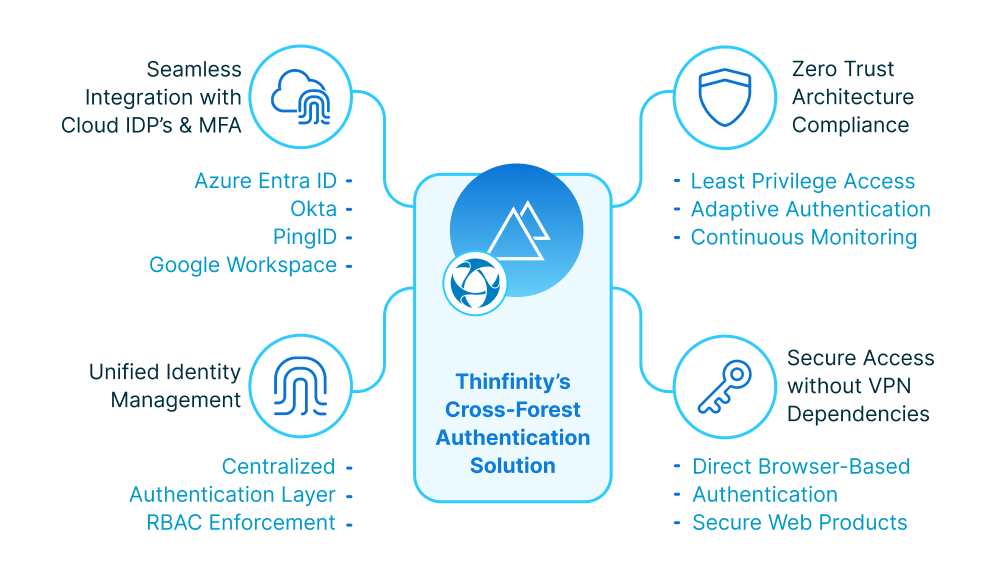
1. Secure access without VPN dependencies

Traditional VPN-based solutions struggle with cross-forest authentication, often requiring complex trust relationships. Thinfinity eliminates these issues by providing direct browser-based authentication using secure web protocols.

2. Seamless integration with Cloud IDPs & Multi-factor authentication (2FA)

Thinfinity integrates with leading identity providers like:

  • Azure Entra ID
  • Okta
  • PingID
  • OneLogin
  • Google Workspace
  • Duo Security
  • Auth0
  • ForgeRock

This ensures that users can leverage existing identity platforms while securing authentication with MFA (Multi-Factor Authentication).

3. Unified identity management with active directory & external domains

Thinfinity creates a centralized authentication layer, mapping external identities to internal AD resources. This allows:

  • Users to log in once and access resources across multiple forests.
  • RBAC (Role-Based Access Control) enforcement to restrict unauthorized access.
  • Elimination of duplicate credentials across different forests.

4. Support for hybrid and Multi-Cloud environments

Many enterprises run workloads across multiple clouds and require cross-domain authentication for:

  • On-premises Active Directory
  • Cloud-hosted Azure Entra ID
  • Hybrid cloud environments (AWS, GCP, Azure, private clouds)

Thinfinity ensures authentication is seamless across these environments, enabling secure access control.

5. Zero Trust architecture (ZTA) compliance

Thinfinity aligns with Zero Trust principles, ensuring:

  • Least Privilege Access: Users can only access authorized applications.
  • Adaptive Authentication: Based on device, location, and risk analysis.
  • Continuous Monitoring: Tracking authentication events and potential anomalies.
 
Thinfinity cross-forest authentication: SSO, MFA, IDP integration (Azure Entra ID, Okta), hybrid cloud support, and Zero Trust compliance
 

Use Cases

Use case 1: Enterprise deployment of cross-forest authentication

Scenario: Multi-Domain Organization with External IDP

A global enterprise has:
  • Corporate AD Domain (HQ)
  • Regional Active Directory Domains (Europe, APAC, Americas)
  • Cloud-based Azure Entra ID for remote users
  • Okta authentication for contractors
Thinfinity’s solution
  1. Users log in using Okta/Azure Entra ID credentials.
  2. Thinfinity maps external users to their corresponding AD accounts in the primary domain.
  3. Users authenticate once and gain access to all authorized applications.
  4. 2FA is enforced on each log in to enhance security.
  5. Access is logged for auditing and compliance.
Outcome

 Seamless authentication across multiple forests

No password duplication or credential sprawl.

Increased security via MFA and RBAC.

Achieving Seamless Enterprise Authentication

Enterprise cross-forest authentication: Thinfinity enables SSO, MFA, RBAC with Azure Entra ID, Okta, secure access, and audit logging.

Use Case 2: MSP-Hosted applications with customer-managed authentication

Scenario: Multi-Tenant MSP with Customer-Managed IDPs

A Managed Service Provider (MSP) offers hosted applications to multiple customers. Each customer:

  • Manages their own Azure Entra ID or Okta authentication.
  • Requires Single Sign-On (SSO) to access MSP-managed applications.
  • Has users in different Active Directory (AD) domains and requires seamless cross-forest authentication.

Challenges faced by the MSP

1. Multi-Tenant Identity Management
  • Customers do not want to provision separate credentials for the MSP’s environment.
  • The MSP must support authentication via each customer’s existing IDP (Azure Entra ID, Okta, etc.).
2. Secure Access Without VPN or Direct AD Trusts
  • VPN tunnels or Active Directory trust relationships with the MSP.
  • Traditional cross-domain authentication methods increase complexity and security risks.
3. Single Sign-On (SSO) to Hosted Applications
  • Users should authenticate once via their own Entra ID or Okta accounts.
  • They should get automatic access to applications hosted in the MSP’s data center or cloud.

Thinfinity’s solution: Global account mapping for MSPs

Thinfinity enables secure cross-forest authentication and SSO between:

Customer-Managed Identity Providers (Azure Entra ID, Okta, PingID, etc.)

MSP-Hosted Applications

Using Global Account Mapping, Thinfinity:

  1. Authenticates users via their customer-managed IDP (Azure Entra ID, Okta, etc.)
  2. Maps the authenticated identity to a corresponding Thinfinity account in the MSP’s domain.
  3. Grants access to MSP-hosted applications via SSO, enforcing Role-Based Access Control (RBAC).

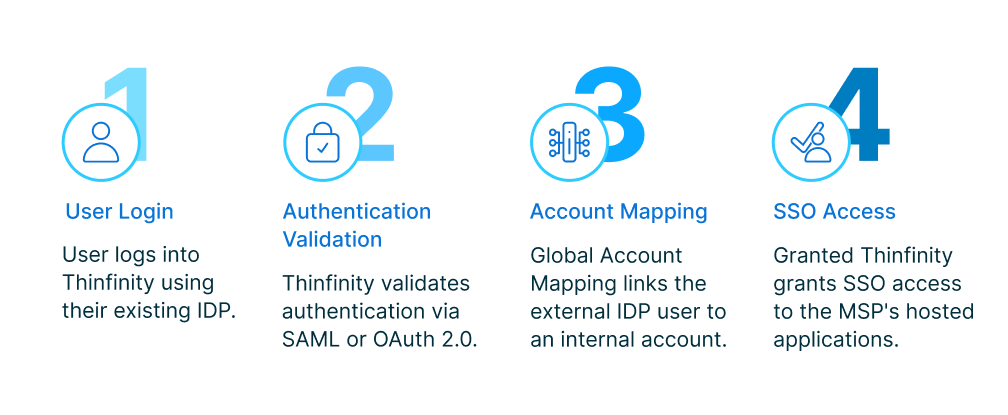
How it works

  1. User logs into Thinfinity using their existing IDP (Azure Entra ID or Okta).
  2. Thinfinity validates authentication via SAML or OAuth 2.0.
  3. Global Account Mapping links the external IDP user to an internal account in the MSP’s environment.
  4. Thinfinity grants SSO access to the MSP’s hosted applications.

Outcome & business impact

Customers authenticate using their existing credentials—no need to manage extra accounts.

 Seamless Single Sign-On (SSO) to MSP-hosted applications.

 No VPNs or direct AD trust relationships required, reducing security risks.

 Full Role-Based Access Control (RBAC) ensures users access only authorized applications.

Thinfinity’s Global Account Mapping Process

MSP cross-forest authentication: Thinfinity enables SSO, MFA, RBAC with Azure Entra ID, Okta, secure access to MSP-hosted applications

Why Thinfinity is the ideal solution for MSPs

  • Multi-Tenant Ready: Supports customer-managed authentication while centralizing access to hosted apps.
  • Cloud-First Security: Enables Zero Trust authentication across multiple identity providers.
  • Seamless Cross-Forest Authentication: Bridges customer IDPs with MSP-hosted environments.
  • Looking to enable secure SSO for MSP-hosted applications? Thinfinity’s Global Account Mapping provides the best solution for multi-tenant authentication.


Conclusion

Thinfinity’s Global Account Mapping for Cross-Forest Authentication provides enterprises with a secure, scalable, and seamless solution for managing authentication across Active Directory forests and external identity providers.

By integrating Azure Entra ID, Okta, and other IDPs, Thinfinity eliminates the complexities of cross-domain authentication while enforcing Zero Trust security and Multi-Factor Authentication.

With Thinfinity, enterprises can modernize their authentication strategy, ensuring users can securely access resources across all domains, clouds, and hybrid environments.

Key takeaways:

Supports Cross-Forest Authentication without VPNs

Seamless Integration with External IDPs (Azure Entra ID, Okta, DUO, etc.)

Role-Based Access Control (RBAC) & MFA for Security

Zero Trust & Secure Web Access Model

Improves IT Efficiency by Eliminating Credential Duplication


About Cybele Software Inc.
We help organizations extend the life and value of their software. Whether they are looking to improve and empower remote work or turn their business-critical legacy apps into modern SaaS, our software enables customers to focus on what’s most important: expanding and evolving their business.

About Version 2 Digital

Version 2 Digital is one of the most dynamic IT companies in Asia. The company distributes a wide range of IT products across various areas including cyber security, cloud, data protection, end points, infrastructures, system monitoring, storage, networking, business productivity and communication products.

Through an extensive network of channels, point of sales, resellers, and partnership companies, Version 2 offers quality products and services which are highly acclaimed in the market. Its customers cover a wide spectrum which include Global 1000 enterprises, regional listed companies, different vertical industries, public utilities, Government, a vast number of successful SMEs, and consumers in various Asian cities.

Nord Security 推出 NordStellar 全新的企業威脅管理平台

領先的網絡安全公司 Nord Security 宣佈推出 NordStellar,是一款全新的威脅暴露管理平台(Threat Exposure Management Platform)。

由市場領先的 VPN 解決方案 NordVPN 的開發團隊設計,這款企業級網絡威脅暴露管理平台可幫助企業檢測並應對網絡威脅、保護數據存取、保障帳戶安全、防範詐騙,並降低勒索軟件攻擊的風險。

NordStellar 產品負責人 Vakaris Noreika 表示:「企業通常在數據外洩後才發現問題。此外,監控外部網絡威脅需要投入大量時間和人力資源。NordStellar 讓企業能縮短數據外洩的檢測時間,利用自動化監控節省資源,並降低企業面臨的風險。」

企業遭受網絡攻擊的威脅日益加劇

針對企業的網絡攻擊數量正以驚人的速度增長。根據最新統計,勒索軟件攻擊激增,目前已佔所有資料洩露事件的近四分之一。2023 年,針對身份的攻擊次數增長了 71%。此外,網絡犯罪分子如今經常濫用有效帳戶,這類事件已佔所有事故的 30%。

Noreika 強調,黑客如今不需要尋找複雜的方法來入侵系統,他們只需搜索可能已經在暗網上流通的憑證即可。這種風險正是 NordStellar 能有效緩解的。

NordStellar 如何為企業提供效益

NordStellar 為員工、品牌和企業安全提供全面的保護與暗網監控。它通過降低勒索軟件風險、防止帳戶被盜用、識別惡意軟件暴露、檢測受損憑證以及保護員工免受身份盜竊的威脅,提升企業抵禦網絡攻擊的能力。

「這一新平台使安全團隊能夠在網絡威脅針對企業前採取行動。這種多層次的方法可以迅速識別和減輕內部及外部威脅,從而增強企業的整體網絡安全水平。」Noreika 表示。


關於 NordStellar

NordStellar is a threat exposure management platform that enables enterprises to detect and respond to network threats before they escalate. As a platform and API provider, NordStellar can provide insight into threat actors’ activities and their handling of compromised data. Designed by Nord Security, the company renowned for its globally acclaimed digital privacy tool NordVPN.

About Version 2

Version 2 Digital is one of the most dynamic IT companies in Asia. The company distributes a wide range of IT products across various areas including cyber security, cloud, data protection, end points, infrastructures, system monitoring, storage, networking, business productivity and communication products. Through an extensive network of channels, point of sales, resellers, and partnership companies, Version 2 offers quality products and services which are highly acclaimed in the market. Its customers cover a wide spectrum which include Global 1000 enterprises, regional listed companies, different vertical industries, public utilities, Government, a vast number of successful SMEs, and consumers in various Asian cities.

×

Hello!

Click one of our contacts below to chat on WhatsApp

×