Skip to content

How to prevent a DDoS attack: 7 key strategies

Key takeaways

  • A DDoS (Distributed Denial of Service) attack is a deliberate attempt to disrupt a network’s normal traffic by flooding it with too much of internet traffic.

  • DDoS attacks remain a significant threat, with a growing frequency and sophistication. In 2023, there was a 25% chance for organizations to face such attacks.

  • DDoS attacks come in various forms: application-layer attacks that target server response mechanisms, volume-based attacks that overwhelm traffic, and protocol attacks that exhaust server and network resources.

  • To prevent DDoS attacks effectively, organizations should implement a multi-layered strategy.

  • NordLayer’s Cloud Firewall, a key part of its security solutions, employs segmentation principles to reduce the attack surface and filter legitimate traffic.

A DDoS attack is a malicious attempt to disrupt normal traffic of a server, service, or network. It overwhelms the target or its surrounding infrastructure with a flood of internet traffic by overloading server capacity. With the frequency of DDoS attacks increasing, it’s crucial for businesses to understand and implement strategies to mitigate these threats.

While phishing attacks and malware are taking the lead on the list of cyber threats businesses are exposed to, DDoS attacks remain relevant when protecting your business. In 2023, organizations faced a 25% chance of dealing with a DDoS attack.
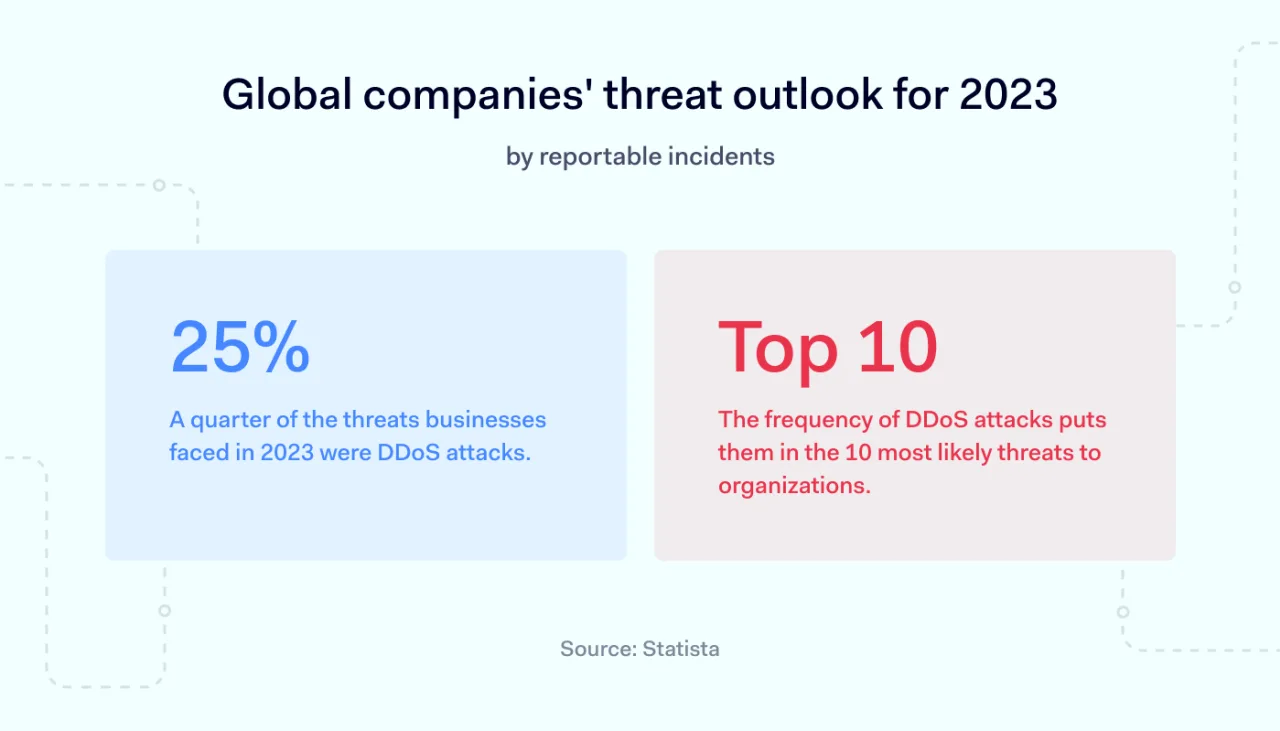
DDoS attack statistics

The risk of being attacked makes it relevant to include DDoS attack prevention in the organization’s cybersecurity strategy. This helps avoid any business disruption like a traffic jam to the website or unavailable service.

How does a DDoS attack work?

Understanding DDoS attacks begins with recognizing the internet traffic as a network of information exchange. 

Imagine a bustling city intersection where cars represent data packets. Now, a DDoS attack is akin to this intersection being suddenly overwhelmed by an orchestrated fleet of vehicles, blocking regular traffic. 

In the digital world, this fleet consists of numerous compromised computer systems, including personal computers and Internet of Things (IoT) devices, controlled by an attacker. These systems are often infected with malware, allowing the attacker to command them remotely.

In a DDoS attack, these hijacked systems are used as a force to generate massive amounts of network traffic, all directed at a single target, such as a website or an online service. 

This influx of traffic from multiple locations creates a massive bottleneck, flooding the target with more requests than it can handle. In this scenario, the victim struggles to differentiate between legitimate and malicious traffic, much like a security guard trying to identify troublemakers in a crowd. 

This makes it challenging to maintain normal operations without also unintentionally blocking legitimate users. Consequently, the targeted site or service becomes slow or completely unresponsive, leading to downtime and potential business losses.

Proactive DDoS defense is critical for businesses

  • At the end of 2023, companies experienced the biggest DDoS attack in the digital history. 

  • Some of the affected parties were large organizations like Google and Amazon.

  • The attack methods generally involved overwhelming the targeted systems with massive amounts of traffic spikes.

  • Affected companies confirmed that malicious actors exploited a weakness in HTTP/2 (a newer version of the HTTP network protocol).

  • The outcomes of these attacks were significant, leading to widespread service disruptions and highlighting the growing need for robust cybersecurity measures.

What are the common types of DDoS attacks?

DDoS attacks come in various forms, each uniquely crafted to disrupt, overwhelm, and hinder. 

Understanding these common attack types isn’t just about knowing how they work but also about getting into the minds of the attackers. These attacks range from flooding with too much traffic to using clever requests to drain resources. 

This knowledge is crucial for anyone looking to fortify their digital defenses against these cyber threats. DDoS attacks vary in form and method, but the primary types include:

Application-layer attacks

App-layer attacks target specific aspects of an application or service. 

This type of attack focuses on the layer where servers generate responses to client requests. They use bots to overload the server by repeatedly requesting the same resource, like HTTP flood attacks, which keep sending HTTP requests using different IP addresses.
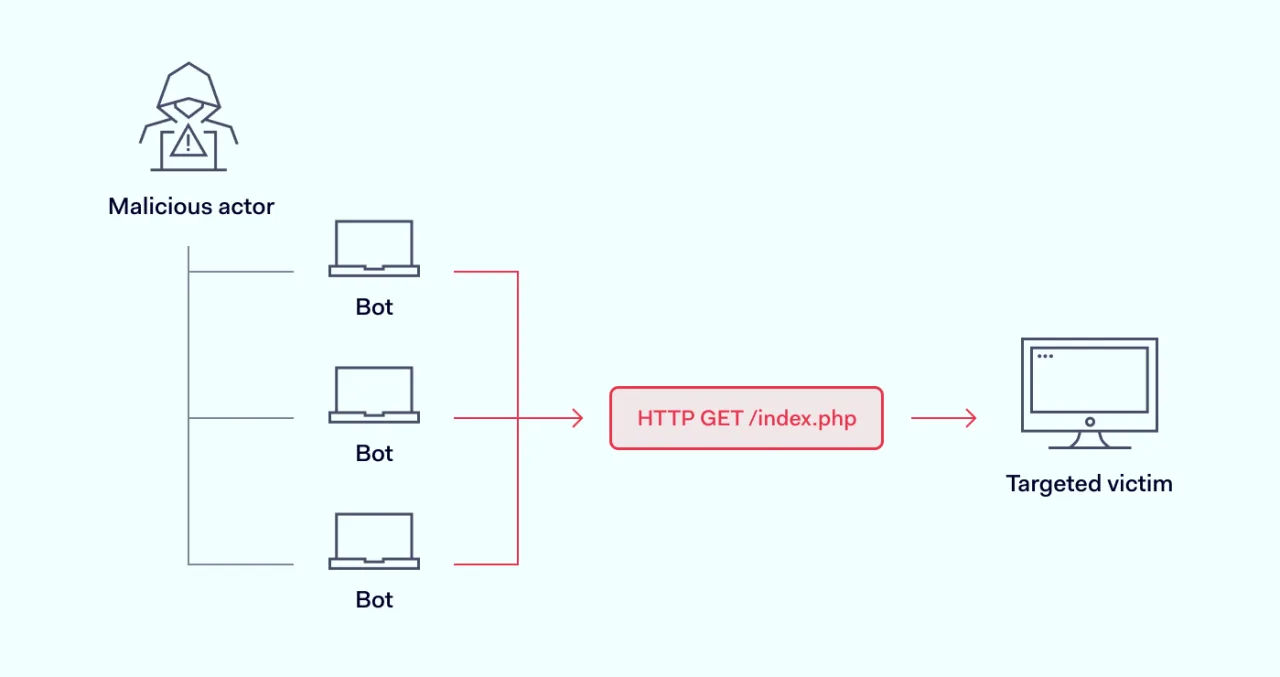
Application-layer attacks

Volume-based attacks

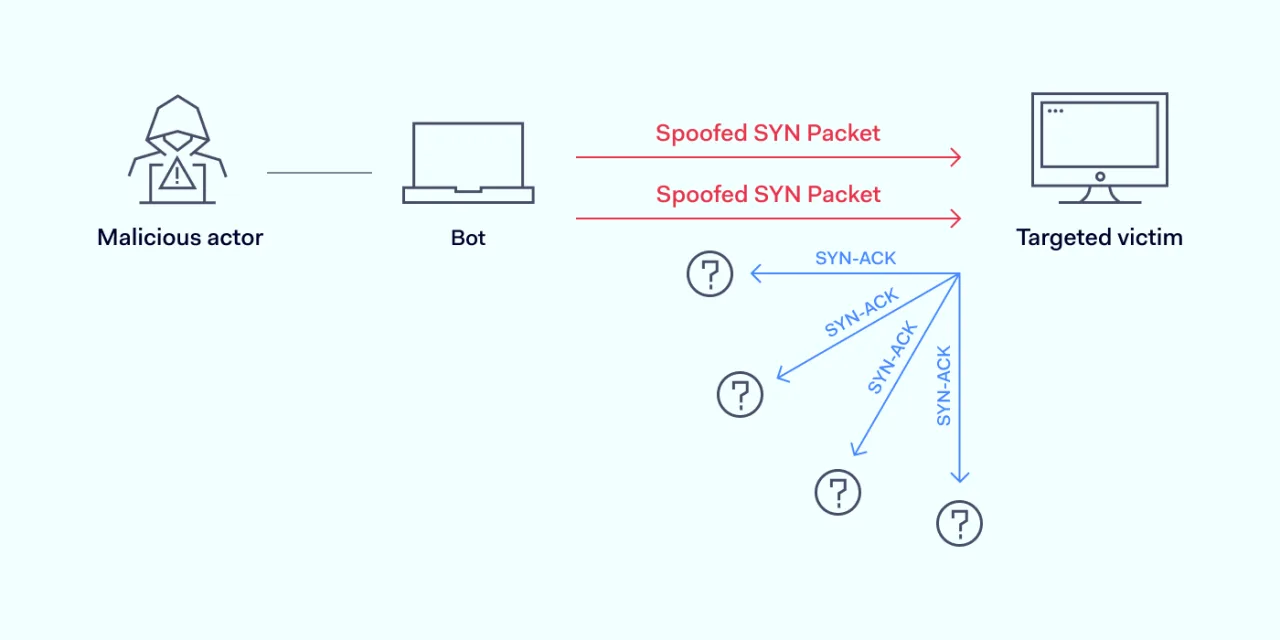
Volume-based–or volumetric–attacks involve overwhelming a system with large traffic volumes.

Volumetric attacks aim to deplete server resources or those of networking systems, such as firewalls or load balancers. A common example is the SYN flood attack, where numerous SYN packets are sent to a server, causing it to crash due to waiting too long for responses.
Volume-based attacks

Protocol attacks

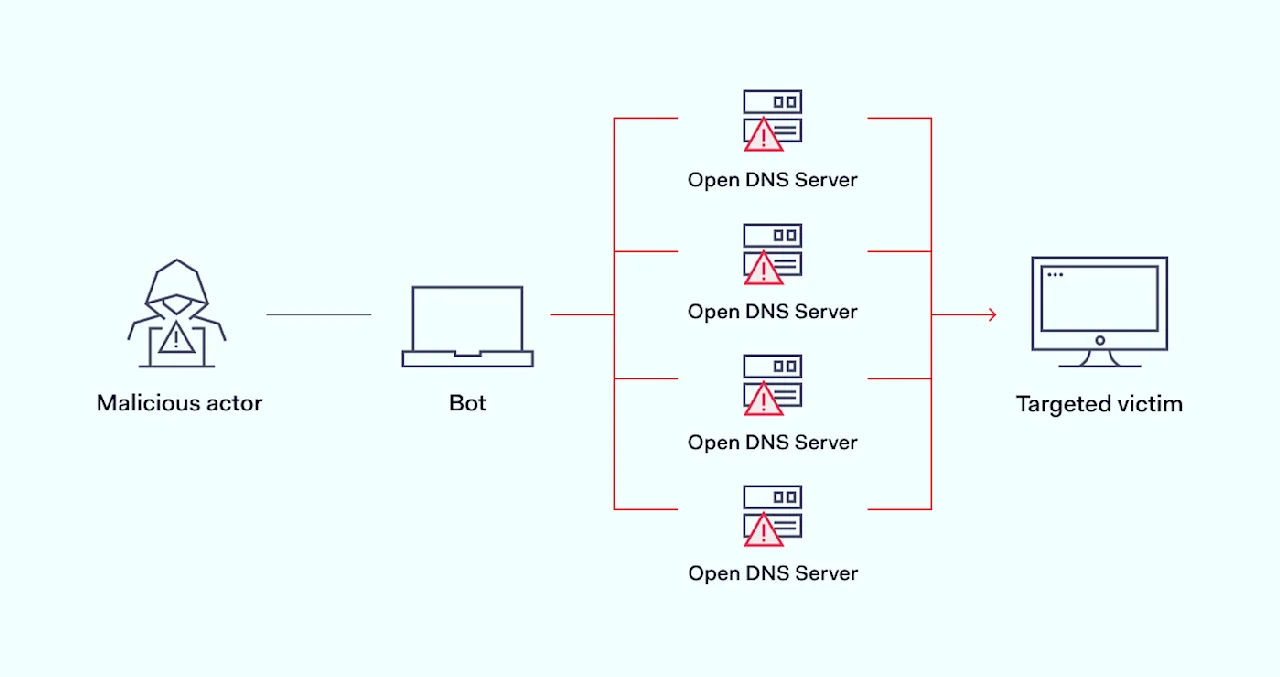
Protocol attacks consume actual server resources or those of intermediate communication equipment, like firewalls and load balancers.

They involve bombarding a server with excessive traffic, exhausting its bandwidth. An example is the DNS amplification attack, where large numbers of DNS responses are sent to the target server, overwhelming it.
Protocol attacks

Each type of protocol attack employs different methods to overload and incapacitate servers or network resources, highlighting the need for robust and versatile defense strategies. 

7 ways to prevent DDoS attacks

Organizations must adopt comprehensive and multi-layered strategies to counter the threat of DDoS attacks effectively. Here are seven key ways to enhance your defense:

1. Enhanced network redundancy

Distributing network resources across multiple locations isn’t just about avoiding a single failure point. It’s like creating a web of pathways where information can travel. 

Imagine a city with multiple roads leading to the same destination. If one road is blocked, traffic smoothly diverts to the other ones. 

Similarly, in network redundancy, data centers play a crucial role. They spread traffic loads, making it difficult for DDoS attacks to target a single weak spot. This strategy is key to building several bridges, so if one falls, others still stand, ensuring the continuous data flow.

2. Robust infrastructure development

Think of your network as a fortress. The walls are your firewalls, the watchtowers are your intrusion prevention systems, and the gates are your security protocols. 

Building a robust network architecture is like fortifying this fortress with various layers of defense. This multi-tiered approach is essential in managing unexpected traffic surges. It’s like having a strong foundation that can support the weight of sudden, heavy loads, ensuring that the network’s flow remains uninterrupted even under the pressure of an attack.

3. Securing the network perimeter

Regularly updating and patching network systems is like continuously reinforcing the walls of your digital fortress. Each update acts like a new layer of armor, closing chinks that attackers might exploit. 

This ongoing maintenance is critical in keeping your network resilient against intrusion attempts. Monitoring IP addresses is like having vigilant guards scanning the horizon for potential threats, ready to raise the alarm and shut the gates against malicious intruders before they can breach your network’s defenses.

4. DDoS protection services

Utilizing DDoS protection services is akin to having an elite security team with advanced tools at your disposal. 

These services, including Firewall as a Service (FWaaS) solutions, are like specialized agents trained to recognize and neutralize specific threats. They keep a watchful eye for volumetric attacks, ensuring your network remains safeguarded against massive, disruptive traffic influxes. 

Think of these services as your rapid response team, always ready to spring into action to maintain the sanctity of your network.

5. Proactive traffic monitoring

Consistent network traffic monitoring is like having a high-tech surveillance system. It lets you detect unusual activity patterns, like traffic spikes, which could signal an upcoming DDoS attack. 

This kind of vigilance enables a swift response, preventing potential threats from escalating. It’s about being one step ahead, recognizing the signs of trouble before they blow up into full-scale attacks.

6. Incident response planning

Having a well-defined incident response plan for DDoS attacks is like having a detailed emergency drill.

Your team knows exactly what to do, how to do it, and when to act. This preparation is key to dealing with threats efficiently, ensuring minimal operational disruption. A good response plan is a playbook that guides your team through a crisis, minimizing chaos and confusion.

7. Employee training

Educating staff about DDoS attack signs and response measures turns your employees into a frontline defense. It’s like training every individual in your organization to spot potential threats and react promptly. 

When your team can recognize early warning signs, such as unusual network slowdowns, they become an integral part of your defense strategy, contributing to quick threat identification and mitigation. This collective awareness is a powerful tool in maintaining the overall security posture of your network.

How NordLayer can help

NordLayer provides a comprehensive approach to network security, with its Cloud Firewall being a standout feature in its arsenal against digital threats, including DDoS attacks. 

This Cloud Firewall is designed not just as a barrier but as a smart filter that adapts to your network’s unique needs. It employs segmentation principles, which are critical to dividing a large, vulnerable surface into smaller, more manageable, and secure zones. 

NordLayer’s Cloud Firewall effectively narrows the attack surface by segmenting the network. This is crucial because a smaller attack surface is less attractive and more challenging for attackers to exploit.

The segmentation works by categorizing network traffic and access points, thus allowing only legitimate and necessary communication to pass through. This targeted filtering significantly reduces the risk of malicious traffic infiltrating the network. 

Are you considering implementing NordLayer’s Cloud Firewall to your security infrastructure to prevent DDoS attacks and other risks? Contact us to learn more about our comprehensive, secure network access solution now.

FAQ

What are the first steps in DDoS protection?

To initiate DDoS protection, start by evaluating your network’s vulnerabilities. Identify critical assets and potential attack vectors. Implementing a robust network infrastructure with redundancy is crucial. This means having your resources spread across various data centers, ensuring no single point of failure. It’s like diversifying your defenses across multiple fortresses instead of just one. Doing so creates a resilient network that’s harder to compromise, significantly helping to prevent attacks.

How can I mitigate DDoS attacks through network configuration?

Mitigating DDoS attacks starts with smart network configuration. Use techniques like rate limiting, which controls the amount of traffic a server accepts over a specific period. Implement geofencing to block or limit traffic from regions that aren’t relevant to your business. Also, configure your network hardware to reject malformed packets and filter out traffic likely to be part of an attack. These steps form a proactive barrier, helping to prevent attacks before they escalate.

Can a firewall stop a DDoS attack?

Cloud firewalls play a crucial role in DDoS attack prevention. They can filter out some malicious traffic and protect against certain attack types. Additional DDoS mitigation measures, such as specialized services and traffic monitoring, are often necessary to effectively counter these attacks. It’s essential to have a comprehensive cybersecurity strategy that combines firewall defenses with other security layers for robust DDoS protection.

About Version 2 Digital

Version 2 Digital is one of the most dynamic IT companies in Asia. The company distributes a wide range of IT products across various areas including cyber security, cloud, data protection, end points, infrastructures, system monitoring, storage, networking, business productivity and communication products.

Through an extensive network of channels, point of sales, resellers, and partnership companies, Version 2 offers quality products and services which are highly acclaimed in the market. Its customers cover a wide spectrum which include Global 1000 enterprises, regional listed companies, different vertical industries, public utilities, Government, a vast number of successful SMEs, and consumers in various Asian cities.

About NordLayer
NordLayer is an adaptive network access security solution for modern businesses – from the world’s most trusted cybersecurity brand, Nord Security.

The web has become a chaotic space where safety and trust have been compromised by cybercrime and data protection issues. Therefore, our team has a global mission to shape a more trusted and peaceful online future for people everywhere.

About NordLayer
NordLayer is an adaptive network access security solution for modern businesses – from the world’s most trusted cybersecurity brand, Nord Security.

The web has become a chaotic space where safety and trust have been compromised by cybercrime and data protection issues. Therefore, our team has a global mission to shape a more trusted and peaceful online future for people everywhere.

Data protection library: exploring the best GDPR books

What is GDPR?

The General Data Protection Regulation (GDPR) is the European Union’s core data privacy and security regulation. GDPR protects individual privacy rights throughout the EU and associated countries. It is also an extra-territorial data protection law, meaning that companies must protect the data privacy of EU residents anywhere in the world.

GDPR is a critical regulatory concern for companies that collect, store, or process EU user data. In practice, the regulations apply to most businesses with global reach. With fines ranging into the millions for misusing personal data, compliance managers need to stay informed about GDPR-related issues.

For a quick intro to EU privacy requirements, check out our GDPR compliance checklist. If you want to dig deeper, boosting your General Data Protection Regulation library is advisable.

Must read GDPR books for 2024

The GPDR is a complex web of clauses and regulatory requirements. With so much complexity, it’s easy to lose sight of regulatory obligations and how to achieve cost-effective compliance. Luckily, there are plenty of GDPR experts. Many of them have written accessible guides for beginners, and there are also some in-depth works for experts.

The list below introduces some of 2024’s best GDPR books. Extra knowledge tends to clear up murky areas and replace confusion with confidence about how to proceed. Let’s dive in and suggest some must-reads for you and your team.

  • “GDPR for Startups and Scaleups: A Practical Guide” by Ben Martin

  • “Ultimate GDPR Practitioner Guide (2nd Edition): Demystifying Privacy & Data Protection” by Stephen Robert Massey

  • “The EU Data Protection Code of Conduct for Cloud Service Providers: A guide to compliance” by Alan Calder

  • “Managing Subject Access Requests: A Practical Handbook for EVERY Business” by Stephen Robert Massey & Catriona Leafe

  • “Beyond GDPR: The Consultant’s Blueprint to Cybersecurity and Data Regulation by Adam Cardwell

  • GDPR for HR Professionals” by Daniel Barnett 

  • “Health Data Privacy under the GDPR: Big Data Challenges and Regulatory Responses” by Maria Tzanou

  • “Data Subject Rights under the GDPR: With a Commentary Through the Lens of the Data-driven Economy” by Helena Vrabec

  • “Good Data: An Optimist’s Guide to Our Digital Future” by by Sam Gilbert

“GDPR for Startups and Scaleups: A Practical Guide” by Ben Martin

GDPR-books-GDPR for Startups and Scaleups: A Practical Guide

Our first recommendation should help small businesses exploit the European market. Ben Martin pitches this short guide at SMEs who may feel intimidated by the GDPR’s data protection clauses. After reading this, nobody should feel scared to expand their European operations.

“GDPR for Startups and Scaleups” explains compliance basics. Martin defines consent obligations and the concept of data privacy by design. He also urges small companies to build data protection into their operations. Smart companies use GDPR to build trust and avoid data breaches. Even if your European operations are modest, you will probably benefit from Martin’s information security advice.

“The Ultimate GDPR Practitioner Guide (2nd Edition)” by Stephen Robert Massey

GDPR-books-The Ultimate GDPR Practitioner Guide (2nd Edition)

Massey’s textbook is a must-have reference work for all data protection professionals. So, if you buy one text from this list, make it this one.

The “Ultimate GDPR Practitioner Guide” scores highly because Massey clarifies every core concept using easily understandable language. He describes legal obligations, suggests practical data protection controls, and generally empowers compliance professionals to master the General Data Protection Regulation.

Aside from that, it’s helpful to have a regulatory “bible” on the bookshelf to refer to when issues arise. And Massey’s guide is the perfect option.

“The EU Data Protection Code of Conduct for Cloud Service Providers: A Guide to Compliance” by Alan Calder

BDPR-books-The EU Data Protection Code of Conduct for Cloud Service Providers: A Guide to Compliance

The relationship between GDPR and cloud computing is a potential pain point for businesses worldwide. Knowing your cloud-related responsibilities is critical when selling digital services to EU residents or gathering data. Alan Calder’s book makes this complex task much easier to digest.

Calder explains how cloud providers can comply with the EU’s privacy regulation, providing practical information security measures that fit regulatory requirements. It’s a quick read and offers clear guidance to help you follow the EU Data Protection Code of Conduct.

“Managing Subject Access Requests: A Practical Handbook for EVERY Business” by Stephen Robert Massey & Catriona Leafe

GDPR-books-Managing Subject Access Requests: A Practical Handbook for EVERY Business

Sooner or later, anyone collecting data from European Union residents will encounter subject access requests (DSARs). DSARs allow users to exercise their data privacy rights. However, complying can be expensive, and not all requests are legitimate.

Massey and Leafe understand these problems and offer solutions. They explain what counts as a reasonable request under GDPR, showing how and when you need to comply with DSARs. If you apply their ideas cleverly, you’ll almost certainly save money with intelligent DSAR policies.

“Beyond GDPR: The Consultant’s Blueprint to Cybersecurity and Data Regulation” by Adam Cardwell

BDPR-books-Beyond GDPR: The Consultant's Blueprint to Cybersecurity and Data Regulation

The General Data Protection Regulation requires robust cybersecurity controls to enhance data protection. However, many organizations experience confusion about appropriate data protection systems and the scope of data security measures. That’s where Cardwell’s information security expertise comes in handy.
This readable guide looks at state-of-the-art data protection, suggesting ways to exceed GDPR requirements. Cardwell’s book is a great starting point for risk management strategies that meet EU requirements and minimize the risk of data breaches.

“GDPR for HR Professionals” by Daniel Barnett 

GDPR-books-GDPR for HR Professionals

If you are confused about how handling employee data relates to EU data protection law, Barnett has your back. This concise introduction sets out the role of HR professionals. Barnett covers consent, dealing with data breaches, and data security controls. If you manage any EU residents – even remotely – his advice is well worth consulting.

“Health Data Privacy under the GDPR: Big Data Challenges and Regulatory Responses” by Maria Tzanou

BDPR-books-Health Data Privacy under the GDPR: Big Data Challenges and Regulatory Responses

Health-related personal data protection is one of the trickiest GDPR challenges. However, Maria Tzanou clearly explains the responsibilities of health organizations, turning a colossal task into something much more manageable. Tzanou’s insights are valuable for companies that process large amounts of health data, with handy recommendations for anonymization and operating internationally. 

It’s a timely exploration, especially in a post-COVID world, offering insights on how GDPR shapes the handling of sensitive health data, from everyday apps to pandemic tracking, making complex legal matters accessible to anyone interested in the future of health privacy.

“Data Subject Rights under the GDPR: With a Commentary Through the Lens of the Data-driven Economy” by Helena Vrabec

BDPR-books-Data Subject Rights under the GDPR: With a Commentary Through the Lens of the Data-driven Economy

Protecting data subjects’ rights is a core mission of GDPR. But what rights do EU residents have, and how should companies allow individuals to exercise them? In this GDPR book, academic Helena Vrabec offers a comprehensive but readable summary of data rights obligations. By the final chapter, readers will know all about critical rights like data portability, the right to be forgotten, and data privacy.

“Good Data: An Optimist’s Guide to Our Digital Future” by Sam Gilbert

GDPR-books-Good Data: An Optimist's Guide to Our Digital Future

It’s important to be realistic about regulatory challenges. But staying positive and confident about new technologies like artificial intelligence and big data is also essential. Gilbert’s book is the ideal antidote to pessimism and doubt.

“Good Data” talks about how GDPR will complement responsible companies, allowing us to capitalize on data while mitigating data security risks. Gilbert argues that we need high-quality regulations to police the wild frontiers of data processing. Applying GDPR reasonably enables firms to explore digital innovation while protecting privacy rights and information security.

Additional resources for GDPR compliance

The books above cover diverse themes, from healthcare data to cloud computing. However, there’s always more to learn about the General Data Protection Regulation. Compliance professionals should always look for more information sources and expertise.

Alongside books, check out online webinars and courses. Cybersecurity companies are also useful sources of guidance. For example, NordLayer’s Learning Centre has an extensive compliance library. It’s the ideal place to refresh your knowledge or become familiar with data protection ideas to aid GDPR compliance.

Privacy and security companies regularly produce GDPR white papers. Look out for new publications after regulatory changes or new national laws. And check in with industry thought leaders like the Data Protection Made Easy or Life With GDPR podcasts.

GDPR is a dynamic regulation with constant refinements and updates. Cast your net widely and set aside time to stay informed. But never forget about the power of reading. A few hours reading our literature suggestions could be the best time you spend all year.

Put your GDPR learning into practice with NordLayer

GDPR compliance is a constant concern for international businesses. Regulators are never shy about imposing penalties for data protection breaches. Organizations need to understand their risk management responsibilities and take appropriate action.

Reading about GDPR subjects is always useful. Arm yourself with up-to-date knowledge to prepare for incidents and regulatory problems. And if reading inspires you to overhaul your GDPR compliance systems, NordLayer is here to help. Get in touch to explore GDPR compliance solutions to lock down customer data and grow your business in the EU.

About Version 2 Digital

Version 2 Digital is one of the most dynamic IT companies in Asia. The company distributes a wide range of IT products across various areas including cyber security, cloud, data protection, end points, infrastructures, system monitoring, storage, networking, business productivity and communication products.

Through an extensive network of channels, point of sales, resellers, and partnership companies, Version 2 offers quality products and services which are highly acclaimed in the market. Its customers cover a wide spectrum which include Global 1000 enterprises, regional listed companies, different vertical industries, public utilities, Government, a vast number of successful SMEs, and consumers in various Asian cities.

About NordLayer
NordLayer is an adaptive network access security solution for modern businesses – from the world’s most trusted cybersecurity brand, Nord Security.

The web has become a chaotic space where safety and trust have been compromised by cybercrime and data protection issues. Therefore, our team has a global mission to shape a more trusted and peaceful online future for people everywhere.

About NordLayer
NordLayer is an adaptive network access security solution for modern businesses – from the world’s most trusted cybersecurity brand, Nord Security.

The web has become a chaotic space where safety and trust have been compromised by cybercrime and data protection issues. Therefore, our team has a global mission to shape a more trusted and peaceful online future for people everywhere.

Libdrop: File sharing through NordVPN

The Libdrop library allows NordVPN users to share files over Meshnet. In this article, we explain how we developed our file transfer system and the role Libdrop plays in it.

What is Libdrop?

Libdrop is a cross-platform library developed in the Rust programming language. It is compatible with Windows, MacOS, Linux, iOS, and Android. File sharing within the NordVPN environment is facilitated by the Libdrop library, which is available as an open-source resource on GitHub.

The goal of Libdrop implementation is to allow smooth and secure file sharing between users over Meshnet. The library should be easily integrated into the NordVPN application so API users can issue transfer requests, with the rest of the processes being carried out in the library.

Libdrop protocol

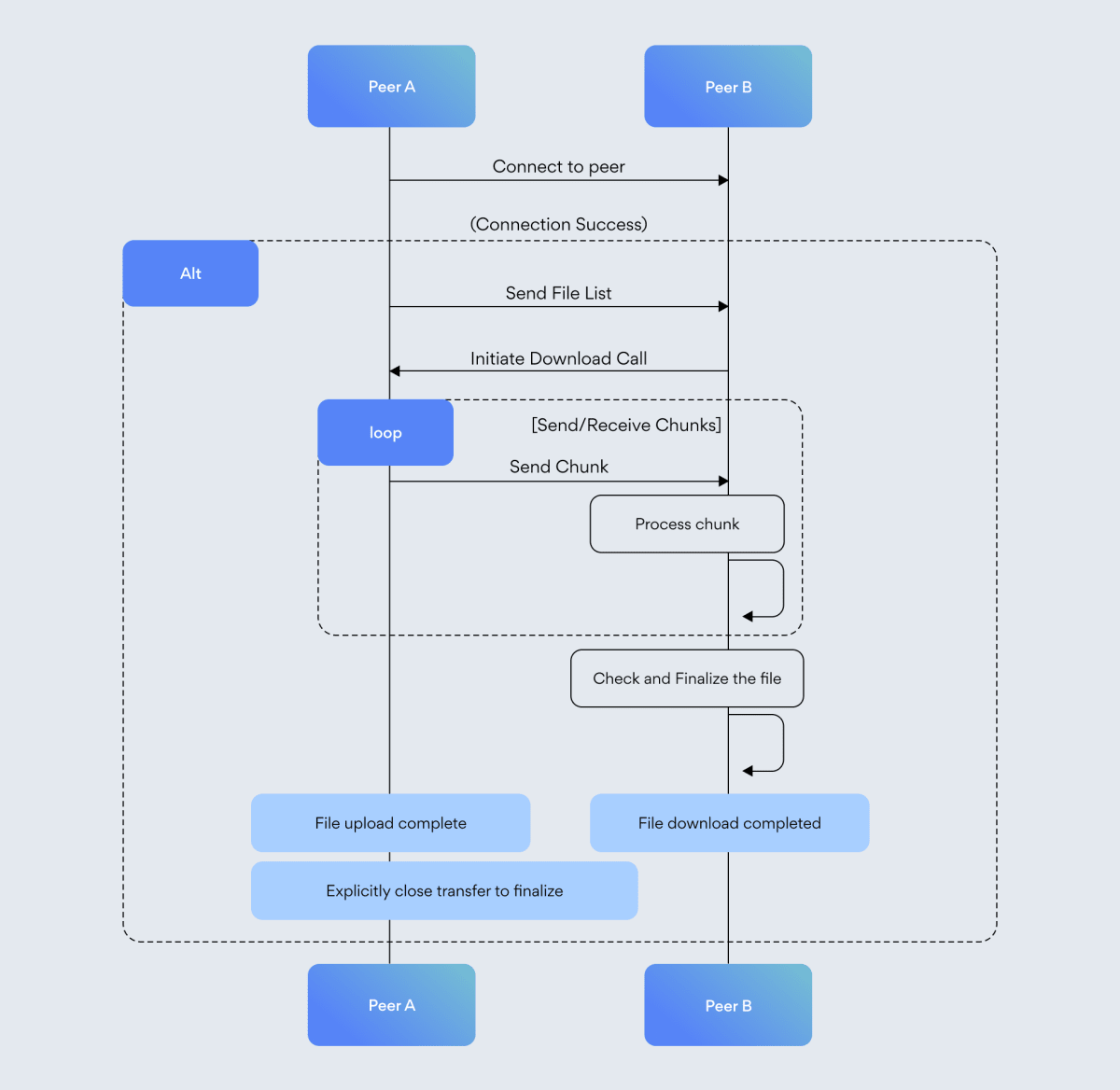
The Libdrop protocol enables peer-to-peer file sharing via both IPv4 and IPv6. In this process, the sender presents files to the receiver, who then selects specific files for download. Downloads are then initiated.

The transfer is live until one of the peers goes down or the transfer is explicitly canceled by either of the peers, after which the files are no longer available for download. This provides the user with a time window where they can decide which files they want to download now and in the future while the transfer is still up.

High-level overview of communication between two peers.

Communication and low-level details

Let’s take a closer look at the technical details of the communication process, and how we developed our current setup.

gRPC

At first glance, it seemed evident that our easiest course of action would be to focus on the HTTP server and client because this is very easy to use and understand, as well as being a time-proven technology. We could make a REST endpoint and just proceed with a regular HTTP download.

To enhance speed and control, we opted for gRPC. Because gRPC is a binary protocol it has less overhead. It is also strongly typed, making errors harder to introduce. gRPC technology automatically generates the code needed for both the client and the server, making it an excellent fit. In fact, Libdrop was originally built on gRPC.

Initially, it was very comfortable to use — both the client and the server code just worked. We could issue a certain call via the wire and expect the appropriate function to be called on the peer.

However, as time went on, we found that debugging gRPC presented some challenges, and the “black box” nature of it began to concern us. The generated code also had little control over the socket itself because it was abstracted too far away to gain direct access. Consequently, we transitioned from gRPC to WebSockets in pursuit of a more adaptable solution.

WebSockets

Unlike gRPC, WebSockets is not strongly typed, which offers a degree of flexibility. This flexibility comes at the cost of making it easier for bugs to appear. However, there’s no automatic code generation, which is a plus.

The ability to easily introduce versioning was another advantage. We just need to have the URL in the form of “ws://{addr}/drop/{version}/query.” It also helped that WebSockets is a fairly easy-to-understand technology that works in tandem with HTTP so the traffic can be inspected easily as well as debugged.

Choosing WebSockets turned out to be a wise decision. It led to a reduction in code complexity and greatly enhanced our understanding of the data flow. Plus, having written the code ourselves, we felt fully in control of the system.

Simplified representation of backward compatibility between Libdrop versions.

Rust and Tokio

Due to the nature of the Libdrop library’s heavy IO and event-driven architecture, the codebase contains a lot of asynchronous flows which could have been a tough problem. However, Rust’s great implementation of async alongside the Tokio library proved to be a great combination in dealing with this and avoiding potential crashes.

Rust shines because the borrow checker is really persistent about lifetimes and safety while developing because it prevents you from compiling incorrect code that breaks ownership rules.

We are also fairly safe from panics as we spend most of the time in Tokio tasks and those are executed in catch_unwind. This means that if the Tokio task panics it will simply yield an error instead of tearing the whole thread down.

Still, not every place in the codebase runs in a Tokio task, and so for those cases where a Tokio task is not involved, we tune Rust linter to detect unwrap() calls in the codebase that could potentially invoke a panic handler.

NordVPN uses Rust in numerous libraries and panics are handled in custom panic handlers. These handlers wrap the error and emit it via callback so the API user receives it and can properly log it.

API and the dilemma: To block or not to block?

We’ll now explore the choices we made around our API.

SWIG

For the API we used SWIG, which was already battle-tested and proven by libraries such as Libtelio. SWIG automatically generates FFI binding code for all target platforms, but it’s not without limitations. While it’s very easy to pass primitives such as integers and strings, higher-order structures are not that comfortable. In a compromise, we accept certain parameters as JSON strings.

JSON strings, while slightly less optimal, are a great solution to the problem. All mainstream languages know how to parse it or have a popular library ready to do so. The downsides to JSON strings are less type safety and a need for greater control to avoid breaking the conformity.

Event-driven architecture and reporting

One question that arose around the API was whether or not we should block it. Based on the API users we opted to not make the API block and communicate via events. This provides more complexity on the API design side but it provides an event-driven API and means that API users don’t need to care about threads. App developers are usually experienced in working with callbacks so this architecture suits them well.

Callbacks are used for event notification and reporting so the API user can receive reports and log them where appropriate. Events are for reporting. Both events and reports are passed on as JSON-encoded strings.

Errors are reported when the parameters to the API are incorrect or when a runtime error is encountered.

Types of events

Events are emitted for various milestones:

A transfer was requested.

The transfer was successfully queued (the API returned no error) and contains all the paths collected.

A file upload/download was started, finished, or failed.

A file upload or download progressed.

User experience and history tracking with SQLite

When considering how to track transfer records and states, our team opted for a local SQLite database that users can easily inspect.

We chose SQLite for its flexibility and cross-platform availability, and because it offers a strong query system that makes it user-friendly.

The widespread use of SQLite in various applications gave us added confidence in its reliability and performance, making it an easier choice over alternatives like JSON files or custom binary formats.

Database limitations: A read-only resource

The SQLite database does not control Libdrop’s operations in any way. Its role is purely read-only. The SQLite database serves to offer our users a convenient API for accessing transfer histories and logs, without impacting the underlying functionality of Libdrop.

In cases where we fail to open or migrate the SQLite database successfully we can remove it entirely and try again. If it fails again we can then use an in-memory database that provides proper functionality while the app is alive.

Security and validation

Security in Libdrop has several key focuses:

  • Ensuring that the right sent file reaches the receiver.

  • Ensuring that a transferred file is immediately picked up and scanned by NordVPN’s Threat Protection feature.

  • Ensuring that foreign apps cannot make calls directly to the peer.

  • File validation: Ensuring integrity from start to finish

As part of our commitment to ensuring a reliable file transfer process, we take several precautions. The moment a file is selected for upload, we immediately fetch its metadata, specifically capturing its size and checksum. This information is then shared with the receiver to ensure both parties have synchronized data right from the start.

During the actual upload, we keep a close eye on the data transfer. We compare the size of the transferred data with that of the received data, allowing us to detect any inconsistencies. If a discrepancy is found, the transfer is terminated, ensuring that only accurate and complete files proceed.

At the receiving end, a fresh checksum is calculated once the correct amount of data is received. If this calculated checksum doesn’t align with the initially shared checksum, the transfer is terminated. In such cases, the transfer is reported and stored as a failed transfer on both ends.

Threat Protection

In both Windows and MacOS, files often carry metadata indicating their origin. Without this information, antivirus software would need to scan each and every file for threats, which isn’t efficient.

Applications regularly produce many files, the majority of which are legitimate and harmless so it’s common practice to embed specific markers within these files. This allows antivirus tools to identify and scan files faster.

On Windows and MacOS, we immediately attach these markers once files are downloaded. This ensures that the Threat Protection scanner can promptly identify and assess them, leaving no gap during which they might be accessed without a prior security check.

MacOS uses kMDItemWhereFroms while Windows uses Zone.Identifier.

Socket security

Finding the protocol and communication method used by Libdrop is straightforward. The port we use is 49111, and the address is in the format ws://{addr}/drop/ (this can all be seen in the source code provided on GitHub).

While it’s true that you can bypass Libdrop by directly connecting to this URL with cURL or similar tools, this is a situation we’d like to avoid. Our aim is to maximize usability and minimize the risks for users.

Since we considered user experience, we also explored the idea of automatically accepting files from trusted peers. However, we recognized the potential risk of someone abusing this feature to spam others, and so decided against it.

To enhance security, we implemented an authorization system based on Meshnet keys. These keys are retrievable via API after successful user authentication. Since NordVPN is consistently aware of peer public keys, we’re able to use this information to validate connections at the Libdrop communication level. If a user fails the authorization process, the transfer is terminated — no questions asked from the receiver side.

To accomplish this, we employ HMAC with SHA-256 and generate a shared key using the Diffie-Hellman algorithm. When initiating a connection, the NordVPN app provides the public key of the peer. Combined with the private key we already possess from the time of initializing Libdrop, we’re able to calculate this shared key. Both sides of the transaction do the same, and the process is only deemed successful if the keys match.

We’re aware that this system isn’t bulletproof. For instance, users might find a way to exploit a Linux CLI app. However, we believe these improvements represent a significant step towards creating a safer and more reliable experience for our users.

Permissions and user access

Integrated into the NordVPN application, Libdrop operates under the constraints of user permissions as enforced by the operating system. This ensures that users can only share files to which they have ownership rights. To initiate a file transfer, a connection between peers must first be established. Enabling file sharing for a specific Meshnet peer allows one to start receiving files from that device. Disabling file-sharing permissions for a Meshnet peer will halt incoming transfers from that particular device. You can read more about file-sharing permissions here.

On the Linux platform, we faced an additional challenge because the app needed to run as root due to Libtelio’s requirements. Running Libdrop as root was out of the question, as it would have unrestricted access to the entire file system. To navigate this, we set Libdrop up to run as a user process that communicates with the NordVPN daemon.

Fortunately, mobile devices didn’t present the same issue, thanks to their robust sandboxing. Likewise, applications on Windows and MacOS operate with user permissions, so there were no concerns on those platforms either.

It’s worth noting that Libdrop isn’t designed for multi-user scenarios, as it uses a hardcoded port number, 49111. However, it can technically bind to different network interfaces without any problems.

File aggregation

To simplify the user experience and streamline integration, we designed Libdrop to automatically enumerate files in the paths provided. These paths can point to either individual files or directories, allowing for greater flexibility. This setup posed several challenges, however:

  • How can we recreate the directory hierarchy?

  • What do we do when we encounter a symlink?

  • What happens if there are too many files?

  • What are the issues with Android permissions?

Let’s take a closer look at how we overcame these challenges.

Recreating the directory hierarchy

For hierarchies, we used the same rename logic as we did with the files, but only for the root level directory. We only communicate the path with the peer starting at the root level of the provided path, meaning that if there’s a directory structure of C:\Files\Photos\Cats\Cute and the user adds C:\File\Photos then we only send Photos\*, the receiver is unaware of the C:\Files portion. This was important because, if the receiver was aware of that portion, personal details could be leaked.

Interestingly, directory separators are not cross-platform. Windows supports both \ and / while Unix-based OSs (Android, iOS, MacOS, Linux) support only /. Initially, we just communicated with the path as-is, which then produced some fun results. Sending a path, “Photos\Cats\1.jpg,” from Windows to a Linux machine would produce a file with that name instead of two directories and one file when transferring a directory.

As an easy solution, we chose the following approach: when the user sends a directory and we aggregate a path, we split it with the native path separator and then glue it back together using the universal one — /. We can then use that path going forward.

We decided that, when a symlink is encountered, we would return an error. This reduces the chances of possible security issues arising around certain files.

Symlinks reduce the visibility of operations, creating situations in which a user might think they are sending one set of files while in reality a different group of files are picked up.

What happens if there are too many files?

In Libdrop we allow for certain configuration values when initializing the library, ensuring that it can be flexible across multiple platforms. To help with interoperability, we decided to add two values: file limit and file depth limit.

Including these two values means that deep directories result in an error. An error is also generated when the file limit is reached. We think it’s better to be explicit than implicit, and so we’d rather generate an error than send an incomplete file transfer.

Android permission issue

Using the transfer system on Android presented us with some challenges. In order to use the POSIX file system, the API needs appropriate permissions in the application manifest. Direct file system access requires that the application is placed within a single specific category, but this was a problem because NordVPN is not just a file or backup manager.

A solution was found when we did an experiment and found that upon selecting the file in Android, it was possible to detach the file descriptor. This enabled us to use POSIX with the provided descriptor:

Testing and dogfooding

We used Python and Docker to load the compiled library and imitate conversation between two peers. This allowed us to reproduce the bugs by writing test cases, easing our concerns about bigger changes in the codebase.

The testing framework allowed us to generate scenarios quickly using a Python API where we can imitate all the actions a user might take alongside the events we would expect as a result.

Tests can’t perfectly replicate what happens in real life so we still constantly seek QA feedback alongside the relevant aggregated logs. Still, having an easy-to-use test framework proved to be very beneficial and boosted our confidence during development.

Meshnet protocol and wire safety

NordVPN’s file-sharing feature is built on Meshnet, a peer-to-peer protocol. This design allows for the shortest possible data path between computers, eliminating the need for third-party cloud storage or service providers.

One caveat is that both Meshnet nodes must be online simultaneously for the transfer to take place. All traffic between Meshnet nodes, including file sharing, is authenticated and encrypted via WireGuard’s cryptography, ensuring that even Nord Security cannot access the contents of the files or the traffic being transmitted. You can read more about the Wireguard protocol here.

Thanks to Libtelio and Meshnet, Libdrop doesn’t need to use any encryption of its own because double-encryption would be unnecessary. If you’re considering implementing Libdrop into your own product, you should integrate transport layer security (TLS), which should be fairly trivial to implement.

In summary, NordVPN’s File Sharing feature offers a secure, efficient, user and API-user-friendly method for peer-to-peer file transfers through the Meshnet.

About Version 2 Digital

Version 2 Digital is one of the most dynamic IT companies in Asia. The company distributes a wide range of IT products across various areas including cyber security, cloud, data protection, end points, infrastructures, system monitoring, storage, networking, business productivity and communication products.

Through an extensive network of channels, point of sales, resellers, and partnership companies, Version 2 offers quality products and services which are highly acclaimed in the market. Its customers cover a wide spectrum which include Global 1000 enterprises, regional listed companies, different vertical industries, public utilities, Government, a vast number of successful SMEs, and consumers in various Asian cities.

About NordLayer
NordLayer is an adaptive network access security solution for modern businesses – from the world’s most trusted cybersecurity brand, Nord Security.

The web has become a chaotic space where safety and trust have been compromised by cybercrime and data protection issues. Therefore, our team has a global mission to shape a more trusted and peaceful online future for people everywhere.

About NordLayer
NordLayer is an adaptive network access security solution for modern businesses – from the world’s most trusted cybersecurity brand, Nord Security.

The web has become a chaotic space where safety and trust have been compromised by cybercrime and data protection issues. Therefore, our team has a global mission to shape a more trusted and peaceful online future for people everywhere.

How Databook Labs met stakeholders’ expectations by doubling down its global team’s security

Databook Labs, a pioneering company in AI, has revolutionized the enterprise sales landscape. Their exceptional ability to interpret vast financial and market data arrays has notably enhanced global strategic relationships for sales teams. 

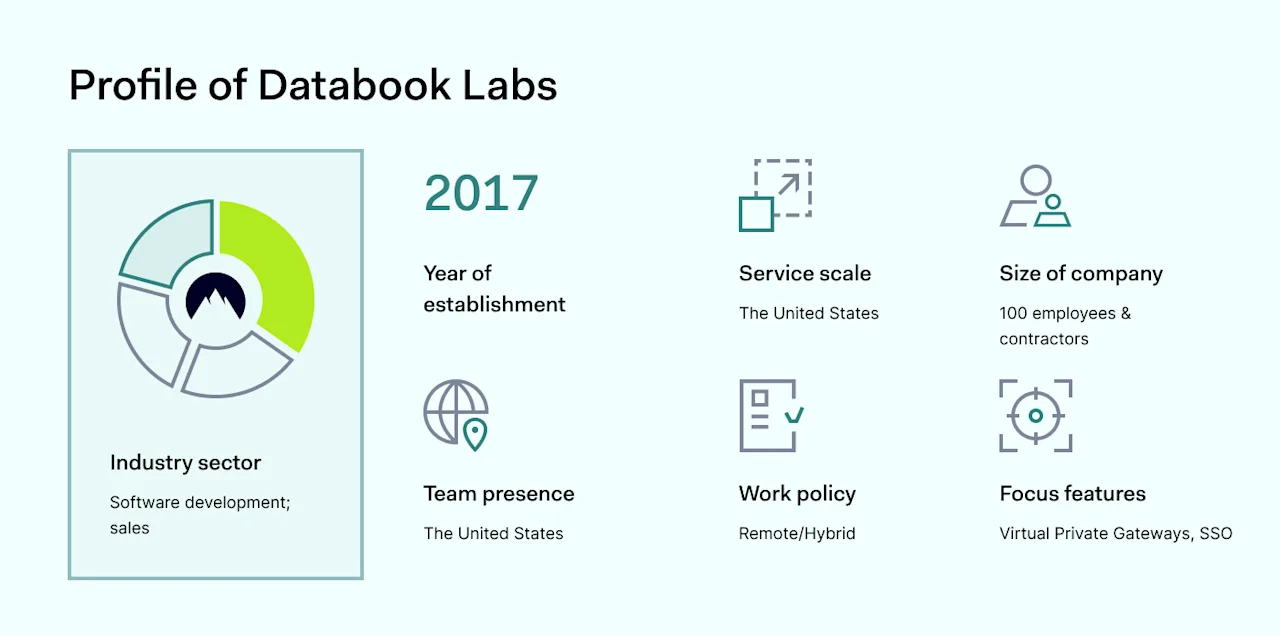
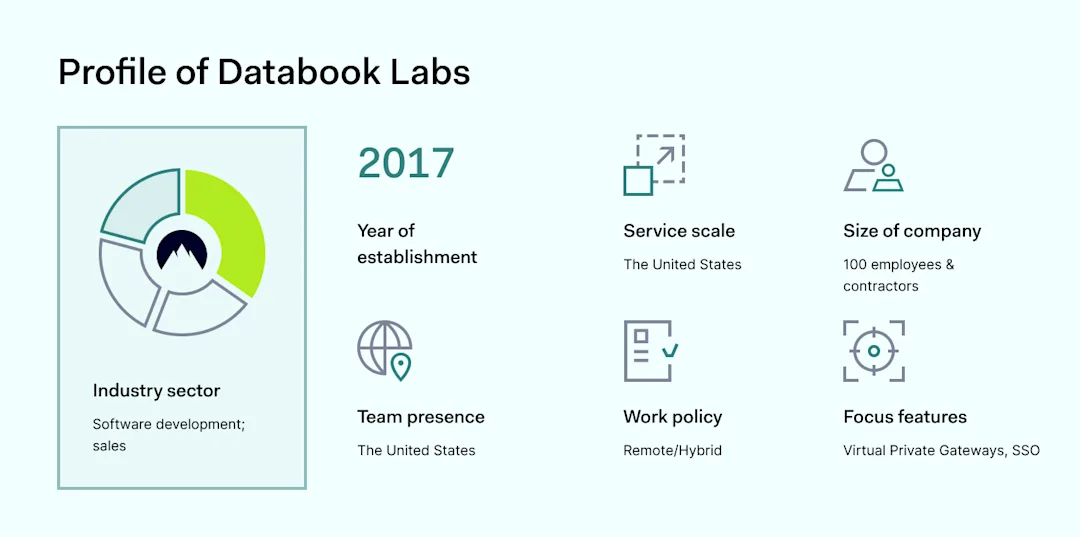
Profile of Databook Labs

With users across 104 countries, the platform ingests and interprets billions of financial and market data signals to generate actionable sales strategies that connect the seller’s solutions to a buyer’s financial pain and urgency.

A successful product led to rapid expansion and a distributed workforce across 8 countries. Anne Simpson, Head of Privacy, Security, and Compliance at Databook Labs, walked us through how the company faced the pressing challenge of ensuring robust cybersecurity in a hybrid work environment.

The challenge

Scaling up securely in a global landscape

Databook Labs experienced accelerated growth, scaling from 12 to 100 employees and expanding to three global offices.

First, starting at the founder’s house basement, the company grew and got its first office before the pandemic. Changing team location and scale required an established security mindset.

Besides, this rapid development and a primarily remote workforce presented significant cybersecurity challenges.

“With a mostly remote workforce, Databook needed a way to secure data while working away from our known networks.”

Click to tweet

Their primary concern was safeguarding data across numerous unknown networks, a critical issue given their large enterprise customer base with stringent security expectations.

The solution

Choosing NordLayer for comprehensive security

When Anne Simpson, Head of Privacy and Security, joined Databook Labs, she recognized the need for a robust VPN solution to protect their global, remote workforce.

“The majority of our customers are large enterprises that want to see high-security standards in place.”

Click to tweet

Besides securing a remote workforce, Anne was also responsible for developing, maintaining, and enforcing Databook’s information security policies to meet client expectations.

“We encourage people to get out there and explore the world while working. When they appear on an unknown network, I can’t guarantee the data transmission’s security, so we had to get a VPN.”

Click to tweet

The integration of NordLayer allowed the company to maintain a high level of security without the need for extensive in-house resources.

“We are a very small team, so we don’t have the resources to build a VPN and maintain one in the house. And that’s what we love about NordLayer.”

Click to tweet

Compatibility, security, and simplicity are the key characteristics NordLayer solution proved to be the top pick.

Why choose NordLayer

After thorough research and peer consultations, NordLayer emerged as the ideal choice. Its ease of implementation, excellent customer support, and compatibility with non-technical users made it a perfect fit for Databook Labs.

The company already had SOC 2 certification, so adding NordLayer to our policies and procedures made it all about privacy and security at Databook Labs.

“After the demo, we felt that NordLayer was the easiest to implement. It gave us everything we needed, and the team was really helpful. We’ve never had a problem with any customer service support issues.”

Click to tweet

As Anne Simpson claims, the tool doesn’t require manual handling, and the security manager doesn’t need to worry about it.

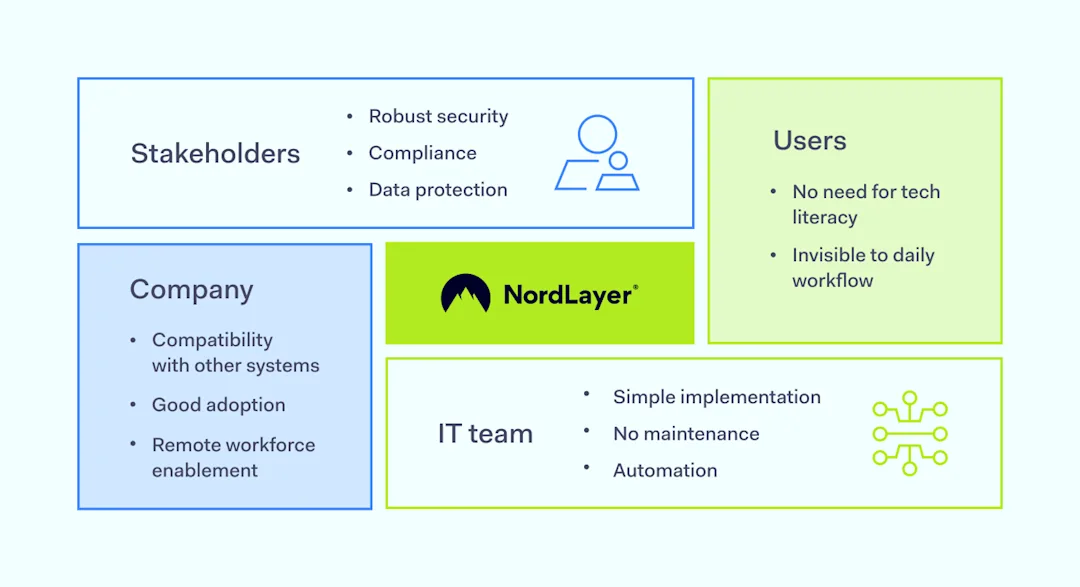
How NordLayer helps manage the expectations of different parties

Overall, NordLayer simplifies the experience of enabling and using a remote network access security tool. It’s designed to be user-friendly for non-tech-savvy employees while meeting the high standards expected by clients and stakeholders.

The outcome

Enhanced security and operational efficiency

Implementing NordLayer had a profound impact on Databook Labs. Anne Simpson and her team found peace of mind in knowing that their data was secure and that they were in compliance with global regulations.

“NordLayer is very user-friendly. During onboarding, our team members receive training on using the VPN, and the Okta integration plays a crucial role. They are well-versed in when it is most beneficial to be connected to the VPN.”

Click to tweet

NordLayer’s solution, with its simplicity, allowed the team to dedicate more time to strategic objectives. It also made it easy for non-technical employees, eliminating the need to manage VPN complexities.

“I would recommend NordLayer VPN as it is simple to use and does not incur any upfront costs, such as setting up our own VPN and needing on-premises hardware.”

Click to tweet

Additionally, NordLayer’s performance causes any issues with the company’s operations, easing initial concerns about potential slowdowns.

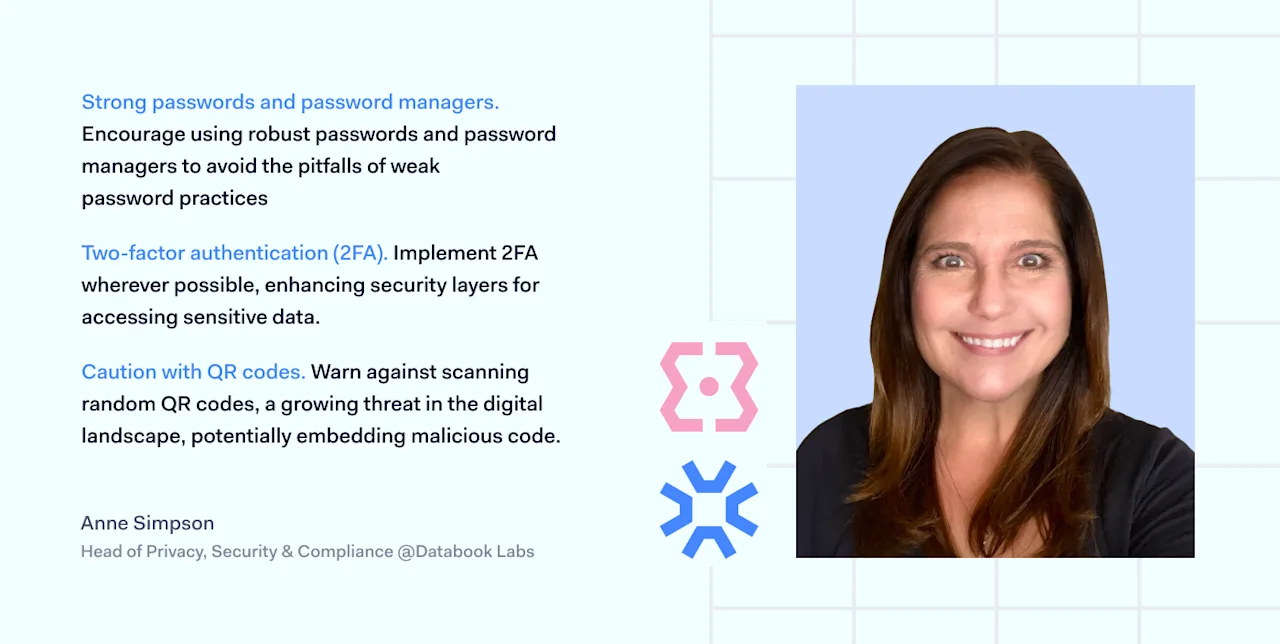
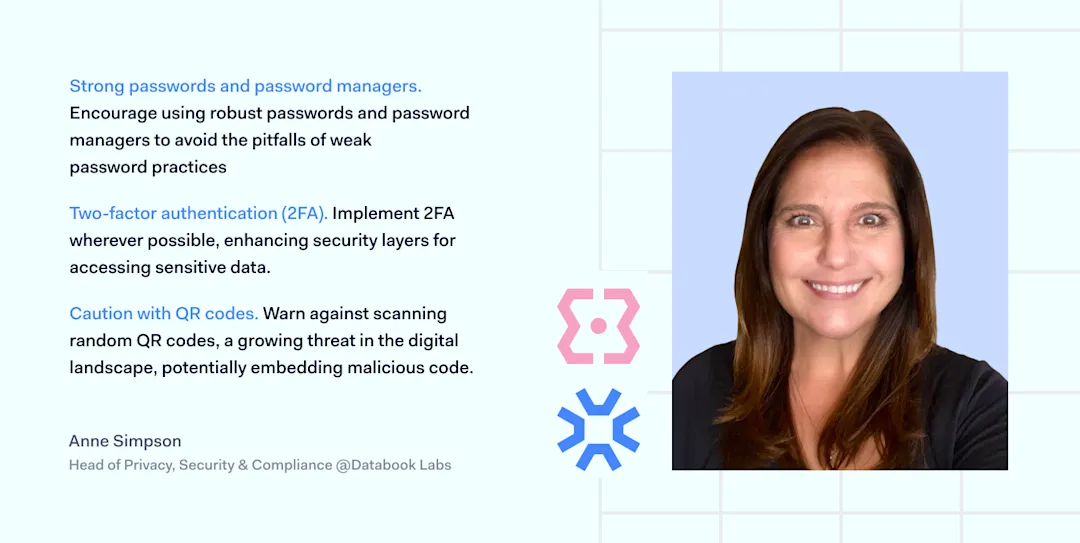
Pro cybersecurity tips

Everyday cybersecurity rules should become a mantra of every tech user in the modern world. But sometimes, it’s not that obvious where to start. Thus, here are the main recommendations from the Head of Privacy, Security & Compliance at Databook Labs, where it’s worth concentrating your focus to begin with.

Quotes of Databook Labs

Databook Labs’ experience using NordLayer proves that being accountable for data security is challenging with remote teams yet achievable using the right solutions. Discover how compatible your cybersecurity strategy is with the NordLayer tool and enjoy the peace of mind it brings to every IT manager who uses it.


IoT Malware Attacks Hit a 400% Increase

So, what’s the problem with these handy IoT devices? In short: they can be hacked – easily. Designed with functionality and convenience in mind, security has taken a back seat. This low level of protection leaves users vulnerable to attack, and IoT devices have become prime targets for cyberattacks. In fact, the Zscaler ThreatLabz research team found that IoT malware attacks increased 400% in the first half of 2023 compared to 2022. 

EU Cyber Resilience Act

On a legislative level, the EU is taking this seriously. The upcoming Cyber Resilience Act (CRA) is already striking fear into the hearts of device manufacturers the world over. But for consumers, the future of IoT looks bright, or at least more secure.

If passed, the CRA “would see inadequate security features become a thing of the past with the introduction of mandatory cybersecurity requirements for manufacturers and retailers of such products, with this protection extending throughout the product lifecycle.”

This is a huge development: Device makers will have to ensure the security of their products past sale. That means regular updates, security patches, and consumer safety being higher on the priority list than ever before. It’s a big shift towards a more secure digital landscape. Smart and secure homes are the future.

US Cyber Trust Mark

While the EU is laying down the law, the US Federal Communications Commission (FCC) is planning to roll out its new “labeling program for smart devices” in 2024. The Cyber Trust Mark will be the shiny new seal of approval for cyber-secure products.

Jessica Rosenworcel, FCC Chairwoman says: “The Cyber Trust Mark will help consumers make more informed decisions about what kind of devices they bring into their homes and businesses. So when you need a baby monitor, or a new appliance, you’ll be able to look for a Cyber Trust Mark… device manufacturers are going to be able to showcase privacy and security in the marketplace by displaying this mark”.

Manufacturers will be permitted to place the seal on products only after official assessment. And though this is still a voluntary seal, i.e. manufacturers aren’t legally obliged to earn it, it’s a step in the right direction for IoT cybersecurity. If you’re in the US, keep an eye out for this logo when making future device purchases.

IoT vulnerabilities & security tips

While most IoT malware attacks are aimed at businesses (manufacturing and education are among the most targeted sectors), consumers should stay vigilant as well. There are several avenues through which attackers can infiltrate your home networks using IoT devices. Here are a few ways that you can protect yourself.

  • Default logins – ISPs and modem/router companies tend to distribute network devices with default logins. These credentials are easily accessible online. A typical username is “admin”, passwords might be basic codes like 1234 or 0000. Easy pickings for hackers – and easy for you to change.

  • Auto-update – If this feature is turned off and you miss security updates, your device will stay open to vulnerabilities longer. Turn on auto-update to avoid this. Smart devices with legacy firmware are the bread and butter of IoT hackers.

  • Separate network for IoT – Keep your devices insulated from your main home network. This acts as an effective layer of security if one of your devices is compromised.

  • Principle of least privilege – Turn off certain “smart” features that you don’t use. Why does your toaster have a camera anyway?

With new regulations taking effect this year and our own proactive security measures at home, a safer cyber future is possible for all.

Listen to the Cyberview podcast on Spotify.

About Version 2 Digital

Version 2 Digital is one of the most dynamic IT companies in Asia. The company distributes a wide range of IT products across various areas including cyber security, cloud, data protection, end points, infrastructures, system monitoring, storage, networking, business productivity and communication products.

Through an extensive network of channels, point of sales, resellers, and partnership companies, Version 2 offers quality products and services which are highly acclaimed in the market. Its customers cover a wide spectrum which include Global 1000 enterprises, regional listed companies, different vertical industries, public utilities, Government, a vast number of successful SMEs, and consumers in various Asian cities.

About NordLayer
NordLayer is an adaptive network access security solution for modern businesses – from the world’s most trusted cybersecurity brand, Nord Security.

The web has become a chaotic space where safety and trust have been compromised by cybercrime and data protection issues. Therefore, our team has a global mission to shape a more trusted and peaceful online future for people everywhere.

About NordLayer
NordLayer is an adaptive network access security solution for modern businesses – from the world’s most trusted cybersecurity brand, Nord Security.

The web has become a chaotic space where safety and trust have been compromised by cybercrime and data protection issues. Therefore, our team has a global mission to shape a more trusted and peaceful online future for people everywhere.

The best compliance books for 2024

Why is it important to be compliant? 

Compliant companies follow industry regulations and implement regulatory standards for data security, privacy protection, and confidentiality.

Digging into the compliance section at Amazon is not an optional extra. Companies that fail to comply face massive penalties or even criminal prosecutions. Compliance also promotes robust security and improves business processes—giving companies a crucial competitive advantage.

Every employee should be aware of compliance. However, compliance books target senior management and security experts. Anyone responsible for handling customer data or defending against cyberattacks should expand their compliance library.

Top compliance books for beginners and professionals

Compliance is a complex and constantly evolving field. It’s also a minefield for poorly informed businesses. Fortunately, a busy community of expert writers interprets regulations and simplifies the compliance challenge.

We don’t have space to list every manual or think-piece here, but the following compliance books are well worth consulting:

  • Governance, Risk Management, and Compliance: It Can’t Happen to Us—Avoiding Corporate Disaster While Driving Success

  • Intentional Integrity: How Smart Companies Can Lead an Ethical Revolution

  • How to Be a Wildly Effective Compliance Officer

  • The Business Guide to Effective Compliance & Ethics

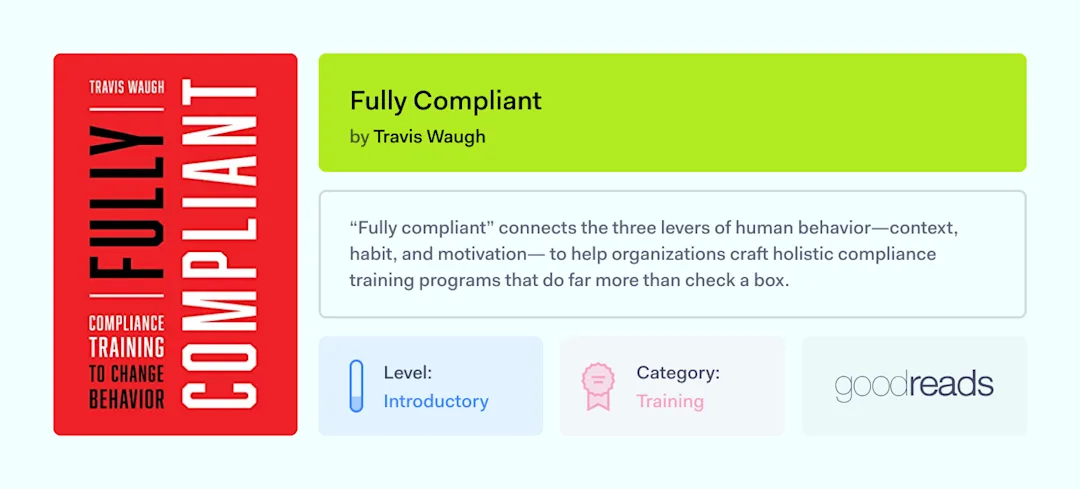
  • Fully Compliant

  • A Concise Guide to HIPAA Compliance

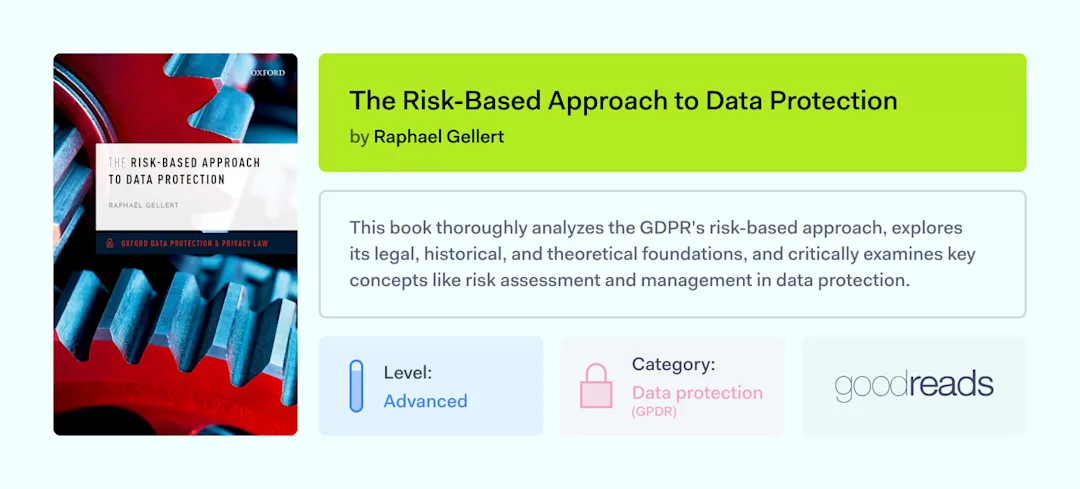
  • The Risk-Based Approach to Data Protection

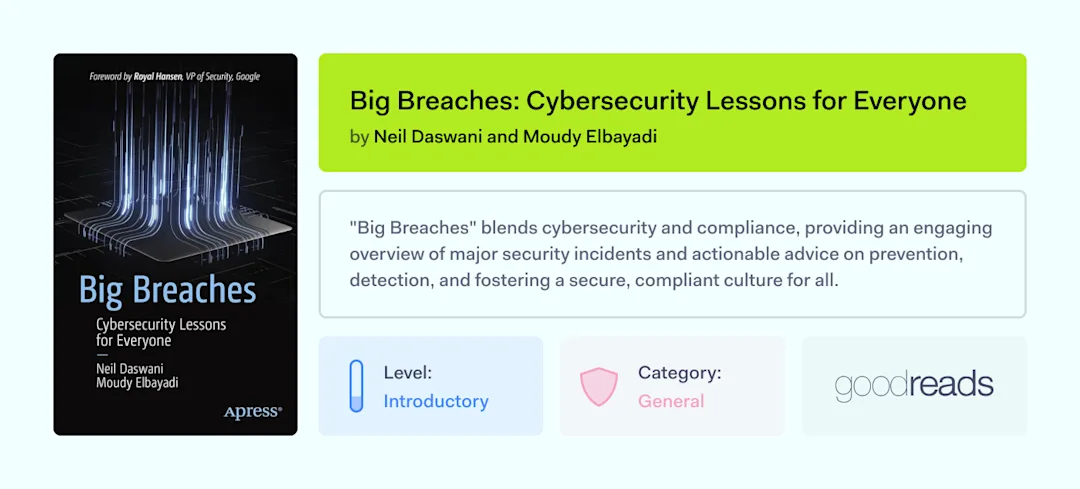
  • Big Breaches: Cybersecurity Lessons for Everyone

  • How To Pay A Bribe: Thinking Like a Criminal to Thwart Bribery Schemes

Governance, Risk Management, and Compliance: It Can’t Happen to Us—Avoiding Corporate Disaster While Driving Success

Author: Richard M. Sternberg

Steinberg founded Pricewaterhouse Cooper’s Strategic Risk Services division and has become one of America’s leading risk consultants. This text primarily aims at senior executives and managers. It provides a general introduction to risk management from a boardroom perspective.

Steinberg’s book is a how-to guide for designing compliant processes and leadership structures. There’s no better way to learn about integrating gold-standard risk management practices into your business organization.

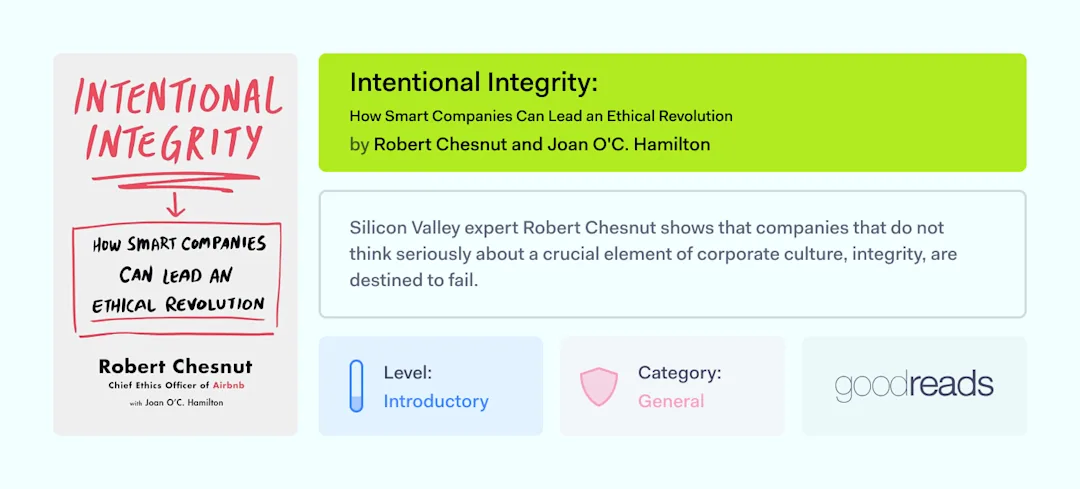
Intentional Integrity: How Smart Companies Can Lead an Ethical Revolution

Authors: Robert Chesnut and Joan O’C. Hamilton

Wouldn’t it be great if every business had an incentive to meet industry regulations and act like a model citizen? Experience suggests that many companies fail to live up to these ideals. But Chesnut argues that’s a mistake. The future belongs to businesses that uphold stellar compliance records and drive an “ethical revolution.”

Chesnut is an expert on Silicon Valley, and he knows about dubious morals. However, things can change for the better. This book is a clear-eyed guide to a world where companies with poor data protection or security records are shamed and punished.

Readers will find inspiration in Chesnut’s advice about building an enterprise-wide ethical culture. And they will also come away with plenty of nuggets about improving corporate governance and how to join the ethical elite.

How to Be a Wildly Effective Compliance Officer

3 Compliance books-How to be a wildly effective compliance officer

Author: Kristy Grant-Hart

Grant-Hart is the CEO of Spark Compliance and a regular winner of Women in Compliance awards. This short primer targets compliance officers. Distilling all of her experience, Grant-Hart provides invaluable advice about persuading colleagues and shaping corporate culture.

This isn’t one of those dust-dry compliance books that overwhelm readers with statistics. Grant-Hart specializes in motivation. Readers will close the book feeling energized, confident, and with a renewed sense of their potential to change business processes.

The Business Guide to Effective Compliance & Ethics

Authors: Tony Osborn and Andy Hayward

Hayward and Osborn tackle the critical question, “Why is corporate compliance failing to prevent scandals and data breaches?” Their answer is radically simple. Tick-box checklists and compliance strategies based on documentation are not enough. Businesses need to be proactive and dynamic to build a culture of compliance.

This book lays out a strategy to create a compliance management program that works. The authors contextualize compliance, focusing on benefits like trust and employee satisfaction. As with all good compliance books, the reader emerges empowered and clear about how to move forward.

Fully Compliant

Author: Travis Waugh

Waugh is a leading expert in compliance training. If you struggle to convey compliance information to employees, this book is an essential read.

Fully Compliant argues that it is not enough to tell employees about the consequences of non-compliance. Successful compliance programs immerse learners in real-life scenarios. Immersive learning induces long-term behavior change—a critical component of continuous compliance strategies.

A Concise Guide to HIPAA Compliance

Author: Lucas M. Slattery

Health Insurance Portability and Accountability Act (HIPAA) compliance is stressful and complicated. It helps to have a go-to reference text as you design compliant systems. Slattery’s work is one of the best compliance books for anyone who needs a grounding in HIPAA rules.

Based on official documents from the Department for Health and Human Services (HHS), this book explains tricky issues like defining personally identifiable health information and applying security controls. Slattery keeps things practical, focusing on affordable and proportionate solutions that meet HIPAA standards.

The Risk-Based Approach to Data Protection

Author: Raphael Gellert

Regulations like the General Data Protection Regulation (GDPR) and the California Consumer Privacy Act (CCPA) have made data protection a hot topic for all digital businesses. Adopting a risk-based approach to compliance balances security and costs—but what does “risk-based” mean? If you have any doubts, Gellert’s expert advice will come in handy.

Gellert is a Professor of Private Law at Radboud University in the Netherlands and isn’t afraid of complexity. His book delves into the history of data protection and conceptual approaches to risk. But it shines when discussing modern-day compliance programs.

Expect to come away with a deeper understanding of how to execute GDPR risk assessments. With Gellert’s help, you should be able to lock down personal data without wasting scarce resources.

Big Breaches: Cybersecurity Lessons for Everyone

Authors: Neil Daswani and Moudy Elbayadi

Brushing up on your compliance knowledge is great, but it also helps to consider the consequences of lax security and privacy processes. Daswani and Elbayadi mercilessly explain worst-case scenarios, using real-world case studies to paint a grisly picture.

Big Breaches range widely. The authors explore phishing and ransomware attacks. They look at software exploits, compromised supply chains, and encryption foul-ups. But it’s not just a tale of woe. Readers learn seven critical habits to avoid data breaches and design a rock-solid compliance program.

How To Pay A Bribe: Thinking Like a Criminal to Thwart Bribery Schemes

Author: Alexandra Wrage and Severin Wirz

This short book dates back to 2016, but it sadly remains evergreen. Comprising a series of essays from prominent anti-corruption lawyers, “How to Pay a Bribe” explains how corruption occurs. The authors use real-life examples of ordinary companies falling victim to bribery or other scandals. They also frame corruption as a compliance failure—suggesting ways to eradicate it from business culture.

Both a good read and a useful guide, this book is essential reading for companies that do business abroad or work in sectors like finance, where US bribery regulations are extremely tight.

Reading compliance books is a great way to refresh your knowledge and gain insights into compliance best practices. However, reading is not enough. Compliance professionals should leverage every source of information and assistance to stay one step ahead of the pack.

Podcasts supplement books with expert interviews and analysis and are perfect for gym sessions or commutes, providing up-to-date opinions from the compliance battlefront. YouTube channels also mix entertainment and information. Webinars from experts provide a gold mine of information about GDPR compliance.

Universities and accreditation bodies offer online compliance courses. There are plenty of course options, including specialized HIPAA or anti-corruption certificates. It’s also worth bookmarking relevant information libraries and referring to them for practical guidance.

NordLayer’s learning center is a good starting place. We have created regulatory compliance articles about regulatory requirements, penalties, and frameworks companies can use to make their operations compliant. Learn about compliance basics and fundamental to advanced techniques, and integrate the latest knowledge into your compliance strategy.

Businesses should never face compliance challenges alone. Order relevant books, binge on podcasts, and bookmark resources to guide your way. You’ll soon find that others have confronted similar problems, and solutions should be easily achievable.


IoT Malware Attacks Hit a 400% Increase

So, what’s the problem with these handy IoT devices? In short: they can be hacked – easily. Designed with functionality and convenience in mind, security has taken a back seat. This low level of protection leaves users vulnerable to attack, and IoT devices have become prime targets for cyberattacks. In fact, the Zscaler ThreatLabz research team found that IoT malware attacks increased 400% in the first half of 2023 compared to 2022. 

EU Cyber Resilience Act

On a legislative level, the EU is taking this seriously. The upcoming Cyber Resilience Act (CRA) is already striking fear into the hearts of device manufacturers the world over. But for consumers, the future of IoT looks bright, or at least more secure.

If passed, the CRA “would see inadequate security features become a thing of the past with the introduction of mandatory cybersecurity requirements for manufacturers and retailers of such products, with this protection extending throughout the product lifecycle.”

This is a huge development: Device makers will have to ensure the security of their products past sale. That means regular updates, security patches, and consumer safety being higher on the priority list than ever before. It’s a big shift towards a more secure digital landscape. Smart and secure homes are the future.

US Cyber Trust Mark

While the EU is laying down the law, the US Federal Communications Commission (FCC) is planning to roll out its new “labeling program for smart devices” in 2024. The Cyber Trust Mark will be the shiny new seal of approval for cyber-secure products.

Jessica Rosenworcel, FCC Chairwoman says: “The Cyber Trust Mark will help consumers make more informed decisions about what kind of devices they bring into their homes and businesses. So when you need a baby monitor, or a new appliance, you’ll be able to look for a Cyber Trust Mark… device manufacturers are going to be able to showcase privacy and security in the marketplace by displaying this mark”.

Manufacturers will be permitted to place the seal on products only after official assessment. And though this is still a voluntary seal, i.e. manufacturers aren’t legally obliged to earn it, it’s a step in the right direction for IoT cybersecurity. If you’re in the US, keep an eye out for this logo when making future device purchases.

IoT vulnerabilities & security tips

While most IoT malware attacks are aimed at businesses (manufacturing and education are among the most targeted sectors), consumers should stay vigilant as well. There are several avenues through which attackers can infiltrate your home networks using IoT devices. Here are a few ways that you can protect yourself.

  • Default logins – ISPs and modem/router companies tend to distribute network devices with default logins. These credentials are easily accessible online. A typical username is “admin”, passwords might be basic codes like 1234 or 0000. Easy pickings for hackers – and easy for you to change.

  • Auto-update – If this feature is turned off and you miss security updates, your device will stay open to vulnerabilities longer. Turn on auto-update to avoid this. Smart devices with legacy firmware are the bread and butter of IoT hackers.

  • Separate network for IoT – Keep your devices insulated from your main home network. This acts as an effective layer of security if one of your devices is compromised.

  • Principle of least privilege – Turn off certain “smart” features that you don’t use. Why does your toaster have a camera anyway?

With new regulations taking effect this year and our own proactive security measures at home, a safer cyber future is possible for all.

Listen to the Cyberview podcast on Spotify.

About Version 2 Digital

Version 2 Digital is one of the most dynamic IT companies in Asia. The company distributes a wide range of IT products across various areas including cyber security, cloud, data protection, end points, infrastructures, system monitoring, storage, networking, business productivity and communication products.

Through an extensive network of channels, point of sales, resellers, and partnership companies, Version 2 offers quality products and services which are highly acclaimed in the market. Its customers cover a wide spectrum which include Global 1000 enterprises, regional listed companies, different vertical industries, public utilities, Government, a vast number of successful SMEs, and consumers in various Asian cities.

About NordLayer
NordLayer is an adaptive network access security solution for modern businesses – from the world’s most trusted cybersecurity brand, Nord Security.

The web has become a chaotic space where safety and trust have been compromised by cybercrime and data protection issues. Therefore, our team has a global mission to shape a more trusted and peaceful online future for people everywhere.

About NordLayer
NordLayer is an adaptive network access security solution for modern businesses – from the world’s most trusted cybersecurity brand, Nord Security.

The web has become a chaotic space where safety and trust have been compromised by cybercrime and data protection issues. Therefore, our team has a global mission to shape a more trusted and peaceful online future for people everywhere.

×

Hello!

Click one of our contacts below to chat on WhatsApp

×