Skip to content

The ever-evolving landscape of cloud security trends

In today’s business environment, cloud computing is the most flexible and cost-efficient method to set up operations. Yet, as businesses increasingly rely on cloud-based services to store, manage, and exchange data, this attracts unwanted guests.

Consequently, there has been a significant increase in data breaches, disrupting business operations and jeopardizing companies’ security and compliance worldwide. These breaches often stem from attackers exploiting vulnerabilities and misconfigurations in cloud systems.

This blog will cover the most recent cloud security trends that are shaping the industry. By keeping up with these developments, businesses can enhance the protection of their digital assets and reinforce the security of their cloud computing infrastructure to mitigate potential breaches.

Key takeaways

  • Cloud computing offers businesses cost-efficiency, flexibility, and scalability, but it also introduces security vulnerabilities and risks

  • The shared responsibility model requires cloud providers to secure the infrastructure while customers secure their data and applications

  • The cloud security landscape is constantly evolving and businesses need to keep up with new trends

  • Cloud security has progressed significantly with improvements in data protection, network security, and connectivity

  • The future of cloud security will see more integration of AI and machine learning

  • To keep up with the trends, organizations can regularly update security policies, implement advanced threat detection, embrace automation, and foster a culture of security awareness

Understanding the concept of cloud security and why it matters today

Cloud computing solves many business problems like scalability, cost-efficiency, and flexibility. At the same time, for most businesses, it also means stepping into unfamiliar territory where it’s easy to leave gaps that hackers could exploit.

The shared responsibility model is also something that needs to be established. In it, the cloud provider is responsible for securing the underlying cloud infrastructure, while the customer is responsible for securing their data and applications. Though it sounds simple, it’s not always easy to crystallize a comprehensive cloud security approach.

As more organizations embrace cloud adoption and rely on cloud services, the need for effective cloud security measures has never been greater.

Evolutions in cloud security

Cloud security has come a long way since its inception. Initially, concerns regarding data protection and network security limited cloud adoption (as well as a requirement for stable online connectivity). Fortunately, as cloud technology has matured, so has its security.

The concept of cloud computing emerged in 1950 with the development of mainframe computers, which could be accessed through thin or static clients. Since then, cloud computing has undergone several iterations, progressing from static clients to dynamic ones, from software-based systems to service-oriented solutions.

Security problems started cropping up when businesses began entrusting their data to major companies like Amazon. Despite the numerous benefits and efficiency improvements, storing critical data on servers that customers couldn’t physically access challenged the conventional notion of security. As data storage expanded in type and volume, hosting companies implemented more extensive precautions to safeguard the data.

The current state of cloud security

Today’s cloud service providers go to great lengths to protect the data stored on their servers. This includes thorough employee background checks to minimize the risk of insider attacks and isolation procedures that prevent one company from accessing another’s data. Yet, it’s still the user’s responsibility to ensure secure passwords and connections like they would have if the data were stored locally.

Encryption of data at rest and in transit, network segmentation, and adopting cybersecurity mesh architectures have all enhanced cloud security. As cloud environments become increasingly complex and multi-cloud adoption rises, ensuring consistent security across different platforms and providers becomes challenging. This emphasizes the need for ongoing security training and proactive new technologies adoption.

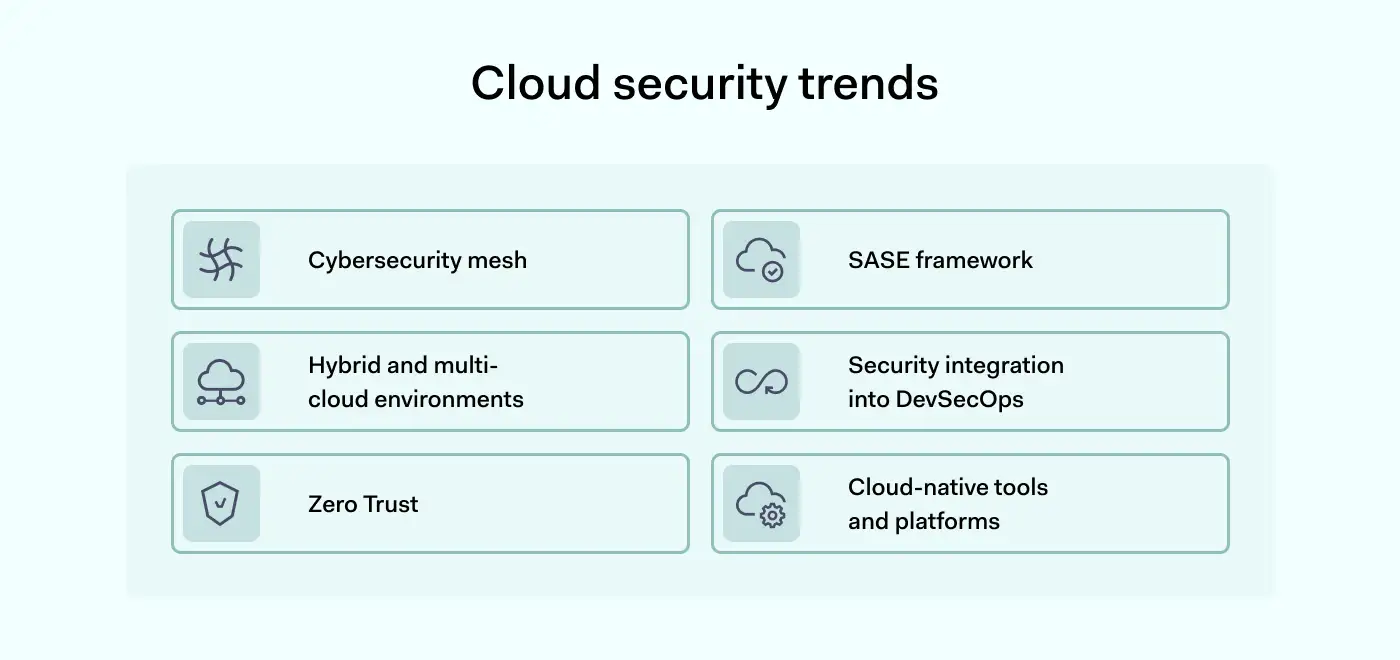
Security teams must be aware of the latest cloud security trends to stay ahead of the ever-changing threat landscape. Here are the main ones you should be aware of:

1. Cybersecurity mesh

Companies are adopting the concept of cybersecurity mesh to ensure the security of data and assets in the cloud. This approach involves creating a distributed network and infrastructure that forms a security perimeter around the individuals and devices connected to the network. By implementing cybersecurity mesh, companies can centrally manage data access and enforce security policies, aligning with Zero Trust architecture principles.

2. Hybrid and multi-cloud environments

The trend in cloud security involves adopting a hybrid approach or leveraging multiple cloud services. Organizations can migrate their data entirely to the cloud or keep some data and services hosted privately. The hybrid approach combines local and cloud-hosted services, allowing for more secure deployments. Additionally, using multiple clouds has gained popularity, with companies adopting a multi-cloud strategy. This approach allows for better utilization of security tools across different environments, such as SIEM and threat intelligence.

3. Zero Trust

The principle of Zero Trust emphasizes verifying rather than blindly trusting anything within or outside an organization’s perimeters. With the increasing reliance on cloud services, Zero Trust should be a priority for all organizations. Traditional perimeter security measures and firewalls are insufficient to protect valuable resources such as user data and intellectual property. Zero Trust enhances security around every device, user, and connection, enabling proactive threat management and comprehensive defense strategies.

4. SASE framework

Gartner has stated that the future of network security lies in the cloud. The Secure Access Service Edge (SASE) framework offers a cloud-based cybersecurity solution that supports digital enterprises’ dynamic and secure access needs. It combines wide area networking (WAN) capabilities with multiple security features such as anti-malware and security brokers to establish a comprehensive security environment within a cloud infrastructure. SASE is an essential framework for securely connecting users, systems, and endpoint devices to a unified cloud environment.

5. Security integration into DevSecOps

DevSecOps is a methodology that integrates security protocols throughout the software development lifecycle (SDLC). Organizations can address threats proactively rather than reactively by incorporating security measures early in the development process. DevSecOps is particularly effective in fast-paced, fully automated software development lifecycles, enabling secure innovation. Collaboration between DevOps and security teams is essential to implement strong security measures throughout the entire supply chain and make security a continuous process within the continuous integration/continuous delivery pipeline.

6. Cloud-native tools and platforms

Cloud-native applications designed specifically for the cloud environment are becoming increasingly prevalent. These applications take advantage of the speed and efficiency offered by cloud platforms. Traditional security tools designed for on-premises applications may not be adequate to protect cloud-based resources. Companies recognize the need to invest in cloud-based security tools and platforms to safeguard their cloud resources against potential attacks.

While cloud security progresses along with cloud computing, it’s crucial to acknowledge the dark side of trends that security teams must address. Attackers are finding new ways to exploit vulnerabilities, and organizations must be cautious. Here are the emerging threats directed at cloud computing security:

Slow patching leaves web services vulnerable

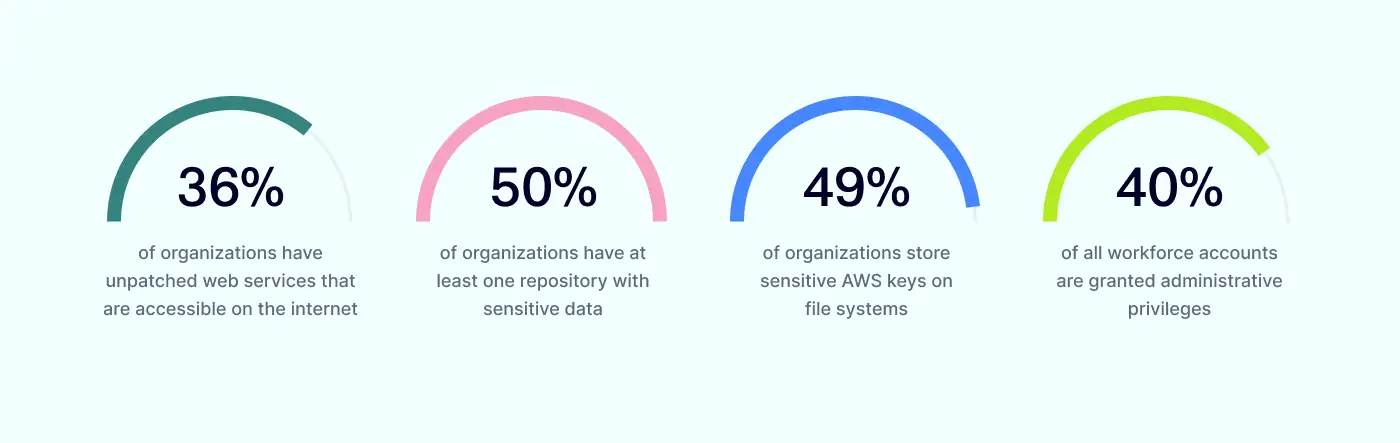
Based on the Orca Security report, 36% of organizations have web services in their cloud environment that are accessible to the Internet but remain unpatched. Such services pose a significant risk as they contain known vulnerabilities and bugs, which can serve as primary entry points for attacks on cloud environments. The absolute majority of cyber-attacks on cloud infrastructure begin with the exploitation of these known vulnerabilities.

Unpatched vulnerabilities provide malicious actors with easy access to cause service downtime, enable remote code execution, or facilitate unauthorized remote access in certain cases. Users must promptly apply fixes through updates or patches to contain potential risks.

Git repositories containing sensitive data

Storing sensitive data in Git repositories should be avoided at all costs. It may include information like database passwords, API keys, encryption keys, hash salts, and secrets, which can be mistakenly pushed into a Git repository. While it deviates from security practices, the inclusion of this data into the source code of an application might inadvertently leak it to hackers. Therefore, repositories must be checked for sensitive information, which should be removed from the repository and its history.

AWS keys storage on file systems

At least 49% of organizations store sensitive AWS keys on file systems within virtual machines. AWS keys can function as backdoors to your system. They can grant access to all your resources and the ability to perform any operation, like launching EC2 instances or deleting S3 objects. Therefore, it’s crucial always to store your AWS keys separately and avoid sharing them with external parties.

Instead of AWS, it’s a good practice to use temporary credentials. They include an access key ID and secret access key that would also include a security token specifying the expiration date of the credentials.

Too many administrators for a single organization

Single sign-on providers suggest putting limits on the administrative privileges. For instance, only 50% of admins should have super admins privileges, if you have more, you’re risking your organization’s security. This is much more than it would be advisable, as administrators have many permissions that directly relate to your information security.

As a rule of thumb, it’s generally inadvisable, except in exceptional circumstances, not to define an IAM role with full administrative privileges. Such a role grants anyone who assumes it the ability to perform any action on any resource within the account. This violates the Principle of Least Privilege (PoLP), significantly expands the attack surface, and increases the risk of a full account takeover.

The road ahead: future of cloud security

Looking ahead, the future of cloud security is full of challenges and opportunities. One of the most obvious courses for development is the continued integration of artificial intelligence and machine learning into cloud security operations. These technologies will enable autonomous threat detection, automated incident response, and adaptive security measures.

The speed at which these developments will reach the end-users depend on the service providers’ initiatives to invest in advanced technologies. Yet, it’s likely that the shared responsibility model will continue to be relevant, and while the user will be provided with more tools, it will still be needed to make sense of the provided data and act on it.

Conclusion

Cloud security is an ever-evolving landscape with new trends and challenges emerging regularly. For this reason, organizations must stay alert and recognize the importance of cloud security and its recent developments.

By adopting advanced technologies, adopting proactive security measures, and fostering collaboration with cloud providers, organizations can navigate the complex cloud environment while safeguarding their data, applications, and infrastructure against evolving security threats.

FAQs

What is the role of AI in cloud security?

AI can be used to enhance threat detection and response capabilities by analyzing vast amounts of data and identifying patterns that may indicate security threats or anomalies. In addition, AI can assist in automating security tasks, such as security patching, vulnerability management, and incident response. This can help prevent various types of attacks like malware, phishing attempts, and data breaches, reduce the workload on security teams, and improve overall efficiency.

What is a cloud access security broker (CASB), and how does it contribute to cloud security?

CASB is an intermediary between an organization’s premises infrastructure or network and cloud service providers. It helps organizations extend their security policies and controls to the cloud environment. Offering a range of security functionalities, it also helps to expand visibility into cloud storage, data loss prevention (DLP), access control, threat detection, encryption, and compliance monitoring.

How does the Zero Trust model enhance cloud security?

The Zero Trust model enhances cloud security by shifting the traditional perimeter-based security approach to a more dynamic and granular model. Instead of blindly trusting users or devices within a network, Zero Trust assumes that all network traffic, whether from inside or outside the network, is potentially malicious and must be verified before granting access. That way, organizations can reduce the risk of lateral movement within their cloud environment, mitigate the impact of compromised credentials, and improve overall security posture.

What strategies can organizations adopt to stay ahead of future cloud security trends?

To stay ahead of future cloud security trends, organizations can:

  • Regularly assess and update security policies

  • Implement advanced threat detection and response capabilities

  • Embrace automation and orchestration

  • Foster a culture of security awareness

All of these actions improve overall business security posture and help stay one step ahead of unauthorized access attempts.

How can NordLayer help?

As cloud computing is at the center of modern business operations building, its security is at the forefront of business priorities. A robust cloud security strategy must include access controls, encryption, firewalls, and auditing. However, finding a reliable partner isn’t always easy.

NordLayer can be a helpful ally when securing public and private cloud infrastructure setups. Using our Virtual Private Gateways, SaaS applications, and other resources can be reached efficiently but securely. With features like IP allowlisting, overall business network security posture is improved, allowing only authorized personnel to access your cloud environments.

Identity checks can be enforced using 2FA and SSO to ensure secure authentication. A tandem of all of these features makes cloud security management safer and easier to manage.

Contact the NordLayer team to learn more about how your cloud infrastructure could be secured.

About Version 2 Digital

Version 2 Digital is one of the most dynamic IT companies in Asia. The company distributes a wide range of IT products across various areas including cyber security, cloud, data protection, end points, infrastructures, system monitoring, storage, networking, business productivity and communication products.

Through an extensive network of channels, point of sales, resellers, and partnership companies, Version 2 offers quality products and services which are highly acclaimed in the market. Its customers cover a wide spectrum which include Global 1000 enterprises, regional listed companies, different vertical industries, public utilities, Government, a vast number of successful SMEs, and consumers in various Asian cities.

About NordLayer
NordLayer is an adaptive network access security solution for modern businesses – from the world’s most trusted cybersecurity brand, Nord Security.

The web has become a chaotic space where safety and trust have been compromised by cybercrime and data protection issues. Therefore, our team has a global mission to shape a more trusted and peaceful online future for people everywhere.

How to change or reset your PayPal password

It goes without saying that you should protect all your online accounts with strong passwords. Data breaches, phishing attacks, and misplaced Post-it notes could all lead to stolen accounts. But when it comes to financial services, it’s particularly important to be careful.

How to change your PayPal password

PayPal is a quick and easy way to send and receive money. But since it is usually linked to your credit card, it’s important to change your password regularly and always use a strong one.

Please note that you can’t change the password through the PayPal app — you’ll have to log in through a browser.

Here’s how to change your PayPal password in four easy steps:

  1. Log into your PayPal account and click the little gear icon in the upper right corner.

  2. Click on “Security” in the top banner.

  3. Click “Update” in the “Password” field.

  4. Enter your current and new passwords and click “Change password.” All done!

How to reset your PayPal password

If you forgot your PayPal password, you can reset it through the browser and the PayPal app.

  1. Go to PayPal, click “Log in,” and select “Forgot password?”

  2. Enter the email address you used to create your account and click “Next.”

  3. Follow the instructions in the email you receive.

How to change your PayPal security questions

Please note that you can’t change the security questions through the PayPal app — you’ll have to log in through a browser.

Here’s how to change your security questions on PayPal:

  1. Log into your PayPal account and click the little gear icon in the upper right corner.

  2. Click on “Security” in the top banner.

  3. Click “Update” in the “Security questions” field.

  4. Select new security questions and write your answers. Click “Save” and you’re done!

How to set up a passkey for your PayPal account

Passkeys are a new and secure authentication standard introduced by the FIDO Alliance. Think of passkeys as a replacement for passwords that use your fingerprint, face, or a device PIN to sign in to apps and websites across the internet. Designed for supreme security and convenience, passkeys facilitate a seamless login process.

If you are interested in setting up a passkey for your PayPal account, here’s a quick rundown of how to do it:

  • Access your PayPal account using your existing username and passwords.

  • Once you access your account you will see an option “Create a passkey.”

  • Now you will need to authenticate via biometrics.

  • Once you’re authenticated, the passkey will be automatically created, and the next time you log in to your PayPal account, you will not need your username or passwords. The passkey will do the trick.

How to use PayPal safely

Using financial services online is convenient, but it can also be risky — there are many malicious actors lurking on the internet, trying to steal your money. Follow these simple tips to increase your security while making payments online:

Avoid making transactions when connected to public Wi-Fi. Hackers can set up fake hotspots and then monitor your actions online. Using a VPN will encrypt your connection, making it impossible for anyone to see the data you send and receive. You only need to be aware of snoopers looking over your shoulder as you type in your passwords!

Keep the PayPal app up to date. Apps can have vulnerabilities and bugs that are not discovered for months. But once they are brought to light, your account could be in danger. Set up automatic updates on your PayPal app to make sure you have the latest security patch installed.

Be cautious with links and attachments in emails. If you get an alarming email from PayPal claiming that your account is in danger and you must change your password immediately, don’t click any links. Open a new tab, enter the address manually, and check to see if your account is really in danger.

Enable two-factor authentication. Passwords are your first line of defense, but using 2FA will take your account security to another level. You can choose to receive a code via text or use an authenticator app or a security key for your PayPal account’s 2FA.

Set up passkeys. Passkeys are a new, passwordless authentication method that offer a more secure and convenient way to access websites and apps using only your fingerprint, face scan, or a device PIN. Because passkeys leverage public key cryptography, they are resistant to phishing attacks, making them even more secure than most multi-factor authentication methods.

Use a unique and strong password. When you change your password, pick one that is impossible to guess. That means using at least 12 characters that include upper- and lowercase letters, numbers, and special symbols. Need help? Try our password generator.

Keep your PayPal password safe with NordPass. Let’s be frank. All of us have way too many passwords on our hands. Remembering each one — well, that’s just an illusion. But with the NordPass password manager you can have all of your passwords securely stored in a single place, and you can autofill them with just a click. The same goes for passkeys — the NordPass Passkey Holder is designed as a secure storage for all of your passkeys. Tidy mess of online life with NordPass today.

Make using financial services online stress free with NordPass!

About Version 2 Digital

Version 2 Digital is one of the most dynamic IT companies in Asia. The company distributes a wide range of IT products across various areas including cyber security, cloud, data protection, end points, infrastructures, system monitoring, storage, networking, business productivity and communication products.

Through an extensive network of channels, point of sales, resellers, and partnership companies, Version 2 offers quality products and services which are highly acclaimed in the market. Its customers cover a wide spectrum which include Global 1000 enterprises, regional listed companies, different vertical industries, public utilities, Government, a vast number of successful SMEs, and consumers in various Asian cities.

About NordPass
NordPass is developed by Nord Security, a company leading the global market of cybersecurity products.

The web has become a chaotic space where safety and trust have been compromised by cybercrime and data protection issues. Therefore, our team has a global mission to shape a more trusted and peaceful online future for people everywhere.

Decrypting the common misconceptions about encryption

In cybersecurity, encryption is one of the key tools to secure sensitive information against unauthorized access. Nowadays, it’s one of the major components of digital data privacy. It’s also a word often encountered, yet frequently misunderstood. This leads to the proliferation of misconceptions that cause confusion and steer individuals toward poorly-informed security choices.

Therefore, in this article, we aim to raise awareness about potential encryption misconceptions that could expose organizations to cyber threats and data breaches. We’ll decode the risks of inconsistent encryption practices and highlight the best practices for adopting encryption in daily operations. By learning how to distinguish between myths and facts, you can effectively fortify your online security and avoid costly errors in safeguarding confidential data.

Understanding encryption

To understand how encryption works, it’s essential to grasp the principles of cryptography. This is the science and practice of designing secure communication and information systems. It provides the theoretical foundation and mathematical tools for creating encryption algorithms that protect sensitive information from unauthorized access.

Cryptography follows the four main principles:

  1. Confidentiality. Refers to rules and guidelines, ensuring the information is restricted to specific senders and recipients.

  2. Data integrity. Maintains that a message cannot be modified during the transit between the sender and the intended recipient.

  3. Authentication. Verifying that the data claimed by the user rightfully belongs to them.

  4. Non-repudiation. Assurance that associated parties cannot deny the authenticity or the act of sending a message.

Therefore, encryption is a specific technique within the field of cryptography. It converts plain, readable data into a scrambled, unintelligible form (ciphertext) using an encryption algorithm and key. It can only be decoded to the original form with a decryption key. The primary purpose of encryption is to ensure the confidentiality of data, preventing unauthorized users from accessing the original content.

Encryption involves hashing an arbitrary length value to obtain a fixed-length ciphertext that depends on the algorithm used. Some examples of cryptographic algorithms include Advanced Encryption Standard, Triple DES, Blowfish, and ChaCha20.

The misconception explained

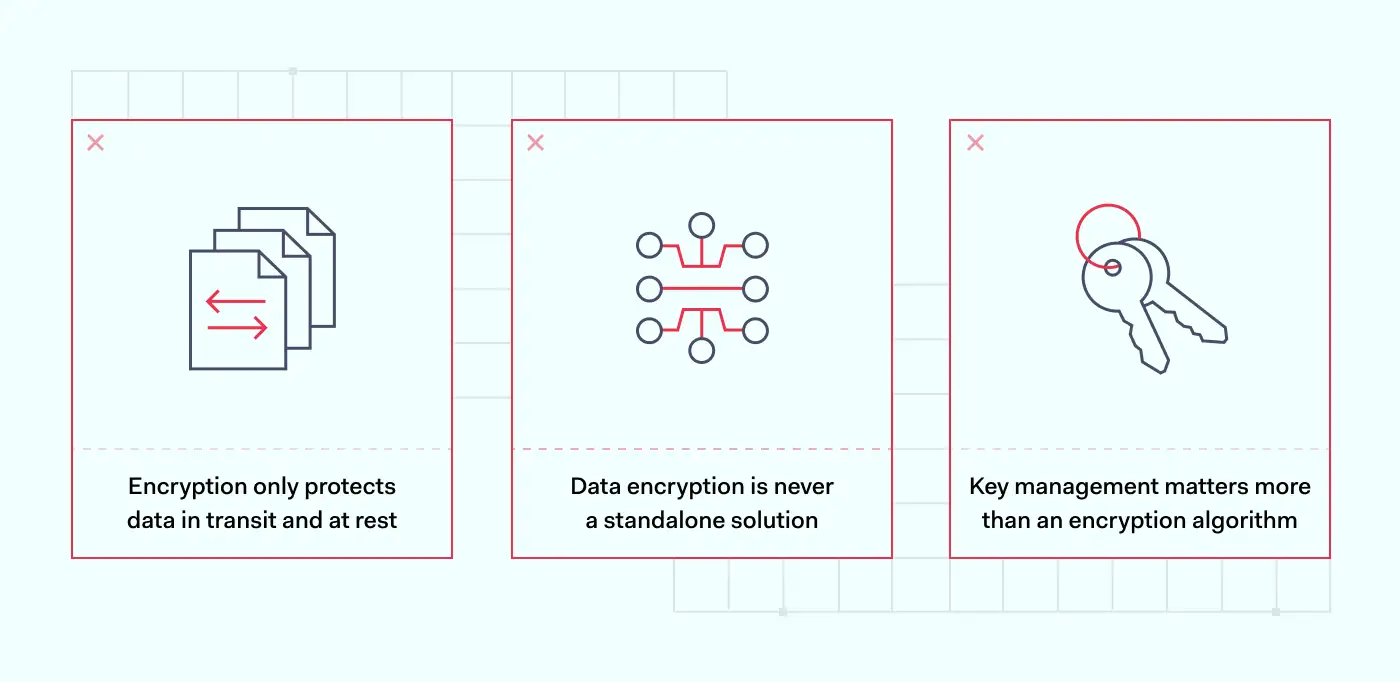
One common misconception about encryption is that it’s an ultimate defense against all cybersecurity threats. While encryption does help against various threats, even if the data is stolen, it’s not a standalone solution. Here are some things that you should consider:

Encryption only protects data in transit and at rest. Encryption is effective in cases when the data is stored or transmitted. This makes it unreadable to anyone without the decryption key. However, it is vulnerable if the end-point device has been compromised and the data is decrypted for use.

Data encryption is never a standalone solution. Encryption should be combined with other cybersecurity measures like multi-factor authentication, firewalls, regular system updates, and more to create a robust defense against cyber threats. This means using multiple layers of security to protect valuable data and assets, with each layer providing more challenges for attackers to breach the system.

Key management may matter more than an encryption algorithm. It’s easy to pick the most complex encryption algorithm for sensitive data and assume it is now protected under nine locks. The problem is that the strength of encryption also depends on the secrecy and security of the keys used to encrypt and decrypt the data. Therefore, proper key management is as important as technological security measures.

The risks of inconsistent encryption practices

Our previous examples show that encryption isn’t enough to guarantee data security. What sometimes matters more than cipher algorithm strength is encryption practices.

Inadequate protection of sensitive information

At its core, encryption transforms understandable information, or plaintext, into unintelligible text, or ciphertext. If an organization inconsistently applies encryption, there’s a chance that some data will not be adequately protected. This inconsistent protection could be due to only encrypting certain data types, failing to encrypt data in transit, or neglecting to encrypt backup files.

As a result, sensitive information such as intellectual property, customer data, or financial records may be exposed. Malicious actors can exploit this information, leading to financial losses and damage to a company’s reputation.

Regulatory non-compliance

Regulations such as the General Data Protection Regulation (GDPR) in the European Union, the California Consumer Privacy Act (CCPA) in the U.S., and many others, require businesses to take specific steps to protect consumer data, often including encryption. Inconsistent encryption practices can lead to regulatory non-compliance, resulting in potential fines and penalties and further damaging an organization’s reputation.

Interoperability issues

Inconsistency in encryption can lead to compatibility problems. For example, if different encryption algorithms or key lengths are used across different systems or departments within the same organization, it can cause difficulty in data sharing and management. This can lead to inefficiency, potential data loss, or the need for resource-intensive data translation.

Best practices for adoption of encryption practices

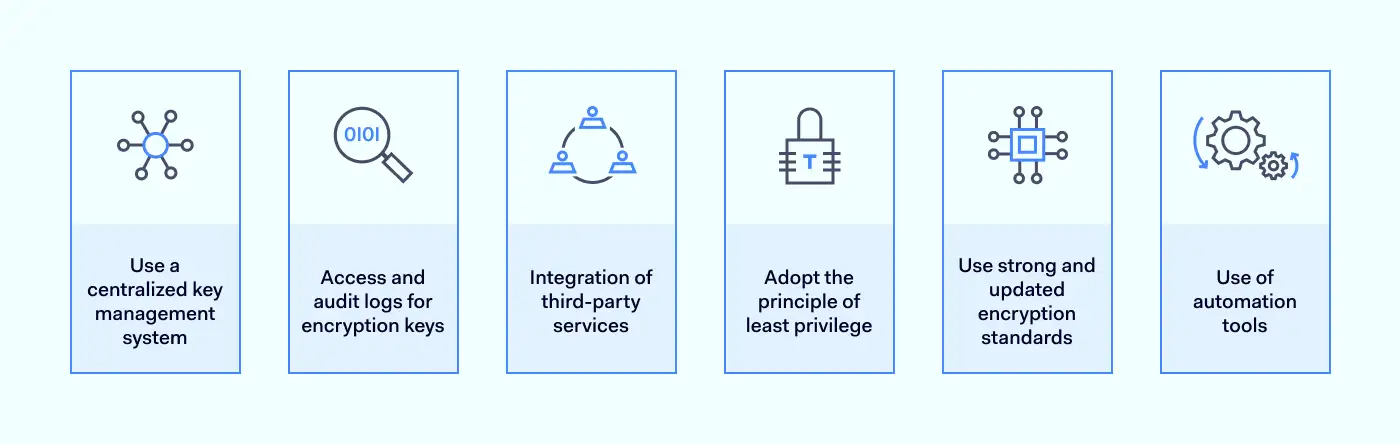
Encryption is vital to any cybersecurity strategy as it adds an essential layer of protection for data at rest and in transit. Here are some of the best practices for adopting encryption.

Centralized key management system

Different encryption keys used can present a significant challenge regarding storage accessibility. A centralized key management system allows storing encryption keys separately from the encrypted data, providing an additional layer of security in case of a data breach, and minimizing the risk of compromise.

The centralization of the key management process offers further advantages in terms of processing. While the encryption and decryption operations occur locally where the data resides, activities like storage, rotation, and generation of keys are performed away from the actual data location. This separation streamlines the encryption-decryption process and enhances overall security.

Access and audit logs for encryption keys

Access to encryption keys should be limited only to those individuals who genuinely need them. This control can be established through a centralized key management process, ensuring only authorized users are granted access. Avoid cases when a single user holds exclusive access to the key, as this could lead to problems if the user loses their credentials or if data corruption occurs.

Additionally, comprehensive audit logs maintenance is critical to encryption key management. These logs must meticulously document the complete interaction logs of each key, encompassing its creation, deletion, and usage patterns. Every operation related to these keys should be recorded, including details about who accessed the key and the timestamp of access. This facilitates compliance requirements and enables efficient investigation during a key compromise.

Integration of third-party services

Organizations frequently rely on external devices distributed across their network to perform various functions. Still, these devices often lack seamless interaction with databases. Consequently, choosing encryption methods compatible with the third-party applications they interact with is essential.

Incorporation of third-party APIs entails significant risks like SQL injection, cross-site scripting, denial of service, spoofing, malware code, and others. This makes API security a major concern. To address this issue, it’s necessary to use API Management Platforms, providing a range of features like monitoring, analytics, alerting, and life-cycle management.

The principle of least privilege

The principle of least privilege advocates that organizations should grant administrative rights based solely on user roles. This restricts the assignment of such rights to applications and minimizes exposure to internal and external threats. As access is limited through role-based control mechanisms, the potential for harm is reduced.

It’s important to note that this principle is not limited to human users. The principle encompasses all interconnected software applications, systems, and devices. For successful implementation, a centralized control system is necessary. It mitigates the risk of “privilege creep” and minimal access levels to human and non-human entities.

Use strong and updated encryption standards

Outdated encryption algorithms are easier to crack because the processing power of computers has dramatically increased. Using robust and up-to-date encryption standards like AES-256 can provide better security. Complex algorithms make it nearly impossible for unauthorized individuals to access the data. This protects sensitive customer information, financial data, trade secrets, and intellectual property.

Use of automation tools

Manual key management not only consumes a significant amount of time but also introduces the risk of errors. This is especially the case when dealing with the scale of large organizations. A more intelligent approach to address this challenge is by implementing automation. For instance, automation can create, rotate and renew keys at specified intervals, proving an effective and prudent practice.

How can NordLayer help?

Encryption is an essential tool in our digital world, providing a robust line of defence against cyber threats. That said, various misconceptions surrounding encryption can undermine its effectiveness. Strong and consistent encryption practices can provide the necessary shield in our interconnected world.

This is also where NordLayer can help. NordLayer establishes connections to a Virtual Private Gateway using OpenVPN, IKEv2/IPsec, and NordLynx protocols that are encrypted with Advanced Encryption Standard (AES) 256-bit or ChaCha20 algorithms. Meanwhile, our single extension for different browsers uses Transport Layer Security encryption for web traffic.

The connections and online browsing can be further secured by enabling features like two-factor authentication, single sign-on, device posture monitoring, ThreatBlock, and DNS filtering.

Most importantly, NordLayer can be set to auto-connect to a Virtual Private Gateway server as soon as an internet connection is detected. This enforces the consistent usage of security tools, as each time an employee turns on a computer, it automatically connects to a Virtual Private Gateway.

Get in touch with the NordLayer team directly to explore innovative data security solutions that make damaging data breaches much less likely.

About Version 2 Digital

Version 2 Digital is one of the most dynamic IT companies in Asia. The company distributes a wide range of IT products across various areas including cyber security, cloud, data protection, end points, infrastructures, system monitoring, storage, networking, business productivity and communication products.

Through an extensive network of channels, point of sales, resellers, and partnership companies, Version 2 offers quality products and services which are highly acclaimed in the market. Its customers cover a wide spectrum which include Global 1000 enterprises, regional listed companies, different vertical industries, public utilities, Government, a vast number of successful SMEs, and consumers in various Asian cities.

About NordLayer
NordLayer is an adaptive network access security solution for modern businesses – from the world’s most trusted cybersecurity brand, Nord Security.

The web has become a chaotic space where safety and trust have been compromised by cybercrime and data protection issues. Therefore, our team has a global mission to shape a more trusted and peaceful online future for people everywhere.

NordLayer 於遙距破突獎項計劃 2023 中 獲評為「整體表現最佳之遙距工作安全解決方案」


NordLayer 宣布於 2023 年度遙距破突獎項計劃(Annual RemoteTech Breakthrough Awards)中,獲評為整體表現最佳的遙距工作安全解決方案(Best Overall Remote Work Security Solution)。

在超過 1,250 個提名中脫穎而出,NordLayer 的 CTO Juta Gurinaviciute 表示:「我們對於獲獎感到引以為傲和充滿感激,尤其是在遙距工作領域。疫情迫使人們轉向遙距工作,這個獎項肯定了我們為各種公司企業提供安全可靠的遙距方案所付出的辛勤工作和奉獻。」

NordLayer 是一款針對商業用途而設計的網絡安全工具,其基於 NordVPN 標準開發,旨在為各種規模和工作模式的公司企業提供靈活且易於實施的解決方案。該工具能夠幫助公司企業以「零壓力」的方式保護網絡,通過技術改進提升網絡安全性並實現現代化的網絡和資源訪問,以符合最佳的監管合規標準。NordLayer 是一個功能強大的工具,支援公司企業採用零信任網絡接入(ZTNA)和安全網關(SWG)原則,同時提供安全服務邊緣(Security Service Edge)的網絡安全服務。它與現有基礎設施輕鬆整合,無需硬件並且考慮到易於擴展的設計,以滿足敏捷企業和分散式工作團隊當今不同的增長節奏和即時網絡安全需求。

「遙距破突獎項計劃」是全球技術創新和領導力領先市場情報和認可平台 Tech Breakthrough 的一部分,獎項旨在表彰全球在遙距工作和分佈式團隊領域所提供的卓越技術、服務、公司和產品之成就,共為技術公司和解決方案在消息傳遞和通信、項目管理、虛擬活動、團隊協作、虛擬辦公室、協作設計等領域提供一個公開認可的論壇。

關於 NordLayer
NordLayer 是現代企業的自適應性網絡存取安全解決方案,來自世界上其中一個最值得信賴的網絡安全品牌 Nord Security。致力於幫助 CEO、CIO 和 IT 管理員輕鬆應對網絡擴展和安全挑戰。NordLayer 與零信任網絡存取(ZTNA)和安全服務邊緣(SSE)原則保持一致,是一個無需硬件的解決方案,保護公司企業免受現代網絡威脅。通過 NordLayer,各種規模的公司企業都可以在不需要深入專業技術知識的情況下保護他們的團隊和網絡,它易於部署、管理和擴展。

關於 Version 2 Digital
Version 2 Digital is one of the most dynamic IT companies in Asia. The company distributes a wide range of IT products across various areas including cyber security, cloud, data protection, end points, infrastructures, system monitoring, storage, networking, business productivity and communication products. Through an extensive network of channels, point of sales, resellers, and partnership companies, Version 2 offers quality products and services which are highly acclaimed in the market. Its customers cover a wide spectrum which include Global 1000 enterprises, regional listed companies, different vertical industries, public utilities, Government, a vast number of successful SMEs, and consumers in various Asian cities.

Our patent journey in the USA: From zero to 100

As cybercrime continuously evolves, so does innovation in the cybersecurity industry. Since 2010, more than 2000 patents have been created in this field, with most cybersecurity patents registered in the United States.

Having recently got our 100th US patent granted, Nord Security now holds the highest number of US patents in the Baltic States. 

Curious how we managed to achieve this so fast? Watch the video featuring Aušra Diliautaitė, Head of IP and Business Operations at Nord Security, and Karolis Pabijanskas, Staff Engineer, R&D at NordVPN, or read below to find out.


What is a patent?

A patent is a government-granted right that gives the patent owner the exclusive right to make, use, sell, or offer to sell the invention for a limited period of time.

To be granted a patent, an invention must meet essential criteria – it must be novel, useful, and non-obvious.

Applications for patents can be submitted to national patent offices, such as the United States Patent and Trademark Office (USPTO), the European Patent Office (EPO), or international organizations like the World Intellectual Property Organization (WIPO) for protection in multiple countries. Patents can help businesses protect their inventions and generate revenue.

The areas of most patents

Today, Nord Security has more than 100 US patents dedicated to the cybersecurity domain. They encompass a wide array of areas, including virtual private networks, data encryption, files and access management, password protection, malware detection, and beyond.

According to Aušra, the highest concentration of all patents at Nord Security are shared between its flagship product NordVPN, the leading password manager of 2023, NordPass, and the recent acquisition of AtlasVPN.

“The latest US patents are related to the features of NordVPN, the best-known product of the company, including the software functions of a virtual network called ‘Meshnet’ which allows direct access to devices located anywhere in the world through encrypted private tunnels. ‘Threat Protection,’ designed to safeguard against malicious software and surveillance tools, also features strongly. <…> Regarding NordPass, recently it developed a solution to securely store and manage passkeys – part of its ambition to contribute to the passwordless future,” shares Karolis Pabijanskas.

Aušra adds that the 100 patents milestone was driven by collaboration between various Nord Security teams and a forward-looking attitude: “The patent portfolio we have today is the result of the collaboration of tech talents from more than 15 teams. Many of them have contributed more than one idea, which has been instrumental in shaping our portfolio. Their efforts have played a key role in our innovation journey.”

The impact of having a patented innovation

We believe in shaping the future through continuous innovation and investment in developing cutting-edge solutions for a safer cyber landscape. To ensure the protection of our innovations, we take strategic measures to patent our inventions.

Besides patent safeguarding inventions, Karolis Pabijanskas adds that they play a crucial role in driving innovation culture.

Aušra Diliautaitė also adds that people who engage in this patent creation process “acquire a new and quite unique skill set” that is incredibly valuable in today’s ever-changing tech world.

Another positive factor of having patented innovations is that it helps form a positive perception not only about the company’s products but also about the company as an employer: “It attracts top tech talents, supports their growth, and boosts employee engagement. Plus, having your name on a US patent is also influential.”

Aušra Diliautaitė agrees that the impact of having a patented idea is undeniable. It helps promote a company’s products on an institutional level, which is especially important in the B2B sector.

quote bubble

Factors driving patenting success at Nord Security

Combining our focus on innovation with proactive patenting, we strengthen our competitive edge while maintaining a friendly and collaborative innovation spirit at our company. Therefore, our efforts in fostering this are visible at various levels:

  • We have a dedicated online space for fast patent generation. According to Aušra, “Ideas can be swiftly turned into patents with minimal intrusions to the main worklines of employees. This investment also contributed to the growth of IP awareness within the company.”

  • We provide full organizational support for the patent development process. Aušra shares that it involves a dedicated patent department, which “sources patentable ideas across the company,” and multiple teams across the organization, such as Research & Development, Product and Business. They all work together to streamline the patenting journey and ensure that “the patent strategy and its outcome are properly aligned with the company’s overall objectives.”

  • Our workspace inspires innovation. From hacker and music rooms to silent zones for those seeking quiet, our office is thoughtfully designed for Nord people to foster their inventiveness.

  • We nurture continuous growth with various learning and development programs, helping generate ideas and turn them into impactful realities.

  • We regard every misstep not as a failure but as a learning opportunity and a stepping stone to success. This perspective enables us to cultivate an environment where innovation thrives.

  • We’re a team of future shapers, constantly searching for the next big innovation and unafraid to push the boundaries.

This blend of future-shaping ambition, continuous learning, innovative workspace design, a growth mindset, and robust organizational support allows us to tackle the challenge of securing patents head-on and succeed.

7 tips for a successful invention patenting

The truth is that the patenting journey is not an easy one, yet the rewards for protecting our innovations make the effort worthwhile. With an impressive portfolio of 100 patents, our experts, Aušra Diliautaitė and Karolis Pabijanskas, shares some practical tips that can help simplify this process:

1. Don’t dismiss your ideas too early: You might think that assembling a bunch of known fixes to solve a problem is only a “hack” and not worth exploring further. But often, it’s these combinations that offer a novel way of solving a problem. A rough idea just waiting to be refined could be gleaming within.

2. Seek challenging problems, and solve them: If you run into a problem that has no clear-cut solution, it might be a perfect candidate for a patent.

3. Collaborate and network across disciplines: The most patentable and impactful solutions stem from problems that cannot be solved alone. Brainstorm with colleagues from various backgrounds and see where the fresh inspiration takes you. Taking an off-the-shelf solution for your task can feel like fitting a square peg into a round hole, while tools from other fields could just fit the bill.

4. Stay updated: Keep yourself well-informed on the latest advancements and technologies in your field. This knowledge might spark fresh ideas and ensures you remain at the cutting edge.

5. Keep detailed records: Maintain thorough records of your ideas. Documentation is crucial when applying for patents, as it establishes a clear timeline of the invention’s development.

6. Analyze and evaluate: Conduct patent searches to identify potential areas where your innovation could be novel and patentable. Assess the market demand and commercial viability of your ideas.

7. Consult with the patent team: Seek professional advice to understand the patenting process better and get guidance on how best you can leverage your inventive potential.

About Version 2 Digital

Version 2 Digital is one of the most dynamic IT companies in Asia. The company distributes a wide range of IT products across various areas including cyber security, cloud, data protection, end points, infrastructures, system monitoring, storage, networking, business productivity and communication products.

Through an extensive network of channels, point of sales, resellers, and partnership companies, Version 2 offers quality products and services which are highly acclaimed in the market. Its customers cover a wide spectrum which include Global 1000 enterprises, regional listed companies, different vertical industries, public utilities, Government, a vast number of successful SMEs, and consumers in various Asian cities.

About NordLayer
NordLayer is an adaptive network access security solution for modern businesses – from the world’s most trusted cybersecurity brand, Nord Security.

The web has become a chaotic space where safety and trust have been compromised by cybercrime and data protection issues. Therefore, our team has a global mission to shape a more trusted and peaceful online future for people everywhere.