Skip to content

Elevating healthcare: a definitive guide to robust cloud security in the industry

When compared to other industries, healthcare has remained quite reluctant to digitalization. However, as technology evolves, cloud computing has become vital in streamlining operations and enhancing data accessibility. On the flip side, this also introduces various security concerns that demand attention.

This comprehensive guide delves into the importance of robust cloud security in healthcare. It provides valuable insights to safeguard sensitive patient information, maintain regulatory compliance, and fortify the industry against evolving threats. Join us as we explore all the essential information regarding cloud security in healthcare.

The growing importance of cloud security in healthcare

After the COVID-19 pandemic, the healthcare industry experienced a heightened demand for improved and more modern services. Distributed care and telemedicine pushed healthcare organizations to move to cloud computing, meaning data security had to be considered. The problem is that the same techniques that were valid for data security on-premises don’t translate well into externally kept data.

Some of the challenges facing the healthcare industry transitioning to cloud infrastructure included:

  • Resource and budget strains. Most healthcare providers work with limited IT budgets, so major infrastructure overhauls are long and tedious.

  • Continuity of operations. Data migrations to the cloud shouldn’t disrupt everyday operations, which isn’t something that all healthcare providers can allow.

  • Regulatory compliance. Patient data is highly confidential information so various local regulations sanction its security.

Generally, healthcare organizations want to move to cloud computing to make their services more effective while avoiding unnecessary or unmanaged risks. As patient data is one of the most sensitive data types, ensuring robust security measures is a top priority.

Types of healthcare cloud security solutions

Healthcare providers (and, by extension, most industries) rely on three main types of cloud computing services. This includes Infrastructure-as-a-Service (IaaS), Platform-as-a-Service (PaaS), and Software-as-a-Service (SaaS).

Infrastructure-as-a-Service (IaaS)

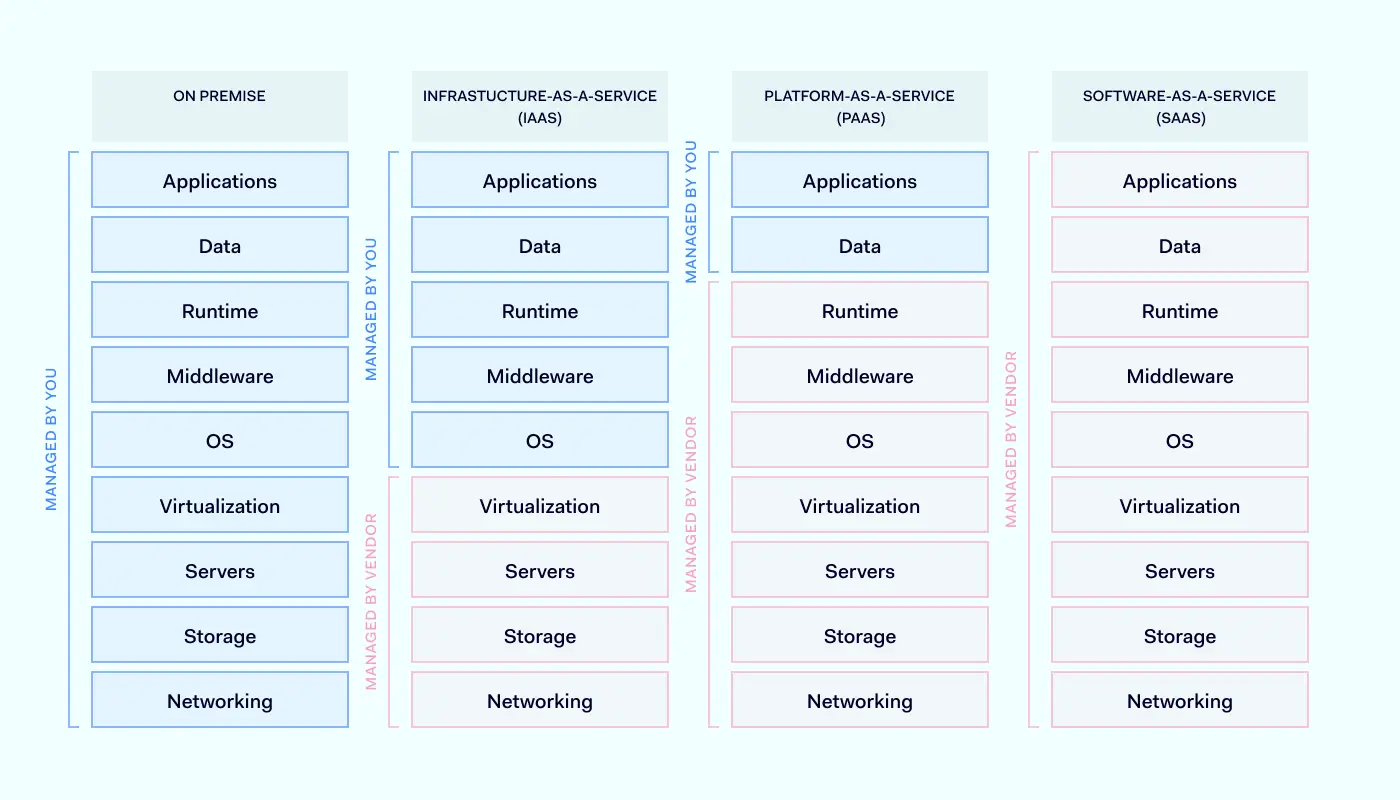
Infrastructure-as-a-Service provides virtualized computing resources as services over the internet. In IaaS, the service provider manages and delivers all associated hardware and software components: servers, storage, networking, and virtualization resources. With IaaS, users can provision and control these resources on-demand, scaling them up or down as needed.

Benefits of IaaS in healthcare

Aside from the fact that cloud computing makes it easier to deploy workloads, IaaS has a range of benefits that could be useful for healthcare companies.

  • Scalability and flexibility. By leveraging IaaS, users can rapidly deploy and configure virtual machines, storage, and network components. This allows healthcare organizations to scale their infrastructure up or down based on their actual needs.

  • Disaster recovery. IaaS enables organizations to back up and recover their critical data and remote machines. As critical data and applications are kept in cloud storage, this ensures their availability and integrity.

  • Cost efficiency. IaaS service providers use a flexible pay-as-you-go pricing model allowing users to pay only for the resources they use. This enables cost optimization, eliminating the need for upfront hardware and infrastructure maintenance investments.

Security challenges and how to address them

IaaS security is shared between the service provider and the user. While the service provider is responsible for managing underlying networking, storage, servers, and virtualization, the user is responsible for managing the security of everything running on top of the infrastructure. This involves operating systems, middleware, data, and applications. This setup is not without cybersecurity challenges.

  • Data protection. Sensitive patient data must be protected using encryption and access controls. As the data is physically located in third-party data centers, unauthorized access or breaches are the primary concern.

  • Compliance. Patient data falls under government-protected information, so regulatory compliance applies to it. Organizations must ensure that their IaaS providers adhere to sensitive patient data from unauthorized access or breaches.

For these reasons, IaaS provider selection is crucial to avoid collateral damage. Implementing multi-factor authentication, regular vulnerability assessments, and proactive monitoring can enhance security.

Platform-as-a-Service (PaaS)

Platform-as-a-Service includes everything from IaaS with a dedicated environment for developing, deploying, and managing applications over the internet. It offers tools, frameworks, and services that enable developers to build, test, and run applications. Much like a physical data centre, PaaS providers handle hardware provisioning, operating system management, and network setup, allowing developers to focus solely on application development.

Benefits of PaaS in healthcare

With PaaS, healthcare providers get a platform for developing, testing and deploying applications in the cloud. Here are its main benefits:

  • Rapid application development. PaaS simplifies the application development process, allowing one to skip multiple setup steps and go directly to the deployment. This can accelerate innovation and provide new solutions quickly.

  • Scalability and performance. As with all cloud-based tools, they can automatically scale based on demand, ensuring high availability and optimal performance.

  • Collaboration and integration. PaaS is compatible with existing systems, meaning currently used tools can be integrated into a unified system.

Security challenges and how to address them

When adopting PaaS, organizations need to be wary of its security challenges. Here are some examples:

  • Application security. PaaS environments involve the deployment and running of custom applications. Therefore, businesses should conduct regular code reviews, implement secure coding practices, and perform vulnerability assessments.

  • Secure configuration. Businesses need to make sure that used PaaS platforms are properly configured. This includes firewalls, network access controls, and encryption protocols.

  • Incident response and monitoring. PaaS environments require ongoing monitoring and timely incident response capabilities. By establishing robust logging and monitoring systems and employing detection and prevention mechanisms, we can have a ready system in case of an intrusion.

Software-as-a-Service (SaaS)

Software-as-a-Service is a cloud computing model in which hosted software is delivered over the internet instead of installed on local premises. In this model, the software is centrally hosted by a provider who manages and maintains the underlying infrastructure, database, and updates. Users only pay a subscription fee to access and use the software on a pay-as-you-go basis.

Many healthcare-related applications are delivered via SaaS, including healthcare picture archiving and communication systems (PACs), electronic health records (EHR), telehealth services, and more.

Benefits of SaaS in healthcare

With SaaS, healthcare organizations are provided with the service directly without the need to handle setup and maintenance. Here are its main benefits:

  • Accessibility and mobility. SaaS applications can be accessed from everywhere, enabling healthcare professionals to securely access patient information on various devices, enhancing workflow efficiency.

  • Automatic updates. The responsibility to handle software updates and patches fall on the service provider, meaning that healthcare applications are always up to date and protected against emerging security threats.

  • Fast deployment. SaaS applications are provided instantly and with minimal setup compared to on-premises software. Software updates and maintenance are handled by the SaaS provider, ensuring smooth operation.

Security challenges and how to address them

The problem is that SaaS brings healthcare organizations not only benefits. It does have some security challenges that need to be addressed by IT personnel.

  • Access control. As SaaS applications are externally hosted, managing user access and authentication is critical. This is the only way to prevent unauthorized intrusions.

  • Third-party integrations. Some SaaS applications need to be integrated with third-party services or APIs. These integrations can introduce security risks if not properly managed or if they have exploitable vulnerabilities.

  • Multi-tenancy risks. The same SaaS application can serve multiple consumers, sharing the same underlying structure and resources. This is why logical separation and isolation between tenants are crucial to prevent data leakage or unauthorized access to customer data.

Compliance and regulatory landscape in cloud security

Regulatory landscape and compliance are critical considerations for organizations across various industries. Most countries have recently implemented various data protection and cybersecurity laws. The government regulates the privacy protection of medical data, and breaching the law ensues grave consequences.

Here are some prominent regulations, guidelines that could impact cloud security, and strategies for ensuring compliance.

HIPAA and HITECH

The Health Insurance Portability and Accountability Act (HIPAA) and the Health Information Technology for Economic and Clinical Health (HITECH) Act are crucial regulations in the healthcare industry. They both perform different functions:

HIPAA — sets standards for protecting sensitive patient health information

HITECH — promotes the adoption of electronic health records

Compliance with both is essential when leveraging cloud computing services in the healthcare sector. Organizations need to take care of security measures like data encryption, access controls, and regular audits to safeguard patient data and meet the requirements outlined in these regulations.

GDPR

The General Data Protection Regulation (GDPR) is a comprehensive data protection framework that affects organizations operating in European Union countries or handling EU citizen data. It emphasizes individual privacy rights, consent management, and data breach notification.

Cloud service providers and organizations utilizing cloud computing services must comply with GDPR by implementing appropriate security measures, conducting data protection impact assessments, and ensuring cross-border data transfers adhere to GDPR guidelines. Encryption, pseudonymization, and privacy-by-design principles are critical for achieving compliance with GDPR in cloud computing.

Other regional regulations and guidelines

In addition to HIPAA, HITECH, and GDPR, other regional regulations and guidelines impact cloud security in specific industries or geographic locations. Examples include the Payment Card Industry Data Security Standard (PCI DSS) for the payment card industry and the Federal Risk and Authorization Management Program (FedRAMP) for U.S. government agencies.

Compliance with these regulations requires organizations to align their cloud security practices with specific requirements. Depending on the regulation and area, this may include data encryption, access controls, vulnerability management, and incident response protocols. Staying informed about relevant regional regulations is crucial to ensure compliance and avoid potential penalties or reputational damage.

As it was mentioned previously, cloud services adoption would involve collaboration with third parties. Here are some key considerations of security responsibilities between the cloud service provider and the customer:

Vendor risk assessment

A thorough vendor risk assessment helps to make sure that a cloud provider will be a matching fit for a healthcare organization’s needs. The cloud service provider’s market is saturated, but not everyone has compliant security controls, certifications, incident response capabilities, and data protection practices. The same strict requirements for healthcare organizations also apply to their third-party partners.

By assessing vendor risks, organizations can make informed decisions and select providers aligning with their security requirements and compliance obligations. Provider’s failure to secure the underlying infrastructure can open the gap in the security set up by the healthcare provider.

Understanding the shared responsibility model

The shared responsibility model defines the division of security responsibilities between cloud service providers and customers. While providers are responsible for securing the underlying infrastructure, customers are accountable for securing their data and applications within the cloud.

Organizations must understand and fulfill their share of responsibilities, which may involve tasks such as configuring access controls, encrypting sensitive data, applying patches and updates, and regularly monitoring for security incidents.

Key cloud security strategies and solutions for healthcare

While cloud computing is appealing to make operations more modern and effective, the downside is the potential cybersecurity risks. Safeguarding sensitive patient data and navigating regulatory compliance requirements are the primary concerns for healthcare providers. There are three main cloud security strategies and solutions to consider.

Advanced threat prevention

Advanced threat prevention is one of the key cloud security strategies for healthcare. It involves deploying sophisticated security measures to identify and mitigate potential threats before they cause any damage. Relying on technologies like machine learning algorithms, behavior analysis, Deep Packet Inspection, and real-time monitoring, organizations aim to detect and respond to suspicious activities.

As a proactive approach to cybersecurity, advanced threat monitoring allows healthcare organizations to identify and effectively neutralize threats. This helps businesses to reduce the risk of data breaches and unauthorized access to patient information.

Cloud-based security operations and monitoring

Monitoring is critical in ensuring the integrity and confidentiality of healthcare data stored in the cloud. By providing continuous oversight and proactive detection of potential security breaches or unauthorized access attempts, monitoring enables organizations to secure against security incidents promptly.

In addition, by leveraging cloud-based security tools, healthcare organizations can centralize security operations, streamline incident response, and gain insights into potential vulnerabilities. The systems can be automated, helping organizations detect and mitigate security breaches on time and enhancing overall security posture without human involvement.

Secure remote work

During the COVID-19 pandemic, the adoption of remote work in the healthcare sector accelerated. Secure remote access became critical as healthcare professionals needed to access patient data and collaborate remotely.

Cloud security solutions enable secure sensitive data storage, ensuring healthcare providers can work efficiently while adhering to strict security protocols. Implementing secure virtual private networks (VPNs), multi-factor authentication, and encryption technologies safeguard data transmission and prevent unauthorized access, mitigating risks associated with remote work.

Cloud security in action: enabling new healthcare capabilities

Cloud security not only performs the function of safeguarding patient data, it also empowers healthcare organizations to embrace new capabilities and innovate. Here are some routes in which cloud security can facilitate advancements.

Redundancies to prevent ransomware attacks

Ransomware attacks use malware that encrypts data stored in the device’s hard drive rendering it inaccessible until a payment is made to the attacker. This is extremely disruptive to organizations relying on on-premises infrastructure as this can completely shut down all operations and compromise patient data.

The only solution to this issue is data replication in multiple dispersed locations. That way, there’s no centralized storage that could be tampered with. In an accident, data can be restored from unaffected backups, minimizing downtime and ensuring continuity of care. Cloud servers enable effective mirroring solutions allowing distributed backups.

Delegation of security responsibilities to third-party firms

Cloud security can catalyze operations outsourcing, allowing better work distribution in your organization. Managing and maintaining robust cloud security infrastructure requires specialized expertise. That’s one of the key reasons why many healthcare organizations delegate their security responsibilities to reputable third-party vendors.

Cloud computing partners already possess the knowledge and resources to implement industry best practices, conduct regular security assessments, and respond to emerging threats promptly. This allows organizations to enhance the cloud security posture and focus on quality patient care.

Automation to free up healthcare resources

Cloud security can be improved by adopting various innovations to improve the setup. By automating vulnerability scanning, log analysis, and security policy enforcement, healthcare providers can free up their workforce from manual and time-consuming tasks.

Automation improves efficiency, reduces the risk of human error, and ensures consistent application of security controls. As IT professionals aren’t burdened with recurring manual tasks. This leaves them more time to focus on advanced security measures and stay updated with evolving threats.

Expert insights and resources for healthcare cloud security

Several organizations provide expert insights and resources for healthcare cloud security. Cloud Security Alliance (CSA), the European Union Agency for Cybersecurity (ENISA), and the National Institute of Standards and Technology (NIST) are the main ones providing various recommendations for cloud security in healthcare companies.

CSA

CSA has established requirements for healthcare organizations to ensure secure cloud computing practices. These requirements mainly focus on several key areas:

  • Implement strong access controls and authentication mechanisms to protect sensitive data.

  • Regularly monitor and audit cloud services for security vulnerabilities and incidents.

  • Encrypt data both in transit and at rest to maintain confidentiality.

  • Conduct regular risk assessments and threat modelling to identify and mitigate potential risks.

  • Establish incident response and recovery plans to handle security breaches effectively.

  • Stay updated with the latest security best practices and standards.

By adhering to these CSA requirements, healthcare organizations can enhance the security of their cloud computing environments and protect patient information from unauthorized access or data breaches.

ENISA

ENISA lays out comprehensive requirements for healthcare organizations in the European Union to enhance their cybersecurity measures. These requirements encompass multiple aspects of cloud security:

  • Develop and enforce robust security policies and procedures for cloud adoption.

  • Perform thorough risk assessments to identify and address potential security threats.

  • Ensure the secure configuration and hardening of cloud computing environments.

  • Employ strong access controls and authentication mechanisms to protect sensitive data.

  • Regularly monitor and log cloud computing activities to detect any suspicious behaviour.

  • Establish incident response plans and conduct regular security audits.

Adherence to these ENISA requirements is vital to safeguarding patient data, protecting critical healthcare systems, and maintaining the resilience and trustworthiness of healthcare services within the EU.

NIST

NIST provides guidelines and requirements and guidelines for healthcare organizations to ensure the security and privacy of patient information. These requirements include:

  • Follow the NIST Cybersecurity Framework for risk management and cybersecurity best practices.

  • Employ strong identity and access management controls to protect data and resources.

  • Use encryption to safeguard data both in transit and at rest.

  • Regularly update and patch cloud infrastructure and applications to address security vulnerabilities.

  • Implement robust network security controls, such as firewalls and intrusion detection/prevention systems.

  • Conduct continuous monitoring and log analysis to promptly detect and respond to security incidents.

Healthcare companies must review and adapt these recommendations to their organizational needs and regulatory requirements.

How can NordLayer help?

Securing cloud infrastructure can be challenging for healthcare companies. Still, the benefits outweigh the risks, so it’s worth considering digitally transforming an organization and improving its services. It’s not a bad idea to turn to third-party partners that could help to take a leap.

NordLayer streamlines network access controls to ensure only authorized users can access confidential data. Access to cloud resources happens using encrypted tunnels using AES 256-bit and ChaCha20 cyphers. The service is also compatible with major cloud platforms like Azure and AWS, allowing seamless integration with other solutions and services.

With correct control mechanisms, NordLayer is a valuable ally to follow through with the best cloud environment security practices. With an extensive set of centrally implemented features and monitoring controls that are all managed via the Control Panel, NordLayer allows the implementation of security policies reducing various risks.

Contact NordLayer and discuss your security options today to ensure safe access to patient data and protect your cloud infrastructure.

FAQ

How can healthcare organizations ensure compliance in the cloud?

Healthcare organizations can ensure compliance in the cloud by understanding applicable regulations. Familiarizing with regulations like HIPAA and GDPR will allow organizations to identify specific compliance requirements. This will serve as a basis for cloud provider choice and guide what access controls and other cybersecurity functionalities must be implemented to align with requirements.

What are examples of cloud security?

Cloud security is an umbrella term encompassing various technologies to protect data and systems in the cloud. This includes encryption, access controls, firewalls, intrusion detection and prevention systems, security information and event management, and data loss prevention.

How does the shared responsibility model work in healthcare cloud security?

The shared responsibility model defines the division of security responsibilities between the cloud service provider (CSP) and the healthcare organization. While the specifics entirely depend on the cloud service model, the cloud service provider usually takes care of the underlying cloud infrastructure. At the same time, the healthcare organization is responsible for application data security and access control.

What steps can healthcare organizations take to mitigate third-party risks?

To mitigate third-party risks, healthcare organizations must establish clear contractual agreements outlining security expectations, data handling procedures, breach notification requirements, and liability provisions. Then, a good plan is to perform ongoing maintenance with regular risk assessments. This should help organizations minimize risks associated with third parties.

About Version 2 Digital

Version 2 Digital is one of the most dynamic IT companies in Asia. The company distributes a wide range of IT products across various areas including cyber security, cloud, data protection, end points, infrastructures, system monitoring, storage, networking, business productivity and communication products.

Through an extensive network of channels, point of sales, resellers, and partnership companies, Version 2 offers quality products and services which are highly acclaimed in the market. Its customers cover a wide spectrum which include Global 1000 enterprises, regional listed companies, different vertical industries, public utilities, Government, a vast number of successful SMEs, and consumers in various Asian cities.

About NordLayer
NordLayer is an adaptive network access security solution for modern businesses – from the world’s most trusted cybersecurity brand, Nord Security.

The web has become a chaotic space where safety and trust have been compromised by cybercrime and data protection issues. Therefore, our team has a global mission to shape a more trusted and peaceful online future for people everywhere.

Single Sign-On: What it is and how it works

Nowadays, single sign-on (SSO) authentication is required more than ever. Many websites offer users the option to sign up with Google, Apple, or any other service. Chances are you have logged in to something via single sign-on today or at least this week. But do you know what it is, how it works, and why it’s used? Take a deep dive into the world of single sign-on and all things related to it.

What is SSO?

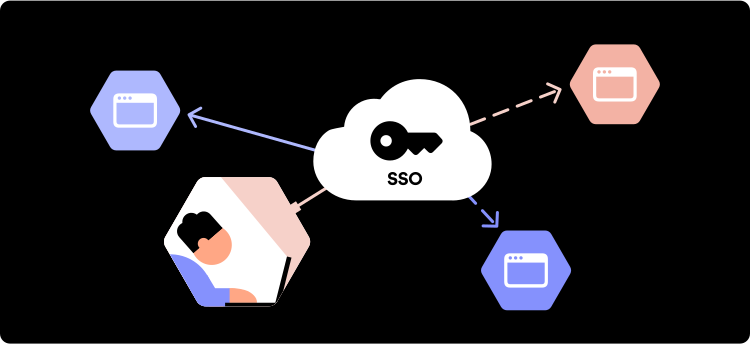
Single sign-on is a session and user authentication service that allows the user to use a single set of login credentials – namely, a username and password – to access multiple websites or applications. Put plainly, SSO allows users to sign up and access a variety of online accounts with a single username and password, thus making things a lot easier for the everyday user. SSO’s primary use is as an identification system that permits websites and apps to use the data of other trusted sites to verify a user upon login or sign-up.

Essentially, SSO puts an end to the days of remembering and entering multiple passwords. An added bonus is that SSO gets users out of the vicious password reset loops.

Additionally, SSO can be great for business, as it improves productivity, security control, and management. With a single security token (a username and password), IT professionals can enable or disable a user’s access to multiple systems, which in some cases mitigates cybersecurity risks.

So, how does the magical service work?

How does SSO work?

Single sign-on is a component of a centralized electronic identity known as federated identity management (FIM). FIM, or Identity Federation, is a system that enables users to use the same verification method to access multiple applications and other resources on the web. FIM is responsible for a few essential processes:

  • Authentication

  • Authorization

  • User attributes exchange

  • User management

When we talk about SSO, it is important to understand that it is primarily related to the authentication part of the FIM system. It’s concerned with establishing the user’s identity and then sharing that information with each platform that requires that data.

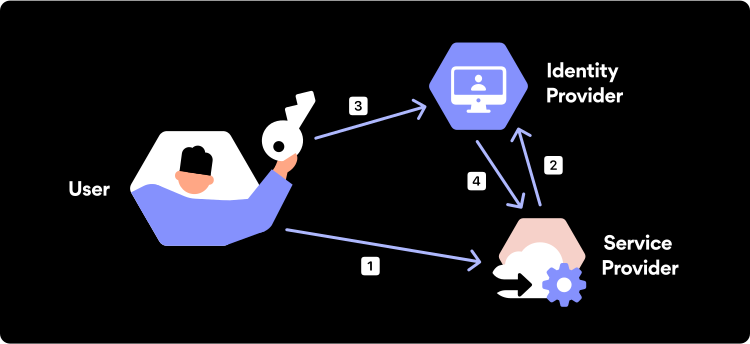
Fancy jargon aside, here are the basic operational processes of single sign-on:

  • You enter a website.

  • You click “Sign In with Apple” or any other service.

  • The site opens Apple’s account login page.

  • If you’re already logged in, then it gives the site your data.

  • You are logged in to your Apple account.

  • Apple’s site verifies that you are authorized to access the site.

  • If you’re authorized, the site creates a session for you and logs you in.

In technical terms, when the user first signs in via an SSO service, the service creates an authentication cookie that remembers that the user is verified. An authentication cookie is a piece of code stored in the user’s browser or the SSO service’s servers. Next time the user logs in to that same app or website using SSO, the service then transfers the user’s authentication cookie to that platform, and the user is allowed to access it. It’s important to highlight that an SSO service doesn’t identify the exact user since it does not store user identities.

What is an SSO Token?

An SSO token is a digital unit that contains data about a particular user such as their email address. The token is used to transfer user information from one system to another during the single sign-on process. For the recipient to verify that the token comes from a trusted source, it has to be signed digitally.

The SSO service creates a token whenever a user signs in to it. The token works like a temporary ID card which helps identify an already verified user. This means that when the user tries to access a given app, the SSO service will need to pass the user’s authentication token to that app so they can be allowed in.

Password security for your business

Store, manage and share passwords.

30-day money-back guarantee

Single-Sign-On Costs

Because many of the SSO solutions currently available on the market are cloud-based, most of them are offered in a monthly subscription model. The price of a cloud-driven SSO solution designed for small and mid-sized businesses can range from $1 to $10 per user per month.

However, those that want to get an SSO solution designed for a big enterprise will need to either pay more each month or make an entry fee. Enterprise-grade solutions are usually more wide-ranging and require vendors to customize them to each of their client’s needs and requirements. Hence, the price difference.

Is single sign-on secure?

Yes. An SSO protocol is secure when implemented and managed properly and used alongside other cybersecurity tools.

The main benefit introduced by single-sign on with regard to cybersecurity is that, because it allows using a single set of credentials for multiple services, there are fewer login details to be lost or stolen. As long as the server is secure and an organization’s access control policies are established, a malicious user or an attacker will have little to no chance to do any damage.

However, this benefit could also pose a certain kind of risk. Since SSO provides instant access to multiple accounts via a single endpoint, if a hacker gains access to an authenticated SSO account, they will also gain access to all the linked applications, websites, platforms, and other online environments.

This issue can be easily mitigated by implementing an additional layer of security known as Multi-Factor Authentication. Combining SSO with MFA allows service providers to verify users’ identity while giving them easy access to applications or online platforms.

The benefits of SSO

Reduced password fatigue

With SSO in place, users only have to remember one password, making life a lot easier. Password fatigue is real and dangerous. SSO encourages users to come up with a single strong password rather than using a simple one for each account separately. It also helps users escape the vicious cycle of password reset loops.

Increased employee and IT productivity

When deployed in a business setting, SSO can be a real time saver. According to a recent report, people waste 16.3 billion hours a year trying to remember, type, or reset passwords. In a business environment, every minute counts. Thanks to SSO, users don’t need to hop between multiple login URLs or reset passwords and can focus on the tasks at hand.

Enhanced user experience

One of the most valuable benefits of SSO is an improved user experience. Because repeated logins are not required, users can enjoy a digital experience with less hassle. This means that users will be less hesitant to use the service. For any commercial web-based service, SSO is an essential part of their user experience.

Centralized control of user access

SSO offers organizations centralized control over who has access to their systems. In a business setting, you can use SSO to grant new employees specific levels of access to different systems. You can also provide employees with a single set of credentials (username and passwords) to access all company systems.

Top single sign-on solutions

Microsoft Azure AD

Microsoft Azure AD includes Active Directory Federation Services (AD FS) as an option to support SSO. Azure AD also offers reporting, security analytics, and multi-factor authentication services. It’s perfectly suited for any company that uses the Microsoft Azure cloud platform, no matter its size.

Okta Identity Cloud

Okta is well-established in the world of SSO solutions. They are open-source SSO leaders because of their flexibility and ease of use. Okta offers customizable open identity management in real time according to business needs, as well as two-factor authentication and a password reset functionality. Okta can serve the needs of multiple industries, from education and nonprofits to financial services and the government.

OneLogin Unified Access Management Platform

OneLogin is an open-source SSO provider that is often used for employee access to the company’s cloud-based applications. OneLogin is suited for a variety of IT administrator needs since it is designed to enforce IT policy in real time. It can also be updated according to specific needs if any changes occur, such as an employee leaving.

Idaptive Application Services

Idaptive is primarily suited for small to medium-sized businesses. Idaptive is capable of providing support to many users at once, thanks to their new cloud architecture. The company also offers adaptive MFA, enterprise mobility management (EMM), and user behavior analytics (UBA) all in a single solution.

Ping Intelligent Identity Platform

Ping offers services to large enterprises. The solution can serve anywhere between a few hundred to a few million users. Ping provides both on-premises and cloud options for deploying their solution. Additionally, the service comes with multi-factor authentication.

Does NordPass provide SSO?

Yes, NordPass does provide a single sign-on authentication! It can be set up via NordPass Admin Panel for users who want to log in to the NordPass app with their Microsoft Azure, Google Workspace, or Okta credentials.

This means that if you turn on Microsoft Azure Active Directory (AD), Google Single Sign-On, or Okta Single Sign-On, and invite new members who use one of these SSOs, they will be allowed to login in using their Azure AD, Google, or Okta SSO credentials — it’s as simple as that.

About Version 2 Digital

Version 2 Digital is one of the most dynamic IT companies in Asia. The company distributes a wide range of IT products across various areas including cyber security, cloud, data protection, end points, infrastructures, system monitoring, storage, networking, business productivity and communication products.

Through an extensive network of channels, point of sales, resellers, and partnership companies, Version 2 offers quality products and services which are highly acclaimed in the market. Its customers cover a wide spectrum which include Global 1000 enterprises, regional listed companies, different vertical industries, public utilities, Government, a vast number of successful SMEs, and consumers in various Asian cities.

About NordPass
NordPass is developed by Nord Security, a company leading the global market of cybersecurity products.

The web has become a chaotic space where safety and trust have been compromised by cybercrime and data protection issues. Therefore, our team has a global mission to shape a more trusted and peaceful online future for people everywhere.

Storage Beyond Passwords: Securely Save Files in NordPass

Ever been in that awful situation where you’re going through old emails or disorganized folders trying to find that one crucial document? The insurance form, an e-copy of your ID, or even a video detailing how to get into your new office? Wouldn’t it be a game-changer if you had all your important files right next to your passwords, credit card information, or secure notes?

Good news! Today, we are excited to introduce File Attachments — a new and improved way to manage important files with NordPass.

Best for large file attachments

Here’s a quick rundown of how it works. As a NordPass Premium user, you now have the ability to attach files to your saved items in NordPass. It’s not just about enhancing organization. This feature also provides an unmatched level of security. Forget the hassle of disorganized unsafe file storage. Any attached files or documents will be as secure as your passwords thanks to our encrypted storage.

But we didn’t stop at mere functionality. NordPass Premium now provides a whopping 3GB of encrypted storage per account, a giant leap forward. That’s not just more — it’s three times more than any other password manager out there! We’re offering you unrivaled storage and advanced security — and that’s certainly what we call more bang for your buck!

NordPass — The best password manager for large file attachments.

– Attila Tomaschek

CNET

No strings attached (except your files)

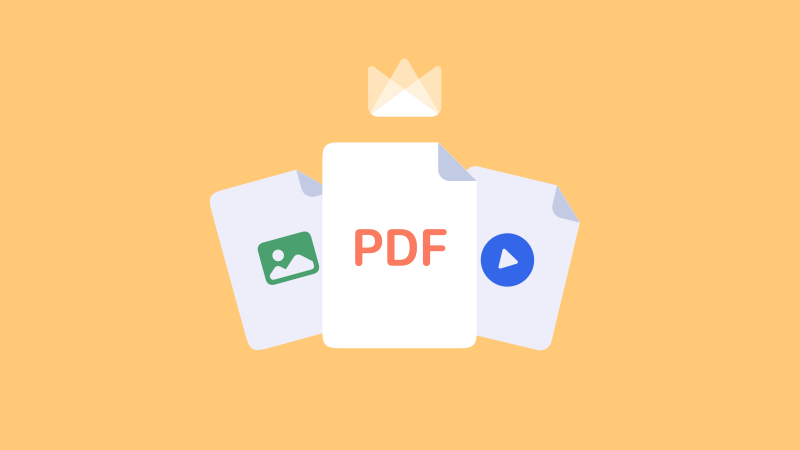
With NordPass Premium’s File Attachments, you have the freedom to store documents of any type to one of your existing items. Whether it’s a simple JPEG, PDF, MP4, or DOC file — NordPass supports them all.

Supported file types

The new feature allows for files up to 50MB in size and up to 50 attachments per single item. The only limit is your 3GB storage per user — and that’s a whole lot of space for your files.

While we aim at maximizing convenience, your security is always our top priority. To ensure maximum protection, we currently do not support attaching files to shared items or sharing items with files attached.

You can learn more about how to attach files to your NordPass items in our handy help center article.

Streamline your digital life with NordPass

In the digital age, we often juggle tons of files, documents, and data, and that can lead to a disorganized and chaotic personal digital space. With our new File Attachments feature, we look to help you take back control and streamline your digital life by allowing you to save documents in a quick and efficient way

With NordPass Premium, you can now attach important files to all your saved items. Store any file in one secure place with 3GB encrypted storage.

Instant access

When you’re in a hurry, having quick access to your important documents can make all the difference. That’s where File Attachments shine. Need to view a copy of your ID or an important receipt? No problem! With File Attachments, all your vital images or documents are just a few clicks away.

Effortless downloads

It’s not just about attaching and storing your files along with your passwords. It’s also about being able to retrieve them whenever necessary. Suppose you’ve stored financial documents that you need to share with your spouse. With File Attachments, you can quickly and effortlessly download these files directly from NordPass.

Unprecedented control

The File Attachments feature isn’t just about adding another functionality to NordPass. It’s about giving you greater control over your digital life. You get to decide what files to attach, what items those files are attached to, and when to download or delete them. You can also organize your vault in a way that best suits your personal or professional needs.

A single secure place for files and passwords

Take your password manager experience to the next level with NordPass Premium. Don’t just manage your passwords, manage your life. No more scrambling for documents, no more disorganized files, and certainly no more compromised security.

Your life. Your files. One secure place. Start your NordPass Premium journey today and make the most of our File Attachments feature.

About Version 2 Digital

Version 2 Digital is one of the most dynamic IT companies in Asia. The company distributes a wide range of IT products across various areas including cyber security, cloud, data protection, end points, infrastructures, system monitoring, storage, networking, business productivity and communication products.

Through an extensive network of channels, point of sales, resellers, and partnership companies, Version 2 offers quality products and services which are highly acclaimed in the market. Its customers cover a wide spectrum which include Global 1000 enterprises, regional listed companies, different vertical industries, public utilities, Government, a vast number of successful SMEs, and consumers in various Asian cities.

About NordPass
NordPass is developed by Nord Security, a company leading the global market of cybersecurity products.

The web has become a chaotic space where safety and trust have been compromised by cybercrime and data protection issues. Therefore, our team has a global mission to shape a more trusted and peaceful online future for people everywhere.

Cost-benefit analysis of cybersecurity spending

As new data breaches are making the headlines, cybersecurity is becoming one of the most critical elements of a long-term business strategy. To protect their sensitive data and mitigate potential risks, businesses are actively looking for ways to move into the 21st century in terms of their infrastructure. However, as many soon discover, cybersecurity integration within an existing business is rarely a one-click solution.

Even putting all the technical questions aside, cybersecurity raises many questions regarding return on investment. This article will provide a broad overview of how to approach cybersecurity spending. We’ll briefly cover what makes up cybersecurity costs, what factors could affect them, the financial impacts of cyberattacks, potential benefits, and some guidelines on approaching cybersecurity estimates in your company.

Costs of cybersecurity

Cybersecurity spending can mean several things. The exact route will depend on the actual business case and the risks that the company is trying to mitigate. Still, no matter which options your company is considering, this is something where budget constraints will have to become a consideration.

Let’s look at the costs from different cybersecurity ecosystem components: solutions, services, personnel, and training.

Solutions

One of the go-to routes for organizations looking to shield themselves against cyberattacks is purchasing cybersecurity hardware or software solutions. This allows companies to flexibly integrate them into the infrastructure, strengthening the areas needing attention.

As such, businesses have numerous options available. Cybersecurity hardware and software provide easy access to firewalls, antivirus, access control mechanisms, intrusion detection and prevention systems. When used collectively, these technologies work together to halt cyberattacks or mitigate their impact if they do occur.

While it’s also true that their costs depend on various factors (which we will address later on), let’s look at the average industry costs associated with various cybersecurity solutions. Please note that the distinction between solutions and services isn’t as set in stone as it used to be due to modern service delivery models (like SaaS) and the popularity of cloud computing.

Firewalls

If an organization relies on a network, a firewall is a must as it monitors and controls network traffic. Acting as a barrier between the internet and/or other untrusted networks and your private network, it’s the first defense against malicious connections based on predefined rules.

The tricky part for the comparison is that they can be implemented at different levels of the network stack, i.e., from the network layer (filtering packets) to the application layer (proxy servers). Finally, they can be hardware or software-based, or a combination of both, affecting the final price tag.

Therefore, an average firewall configuration can range between $450 and $2,500 (as a one-off investment not factoring in its maintenance which costs extra). That doesn’t take into account setup or maintenance costs, so the final cost can be higher.

Antivirus software

Antiviruses are still staples to protect computer systems from malware, viruses, and other security threats. As an essential component of comprehensive cybersecurity strategy, they can be used as the last line of defense. Usually, in business settings, they’re deployed across an organization’s network to protect all connected devices.

It’s often the case that antiviruses also include additional features like firewalls, intrusion prevention systems, and email filtering to provide further protection against cyber threats. This also makes our comparison more difficult.

Still, if we’re looking for rough estimates, which is what we’re doing here: basic antivirus usually costs between $3 and $5 per user and $5 to $8 per server monthly. While the final price tag will entirely depend on your organization’s size, the estimate could be at least $30 a month if you have around five users.

Spam filters

Business communication primarily still takes place over emails. This is something that hackers are exploiting in phishing attacks. For this reason, having spam filters is essential to identify and block harmful emails before they end up in employees’ inboxes. Spam filters rely on various technologies to analyze the content and metadata of incoming messages to determine whether they are legitimate.

Some email providers offer spam filters already integrated into their suite. Meanwhile, for other cases, it’s required to set up a spam filter on top of it. It’s estimated that the price for this ranges between $3 – $6 per user per month.

Services

What makes cybersecurity services different from cybersecurity solutions is that they’re typically provided by a third-party provider, who may offer the service on a subscription basis. While a cybersecurity service may include various cybersecurity solutions, the two concepts are not interchangeable. Cybersecurity service by definition encompasses ongoing protection against cybersecurity threats.

Frequently this also means that cybersecurity services can help against threats of greater sophistication. This makes them a good pick for organizations looking into securing their digital assets and preventing unauthorized access, theft, and exploitation of sensitive information.

VPN

With plenty of employees working remotely, businesses need a secure way for their employees to access company resources. VPN encryption seals the sensitive data in a secure tunnel, enabling secure exchanges to the company’s network. This additional protection layer also helps mitigate cyber threats by masking the user’s IP address.

Yet, as with most cybersecurity components, there are multiple routes to consider here. A VPN could be set up as a hardware stack with ongoing third-party maintenance fees or a software-only solution. This is something that can skew the price.

While the software-only is cheaper and can be up to $10 per user, the hardware setup can range up to $3,500 per device. That’s a significant gap between them, while both options provide similar functionality. The particular business case will be a deciding factor.

Consulting and testing

Cybersecurity consulting and testing service providers have a high level of expertise in identifying and mitigating security risks. This is something that few companies can manage to achieve out of their own resources. Specialized cybersecurity professionals perform various checks to properly evaluate the used cybersecurity measures’ effectiveness and outline the most critical areas.

Due to the nature of their services, this can be a pretty expensive endeavor. A vulnerability assessment for a network with up to three servers would cost $1,500 to $6,000. It goes without saying that if the scope of investigations needs to be broader, this will only add up to the final price tag.

Endpoint detection and response

Businesses turn to endpoint detection and response (EDR) services because they provide high protection against cyber threats by monitoring and detecting potential security breaches. This allows businesses to detect and respond to cyber threats quickly and before they cause significant damage to the organization’s assets, reputation, and financial standing. EDR solutions typically operate through a combination of software agents and cloud-based systems.

Endpoint detection and response solutions cost around $5 to $10 per month per device. Yet, as with most subscription-based services, there are discounts: with more devices, EDR usually becomes cheaper per single device. Still, EDR solutions come in different depths and feature sets, so the final cost can be higher.

Personnel

Personnel is one of the most important cybersecurity assets at any company’s disposal. These specialists will protect your data from various forms of cyberattacks and ensure the risks are minimal. Whatever cybersecurity solutions or services you’ve purchased, the IT personnel will set up and maintain those tools.

Cybersecurity doesn’t become an integral part of an organization’s DNA just by purchasing some subscriptions. It needs to be cultivated. One way to ensure this is sustainable is to develop security policies and protocols — exactly what cybersecurity personnel will do.

Network administrators

Network administrators are responsible for setting up and maintaining the organization’s network infrastructure. They must ensure the network is secure from unauthorized access and that all transmitted data is protected from interception and other potential threats. The administrators will be configuring and managing firewalls, blocking specific ports, managing user permissions, monitoring the network, and patching system components.

As for their cost, you can look at conflicting data sources: depending on the region, experience, market saturation, and other factors. Still, if we’re looking for a broad view based on data from Payscale, this should be within $63,244 per year.

Compliance officers

Compliance officers are specialists who ensure an organization’s cybersecurity by implementing policies and procedures to align compliance with regulations and industry standards. They identify risks, monitor security measures, and ensure employees follow security protocols. These key people outline how an organization should handle sensitive data, access controls, and incident response.

A compliance officer’s salary is $73,255 a year based on publicly available data. Mind you, compliance is one of the trickiest landscapes to navigate, so these specialists must periodically refresh their knowledge to stay updated with the latest policy changes.

Security analysts

Security analysts identify potential threats to an organization’s network, systems, and data. They’re using various tools and techniques to detect and prevent cyberattacks before they can cause damage. Security analysts identify vulnerabilities in an organization’s systems and infrastructure by conducting risk assessments.

Security analysts are crucial in protecting an organization’s assets and cyber threats. Based on Glassdoor data, their salaries, on average, are around $90,283 a year. Due to the increased frequency and complexity, professional cyber security analysts are in high demand, which can further increase their salaries.

Trainings

The cybersecurity landscape is constantly changing. Therefore employees’ skills and knowledge need to be periodically refreshed. This is where cybersecurity training and certifications ensure that employees know the best practices for protecting this information and can identify potential threats. These trainings can be expensive, and organizations must ensure they are effective.

Courses

Cybersecurity courses can be an invaluable resource in helping to understand the importance of protecting company data from cyberattacks. By teaching employees how to identify potential security threats and how to take preventative measures, companies can reduce the risk of data breaches and protect their sensitive information. Nowadays, there are plenty of resources, ranging from in-person training to online lectures.

For this reason, cybersecurity training costs vary significantly and can range from freely available online resources to $5,000 or more. Mind you that the price is affected by factors like depth and competencies. Courses intended for niche specializations will always cost more than a basic introduction.

Certifications

Cybersecurity certifications provide credibility to professionals working in the field, demonstrating that they have met rigorous standards and have the necessary knowledge and skills to protect against cyber threats. Using certification as a standardized measure allows aligning the team and ensuring that best practices are applied when making organization-level cybersecurity improvements.

There are several popular cybersecurity certifications widely recognized in the industry. For example, the Certified Information Systems Security Professional (CISSP) exam costs around $699. Certified Ethical Hacker (CEH), another important pick for cybersecurity professionals, costs around $1199. Along with GIAC Security Essentials (GSEC) certification and exam, it’s priced around $1699, which makes it one of the more expensive courses.

Factors that affect cybersecurity costs

It’s important to note that the cybersecurity costs provided in the previous section are only rough estimates. The final price will depend on numerous factors, which will be the key differentials from business to business when calculating cybersecurity costs. Let’s look at some of them to see how they factor into the final price tag.

Size

The size of an organization is one of the most important factors which can drastically alter cybersecurity costs. As larger companies have more complex IT infrastructures, more employees to train, and a higher risk of cyber attacks due to their visibility and financial resources — their security naturally costs more. When compared to smaller organizations, the difference might be night and day.

Keep in mind that, in some cases, some cybersecurity tools will need to be adjusted. They cannot operate that well when used in corporate settings, which are within a completely different pricing category. However, numerous reports confirm that small businesses are three times more likely to be targeted by cybercriminals than larger companies. So while the risks remain high, not all companies are as well equipped to tackle the potential risks.

Industry

The industry in which an organization operates and any regulatory requirements it must comply with can impact its cybersecurity costs. Organizations working in highly regulated industries like healthcare and finance will have higher cybersecurity costs because more regulations apply to the data they’re holding.

As a side note, the industry determines an organization’s risk tolerance. Different industries can have very different thresholds for acceptable risk levels. This means that security’s scope will have to be aligned, which will also, in turn, affect cybersecurity costs. In addition, businesses in certain industries seem to fall victim to more cyberattacks than others, which is also a factor.

Financial impact of cyber attacks

While up until this point, you got the impression that cybersecurity is expensive, let’s move on to an overview of the financial impact of cyber attacks. Depending on what business operations are targeted, the attack scope, and the kinds of data leaking to the public, all constitute significant financial losses. Let’s look at revenue losses, legal fees, and reputational damage.

Revenue

Cyberattacks can disrupt normal organizations’ day-to-day operations and compromise sensitive data. This can easily make an organization’s systems and networks inaccessible or unusable. The downtime when the IT team is trying to patch together a solution and get the operations back up and running costs time, which also translates into lost revenue.

2 financial impact of cyberattacks

The recovery costs can also be factored in as damaged equipment needs to be replaced, and systems need to be restored from the backups. It’s not a coincidence that a quarter of companies that have experienced a cyber attack have lost between $50,000 and $99,999 in revenue. These are steep numbers, and they don’t factor in the costs of getting the operations back up and running.

Legal fees

After data breach remediation and operations restoration, the trouble isn’t over. Especially in cases of a large data breach, companies need to hire legal counsel, forensic experts, and other professionals to help manage the aftermath. So there’s the precedent of estimation and cleaning up.

3 post-breach legal fees breakdown

Additionally, depending on the data breach’s severity, the company may also be held responsible for the damage suffered by affected customers or clients. If there are lawsuits, this can quickly mount legal fees, including settlement costs. For smaller companies, that’s an instant endgame as they often just aren’t equipped to handle such expenses. For instance, it’s estimated that legal costs range from $50,000-$148 million, with a median of $1.6 million and a mean of $13 million.

Reputational damage

A data breach leaves a permanent black mark on a company’s reputation. Companies will need to spend a lot of resources to repair their image and reassure the customers that they have learned from their mistakes and won’t happen again. This long process involves public statements and social media management and should be an aspect of long-term customer trust remediation.

4 cybersecurity reputational costs

According to various reports, the proportion of the total costs that can be attributed to reputational costs like abnormal customer turnover and loss of goodwill was around $1.57 million. Mind you that this is something that affects companies for a long time, provided that a company even makes a recovery from a data breach.

Benefits of cybersecurity spending

Cybersecurity spending can minimize various risks associated with revenue, reputation, or legal fees. While this is a solid argument advocating for cybersecurity solutions, this is far from the only benefit. Having a functioning infrastructure with a cybersecurity-focused mindset also generates a positive outcome for organizations. Let’s look at some of the indirect benefits of cybersecurity spending.

Better compliance alignment

Many compliance regulations, like General Data Protection Regulation (GDPR) and the Health Insurance Portability and Accountability Act (HIPAA), require organizations to implement specific security measures to protect sensitive data. Therefore, investments in cybersecurity help to achieve two goals simultaneously:

  • The risk profile is contained, and the organization is more resistant to cyberattacks.

  • The organization ensures that it has all the necessary technologies and policies in place to meet compliance requirements.

Reports confirm that achieving substantial compliance goals require holistic and integrated security solutions, ensuring that every aspect of an organization is covered. For this alone, cybersecurity investments should be at the top of the business manager’s list.

Increased productivity

Cybersecurity matters can often be a catalyst for workplace modernization. While this may not always be a seamless transition, the change often allows the work to be performed more efficiently and securely. A good example of this is the remote and hybrid work trend, which became very popular after the global pandemic.

In fact, securing identities and endpoint devices enables users to do their work quickly and securely from anywhere. Nowadays, there are many ways of working, and cybersecurity can be a good contributor to breaking the cycle of outdated tech and enabling all ways of working.

How to apply cost-benefit analysis for your organization

Our rough estimates demonstrate that data breach costs outweigh cybersecurity expenses. While this is a valid statement, this doesn’t provide clear guidelines on what actionable steps should be taken when considering cybersecurity spending. Businesses have finite resources, and cybersecurity is just one area that needs to be addressed. Thankfully, there are some models that we can use as a basis to evaluate cybersecurity costs and benefits.

Let’s start by looking at one of the most widely used schemes: the National Institute of Standards and Technology (NIST) Cybersecurity Framework. This is a helpful document consisting of standards, guidelines, and best practices to manage cybersecurity risks. It’s especially useful because it’s applicable to companies from all industries.

The problem with it is that while it recognizes that management of cybersecurity risks is always organization-specific, which will also shape how the final cost-benefit evaluation will look, it doesn’t outline how the cost-benefit analysis should be provided. For this reason, some researchers suggest integrating mathematical models Lawrence A. Gordon and Martin P. Loeb developed into the NIST Cybersecurity Framework. The model calculates an optimal investment in cybersecurity based on the cost of an attack, the expected probability, and the effectiveness of the security measures put in place.

The basic premise of the Gordon-Loeb model is that there is a tradeoff between the cost of an attack and the cost of investing in cybersecurity. Organizations want to minimize the total cost, including the cost of an attack and the security investment. The model assumes that the cost of an attack is proportional to the value of the information assets that could be compromised.

The model also considers the probability of an attack occurring, which is a function of the number of potential attackers, the likelihood that they will attempt an attack, and the effectiveness of the security measures. The effectiveness of security measures is assumed to be proportional to the level of investment in cybersecurity.

To calculate the optimal investment in cybersecurity, a balance needs to be found between the level of investment and the expected total cost. This relies on the relation between the expected cost of an attack and the cost of the security investment. This leaves us with a four-step approach:

  1. The value of protected information should be estimated as it represents the potential loss (L)

  2. The probability of the information being breached should be estimated (v)

  3. These first two values should be combined to derive the expected loss (vL)

  4. Cybersecurity investments should be allocated to the information based on the productivity and cost of the investments, so an optimal investment level (z)

Putting this data in the graph gives us some perspective on the diminishing returns. If the values of v and L are small, for instance, when v equals 0.1, and L equals $1M, extensive investments in cybersecurity aren’t optimal, as the expenses are higher than the benefits.

However, as the values of v and L increase, the optimal investment amount (z) and the expected loss resulting from a cybersecurity breach (vL) increase in this scenario.

5 graph showing optimal cybersecurity spending

In other words, the more valuable data an organization has, the more it has to lose. Once that threshold is met, not investing in cybersecurity is sitting on a powder keg. It’s a simple exercise to go through to better evaluate your organization’s standing in terms of cybersecurity. As a rule of thumb, the authors of the study suggest that organizations should generally invest less than 37% of the expected loss from a cybersecurity breach. The actual number will then need to be individually calculated based on your organization’s specifics.

How to improve your cybersecurity with NordLayer?

Cybersecurity is unavoidable in the current business environment because cyber threats aren’t going anywhere. This also has associated costs: solutions, services, personnel, and trainings. Organizations aren’t left alone without help, so for those willing to team up with cybersecurity providers — the market offers numerous opportunities that could make your company more resistant to cyber threats.

When it comes to the price, though, there are numerous factors that can also affect cybersecurity costs, like industry and size. As most cyberattacks are financially motivated, the companies with the most sensitive data are the prime targets. Although, it’s always fair to assume that no matter the industry or size, no one is immune to them.

That is why organizations need modern cybersecurity solutions that adapt to changing complexities of today’s working environments. All organizations have information that needs protecting, so all communication channels are interesting to hackers.

With NordLayer’s solutions, organizations can secure access to sensitive information and prevent reputational, legal, and financial damage. No matter what industry, NordLayer can be a reliable ally to help you stay secure. Contact us, and let’s discuss your cybersecurity journey together.

About Version 2 Digital

Version 2 Digital is one of the most dynamic IT companies in Asia. The company distributes a wide range of IT products across various areas including cyber security, cloud, data protection, end points, infrastructures, system monitoring, storage, networking, business productivity and communication products.

Through an extensive network of channels, point of sales, resellers, and partnership companies, Version 2 offers quality products and services which are highly acclaimed in the market. Its customers cover a wide spectrum which include Global 1000 enterprises, regional listed companies, different vertical industries, public utilities, Government, a vast number of successful SMEs, and consumers in various Asian cities.

About NordLayer
NordLayer is an adaptive network access security solution for modern businesses – from the world’s most trusted cybersecurity brand, Nord Security.

The web has become a chaotic space where safety and trust have been compromised by cybercrime and data protection issues. Therefore, our team has a global mission to shape a more trusted and peaceful online future for people everywhere.

Using artificial intelligence (AI) in cybersecurity

Artificial intelligence (AI) has made remarkable progress in recent years and has proved its value in various fields, including cybersecurity. With the rise of cyber threats and the increasing complexity of cyberattacks, AI has become a central tool for protecting against cybercrime.

Integrated artificial intelligence systems have the potential to be trained for the automatic identification of cyber threats, alerting users, and safeguarding sensitive information of businesses. Therefore, this article explores AI in cybersecurity, its benefits, use cases, and solutions, and addresses some frequently asked questions.

How is AI used in cybersecurity?

Artificial intelligence combines large data sets and uses them with intuitive processing algorithms. As the scope of networks and systems expands, AI in cybersecurity helps to automate operations by processing large amounts of data much faster than a human ever could. For this reason, most cybersecurity tools integrate deep learning and other capabilities intended to work with big data. Here are the main ways in which AI is used in cybersecurity:
  • Threat detection. AI can act as a filter for analyzing files and software code to identify potential malware threats while avoiding false positives. Machine learning algorithms can be trained for threat detection to recognize patterns and characteristics of known malware and flag any new code that matches these patterns.

  • Network security. AI algorithms can analyze network traffic data to detect patterns and anomalies indicating an attempted intrusion or attack. AI can flag any deviations from this baseline as potential threats by learning what normal network traffic patterns look like.

  • Behavioral analysis. AI can be used to analyze user behavior and detect anomalies that may indicate unauthorized access or malicious activity using machine learning. This allows for more effective user activity monitoring and detection of potential threats while limiting false positives.

  • Automated incident response. AI-based systems can be used to automatically respond to detected threats, like shutting down connections, quarantining infected machines, and disabling user accounts. Advanced machine learning models help to contain hacking attempts and minimize potential damage.

  • Vulnerability assessment. AI can identify potential vulnerabilities in systems and networks. This allows for proactive measures to be taken to mitigate potential threats before they can be exploited.

AI can be a powerful tool that can contribute in real-time, which can be essential in today’s rapidly evolving cyber threat landscape and lowers the odds that an organization will be affected by a data breach.

Benefits of AI in cybersecurity

AI solutions are versatile and can be applied in various scenarios. However, it requires preparation and feeding the deep learning models with plenty of data that could be used as a reference when identifying patterns. AI for cybersecurity does bring benefits, creating a more secure environment. Here are some of them that are noteworthy in a business setting.

1. Better vulnerability management

Considering the scope of threats that organizations face daily, network administrators need all the help they can get for endpoint protection. AI can analyze existing security measures to identify potential gaps, enabling businesses to focus on the most critical areas. This makes troubleshooting more efficient and provides in-depth oversight of the security level faster than any human ever could.

2. Self-correcting models

AI models can use deep and machine learning techniques to analyze network behavior and identify deviations from the norm. This allows further adjustments, enabling them to trigger various response actions when something odd is detected. This system adjusts its model over time, making it more accurate.

3. Limits process duplication

Some cybersecurity tasks are repetitive and monotonous, adding to personnel frustration and increasing the chances that some threats will slip by. AI-driven tools can perform all those recurring tasks automatically and only require confirmation before making the final changes. This allows security against potential gaps by consistently implementing the best network security practices.

4. Secure authentication

The industry is moving away from passwords and looking for ways to make security smarter. AI can be a helpful addition to implementing multiple authentication layers to verify a user’s identity. Using tools like fingerprint scanners, facial recognition, and other AI solutions helps identify fraudulent login attempts. This creates a much tighter security mechanism when allowing users in.

5. Helps to cover more ground

AI tools can perform multiple tasks simultaneously. At the same time, AI can scan and identify disguised threats while prioritizing prevention, even when dealing with multiple threats simultaneously. This versatility positively translates in terms of cybersecurity. Human attention can be limited to a single task at once, while AI can cover them in all other areas, which helps to expand network visibility and ensure appropriate security.

6. Helps to balance out workloads

Cybersecurity personnel isn’t cheap to hire or maintain, so it’s in a business’s best interest to ensure their experience is spent on tasks with the highest complexity. While AI can take care of manual tasks, human personnel can think of other ways to improve the cybersecurity posture in the organization. In the long run, this creates a greater value.

The limitations of traditional methods

The main difference between traditional cybersecurity tools and AI is their flexibility. Conventional cybersecurity tools like antiviruses or firewalls function based on strictly predetermined rule sets. A tool comes equipped with a list of malware types or blacklisted websites, which must be manually updated over time — it’s a very static system.

Meanwhile, AI can detect and respond to threats in real-time. Its ability to process large amounts of data when making decisions is unparalleled and extremely valuable. Cybersecurity threats are becoming more complex, so cybersecurity tools must react quickly if they want to stop them, which is why static models are too slow in today’s cyber landscape.

Hackers are also following developments of AI, which puts a lot of pressure on traditional cybersecurity solutions, as well. That’s another reason why AI in cybersecurity can level the playing field and provide a more well-rounded security solution.

AI cybersecurity solutions

The current cybersecurity market is saturated with solutions that integrate AI capabilities. Their advanced models allow them to process large amounts of data in real-time. Here’s a broad overview of cybersecurity technologies that integrate AI for cybersecurity.

Endpoint security

Endpoint security uses AI integrating network and device security to provide holistic protection against various threats. Tracking and analyzing processes on laptops, desktops, and mobile devices before the execution of malicious code allows the solution to shut down threats before they cause damage. Additionally, the models are expanded with additional input from past threats as they’re actively updated as they’re used.

Intrusion detection systems (IDS)

AI-powered IDS systems are capable of autonomously identifying threats using machine learning models. With enough data to work with and thorough training (and enough computational power), the model can be very accurate when discerning potential threats. This can help identify signs of intrusion moments from when it started. When combined with the remaining cybersecurity suite, the solutions can also help automate certain tasks, i.e., alert security teams or shut down network parts.

Data Loss Prevention (DLP)

DLP tools automatically encrypt data before it’s transmitted or restrict unauthorized users from accessing sensitive information. It’s no wonder that modern DLP tools are using AI and machine learning to improve their functionality and performance. AI can monitor and analyze organizational data flows to prevent unauthorized or accidental data leaks. Identifying sensitive information, enforcing data handling policies, and detecting potential data exfiltration attempts in a blink of an eye.

Security Information and Event Management (SIEM)

AI-powered SIEM tools use machine learning, user behavior analytics, and cybersecurity threat feeds to detect abnormal activities. This contribution to threat hunting can help automate many time-consuming manual tasks that network administrators must perform by using AI. This allows for balancing automation with cost-effectiveness and efficiency, improving the organization’s overall security posture. Automatic events correlation, suspicious activity detection, and real-time insights into potential threats enable faster incident response and threat hunting.

FAQ

What is the future of AI in cyber security?

Recent developments have shown that AI will continue to be closely integrated into cybersecurity solutions as attacks become more sophisticated. Many experts believe that using AI will be one of the main directions in which cybersecurity solutions will evolve. This will allow them to identify threats and potential vulnerabilities before they cause damage.

What are AI-enhanced cyber threats?

AI is used not only by cybersecurity specialists but by hackers, as well. This allows them to evade detection and cause more damage. The whole process can be automated — hackers are already writing convincing phishing attack emails using AI and natural language processing. Malware development can also be enhanced using AI, allowing hackers to write sophisticated malware that effectively bypass security measures. Various freely available chatbots are already contributing to the already saturated malware development.

About Version 2 Digital

Version 2 Digital is one of the most dynamic IT companies in Asia. The company distributes a wide range of IT products across various areas including cyber security, cloud, data protection, end points, infrastructures, system monitoring, storage, networking, business productivity and communication products.

Through an extensive network of channels, point of sales, resellers, and partnership companies, Version 2 offers quality products and services which are highly acclaimed in the market. Its customers cover a wide spectrum which include Global 1000 enterprises, regional listed companies, different vertical industries, public utilities, Government, a vast number of successful SMEs, and consumers in various Asian cities.

About NordLayer
NordLayer is an adaptive network access security solution for modern businesses – from the world’s most trusted cybersecurity brand, Nord Security.

The web has become a chaotic space where safety and trust have been compromised by cybercrime and data protection issues. Therefore, our team has a global mission to shape a more trusted and peaceful online future for people everywhere.