Skip to content

Demystifying RDP part 1: Understanding RDP, VDI, and RDS

Microsoft’s Remote Desktop Protocol (RDP) has been around for 20 years, but even avid users only have a vague understanding of the concept and its applications. 

In my Demystifying RDP series, I’ll start by covering the basics.

RDP (Remote Desktop Protocol) was baked into the Windows client Operating System (OS) when Windows XP was released in 2001.
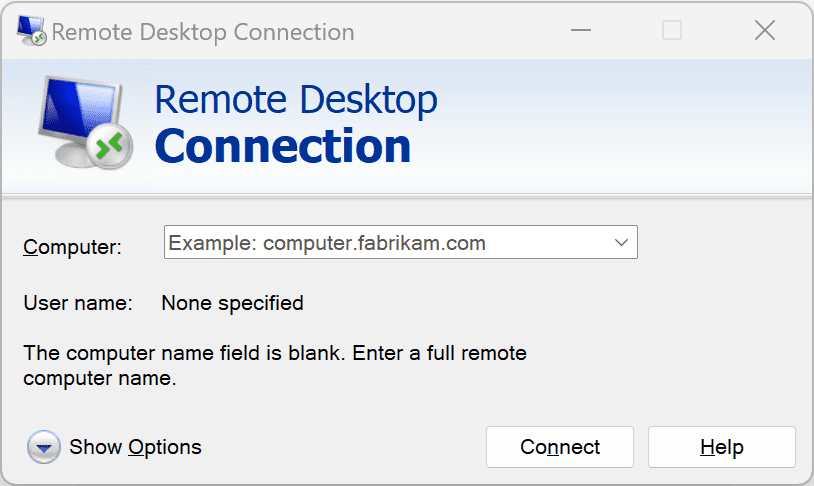
RDP is a proprietary protocol from Microsoft that provides users with a graphical interface to connect to another computer over a network.

The RDP protocol helps in the setup of server-based computing.

It enables clients to connect to servers – and in the context of RDP, those servers will run operating systems (e.g., Microsoft Windows) or applications (e.g., Sage BOB50, Microsoft Navision, etc.).

Since then, RDP technology has evolved rapidly. Truthfully, it’s become a complex endeavor that only a few people master.

Below, I’ll provide structure and simplify the complexity of RDP, the different options and elements, the high-level benefits, and the downsides. We’ll also explain how Parallels Secure Workspace layers benefits on top of RDP and the various ways to deploy it. I’ll keep it high-level in part 1 of the series, then deep dive into some of the situations and areas mentioned in subsequent posts. Now, let’s get started.

Ready to get started with your free trial of Parallels Secure Workspace? Download it now.

VDI vs. RDS

Microsoft’s Remote Desktop Protocol (RDP) is the main glue connecting clients (e.g., laptops or desktops) to operating systems and applications that are running on a remote device. Typically, this will be a server, but it might also be a personal computer in some cases.

We can identify two models in which RDP is used.

The following picture can serve as a summarized overview — read on for more detail.
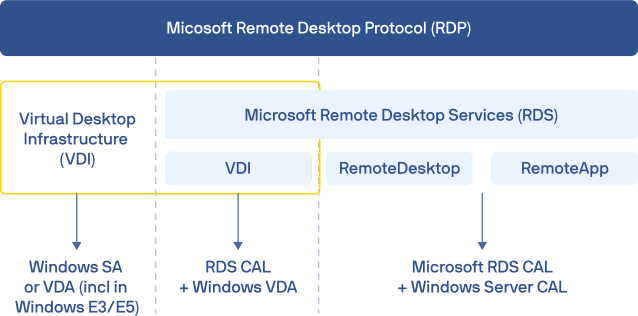
graph-demystifying-RDP

Virtual Desktop Infrastructure (VDI)

In VDI, the client connects to a dedicated host running a client version of Windows, such as the instance of Windows 7 or Windows 10 that is running on your laptop. The “host” will typically be a virtual machine, but it could also be a PC (on the condition that it’s connected to power and the network).

This virtual machine is dedicated to the client and cannot be shared.

As end users can access a remote but dedicated operating system, they can also get admin rights and install desktop applications themselves. From an infrastructure perspective, VDI is considered expensive as every user would typically have their own Virtual Machine running a version of Windows, and there is no resource sharing.

Microsoft has introduced Windows Virtual Desktop on Azure. As part of Windows Virtual Desktop, Microsoft also introduced multi-session Windows 10. This is only available on Azure, not on any other public or private cloud.

Remote Desktop Services (RDS)

Microsoft RDS, in contrast to VDI, is a server-based technology. (Note: previously, RDS was referred to as Terminal Server). For example, it doesn’t run on the version of Windows 10 that you run on your PC but on a Windows Server.

The biggest benefit of RDS being a server-based technology is that your infrastructure resources can be shared — multiple users can access the same operating system simultaneously.

What resources are end users accessing? The resource(s) in question could be a full desktop or a single application.

In the case of the full desktop, the actual resource accessed would be a Windows server, which is typically skinned to make it look like a desktop version of Windows.

However, it is not a desktop version, meaning that some desktop applications might be unable to run. RDS or Remote Desktop Services is a framework of roles. These roles are explained below. You don’t need all these roles for a simple VDI connection (without RDS).

I already covered how RDS can be used to give access to full desktops and individual applications.

For the latter, RemoteApp is involved. RemoteApp is a subset of Microsoft RDS, which gives the end user the impression they only have access to a single and isolated application (e.g., Microsoft Excel) without the operating system behind it.

For this purpose, you can use RemoteApp and install applications like Microsoft Excel on this desktop. The end user will then remotely launch their Windows (Server) and then open Excel inside that instance of Windows.

Note that RemoteApp is only available as of Windows Server 2008R2. Technically, the RDS technology can also be used to connect to VDI-based desktops. That means that you can connect via RDP to a VDI, but also via RDP over an RDS platform to a VDI. In this shared infrastructure, end users can’t enjoy admin access. However, the consumed infrastructure costs will be considerably lower than VDI from an economic perspective.

Start your free trial of Parallels Secure Workspace, and stay tuned for the next post in my series aimed at demystifying RDP.

About Version 2 Digital

Version 2 Digital is one of the most dynamic IT companies in Asia. The company distributes a wide range of IT products across various areas including cyber security, cloud, data protection, end points, infrastructures, system monitoring, storage, networking, business productivity and communication products.

Through an extensive network of channels, point of sales, resellers, and partnership companies, Version 2 offers quality products and services which are highly acclaimed in the market. Its customers cover a wide spectrum which include Global 1000 enterprises, regional listed companies, different vertical industries, public utilities, Government, a vast number of successful SMEs, and consumers in various Asian cities.

About Parallels 
Parallels® is a global leader in cross-platform solutions, enabling businesses and individuals to access and use the applications and files they need on any device or operating system. Parallels helps customers leverage the best technology available, whether it’s Windows, Linux, macOS, iOS, Android or the cloud.

Guarding the heart of giving: cybersecurity for NGOs

In today’s digital age, cybersecurity is critical for all organizations, including charities and non-governmental organizations (NGOs). These entities, driven by a passion for positive change, increasingly rely on technology to streamline their operations and advance their missions. However, they also face unique cybersecurity challenges that require tailored solutions.

  • NGOs are independent organizations not tied to governments, focusing on various social or environmental issues, funded by donations and grants. 

  • Charity organizations, a type of NGO, provide public benefit, such as alleviating poverty or improving health, funded by voluntary contributions and often enjoy tax-exempt status.

Understanding the vulnerability of NGOs

Recent research, like the report released by GOV.UK has brought to light the heightened vulnerability of NGOs like charities to cyber threats.

These organizations often operate with limited resources and cybersecurity expertise, making them attractive targets for cybercriminals. Data breaches, ransomware attacks, and phishing scams are just a few of the numerous threats they face.

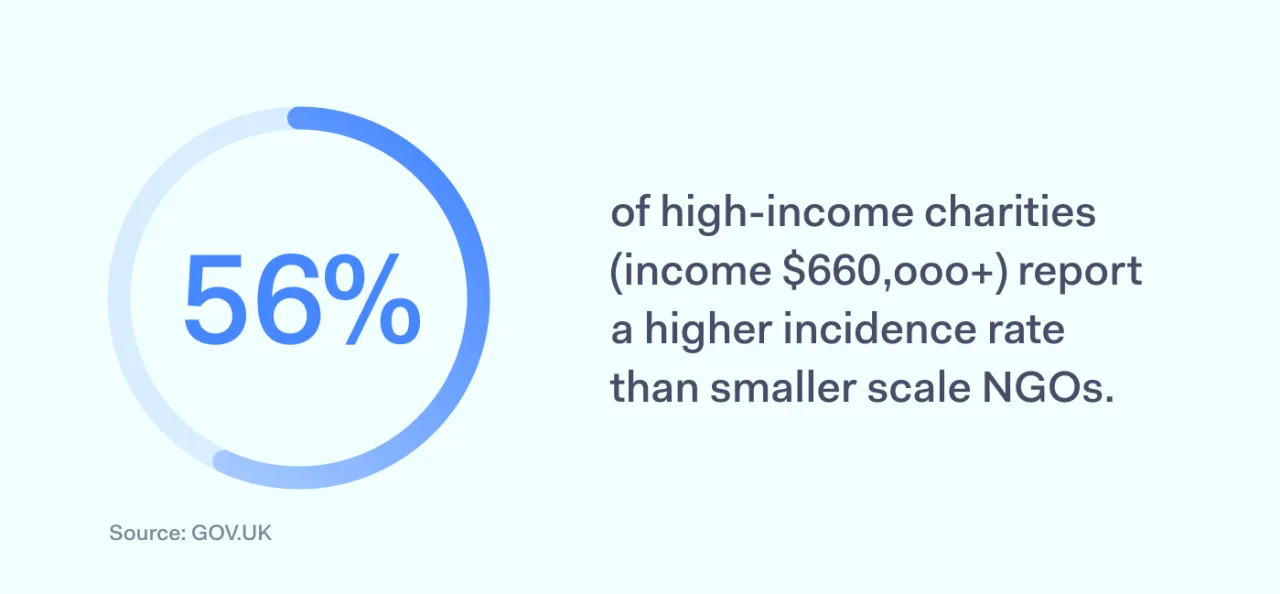
In the last 12 months, high-income NGOs have been a common target of cyber threats due to their higher-scale impact on the organization and benefit for bad actors. However, a lower frequency of attacks on smaller-scale organizations doesn’t mean they are less attractive to attackers.

High-income charities report higher incident rateThey are less likely to detect cybersecurity breaches and attacks compared to the previous year because senior managers in these organizations have downplayed cybersecurity in the current economic context, resulting in reduced monitoring and logging of such incidents.
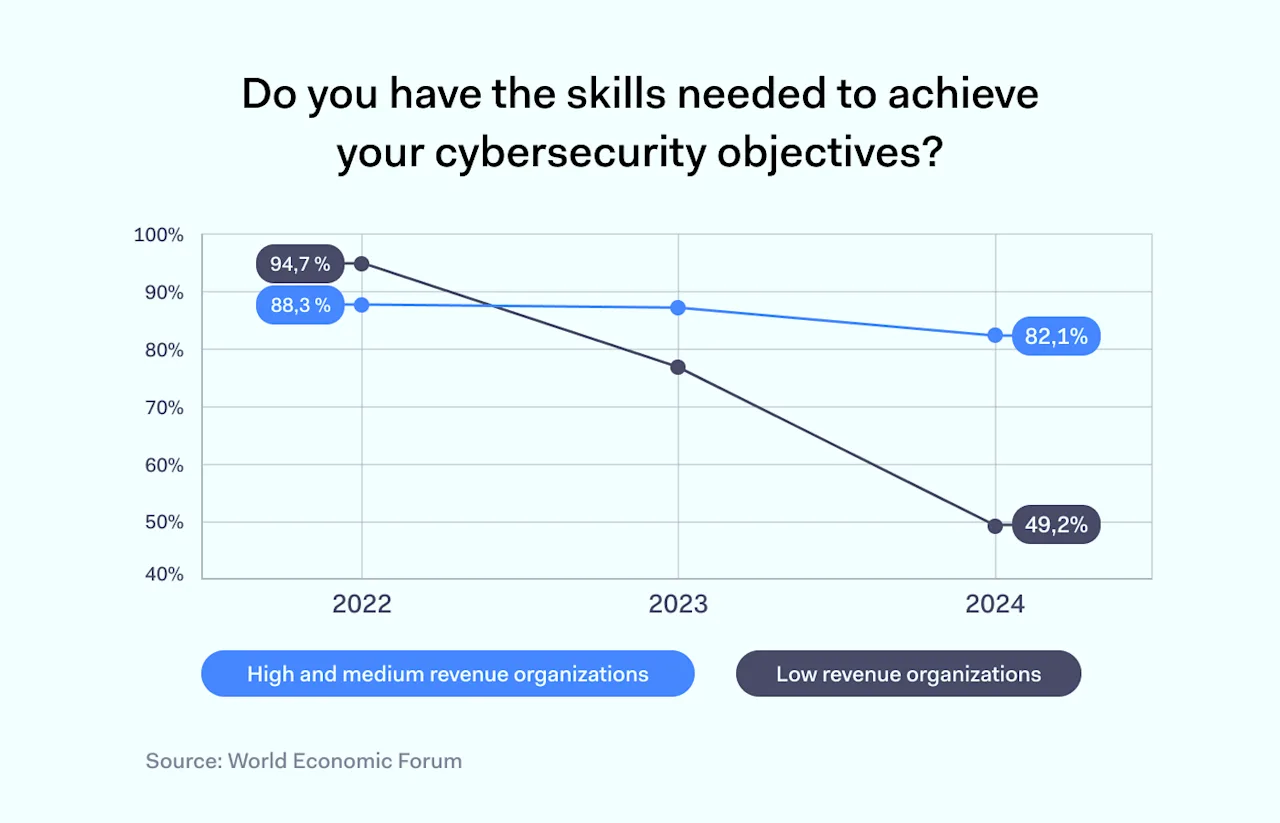
The World Economic Forum insights report reveals the actual decline in professionals with cybersecurity competency in lower-revenue organizations. It confirms that the perception of the actual threat landscape potential is shrinking compared to higher-income NGOs because of the lack of gathered and evaluated data.

Skills needed to achieve cybersecurity objectives in NGOs

Meanwhile, the data breach costs are rising. According to the latest IBM Data Breach Report 2023, the public sector, which includes NGOs, sees growth in data breach costs:

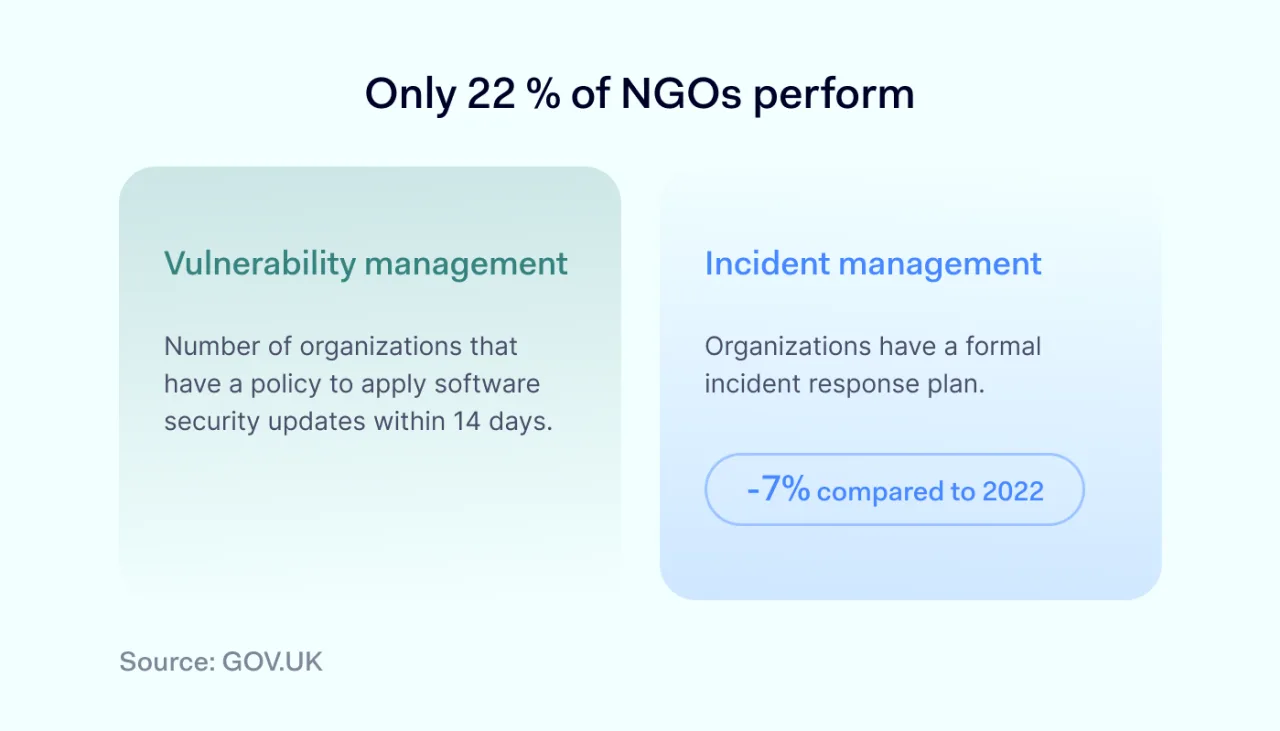
Approximately one in five organizations apply cybersecurity measures to protect their network and reduce the potential of cyber-attacks. The same proportion of NGOs have an incident response plan to act in case of an incident.

NGOs risk managementInadequate preparation and neglecting the impact of digital threats result in financial and reputational losses. Understanding the importance of donors’ financial support to deliver their mission to do good in the world, unsecured charities are more likely to pay with their credibility than actual money.
The challenges faced by NGOs

NGOs handle sensitive information, including donor details and beneficiary data. A breach in their systems can have far-reaching consequences, corrupting public trust and potentially harming those they aim to help.

The lack of dedicated IT staff and insufficient cybersecurity training further heightens these risks. Only a third of NGOs have people with some level of cybersecurity knowledge.

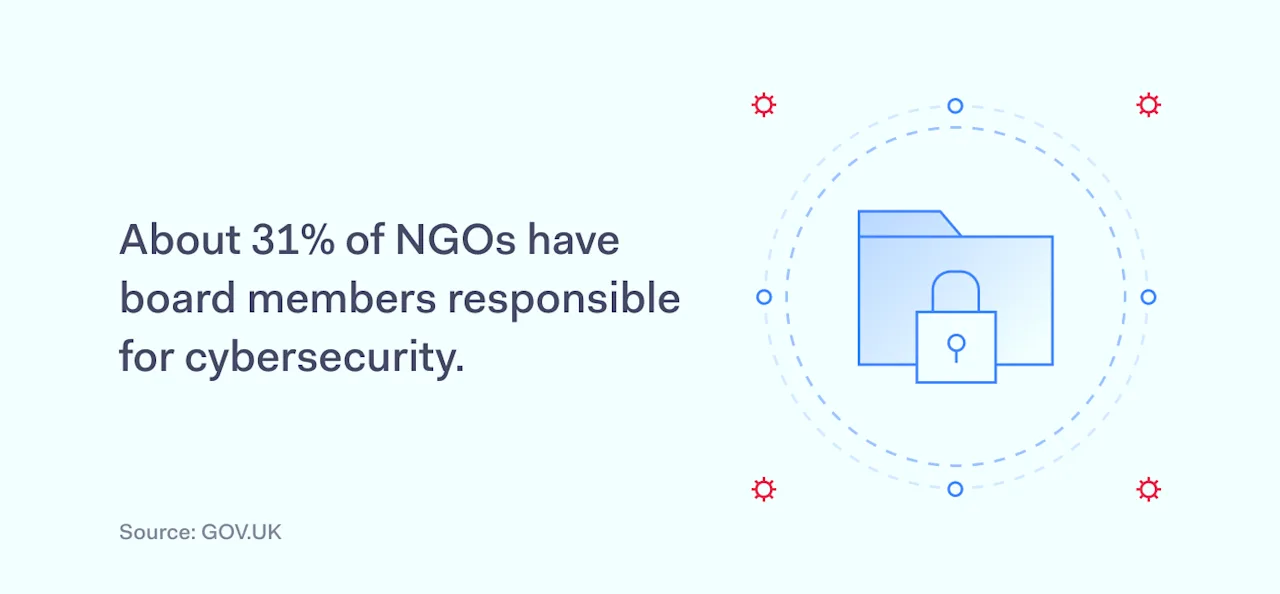
NGOs board members responsible for cybersecurity

On the other hand, employee training is in an even worse position. Only 17% of organizations have carried out staff training or awareness-raising activities. Users unaware of malicious activity and not restricted by additional identification policies pose a huge risk to NGOs’ network security.

The report also shows that charities tend to dismiss or be unaware of various regulatory compliance and cybersecurity awareness campaigns organized at the state level. Frameworks and guidelines simplify and compass NGOs to a clear direction on data protection, yet they are ineffective when left unused.

Red Cross data breach case

Another sensitive and curious topic is data protection. NGOs deal with entities that aim to aid and financial donors who provide money and resources for good deeds. Because of the data type that non-governmental organizations handle, it places them in an interesting position.

In 2022, there was a case of a Red Cross organization getting breached for information. The attack didn’t qualify as a ransomware attack.

Bad actors used the vulnerability of lack of access controls and retrieved sensitive data about refugees and other displaced people. In this case, lost information can bring more extensive damage than just financial losses.

Actionable solutions for enhanced cybersecurity

To address these challenges, charities and NGOs must adopt a comprehensive cybersecurity strategy.

This includes regular risk assessments, employee training on cybersecurity best practices, and the implementation of robust cybersecurity solutions. Encouraging a culture of cybersecurity awareness is also crucial.

Although NGOs employ measures like malware protection, cloud backups, and passwords, a relatively small portion of organizations perform cybersecurity risk assessment and management.

Data shows there has been a decline in the adoption of certain cyber hygiene practices over recent years.

Understanding that NGOs lack resources for cybersecurity, starting from people and knowledge to investments, these organizations need solutions that don’t require active input from the user.

  • The tools must be seamlessly integrated and don’t interfere with day-to-day operations.

  • The solutions should protect the most important and critical assets.

  • Network security solutions should bring money to value.

  • The tools could bring NGOs closer to regulatory compliance requirements.

  • The tools are easy to use and don’t require technical knowledge.

The solutions are available to outsource with managed security services.

Learning from experience: case studies

Our published NGO case studies offer valuable insights into real-world applications of effective cybersecurity strategies. These stories demonstrate how tailored cybersecurity measures can mitigate risks and safeguard operations.

Let’s take a look at the Canadian Mental Health Association (CMHA), Alberta South Region case.

For more information on how CMHA protected sensitive client data in dynamic team environments, visit the CMHA x NordLayer case study.

NordLayer: empowering NGOs with expert cybersecurity support

NordLayer provides expert cybersecurity solutions to NGOs. Our approach is holistic, offering not just tools but also the knowledge and support necessary to navigate the complex digital landscape. We specialize in identifying unique vulnerabilities and customizing security solutions to meet the specific needs of NGOs.

The NordLayer advantage

Our services are designed to empower NGOs to focus on their core mission without worrying about digital threats. By leveraging our expertise, NGOs can strengthen their digital defenses, ensuring data integrity and maintaining the trust of their stakeholders. Our solutions are easy to implement, cost-effective, and backed by continuous support.

A special offer: amplifying the positive global impact

NordLayer is proud to offer a special promotion to further support NGOs in their crucial work. We provide a 60% discount for all yearly NordLayer plans (T&C apply), making our top-tier cybersecurity solutions more accessible. This initiative reflects our dedication to enabling NGOs to amplify their positive influence globally.

About Version 2 Digital

Version 2 Digital is one of the most dynamic IT companies in Asia. The company distributes a wide range of IT products across various areas including cyber security, cloud, data protection, end points, infrastructures, system monitoring, storage, networking, business productivity and communication products.

Through an extensive network of channels, point of sales, resellers, and partnership companies, Version 2 offers quality products and services which are highly acclaimed in the market. Its customers cover a wide spectrum which include Global 1000 enterprises, regional listed companies, different vertical industries, public utilities, Government, a vast number of successful SMEs, and consumers in various Asian cities.

About NordLayer
NordLayer is an adaptive network access security solution for modern businesses – from the world’s most trusted cybersecurity brand, Nord Security.

The web has become a chaotic space where safety and trust have been compromised by cybercrime and data protection issues. Therefore, our team has a global mission to shape a more trusted and peaceful online future for people everywhere.

About NordLayer
NordLayer is an adaptive network access security solution for modern businesses – from the world’s most trusted cybersecurity brand, Nord Security.

The web has become a chaotic space where safety and trust have been compromised by cybercrime and data protection issues. Therefore, our team has a global mission to shape a more trusted and peaceful online future for people everywhere.

Surfing the Seas of Risk: Cybersecurity Challenges in the Insurance Industry

The insurance industry, a bedrock of financial stability, has been facing turbulent waters as it faces an array of risks. Recent research conducted by PwC and CSFI from May to August 2023, known as the Insurance Banana Skins 2023 report, shed light on the pressing cyber risks and concerns affecting the insurance sector. This comprehensive research, based on 589 responses from 39 territories, presents a vivid picture of the challenges that insurance market practitioners and observers find most urgent with cybercrime at the top of the list as a leading risk.

The Dominance of Cybercrime

Among the numerous risks identified, cybercrime stands out as the unrivaled leader. The report reveals that concerns related to potential data breaches, theft of sensitive data, phishing, and ransomware attacks have taken center stage. This not only mirrors the rise in claims for cyber incidents, but also highlights the vulnerability of insurance companies’ own systems to attacks. In 2023, themes such as the growing sophistication of criminals and government backing further intensified the gravity of the situation.

Sector and Region-Specific Concerns

Breaking down the results by sector provides quite interesting insights. The composite insurance sector identifies cybercrime as its primary concern, reflecting the pervasive fear of digital threats. Life and non-life insurance, as well as reinsurance, place cybercrime in the second position (right after climate change and regulations), acknowledging its significance. Brokers, while recognizing the threat, place cybercrime in the third position.

Geographical disparities also play a role in shaping the cyber risk landscape. For Europe and the Asia Pacific, cybercrime is the top “banana skin,” reflecting the global nature of digital threats. In contrast, for Africa and North America, cybercrime ranks as the second most pressing risk, highlighting regional nuances in the perceived severity of the threat.

A Growing Landscape of Vulnerability and Cyber Risks

The research conducted by PwC and CSFI indicates a rising concern among respondents that phishing and hacking attempts are ever-present. The ease with which criminals can monetize stolen data adds a layer of complexity to the challenge. The consequences of a data breach or a successful cyberattack extend beyond mere financial losses, as the theft of sensitive data, for instance, health insurance-related information, could have far-reaching consequences for both individual firms and the industry at large.

Reasons Why The Insurance Sector Is Targeted

In all honesty, who would be surprised that insurance companies are often attacked? Handling vast amounts of valuable personal identifiable information and sensitive data, these organizations become an attractive target for cybercriminals due to several compelling reasons. Firstly, insurance companies store a wealth of personally identifiable information (PII) and financial data, making them a lucrative source for identity theft and financial fraud. The value of protected health information (PHI) within the healthcare insurance sector is particularly attractive for cybercriminals, as this data brings big profits on the dark net. Additionally, insurance companies hold critical data on assets, liabilities, and financial transactions, making them a prime target for those seeking insider information for financial gain.

Moreover, the interconnected nature of the insurance ecosystem, involving collaborations with various third-party vendors and partners, creates potential entry points for cyber threats. Attackers may exploit vulnerabilities in the supply chain, leveraging less secure partners as gateways to infiltrate the primary insurance company network. As the insurance sector embraces digital transformation and adopts technologies such as cloud computing and IoT devices, the attack surface widens, providing cybercriminals with more avenues for exploitation.

The nature of insurance operations, often involving large transactions and the transfer of significant funds, further increases the attractiveness of insurance companies as targets for cyber attacks.


Cybercriminals recognize the potential for substantial financial gains through ransomware attacks,
more than 40%
of which are carried out through phishing, where they encrypt critical data and demand hefty ransoms for its release.


Fragile Fortifications: The Alarming State of Cybersecurity in the Insurance Business

Unfortunately, despite the fact that insurance companies hand huge amounts of highly sensitive and valuable data, and the representatives consider cybercrime to be one of the most urgent risks, several researches highlight the fragile state of cybersecurity in the insurance industry. According to the Cyber Insurance Risk in 2022 report, nearly 20% of the top 99 insurance carriers have a high susceptibility to ransomware, while 82% of insurance firms are vulnerable to phishing attacks.


The Phishing by Industry Benchmarking 2023 report reveals that, for large organizations (with more than 1,000 employees), the insurance industry remains
the most at-risk
for the second consecutive year, with a phish-prone percentage of 53.2%, showing little improvement from 2022


Additionally, according to the Insurance Banana Skins 2023 report mentioned above, the respondents, when asked to rate their preparedness for cyberattacks on a scale of 1 (poorly) to 5 (well), gave an average response of 3.20. This marks a decrease from 3.22 in 2021, signaling a slight decline in already low confidence in the industry’s ability to address the changing cyber threat landscape. The worry is palpable enough, with a sense that a successful cyberattack could jeopardize business continuity and lead to disastrous reputational consequences.

The Post-ChatGPT Era: A New Wave of Threats

The emergence of ChatGPT in November 2022 has ushered in a new era of challenges for cyber attackers. Historically, markets like Japan experienced fewer claims from phishing attacks due to the complexities fraudsters faced in translating attack emails. However, the deployment of large language models has transformed the cyber attack landscape, enabling the creation of more sophisticated phishing emails, analysis of code to find vulnerabilities and even the generation of malicious code. This shift underscores the need for increased vigilance, consistent measures, and innovative solutions in the face of evolving cyber threats.

To sum up, the insurance industry is at a critical juncture as it battles the ongoing onslaught of cyber threats. The Insurance Banana Skins 2023 report serves as a sharp reminder that cybercrime is not just a technical issue but a multifaceted challenge requiring an integrated approach. As the industry navigates these perilous waters, coordinated efforts towards strengthening cybersecurity, embracing advanced technologies, and developing a culture of resilience are imperative to protect the stability and trust that the insurance sector provides around the world.

About Version 2 Digital

Version 2 Digital is one of the most dynamic IT companies in Asia. The company distributes a wide range of IT products across various areas including cyber security, cloud, data protection, end points, infrastructures, system monitoring, storage, networking, business productivity and communication products.

Through an extensive network of channels, point of sales, resellers, and partnership companies, Version 2 offers quality products and services which are highly acclaimed in the market. Its customers cover a wide spectrum which include Global 1000 enterprises, regional listed companies, different vertical industries, public utilities, Government, a vast number of successful SMEs, and consumers in various Asian cities.

About SafeDNS
SafeDNS breathes to make the internet safer for people all over the world with solutions ranging from AI & ML-powered web filtering, cybersecurity to threat intelligence. Moreover, we strive to create the next generation of safer and more affordable web filtering products. Endlessly working to improve our users’ online protection, SafeDNS has also launched an innovative system powered by continuous machine learning and user behavior analytics to detect botnets and malicious websites.

23.12.4 ‘Voyager’ released

Changes compared to 23.12.3

New Features

  • Added the ability for top-level admins to create a new user in any tenant in the Comet Server web interface

Enhancements

  • Improved performance of “Optimizing snapshot” steps during a retention pass for remote Storage Vaults
  • Improved the “Add user” dialog in the Comet Server web interface to allow creating multiple users at once without having to enable advanced options

Bug Fixes

  • Fixed a performance regression introduced in Comet 23.9.10 when using granular restore to restore multiple files from a Disk Image or Hyper-V Protected Item

About Version 2 Digital

Version 2 Digital is one of the most dynamic IT companies in Asia. The company distributes a wide range of IT products across various areas including cyber security, cloud, data protection, end points, infrastructures, system monitoring, storage, networking, business productivity and communication products.

Through an extensive network of channels, point of sales, resellers, and partnership companies, Version 2 offers quality products and services which are highly acclaimed in the market. Its customers cover a wide spectrum which include Global 1000 enterprises, regional listed companies, different vertical industries, public utilities, Government, a vast number of successful SMEs, and consumers in various Asian cities.

About Comet
We are a team of dedicated professionals committed to developing reliable and secure backup solutions for MSP’s, Businesses and IT professionals. With over 10 years of experience in the industry, we understand the importance of having a reliable backup solution in place to protect your valuable data. That’s why we’ve developed a comprehensive suite of backup solutions that are easy to use, scalable and highly secure.

ESET achieves the Champion position in Canalys Global Cybersecurity Leadership Matrix 2023

BRATISLAVA, — January 22, 2024 —  ESET, a global leader in digital security, maintains its Champion status for the fifth consecutive year in the latest Cybersecurity Leadership Matrix from Canalys. With this milestone, it reaffirms its position as a world-renowned vendor of digital security and a top security provider for global partner networks.

According to Canalys, a leading global technology market analyst firm providing an overall assessment of the leading cybersecurity vendors with established channel programs, ESET is “one of a few full-spectrum cybersecurity vendors that cover consumer, SMB, enterprise, and MSP segments, giving it access to extensive threat intelligence.”

“Since beginning this company more than 30 years ago, we have been focusing on helping our partners develop their cybersecurity businesses and working to protect their customers against all types of threats by consistently innovating and reinforcing the protections offered by our multilayered technology. Focused improvement of our offering and being named a Champion for the fifth consecutive time affirm the impact of our efforts. We’re pleased to be rated highly by our partners, recognizing the value they place on the investments we’ve made to our platforms and systems,” said Miroslav Mikuš, President of Global Sales.

ESET’s ability to centrally plan and coordinate its go-to-market strategies and its policy of empowering both partners and country offices to run campaigns and sales executions relevant to local strengths are key contributors to its Champion status. Other key areas that have maintained high ratings among ESET´s partners are the quality of account management and technical support, together with overall ease of doing business.

ESET’s network now consists of more than 10,000 active MSPs and 24,000 active resellers. The MSP segment, with its 30% revenue growth, remains a core part of ESET’s strategy. The company has strengthened its proposition by enabling MSPs to offer Inspect and Inspect Cloud XDR solutions and both the ESET Professional and Security Services portfolios, including health checks and MDR.

“ESET’s consistency of engagement and support, as well as focused partner enablement to run campaigns and execute sales initiatives relevant to local strengths, were key contributors to its success in the channel,” said Matthew Ball, Chief Analyst at Canalys. “Partners highly rated its commitment and ease of doing business, as well as the quality of account management.”

The Canalys Cybersecurity Leadership Matrix assessed 29 cybersecurity vendors on their global channel and market performance over the latest 12-month period. The matrix combines three primary types of inputs: partner feedback from Canalys’ Vendor Benchmark ratings with an independent analysis of each vendor’s momentum in the channel based on their investments, strategy, execution and market performance metrics as the vendor´s growth and market share within the peer groups.

To find out more about the Canalys Leadership Matrix Awards, visit the website here.

About Version 2 Digital

Version 2 Digital is one of the most dynamic IT companies in Asia. The company distributes a wide range of IT products across various areas including cyber security, cloud, data protection, end points, infrastructures, system monitoring, storage, networking, business productivity and communication products.

Through an extensive network of channels, point of sales, resellers, and partnership companies, Version 2 offers quality products and services which are highly acclaimed in the market. Its customers cover a wide spectrum which include Global 1000 enterprises, regional listed companies, different vertical industries, public utilities, Government, a vast number of successful SMEs, and consumers in various Asian cities.

About ESET
For 30 years, ESET® has been developing industry-leading IT security software and services for businesses and consumers worldwide. With solutions ranging from endpoint security to encryption and two-factor authentication, ESET’s high-performing, easy-to-use products give individuals and businesses the peace of mind to enjoy the full potential of their technology. ESET unobtrusively protects and monitors 24/7, updating defenses in real time to keep users safe and businesses running without interruption. Evolving threats require an evolving IT security company. Backed by R&D facilities worldwide, ESET became the first IT security company to earn 100 Virus Bulletin VB100 awards, identifying every single “in-the-wild” malware without interruption since 2003.

×

Hello!

Click one of our contacts below to chat on WhatsApp

×