Skip to content

How social networks put your biometric data at risk

Social networks have become integral to our lives, enabling us to share photos, videos, and audio to connect with others, build our social presence, and even generate income. However, by sharing this content, we may unintentionally expose our faces, irises, fingerprints, voices, and other biometric patterns to hackers, who can exploit them for malicious purposes.

In this blog post, together with Andrius Januta, Cybersecurity Technical Manager at Nord Security, we’ll explore how content shared online can be used to steal our biometrics and discuss ways to protect ourselves from this threat. Let’s dive in.

Biometric data: What is it?

Biometric data, or biometrics for short, are body measurements and calculations related to an individual’s biological, physical, and behavioral characteristics. This can range from DNA, blood type, signature, and walking gait to the more commonly known fingerprints, face, iris, and voice patterns.

Each person’s biometrics are unique, so they offer a superior alternative to passwords for ease of use and enhanced privacy and security. As a result, biometric identification has become increasingly widespread, not only in high-security facilities but also in people’s everyday lives.

Today, over 80% of smartphones offer biometric capabilities for their users, enabling device unlocking, user authentication for purchases, and confirmation of sensitive actions within various applications.

Social networks: An endless source of biometrics

Our digital lives are dominated by biometric features that can be exposed on social media platforms like Facebook, Twitter, Instagram, YouTube, TikTok, and others. So by posting seemingly innocent-looking eye makeup, unboxing or live-painting videos, profile photos, stories featuring our daily life, and voicemails, we’re also sharing our unique identifiers with the world.

Rapidly advancing technology and media platforms supporting high-resolution image and video can inadvertently expose our face, iris, fingerprints, and voice patterns that can be cloned and used by threat actors.

How can biometric recognition systems be fooled?

Face, iris, fingerprints, and voice patterns are the four most common biometrics that can easily be harvested from social networks.

Andrius Januta, Cybersecurity Technical Manager at Nord Security, says that while, in general, biometric data offers greater security than passwords, several cases also demonstrate its inherent vulnerabilities.

  • Facial recognition systems can be fooled by gathering high-quality images or videos of an individual, which can then be utilized to craft makeup that mimics another person’s facial features, produce hyper-realistic masks, generate 3D renderings, fabricate full-size head replicas, and even employ deepfake technology.

  • Fingerprint recognition systems, designed to permit authorized users to unlock or access applications, can be compromised by silicone fingerprint replicas or even crafted duplicates made from wood glue.

  • Iris recognition systems are generally more challenging to falsify compared to facial and fingerprint equivalents. Nevertheless, A. Januta highlights that a few years ago, a high-resolution photograph of the iris, in combination with a contact lens, was sufficient to mimic an eye for unlocking personal devices.

  • Voice recognition systems are widely used in smart home devices, banking, and finance. However, voice cloning AI software can replicate the voice captured from video or audio messages. Important to highlight is that today, even a short three-second recording is enough to create a high-quality replica of someone’s voice.

Malicious use cases

While it’s possible that biometric data can be extracted from social networks, the majority of it doesn’t leak directly from these platforms. Rather, the greater risk for biometric data leaks is from poorly secured databases. In both cases, exposed biometric data can be exploited in various malicious cases.

Accessing devices and accounts

With access to your personal devices and a convincing replica of your facial features, fingerprint, or iris, a cybercriminal can bypass authentication requirements to unlock your device. As a result, they can gain full access to your private information, including contact lists, personal photos and videos, work files, financial data, login credentials, and other sensitive documents.

They can access online shopping portals and financial accounts and make unauthorized withdrawals, transactions, or purchases. They could install malicious software on your device to extract data or monitor your activities. A compromised device may even be used to distribute spam or malware to others.

Accessing services or committing fraud

Exposed biometric data can also enable fraudsters to impersonate you when accessing various services and facilities. This may include unauthorized entry to restricted areas and accessing financial, educational, governmental, or medical services. A.Januta adds that in some countries, biometric data already enables people to withdraw money from ATMs, enter sports events, and even pay for goods in supermarkets.

Equipped with your biometric data, threat actors can impersonate you while committing crimes. Examples of this include wearing hyper-realistic masks to take loans, accessing bank accounts using AI-synthesized voice clones, or scamming contacts with deepfakes, which according to A. Januta is one of the most common cases today.

He mentions that in one of the cases, threat actors impersonated a Binance executive, copying his image during video meetings and compromising multiple crypto projects. In another case, fraudsters created a deepfake video of one American in which he encouraged his friend to invest in Bitcoin mining.

Compromising your reputation

Deepfake videos or AI-generated images can falsely portray you participating in inappropriate activities or experiencing emergencies. Additionally, this data could be employed to fabricate your fingerprints at crime scenes or impersonate your voice in vishing schemes aimed at your family members.

How to protect biometric data?

Biometric system spoofing is like a cat-and-mouse game. Once cybersecurity specialists or threat actors find a vulnerability in biometric recognition systems that can be exploited, biometric system providers and tech companies quickly fix them. While it’s less likely to happen to average people, high-profile individuals like celebrities, businesspeople, or politicians remain vulnerable, so we cannot overlook the potential risks associated with the exposure of biometric data on social media,” warns A. Januta.


To address these concerns, A. Januta offers a range of practical suggestions for safeguarding our biometric information and preventing its extraction from social networks.

  • Be cautious about sharing biometrics on social media: Stay vigilant when posting videos or images that may expose your unique biometric features, such as fingerprints, face, or iris patterns.

  • Modify media quality and cover sensitive areas: Reduce the resolution of videos and images featuring you, and consider editing or blurring sensitive biometric information before sharing.

  • Opt for less exposed biometric factors: Choose biometric authentication methods that are less commonly exposed publicly or have a lower risk of being compromised, such as iris or retina.

  • Review shared media thoroughly: Scrutinize any media featuring your biometrics before sharing it on social networks, ensuring that no unintended exposure occurs.

  • Conduct regular media searches: Periodically search for your own image online and assess the context in which your images appear, taking necessary actions to remove any unwanted or potentially harmful exposure.

  • Prioritize multi-factor authentication (MFA): Use biometrics that are less exposed for single-factor authentication, or better yet, incorporate biometrics as part of a multi-factor authentication process rather than relying solely on a single biometric factor.

  • Use an additional hardware authentication device: Enhance security with a FIDO-enabled hardware device, providing an extra layer of protection against unauthorized access via standardized protocols.

  • Instead of biometrics, use complex and unique passwords: For less important accounts, use strong passwords, just don’t forget to update them regularly and securely store them in a reputable password manager.

  • Exercise caution with new services and technologies: Be vigilant when providing your biometric data to emerging services or technologies, and ensure that these entities have robust security measures in place to protect your sensitive information.

About Version 2 Digital

Version 2 Digital is one of the most dynamic IT companies in Asia. The company distributes a wide range of IT products across various areas including cyber security, cloud, data protection, end points, infrastructures, system monitoring, storage, networking, business productivity and communication products.

Through an extensive network of channels, point of sales, resellers, and partnership companies, Version 2 offers quality products and services which are highly acclaimed in the market. Its customers cover a wide spectrum which include Global 1000 enterprises, regional listed companies, different vertical industries, public utilities, Government, a vast number of successful SMEs, and consumers in various Asian cities.

About NordLayer
NordLayer is an adaptive network access security solution for modern businesses – from the world’s most trusted cybersecurity brand, Nord Security.

The web has become a chaotic space where safety and trust have been compromised by cybercrime and data protection issues. Therefore, our team has a global mission to shape a more trusted and peaceful online future for people everywhere.

How Board of Innovation manages security to protect its teamwork & client data

Board of Innovation is a global innovation firm imagining tomorrow’s products, services, and businesses – and creating them today. The company joins forces with the world’s most ambitious businesses to make what life needs next.

Working with prospects and new ideas requires creative flexibility that the company initially doesn’t want to block with security restrictions and limitations. On the other hand, protecting business and client data remains one of the company’s top priorities. Hence, Mehdi Lahmamsi Pinel, Global Operations & IT Manager at Board of Innovation tells how juggling those equally important things in the context of cyber threats aligns with the right security approach. 

The challenge

Trust over control within client confidentiality

The company culture at Board of Innovation is based on trust and employee enablement. These are critical elements for a creative industry. To succeed, the company is remote-first, and collaboration with freelancers and consultants of different backgrounds supplements full-time employees to generate new-of-the-kind products and services.

“Board of Innovation team is diverse as we have around 100 people of about 30 different nationalities in 60 places varying in cities, countries, and continents.”

Click to tweet

Yet, with a dynamic network of company innovators, consultants who move to client facilities, and third-party partners, IT managers face many challenges maintaining high levels of security that don’t interfere with team workflow.

“Business with client companies makes data security and confidentiality imperative, balancing it with the IT Manager’s responsibility to ensure the team works efficiently and effectively.”

Click to tweet

Board of Innovation works with high-profile companies and industry leaders. High traffic of changing projects, collaborators, and partners also requires precise supervision to mitigate the risks.

Since employees are unrestricted with their choices of how they want to work, self-awareness of the entire organization must be on board to achieve security goals. But how does one define the proper data protection standards and make security implicit yet not dominant? It’s a tough and subtle challenge for the IT manager to tackle.

The solution

Depicting minimums of must-security

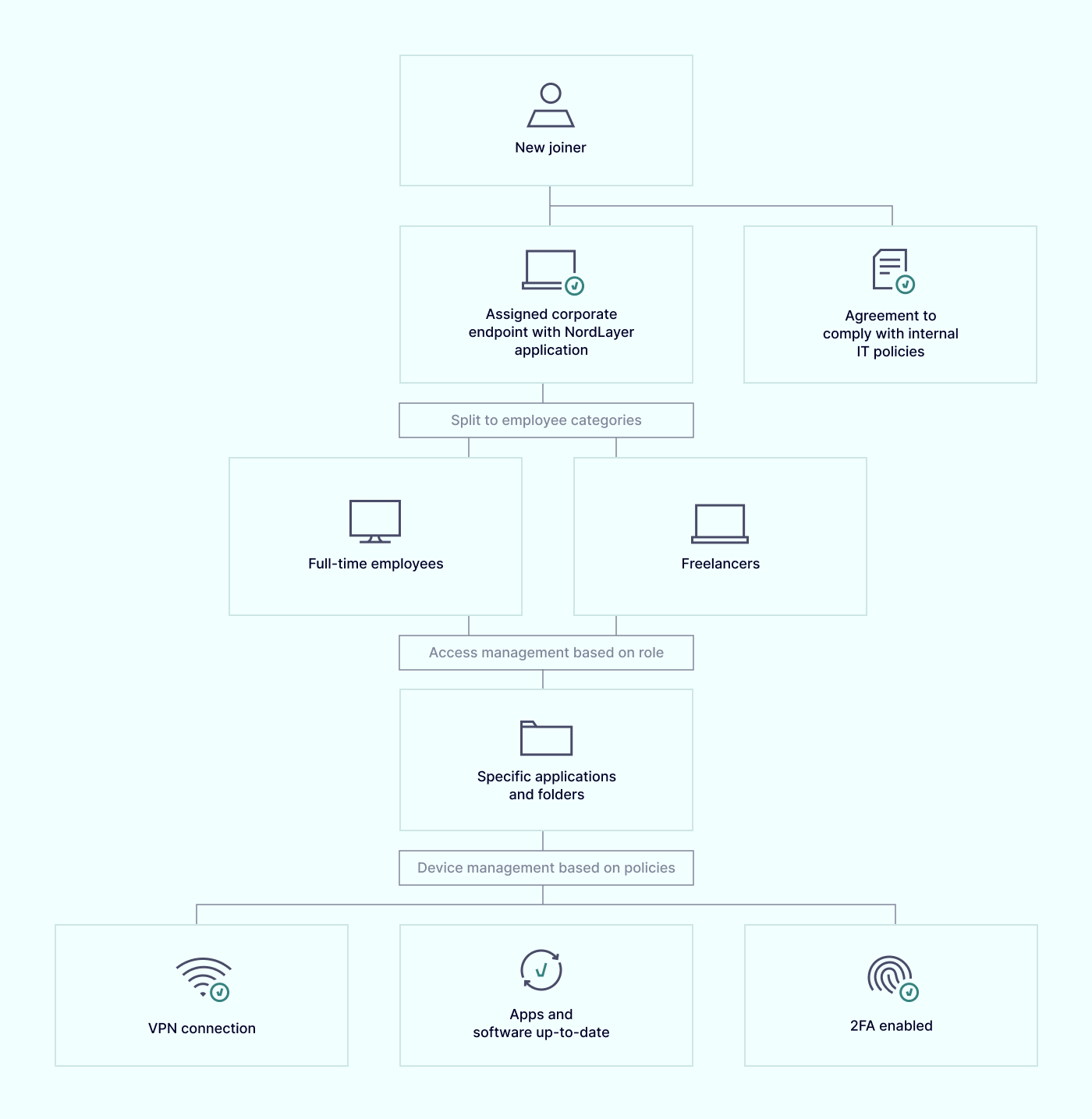
With evaluation of team setup, work environments, and the need for flexibility, a VPN solution was the most straightforward tool for Board of Innovation. It enables many different security protocols defined in the company. One of the policies is establishing a safe connection to the company network — this is where NordLayer comes into play.

A newly assigned IT manager started by reviewing the then-current cybersecurity strategy applied in the organization. Deployed by the previous responsible manager, Board of Innovation already had an ongoing NordLayer subscription. Yet, it needed a strategy that fits company culture to its benefit.

“I’ve started by revisiting and improving the existing cybersecurity setup. NordLayer was there but not utilized to its fullest potential.”

Click to tweet

So what needed to be added to create a sound cybersecurity strategy that works?

The company has a secure network access solution in place. VPN is a mandatory factor of encrypted connection, and every organization member has to familiarize themselves and agree to data protection policies.

“Whether our collaborators and employees use personal or corporate devices for the job, they must acknowledge internal IT security policies to follow.”

Click to tweet

Board of Innovation follows a streamlined approach to managing its workforce — company policies define access levels to internal data. To put policies into force, corporate devices became a connecting point for every user with access to company resources.

“Mandatory apps like NordLayer and tools for password management, specific internet navigation, and work organization are pre-installed by default. That’s how we enforce security via device management on corporate devices.”

Click to tweet

Having the tools that fulfill internal and client data security requirements relieves the security manager from dependency on employees. And having those corporate devices set up and readily distributed to the hands of the workforce is half the job done.

Users have to launch VPN once connecting to untrusted networks wherever and whenever they work, and the admin can supervise the whole process if the rules are followed.

Why choose NordLayer

Creative freedom and trust are the foundation of the Board of Innovation culture. Thus, any tools and solutions used to keep up with the security requirements must be convenient and simple, enabling and not disrupting the workers.

The organization decided to keep the NordLayer solution due to its user-friendliness. Moreover, the well-known service provider has to sustain being a reputable vendor of a safe and efficient solution.

Role and endpoint management leaves more space for protecting digital company assets by enforcing authenticated user identities. More granular network access segmentation enables careful supervision over the organization members. 

How NordLayer enables data security on different network layers

Systems and policies allow the IT manager to achieve consistency in business processes and operations. Having an overview on the NordLayer dashboard makes it easier to see who complies with the rules, like having the 2FA enabled. Moreover, or get a report of the connection history.

The outcome

Streamlined consistency aligned with internal policies 

Now, Board of Innovation has all workforce onboarded to the NordLayer solution. The solution present in every corporate device and combined with two-factor authentication makes it easier for the IT manager to ensure policies are up and running.

“We distribute NordLayer licenses to all organization members and contributors as a basic rule in our company. We aim to reinforce security policies in as many places as possible.”

Click to tweet

The remote network access solution enables the organization to collaborate with various clients, partners, and freelancers. Managing access to internal resources and project information creates barriers to stopping data leaks and breaches. And importantly, security policies don’t overcome and interrupt innovators’ creativity and workflow.

“Using NordLayer is so easy — simply open the user interface, choose a gateway, get connected, and here you go.”

Click to tweet

All that is left for the IT manager is to distribute access and privileges to internal resources according to the company policies and check that everyone is on board with the process. 

Pro cybersecurity tips

Sharing best practices is what helps businesses of any industry innovate in their own way of security. Creating a strategy for protecting the company network and securing information of different levels can be based on the most unconventional and unexpected advice. Thus, this time just like every time, we asked Mehdi Lahmamsi Pinel, the Global Operations & IT Manager at Board of Innovation, to share his professional insights on business cybersecurity:

Have you ever hesitated to impose security policies because they might overcrowd business operations and disrupt employees’ daily work? Creative freedom and simplicity can remain a priority since cybersecurity doesn’t have to become dominant yet effective and efficient.

NordLayer solution secures and enables every way of working, even if you want to prioritize trust and flexibility. The application, running in the background, simply does its job encrypting connections and segmenting the teams wherever the employees are. They can combine organization-provided devices with personal endpoints securely enabling BYOD policy within the company and IT managers can attend to their work stress-free. Sounds good? Reach out to learn more about NordLayer possibilities.

About Version 2 Digital

Version 2 Digital is one of the most dynamic IT companies in Asia. The company distributes a wide range of IT products across various areas including cyber security, cloud, data protection, end points, infrastructures, system monitoring, storage, networking, business productivity and communication products.

Through an extensive network of channels, point of sales, resellers, and partnership companies, Version 2 offers quality products and services which are highly acclaimed in the market. Its customers cover a wide spectrum which include Global 1000 enterprises, regional listed companies, different vertical industries, public utilities, Government, a vast number of successful SMEs, and consumers in various Asian cities.

About NordLayer
NordLayer is an adaptive network access security solution for modern businesses – from the world’s most trusted cybersecurity brand, Nord Security.

The web has become a chaotic space where safety and trust have been compromised by cybercrime and data protection issues. Therefore, our team has a global mission to shape a more trusted and peaceful online future for people everywhere.

Top cybersecurity trends to be on the lookout for in 2023

Much like seasonal flu, cyber threats are constantly evolving every year. While the coronavirus curve has been, for the most part, flattened and more enterprises opened up their offices for on-premise employees, the number of cyberattacks continues to grow. Even last year, cyberattacks increased by 38% in 2022, compared to 2021.

Even without covid as a catalyst, businesses are still becoming more digital, leading to increased attacks. In this environment, cybersecurity is a real challenge, and both business managers and network administrators have a real head-scratcher on their hands. Here are our predictions on the cybersecurity trends for this year.

Cybersecurity is no longer an IT manager’s concern. It’s something that comes into play when making key business decisions. Data breaches can turn the business upside down with penalties and loss of customer trust. It’s a challenge that can come from outside and inside with improperly configured networks.

As digital transformation is becoming more prevalent among businesses, so does the increase of various threats. Here are the eight main cybersecurity trends shaping this year’s digital environment.

Top cybersecurity trends for 2023 blog visual web 1400x843Chat GPT-enforced attacks

Soon after OpenAI launched the intelligent chatbot ChatGPT, it was quickly revealed that it could do more than just form responses across many knowledge domains. Cybercriminals have already started to use this tool for building hacking tools, while scammers are gathering knowledge to build similar chatbots to use for impersonation.

While the publicly available ChatGPT-coded tools are quite rudimentary, it seems that it’s only a matter of time before hackers can turn the AI to their advantage. In general, the least of its contributions is that it lowers the entry threshold by being a huge help for novice malware developers. Even without coding assistance, it helps to write genuine-sounding phishing emails for hackers.

Although ChatGPT has various safeguards to prevent it from being used for exploitation, this is something that businesses should keep in mind. Artificial intelligence is going mainstream which levels the playing field for hackers and can put increased pressure on your cybersecurity plan.

Remote and hybrid employees risks

After the pandemic, businesses have settled with hybrid workforce models. In some cases, these models are relics of a period when the Covid-19 outbreak forced the digital transition. As this development had to happen very quickly and not interrupt business operations, this also meant that the security measures weren’t always without gaps.

This blend of employees working on-premises, remote working contractors, and a wide variety of their used company-issued and personal devices makes it a colossal job to secure everything. For IT administrators, the attack surface is too huge to oversee everything that is happening. As data breach cases pile up, we’ll likely continue to see an increased interest in securing business networks and balancing them with workplace flexibility.

Automation of cybersecurity

As hackers themselves are starting to leverage AI for their exploits, it’s only natural that businesses should keep up. Data sources multiply exponentially, so automation is necessary to crunch numbers before humans can analyze them. This allows companies to get the best of both worlds and dramatically improve their cybersecurity status.

Various sources show that successful AI pairings can extend network visibility by up to 35%. These developments clearly show that AI has the potential to be a key component when transforming network security operations. Leveraging machine learning moves organizations forward and builds more sophisticated systems to withstand the most complex online threats.

International state-sponsored attacks

While state-sanctioned cyberattacks are nothing new, the ongoing war in Ukraine marked a turning point for a steep increase. Russia remains largely isolated from the rest of the Western world, and 64% of Russian hacking was directed directly at Ukraine. These are huge numbers, even without factoring in hacking attempts at their allies. Cyber espionage is escalating in other areas as the US recently shot down the Chinese surveillance balloon.

As all this is happening, a business can easily be caught in the crossfire. This makes private companies and critical infrastructure organizations prime targets for credential theft, vulnerability exploitation, or ransomware. In such a climate, not having a cybersecurity plan in place is a severe liability, and businesses will likely take action to address IT security shortcomings.

Building a security-aware culture

According to Verizon, 85% of breaches involve a human element, so investing in cybersecurity technologies but skimping on the workforce is missing the forest for the trees. In today’s climate, thinking that cybersecurity risks are a problem for the IT department can blow up when you least expect it. Every single employee must be aware of potential cyber risks and know how to deal with them.

In some cases, this may require building transparent information security policies. In others, security awareness training may be necessary. Security culture building will become a key factor in many organizations this year. As social engineering attack numbers aren’t subsiding, there’s no other way to combat these threats than through company culture.

Data breaches will continue to increase

Data breaches increase yearly more than they did the previous year, and this year will be no exception. Data is still one of the most valuable assets, and organizations still leave plenty of room for attackers to exploit gaps in the fence. Building a firm infrastructure isn’t cheap or simple, either, so most companies exist hoping they won’t be the next target.

This said prevention is much more effective (and cheaper) than settlements, lawsuits, and fines for data security violations. Yet, many businesses still rely on legacy software without any risk management policy and procedure updates. We can expect that more businesses will be caught off guard this year while others will try to learn from others’ mistakes rather than their own.

Global recession serves as a catalyst for hackers

As many experts are warning about economic downturns, this can catalyze cybercrime. Most cyberattacks are financially backed, so as the economy shrinks due to global geopolitical events like Russia’s war in Ukraine, this sends a shockwave throughout all spheres of life. Hacking, therefore, can become a lucrative option if a person has the skills and no other options to earn a living wage.

Hackers-for-hire, therefore, may emerge in search of easy money, which can have various devastating consequences for companies. While some might perform penetration tests or collect bug bounties, others may not be so ethical. This should be considered, especially in Europe, considering its geopolitical tensions.

Credential stealing will continue to rise

Various reports show that mobile device vulnerabilities targeting credentials are on the rise. Hackers know that employees use their IoT devices to access the company network. So these devices are user-managed. They tend to have quite more vulnerabilities that hackers could exploit.

What also helps hackers is that most systems are still protected with only passwords. It’s especially easy to crack such a setup when employees reuse the same passwords. A move towards passwordless or hardware identity tokens is happening slowly. This proves to be a lucrative opportunity for thieves. Some experts claim that we’ll also see more second-factor authentication exploits via SMS and push-based multi-factor authentication solutions this year.

Tips on how to prepare your business for 2023

To prepare for this year, companies should start with budgeting. The amount spent on cybersecurity in 2021 and 2022 should be a benchmark for the 2023 budget. It should also adjust according to how many significant changes occurred in the organization and the cybersecurity landscape.

Adjusting the cybersecurity budget according to your company size is also common. A rule of thumb is to allocate at least 10-20% of your total budget. Revising the budgeting plan as you go is always a good idea. Cybersecurity threats and landscape can change a lot throughout the year, so staying flexible is one of the methods to stay ahead of the curve.

How can NordLayer help to protect your business in 2023?

Most recent developments in cyberspace are relevant to every business as most of them will be affected by them. Organizations need trustworthy allies to deter cyber threats as the threats keep piling up.

A modern remote network access solution like NordLayer is developed to integrate threat, network, and security management centrally to provide an explicit range of issue-targeted features. Especially with the help of a convenient design that combines cloud-based platforms, data privacy protection, and access control security strategies. 

NordLayer covers security with a centralized control interface and product integration to existing infrastructure. It provides secure remote access solutions for hybrid environments and implements zero trust for distributed workforces conveying everything to the cloud environment.

Achieve a multilayered security protection network and data environment — secure your business in 2023 with NordLayer — reach out to talk more.

About Version 2 Digital

Version 2 Digital is one of the most dynamic IT companies in Asia. The company distributes a wide range of IT products across various areas including cyber security, cloud, data protection, end points, infrastructures, system monitoring, storage, networking, business productivity and communication products.

Through an extensive network of channels, point of sales, resellers, and partnership companies, Version 2 offers quality products and services which are highly acclaimed in the market. Its customers cover a wide spectrum which include Global 1000 enterprises, regional listed companies, different vertical industries, public utilities, Government, a vast number of successful SMEs, and consumers in various Asian cities.

About NordLayer
NordLayer is an adaptive network access security solution for modern businesses – from the world’s most trusted cybersecurity brand, Nord Security.

The web has become a chaotic space where safety and trust have been compromised by cybercrime and data protection issues. Therefore, our team has a global mission to shape a more trusted and peaceful online future for people everywhere.

Software development in the cloud: benefits & challenges

Digital transformation touched most businesses operating today, and the transition to the cloud is an important step. The cloud became a primary environment for creating new software, particularly for software developers and IT professionals. Combining flexibility and efficiency for the price served as the new way of doing business.

Yet, not everything was all moonlight and roses — the outsourced model also brings a fair share of cybersecurity risks. This creates a head-scratcher for network administrators and developers in balancing the benefits with the risks to ensure a streamlined mode of operation that is as effective as it’s secure. Let’s take a deep dive into all things cloud software development.

What is cloud computing?

Cloud computing is an infrastructure model in which resources and processes are outsourced to data centers rather than done internally. This method relies on the public internet as the primary mode of delivery, allowing a much wider reach than possible using conventional methods.

Cloud computing often provides services like data storage, management, device access, networking, and cybersecurity. Externalizing these operations to cloud-based infrastructure allows businesses to focus their efforts elsewhere. In addition, this also enables them to flexibly adjust their operations according to their needs allowing them to be changed at a moment’s notice. It’s a key driving force behind the startup culture and innovations.

Service models

Reliable, fast, and secure services are what every customer takes as a baseline. Businesses are pressed to deliver on the highest level at all times. However, IT infrastructures can’t always stretch that fast, nor can every business owner issue blank checks for upgrades.

Cloud computing solves these pressing issues by providing a streamlined model delivered via the internet. According to specific business requirements, cloud computing services are classified into three distinct models.

Software as a Service (SaaS)

SaaS is primarily used for the delivery of web applications. Fully managed by the service provider, cloud software is accessed remotely and typically has pricing based on plans and subscriptions. In most cases, this provides a much cheaper solution that manages software internally and relieves the teams from the need to perform maintenance.

Platform as a Service (PaaS)

PaaS offers a remotely accessible environment allowing developers to build and deliver software applications. This bypasses the need to use Integrated Development Environments, which are expensive and difficult to set up and maintain. The model includes everything you’d need to start working on your applications, like various middleware tools and operating systems. PaaS uses the same pay-as-you-go model as other remaining cloud service models.

Infrastructure as a Service (IaaS)

IaaS offers core cloud computing services like servers, storage, and networking on demand. This type helps a company to adjust company resources on demand. In cases when new applications have launched, this type also helps to quickly provision them and extend the reliability of existing infrastructure. Usually, payment costs are collected based on using a particular resource, allowing you to install and manage your software on top.

Cloud deployment models

The cloud services deployment model may also have various distinct particularities like ownership, scale, access rights, etc. It defines the location of the servers your organization will be using, what can be changed, and the needed input from the client. This distinguishes different cloud deployment types.

Public cloud

As you can probably guess from the name, the public cloud is available for everyone to access. It’s provided for the general population, making it the least secure cloud type. Owned and managed by the cloud services provider, this type doesn’t require much maintenance but is also the most difficult to secure. On other hand, some public clouds are free to use, while some require a subscription to move beyond the basic plan. 

Private cloud

The polar opposite of the public cloud is a private type — it’s reserved for a single user using separate hardware. Often incorporated into the organization’s infrastructure, the private cloud facilitates handling all the hardware and software services within its perimeter. It offers the most flexibility of all the cloud service types allowing an organization to customize even the tiniest aspects of the setup.

Hybrid cloud

Hybrid combines the best private and public cloud features using proprietary software. This allows hosting applications in a safe environment and cheaper service due to reliance on the public internet. In a way, this functions like a partially locked public cloud with much more customization options.

Benefits of software development in the cloud

If your business rapidly expands, cloud technology is a natural addition to improving your operations. This allows you simultaneously to improve productivity and give more opportunities for your internal teams. Here is a list of the principal benefits related to cloud computing.

1. Scalability

Traditional server hosting always met various constraints as it was based on physical hardware — the capacity can only be proportional to your internal server stack. Cloud computing turns this premise on its head, removing all constraints. No matter the organization’s size or budget, it’s possible to find an option to fit any budget. 

When a bigger capacity is needed, allocating more servers to combine their processing power is easy. Various server service providers also offer flexible memory or CPU adjustments, so it’s possible to customize the cloud computing setup to the smallest details.

2. Cost-efficiency

For businesses looking for various entry points to test the waters before committing to a full-scale infrastructure, the cloud computing model’s cost efficiency is the key benefit. Unlike hosting everything internally, cloud doesn’t need any upfront investments, making it a perfect starting spot to increase usage, on a need basis.

Pricing-wise, cloud service providers widely adopt pay-per-usage fees, meaning that organizations are only charged for the resources they use. This means it’s much more convenient to manage overspending and provides a safety net if the operations need to be quickly shrunk. 

3. Disaster recovery and redundancy

No matter which method for application and data hosting a business chooses, emergency data recovery methods will have to be set up. Admittedly, cloud services should be much easier as they come out of the box with easy data mirroring and backup solutions.

Traditional on-premise setups will have to be configured from the ground up, meaning that additional investments are very likely. Setting the mirroring within the internal perimeter doesn’t help in case the whole network becomes infected. This could potentially damage the backup as well. This is one of the biggest advantages of cloud computing.

4. Fast provisioning of resources

Relying only on the currently available on-premises leaves companies with only a few resources. Various software development and test environments require thorough planning in advance and take a while to get running. However, with the cloud model, everything can be available instantly.

Brand-new environments for testing or development purposes can be created instantly. This can speed up cloud software development by skipping preparation steps and getting the work environment ready instantly. The cloud provider periodically introduces new adjustments, ensuring that the prepared application seamlessly integrates into the new technological landscapes.

5. Multiple models and offerings

The cloud model is less restrictive and doesn’t operate in one-size-fits-all absolutes. By design, it’s flexible and aims to adapt to accommodate the organization’s needs, not the other way around.

On average, each provider has at least several options to choose from, while most will allow even greater personalization for an extra fee. As it was mentioned previously, various internal and outsourced cloud infrastructure models can be combined to develop a hybrid approach if that’s the direction in which a business wants to progress. 

6. Wide geographic reach

Unlike on-premises hardware, cloud-based infrastructures have a much wider reach. This can be helpful when connecting your globally distributed workforce and reaching your customers. The latter could be improved by optimizing the server load by leveraging cloud architecture.

Even if an application is hosted in a single location, a distributed cloud model allows users to easily access it through multiple points of presence scattered around the globe. This is further facilitated by content delivery networks allowing instant access to various resources and services.

7. Easy deployment

The innate flexibility of cloud infrastructures brings easy deployment capabilities. In practice, some operations could be automated by integrating various cloud processes into your existing setup. This could significantly speed up the application testing process.

Simultaneously this allows a business to ramp up the cloud software development speed allowing instant updates in testing environments. If everything works well, the slots could be easily swapped to go into production. This works wonders for testing new features and ensuring new upgrades work as intended before releasing them to the public.

Possible challenges of cloud software development

While it opens many doors of possibilities, cloud software development isn’t without its fair share of challenges. Outsourcing can be difficult, especially for companies with a functioning system. Here are the major challenges that face cloud application software development.

Seamless interoperability

The major challenge facing organizations that are considering cloud frameworks is interoperability. The written code needs to work with multiple cloud providers despite their differences. This even gets more complex when portability is involved. The same code might be difficult to transfer from one environment to another.

This needs to be addressed by introducing standards and facilitating data access across different software platforms. For this reason, operating protocols must be highly standardized to avoid potential interoperability errors.

Performance issues

When we’re talking about the cloud, we’re talking about distributed physical servers. This still means that their physical location is important, and customer connection to them could impact their experience.

Therefore it’s important to prepare in advance and figure out which data centers will be hosting your data. It will be much easier to set everything up correctly in advance rather than to plan the move once the operations are up and running. End-to-end testing is critical. Cutting corners will result in an inefficient mechanism that hurts your company in the long run. 

False promises of scalability

While it is true that all cloud computing providers can provide scalability, this still has the constraints of the provider’s capacity. Scalability is always limited to the number of resources a provider has, so if your scaling needs are beyond what the provider can deliver, you may be stuck with a service that doesn’t cover your needs.

The key risk here is choosing a predefined program that isn’t as flexible or adjusted to your needs. In some cases sticking with a hybrid model allows for the best solutions from the best worlds.

Reliability and availability

While the cloud model helps to maintain high uptime for cloud apps, this isn’t always a guarantee. Cloud providers rarely offer around-the-clock service, so outages could be left unresolved. Similarly, the provider might not inform leniently about maintenance schedules or other problems.

This requires additional effort on the client’s part. The used cloud service should be monitored using additional tools. Things like service usage and performance should be something that an organization knows at all times.

Dependency on the provider

When building applications, it is very convenient to tailor-make the code to work best within its cloud environment. However, this also has the side-effect of becoming heavily reliant on the external partner for your operations. Sometimes, changing the provider might be expensive, time-consuming, or difficult from a technical standpoint.

Your services should follow good architecture practices to avoid being tangled with underlying service logic if a business decides to move operations elsewhere. For developers, this means understanding different protocol particularities and responsibly adjusting application behavior.

Programming modes

Developing applications in the cloud require different programming skills. While most developers are familiar with SQL operations passing application-specific functions aligned with federated data sources, cloud software developments don’t work the same way. This requires developers to adopt query-oriented processing to derive federated data sets performing complex queries or function compositions that align better with cloud computing models.

Application security

Outsourcing such critical elements as application software development means their access should be heavily restricted. This makes application security a challenge due to the web delivery model and the state of the browsers.

For this reason, the connection outside the browser must be properly secured using encryption and tunneling protocols. Still, it’s a broad topic that could be addressed separately.

What measures should developers take to secure software in the cloud?

Transferring developing workflows in the cloud is one of the most important moves that a company could make. While it provides various benefits for developers, security is one of the most important concerns related to it. Here’s how it could be improved.

1. Establish governance policies

Clearly defined governance policies help to achieve better security in cloud software development operations. They put procedures and policies in place and give employees clear guidance in the workplace.

When aligned with your company’s internal security requirements, these policies create a holistic system defining organization-wide operational standards. This even out security across the board, creating transparent processes.

2. Segment your network

An architectural approach of dividing networks into smaller segments helps to manage various security risks in case of a data breach. As free lateral movement across the network is restricted, hackers are isolated within a subnet limiting the pace and time during which they could undetected could stage an attack.

Resources can be shared between segments, so no additional processing power is needed. In addition, this approach helps from the security standpoint and allows control of traffic flow between subnets based on granular policies.

3. Automate security processes

Security automation is an essential component of a solid cloud software development operations model. Code analysis could be automated during the building and testing phases. Meanwhile, infrastructure as code practices can automate configuration management. Finally, various potential threats could be instantly responded to without human intervention preventing potential damage.  

4. Conduct vulnerability management

Identification, evaluation, and security vulnerability reporting is a critical procedure that is paramount to secure cloud software development. Applications should be provided to the customer if they have unresolved known vulnerabilities. Otherwise, hackers could easily exploit them. Penetration testing mechanisms are therefore needed to assess potential exploits better and address critical application shortcomings.

5. Regularly audit security

Organizations’ security practices should match their policies. If the two don’t align, this catalyzes a cybersecurity incident. Periodic evaluations of security practices should be one of the cybersecurity strategy pillars. Various improvements should also be considered helping to set benchmarks and progress measurements.

How NordLayer can help secure the cloud

As the cloud-first approach is a firmly established infrastructure organization method among modern businesses, its security is one of the most important disciplines of modern cybersecurity. Application software development relies heavily on cloud computing to make the heavy lifting possible, but this must always be secure.

NordLayer offers cloud-native tools incorporating ZTNA practices within a Secure Service Edge model. Allowing secure remote access by encrypting traffic from end to end can protect data, whether it’s hosted locally or on the cloud.

Features like IP allowlisting enable network administrators to approve authenticated connections and block everything else. This helps to create an airtight system that provides a secure access model when using external cloud services.

Get in touch with the NordLayer team and explore our cloud-based products today.

About Version 2 Digital

Version 2 Digital is one of the most dynamic IT companies in Asia. The company distributes a wide range of IT products across various areas including cyber security, cloud, data protection, end points, infrastructures, system monitoring, storage, networking, business productivity and communication products.

Through an extensive network of channels, point of sales, resellers, and partnership companies, Version 2 offers quality products and services which are highly acclaimed in the market. Its customers cover a wide spectrum which include Global 1000 enterprises, regional listed companies, different vertical industries, public utilities, Government, a vast number of successful SMEs, and consumers in various Asian cities.

About NordLayer
NordLayer is an adaptive network access security solution for modern businesses – from the world’s most trusted cybersecurity brand, Nord Security.

The web has become a chaotic space where safety and trust have been compromised by cybercrime and data protection issues. Therefore, our team has a global mission to shape a more trusted and peaceful online future for people everywhere.

An essential guide to the HIPAA Minimum Necessary Standard

The HIPAA Minimum Necessary Rule applies to all Protected Health Information (PHI). And includes physical documents, spreadsheets, films, and printed images, patient data stored or processed electronically, and information communicated verbally.

Every covered entity and business associate must make reasonable efforts to ensure minimal access to Protected Health Information for a particular use. But how does it work in practice? And how can you interpret “reasonable effort” or “minimum necessary disclosure“? Read our complete guide on the HIPAA Minimum Necessary Standard.

The ABC of HIPAA compliance

Let’s start with what HIPAA is. Passed in 1996 by the US government, the Health Insurance Portability and Accountability Act (HIPAA) obligates every covered entity to protect sensitive health information. Five HIPAA rules define how healthcare professionals should proceed when they handle sensitive data. One of them, the HIPAA Privacy Rule, outlines patients’ rights regarding their health information and regulates who can access it.


HIPAA compliance ensures healthcare providers meet the regulatory requirements for Protected Health Information (PHI). For example, an insurance company can only get the reasonably necessary information on a patient’s clinical history. Or if a journalist requests a plastic surgeon to disclose their celebrity patient data, they can’t do that. In short, every covered entity must follow HIPAA regulations. And restrict access to their PHI. 

Why is it critical to be HIPAA-compliant?

HIPAA compliance is essential for healthcare organizations and patients. Here is why: 

  • It ensures healthcare organizations securely handle sensitive information according to the same rules.

  • It gives patients peace of mind about their sensitive data by keeping strict security checks on who can access it and why. 

So, is complying with the HIPAA Privacy Rule important only because of the law? Violating HIPAA rules indeed results in high penalties. Also, HIPAA compliance builds patients’ trust and your organization’s reputation. And boosts your staff morale. 

What is the HIPAA Minimum Necessary Standard?

The HIPAA Minimum Necessary Standard is a component of the HIPAA Privacy Rule. It states that covered entities must make reasonable efforts to ensure minimum access to physical or electronically protected health information.

But since both terms, “minimum necessary information” and “reasonable efforts,” are not defined in HIPAA, what do they mean? They mean that a covered entity can only share necessary information upon request. And decide about the disclosure or restriction of specific parts of information.

Also, the HIPAA Minimum Necessary Standard states that a rational justification for the decision should always follow.

Sounds complex? Let’s examine some examples to clarify how the HIPAA Minimum Necessary Standard works. 

  • A doctor can only access patient records except for their social security number, billing information, and other sensitive information unrelated to treatment. 

  • A billing specialist can obtain the name of the test that a patient did but not the results.

  • An insurance company can only get information about a patient’s records relevant to the request related to the insured event, not the whole medical history.

  • A physician can’t disclose a patient’s medical diagnosis to unauthorized personnel or third parties. 

Every covered entity must limit unnecessary or inappropriate access and disclosure of their patients’ sensitive data.

When does the HIPAA Minimum Necessary Standard apply?

As we said before, the HIPAA Minimum Necessary Standard applies to all HIPAA-covered entities and healthcare providers, such as:

  • Hospitals.

  • Insurance companies.

  • Healthcare clearing houses.

  • Business associates who provide services to healthcare services providers.

 It compels these organizations to take reasonable actions to limit oversharing of PHI. 

Exceptions to the HIPAA Minimum Necessary Standard 

There is an exception for every rule. And the HIPAA Minimum Necessary Standard is no different. Here we have six exceptions to the uses and disclosures of PHI. 

1. Patient’s access to their medical history

A patient of a covered entity has the right to access their own Protected Health Information. To do so, they need to make a written request.

2. Treatment of a patient

A healthcare provider may access a patient’s PHI for the purpose of treatment. It also applies to consultations between providers regarding a patient.

3. The HIPAA rules enforcement

The Department of Health and Human Services asks for a disclosure of PHI based on the HIPAA Enforcement Rule

4. Consent of the person whose PHI is in question

A patient may allow a covered entity to disclose or use their PHI, but he or she must sign an authorization. 

5. Requests required by law

HIPAA-covered entities may disclose PHI without authorization for judicial or administrative proceedings, for example, in adult abuse, neglect, or domestic violence. 

6. Requests required for compliance with HIPAA

It concerns uses or disclosures needed for compliance with the HIPAA Administrative Simplification Rule that ensures consistent electronic communication and data exchange across the U.S. healthcare system.

How to carry out the HIPAA Minimum Necessary Rule in your company

Before implementing the HIPAA Minimum Necessary Standard, check if your organization has adequate policies and procedures. Here is our guide to HIPAA compliance.

Establish your organization’s policy

The policy and procedures should identify the following:

  • Who within your organization can access sensitive data to perform their duties

  • The categories or types of PHI 

  • The conditions appropriate to access.  

It’s also crucial to consider the exceptions you must make, to whom they apply, and under what circumstances. 

Control access to PHI and monitor compliance

Develop role-based permissions and determine what information various employees or third parties need. Instal monitoring software solutions to ensure your staff can access only the necessary PHI.

Define your business associate’s access to PHI 

Before you sign an agreement with a new business associate, agree on what data they can access. 

Keep documentation

Demonstrate compliance with the HIPAA Minimum Necessary Standard by keeping all the relevant documents, such as policy changes and employee training,

Train employees on HIPAA compliance

Make sure they know how to follow the HIPAA Minimum Necessary Standard and what sensitive data can be transferred, to whom, and in what circumstances. It will help you avoid HIPAA violations.

Who determines the HIPAA Minimum Necessary Standard?

For routine or recurring requests, a covered entity must have a protocol to limit the disclosure of Protected Health Information to the minimum. For non-routine disclosures, covered entities must develop reasonable criteria for determining and limiting the disclosure. Each such request must be reviewed individually.

Here are a few cases when a reasonable judgment is permitted:

  • A researcher asks for information and suitable documentation from an Institutional Review Board or Privacy Board.

  • A workforce member or a covered entity’s business associate requests minimum necessary information for a stated purpose.

  • A covered entity asks another entity for minimum necessary information.

  • A public official or an agency needs minimum necessary information for public health purposes. 

How often is the HIPAA Minimum Necessary Standard violated?

Although the exact number of violations is not specified, HHS Enforcement Highlights claims the HIPAA Minimum Necessary Standard violations are the fifth most common non-compliance events. There is also no data on who reports these violations, whether self-reported or submitted by covered entities, patients, or health plan customers.

So, what kind of situations violate the HIPAA Minimum Necessary Rule?

  • A doctor requires access to a patient’s medical records to treat them and simultaneously accidentally accesses sensitive data, such as their Social Security number or payment details.

  • A gynecologist gossips with their colleague over lunch about a celebrity patient being pregnant. A cafeteria waitress overhears it, and the Minimum Necessary Rule is violated.

  • An IT professional performs maintenance work on a hospital’s database and clicks on a few files with patients’ medical records. Since they didn’t have permission, they violated the Minimum Necessary Rule.

  • A nurse reveals information about a patient having hepatitis C in a hallway. If other patients can hear it, they can file a complaint that his PHI was disclosed without permission.

The effects of sharing more than the minimum necessary PHI

The consequences of HIPAA violations are significant. Apart from financial penalties, organizations lose their reputation, patient trust, and their ability to operate a business. Filefax, a medical storage company, agreed to pay$100,000 to settle potential HIPAA violations of the HIPAA Privacy Rule. And although Filefax shut its doors during the Office for Civil Rights investigation, it still didn’t escape additional fines and penalties.

However, the Privacy Rule allows incidental or accidental disclosures.

Let’s explain it with examples. Suppose an authorized individual, such as a physician, provides a patient’s PHI to another authorized person, also a physician, and by mistake, they share records of another patient. In that case, we are talking about accidental disclosure breaking HIPAA rules. What about incidental exposure? A person visiting their relative at the hospital may see another patient’s x-ray or can overhear nurses talking about a patient. And in this way, they incidentally access Protected Health Information. 

How can NordLayer help?

Storing patient data in a cloud has become the primary archiving method in the healthcare industry. And healthcare organizations need modern security solutions that help them follow HIPAA regulations.

NordLayer’s policies, standards, and procedures were reviewed by independent assessors who concluded we meet the security objectives outlined in the HIPAA Security Rule. And we have the appropriate measures for securing access to Protected Health Information according to HIPAA requirements.

NordLayer’s HIPAA-compliant solutions can protect endpoints with your organization’s sensitive information, adding an extra security layer to access your network, cloud tools, or databases. Contact us if you want to learn more about how we can help.

Disclaimer: This article has been prepared for general informational purposes and is not legal advice. We hope that you will find the information informative and helpful. However, you should use the information in this article at your own risk and consider seeking advice from a professional counsel licensed in your state or country. The materials presented on this site may not reflect the most current legal developments or the law of the jurisdiction in which you reside. This article may be changed, improved, or updated without notice.

Partnership Will Drive Increased Adoption of Portnox’s Cutting-Edge NAC Solution Purpose-Built for Large Distributed Organizations in the Region

LONDON — Portnox, which supplies network access control (NAC), visibility and device risk management to organizations of all sizes, today announced that it has partnered with Distology for the sole distribution and resell of its cloud-delivered NAC-as-a-Service solution in the United Kingdom and Ireland.

We chose to partner with Distology because of their successful history of IT security solution distribution in the UK and Irish markets, said Portnox CEO, Ofer Amitai. Were confident this collaboration will yield tremendous growth for both parties, as Portnox has a unique value proposition and Distology has the market enablement expertise to effectively evangelize our network security offering.

We have a long-established relationship with Portnox and it speaks volumes that the team have decided to choose Distology as their sole UK&I distributor. The technology Portnox brings to the market is incredibly exciting and complements our existing vendor stack effortlessly, said Stephen Rowlands, Head of Sales for Distology. Were especially looking forward to representing and promoting Portnox Clear to our growing partner base, as this brand-new cloud-based technology has potential to completely disrupt the market and we foresee masses of growth potential in this innovative product.

Portnox introduced its cloud-delivered NAC-as-a-Service solution to the UK & Irish markets less than two years go. As the first to bring NAC to the cloud, Portnox has quickly gained a foothold in the region, particularly among large distributed enterprises in the retail, construction and utilities industries.

The adoption of our NAC-as-a-Service product in the UK has been very strong to date, said VP of Products, Tomer Shemer. This is a testament to the fact that the UK is one of the markets leading the trend of cloud security adoption. We expect to see continued growth in the coming years in this area of Europe.

Portnox is set to exhibit at this week’s RSA 2020 Conference (booth #4234) in San Francisco, February 24-28. Additionally, Portnox (booth #G108) and Distology (booth #C40) will both be exhibiting at InfoSec Europe 2020, Europes largest event for information and cyber security, in London, June 2-4.

About Version 2 Digital

Version 2 Digital is one of the most dynamic IT companies in Asia. The company distributes a wide range of IT products across various areas including cyber security, cloud, data protection, end points, infrastructures, system monitoring, storage, networking, business productivity and communication products.

Through an extensive network of channels, point of sales, resellers, and partnership companies, Version 2 offers quality products and services which are highly acclaimed in the market. Its customers cover a wide spectrum which include Global 1000 enterprises, regional listed companies, different vertical industries, public utilities, Government, a vast number of successful SMEs, and consumers in various Asian cities.

About Portnox
Portnox provides simple-to-deploy, operate and maintain network access control, security and visibility solutions. Portnox software can be deployed on-premises, as a cloud-delivered service, or in hybrid mode. It is agentless and vendor-agnostic, allowing organizations to maximize their existing network and cybersecurity investments. Hundreds of enterprises around the world rely on Portnox for network visibility, cybersecurity policy enforcement and regulatory compliance. The company has been recognized for its innovations by Info Security Products Guide, Cyber Security Excellence Awards, IoT Innovator Awards, Computing Security Awards, Best of Interop ITX and Cyber Defense Magazine. Portnox has offices in the U.S., Europe and Asia. For information visit http://www.portnox.com, and follow us on Twitter and LinkedIn.。

About Distology
Distology is a Market Enabler and offers true value for the distribution of disruptive IT Security solutions. The vendors we work with represent innovative and exciting technology that continues to excite and inspire their reseller network. Our ethos is based on trust, relationships, energy and drive and offers end to end support in the full sales cycle providing vendor quality technical and commercial resource.

These days, cybercrime is rampant. It’s no longer a matter of “if” you’re going to suffer an attack but “when” it will happen. All companies want to be ready for any crisis. And this is where a business continuity plan comes into play.

But what is a business continuity plan exactly? Why is it important? What should one include? Today, we’re exploring all these questions in-depth.

What is a business continuity plan?

A business continuity plan (BCP) is a document that sets guidelines for how an organization will continue its operations in the event of a disruption, whether it’s a fire, flood, other natural disaster or a cybersecurity incident. A BCP aims to help organizations resume operations without significant downtime.

Unfortunately, according to a 2020 Mercer survey, 51% of businesses across the globe don’t have a business continuity plan in place.

What’s the difference between business continuity and disaster recovery plans?

We often confuse the terms business continuity plan and disaster recovery plan. The two overlap and often work together, but the disaster recovery plan focuses on containing, examining, and restoring operations after a cyber incident. On the other hand, BCP is a broader concept that considers the whole organization. A business continuity plan helps organizations stay prepared for dealing with a potential crisis and usually encompasses a disaster recovery plan.

Importance of business continuity planning

The number of news headlines announcing data breaches has numbed us to the fact that cybercrime is very real and frequent and poses an existential risk to companies of all sizes and industries.

Consider that in 2021, approximately 37% of global organizations fell victim to a ransomware attack. Then consider that business interruption and restoration costs account for 50% of cyberattack-related losses. Finally, take into account that most cyberattacks are financially motivated and the global cost of cybercrime topped $6 trillion last year. The picture is quite clear — cybercrime is a lucrative venture for bad actors and potentially disastrous for those on the receiving end.

To thrive in these unpredictable times, organizations go beyond conventional security measures. Many companies develop a business continuity plan parallel to secure infrastructure and consider the plan a critical part of the security ecosystem. The Purpose of a business continuity plan is to significantly reduce the downtime in an emergency and, in turn, reduce the potential reputational damage and — of course — revenue losses.

Business continuity plan template

Password security for your business

Store, manage and share passwords.

30-day money-back guarantee

Business Continuity Plan Example

[Company Name]

[Date]

I. Introduction

  • Purpose of the Plan

  • Scope of the Plan

  • Budget

  • Timeline

The initial stage of developing a business continuity plan starts with a statement of the plan’s purpose, which explains the main objective of the plan, such as ensuring the organization’s ability to continue its operations during and after a disruptive event.

The Scope of the Plan outlines the areas or functions that the plan will cover, including business processes, personnel, equipment, and technology.

The Budget specifies the estimated financial resources required to implement and maintain the BCP. It includes costs related to technology, personnel, equipment, training, and other necessary expenses.

The Timeline provides a detailed schedule for developing, implementing, testing, and updating the BCP.

II. Risk Assessment

  • Identification of Risks

  • Prioritization of Risks

  • Mitigation Strategies

The Risk Assessment section of a Business Continuity Plan (BCP) is an essential part of the plan that identifies potential risks that could disrupt an organization’s critical functions.

The Identification of Risks involves identifying potential threats to the organization, such cybersecurity breaches, supply chain disruptions, power outages, and other potential risks. This step is critical to understand the risks and their potential impact on the organization.

Once the risks have been identified, the Prioritization of Risks follows, which helps determine which risks require the most attention and resources.

The final step in the Risk Assessment section is developing Mitigation Strategies to minimize the impact of identified risks. Mitigation strategies may include preventative measures, such as system redundancies, data backups, cybersecurity measures, as well as response and recovery measures, such as emergency protocols and employee training.

III. Emergency Response

  • Emergency Response Team

  • Communication Plan

  • Emergency Procedures

This section of the plan focuses on immediate actions that should be taken to ensure the safety and well-being of employees and minimize the impact of the event on the organization’s operations.

The Emergency Response Team is responsible for managing the response to an emergency or disaster situation. This team should be composed of individuals who are trained in emergency response procedures and can act quickly and decisively during an emergency. The team should also include a designated leader who is responsible for coordinating the emergency response efforts.

The Communication Plan outlines how information will be disseminated during an emergency situation. It includes contact information for employees, stakeholders, and emergency response personnel, as well as protocols for communicating with these individuals.

The Emergency Procedures detail the steps that should be taken during an emergency or disaster situation. The emergency procedures should be developed based on the potential risks identified in the Risk Assessment section and should be tested regularly to ensure that they are effective.

IV. Business Impact Analysis

The Business Impact Analysis (BIA) section of a Business Continuity Plan (BCP) is a critical step in identifying the potential impact of a disruption to an organization’s critical operations.

The Business Impact Analysis is typically conducted by a team of individuals who understand the organization’s critical functions and can assess the potential impact of a disruption to those functions. The team may include representatives from various departments, including finance, operations, IT, and human resources.

V. Recovery and Restoration

  • Procedures for recovery and restoration of critical processes

  • Prioritization of recovery efforts

  • Establishment of recovery time objectives

The Recovery and Restoration section of a Business Continuity Plan (BCP) outlines the procedures for recovering and restoring critical processes and functions following a disruption.

The Procedures for recovery and restoration of critical processes describe the steps required to restore critical processes and functions following a disruption. This may include steps such as relocating to alternate facilities, restoring data and systems, and re-establishing key business relationships.

The Prioritization section of the plan identifies the order in which critical processes will be restored, based on their importance to the organization’s operations and overall mission.

Recovery time objectives (RTOs) define the maximum amount of time that critical processes and functions can be unavailable following a disruption. Establishing RTOs ensures that recovery efforts are focused on restoring critical functions within a specific timeframe.

VI. Plan Activation

  • Plan Activation Procedures

The Plan Activation section is critical in ensuring that an organization can quickly and effectively activate the plan and respond to a potential emergency.

The Plan Activation Procedures describe the steps required to activate the BCP in response to a disruption. The procedures should be clear and concise, with specific instructions for each step to ensure a prompt and effective response.

VII. Testing and Maintenance

  • Testing Procedures

  • Maintenance Procedures

  • Review and Update Procedures

This section of the plan is critical to ensure that an organization can effectively respond to disruptions and quickly resume its essential functions.

Testing procedures may include scenarios such as natural disasters, cyber-attacks, and other potential risks. The testing procedures should include clear objectives, testing scenarios, roles and responsibilities, and evaluation criteria to assess the effectiveness of the plan.

The Maintenance Procedures detail the steps necessary to keep the BCP up-to-date and relevant.

The Review and Update Procedures describe how the BCP will be reviewed and updated regularly to ensure its continued effectiveness. This may involve conducting a review of the plan on a regular basis or after significant changes to the organization’s operations or threats.

What should a business continuity plan checklist include?

Organizations looking to develop a BCP have more than a few things to think through and consider. Variables such as the size of the organization, its IT infrastructure, personnel, and resources all play a significant role in developing a continuity plan. Remember, each crisis is different, and each organization will have a view on handling it according to all the variables in play. However, all business continuity plans will include a few elements in one way or another.

  • Clearly defined areas of responsibility

    A BCP should define specific roles and responsibilities for cases of emergency. Detail who is responsible for what tasks and clarify what course of action a person in a specific position should take. Clearly defined roles and responsibilities in an emergency event allow you to act quickly and decisively and minimize potential damage.

  • Crisis communication plan

    In an emergency, communication is vital. It is the determining factor when it comes to crisis handling. For communication to be effective, it is critical to establish clear communication pipelines. Furthermore, it is crucial to understand that alternative communication channels should not be overlooked and outlined in a business continuity plan.

  • Recovery teams

    A recovery team is a collective of different professionals who ensure that business operations are restored as soon as possible after the organization confronts a crisis.

  • Alternative site of operations

    Today, when we think of an incident in a business environment, we usually think of something related to cybersecurity. However, as discussed earlier, a BCP covers many possible disasters. In a natural disaster, determine potential alternate sites where the company could continue to operate.

  • Backup power and data backups

    Whether a cyber event or a real-life physical event, ensuring that you have access to power is crucial if you wish to continue operations. In a BCP, you can often come across lists of alternative power sources such as generators, where such tools are located, and who should oversee them. The same applies to data. Regularly scheduled data backups can significantly reduce potential losses incurred by a crisis event.

  • Recovery guidelines

    If a crisis is significant, a comprehensive business continuity plan usually includes detailed guidelines on how the recovery process will be carried out.

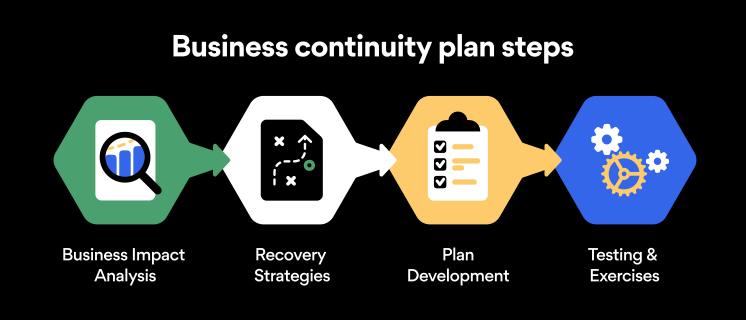
Business continuity planning steps

Here are some general guidelines that an organization looking to develop a BCP should consider:

Analysis

A business continuity plan should include an in-depth analysis of everything that could negatively affect the overall organizational infrastructure and operations. Assessing different levels of risk should also be a part of the analysis phase.

Design and development

Once you have a clear overview of potential risks your company could face, start developing a plan. Create a draft and reassess it to see if it takes into account even the smallest of details.

Implementation

Implement BCP within the organization by providing training sessions for the staff to get familiar with the plan. Getting everyone on the same page regarding crisis management is critical.

Testing

Rigorously test the plan. Play out a variety of scenarios in training sessions to learn the overall effectiveness of the continuity plan. By doing so, everyone on the team will be closely familiar with the business continuity plan’s guidelines.

Maintenance and updating

Because the threat landscape constantly changes and evolves, you should regularly reassess your BCP and take steps to update it. By making your continuity plan in tune with the times, you will be able to stay a step ahead of a crisis.

Level up your company’s security with NordPass Business

A comprehensive business continuity plan is vital for the entire organization’s security posture. However, in a perfect world, you wouldn’t have to use it. This is where NordPass Business can help.

Remember, weak, reused, or compromised passwords are often cited as one of the top contributing factors in data breaches. It’s not surprising, considering that an average user has around 100 passwords. Password fatigue is real and significantly affects how people treat their credentials. NordPass Business counters these issues.

With NordPass Business, your team will have a single secure place to store all work-related passwords, credit cards, and other sensitive information. Accessing all the data stored in NordPass is quick and easy, which allows your employees not to be distracted by the task of finding the correct passwords for the correct account.
In cyber incidents, NordPass Business ensures that company credentials remain secure at all times. Everything stored in the NordPass vault is secured with advanced encryption algorithms, which would take hundreds of years to brute force.

If you are interested in learning more about NordPass Business and how it can fortify corporate security, do not hesitate to book a demo with our representative.


About Version 2 Digital

Version 2 Digital is one of the most dynamic IT companies in Asia. The company distributes a wide range of IT products across various areas including cyber security, cloud, data protection, end points, infrastructures, system monitoring, storage, networking, business productivity and communication products.

Through an extensive network of channels, point of sales, resellers, and partnership companies, Version 2 offers quality products and services which are highly acclaimed in the market. Its customers cover a wide spectrum which include Global 1000 enterprises, regional listed companies, different vertical industries, public utilities, Government, a vast number of successful SMEs, and consumers in various Asian cities.

About NordPass
NordPass is developed by Nord Security, a company leading the global market of cybersecurity products.

The web has become a chaotic space where safety and trust have been compromised by cybercrime and data protection issues. Therefore, our team has a global mission to shape a more trusted and peaceful online future for people everywhere.

×

Hello!

Click one of our contacts below to chat on WhatsApp

×