Skip to content

Network segmentation’s role in PCI DSS

PCI-DSS is the set of security standards that seeks to extend consistent data protection practices across the credit processing industry. Any organization handling credit card data must comply with PCI-DSS regulations.

PCI-DSS compliance places a major burden on businesses, especially small and medium-sized enterprises. But companies can reduce the cost of compliance by intelligently scoping their credit processing environment.

Segmentation allows IT teams to apply network segmentation to protect credit card data while reducing the need to secure less critical system components.

This blog will introduce network segmentation in PCI-DSS. We will look at how segmentation works and how it contributes to robust financial sector cybersecurity strategies.

What is network segmentation?

Network segmentation separates network resources to control access and enhance security. In the context of PCI-DSS, network segmentation divides the cardholder data environment (CDE) from other system components.

Separating the cardholder data environment from other resources allows businesses to secure cardholder data. This is a major challenge of cybersecurity in finance. With proper segmentation, hackers will struggle to move from off-scope endpoints and apps to the CDE. Data breaches are much less likely.

Segmentation is not a PCI-DSS requirement. It complements other compliance tools such as encryption, access management, and firewall protection. If you have any doubts about core requirements, check out our PCI-DSS compliance checklist for more information.

However, the PCI Security Standards Council (SSC) has issued guidance advising companies to employ segmentation if possible.

As the SSC says, “Effective segmentation can greatly reduce the risk of CDE systems being impacted by security weaknesses or compromises originating from out-of-scope systems.” But it is not a magic bullet. Segmentation must work with other technologies and controls to achieve PCI-DSS compliance.

Understanding PCI DSS network segmentation scope

When discussing network segmentation for PCI-DSS, it’s important to assess the “scope” of controls required.

Scope refers to the extent of protection required to achieve compliance. Establishing PCI-DSS scope is a critical priority before applying segmentation.

Proper scoping provides security teams with the visibility and knowledge needed to locate and defend critical data. Scoping allows you to segment cardholder data from other parts of the network, boosting security and cutting costs.

There are three main categories to think about when carrying out a PCI-DSS assessment.

In-scope assets

Network resources that make direct contact with cardholder information. This includes payment systems, points of sale, credit card databases, communication tools, and even CRM systems. If an app or device holds credit card data, it is “in scope.”

Connected-to assets

These systems connect to in-scope assets but do not hold card data themselves. They may not require segmentation but must be tightly secured as part of the CDE.

Out-of-scope assets

Anything without access to the cardholder data environment is defined as “out of scope” and does not require the same level of protection.

The PCI-DSS regulations state that “even if the out-of-scope system component was compromised, it could not impact the security of the CDE.” This is a good way of approaching the scoping task.

If system components provide attackers with indirect access to cardholder data, it qualifies as in-scope. If not, you can relegate it to a lower priority level and concentrate resources where they matter most.

“Flat” networks where system components are connected to a single network switch are an important exception. In these cases, the entire network is categorized as in-scope.

In flat network settings, there is no such thing as an out-of-scope system. If an attacker gains access to any node on the network, they can potentially spread to systems handling credit data.

Why scoping matters to network segmentation

PCI-DSS scoping is a crucial first step in the segmentation process. You cannot create segments protecting cardholder data unless you know where that data resides.

Scoping maps data locations and flows. Compliance teams build a picture of how credit card data moves throughout the network, where it is stored, and who requires access. This provides a solid foundation for creating accurate and effective network segments.

Scoping also ensures that the segmentation process covers every asset. Security teams can start from the assumption that everything is in scope. They can then eliminate out-of-scope assets from the CDE and apply precise segmentation for cardholder data.

How to implement network segmentation for PCI DSS?

When carrying out a PCI-DSS assessment, it’s essential to keep one thing in mind: segmentation is not a substitute for comprehensive cybersecurity controls and policies. Network segmentation is part of a wider toolkit, not a solution to your compliance worries.

Having said that, PCI-DSS best practices advise that companies segment the cardholder data environment from other network systems. So how should you approach this task?

Network segmentation applies specific security controls to create sub-networks containing critical cardholder data. There are various ways of achieving this, including:

Firewall barriers between the rest of the network and cardholder data

Firewalls regulate network traffic across the CDE perimeter, preventing unauthorized access requests.

Data loss prevention (DLP) solutions

DLP tracks the movement of critical data, and works in tandem with firewall protection. Users cannot move or copy protected data without authorization. Security controls automatically block any unauthorized transfers.

Physical access controls for in-scope devices

Some workplaces may impose physical identity checks between CDE-connected devices and other offices or workstations.

Air gaps

Physical air gaps can also divide cardholder data from other network assets. Companies may choose to use two separate systems for payment processing and general operations.

Identity and access management (IAM) systems and multi-factor authentication (MFA)

Authentication systems require multiple credentials for any login. Secure network zones can require extra credentials before granting access.

Zero Trust controls on user privileges

Network managers should keep the number of users with administrative privileges as low as possible. Cardholder data environment access should only be available for users with appropriate permissions. All user access is seen as illegitimate until proven otherwise.

Continuous activity monitoring

Security teams can automate monitoring to track suspicious behavior. Tracking systems raise alerts when out-of-scope assets request access to a network segment within the CDE.

When you decide how to apply segmentation, the core challenge is determining which assets are in-scope and what lies out-of-scope.

Security teams must interview employees throughout the organization to understand how they use data. Employees can provide invaluable information about where cardholder data resides – knowledge that may not be immediately obvious.

The next step in PCI-DSS compliance is ensuring that network segmentation covers every part of the CDE. Elements to consider include:

  • Applications handling cardholder data. This could cover web apps and locally hosted databases.

  • Authentication servers and internal firewalls that connect with or defend the CDE. Protecting sensitive authentication data is a critical priority.

  • Security services that ensure data security and guard cardholder data. This includes intrusion detection systems, malware scanners, and anti-virus tools.

  • Log storage servers and backups. Any audit logs must be properly secured, including connections between active payment databases and historical logs.

  • Virtual machines, apps, hypervisors, or virtual routers that store or process cardholder data.

  • Network infrastructure such as routers, switches, hardware firewalls, and any other equipment that connects to the CDE.

  • Network servers handling cardholder data flows from sites of payment and within the corporate network. This may include web, mail, proxy, and DNS servers.

  • Third parties. Any third-party applications or users with access to payment or cardholder data storage systems lie within the CDE.

The critical task when applying PCI-DSS controls is mapping connections. Any endpoint or application that can access cardholder data needs to be secured.

It isn’t always easy to discover connections between system components. But a comprehensive planning process will generate enough information to keep your data breach risk low.

How can NordLayer solutions help?

Network segmentation is a critical part of PCI-DSS compliance. It allows organizations to separate the cardholder data environment from other system components. Attackers seeking access via remote devices or insecure endpoints will find it much harder to extract cardholder data.

NordLayer can help you build a security setup that meets PCI-DSS requirements. Our PCI-DSS compliance solutions make it easy to segment networks to protect cardholder environments. With Nordlayer, you can:

  • Create groups of network users and assign different network access privileges to each group.

  • Create Virtual Private Gateways for specific groups, resources, or websites.

  • Use IP allowlisting with Dedicated IP addresses to allow authorized users and block others.

In the near future, we will also offer Cloud firewall functionality. This will simplify segmenting cloud-based credit processing environments with granular and flexible access controls.

However, network segmentation is not a single solution. Companies must couple PCI-DSS network segmentation with other security tools to be compliant. Nordlayer can help here as well. In addition to segmentation, our tools can help you:

  • Install secure remote access solutions to transmit cardholder data safely.

  • Set user permissions to block unauthorized access to every network segment.

  • Employ quantum-safe cryptography in tunnel encryption to hide your traffic and online activity from users on the open internet.

  • Put in place multi-factor authentication for users accessing cardholder data. Ensure only trusted users can handle customer information and keep data breach risks low.

Make PCI-DSS compliance manageable by partnering with an experienced security provider. Get in touch with the NordLayer team to explore smart data security solutions that make damaging data breaches much less likely.

About Version 2 Digital

Version 2 Digital is one of the most dynamic IT companies in Asia. The company distributes a wide range of IT products across various areas including cyber security, cloud, data protection, end points, infrastructures, system monitoring, storage, networking, business productivity and communication products.

Through an extensive network of channels, point of sales, resellers, and partnership companies, Version 2 offers quality products and services which are highly acclaimed in the market. Its customers cover a wide spectrum which include Global 1000 enterprises, regional listed companies, different vertical industries, public utilities, Government, a vast number of successful SMEs, and consumers in various Asian cities.

About NordLayer
NordLayer is an adaptive network access security solution for modern businesses – from the world’s most trusted cybersecurity brand, Nord Security.

The web has become a chaotic space where safety and trust have been compromised by cybercrime and data protection issues. Therefore, our team has a global mission to shape a more trusted and peaceful online future for people everywhere.

HIPAA compliance for SaaS: a guide for healthcare providers

As healthcare providers increasingly rely on Software-as-a-Service (SaaS) applications to manage patient data, it is crucial for them to understand the importance of HIPAA compliance.

This article will discuss what healthcare organizations need to know about HIPAA compliance for SaaS and how to ensure that their SaaS applications follow industry-specific regulations.

What does HIPAA compliance mean for SaaS?

When it comes to HIPAA compliance, SaaS providers fall into two broad categories: developers and app providers and SaaS hosting services. The two groups have different compliance needs, so it’s helpful to discuss them separately.

SaaS developers and providers

SaaS developers and providers that serve the healthcare sector must ensure their products are HIPAA compliant.

HIPAA compliance means that SaaS developers and service providers adhere to HIPAA’s Security, Privacy, and Breach Notification rules. The most important section here is the HIPAA Security Rule, which has three sub-sections: technical, administrative, and physical.

Under the HIPAA Security Rule, Covered Entities (CEs) and Business Associates (BAs) must put in place protective measures to secure Protected Health Information (PHI). SaaS companies tend to fall under the Business Associate header.

SaaS providers must sign Business Associate Agreements (BAAs) with clients. These agreements set out areas of responsibility and liability. Both healthcare companies and cloud providers should be clear about sharing compliance duties and protecting patient data.

SaaS hosting services

The situation is less clear about SaaS hosting services. HIPAA security rule does not set clear guidelines for cloud computing companies hosting healthcare services. Yet, it has become increasingly important to brand cloud infrastructure as HIPAA-eligible.

HIPAA-eligible hosts offer products that clients can adapt to meet HIPAA standards. This reassures clients that shared cloud computing architecture is properly secured. The major cloud platforms offer HIPAA-eligible services, including Amazon Web Services, Microsoft Azure, and Google Cloud.

Important HIPAA compliance areas for companies and SaaS providers

Not all SaaS companies working in the healthcare sector need to worry about HIPAA compliance. For example, many health app developers won’t handle patient records if their involvement ends when the app is delivered to clients.

But this changes if DevOps teams maintain and update cloud apps for health companies. If you handle Protected Health Information or could access PHI during development tasks, you must be HIPAA compliant.

Generally speaking, HIPAA compliance is critical for providers of SaaS-based healthcare services such as monitoring apps, payment portals, or insurance management tools. And compliance is also a concern for services that host PHI on cloud infrastructure.

Specifically, healthcare organizations need to protect patient data:

  • When creating patient records

  • When information is received

  • When PHI is at rest on cloud resources

  • During transmission (if this involves SaaS infrastructure or apps).

HIPAA requirements for SaaS providers

What does the process of becoming HIPAA-compliant look like? Under the HIPAA Privacy rule, there are three main areas of focus.

Firstly, achieving SaaS data security involves creating robust technical controls. This could include encryption of data in transit and at rest. It also includes access controls to prevent unauthorized access to confidential data. Multi-factor authentication, firewall protection, and password management systems all contribute.

On the administrative side, SaaS companies must train workers to use SaaS tools safely. They must also have robust data handling policies and device usage rules to prevent the unsafe movement of patient data.

Finally, physical security measures include securing data centers via locks, authorization systems, and cameras. There should be measures to protect physical devices on and off-site and plans to guard data against natural disasters and sabotage.

Business Associate Agreements cover all three of these areas. The Covered Entity and Business Associate sign BAAs before commencing their business partnership.

The BAA describes the areas of responsibility of clients and SaaS providers. It includes details on how to achieve compliance. And it explains how partners will be liable when security breaches occur.

Sharing compliance responsibilities

Under the Privacy Rule. SaaS partners and Covered Entities have shared responsibility for protecting patient data.

Cloud Service Providers guard infrastructure and data at rest on their servers. Service users manage access control, data in transit, and how users interact with their apps. This situation applies in healthcare as well. But controls on data access are much tighter.

HIPAA-compliant SaaS hosts and providers must apply the strongest possible encryption to all confidential data. They are responsible for ensuring data is available when requested. Servers must also remain online when healthcare organizations need them.

SaaS hosts manage the physical safety of hosting infrastructure. SaaS providers handle the integrity of application code. They must guard against emerging threats like Zero Day Exploits and ensure healthcare apps are as secure as possible.

Healthcare organizations (Covered Entities) have different responsibilities. Healthcare organizations must train staff to use SaaS services safely. Every covered entity needs to educate users about safe remote access, using encryption, managing passwords, and avoiding phishing attacks.

Healthcare organizations also deal with access controls. They must ensure PHI is only available to authorized professionals or patients themselves.

Most cloud-based cyber attacks have their roots in unsafe user behavior or loose access controls. Provider-side security is critical. Yet, it’s also important for SaaS providers and hosts to tighten their HIPAA compliance.

Healthcare organizations and SaaS partners should know exactly how to share responsibility and take appropriate action to ensure watertight compliance.

Implementing HIPAA compliance measures

A robust HIPAA compliance plan ensures that SaaS companies follow HIPAA’s Security, Privacy, and Breach Notification rules. Dividing your compliance plan between the three HIPAA regulations is good practice.

Compliance plans cover many areas, and the exact make-up varies between organizations. But common elements include:

Risk management

Create risk management plans for all critical data protection risks. Risk assessment processes should include risk severity and actions required to mitigate each risk.

Project ownership

Appoint individuals with responsibility for HIPAA privacy and security management.

Security controls

This includes physical safeguards such as cameras and locks. Data protection controls are also crucial. Use encryption, access management, endpoint protection, and monitoring tools to track user activity,

Administrative safeguards

This could include training plans to educate workers and communicate HIPAA responsibilities.

Auditing

Regular compliance audits ensure controls function properly and that staff training achieves the desired results.

Systems to receive and act on HIPAA complaints

Create a secure email or phone line to report PHI violations. Organizations must make data available to patients and have streamlined processes to report data breaches to regulators.

Documentation

Create and store clear documentation outlining HIPAA compliance policies. Make documents available to staff members and regulators if needed.

Handling third parties and associates

HIPAA-compliant organizations must have solid procedures to onboard business associates. SaaS partners should be able to provide clear evidence of compliance and HIPAA eligibility (if needed).

Clients should immediately know that the SaaS provider is a dependable and secure partner. If you have not done so, plan to achieve recognized security standards such as NIST 800-53, ISO 27001, or ISO 20000-1.

How can NordLayer help?

Becoming HIPAA compliant can be challenging for SaaS developers and service providers. But if you want to thrive in the healthcare sector, a strong compliance plan is essential. Nordlayer’s HIPAA-compliant solution can help you make the changes needed when building a reputation in SaaS health provision.

Our network security solutions include the following:

  • Streamlined network access controls to ensure only authorized users can access PHI.

  • Secure Remote Access from all endpoints ensures equally secure and protected network access for remote and hybrid work environments without putting health data at risk.

  • 256-bit AES encrypts data that is being sent between networks and reduces data breach risks.

  • Compatibility with major cloud platforms such as Azure and AWS. Integrate Secure Remote Access with cloud-native controls to create a solid HIPAA security setup.

All SaaS companies operating in the health sector need rock-solid data protection that complies with HIPAA regulations. Explore your options and ensure safe access to PHI with Nordlayer’s assistance.

About Version 2 Digital

Version 2 Digital is one of the most dynamic IT companies in Asia. The company distributes a wide range of IT products across various areas including cyber security, cloud, data protection, end points, infrastructures, system monitoring, storage, networking, business productivity and communication products.

Through an extensive network of channels, point of sales, resellers, and partnership companies, Version 2 offers quality products and services which are highly acclaimed in the market. Its customers cover a wide spectrum which include Global 1000 enterprises, regional listed companies, different vertical industries, public utilities, Government, a vast number of successful SMEs, and consumers in various Asian cities.

About NordLayer
NordLayer is an adaptive network access security solution for modern businesses – from the world’s most trusted cybersecurity brand, Nord Security.

The web has become a chaotic space where safety and trust have been compromised by cybercrime and data protection issues. Therefore, our team has a global mission to shape a more trusted and peaceful online future for people everywhere.

Why security mindset for small-medium companies is critical to business success: talk with Cutec

A discussion with Mark Rowland, Co-Founder & Managing Director at Cutec, about how they solved client problems using NordLayer and what to expect for next cybersecurity’s major challenges and possibilities.

Cutec is a Managed Service Provider (MSP) and IT support company from England. Operating in the industry for 25 years, a 20-employee expert team supports a range of small and medium clients across the UK. Whether an organization has a staff of just a few or hundreds of people, Cutec’s role is to consult companies with technical focus and accuracy to fill in the vacancy of an internal IT person for the client.

The consultancy firm fills in the IT management and knowledge gap, which is a recurring issue for many businesses, especially smaller organizations Cutec gets to consult. However, conversing with different clients revealed another concern — there’s no cybersecurity mindset. Mark Rowland, a Co-founder and Managing Director at Cutec, shares his insight on how crucial security awareness is for business continuity. 

Business case: decentralizing single-site infrastructure

The client has been with Cutec for about 6 years — during this time, the company of 30 people expanded to an almost 300-employee organization. And as this financial services provider grew into a country-wide company, it started facing security challenges.

“As for a managed IT service provider, it is important to be there for your client when they need you. It’s our responsibility to support branches dotted around different parts of the UK — online presence becomes a necessity over physical.”

Click to tweet

Being contained in one place and managing 20 people is relatively easy. However, the client business model involved advisors spread all over the country. Combine it with rapid growth during a short time and data sensitivity due to the nature of financial services — the need to protect databases, CRM, and phone systems was critical.

The foundational elements for security were there: the client had two-factor authentication, password management, and fixed IP in place. It’s secure enough for 20 people sitting in one office, but not if numbers jump to hundred users in dozen cities — circumstances urged for an extra layer of security.

An increasing number of VPN connections to internal applications started causing connectivity issues and quickly bogged the network. This was the turning point for Cutec to find a better solution for a VPN route that would ensure security.

Close-up on the solution

One of the available options for the client was to get much more powerful broadband for the HQ office, install hardware firewalls, and achieve the wanted level of security for an outrageous expense bill.

Moreover, the solution would bind everything to one location. From a disaster management perspective, it’s not sustainable for business continuity — if the power is cut off, the internet goes down, and all employees get disconnected despite their location.

The alternative was getting a NordLayer subscription. Although it meant paying per user license, it offered what the company needed — a fixed IP address that provided much-needed flexibility and stability.

Choosing NordLayer allowed upgrading and downgrading the number of member accounts as the staff comes and leaves and, most importantly, eliminating the dependence on the HQ office — if the power got cut off, server design allowed carry-on working.

Sorting out the inconvenience of in-house security

Deployment and maintenance of the on-premise solution meant a lot of man-hours. It included a remote connection to a client’s PC and setting up their VPN connection. 

NordLayer, on the other hand, provided a simple solution. The MSP had to connect to the Partner Portal and add the user, so they could complete the setup themselves — click the welcome link to install the VPN.

“The solution setup was fantastic as we looked at a massive project and a big headache. Rolling out NordLayer VPN connection to 300 people was achieved in four days. And out of 300 members, we had only five people calling for help, but that’s because they were cautious, not because they didn’t know what to do.”

Click to tweet

It’s worth mentioning that the client has no one in-house with the knowledge and expertise on cybersecurity. In this case, Cutec is an advisor and a guide for organizations’ cybersecurity strategy, closely collaborating with a single point of contact on-premise, the Technology Director, to help steer the business away from cyber threats.

Expert insights: take on SMBs security

The client scope Cutec works with is usually small-medium sized businesses without internally dedicated IT staff. Better to say SMBs have little understanding of cybersecurity. There’s a persistent tendency for a slow but inevitable change in the business mindset:

  • A now-outdated perspective of ‘antivirus solves all our security problems’ was effective 10–20 years ago — today you have to think outside the box.

  • Small-medium enterprises tend to give on-premise servers and migrate to the cloud more often. Core IT support is going to change. It will be more about picking the right cloud solution for people driving the migration to the cloud. Over the next three years, people will drop on-premise stuff and go to the cloud completely, and we’ll be there to help them with that.

  • Cloud-edge solutions like NordLayer are going to get more popular over time. Teams work from coffee shops and McDonald’s — they connect to public Wi-Fi and hot spots and must protect their traffic with tools that work well.

A future notion on SMBs from sensitive industries

The cybersecurity landscape changed— now it’s about protecting yourself online. At our company, we notice clients are transitioning to online cloud services. The number of adopted vendors and service providers can be three, five, or a dozen online solutions and tools.

Previously, having a server in the office under lock and key with a firewall allowed us to assume that that was enough to keep the company secure. However, small businesses struggle to comprehend the gravity of cybersecurity.

“Using Office365, therefore, thinking my data is secure is a mistaken approach. Company data might be secure in the Microsoft Data Center, but is it safe where you are accessing it from?”

Click to tweet

After Covid, once people started connecting from their home PCs and smartphones, companies without proper security measures risked having their business data on employees’ personal devices.

Larger enterprises and governmental institutions already have an awareness – sometimes forced by insurance companies and bank regulations – of owning some security accreditations to filter down the risks. Meanwhile, small-medium enterprises don’t have this perception, and MSPs like Cutec help them drive in the right direction.

Our biggest challenge is overcoming the big issue of clients thinking that security is finite. Threats are layered and complex — getting an antivirus or a firewall might solve only a small part of the potential risks and gaps for threat actors to exploit. Instead, business owners and their teams must keep up-to-date with a cybersecurity mindset to guarantee business continuity.

Pro cybersecurity tips

Education on cybersecurity is increasing, and it is becoming a common topic of conversation. More and more employees and decision-makers now acknowledge a serious lack of digital security knowledge. To make the learning process easier, it’s better to ask questions and have some starting points. Here’re some pro tips you can begin with:

Explore cybersecurity to broaden your knowledge about threats and solutions for managing them. NordLayer offers layered-by-design network access solutions for all kinds of businesses and their team setups to rise to the challenges of a modern company. And at NordLayer, we care about guidance. Thus, explore our Cybersecurity Learning Center and Decision Maker’s Kit for in-depth support for building your own cybersecurity strategy.

Want to join forces to build a more resilient and aware cybersecurity landscape for businesses and organizations? NordLayer invites Managed Service Providers to seize the opportunity to join our Partner Program — reach out to learn more about it.

About Version 2 Digital

Version 2 Digital is one of the most dynamic IT companies in Asia. The company distributes a wide range of IT products across various areas including cyber security, cloud, data protection, end points, infrastructures, system monitoring, storage, networking, business productivity and communication products.

Through an extensive network of channels, point of sales, resellers, and partnership companies, Version 2 offers quality products and services which are highly acclaimed in the market. Its customers cover a wide spectrum which include Global 1000 enterprises, regional listed companies, different vertical industries, public utilities, Government, a vast number of successful SMEs, and consumers in various Asian cities.

About NordLayer
NordLayer is an adaptive network access security solution for modern businesses – from the world’s most trusted cybersecurity brand, Nord Security.

The web has become a chaotic space where safety and trust have been compromised by cybercrime and data protection issues. Therefore, our team has a global mission to shape a more trusted and peaceful online future for people everywhere.

Healthcare cybersecurity: how to protect patient data

Cybersecurity for healthcare organizations involves protecting sensitive patient data from unauthorized access, use, and disclosure. It’s a strategic imperative for every healthcare business, but with the digitization of medical records, sharing sensitive information has become simple and, at the same time, much more exposed to cyber threats.

Cyberattacks often cause serious disruptions to patient care and lead to misdiagnosis and medical errors. Many studies have shown that ransomware attacks affected hospital mortality rates due to the lack of access to patient information. Also, as HIPAA Breach Notification Rule states, sensitive information violations can have serious financial consequences.

What other cybersecurity risks are healthcare organizations facing? And how can you mitigate them? Read on to discover the best practices for healthcare cybersecurity.

Over 93% of covered entities and business associates faced a breach in the last two years. According to IBM Data Breach Report, in 2022, the healthcare sector suffered the highest costs of data breaches. And although the number of breached records fell from 54.09 million in 2021 to 51 million in 2022, healthcare still remains one of the industries most affected by hackers. The commercial and public health sector is clearly under fire.

A new trend is a growing number of attacks through third-party vendors. Nearly 26 million records were exposed from business associates, and almost 25 million were on healthcare organizations.

Cyber attacks will continue to plague the US health sector, the Healthcare Cybersecurity Report for 2022 states. The criminal ecosystem keeps evolving and adjusting to new security measures. Threat actors will increasingly look for and exploit vulnerabilities in the systems. Also, third-party vendors are more at risk now.

Other long-term trends are seemingly unrelated geopolitical events directly impacting the healthcare industry. Since the beginning of the war, the Russian government has regularly leveraged wipers and DDoS attacks. And the same applies to Russia’s allies, such as China, North Korea, and Iran. 

Cybersecurity challenges for healthcare organizations

Let us examine why the healthcare industry is an attractive target for threat actors. There are 3 main reasons for that trend: 

  • Poor risk management

Healthcare organizations deal with connected medical devices (Internet of Medical Things), employees’ devices that don’t have adequate security measures, and several third parties that access Protected Health Information (PHI) and other critical assets. Ensuring adequate cybersecurity solutions that mitigate risk and address vulnerabilities in a legacy system is critical.

  • A huge value of PHI on the Dark Web

Stolen patient data can be used for malicious activities like identity theft or healthcare insurance fraud. A single medical record is valued at up to $250 on the black market, and this information is worth about 50 times more than credit card details on the Dark Web.  All this means that patient privacy is at risk of being violated.

  • Financial reasons 

It’s a major security risk for the industry. Suffering a ransomware attack, for example, means paying a large amount to the attackers. 

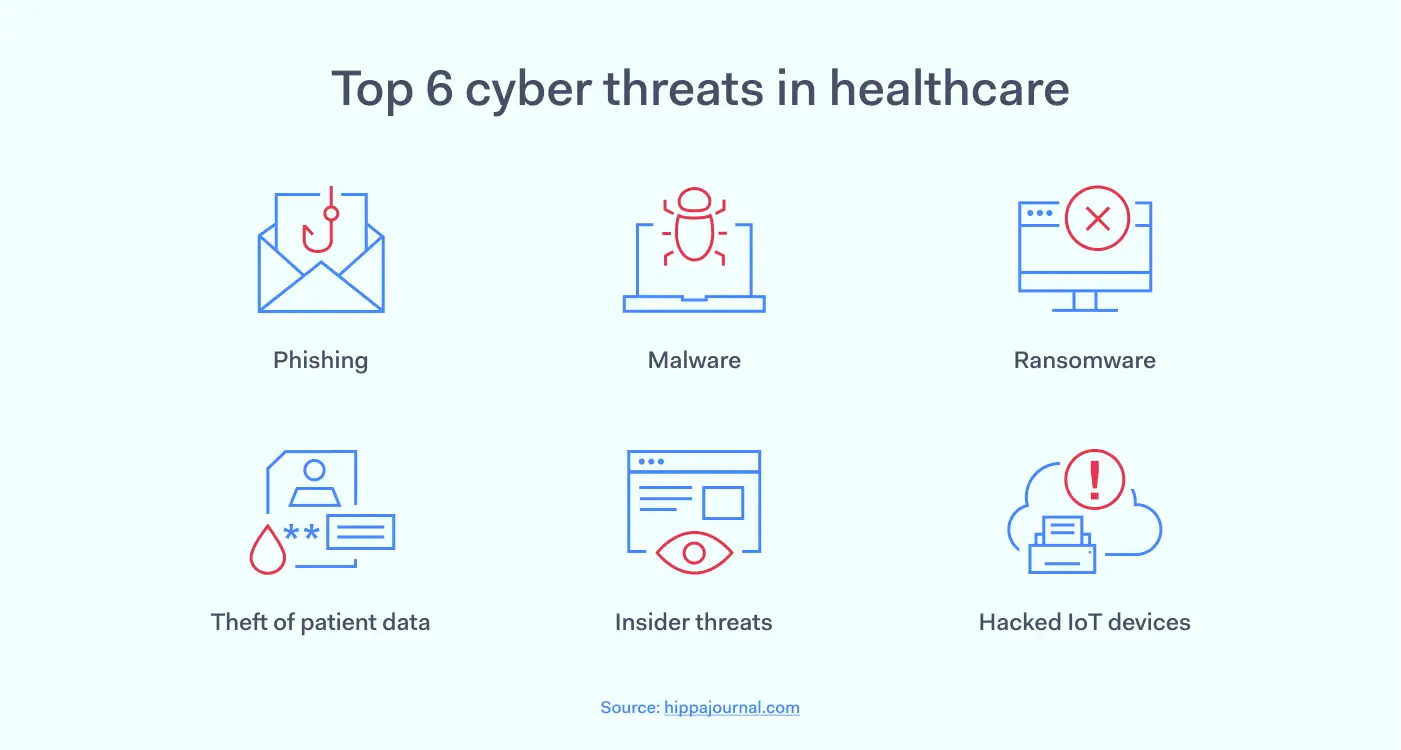
Top 6 cyber threats for healthcare organizations

Threats for the healthcare industry come in many forms, from ransomware to theft of personal information. In 2022, the biggest security breaches in healthcare came from phishing and malware attacks.

  • Phishing

Phishing targets individuals by tricking them into disclosing sensitive information, clicking a malicious link, or opening a malicious attachment. The most common telltale sign of a phishing email is that it conveys a sense of urgency or preys on fear or greed. Scammers can also use social media, text messages, and voice calls for phishing. 

  • Malware

It’s malicious software installed on a computer without a user’s consent. It can steal passwords or money or perform other malicious actions. Examples of malware include a Trojan horse, spyware, adware, or a virus.

  • Ransomware

Ransomware is a form of malware that encrypts files on a user’s device and locks them out until they pay the hacker money to release them. 

  • Theft of patient data

Stolen patient medical records may be sold on the dark web and used for insurance fraud or identity theft. Often, data recovery is not possible.

  • Insider threats

These risks can come from current or former staff members or contractors and happen intentionally or by negligence. For example, an employee may accidentally click a malicious link in a phishing email or skip security protocols to make their job easier. 

  • Hacked IoT devices

Hackers take advantage of vulnerabilities in devices connected by IoT, such as handheld devices, camera sensors, or CT scanners.

Top 6 cyber risks in healthcare

All the facts and statistics mentioned earlier mean one thing: cybersecurity in healthcare is a burning issue. Criminals can disrupt health businesses with malware, ransomware, or phishing. And damage the organization’s reputation and endanger patients’ lives. But apart from that, healthcare organizations are exposed to various cyber risks, such as unprotected access to PHI, human error, vulnerabilities of legacy systems, third-party vendors, and a lack of regular cyber risk audits. 

Risk 1: Unsecured access to PHI

According to new HIPAA encryption requirements, ensuring all sensitive patient data is unreadable, undecipherable, and unusable to any person or software program without access rights is mandatory. For your organization, it means implementing robust security controls that help store Protected Health Information (PHI) safely and protect it from unauthorized access.

Risk 2: Human error

82% of data breaches involved a human element, including social attacks, errors, and misuse.  according to Verizon’s 2022 Data Breach Investigations Report. Understanding how human error affects your organization can help you mitigate risks for the future. Almost one-third of such incidents involved a person abusing their use of internal resources. For example, a doctor shares access to their work-issued device with children, who click on a malicious link and download malware. 

Risk 3: Vulnerabilities of legacy systems 

Outdated technology opens doors for cybercriminals. Legacy devices and operating systems are vulnerable because they can’t update properly. This means inadequate security control and weaknesses in the system can’t be patched. 

However, some healthcare organizations delay transitioning to up-to-date security solutions because of tight budgets or complacency. They choose to fix a problem only after a system failure or a cyber attack. Deploying technology that encrypts data, monitors authorized users, and blocks unauthorized user access can help minimize cyber risks. 

Risk 4: Third-party vendors

The number of business associates that handle sensitive data has grown with the volume of electronic medical records. According to an analysis by Fortified Health Security, third-party vendors accounted for 16% of data breaches in the first half of 2022. 

In 2022, the largest third-party vendor data breach, which affected almost 4 million individuals, happened through a ransomware attack at Eye Care Leaders. The breach impacted at least 39 covered entities, as well. 

Risk 5: Compliance 

Healthcare organizations also face regulatory challenges. Protecting patient privacy according to the latest HIPAA and GDPR rules can be complex. Besides following compliance guidelines, your organization should implement the best cyber security practices. Failure to keep patient records private may result in substantial penalties and harm your reputation. 

Risk 6: The absence of risk assessments

Every healthcare organization should conduct a regular risk assessment to identify vulnerabilities and risks to the confidentiality and integrity of PHI.  The evaluation should determine your organization’s capabilities for detecting, preventing, and responding to cyberattacks. It’s also crucial to know where your sensitive information is, what threats your organization faces, and your system’s vulnerabilities and security holes. And what your action plan in case of an attack is. 

Best practices for healthcare cybersecurity challenges 

This year’s IBM Data Breach Report demonstrates no system is impenetrable. But healthcare cybersecurity is all about basic security measures that stop criminals and make them look for an easier target. What are the best practices for minimizing cyber risks? Here is a list of the strategies worth adopting: 

  • Deploy verified cybersecurity software

Install cybersecurity software on every connected device and secure your network. 

  • Update your software regularly

Prompt, regular updates will address patches and vulnerabilities.

  • Train your staff on cybersecurity

Your employees should be aware of cyber threats and how to detect them. 

  • Strengthen your system access controls 

Restrict access to your most sensitive data and monitor who accesses it.

  • Conduct regular risk assessments 

Identify weaknesses in your system and mitigate risks. Determine where your sensitive information is and protect access to it.

  • Ensure your business associates have strict security policies 

Some business associates have lax policies that can create problems for the healthcare organization they cooperate with. Don’t let stolen vendor credentials or data will compromise your organization. 

Cybersecurity solutions for healthcare organizations

Securing your organization from cyber threats can be overwhelming. Protecting your valuable data and critical equipment is complicated but doesn’t have to be complex. That’s why we have prepared a guide on security solutions tailored to the health industry.  

  • Network security

The key to combating any external threats is network visibility and responsive protection. A solution that quickly isolates risks will prevent your network from being exposed. Setting permissions and policies for secure users and apps across multiple devices is also good. This way, you will ensure that only authorized staff will access your confidential data. 

  • Application security 

The best way to secure access to your applications is to verify and authenticate every user, device, and connection. This Zero-trust approach enforces mandatory checks at every step and minimizes security gaps. It also enables your staff to work remotely and on multiple devices. 

  • Endpoint security

If your devices are left unsecured, they can be a gateway for breaches, and an infected endpoint will affect your organization’s functioning ability. A comprehensive solution for endpoint protection uses data encryption and enforces unified security policies on all servers, networks, and endpoints. It also monitors 24/7 access to your resources, alerting you if there is suspicious activity. 

  • Data security

Encrypting sensitive healthcare data can help conceal it from outsiders. MFA will add strength to authentication processes. Permission sets enable managing data access, meaning only authorized users can access it.  Everyone else will be blocked by default until granted the necessary privileges. Before you apply access controls, you need to classify your data accordion to its value and vulnerability. 

  • Cloud data security

As healthcare organizations move their assets and data to the cloud, cloud services need robust protection. Cloud providers and businesses should share responsibilities to ensure data security, but this doesn’t mean you will always have a full view of your infrastructure. The provider may move data without you even knowing it. That’s why having a clear division of responsibilities is crucial. Also, you should encrypt everything in the cloud and set strict access permissions. You add IP allowlists to only connect specific IP ranges to your network. 

How NordLayer can help 

You can protect access to your sensitive data and transition your organization towards the SSE framework by implementing our solutions for Zero Trust Network Access.

NordLayer also provides an adaptive network security solution that easily integrates with your existing infrastructure and provides secure access to sensitive resources.

Contact our sales team and discover how to protect your patient data from cyber threats.

Disclaimer: This article has been prepared for general informational purposes and is not legal advice. We hope that you will find the information informative and helpful. However, you should use the information in this article at your own risk and consider seeking advice from a professional counsel licensed in your state or country. The materials presented on this site may not reflect the most current legal developments or the law of the jurisdiction in which you reside. This article may be changed, improved, or updated without notice.

About Version 2 Digital

Version 2 Digital is one of the most dynamic IT companies in Asia. The company distributes a wide range of IT products across various areas including cyber security, cloud, data protection, end points, infrastructures, system monitoring, storage, networking, business productivity and communication products.

Through an extensive network of channels, point of sales, resellers, and partnership companies, Version 2 offers quality products and services which are highly acclaimed in the market. Its customers cover a wide spectrum which include Global 1000 enterprises, regional listed companies, different vertical industries, public utilities, Government, a vast number of successful SMEs, and consumers in various Asian cities.

About NordLayer
NordLayer is an adaptive network access security solution for modern businesses – from the world’s most trusted cybersecurity brand, Nord Security.

The web has become a chaotic space where safety and trust have been compromised by cybercrime and data protection issues. Therefore, our team has a global mission to shape a more trusted and peaceful online future for people everywhere.

HIPAA violation consequences: legal, financial, and reputational risks

The Health Insurance Portability and Accountability Act (HIPAA) is the most important data protection regulation for healthcare providers in the USA. It covers health insurers, clinics, hospitals, private practices, and developers of health apps, care settings, and pharmacies.

If you handle patient records, you need to be HIPAA-compliant. For your convenience, we have created a handy HIPAA compliance checklist for covered organizations. However, this blog looks at another critical HIPAA-related issue: the different types of violations and the penalties for breaching HIPAA rules.

Violations matter. Poor compliance causes customers to lose trust in your data protection policies. It’s only a matter of time before patients move their business elsewhere. Regulators can also issue significant financial penalties or even jail offenders in the most extreme cases.

This makes protecting sensitive data a critical task for health companies and their partners. So let’s explore the issue in-depth and explain everything you need to know about HIPAA violations.

What qualifies as a HIPAA Violation?

Before talking about HIPAA penalties, we need a clear understanding of what exactly constitutes a HIPAA violation. Fortunately, the legal definition of a violation is extremely clear.

HIPAA violations take place when either a covered entity (CE) or a business associate (BA) of a covered entity breach HIPAA Security, Private, or Breach Notification Rules.

HIPAA has three main rules. Here is a quick summary of what you need to know about them:

  • The HIPAA Privacy Rule sets out protections for private health data. CEs must keep data confidential and prevent unauthorized disclosure. They must also make health records available if patients desire.

  • The HIPAA Security Rule states that healthcare organizations must keep patient records secure. This includes physical, administrative, and electronic safeguards. You could see this rule as putting the privacy rule into practice.

  • The HIPAA Breach Notification Rule requires CEs to inform patients about any actual or potential data breaches. Notification must occur within 60 days of the breach.

Covered entities must become familiar with these rules when creating a compliance strategy. If you suffer a penalty, ignorance of HIPAA guidelines is not a valid defense. Covered entities must be aware of their responsibilities under the law.


Business associates, third parties your company uses also need to be part of compliance strategies. If partners can access your network assets, they could potentially cause a data breach.

Deliberate versus accidental violations

The first thing to note is that violating HIPAA can be deliberate or accidental. Covered entities need policies to cover both types of violations.

Deliberate breaches could include nurses passing the health records of a celebrity to media contacts or selling records on the Dark Web. But they also extend to simply sharing patient data without the consent of the individual concerned. In these cases, penalties tend to be severe.

Deliberate breaches also include offenses where organizations fail to act when they should do so. For instance, companies may refuse to issue breach notifications to customers within the required 60-day limit.

Company policies that clash with HIPAA rules are often deemed deliberate breaches if regulators decide that the covered entity knew about the issue and was able to remove the conflict.

Accidental breaches of HIPAA rules carry less severe penalties. They could include the absence of encryption on mobile devices or failure to train staff in cybersecurity practices.

For example, physicians could click on phishing links disguised as communications from pharmaceutical partners. There is probably no deliberate or malicious breach here. But the covered entity would be liable due to poor security training and policies.

Broadly speaking, if companies fail to take action to conform to HIPAA rules, this will qualify as a breach. That’s why having a comprehensive HIPAA compliance strategy is essential.

Criminal versus civil violations

It’s also important to understand the difference between criminal and civil HIPAA breaches.

Criminal cases are mounted by the Department of Justice and are much less common than civil penalties. They deal with deliberate violations and can lead to prison sentences for individuals at the organizations involved. Offenses leading to criminal charges include:

  • Wrongful disclosure of Protected Health Information (PHI)

  • Wrongful disclosure of PHI under false pretenses (e.g. seeking access to medical records of patients not under the care of a physician)

  • Wrongful disclosure of PHI under false pretenses with malicious intent (to sell or otherwise benefit from stealing PHI)

Most of the time, you or your staff won’t risk criminal charges. Instead, the challenge is to minimize the risk of civil cases.

Civil cases may involve behavior that is deliberate, but not malicious. Instead, civil offenses tend to involve poor risk assessment processes or simply ignorance of what HIPAA requires.

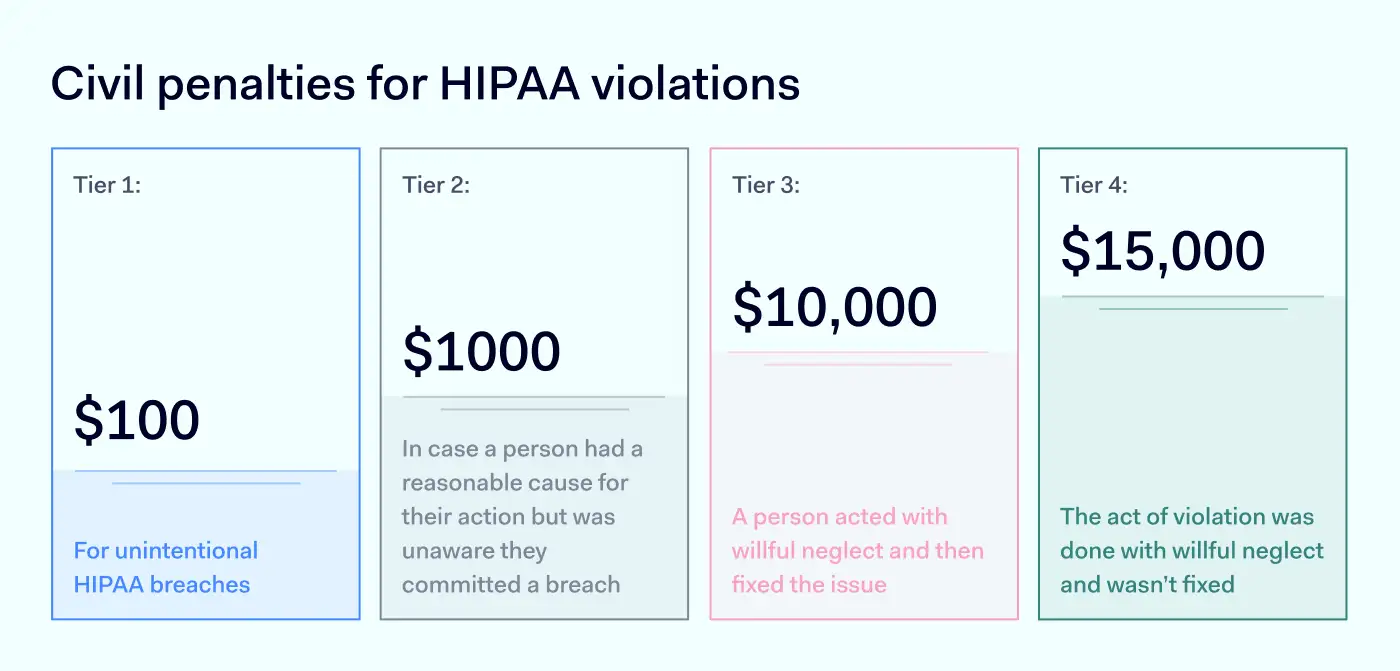
In these cases, the OCR or Attorneys General will seek a financial penalty under the HIPAA enforcement rule. Civil violations are covered by four tiers, which we will look at in more detail below.

4 types of HIPAA violations

In most instances, the Office for Civil Rights (OCR) receives complaints and decides whether organizations have violated HIPAA regulations. When the OCR deliberates, its regulators use a four-tier system to categorize potential violations.

The four tiers differ in terms of severity, with rising financial penalties. They also differ in terms of culpability. In some cases, organizations are not aware of HIPAA violations. In others, breaches are wilful and systematic.

The size of the financial penalty is related to various factors. Regulators consider:

  • How long the violation has existed

  • How many individuals are affected

  • The value and amount of the data at risk

  • Whether the organization willingly collaborates with OCR

  • Whether the organization has a clean regulatory history

Tier 1 – Accidental violation

At this tier, organizations are not aware of HIPAA breaches. The organization also had no way to avoid the violation, even with complete adherence to HIPAA regulations. At this level, covered entities must show evidence of compliance. This proves that the breach could not be avoided.

Highest penalty: $100 per incident, with a limit of $50,000

Tier 2 – Aware of violation, but no remediation possible

At tier 2, organizations know about HIPAA violations before OCR is informed. In this category, staff should have been aware of the fault. But the organization could not avoid violating HIPAA rules, even while administering adequate levels of care. This level falls short of the definition of “wilful neglect.”

Highest penalty: $1,000 per incident, with a limit of $100,000

Tier 3 – Wilful neglect with remediation

At tier 3, organizations commit “wilful neglect”. This means they were aware of the violation. the covered entity could have taken action to remedy the breach but failed to do so. However, there is a caveat here. Tier 3 penalties are lower because the organization involved has taken action to remediate the issue.

Highest penalty: $10,000 per incident, with a limit of $250,000

Tier 4 – Wilful neglect without remediation

At tier 4, organizations are also guilty of “wilful neglect”. The violation was known and the organization failed to take remedial action. Breaches in this category could continue for months or years, with serious consequences for patient welfare and data protection. For these reasons, Tier 4 penalties are far higher than other categories.

Highest penalty: $50,000 per incident, with a limit of $1.5 million

The consequences of a HIPAA violation

According to US law, if a covered entity breaks the HIPAA regulations, it may face a penalty of up to $50,000 and up to one-year imprisonment. The actual consequences depend on the type and severity of the HIPAA violation, and whether they were committed by a healthcare employee or an employer, i.e., covered entities.

There are two types of violations: civil and criminal. Each category has tiers to determine penalties for a specific breach.

Civil HIPAA penalties

HIPAA violations committed without malicious intent fall into the category of civil penalties. What’s the most common reason for these violations? Most of the time, it’s because healthcare employees or covered entities don’t know the HIPAA Privacy Rule. Yet, unawareness or negligence of HIPAA standards is not an excuse for escaping a penalty.

Criminal HIPAA penalties

Intentional HIPAA violations, such as disclosing or selling personal health information, are a crime. The criminal penalties for these violations can be severe and restitution may be also paid to the victims. A covered entity that committed a HIPAA violation must settle it with OCR and state attorneys general.

The height of the criminal penalties depends on the following factors:

  • the seriousness of HIPAA violations

  • the length of time that the violation has been taking place

  • the number of violations identified.

Who issues penalties?

HIPAA is a Federal regulation. So you might assume that penalties are issued exclusively by the Federal Government. However, the actual situation is more complex. Covered entities should be familiar with all regulatory bodies in their specific business sector.

The Office for Civil Rights (OCR)

To start with, the Office for Civil Rights processes most HIPAA violations and issues penalties. OCR is part of the Department of Health and Human Services (HHS), and it has a general bias towards negotiation instead of penalizing organizations.

As a rule, before mandating penalties, OCR will issue technical assistance and monitor voluntary compliance agreements with covered entities. However, if breaches persist, OCR will launch civil cases to demand HIPAA violation penalties. This is particularly likely if covered entities have a previous history of repeat violations.

OCR has the power to launch civil proceedings. But it can also pass HIPAA cases to the Department of Justice (DOJ) to handle criminal violations. So a violation at the federal level can lead to jail time alongside large financial penalties.

State-level Attorneys General

HIPAA penalties may also be issued at a state level by Attorneys General. Attorneys General can use powers granted by the 2009 HITECH Act to launch lawsuits against organizations breaching HIPAA rules. These suits are civil cases, so they do not lead to prison sentences. But they can result in large financial penalties.

Additionally, HIPAA violations can stretch across state boundaries. In these situations, covered entities may face lawsuits from numerous Attorneys General. This multiplies the financial cost of non-compliance.

Internal penalties

Proactive organizations may also create policies to penalize staff members when they violate HIPAA regulations. This could be developed autonomously, or in collaboration with the Office for Civil Rights as part of compliance strategies.

Internal penalties tend to range in severity and seek to deter unsafe behavior when handling patient data. They are an important data security measure, especially when deployed with mandatory security training.

How can NordLayer solutions mitigate HIPAA risks?

Violating HIPAA suggests that your data protection measures are below the standard needed in today’s digital marketplace. That’s why organizations need modern security solutions that easily adapt to the complexities of today’s hybrid working environments and HIPAA rules. All locations, users, devices, apps, and data must have the same advanced level of protection. 

With Nordlayer’s solutions, you can secure access to sensitive information, prevents reputational, legal, and financial damage, and helps achieve HIPAA compliance.  Whatever area of healthcare you work in, Nordlayer is ready to help you succeed. Get in touch and discuss your options today.

Partnership Will Drive Increased Adoption of Portnox’s Cutting-Edge NAC Solution Purpose-Built for Large Distributed Organizations in the Region

LONDON — Portnox, which supplies network access control (NAC), visibility and device risk management to organizations of all sizes, today announced that it has partnered with Distology for the sole distribution and resell of its cloud-delivered NAC-as-a-Service solution in the United Kingdom and Ireland.

We chose to partner with Distology because of their successful history of IT security solution distribution in the UK and Irish markets, said Portnox CEO, Ofer Amitai. Were confident this collaboration will yield tremendous growth for both parties, as Portnox has a unique value proposition and Distology has the market enablement expertise to effectively evangelize our network security offering.

We have a long-established relationship with Portnox and it speaks volumes that the team have decided to choose Distology as their sole UK&I distributor. The technology Portnox brings to the market is incredibly exciting and complements our existing vendor stack effortlessly, said Stephen Rowlands, Head of Sales for Distology. Were especially looking forward to representing and promoting Portnox Clear to our growing partner base, as this brand-new cloud-based technology has potential to completely disrupt the market and we foresee masses of growth potential in this innovative product.

Portnox introduced its cloud-delivered NAC-as-a-Service solution to the UK & Irish markets less than two years go. As the first to bring NAC to the cloud, Portnox has quickly gained a foothold in the region, particularly among large distributed enterprises in the retail, construction and utilities industries.

The adoption of our NAC-as-a-Service product in the UK has been very strong to date, said VP of Products, Tomer Shemer. This is a testament to the fact that the UK is one of the markets leading the trend of cloud security adoption. We expect to see continued growth in the coming years in this area of Europe.

Portnox is set to exhibit at this week’s RSA 2020 Conference (booth #4234) in San Francisco, February 24-28. Additionally, Portnox (booth #G108) and Distology (booth #C40) will both be exhibiting at InfoSec Europe 2020, Europes largest event for information and cyber security, in London, June 2-4.

About Version 2 Digital

Version 2 Digital is one of the most dynamic IT companies in Asia. The company distributes a wide range of IT products across various areas including cyber security, cloud, data protection, end points, infrastructures, system monitoring, storage, networking, business productivity and communication products.

Through an extensive network of channels, point of sales, resellers, and partnership companies, Version 2 offers quality products and services which are highly acclaimed in the market. Its customers cover a wide spectrum which include Global 1000 enterprises, regional listed companies, different vertical industries, public utilities, Government, a vast number of successful SMEs, and consumers in various Asian cities.

About Portnox
Portnox provides simple-to-deploy, operate and maintain network access control, security and visibility solutions. Portnox software can be deployed on-premises, as a cloud-delivered service, or in hybrid mode. It is agentless and vendor-agnostic, allowing organizations to maximize their existing network and cybersecurity investments. Hundreds of enterprises around the world rely on Portnox for network visibility, cybersecurity policy enforcement and regulatory compliance. The company has been recognized for its innovations by Info Security Products Guide, Cyber Security Excellence Awards, IoT Innovator Awards, Computing Security Awards, Best of Interop ITX and Cyber Defense Magazine. Portnox has offices in the U.S., Europe and Asia. For information visit http://www.portnox.com, and follow us on Twitter and LinkedIn.。

About Distology
Distology is a Market Enabler and offers true value for the distribution of disruptive IT Security solutions. The vendors we work with represent innovative and exciting technology that continues to excite and inspire their reseller network. Our ethos is based on trust, relationships, energy and drive and offers end to end support in the full sales cycle providing vendor quality technical and commercial resource.

These days, cybercrime is rampant. It’s no longer a matter of “if” you’re going to suffer an attack but “when” it will happen. All companies want to be ready for any crisis. And this is where a business continuity plan comes into play.

But what is a business continuity plan exactly? Why is it important? What should one include? Today, we’re exploring all these questions in-depth.

What is a business continuity plan?

A business continuity plan (BCP) is a document that sets guidelines for how an organization will continue its operations in the event of a disruption, whether it’s a fire, flood, other natural disaster or a cybersecurity incident. A BCP aims to help organizations resume operations without significant downtime.

Unfortunately, according to a 2020 Mercer survey, 51% of businesses across the globe don’t have a business continuity plan in place.

What’s the difference between business continuity and disaster recovery plans?

We often confuse the terms business continuity plan and disaster recovery plan. The two overlap and often work together, but the disaster recovery plan focuses on containing, examining, and restoring operations after a cyber incident. On the other hand, BCP is a broader concept that considers the whole organization. A business continuity plan helps organizations stay prepared for dealing with a potential crisis and usually encompasses a disaster recovery plan.

Importance of business continuity planning

The number of news headlines announcing data breaches has numbed us to the fact that cybercrime is very real and frequent and poses an existential risk to companies of all sizes and industries.

Consider that in 2021, approximately 37% of global organizations fell victim to a ransomware attack. Then consider that business interruption and restoration costs account for 50% of cyberattack-related losses. Finally, take into account that most cyberattacks are financially motivated and the global cost of cybercrime topped $6 trillion last year. The picture is quite clear — cybercrime is a lucrative venture for bad actors and potentially disastrous for those on the receiving end.

To thrive in these unpredictable times, organizations go beyond conventional security measures. Many companies develop a business continuity plan parallel to secure infrastructure and consider the plan a critical part of the security ecosystem. The Purpose of a business continuity plan is to significantly reduce the downtime in an emergency and, in turn, reduce the potential reputational damage and — of course — revenue losses.

Business continuity plan template

Password security for your business

Store, manage and share passwords.

30-day money-back guarantee

Business Continuity Plan Example

[Company Name]

[Date]

I. Introduction

  • Purpose of the Plan

  • Scope of the Plan

  • Budget

  • Timeline

The initial stage of developing a business continuity plan starts with a statement of the plan’s purpose, which explains the main objective of the plan, such as ensuring the organization’s ability to continue its operations during and after a disruptive event.

The Scope of the Plan outlines the areas or functions that the plan will cover, including business processes, personnel, equipment, and technology.

The Budget specifies the estimated financial resources required to implement and maintain the BCP. It includes costs related to technology, personnel, equipment, training, and other necessary expenses.

The Timeline provides a detailed schedule for developing, implementing, testing, and updating the BCP.

II. Risk Assessment

  • Identification of Risks

  • Prioritization of Risks

  • Mitigation Strategies

The Risk Assessment section of a Business Continuity Plan (BCP) is an essential part of the plan that identifies potential risks that could disrupt an organization’s critical functions.

The Identification of Risks involves identifying potential threats to the organization, such cybersecurity breaches, supply chain disruptions, power outages, and other potential risks. This step is critical to understand the risks and their potential impact on the organization.

Once the risks have been identified, the Prioritization of Risks follows, which helps determine which risks require the most attention and resources.

The final step in the Risk Assessment section is developing Mitigation Strategies to minimize the impact of identified risks. Mitigation strategies may include preventative measures, such as system redundancies, data backups, cybersecurity measures, as well as response and recovery measures, such as emergency protocols and employee training.

III. Emergency Response

  • Emergency Response Team

  • Communication Plan

  • Emergency Procedures

This section of the plan focuses on immediate actions that should be taken to ensure the safety and well-being of employees and minimize the impact of the event on the organization’s operations.

The Emergency Response Team is responsible for managing the response to an emergency or disaster situation. This team should be composed of individuals who are trained in emergency response procedures and can act quickly and decisively during an emergency. The team should also include a designated leader who is responsible for coordinating the emergency response efforts.

The Communication Plan outlines how information will be disseminated during an emergency situation. It includes contact information for employees, stakeholders, and emergency response personnel, as well as protocols for communicating with these individuals.

The Emergency Procedures detail the steps that should be taken during an emergency or disaster situation. The emergency procedures should be developed based on the potential risks identified in the Risk Assessment section and should be tested regularly to ensure that they are effective.

IV. Business Impact Analysis

The Business Impact Analysis (BIA) section of a Business Continuity Plan (BCP) is a critical step in identifying the potential impact of a disruption to an organization’s critical operations.

The Business Impact Analysis is typically conducted by a team of individuals who understand the organization’s critical functions and can assess the potential impact of a disruption to those functions. The team may include representatives from various departments, including finance, operations, IT, and human resources.

V. Recovery and Restoration

  • Procedures for recovery and restoration of critical processes

  • Prioritization of recovery efforts

  • Establishment of recovery time objectives

The Recovery and Restoration section of a Business Continuity Plan (BCP) outlines the procedures for recovering and restoring critical processes and functions following a disruption.

The Procedures for recovery and restoration of critical processes describe the steps required to restore critical processes and functions following a disruption. This may include steps such as relocating to alternate facilities, restoring data and systems, and re-establishing key business relationships.

The Prioritization section of the plan identifies the order in which critical processes will be restored, based on their importance to the organization’s operations and overall mission.

Recovery time objectives (RTOs) define the maximum amount of time that critical processes and functions can be unavailable following a disruption. Establishing RTOs ensures that recovery efforts are focused on restoring critical functions within a specific timeframe.

VI. Plan Activation

  • Plan Activation Procedures

The Plan Activation section is critical in ensuring that an organization can quickly and effectively activate the plan and respond to a potential emergency.

The Plan Activation Procedures describe the steps required to activate the BCP in response to a disruption. The procedures should be clear and concise, with specific instructions for each step to ensure a prompt and effective response.

VII. Testing and Maintenance

  • Testing Procedures

  • Maintenance Procedures

  • Review and Update Procedures

This section of the plan is critical to ensure that an organization can effectively respond to disruptions and quickly resume its essential functions.

Testing procedures may include scenarios such as natural disasters, cyber-attacks, and other potential risks. The testing procedures should include clear objectives, testing scenarios, roles and responsibilities, and evaluation criteria to assess the effectiveness of the plan.

The Maintenance Procedures detail the steps necessary to keep the BCP up-to-date and relevant.

The Review and Update Procedures describe how the BCP will be reviewed and updated regularly to ensure its continued effectiveness. This may involve conducting a review of the plan on a regular basis or after significant changes to the organization’s operations or threats.

What should a business continuity plan checklist include?

Organizations looking to develop a BCP have more than a few things to think through and consider. Variables such as the size of the organization, its IT infrastructure, personnel, and resources all play a significant role in developing a continuity plan. Remember, each crisis is different, and each organization will have a view on handling it according to all the variables in play. However, all business continuity plans will include a few elements in one way or another.

  • Clearly defined areas of responsibility

    A BCP should define specific roles and responsibilities for cases of emergency. Detail who is responsible for what tasks and clarify what course of action a person in a specific position should take. Clearly defined roles and responsibilities in an emergency event allow you to act quickly and decisively and minimize potential damage.

  • Crisis communication plan

    In an emergency, communication is vital. It is the determining factor when it comes to crisis handling. For communication to be effective, it is critical to establish clear communication pipelines. Furthermore, it is crucial to understand that alternative communication channels should not be overlooked and outlined in a business continuity plan.

  • Recovery teams

    A recovery team is a collective of different professionals who ensure that business operations are restored as soon as possible after the organization confronts a crisis.

  • Alternative site of operations

    Today, when we think of an incident in a business environment, we usually think of something related to cybersecurity. However, as discussed earlier, a BCP covers many possible disasters. In a natural disaster, determine potential alternate sites where the company could continue to operate.

  • Backup power and data backups

    Whether a cyber event or a real-life physical event, ensuring that you have access to power is crucial if you wish to continue operations. In a BCP, you can often come across lists of alternative power sources such as generators, where such tools are located, and who should oversee them. The same applies to data. Regularly scheduled data backups can significantly reduce potential losses incurred by a crisis event.

  • Recovery guidelines

    If a crisis is significant, a comprehensive business continuity plan usually includes detailed guidelines on how the recovery process will be carried out.

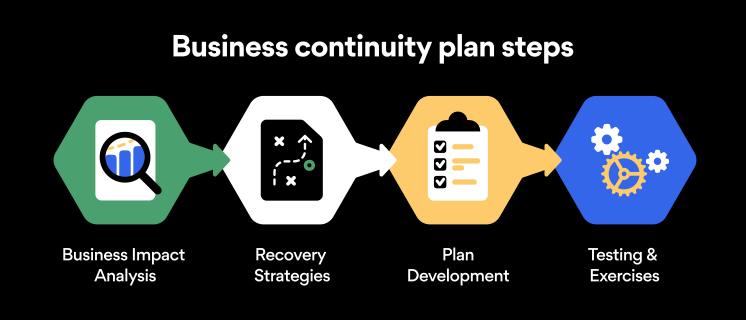
Business continuity planning steps

Here are some general guidelines that an organization looking to develop a BCP should consider:

Analysis

A business continuity plan should include an in-depth analysis of everything that could negatively affect the overall organizational infrastructure and operations. Assessing different levels of risk should also be a part of the analysis phase.

Design and development

Once you have a clear overview of potential risks your company could face, start developing a plan. Create a draft and reassess it to see if it takes into account even the smallest of details.

Implementation

Implement BCP within the organization by providing training sessions for the staff to get familiar with the plan. Getting everyone on the same page regarding crisis management is critical.

Testing

Rigorously test the plan. Play out a variety of scenarios in training sessions to learn the overall effectiveness of the continuity plan. By doing so, everyone on the team will be closely familiar with the business continuity plan’s guidelines.

Maintenance and updating

Because the threat landscape constantly changes and evolves, you should regularly reassess your BCP and take steps to update it. By making your continuity plan in tune with the times, you will be able to stay a step ahead of a crisis.

Level up your company’s security with NordPass Business

A comprehensive business continuity plan is vital for the entire organization’s security posture. However, in a perfect world, you wouldn’t have to use it. This is where NordPass Business can help.

Remember, weak, reused, or compromised passwords are often cited as one of the top contributing factors in data breaches. It’s not surprising, considering that an average user has around 100 passwords. Password fatigue is real and significantly affects how people treat their credentials. NordPass Business counters these issues.

With NordPass Business, your team will have a single secure place to store all work-related passwords, credit cards, and other sensitive information. Accessing all the data stored in NordPass is quick and easy, which allows your employees not to be distracted by the task of finding the correct passwords for the correct account.

In cyber incidents, NordPass Business ensures that company credentials remain secure at all times. Everything stored in the NordPass vault is secured with advanced encryption algorithms, which would take hundreds of years to brute force.

If you are interested in learning more about NordPass Business and how it can fortify corporate security, do not hesitate to book a demo with our representative.


About Version 2 Digital

Version 2 Digital is one of the most dynamic IT companies in Asia. The company distributes a wide range of IT products across various areas including cyber security, cloud, data protection, end points, infrastructures, system monitoring, storage, networking, business productivity and communication products.

Through an extensive network of channels, point of sales, resellers, and partnership companies, Version 2 offers quality products and services which are highly acclaimed in the market. Its customers cover a wide spectrum which include Global 1000 enterprises, regional listed companies, different vertical industries, public utilities, Government, a vast number of successful SMEs, and consumers in various Asian cities.

About NordPass
NordPass is developed by Nord Security, a company leading the global market of cybersecurity products.

The web has become a chaotic space where safety and trust have been compromised by cybercrime and data protection issues. Therefore, our team has a global mission to shape a more trusted and peaceful online future for people everywhere.

×

Hello!

Click one of our contacts below to chat on WhatsApp

×