Skip to content

Why Hospital Cyber Protection Is a Hard Nut to Crack

There is a simple reason why hospitals are the frequent targets of cybercriminals. Hospital networks contain patients’ and research data that is highly valued on the black market. And their infrastructure specifics make protecting it difficult.

In 2020, all 16 Czech key hospitals covered that year by the Cybersecurity Act reported a cyber incident. But also smaller healthcare facilities were being attacked and protecting them was no less complicated.

There are a few complications that make hospital cybersecurity challenging: the complex architecture of hospital networks, the frequent obsolescence of operating systems and also the insufficient number of qualified security personnel.

In addition, legislative requirements place high demands on security, including:

  • GDPR
  • Your National eHealth Center’s methodological guidelines (if you have one)
  • International standards that summarize security recommendations for the use of healthcare systems and best practices (ENISA – Cyber security and resilience for Smart Hospitals, MDISS – Medical Device Innovation, Safety & Security Consortium)

Last, but not least, every organization usually has its own internal security regulations. These are based on risk analyses or the internal recommendations and requirements of the hospital’s governing board for the operation of IT in the hospital.

The Most Common Targets of Attackers

In the first stages, attackers aim usually at hospital employees’ login credentials, through which attackers try to gain access to VPNs, internal or health information systems. All these systems contain high-value data through which the attacker can hold the hospital to ransom.

Another source of income for attackers is research data that can be effectively monetized, but patient data is an especially big gain. The price for this information (data about a person and their health status) is from tens to hundreds of dollars per record on the black market. By contrast, mere contact details (for example, from a hacked e-shop) are only worth units of dollars.

And, of course, there are attacks whose primary goal is to take a hospital out of operation. In the case of compromised information systems, hospitals are unable to retrieve medical records or determine the availability of drugs and supplies. In the worst case scenario, the attack affects the operational infrastructure.

In short: the hospital cannot provide the healthcare function essential for its patients.

The Specifics of Internal Hospital Networks

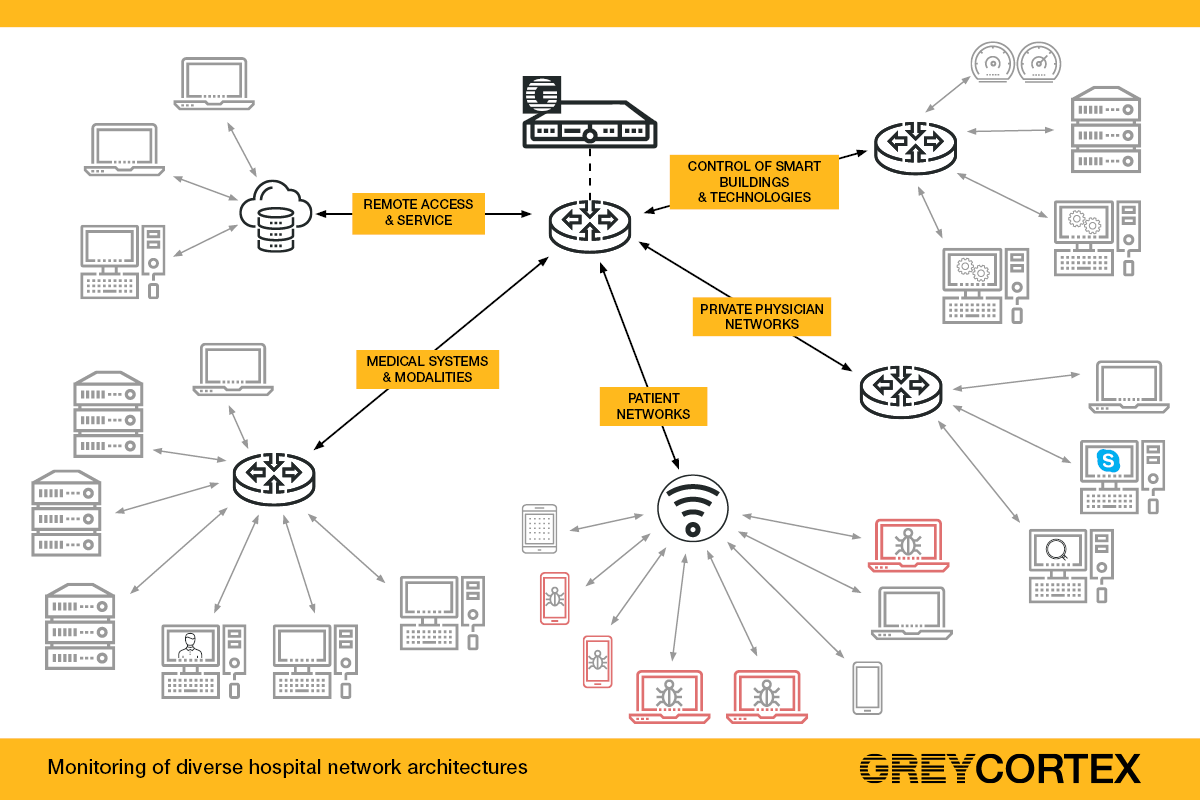
Hospital internal networks have a specific and rather complicated architecture. They are the combination of not only IT elements but also include the operational technology of specialized medical departments as well as devices such as air conditioning, heating or blind controls.

There are many different types of IT networks in hospitals, for example:

  • Medical networks, in which doctors and nurses access medical records, inventories and other medical information
  • Patient networks, which are used by patients and visitors to the hospital
  • Private physician networks, which lease connectivity from the hospital and also have access to the internal network of information systems

All of this is often complicated by the frequent use of outdated systems and insufficient staff capacity to ensure the organization’s cybersecurity.

We should view these characteristics as specifics that cannot be immediately addressed but need to be kept in mind when securing health facilities. For example, some modalities (diagnostic equipment such as X-ray machines, ultrasound, etc.) were purchased by hospitals 10 to 15 years ago and their level of security corresponds to their age. Often, the manufacturer does not even provide necessary updates, so there are devices with an un-updated operating system in the network. We have seen devices running on Windows XP. Even DOS and old versions of Linux are not rare as without these operating systems, it is not possible to use these devices.
Our experience, coming from dozens of hospitals in the European Union and Asia, has shown us that there are many hospitals with a high level of cyber protection. Unfortunately, there are also those with a large number of security shortcomings that need to be solved. Fortunately, GREYCORTEX Mendel can help them all.
About Version 2 Digital

Version 2 Digital is one of the most dynamic IT companies in Asia. The company distributes a wide range of IT products across various areas including cyber security, cloud, data protection, end points, infrastructures, system monitoring, storage, networking, business productivity and communication products.

Through an extensive network of channels, point of sales, resellers, and partnership companies, Version 2 offers quality products and services which are highly acclaimed in the market. Its customers cover a wide spectrum which include Global 1000 enterprises, regional listed companies, different vertical industries, public utilities, Government, a vast number of successful SMEs, and consumers in various Asian cities.

About GREYCORTEX
GREYCORTEX uses advanced artificial intelligence, machine learning, and data mining methods to help organizations make their IT operations secure and reliable.

MENDEL, GREYCORTEX’s network traffic analysis solution, helps corporations, governments, and the critical infrastructure sector protect their futures by detecting cyber threats to sensitive data, networks, trade secrets, and reputations, which other network security products miss.

MENDEL is based on 10 years of extensive academic research and is designed using the same technology which was successful in four US-based NIST Challenges.

Why Hospital Cyber Protection Is a Hard Nut to Crack

There is a simple reason why hospitals are the frequent targets of cybercriminals. Hospital networks contain patients’ and research data that is highly valued on the black market. And their infrastructure specifics make protecting it difficult.

In 2020, all 16 Czech key hospitals covered that year by the Cybersecurity Act reported a cyber incident. But also smaller healthcare facilities were being attacked and protecting them was no less complicated.

There are a few complications that make hospital cybersecurity challenging: the complex architecture of hospital networks, the frequent obsolescence of operating systems and also the insufficient number of qualified security personnel.

In addition, legislative requirements place high demands on security, including:

  • GDPR
  • Your National eHealth Center’s methodological guidelines (if you have one)
  • International standards that summarize security recommendations for the use of healthcare systems and best practices (ENISA – Cyber security and resilience for Smart HospitalsMDISS – Medical Device Innovation, Safety & Security Consortium)

Last, but not least, every organization usually has its own internal security regulations. These are based on risk analyses or the internal recommendations and requirements of the hospital’s governing board for the operation of IT in the hospital.

The Most Common Targets of Attackers

In the first stages, attackers aim usually at hospital employees’ login credentials, through which attackers try to gain access to VPNs, internal or health information systems. All these systems contain high-value data through which the attacker can hold the hospital to ransom.

Another source of income for attackers is research data that can be effectively monetized, but patient data is an especially big gain. The price for this information (data about a person and their health status) is from tens to hundreds of dollars per record on the black market. By contrast, mere contact details (for example, from a hacked e‑shop) are only worth units of dollars.

And, of course, there are attacks whose primary goal is to take a hospital out of operation. In the case of compromised information systems, hospitals are unable to retrieve medical records or determine the availability of drugs and supplies. In the worst case scenario, the attack affects the operational infrastructure.

In short: the hospital cannot provide the healthcare function essential for its patients.

The Specifics of Internal Hospital Networks

Hospital internal networks have a specific and rather complicated architecture. They are the combination of not only IT elements but also include the operational technology of specialized medical departments as well as devices such as air conditioning, heating or blind controls.

There are many different types of IT networks in hospitals, for example:

  • Medical networks, in which doctors and nurses access medical records, inventories and other medical information
  • Patient networks, which are used by patients and visitors to the hospital
  • Private physician networks, which lease connectivity from the hospital and also have access to the internal network of information systems

All of this is often complicated by the frequent use of outdated systems and insufficient staff capacity to ensure the organization’s cybersecurity.

We should view these characteristics as specifics that cannot be immediately addressed but need to be kept in mind when securing health facilities. For example, some modalities (diagnostic equipment such as X‑ray machines, ultrasound, etc.) were purchased by hospitals 10 to 15 years ago and their level of security corresponds to their age. Often, the manufacturer does not even provide necessary updates, so there are devices with an un-updated operating system in the network. We have seen devices running on Windows XP. Even DOS and old versions of Linux are not rare as without these operating systems, it is not possible to use these devices.

Our experience, coming from dozens of hospitals in the European Union and Asia, has shown us that there are many hospitals with a high level of cyber protection. Unfortunately, there are also those with a large number of security shortcomings that need to be solved. Fortunately, GREYCORTEX Mendel can help them all.

About Version 2 Digital

Version 2 Digital is one of the most dynamic IT companies in Asia. The company distributes a wide range of IT products across various areas including cyber security, cloud, data protection, end points, infrastructures, system monitoring, storage, networking, business productivity and communication products.

Through an extensive network of channels, point of sales, resellers, and partnership companies, Version 2 offers quality products and services which are highly acclaimed in the market. Its customers cover a wide spectrum which include Global 1000 enterprises, regional listed companies, different vertical industries, public utilities, Government, a vast number of successful SMEs, and consumers in various Asian cities.

About GREYCORTEX
GREYCORTEX uses advanced artificial intelligence, machine learning, and data mining methods to help organizations make their IT operations secure and reliable.

MENDEL, GREYCORTEX’s network traffic analysis solution, helps corporations, governments, and the critical infrastructure sector protect their futures by detecting cyber threats to sensitive data, networks, trade secrets, and reputations, which other network security products miss.

MENDEL is based on 10 years of extensive academic research and is designed using the same technology which was successful in four US-based NIST Challenges.

Why GREYCORTEX Mendel Is the Essential Member of Your Network Security Product Family

There are several basic tools for securing network infrastructure that should not be missing from any organization. Let’s take a look at the role of GREYCORTEX Mendel in all those products protecting the data and network in your company.

Antivirus software, firewalls and intrusion prevention systems (IPS) should be an integral part of any organization’s cybersecurity solution. Nowadays, however, they are often not enough. That’s where Mendel steps in.

GREYCORTEX Mendel stands on several levels:

  • It is a unique tool that sees, visualizes and analyzes everything in your network – devices, access and all communications.
  • It is a great extension to the functionality of standard cybersecurity tools: antivirus, firewalls and network performance monitoring. They are crucial, but there are some threats that even they cannot detect. The reason is simple: attackers are often ready for these standard systems.

Mendel Sees and Visualizes in the Context of Time and Events

Imagine a tool that sees all the devices in your network, how they are communicating together, what protocols they are using and where your data is going. With Mendel, you can see all of that. You can also view the details of a specific device, its communication and where it is connected to at the moment, and also yesterday or a year ago.

With this unique analysis, you can uncover a sophisticated attack on your infrastructure before it really happens. That’s because you can relate current events to events that happened before, even in the more distant past.

Let’s take a look at an example of an attack that may go unnoticed by a standard detection mechanism: Advanced malware is not detected on the end device, but that device shows behavior that could endanger the network – for example, trying to access somewhere it has not accessed before. It could be spyware or an APT in your internal domains that is gradually spreading across your network through a domain, while the infected machines start accessing unusual devices and data sources and performing lateral movement. Mendel can identify and notify you of such unusual behavior.

More Reliable End-Point Security

Because end-points are an easy target, often provide valuable data and are an entry point for gaining deeper access to your network, they are the frequent initial targets of cyber-attacks.

Commonly known end-point attacks include:

  • network mapping
  • data exfiltration (sending data in non-standard or encrypted channels, communication with control devices)
  • Dictionary attacks, password data breaches
  • Data mining (reading important information, mining data from a database, mining users from information systems or from a domain controller)

Mendel flags such attacks as dangerous behavior and recognizes the threat that might not have been recognized by endpoint security or that is well hidden by the attacker. Even if antivirus software is deployed, Mendel monitors the communication of your devices and reveals any anomalies in it. All of that using a broad database specializing in network cyber threats that include not only known threats but also signatures of unusual behavior.

A Smarter Firewall

We can understand a few things that fall under the term firewall: standard firewalls and smart solutions known as an IPS.

Traditional firewalls stand first in the line of defense and secure broad traffic filtering. They adjust network transitions and the availability of network services and are mostly used on the external perimeter – in some cases within the internal network. They are often open or insufficiently configured.

In such cases, Mendel plays the role of an auditing tool – controlling the function of the firewall itself and checking its configuration. You can use this feature for verifying and controlling the communication matrix in your internal network and critical systems. It helps you understand who is connecting where, who is using what and who is behaving differently than they should.

Smart solutions such as IPS see more deeply into your network, can detect known threats and block them. Also here, Mendel provides you a double-check by monitoring the operation of web proxies and email gateways. This means no potential threat can pass. Even in this case, Mendel’s advantage is its extensive database of threats, consisting of multiple sources and signatures that verify not only known attacks but also security policies and potentially dangerous access to data sources, such as administrative sharing. This approach is much more effective for the detection of vulnerabilities than just a database of known threats from one vendor.

This way, Mendel shows much more – not only what needs to be blocked but also unwanted or insecure applications and access to risky services. You’ll get a much better overview of what is going on and what is going through your network and how.

The Danger of Unknown Threats

In all mentioned cases, Mendel not only deals better with detecting known threats, its strength lies in also detecting unknown threats. How? Mendel recognizes different types of actions using behavioral analysis.

Right after anomalous behavior or an unknown threat is detected, the system notifies you, for example, by email. It’s then your choice. You can either take the necessary steps or you can connect Mendel to the firewall API and it will block the unwanted communication automatically for you.

A Huge Help for Monitoring Network Performance

At the next level, there are tools for internal system monitoring. In this case, Mendel shows a clear overview of the network – how it is loaded and used, who is accessing it, what services are operating and what the performance of applications and transmission lines is.

Imagine seeing just how loaded your information system, domain controller, Wi-Fi network or data center are!

GREYCORTEX Mendel helps you increase the reliability of your network. Even industrial control systems can get the right amount of control, so any attack or even a major network failure has no catastrophic consequences.

Antivirus software shows you current threats. A firewall displays the current settings and whether it is leaking something or not. But nothing will clearly show you events in your network an hour, a week or a year ago. In a nutshell, Mendel sees, visualizes and (thanks to data storage of up to the last several years) also analyzes current as well as past events.

About Version 2 Digital

Version 2 Digital is one of the most dynamic IT companies in Asia. The company distributes a wide range of IT products across various areas including cyber security, cloud, data protection, end points, infrastructures, system monitoring, storage, networking, business productivity and communication products.

Through an extensive network of channels, point of sales, resellers, and partnership companies, Version 2 offers quality products and services which are highly acclaimed in the market. Its customers cover a wide spectrum which include Global 1000 enterprises, regional listed companies, different vertical industries, public utilities, Government, a vast number of successful SMEs, and consumers in various Asian cities.

About GREYCORTEX
GREYCORTEX uses advanced artificial intelligence, machine learning, and data mining methods to help organizations make their IT operations secure and reliable.

MENDEL, GREYCORTEX’s network traffic analysis solution, helps corporations, governments, and the critical infrastructure sector protect their futures by detecting cyber threats to sensitive data, networks, trade secrets, and reputations, which other network security products miss.

MENDEL is based on 10 years of extensive academic research and is designed using the same technology which was successful in four US-based NIST Challenges.

GREYCORTEX Team Takes Third Place in NVIDIA Hackathon

During the 30-hour NVIDIA DPU virtual hackathon, participating teams worked on technologies for furthering advancements in AI , cloud and accelerated computing. Our GREYCORTEX team was among them, and our solution was awarded third place.

The goal of the hackathon was to validate the potential of using DPU (Data Processing Unit) accelerator cards for AI , networking, security and storage. The teams worked on developing a solution demonstrating the possibilities of using DPU in a data centre infrastructure.

In a competition made up of teams from all over Europe, the jury awarded third place to the project of the GREYCORTEX team, consisting of Petr Chmelař, Marek Brychta, Ondřej Kvasnica, Marina Volkova and Jozef Mlích. Our team used NVIDIA BlueField DPU cards for a DDoS attack detection and mitigation system.

With the DPU , Mendel will be able to process traffic faster, smarter and at a lower cost than before.

“ At GREYCORTEX , we are involved in a number of research projects outside of Mendel product development, trying to anticipate where market and customer needs will go. We are looking for ways to solve these problems and challenges,” says Pavel Jurka, CTO of GREYCORTEX .

One of the topics we have been working on over the past year is the processing of big data streams and their analysis using advanced methods that leverage machine learning and artificial intelligence. At the same time, we are looking at how to actively defend against such advanced attacks, which can be aided by hardware-level acceleration.

Participation in the hackathon followed our testing of the latest generation of NVIDIA BlueField DPU cards, which allowed us to demonstrate our intentions for how to use DPU in practice.

“ We hope that this technology will move into production deployment in the near future and we will be able to use it to provide better security for our customers,” concludes Pavel Jurka.

For more technical information, please contact our research team.

About Version 2 Digital

Version 2 Digital is one of the most dynamic IT companies in Asia. The company distributes a wide range of IT products across various areas including cyber security, cloud, data protection, end points, infrastructures, system monitoring, storage, networking, business productivity and communication products.

Through an extensive network of channels, point of sales, resellers, and partnership companies, Version 2 offers quality products and services which are highly acclaimed in the market. Its customers cover a wide spectrum which include Global 1000 enterprises, regional listed companies, different vertical industries, public utilities, Government, a vast number of successful SMEs, and consumers in various Asian cities.

About GREYCORTEX
GREYCORTEX uses advanced artificial intelligence, machine learning, and data mining methods to help organizations make their IT operations secure and reliable.

MENDEL, GREYCORTEX’s network traffic analysis solution, helps corporations, governments, and the critical infrastructure sector protect their futures by detecting cyber threats to sensitive data, networks, trade secrets, and reputations, which other network security products miss.

MENDEL is based on 10 years of extensive academic research and is designed using the same technology which was successful in four US-based NIST Challenges.

GREYCORTEX MENDEL 3.7 NOW AVAILABLE

GREYCORTEX has released the latest version of its Mendel Network Detection and Response solution. Version 3.7.0 brings important features and improvements. The main features in Mendel 3.7.0 include CISCO ISE user identity integration and response, CISCO Firepower incident response, SNMP appliance monitoring & SNMP trap, or AWS, MS Azure and Google cloud deployability.

ENHANCED INTEGRATION WITH YOUR INFRASTRUCTURE

Better visibility on user identity

For use cases when Mendel has no direct access to AD/LDAP server or with limited permissions then user identity could be provided via integration with CISCO Identity Service Engine (ISE).

Active response to threats

For situations where it is necessary to respond to emerging threats, we will ensure appropriate steps through integration with CISCO network elements. If this is unavoidable, you can block endpoint communication, isolate part of the network, etc.

SNMP Appliance Monitoring

With incorporation of SNMP agent and trap functionality you are able to oversee MENDEL appliances with your current infrastructure monitoring solution.

MORE EFFICIENT OPERATIONS 

New upgrade management to all your appliances

Upgrade the whole Mendel deployment through a single point  = collector’s UI. Choose either “One click” multi upgrade or upgrade each sensor individually. Upgrade is performed by two step method, to keep sensor running for maximum time and shorten the maintenance time.

Mendel installation on common cloud services 

Amazon Web Services, Microsoft Azure and Google Cloud are now supported for deployment of Collector or Central Event Management (CEM).

Utilization of high-speed disks within MultiTier storage and optimized database queries

Use your fast disks not only for the operation of the system itself, but also for a much faster response of the user interface when displaying the „hot“ data and views of them. If your deployment does not have multi-tier storage with fast disks, we still bring you a faster response in the GUI by optimizing the database queries.

False Positives for limited time period

Hide events only for the time that is relevant and related to the maintenance of your infrastructure, tests, etc. Apply false positives with specific time frame and/or recurrence.

Conditional PCAP recording

Data captures can be triggered on-demand or by specified conditions (user-defined & event-based).

OT/ICS/SCADA

Asset discovery 

Ability to discover devices in network using various OT protocols to get asset details such as firmware versions, and many others.

Policy monitoring

We introduce a new script approach in IDS rules which allows you to define custom policy rules to monitor allowed values and perform whitelists/blacklists operations inside OT protocols like IEC104, MMS and many others.

ALL FEATURES – IT

CISCO ISE user identity integration and response
CISCO Firepower incident response
SNMP appliance monitoring & SNMP trap
Upgrade management over appliances
AWS, MS Azure and Google cloud deployability
High-speed disk utilization within multi-tier storage
False positives for limited time period
Trigger based PCAP recording
Processing netflow data with NAT information
Switch flow errors  from flags to real calculation
Connect Mendel sensor to secondary collector (HA)
Deactivate inactive Sensor on Collector
User Documentation available via GUI
Time validity of false positives
Connect Mendel sensor to secondary collector (HA)
Deactivate inactive Sensor on Collector 

FEATURES – OT / ICS

Asset Discovery
Parsing MQTT, COAP and Profinet protocols
Detection of LoRaWAN protocol

ENHANCEMENTS

Process VMware ESXi NSX-T IPFIX format
Add support for storing Suricata Variables in DB
Enhance update server update data sources
Semi-automated restoration of SMB backup
IDS signatures using the detected application
Display the logged-in user name on all pages
False positive change Priority field Default text
False positive not applicable into past by default
Import new JA3 hash codes from ja3er.com
Add description field into data exports
Hide user from managerial/security reports and email
Added assignee, reporter and date of last updated to Incident exports (PDF)
Reworked Firewall settings with new location in UI
Better explanation over data transfer between hosts in peers graph
Evaluate and add IPv6 multicast address into monitored subnets
System logs in mshell
CAT tool for ME localization 

OFFICIAL MENDEL PRODUCT SUPPORT

With release of version 3.7.0 full-service support will be provided for the versions 3.7.x and 3.6.x. Limited service support is provided for previous version 3.5.x. Versions 3.4.x and older are no longer supported, end-users with valid support and maintenance or active SW subscription can upgrade to the supported version(s).

About Version 2 Digital

Version 2 Digital is one of the most dynamic IT companies in Asia. The company distributes a wide range of IT products across various areas including cyber security, cloud, data protection, end points, infrastructures, system monitoring, storage, networking, business productivity and communication products.

Through an extensive network of channels, point of sales, resellers, and partnership companies, Version 2 offers quality products and services which are highly acclaimed in the market. Its customers cover a wide spectrum which include Global 1000 enterprises, regional listed companies, different vertical industries, public utilities, Government, a vast number of successful SMEs, and consumers in various Asian cities.

About GREYCORTEX
GREYCORTEX uses advanced artificial intelligence, machine learning, and data mining methods to help organizations make their IT operations secure and reliable.

MENDEL, GREYCORTEX’s network traffic analysis solution, helps corporations, governments, and the critical infrastructure sector protect their futures by detecting cyber threats to sensitive data, networks, trade secrets, and reputations, which other network security products miss.

MENDEL is based on 10 years of extensive academic research and is designed using the same technology which was successful in four US-based NIST Challenges.

×

Hello!

Click one of our contacts below to chat on WhatsApp

×