Skip to content

Healthcare data security for modern organizations

Summary: Learn why healthcare data security is critical, the top threats, and practical strategies healthcare organizations can use to protect patient data.

Imagine an attacker quietly gaining access to sensitive patient information in your hospital network—reading lab results, personal health information, insurance details, and even payment data, undetected for weeks. For many healthcare organizations, this is not a hypothetical scenario but a daily concern.

In a world driven by electronic health records and digital transformation, healthcare data security has become critical for protecting patient privacy, maintaining operational integrity, and complying with strict regulations while building patient trust.

In this article, we’ll walk through what makes healthcare data security uniquely challenging and why it’s critical to get it right—from understanding the most common threats to implementing practical strategies that protect patient data.

What is healthcare data security?

Healthcare data security refers to the policies, practices, and technologies healthcare providers and companies use to protect electronic health records (EHRs), personal health information (PHI), and other sensitive patient data from unauthorized access, corruption, or theft.

It ensures that patient data security aligns with regulatory requirements, organizational goals, and patient privacy expectations.

Healthcare data security involves implementing layered security measures, including secure networks, encryption, role-based access control (RBAC), multi-factor authentication (MFA), and continuous monitoring to protect healthcare data across all systems and endpoints.

Why healthcare data is a growing cybersecurity concern

The healthcare industry is especially exposed to cyber threats that are becoming more advanced and frequent. While the number of data breaches continues to rise, several reasons make healthcare data security harder to maintain:
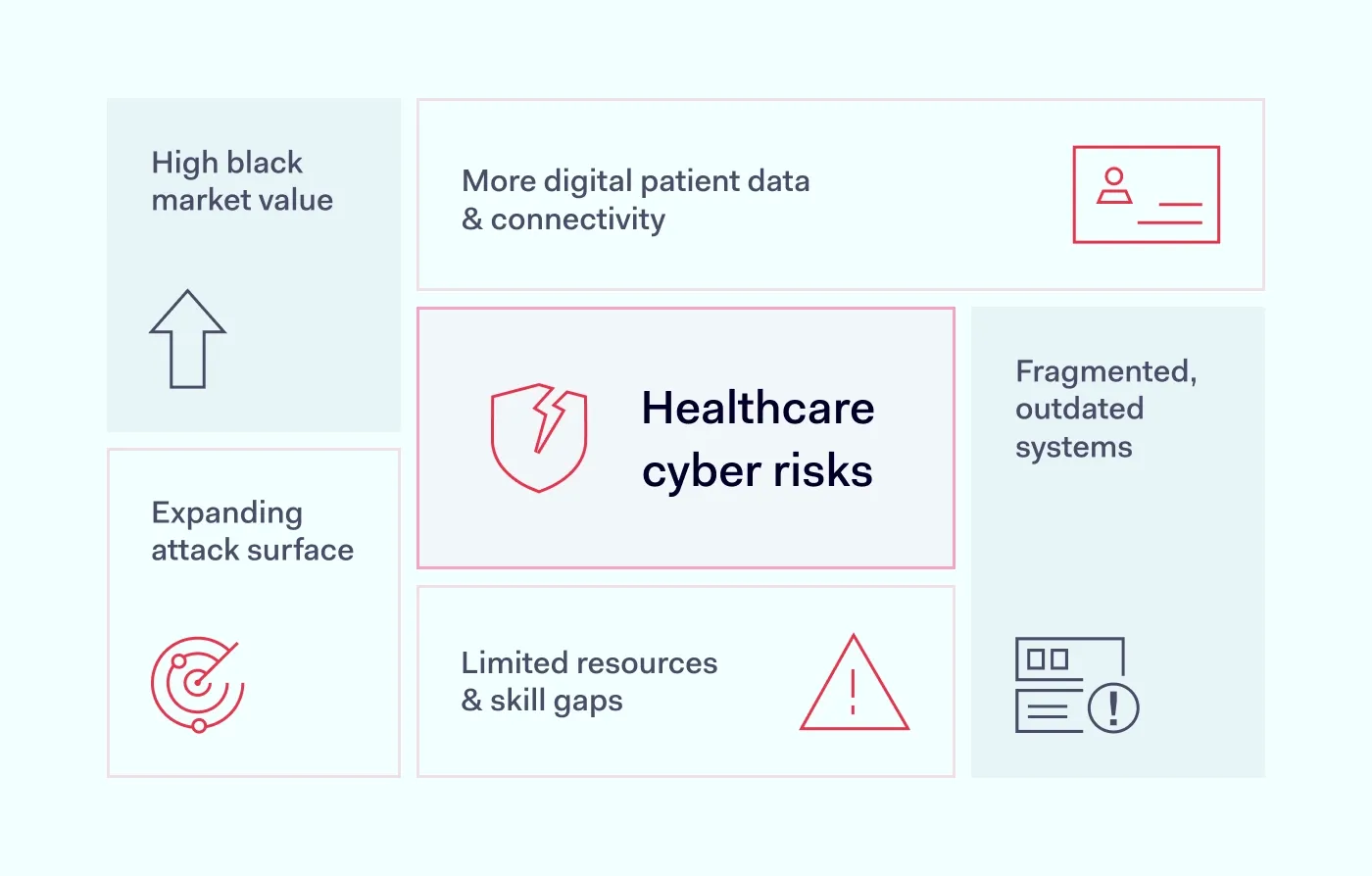
Key reasons why healthcare faces growing cybersecurity risks: digital data surge, outdated systems, black market value, wider attack surface, and skill gaps.

Surge in digital patient data & interconnectedness

The widespread adoption of EHRs, coupled with the rapid expansion of telehealth services and remote patient monitoring, has dramatically increased the volume of sensitive patient data stored, processed, and transmitted digitally.

Every new digital tool helps patient care, but also gives attackers more points to target. The amount of valuable data makes healthcare organizations attractive targets for cybercriminals.

Fragmented systems & outdated infrastructure

Many healthcare providers still use old systems that were not built with modern cybersecurity in mind. These outdated systems often lack security features, have known weaknesses, and are hard to update or patch, making them easy targets for bad actors.

Replacing or upgrading these systems can be expensive, so many healthcare organizations struggle to modernize their cybersecurity.

High value of healthcare data on the black market

Unlike credit card numbers, which can be quickly canceled, PHI and insurance data are incredibly valuable on the black market. They can be used for various illicit activities, including identity theft, insurance fraud, and even medical fraud, for years.

This high street value makes healthcare organizations exceptionally attractive targets for financially motivated cybercriminals, leading to an alarming number of data breaches—only in May 2025, 59 breaches were reported in the U.S. healthcare sector, affecting 1.8 M individuals.

The average cost of a healthcare data breach is significantly higher than in other sectors, reflecting the sensitive nature of the data involved.

The expanding attack surface

The healthcare ecosystem is incredibly complex, with healthcare organizations relying heavily on a vast network of third-party vendors for everything from billing and IT services to specialized medical devices. If not properly secured, each third-party connection represents a potential entry point for attackers.

Furthermore, the growing use of IoT medical devices—from smart infusion pumps to remote monitoring sensors—introduces new vulnerabilities. Many of these devices are not built with robust healthcare data security in mind, creating a wider attack surface and increasing the risk of data breaches.

Resource constraints & skill gaps

Despite the critical nature of their data, many healthcare organizations operate with limited cybersecurity budgets and a lack of skilled cybersecurity professionals to manage it. This makes it harder to implement, maintain, and continuously update the advanced security measures necessary to keep pace with modern threats.

The ability to invest in cutting-edge healthcare data security tools and retain top talent is often a challenge.

Key regulations in healthcare data protection

To ensure patient data security and privacy, healthcare organizations must comply with several key regulations:

  • Health Insurance Portability and Accountability Act (HIPAA): Establishes national standards for protecting sensitive patient information.
  • Health Information Technology for Economic and Clinical Health Act (HITECH): Encourages healthcare providers to adopt electronic health records while strengthening the privacy and security protections under HIPAA.
  • General Data Protection Regulation (GDPR): This regulation applies to healthcare providers processing EU residents’ data and requires strict data protection measures.
  • State-specific privacy laws: Regulations like the California Consumer Privacy Act (CCPA) may also apply, emphasizing patient privacy and data security practices.

These regulations are designed to ensure healthcare data protection, requiring healthcare organizations to adopt robust security measures and implement strong data protection practices.


Top security threats to healthcare organizations

Various cybersecurity firms and annual industry reports confirm healthcare as a prime target for specific attack types like ransomware and phishing. Reports from cybersecurity firms like Proofpoint indicate that 88–92% of healthcare organizations experience cyber-attacks once a year. The threats they mostly encounter are:

Ransomware attacks

These remain one of the most debilitating threats. Often initiated via phishing or exploiting unpatched vulnerabilities, ransomware encrypts critical systems and patient data, demanding a ransom. Such attacks can bring hospital operations to a standstill, directly impacting patient care and causing extensive data breaches, with recovery costs often in the millions.

Insider breaches

Not all threats originate externally. Employees or contractors with authorized access can intentionally misuse or accidentally expose patient data, from unauthorized snooping to misdirected emails. These incidents pose serious patient data security issues and are particularly challenging to detect given the authorized access.

Phishing and credential theft

Phishing remains a primary initial vector for many cyber-attacks. Highly sophisticated campaigns target healthcare providers to trick staff into revealing login credentials. Once stolen, these credentials grant attackers unauthorized access to internal networks and sensitive patient data, directly leading to data breaches.

Third-party and vendor risks

The intricate supply chain means healthcare organizations rely on numerous vendors. Insecure systems within these third parties can become direct entry points into an organization’s network. A data breach at a vendor can thus compromise data for multiple partner healthcare organizations, creating a snowball effect on healthcare data security.

IoT vulnerabilities

While beneficial, the growing use of IoT medical devices introduces significant security risks. Many such devices prioritize functionality over robust security, often lacking strong authentication or encryption. This vulnerability allows potential unauthorized access to patient data or even manipulation of device functionality, impacting both healthcare data security and patient safety.


Security challenges in the healthcare industry

The healthcare industry faces a unique and persistent set of challenges in maintaining effective data security in healthcare, which often exceed those found in other sectors. Successfully addressing these requires a careful understanding of the operational realities within healthcare organizations.

  • Balancing ease of access for medical staff with robust patient data security. Healthcare environments demand immediate, seamless access to patient information, especially in critical situations, making it a constant struggle to enforce strong network security without impeding patient care efficiency.
  • Integrating new technologies while maintaining compliance and security measures. The rapid adoption of innovations like AI and telemedicine requires careful integration into existing infrastructures, all while ensuring continuous regulatory compliance and maintaining a high level of data security across all systems.
  • Limited budgets and IT resources for advanced security tools. Many healthcare organizations, especially smaller providers, operate with constrained cybersecurity budgets and a shortage of skilled professionals, limiting their ability to invest in advanced healthcare data security tools and increasing their vulnerability to sophisticated cyber-attacks and data breaches.
  • Managing a diverse ecosystem of connected devices and vendor systems. A typical healthcare organization faces a challenge in ensuring consistent and effective data security across many interconnected medical devices, diverse IT systems, and numerous external vendor platforms that broaden the attack surface and increase the potential for undetected data breaches.

These challenges encourage healthcare organizations to adopt a proactive, multi-layered, and flexible approach to data protection. It’s not a one-time fix but an ongoing commitment to continuous improvement, built on robust strategies and strong partnerships. Let’s explore this more by diving into the best practices of data protection in healthcare.

Best practices to protect healthcare data

Implementing a strong healthcare data security strategy requires a combination of technology, processes, and people. These best practices are crucial for healthcare organizations aiming to prevent data breaches and maintain patient trust.
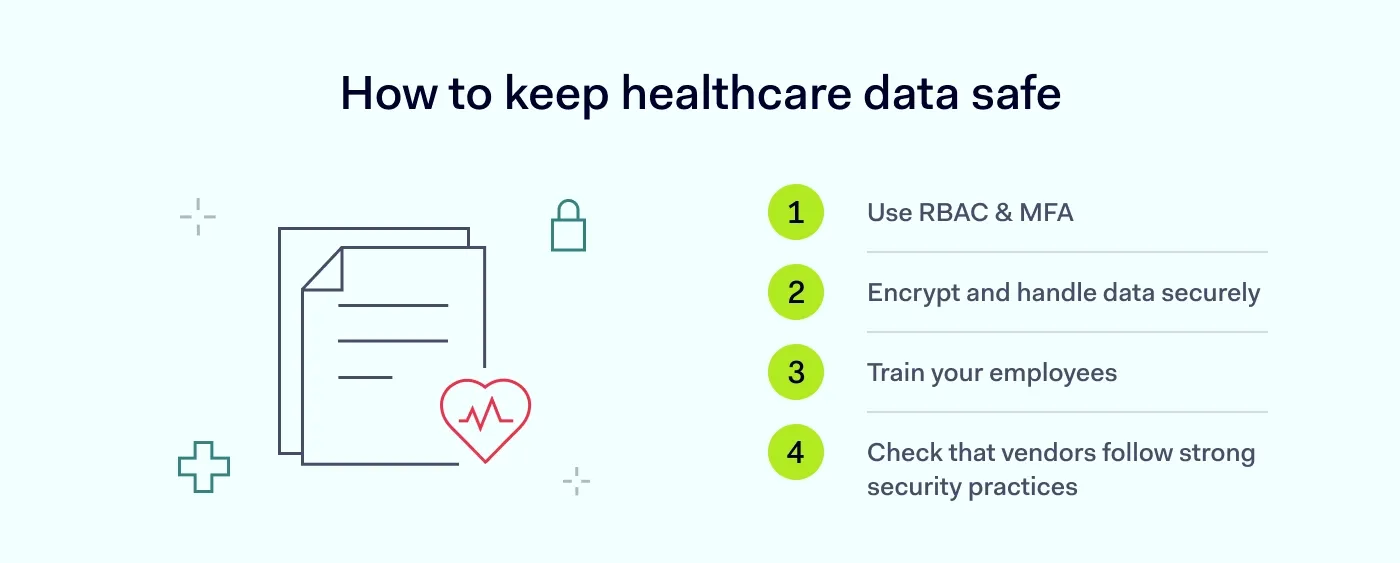
Four essential practices for protecting healthcare data: role-based access control with MFA, encryption and secure handling, staff training, and vendor security checks.

Role-based access control (RBAC) and MFA

Limit access to sensitive patient information based on job roles and enforce multi-factor authentication to add an extra layer of protection for EHRs. This ensures that employees only access the data necessary for their duties. At the same time, MFA significantly hardens login security, making it much more difficult for unauthorized users to gain access even with stolen credentials.

Encryption and secure data handling

Encrypt patient data at rest and in transit to safeguard healthcare data from unauthorized access. Even if a system is compromised, encryption renders the data unreadable to attackers. Implement secure data handling practices, including strict protocols for data disposal and secure file sharing, to minimize exposure risks.

Continuous staff training

Regularly train staff on data security practices, phishing awareness, and handling sensitive patient information securely to reduce human error. An informed workforce is often the first line of defense, capable of identifying and reporting potential threats before they escalate into data breaches.

Vendor and third-party oversight

Vet vendors and third-party services to ensure they follow strong data protection practices and do not expose your organization to unnecessary risks. Comprehensive due diligence and ongoing monitoring of third-party security postures are essential to extend your healthcare data security perimeter beyond your immediate infrastructure.

How to respond to a healthcare data breach

Despite all preventative efforts, data breaches can and do happen. A swift, organized, and compliant response is crucial to minimizing damage, restoring operational integrity, and rebuilding patient trust. This is a critical component of overall healthcare data security.

1. Contain the incident and assess the scope

Immediately isolate affected systems to prevent further damage and assess the scope of compromised patient data. Quick containment limits the spread of the breach, while a rapid assessment helps understand what data was impacted and how many individuals are affected.

2. Investigate the cause and preserve evidence

Identify how the breach occurred, preserve evidence for compliance and potential legal needs, and understand vulnerabilities in your systems. A thorough forensic investigation is vital not only for accountability but also to prevent future similar incidents and strengthen healthcare data security.

3. Notify affected parties and implement long-term fixes

Notify affected individuals and regulatory bodies as required, while addressing the root causes to strengthen data security in healthcare and prevent future incidents. Clear communication and quick action help reduce legal risks and regain trust in your data security.

How can NordLayer help with data security in healthcare

NordLayer supports healthcare providers and companies by securing their networks, helping with security compliance, and protecting healthcare data through layered security, Zero Trust Network Access (ZTNA), and continuous monitoring.

Our healthcare cybersecurity solutions are designed to address the complex challenges of healthcare data security, providing a robust defense against modern cyber threats. We help healthcare organizations strengthen data security and maintain patient trust while working toward compliance with healthcare regulations.

Frequently asked questions

What types of healthcare data are most frequently targeted by attackers?

Attackers typically target electronic health records, PHI, insurance data, and payment details due to their high value on the black market. These data types are central to many data breaches in the healthcare sector.

Do smaller healthcare providers face the same security challenges as large systems?

Yes, smaller healthcare providers face similar security challenges but often with fewer resources, making them particularly vulnerable to cyber threats and data breaches. They may lack the sophisticated defenses of larger healthcare organizations.

How do you secure healthcare data?

Securing healthcare data involves a layered approach, including role-based access, encryption, continuous monitoring, regular staff training, and strong vendor management, while aligning with regulatory requirements for healthcare data protection.
 

About NordLayer
NordLayer is an adaptive network access security solution for modern businesses – from the world’s most trusted cybersecurity brand, Nord Security.

The web has become a chaotic space where safety and trust have been compromised by cybercrime and data protection issues. Therefore, our team has a global mission to shape a more trusted and peaceful online future for people everywhere.

About Version 2 Digital

Version 2 Digital is one of the most dynamic IT companies in Asia. The company distributes a wide range of IT products across various areas including cyber security, cloud, data protection, end points, infrastructures, system monitoring, storage, networking, business productivity and communication products.

Through an extensive network of channels, point of sales, resellers, and partnership companies, Version 2 offers quality products and services which are highly acclaimed in the market. Its customers cover a wide spectrum which include Global 1000 enterprises, regional listed companies, different vertical industries, public utilities, Government, a vast number of successful SMEs, and consumers in various Asian cities.

How omnisend enhanced its threat visibility with nordstellar

Summary: Omnisend, a leading provider of marketing automation technology, now leverages NordStellar to proactively monitor and mitigate external threats before they escalate.

As a provider of a marketing automation platform used by over 150,000 online stores worldwide, Omnisend must stay ahead of cyber threats at all times. To achieve this, the company relies on solutions like NordStellar.

KEY FACTS

Industry: Marketing technology

Challenge: Limited visibility into external cyber threats and dark web exposure

Solution: NordStellar threat exposure management platform

Results:

  • Improved detection of cyber threats targeting the company
  • Simplified threat prioritization for the Omnisend team
  • Identified instances of company credential leaks
  • Found the root cause of a past security incident

ABOUT OMNISEND

Omnisend provides a cutting-edge marketing automation platform for e-commerce brands, dedicated primarily to email and SMS marketing. The company’s solution is used by over 150,000 online shops worldwide. In 2022, Omnisend was ranked #77 in the Financial Times ranking of Europe’s 1000 fastest-growing companies, and earned the #44 spot in the Deloitte UKFast50 for the third consecutive year.

CHALLENGE

While Omnisend already had several protective measures in place to ensure strong protection of its data and infrastructure, some threats remained under the radar. This was due to the company’s limited visibility into areas such as the dark web. As a result, Omnisend didn’t have the means to monitor leaked company credentials or data compromised by malware.

The company decided to address this after its team attended a live demo of NordStellar, where the platform was used to assess their threat exposure using actual company data. The results were eye-opening. Once they saw what kind of information NordStellar was able to uncover about their business on the dark web, they decided to take appropriate action. In their own words: “Like any professional security team with high standards, we couldn’t just walk away from such findings.”

SOLUTION

Shortly after the demo, Omnisend decided to move forward with the NordStellar platform. The decision was based on three factors:

  • The actionable and impactful findings it delivers
  • A wide range of external threat management features
  • Immediate proof of the platform’s high value during the demo

The company was most impressed with NordStellar’s ability to detect leaks involving employee credentials, a threat vector that often goes unnoticed. Omnisend also praised the platform for providing clear, practical feedback that the team could act on right away, rather than just basic notifications.

To gain insights into external threats targeting the company, Omnisend is making full use of all NordStellar’s features, including:

  • Data breach monitoring
  • Dark web monitoring
  • Attack surface management
  • Domain squatting detection

NordStellar delivers findings that include risk levels and contextual information about security events to help Omnisend better understand the specific circumstances surrounding each incident. As a result, it significantly improves the company’s cybersecurity posture and threat response.

IMPACT

The findings provided by NordStellar help Omnisend’s security team prioritize their tasks and dedicate more attention to other urgent issues. As Žygimantas Stauga, Director of Information Security at Omnisend, said, “There is always an issue to address, but resources are limited. That’s why it’s crucial to prioritize tasks when planning security activities. Insights from NordStellar help us do exactly that.”

NordStellar has also helped the company uncover the root cause of a past security incident. Although the issue had already been handled, the team wasn’t sure exactly what had caused it. Thanks to NordStellar, they discovered it was malware. This revelation had a big impact on the company’s processes and led to important changes in its threat response strategy.

Today, instead of guessing if there’s any trouble, NordStellar immediately notifies Omnisend whenever external threats require their attention. With this information, the company can mitigate risks before they escalate.

“NordStellar is the missing puzzle piece in most organizations’ cybersecurity, catching threats that slip past other defenses.”

Žygimantas Stauga, Director of Information Security at Omnisend

Curious what hackers might know about your business? See NordStellar in action—book a demo with us and learn about the risks you’re probably unaware of.


About NordStellar

NordStellar is a threat exposure management platform that enables enterprises to detect and respond to network threats before they escalate. As a platform and API provider, NordStellar can provide insight into threat actors’ activities and their handling of compromised data. Designed by Nord Security, the company renowned for its globally acclaimed digital privacy tool NordVPN.

About Version 2 Digital

Version 2 Digital is one of the most dynamic IT companies in Asia. The company distributes a wide range of IT products across various areas including cyber security, cloud, data protection, end points, infrastructures, system monitoring, storage, networking, business productivity and communication products.

Through an extensive network of channels, point of sales, resellers, and partnership companies, Version 2 offers quality products and services which are highly acclaimed in the market. Its customers cover a wide spectrum which include Global 1000 enterprises, regional listed companies, different vertical industries, public utilities, Government, a vast number of successful SMEs, and consumers in various Asian cities.

Machine Identity Crisis: A Security Risk Hiding in Plain Sight

Key Takeaways for CISOs and IT Teams:

  • Machine identities now outnumber humans 45 to 1—but most go unmanaged.

  • SSL/TLS certificate lifespans will shrink to 47 days by 2029, making manual management unsustainable.

  • 71% of breaches now start with stolen or misused credentials—including certificates and service accounts.

  • Most teams fail audits due to poor machine identity visibility, ownership, and lifecycle control.

  • This guide shows how to prevent outages, avoid audit risk, and automate before it’s too late.

When Microsoft Teams went dark for millions of users worldwide, the culprit wasn’t a sophisticated cyberattack or server failure. It was an expired SSL certificate. A simple piece of digital paperwork that nobody remembered to renew brought down one of the world’s most critical communication platforms. 

This isn’t an isolated incident. It’s a glimpse into a massive security blind spot that’s hiding in plain sight across every enterprise network: machine identity management.

Why machine identities are the new security frontier 

While your security team has spent years perfecting human identity management (multi-factor authentication, single sign-on, privileged access controls), an invisible workforce has been quietly multiplying in the background. 

These are your machine identities: the digital certificates, API keys, and cryptographic tokens that authenticate servers, applications, and IoT devices. 

Today, these non-human identities outnumber human employees by ratios as high as 45 to 1, and security leaders expect that number to grow by another 150% in the coming year. 

When machine identities are compromised or mismanaged, the consequences range from data breaches that make headlines to outages that cost millions in lost revenue. Yet most organizations are still managing these critical credentials with the same manual processes they used a decade ago. That is, if they’re managing them at all.

What Is a Machine Identity?

Think of machine identity as the digital equivalent of a passport or driver’s license, but for software, devices, and automated systems. Just as humans prove their identity with credentials, machines authenticate themselves using digital certificates, cryptographic keys, API tokens, and other secrets.

A “machine” in this context isn’t limited to physical hardware. It encompasses any non-human entity in your digital ecosystem: servers, virtual machines, containers, microservices, APIs, databases, applications, IoT sensors, and even AI models. 

Each requires some form of identifier and credential to establish trust with other systems. Common forms of machine identity include:

  • X.509 certificates for establishing encrypted HTTPS connections
  • API keys that authenticate applications to cloud services
  • SSH keys for secure server access and file transfers
  • Service account credentials that enable applications to access databases
  • OAuth tokens for secure API communications
  • Session-based credentials for Agentic AI acting on behalf of users across SaaS platforms or browser environments
  • Access tokens used in autonomous workflows and machine-to-machine actions

When you visit a website and see the HTTPS padlock, you’re witnessing machine identity in action. The server presents a digital certificate proving its legitimacy before your browser trusts it with sensitive data. This same principle scales across your entire infrastructure. Every service-to-service connection should verify identity before exchanging information.

The challenge lies in the explosive growth of these digital credentials. The growing trend of decentralization is disrupting cybersecurity oversight, with 75% of employees expected to acquire or modify tech outside IT’s control by 2027

Each new application, microservice, or automated process adds more machine identities to manage, creating complexity that manual processes simply cannot handle.

The Hidden Risks of Unmanaged Machine Identities

Overlooking machine identities creates serious business risks that extend far beyond IT operations. When these credentials are compromised or mismanaged, the consequences ripple through your entire organization.

Breach Enablement Through Credential Compromise

Attackers are increasingly using machine credentials as entry points, and breaches that start with stolen or compromised credentials have seen a 71% year-over-year rise. 

When attackers compromise a machine identity, they effectively “become” a trusted system within your network. This grants them the ability to move laterally, access sensitive data, and establish persistent footholds without triggering traditional security alerts. 

Unlike human accounts that often show suspicious behavior, compromised machine credentials can act normally while exfiltrating data or preparing attacks unnoticed.

The SolarWinds supply chain attack is perhaps the most stark example of this threat. Hackers misused digital certificates to impersonate trusted software updates, making malware appear legitimate and bypassing security controls. As a result, they got access to over 18,000 organizations around the world. 

The Washington Post described the attack as “the computer network equivalent of sneaking into the State Department and printing perfectly forged U.S. passports.”

Operational Disruptions and Revenue Loss

Certificate-related outages represent one of the most common yet preventable causes of business disruption. In addition to creating headaches for IT, they lead to lost revenue, customer frustration, and reputational damage.

Studies indicate that a single expired certificate outage can cost large organizations millions in recovery efforts and business impact.

The root cause often stems from a lack of visibility: teams simply don’t know where certificates are deployed or when they’re set to expire.

Now, the challenge is about to get harder. Starting in March 2026, the maximum validity period for public SSL/TLS certificates will drop from 398 days to 200 days, and by 2029, that window will shrink to just 47 days. This change—driven by industry mandates—will require certificates to be renewed up to 8 times a year. Manual management won’t scale. Without automation, organizations risk facing a flood of avoidable outages, compliance failures, and exposure from stale or expired credentials.

As your infrastructure grows more dynamic—with containers, microservices, and agentic AI adding complexity—automated certificate lifecycle management is no longer optional. It’s foundational.

Compliance and Governance Gaps

When organizations can’t inventory or secure their machine credentials, they risk failing audits and violating data protection requirements.

It’s particularly challenging because 88% of companies still treat “privileged user” as meaning humans only, even though about 42% of machine identities have sensitive or admin-level access. This creates a dangerous gap where powerful machine credentials operate without the oversight typically applied to privileged human accounts.

Cyber insurers and regulators are beginning to scrutinize machine identity practices more closely. Organizations that can’t demonstrate proper credential management may face higher insurance premiums, regulatory penalties, or exclusion from certain contracts requiring security certifications.

How Machine Identities Enable Modern Security Initiatives

Securing machine identities is a powerful enabler of transformative security and business initiatives. When properly managed, machine identities become the backbone of Zero Trust architectures, cloud-native development, and DevOps automation.

Zero Trust Security: “Never Trust, Always Verify” for Machines

Zero Trust security models require verification for every access request, whether from humans or machines. The principle “validate every machine’s identity irrespective of its location” ensures that malicious devices or rogue microservices can’t exploit implicit trust relationships.

Machine identity management makes Zero Trust architectures possible by ensuring every API call and service-to-service connection presents valid credentials. No machine or workload receives implicit trust based on network location. Each must prove its identity at every interaction, similar to multi-factor authentication for users.

Implementing mutual TLS, where each service possesses its own certificate, is a good example of this approach. Services only communicate after both parties prove their identities, preventing attackers from exploiting unverified connections. Even if one service is compromised, attackers can’t impersonate other trusted machines across the network.

Cloud-Native Scaling and Microservices

Modern cloud architectures depend heavily on microservices, containers, and APIs, which are essentially fleets of machines that scale dynamically based on demand. Managing identities manually in this environment becomes impossible so you need automated machine identity solutions to secure growth at scale.

Companies like Netflix show the power of this approach. Netflix uses an internal machine identity framework based on SPIFFE/SPIRE (a set of open-source standards for service identity) to authenticate thousands of microservices in real time, ensuring secure service-to-service communication across its global infrastructure. This implementation resulted in a 60% reduction in security incidents within their microservices environment.

Similar to Netflix, companies with proper machine identity management can auto-scale services without sacrificing security. Every new instance automatically receives valid credentials, and every connection maintains encryption and verification. 

This eliminates the traditional trade-off between agility and security, enabling developers to deploy rapid updates and connect to third-party APIs while maintaining least privilege access controls.

DevOps and Automation: Agility with Security

DevOps environments require automation to maintain both speed and safety. Machine identity management integrated into CI/CD pipelines automates the critical tasks of issuing, configuring, and rotating credentials for applications and infrastructure.

This automation prevents human errors that cause outages while accelerating deployment cycles. When a new microservice comes online during deployment, automated machine identity services immediately issue certificates and update trust stores, enabling secure communication from the start. No helpdesk tickets, no delays, no forgotten expiring certificates.

Strong machine identities also enable advanced practices like microsegmentation and fine-grained access control in orchestration platforms. Each service maintains its own credentials and operates within defined interaction boundaries, supporting both rapid development and robust security controls.

Best Practices for Securing Machine Identities

Implementing effective machine identity security requires a systematic approach that addresses discovery, automation, access control, and monitoring. These practices provide the foundation for managing machine identities at enterprise scale.

Maintain Comprehensive Inventory and Discovery

You cannot protect what you don’t know exists. Start by creating and maintaining an up-to-date inventory of all machine identities across your environment, whether it’s certificates, keys, API tokens, service accounts, and other credentials. Understand where each credential resides, which systems depend on it, and when it expires or requires renewal.

Many organizations discover hundreds or thousands of forgotten certificates and secrets scattered across cloud and on-premises systems during their first comprehensive audit. Continuous discovery tools can automatically scan networks and integrate with cloud platforms to enumerate these credentials, providing ongoing visibility as new identities are created.

Your inventory should classify privileged versus non-privileged machine accounts, helping you prioritize which credentials require enhanced security controls and monitoring.

Automate Credential Lifecycle Management

Given the volume and short lifespan of modern machine identities, manual management simply doesn’t scale. Automation becomes critical for handling issuance, renewal, and revocation of certificates and keys programmatically.

When new containers or virtual machines launch, automation tools should immediately provision appropriate credentials without human intervention. Implement regular rotation schedules for secrets and keys. Or even better, rotate after each use for highly sensitive credentials.

Automated workflows prevent outages by renewing certificates before expiration and ensure proper retirement of old credentials. These processes should integrate directly into your DevOps pipelines, creating a self-driving identity lifecycle where credentials are issued when needed, rotated frequently, and revoked instantly when suspicious activity occurs.

Enforce Least Privilege Access Controls

Apply the principle of least privilege to all machine identities with the same rigor used for human accounts. Audit the privileges of service accounts, API keys, and certificates to ensure they grant only the access each service actually needs.

If a microservice only needs to read from one database, its credentials shouldn’t allow write access to multiple systems. Too often, machine identities receive over-provisioned permissions or retain default high privileges that create attractive targets for attackers.

Bring machine identities into your Privileged Access Management (PAM) strategy. Vault their credentials, monitor their usage, and require additional verification for sensitive actions. Implement network segmentation based on machine roles, using firewall rules, service mesh policies, or cloud IAM to constrain what each identity can access.

Implement Continuous Monitoring and Response

Establish monitoring across multiple levels to detect misuse or anomalies in machine identity usage. Track certificate and key usage patterns and investigate when dormant certificates suddenly become active or API keys make calls from unusual locations.

Leverage analytics to baseline normal machine-to-machine communication patterns and generate alerts for deviations. Examples include surges in failed certificate authentications or service accounts accessing unusual resources.

Implement centralized logging for all authentication events, including mutual TLS handshakes and key usage, feeding this data into your SIEM platform. When suspicious activity occurs, have incident response playbooks ready to automatically revoke credentials or quarantine services until verification completes.

Regular testing of incident response procedures for machine identity compromise ensures your team can quickly remove or replace stolen credentials across systems, building cyber resilience through preparation and practice.

The Future: AI and Machine Identity Convergence

The relationship between AI and machine identity will evolve in two critical directions: protecting AI systems through robust machine identity controls and leveraging AI to enhance machine identity management capabilities.

Securing AI Through Machine Identity

81% of organizations now consider machine identity protection vital for safeguarding emerging AI and cloud initiatives. As AI-driven platforms become more common, they generate new types of machine identities that require protection. Sophisticated adversaries already target AI models and data, viewing machine credentials as keys to these valuable assets.

Malicious actors who can impersonate AI services or manipulate ML model API credentials could inject bad data, steal sensitive insights, or deploy rogue AI agents with elevated privileges. Protecting AI requires ensuring every automated agent, ML pipeline, and bot maintains a verifiable identity within defined access boundaries.

Future AI development frameworks will likely incorporate machine identity controls as standard practice. Things like digital signatures on AI model files, hardware-backed keys for computing environment verification, and Zero Trust principles applied to every algorithm and data feed.

AI-Enhanced Identity Management

The volume and velocity of machine identity data create perfect opportunities for AI and machine learning analytics. Next-generation identity platforms are beginning to incorporate “self-healing identity systems” that automatically adjust and repair themselves based on learned patterns.

AI engines monitoring certificates and keys could predict optimal renewal timing, automatically suspend credentials showing anomalous usage patterns, and generate replacement credentials to prevent service interruptions. These systems will optimize lifecycle management, finding ideal rotation frequencies based on risk profiles and performing predictive threat detection.

Behavioral analytics powered by AI will help differentiate normal machine behavior from malicious activity, similar to how User and Entity Behavior Analytics (UEBA) detects account takeovers. 

This combination of robust machine identity practices with AI-assisted tools promises predictive, self-healing identity infrastructures that adapt at machine speed to protect against emerging threats.

Taking the First Step: Your Machine Identity Journey

The complexity of machine identity management shouldn’t prevent you from starting. Begin with an honest assessment of your current practices: How are certificates, keys, and service accounts currently handled? What visibility exists into machine credential lifecycles?

Conduct a thorough audit to uncover unknown certificates, hard-coded credentials in scripts, and legacy keys requiring rotation. This audit will make risks tangible to stakeholders while providing the foundation for improvement planning.

Create a roadmap that prioritizes quick wins like renewing near-expiry certificates, cleaning up orphaned credentials – all the while evaluating solutions for long-term automation and management. Engage cross-functional teams across security, IT, and DevOps, since success requires collaboration across these domains.

Frame this initiative as a strategic business move rather than a technical project. Emphasize positive outcomes: preventing costly breaches and downtime, enabling faster cloud deployments, and ensuring customer trust through robust security. 

With leadership support, implement your machine identity management program iteratively. Start with automating certificate management in one infrastructure area, then expand coverage systematically. 

Secure Your Machine Identities Today

Most teams don’t realize the risk until it’s too late. Machine identity security starts now with the right tools and a trusted partner. Segura® simplifies this transition, providing robust, ready-to-implement solutions like automated credential discovery, lifecycle management, and real-time monitoring that integrate seamlessly with your existing DevOps and cloud infrastructure.

Request a personalized demo of Segura® today.

Frequently Asked Questions About Machine Identity Management

What is a machine identity in cybersecurity?

A machine identity is any non-human credential—like a digital certificate, API key, or service account—that systems use to authenticate and communicate securely. These identities are critical for verifying trust between applications, servers, containers, and AI agents.

Why are machine identities a security risk?

Machine identities now outnumber human users by as much as 45 to 1. When they’re unmanaged or overprivileged, attackers can exploit them to move laterally, access sensitive data, and evade detection. Most breaches involving credentials start with a compromised machine identity.

What causes machine identity outages?

Most outages are caused by expired or misconfigured digital certificates. As certificate lifespans shrink to 90 days or less, manual tracking becomes nearly impossible. Without automation, teams risk system failures, compliance gaps, and reputational damage.

How do I prepare for audits involving machine credentials?

Auditors increasingly expect clear visibility, ownership, and lifecycle control of all credentials, including machine identities. You’ll need a current inventory, automated renewal policies, access controls, and logging. Solutions like Segura help teams surface risks and streamline reporting.

What’s the best way to manage machine identities at scale?

Use automated discovery and lifecycle management across certificates, keys, tokens, and service accounts. Integrate credential workflows into CI/CD pipelines. Enforce least privilege access. And continuously monitor for anomalies—especially across cloud, hybrid, and AI-enabled environments.

About Segura®
Segura® strive to ensure the sovereignty of companies over actions and privileged information. To this end, we work against data theft through traceability of administrator actions on networks, servers, databases and a multitude of devices. In addition, we pursue compliance with auditing requirements and the most demanding standards, including PCI DSS, Sarbanes-Oxley, ISO 27001 and HIPAA.

About Version 2 Digital

Version 2 Digital is one of the most dynamic IT companies in Asia. The company distributes a wide range of IT products across various areas including cyber security, cloud, data protection, end points, infrastructures, system monitoring, storage, networking, business productivity and communication products.

Through an extensive network of channels, point of sales, resellers, and partnership companies, Version 2 offers quality products and services which are highly acclaimed in the market. Its customers cover a wide spectrum which include Global 1000 enterprises, regional listed companies, different vertical industries, public utilities, Government, a vast number of successful SMEs, and consumers in various Asian cities.

Zero Trust Data Protection: a modern approach to securing sensitive data

Summary: Learn about Zero Trust Data Protection and its role in modern cybersecurity. See how it redefines data control, access, and risk in high-threat environments.

Today, traditional perimeter-based security models are no longer enough. With sensitive data flowing across hybrid environments, remote endpoints, and decentralized cloud systems, the challenge is no longer where data is—but who can access it and under what conditions. Zero Trust Data Protection offers a modern, policy-driven framework that rethinks how data security should function in a world where implicit trust is a liability.

This article explores what Zero Trust Data Protection really means, how it differs from broader Zero Trust security strategies, and why forward-thinking enterprises are adopting it as a foundational layer of their cybersecurity. If your organization handles sensitive data—and needs to ensure it’s always protected regardless of location, user, or device—this guide is for you.

What is Zero Trust Data Protection?

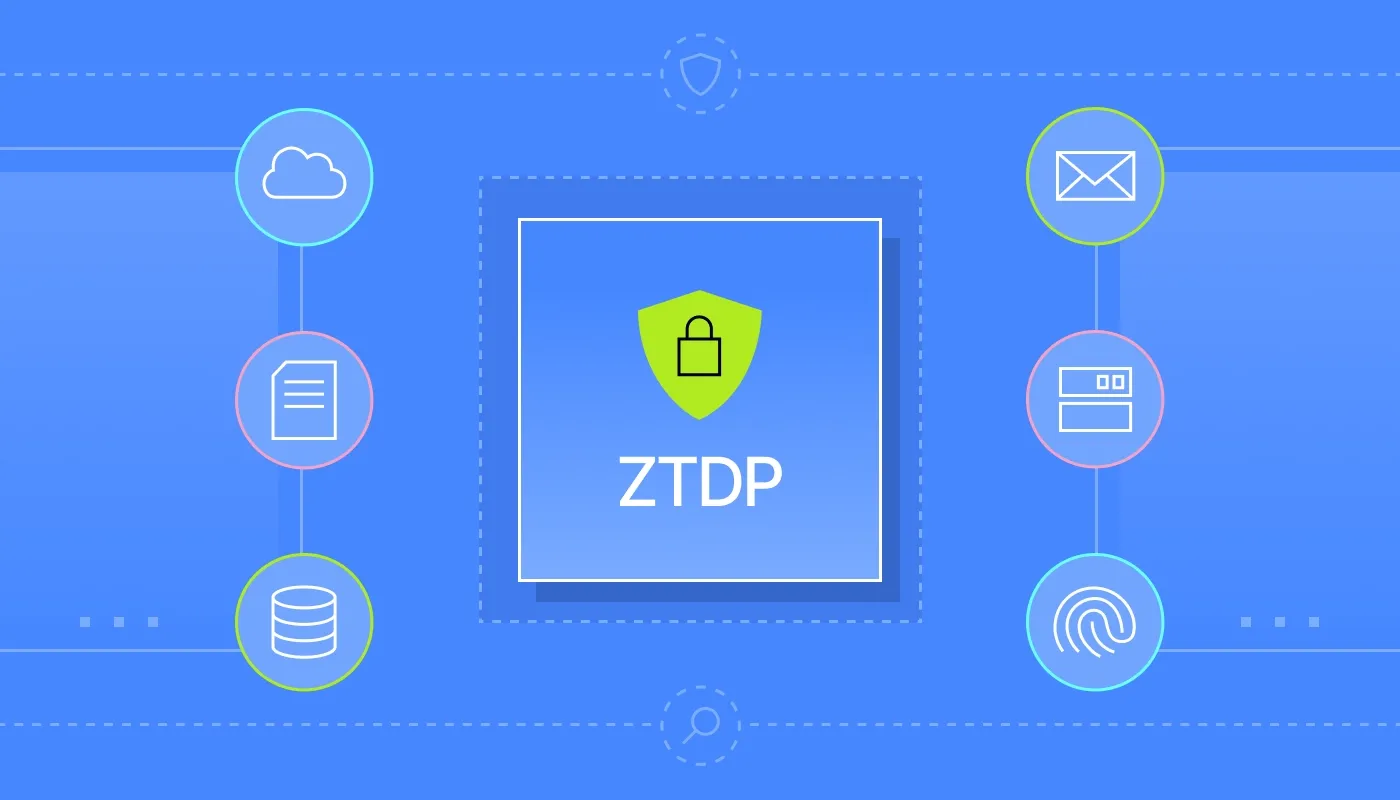
Zero Trust Data Protection (ZTDP) is an advanced security approach that applies Zero Trust principles specifically to how data is accessed, used, and protected. Unlike traditional models that assume trust based on network location or credentials, ZTDP follows the “never trust, always verify” philosophy—enforcing strict access controls and continuous validation across every layer of data interaction.

While it shares DNA with Zero Trust architecture, ZTDP goes a step further by shifting the focus from infrastructure to data access itself. This means that even if a user, device, or application gains entry into a trusted environment, data access is never assumed. Instead, policies built around least privilege access, real-time context, and behavioral signals govern who or what can interact with sensitive information—and under what conditions.

How does Zero Trust differ from traditional data security models?

Traditional data security models were built around the idea of a secure perimeter—think firewalls, VPNs, and on-premises access controls. In these models, once a user or device was authenticated and “inside the network,” they were typically granted broad access to internal systems and protected data. Trust was implicit, and security was largely dependent on defending the perimeter.

Zero Trust Data Protection completely upends this approach. Rooted in Zero Trust principles and enforced through Zero Trust architecture, ZTDP assumes that no user, device, or process should be trusted by default—even if inside the corporate network. Instead, every attempt to access data is treated as potentially hostile and evaluated in real time using contextual signals like identity, device health, geolocation, and behavior.

Another key distinction is how access is granted. While legacy systems often rely on static role-based access, ZTDP enforces least privilege access, ensuring that users can only access the data and resources they absolutely need, and only for the duration required. These strict access controls dramatically reduce the attack surface and limit lateral movement in the event of a breach.

In short, while traditional models focus on protecting the network, Zero Trust Data Protection is designed to protect the data itself—wherever it resides. This shift is critical in remote work, cloud adoption, and escalating insider threats. For organizations aiming to modernize their security posture and prevent unauthorized access or data loss, ZTDP isn’t just an upgrade—it’s a necessity.

What’s the difference between Zero Trust Data Protection and Zero Trust Data Security?

While often used interchangeably, Zero Trust Data Protection and Zero Trust Data Security serve distinct purposes—and understanding the difference is critical for businesses building advanced cybersecurity strategies.

In short, ZTDP differs from Zero Trust Data Security in that it centers more narrowly on data as the protected asset, rather than the broader ecosystem of users, networks, and endpoints. It strengthens an organization’s security posture, mitigates the risk of unauthorized access, and forms the backbone of effective data loss prevention strategies in modern, decentralized environments.

To put things into perspective, Zero Trust Data Security refers to the broader application of the Zero Trust security model. It includes securing networks, applications, endpoints, and identities, and is designed to eliminate implicit trust across the IT environment. Its goal is to reduce attack surfaces and prevent lateral movement through continuous verification and contextual authentication.

Zero Trust Data Protection, on the other hand, applies those principles directly to confidential data itself. Rather than focusing on infrastructure or identity per se, ZTDP enforces least privilege access to data at the object level—governing who or what can interact with specific data assets, under which conditions, and for how long. This data-centric approach is especially valuable in complex, distributed environments where access to data is fluid and dynamic.

The distinction matters. A company may implement Zero Trust security controls across its network and endpoints, but still leave data vulnerable if access policies aren’t enforced at the data layer. ZTDP closes that gap, enabling granular enforcement, contextual visibility, and stronger protection against unauthorized access—whether from external actors or insider threats.

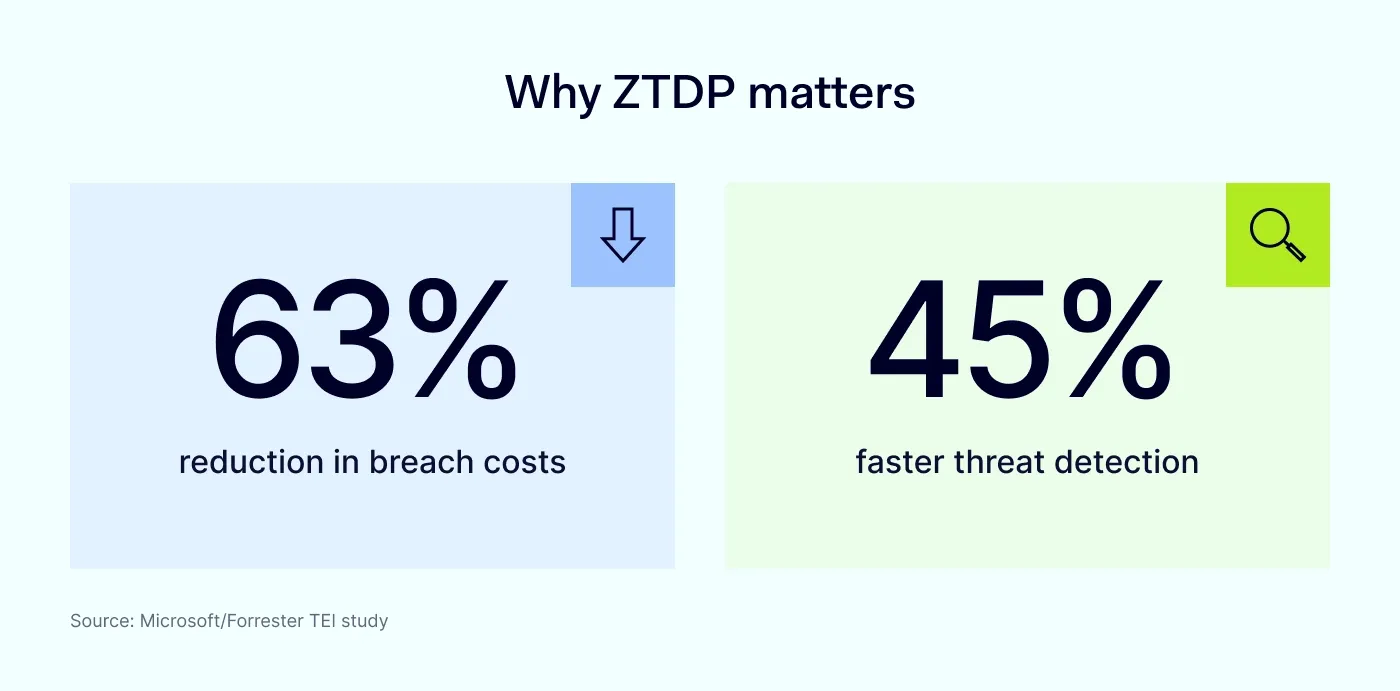
An infographic showcasing that ZTDP matters, because it has reduced breach costs by 63% and enabled 45% faster threat detection.

This difference isn’t just theoretical. A 2021 study found that organizations implementing mature Zero Trust strategies—including data-level enforcement—experienced 63% lower breach costs and detected incidents 45% faster than those relying on traditional models or partial Zero Trust rollouts. In another example, a mid-sized healthcare provider reduced insider threat incidents by 40% after adopting data-centric Zero Trust controls, which limited data access to authorized personnel only, in real-time conditions.

For B2B organizations handling regulated or high-value data, Zero Trust Data Protection represents the next level of strategic investment—one that directly supports compliance, operational resilience, and long-term risk reduction.

Benefits of Zero Trust Data Protection

Securing data today isn’t just about keeping intruders out—it’s about controlling exactly who can access what, and under what conditions. As businesses grow more distributed and data becomes increasingly portable, traditional security approaches that focus on the perimeter or user identity alone are no longer enough. Zero Trust Data Protection takes a different approach: it puts the data at the center of the security strategy.

Below are some of the most valuable outcomes organizations can expect when implementing a ZTDP model:

Minimizes the attack surface

ZTDP reduces risk by enforcing least privilege access—only verified users and systems get access to the data they’re explicitly authorized to use. This limits the impact of compromised credentials or insider threats and prevents lateral movement within the environment.

Improves data visibility and control

One of the core benefits of Zero Trust—and of ZTDP specifically—is enhanced operational visibility. This makes it easier to detect unusual activity, apply dynamic policies, and respond to incidents faster.

Supports regulatory compliance

ZTDP helps meet regulatory requirements by applying precise, auditable controls to protected data. Organizations can enforce consistent policies and demonstrate that access is both justified and logged, simplifying audits and reducing compliance risk.

Key principles of Zero Trust applied to data protection

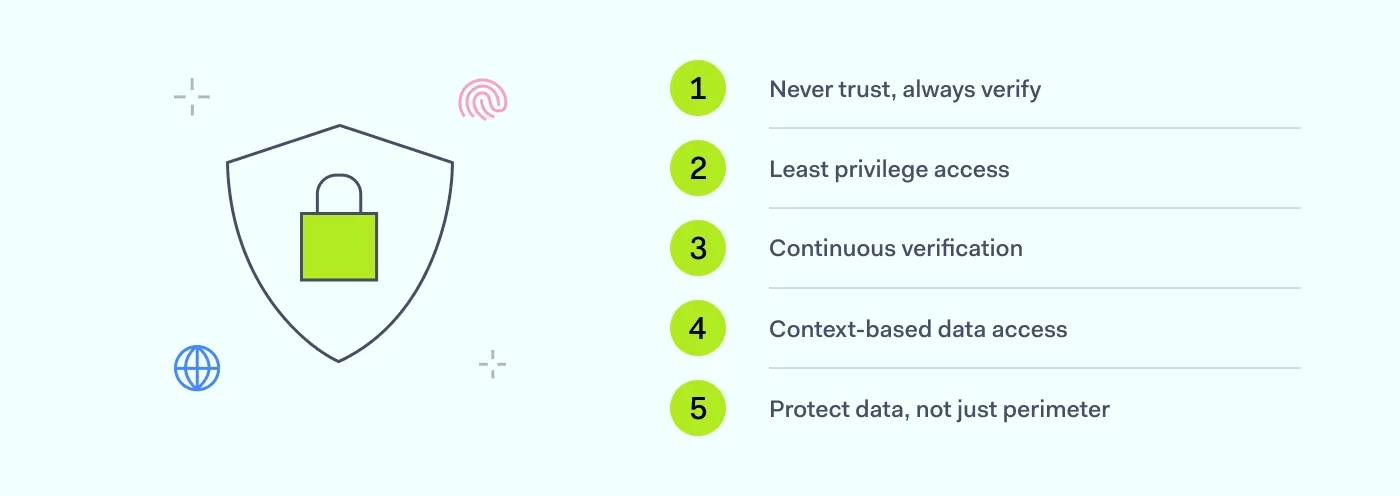
An image of a lock inside a shield and a list of the key principles of Zero Trust Data Protection: never trust, always verify; least privilege access; continuous verification; context-based data access; Protect data, not just perimeter

The principles of Zero Trust security form the foundation of an effective data protection strategy. When applied specifically to securing sensitive data, these principles help organizations reduce risk, enforce precise access controls, and respond dynamically to changing threats. Here are the core Zero Trust security principles as they relate to data protection:

  • Never trust, always verify. Trust is never assumed—even within the corporate network. Every request to access data must be authenticated, authorized, and continuously evaluated based on context such as user identity, device health, and location.
  • Least privilege access. Users, applications, and devices are granted only the minimum level of data access necessary to perform their function. This reduces the blast radius of potential breaches and enforces tight control over who can interact with which data.
  • Continuous verification. ZTDP relies on ongoing validation—not one-time authentication. Access is reassessed in real time using telemetry and behavior analysis, ensuring that session context and trust levels remain valid throughout.

How NordLayer helps implement Zero Trust Data Protection

Implementing Zero Trust Data Protection requires more than just high-level strategy—it demands technology that can enforce granular access controls, support dynamic work environments, and scale securely across your infrastructure. That’s where NordLayer’s platform stands out.

NordLayer enables organizations to apply Zero Trust security principles directly to data access, ensuring that every interaction with sensitive resources is authorized, authenticated, and context-aware. With identity-based Network Access Control (NAC), network segmentation, and Device Posture Security, NordLayer helps enforce least privilege access across your distributed workforce.

Its centralized Control Panel allows IT teams to manage user permissions, apply policy changes in real time, and monitor data activity across cloud and on-prem environments. By continuously verifying user and device trust levels, NordLayer ensures that access is both dynamic and compliant with modern security standards.

For organizations navigating complex compliance landscapes or hybrid infrastructure, NordLayer offers the tools to move from legacy perimeter-based models toward practical, enforceable Zero Trust solutions—ones that place data access at the core of the security strategy.

About NordLayer
NordLayer is an adaptive network access security solution for modern businesses – from the world’s most trusted cybersecurity brand, Nord Security.

The web has become a chaotic space where safety and trust have been compromised by cybercrime and data protection issues. Therefore, our team has a global mission to shape a more trusted and peaceful online future for people everywhere.

About Version 2 Digital

Version 2 Digital is one of the most dynamic IT companies in Asia. The company distributes a wide range of IT products across various areas including cyber security, cloud, data protection, end points, infrastructures, system monitoring, storage, networking, business productivity and communication products.

Through an extensive network of channels, point of sales, resellers, and partnership companies, Version 2 offers quality products and services which are highly acclaimed in the market. Its customers cover a wide spectrum which include Global 1000 enterprises, regional listed companies, different vertical industries, public utilities, Government, a vast number of successful SMEs, and consumers in various Asian cities.

×

Hello!

Click one of our contacts below to chat on WhatsApp

×