Skip to content

A CISO’s Guide to Managing Machine Identities

Practical strategies for securing your digital infrastructure beyond human users.

In today’s complex digital environment, machines are often the majority of users accessing systems and data. This presents a new challenge for Chief Information Security Officers (CISOs) and their teams: how to manage and secure these non-human “machine identities.” A failure in this area can lead to costly outages, data breaches, and a lack of control over your infrastructure.

Types of Critical Machine Identities

API Keys and Secrets

These provide programmatic access to services, often bypassing standard security controls. They are a common source of vulnerability if not properly managed, as they can lead to unauthorized access and API security gaps.

Service Accounts

These accounts enable automated operations across systems. They are a significant part of an organization’s identity landscape, and securing them is essential to prevent misuse and credential sprawl.

TLS/SSL Certificates

Certificates secure communication across thousands of endpoints. When they expire or are mismanaged, they can cause major vulnerabilities and disrupt access to critical services. Proper lifecycle management is key to preventing these issues.

Core Strategies for Management

Automated Discovery and Monitoring

You can’t secure what you can’t see. CISOs should deploy automated scanners to discover all machine identities, including forgotten or “shadow” credentials. Continuously monitoring these identities ensures that vulnerabilities are found early.

Lifecycle Management and Ownership

Every machine identity should have a human owner responsible for its lifecycle—from creation to retirement. Automating tasks like dynamic secret generation and automated credential expiration can help scale this process and reduce manual errors.

Integrating Machine Identities into IAM

Machine identities must be a core part of your overall Identity and Access Management (IAM) strategy. By doing so, you gain a unified view and consistent control over both human and non-human access to your most critical systems.

About Segura®
Segura® strive to ensure the sovereignty of companies over actions and privileged information. To this end, we work against data theft through traceability of administrator actions on networks, servers, databases and a multitude of devices. In addition, we pursue compliance with auditing requirements and the most demanding standards, including PCI DSS, Sarbanes-Oxley, ISO 27001 and HIPAA.

About Version 2 Digital

Version 2 Digital is one of the most dynamic IT companies in Asia. The company distributes a wide range of IT products across various areas including cyber security, cloud, data protection, end points, infrastructures, system monitoring, storage, networking, business productivity and communication products.

Through an extensive network of channels, point of sales, resellers, and partnership companies, Version 2 offers quality products and services which are highly acclaimed in the market. Its customers cover a wide spectrum which include Global 1000 enterprises, regional listed companies, different vertical industries, public utilities, Government, a vast number of successful SMEs, and consumers in various Asian cities.

大型語言模型 (LLM) 和機器學習:背景及其在客戶服務中的應用

Large Language Models (LLMs) and Machine Learning:
A Guide for Modern Customer Service

Artificial intelligence (AI) is revolutionizing customer service, but many organizations struggle to translate its potential into practical business value. To effectively leverage AI, leaders need a clear understanding of the core technologies driving it. This article demystifies Large Language Models (LLMs) and Machine Learning (ML), exploring how they work and what they can achieve in customer service.


Building the Foundation: From Machine Learning to LLMs

To understand LLMs, you must first understand the engine that powers them: Machine Learning.

What Is Machine Learning (ML)?

Machine Learning is a field of AI where systems learn from data rather than being explicitly programmed for every task. ML models are trained on vast datasets to recognize patterns, make predictions, and improve their performance over time without new instructions.

Think of it this way: instead of coding a program with rigid rules to identify a cat, you show an ML model thousands of cat pictures. The model learns the patterns—whiskers, pointy ears, tails—and can then identify a cat in a new image on its own.

This learning process is refined through techniques like reinforcement learning, where the model is taught which of its outputs is the best choice, allowing it to make progressively better decisions.

What Are Large Language Models (LLMs)?

Large Language Models are a specialized and powerful application of machine learning. They are neural networks, designed to mimic the human brain, that have been trained on immense volumes of text and data. This training enables them to understand, interpret, summarize, and generate human-like language—a field known as Natural Language Processing (NLP).

A major breakthrough came in 2017 with the introduction of "transformer models," which allow LLMs to weigh the importance of different words in a sentence. This architecture dramatically increased their speed and contextual understanding, making them far more powerful.

Today, companies can either build their own LLMs or license pre-trained models. These models can be further fine-tuned with company-specific data, adapting them to a particular industry, task, or communication style for more precise and relevant outputs.


The Impact of LLMs on Customer Service

LLMs are uniquely suited to optimize customer service by empowering agents, automating tasks, and delivering a faster, more consistent customer experience.

Key Capabilities in a Service Environment:

  • Intelligent Automation:LLMs power chatbots that can handle entire support conversations, answer frequently asked questions 24/7, classify incoming tickets, and route them to the right department.
  • Agent Empowerment:Instead of replacing agents, LLMs act as powerful assistants. They can instantly summarize long ticket histories, analyze customer sentiment to flag frustration, and draft accurate, context-aware responses that agents can simply review and send.
  • Enhanced Quality and Consistency:LLMs can rephrase complex technical information into simple terms, translate conversations in real-time, and ensure all communications adhere to a consistent brand voice.

A Practical Use Case

Imagine a customer contacts support about a complex issue with a recent software implementation. The assigned agent can use an LLM to:

  • Instantly summarize all previous interactions with the customer.
  • Use sentiment analysis to detect the customer's frustration level.
  • Receive a suggested response that addresses the issue, which the agent can quickly edit and approve.

The time saved is enormous, and the combination of AI-powered context and human oversight leads to a faster, more empathetic, and more effective resolution.


A Practical Guide: Using LLMs and ML Effectively

The question is no longer if you should use these technologies, but how. Here are practical tips for maximizing their benefits while navigating potential challenges.

1. Make the Most of the Benefits

  • Aim for Strategic Automation:Don't just use LLMs to assist with manual tasks. Identify processes that can be fully automated, such as generating first-response emails, creating knowledge base articles from resolved tickets, or handling routine information requests from start to finish.
  • Enhance Precision and Quality:Leverage advanced ML to produce high-quality content. LLMs excel at generating well-crafted reports, clear summaries, and accurate translations, raising the standard of your communications.
  • Find Creative Solutions:Because LLMs are trained on vast and diverse datasets, they can connect disparate information to propose creative or unconventional solutions that a human agent might not have considered.

2. Overcome the Challenges

While the advantages are significant, a responsible AI implementation requires awareness of the challenges.

  • Dealing with "Hallucinations":Occasionally, an LLM will generate information that sounds plausible but is factually incorrect. This happens because the model predicts the next most likely word, not the most truthful one.Mitigation:Reduce hallucinations by providing the LLM with specific context—like a relevant knowledge base article or technical document—to ground its responses in fact.
  • Identifying Bias:LLMs can inadvertently reproduce biases present in their training data (e.g., social stereotypes, US-centric examples, or overly formal language).Mitigation:Use mature, well-tested applications. Fine-tuning models with your own curated and diverse datasets can significantly minimize bias.
  • Protecting Sensitive Data:Customer data is confidential. Never input personal or sensitive information into a public LLM.Mitigation:Use enterprise-grade AI solutions that comply with data protection regulations like GDPR and offer robust data privacy controls.

Conclusion: The Future is a Strategic Choice

Large Language Models and Machine Learning are no longer futuristic concepts; they are essential tools for modern customer service. They deliver clear gains in efficiency, enhance the customer experience, and improve satisfaction by providing fast, accurate, and personalized support.

Ultimately, the key differentiator will be how businesses choose to integrate these technologies. They can be used in one of two ways:

  • As a Supportive Tool:Used occasionally to speed up or enhance existing manual processes.
  • As a Disruptive Technology:Used strategically to automate and replace manual processes entirely.

While the first approach offers incremental gains, the second unlocks the full transformative potential of AI. Businesses that only use LLMs for minor assistance are just scratching the surface of what’s possible. The future of exceptional customer service belongs to those who fully embrace a technology-driven, automated, and intelligent strategy.

關於 OTRS

OTRS (originally Open-Source Ticket Request System) is a service management suite. The suite contains an agent portal, admin dashboard and customer portal. In the agent portal, teams process tickets and requests from customers (internal or external). There are various ways in which this information, as well as customer and related data can be viewed. As the name implies, the admin dashboard allows system administrators to manage the system: Options are many, but include roles and groups, process automation, channel integration, and CMDB/database options. The third component, the customer portal, is much like a customizable webpage where information can be shared with customers and requests can be tracked on the customer side.

About Version 2

Version 2 Digital is one of the most dynamic IT companies in Asia. The company distributes a wide range of IT products across various areas including cyber security, cloud, data protection, end points, infrastructures, system monitoring, storage, networking, business productivity and communication products. Through an extensive network of channels, point of sales, resellers, and partnership companies, Version 2 offers quality products and services which are highly acclaimed in the market. Its customers cover a wide spectrum which include Global 1000 enterprises, regional listed companies, different vertical industries, public utilities, Government, a vast number of successful SMEs, and consumers in various Asian cities.

Parallels Desktop 26: Ready for macOS Tahoe

A look at the new features and improvements in the latest version of Parallels Desktop.

Parallels Desktop 26 has been launched with full support for the new macOS Tahoe 26 and Windows 11 version 25H2. This release focuses on providing a more seamless, stable, and secure experience for users who need to run multiple operating systems on their Mac.

Key Features for Individual Users

Seamless macOS Tahoe 26 Support

Parallels Desktop 26 is built to handle the new background process changes and restrictions in macOS Tahoe, ensuring that key features like **Coherence Mode** and setup routines continue to work smoothly. The new version also includes visual updates to match the new “Liquid Glass” aesthetic of macOS Tahoe.

Accurate Disk Space Visibility

Windows virtual machines can now accurately see the available disk space on your Mac’s hard drive. This helps you better manage storage, preventing slowdowns, freezes, and crashes that can occur during large installations or disk-intensive tasks.

Key Features for Businesses & IT Teams

Simplified Single-App Deployment

Parallels Desktop 26 includes new documentation and tools that allow IT administrators to easily deploy and manage a single Windows application on a Mac without giving end-users the full Windows or Parallels interface. This is ideal for specialized workflows and legacy applications.

Jamf Pro Integration

IT teams can now monitor and manage Windows OS updates within virtual machines using Jamf Pro and other mobile device management (MDM) platforms. This gives administrators better control over their virtual environments.

SOC 2 Type II Compliance

The new release has successfully completed a SOC 2 Type II audit, demonstrating Parallels’ strong commitment to security, availability, and privacy. This helps enterprise IT teams meet their internal and external compliance standards.

About Parallels 
Parallels® is a global leader in cross-platform solutions, enabling businesses and individuals to access and use the applications and files they need on any device or operating system. Parallels helps customers leverage the best technology available, whether it’s Windows, Linux, macOS, iOS, Android or the cloud.

About Version 2 Digital

Version 2 Digital is one of the most dynamic IT companies in Asia. The company distributes a wide range of IT products across various areas including cyber security, cloud, data protection, end points, infrastructures, system monitoring, storage, networking, business productivity and communication products.

Through an extensive network of channels, point of sales, resellers, and partnership companies, Version 2 offers quality products and services which are highly acclaimed in the market. Its customers cover a wide spectrum which include Global 1000 enterprises, regional listed companies, different vertical industries, public utilities, Government, a vast number of successful SMEs, and consumers in various Asian cities.

Caddy Webserver Data in Graylog

If you’re running Caddy Webserver on Ubuntu, Graylog now has a new way to make your access logs more actionable without tedious parsing or manual setup. The new Caddy Webserver Content Pack, available in Illuminate 6.4 and a Graylog Enterprise or Graylog Security license, delivers ready-to-use parsing rules, streams, and dashboards so you can quickly turn raw logs into structured, searchable insights.

What is Caddy Webserver?

Caddy is a popular web server because it’s lightweight, easy to configure, and comes with automatic HTTPS by default, thanks to its built-in Let’s Encrypt integration. It supports modern protocols like HTTP/2 and HTTP/3, offers simple yet powerful configuration through a human-friendly syntax, and runs efficiently with minimal dependencies. Developers and system administrators appreciate Caddy’s security-focused defaults, cross-platform support, and ability to serve static files, reverse proxy applications, and handle complex routing with minimal setup.

What This Pack Does

The Caddy Webserver Content Pack is purpose-built for environments running Caddy version 2.7.x on Ubuntu. Once installed, it automatically parses access logs into Graylog schema-compatible fields, tagging each event with the GIM code 180200 (http.communication) so they integrate seamlessly into your security workflows.

Included in the pack:

  • Stream: Illuminate:Caddy Webserver Messages – created automatically if it doesn’t exist, with routing rules preconfigured.
  • Index Set: Caddy Webserver Logs – pre-defined and ready for tuning after installation.
  • Parsing Rules: Extracts structured fields such as remote IP, HTTP method, URI, status code, and more.
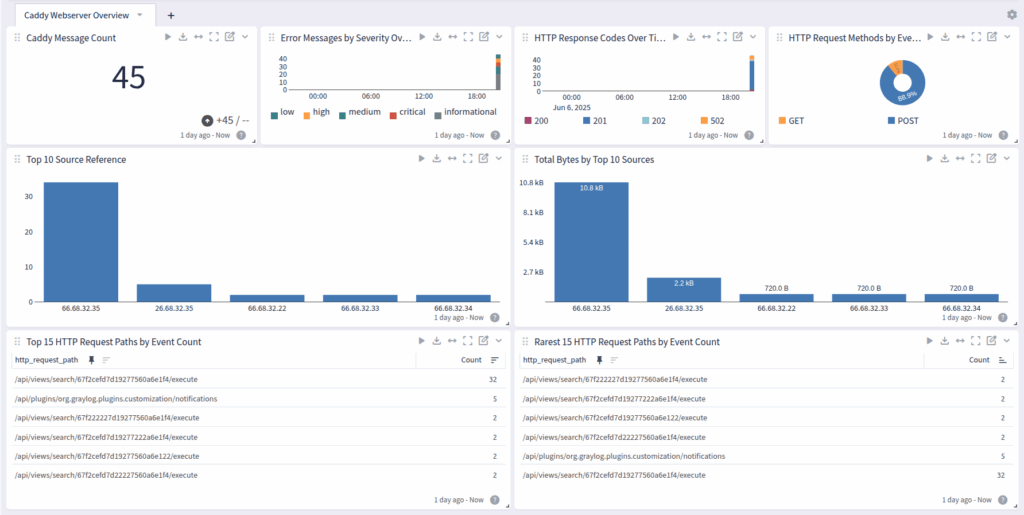
  • Dashboard: Creates a dashboard overview with message counts, severity, response codes, request paths and others.


Requirements

To use this pack, you’ll need:

  • Ubuntu/Linux with standard Caddy log paths.
  • Filebeat with Graylog Sidecar for log delivery.
  • Graylog Enterprise or Graylog Security with Illuminate installed.


Getting Logs into Graylog

  1. Configure Graylog Server
  • Create a global Beats input in Graylog.
  • Generate a Graylog REST API token.
  • In Sidecar, create a Filebeat configuration for Linux and set:
filebeat.inputs:
  - input_type: log
    paths:
      - /var/log/caddy/*
    type: filestream
    fields_under_root: true
    fields:
      event_source_product: caddy_webserver


  1. Install and Configure Sidecar on the Caddy Host


wget https://packages.graylog2.org/repo/packages/graylog-sidecar-repository_1-5_all.deb

sudo dpkg -i graylog-sidecar-repository_1-5_all.deb

sudo apt-get update && sudo apt-get install graylog-sidecar

Edit /etc/graylog/sidecar/sidecar.yml with your Graylog server URL and API token, then install and start the service.


  1. Install Filebeat


wget -qO - https://artifacts.elastic.co/GPG-KEY-elasticsearch | sudo apt-key add -

sudo apt-get install apt-transport-https

echo "deb https://artifacts.elastic.co/packages/oss-8.x/apt stable main" | sudo tee -a /etc/apt/sources.list.d/elastic-8.x.list

sudo apt-get update && sudo apt-get install filebeat

sudo systemctl enable filebeat

sudo systemctl start filebeat


Why Log Caddy Webserver Logs?

Logging Caddy Webserver logs gives you more than just HTTP request history — it can directly support security, performance, troubleshooting, and compliance use cases. Here’s a breakdown.


Caddy Webserver Dashboard Overview

Security Monitoring

  • Detect Malicious Activity
    • Identify brute-force login attempts, directory traversal (../) exploits, or repeated 404s from the same IP.
    • Spot unusual request patterns that could indicate reconnaissance or a botnet probe.
  • Track Suspicious Clients
    • Find requests with unusual User-Agent strings, malformed headers, or high request rates.
  • GeoIP Correlation
    • See where requests are coming from and detect anomalies (e.g., sudden traffic from countries where you have no users).


Performance & Optimization

  • Monitor Response Times
    • Track slow requests by path, method, or upstream target.
    • Correlate spikes in latency with backend or network issues.
  • Traffic Analysis
    • Understand peak usage hours, top requested endpoints, and request method distribution.
  • Bottleneck Identification
    • Pinpoint routes causing high CPU/memory usage due to expensive processing.


Troubleshooting & Incident Response

  • Error Investigation
    • Analyze 4xx and 5xx patterns to quickly identify misconfigurations or service failures.
  • Debugging
    • Review request/response logs when APIs or web apps behave unexpectedly.
  • Historical Context
    • See what happened leading up to an outage or anomaly.


Compliance & Audit

  • Regulatory Requirements
    • PCI DSS, HIPAA, SOC 2, and similar frameworks often require logging of all access to sensitive systems.
  • Forensic Evidence
    • Maintain an immutable record for post-incident analysis or investigation.
  • Retention Policies
    • Store logs in a central system to meet audit trail requirements.


Integration & Automation

  • Centralized Observability
    • Send Caddy logs to Graylog to correlate with application, system, and security logs.
  • Alerting
    • Trigger alerts for abnormal traffic patterns, high error rates, or possible DDoS events.
  • Automated Blocking
    • Integrate log-based rules with WAFs or firewalls to block malicious IPs in real time.


Graylog Enterprise and Security

By operationalizing your Caddy logs in Graylog, you can quickly detect anomalies, identify suspicious requests, and feed relevant data directly into your threat detection and response workflows. For more info on what fields are available click here

About Graylog  
At Graylog, our vision is a secure digital world where organizations of all sizes can effectively guard against cyber threats. We’re committed to turning this vision into reality by providing Threat Detection & Response that sets the standard for excellence. Our cloud-native architecture delivers SIEM, API Security, and Enterprise Log Management solutions that are not just efficient and effective—whether hosted by us, on-premises, or in your cloud—but also deliver a fantastic Analyst Experience at the lowest total cost of ownership. We aim to equip security analysts with the best tools for the job, empowering every organization to stand resilient in the ever-evolving cybersecurity landscape.

About Version 2 Digital

Version 2 Digital is one of the most dynamic IT companies in Asia. The company distributes a wide range of IT products across various areas including cyber security, cloud, data protection, end points, infrastructures, system monitoring, storage, networking, business productivity and communication products.

Through an extensive network of channels, point of sales, resellers, and partnership companies, Version 2 offers quality products and services which are highly acclaimed in the market. Its customers cover a wide spectrum which include Global 1000 enterprises, regional listed companies, different vertical industries, public utilities, Government, a vast number of successful SMEs, and consumers in various Asian cities.

API 威脅、機器人攻擊與隨機流量高峰:AWS WAF + Cloudbric WMS 如何在 2025 年保障您的安全

API 威脅、機器人攻擊與流量高峰:
AWS WAF + Cloudbric WMS 如何在 2025 年確保您的業務安全

在 2025 年,數碼版圖已成為一個高風險的戰場。API 成為新的前線,自動化機器人數量已超越人類用戶,而超大流量的 DDoS 攻擊規模達到了前所未有的程度。對於在 AWS 上營運的企業來說,標準的、開箱即用的安全防護已遠遠不夠。您需要的是專家管理、情報驅動的防禦。

這正是 Cloudbric WMS 發揮作用之處,它能將您的 AWS WAF 從一個簡單的工具,轉變為一個人員齊備、全面的安全營運中心。

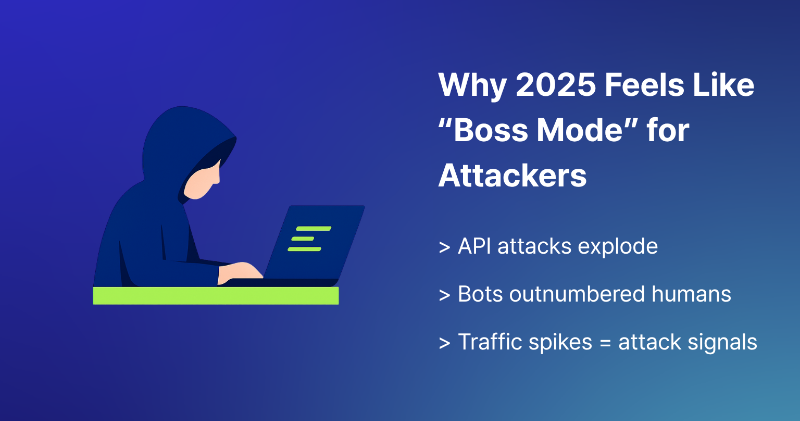
1. 挑戰:攻擊者已進入「BOSS 模式」

2025 年的威脅數據明確顯示:攻擊的複雜性和數量,正讓手動防禦不堪重負。

趨勢數據點
API 攻擊爆炸性增長2024 年 Web 應用程式與 API 攻擊達 3,110 億次,年增 33%。
機器人數量超越人類自動化流量現佔網路 51%;僅惡意機器人就佔 37%。
流量高峰即攻擊信號超大流量 HTTP DDoS 攻擊 (>1 億 pps) 季增 592%。
業務邏輯濫用OWASP 現將「無限制存取敏感業務流程」列為關鍵 API 風險 (API6:2023)。

雖然 AWS WAF 提供了具備低延遲邊緣保護的堅實基礎,但它將最關鍵的任務——持續的規則調整、誤報管理和主動式威脅分析 —— 留給了您。這在「擁有工具」和「擁有真正的安全解決方案」之間,造成了一個危險的差距。

2. 解決方案:Cloudbric WMS——在 AWS WAF 之上疊加情報與專業知識

Cloudbric WMS 透過在您現有的 AWS WAF 部署之上,疊加三項關鍵能力來彌補這一差距。

能力提供的價值
先進情報技術棧來自全球情報源的即時威脅 IP 評分、一個能分析 WAF 日誌以偵測異常和機器人指紋的 AI 引擎,以及一個擁有 91.53% 偵測率的專有規則引擎 (Tolly BMT)。
全天候專家支援一個全球安全營運中心 (SOC) 作為您團隊的延伸。我們的專家分析師能解讀警報、處理事件、在數分鐘內推送緩解措施,並提供符合您業務邏輯的客製化規則諮詢——沒有第一線客服腳本,沒有延遲。
具洞察力的可視性一個統一的營運儀表板,為您和我們的專家提供清晰的流量與威脅視圖,而高階主管級威脅報告則為稽核和策略規劃提供所需洞見。

3. 攻防速查表

親眼見證其中的差異。以下是常見的複雜攻擊,在使用與不使用 Cloudbric WMS 的情況下,處理方式有何不同。

威脅情境原生 AWS WAF搭配 Cloudbric WMS
針對未記載 API 端點的 GraphQL 注入需要手動建立複雜的正規表示式 (Regex) 規則。自動學習的 API 結構結合行為偵測,能自動攔截攻擊。
AI 驅動的價格爬蟲機器人集群機器人控制功能可攔截已知的惡意機器人,但複雜的機器人可能繞過。威脅 IP 評分能立即攔截低信譽來源,同時透過無頭瀏覽器指紋辨識和分鐘級速率限制來阻止集群攻擊。
突發的 7 Tbps DDoS 攻擊依賴預設的 ACL 速率限制;您的團隊需在事後分析日誌。我們的 24/7 SOC 會立即升級處理、應用地理過濾來阻擋攻擊節點,並在 15 分鐘內提交一份無需您介入的事件報告。
濫用「大量訂購」API 流程 (API6)沒有針對業務邏輯濫用的特定、開箱即用的防護。一套客製化的業務邏輯規則,包含交易上限和異常評分,能有效防止此類濫用。

4. 數分鐘完成部署,無需數月

入門過程簡單快捷。

  1. 在 AWS Marketplace 上訂閱 Cloudbric WMS。
  2. 委派存取權限給您現有的 AWS WAF 及相關資源 (如 CloudFront)。
  3. 基準日誌記錄開始,我們的威脅 IP 評分模型會自動建立。
  4. 我們會在 **48 小時的「僅監控模式」**下運行,同時由我們的 SOC 調整任何誤報。
  5. 啟動攔截模式,您將開始收到每週的規則優化和高階主管威脅報告。

5. 經實證的業務成果

成果Cloudbric WMS 的影響
更少誤報透過先進的威脅 IP 評分和專家調校,最多減少 40%。
更高偵測率91.53% 的 OWASP Top-10 偵測率,相比領先的競爭對手低於 70% (Tolly,2024 年 2 月)。
更快緩解速度歸功於我們的 24/7 SOC,平均緩解時間少於 5 分鐘。
備受信賴的信譽獲認可為 AWS WAF Ready 與 ISV Accelerate 合作夥伴,並榮獲多項業界大獎。

6. 立即行動

準備好將您的 AWS WAF 升級為一個全天候、精通 API 的防護盾了嗎?立即開始您的 Cloudbric WMS 免費試用,親身體驗即時威脅 IP 評分、專家級 SOC 洞察以及零日規則更新的強大功能。

FAQ

Q1. Cloudbric WMS 會取代 AWS WAF 嗎?
A. 不會。它透過先進的情報、專業的 SOC 監控和更高精度的規則來擴展和增強 AWS WAF,同時確保您的流量安全地保留在 Amazon 的全球邊緣網路上。

Q2. 威脅 IP 評分是額外費用嗎?
A. 不,它是包含在所有 WMS 方案中的核心功能。評分會透過 Cloudbric 的全球威脅情報源進行即時更新。

About Penta Security

Penta Security takes a holistic approach to cover all the bases for information security. The company has worked and is constantly working to ensure the safety of its customers behind the scenes through the wide range of IT-security offerings. As a result, with its headquarters in Korea, the company has expanded globally as a market share leader in the Asia-Pacific region.

As one of the first to make headway into information security in Korea, Penta Security has developed a wide range of fundamental technologies. Linking science, engineering, and management together to expand our technological capacity, we then make our critical decisions from a technological standpoint.

About Version 2

Version 2 Digital is one of the most dynamic IT companies in Asia. The company distributes a wide range of IT products across various areas including cyber security, cloud, data protection, end points, infrastructures, system monitoring, storage, networking, business productivity and communication products. Through an extensive network of channels, point of sales, resellers, and partnership companies, Version 2 offers quality products and services which are highly acclaimed in the market. Its customers cover a wide spectrum which include Global 1000 enterprises, regional listed companies, different vertical industries, public utilities, Government, a vast number of successful SMEs, and consumers in various Asian cities.

×

Hello!

Click one of our contacts below to chat on WhatsApp

×