Scale Computing and Veeam Launch Integrated Data Protection Solution to Counter Rising Virtualization Costs and Complexity
New Veeam Plug-in for Scale Computing HyperCore delivers agentless backup, offering a powerful, cost-effective alternative in the post-VMware acquisition era.
In a direct response to the seismic shifts in the virtualization market, Scale Computing, the leader in edge computing, today announced the official, full support of its SC//Platform by Veeam® Backup & Replication. The new Veeam Plug-in for Scale Computing HyperCore delivers agentless hypervisor backup within the Veeam Data Platform, fulfilling a key milestone in the strategic partnership announced in April with the #1 leader in data resilience.
Addressing the Modernization Mandate
Following Broadcom’s acquisition of VMware, IT teams face mounting pressure from rising hypervisor prices and restrictive licensing. This integration directly addresses the market's urgent need for virtualization solutions that are faster to deploy, easier to manage, and more cost-effective. By combining Scale Computing's award-winning platform with Veeam's industry-leading data resilience, the solution delivers simple, secure, and scalable infrastructure from the data center to the distributed edge.
Freedom from Vendor Lock-In
“Our partners and customers have long asked for deeper integration with Veeam, and we are thrilled to share that the new plug-in is available with full Veeam support—ahead of schedule—and it’s going to be a game-changer,” said Jeff Ready, President and Chief Marketing Officer of Scale Computing. “For partners and customers running workloads anywhere from the edge to the datacenter, we’re delivering fast, secure VM backups and simplified management without compromise.”
The partnership gives IT teams true freedom of choice, enabling seamless workload migration and management across any environment while sidestepping vendor lock-in.
“By integrating Veeam’s industry-leading data resilience with Scale Computing’s flexible, modern infrastructure, we’re providing another secure approach to virtualization and backup – free from unnecessary complexity,” said Shiva Pillay, Senior Vice President and General Manager, Americas at Veeam.
Version 2 Digital is one of the most dynamic IT companies in Asia. The company distributes a wide range of IT products across various areas including cyber security, cloud, data protection, end points, infrastructures, system monitoring, storage, networking, business productivity and communication products.
Through an extensive network of channels, point of sales, resellers, and partnership companies, Version 2 offers quality products and services which are highly acclaimed in the market. Its customers cover a wide spectrum which include Global 1000 enterprises, regional listed companies, different vertical industries, public utilities, Government, a vast number of successful SMEs, and consumers in various Asian cities.
Summary: Best practices of eCommerce security to protect your online store and customer data from breaches, fraud, and evolving cyber threats effectively.
Running an e-shop offers many opportunities, but it also brings security risks you can’t ignore. As online shopping grows, cybercriminals keep evolving their tactics to exploit weaknesses. Protecting your online store from cyber threats is crucial for both keeping your business secure and your customers’ payment information safe.
From credit card details to other sensitive data, your customers trust you to protect their confidential information. This guide will walk you through the eCommerce security best practices, covering key areas to help strengthen your online store and reduce the risk of cyber threats.
Why it’s important to protect your eCommerce website
A single security breach can cause serious harm to your business. It can lead to significant financial losses, legal penalties, a loss of customer trust, and severe reputational damage that takes years to rebuild. Imagine the fallout if customer data is stolen, or your store goes offline during a busy sales period.
Beyond the immediate chaos, a security breach can result in:
Financial losses: Costs from investigations, legal fees, fines (like GDPR or CCPA penalties), credit monitoring for affected customers, and lost revenue during downtime.
Reputational damage: News of a data breach can spread fast, leading to bad publicity and loss of customer confidence. Regaining trust is hard once it’s lost.
Legal and compliance issues: Failing to follow data protection rules can lead to heavy fines and legal consequences.
Operational disruptions: Cyber-attacks can shut down your store, affecting sales, your supply chain, and day-to-day operations.
Strong eCommerce security isn’t just about meeting compliance requirements. It’s about building a reliable, trustworthy online store that customers can depend on.
Common eCommerce security threats
Cyber threats constantly change, with attackers finding new ways to target online shops. Understanding these common threats is the first step in building effective defenses.
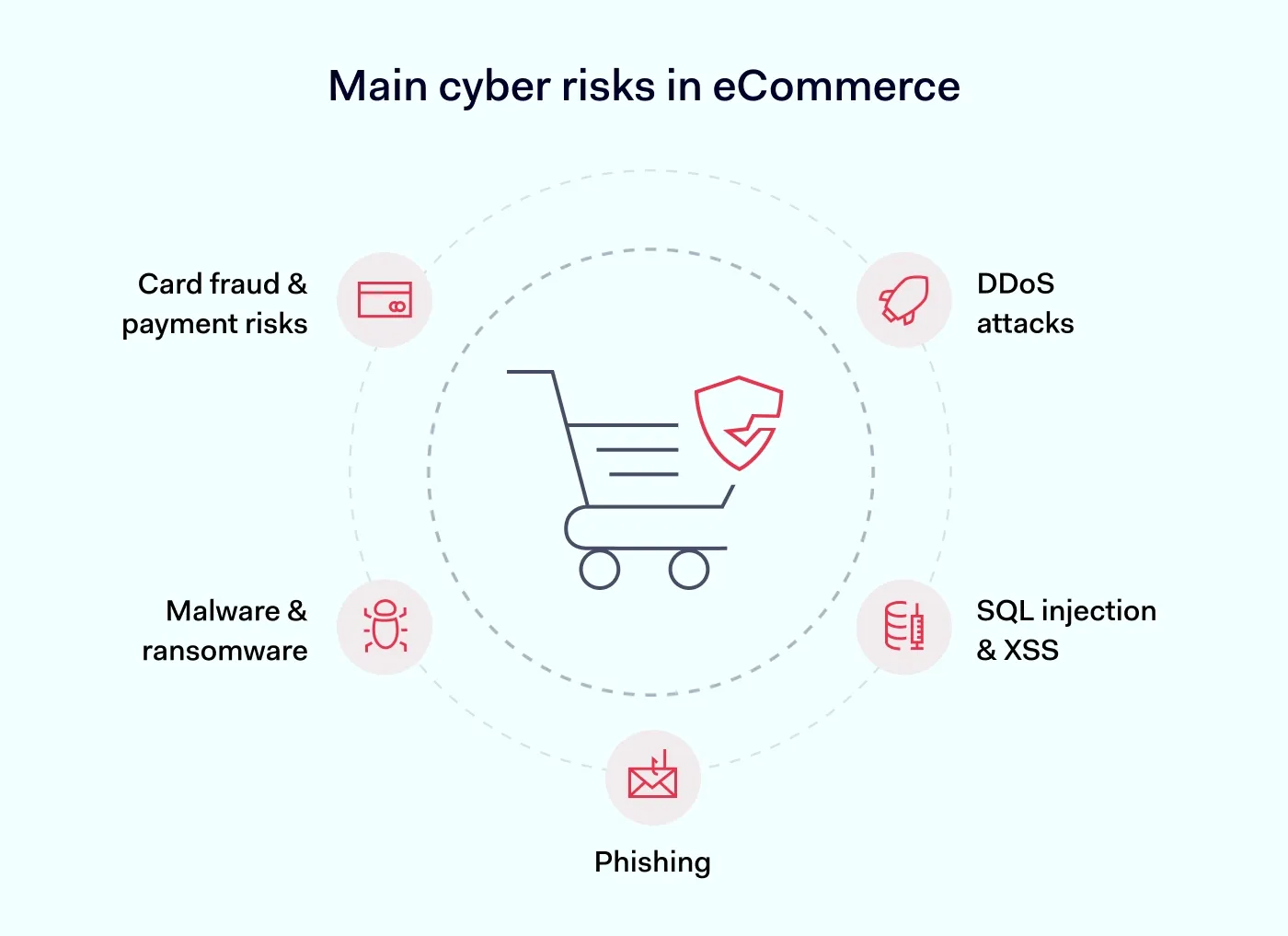
SQL injection and XSS vulnerabilities
SQL injection and Cross-Site Scripting (XSS) are two common weaknesses that can seriously harm your eCommerce website’s security:
SQL injection. This attack occurs when an attacker inserts malicious SQL code into input fields on your website, like login forms or search bars. If your server doesn’t validate these inputs properly, the attacker’s code can run on your website’s database. This could grant them unauthorized access to, or even manipulation of, your database, potentially exposing sensitive data like customer records, order details, and even credit card information.
Cross-Site Scripting (XSS) vulnerabilities. XSS attacks involve injecting malicious scripts into trusted websites. When a user visits your site, their browser runs the malicious script, which can lead to session hijacking, redirecting users to fake sites, or stealing customer data. For online stores, this can mean compromised user accounts or tricking customers into giving away personal information.
Phishing attacks targeting online stores
Phishing attacks remain one of the most common and effective methods for cybercriminals. In eCommerce, phishing can target both the business itself and your customers.
Targeting businesses: Attackers may send fake emails to your employees, pretending to be vendors, banks, or company leadership. These emails try to trick employees into sharing login credentials for your store’s admin panel or financial systems. If they succeed, attackers can gain direct access to sensitive business data.
Targeting customers: Malicious actors often create fake websites or send fraudulent emails that look like real e-stores. They trick customers into entering their login or payment information on these fake sites, leading to data breaches and financial fraud.
Teaching your employees and customers how to spot phishing attempts is one of the most important steps you can take. Human error is still the easiest way for cybercriminals to bypass technical security measures.
Malware and ransomware
Malware—short for malicious software—includes many harmful programs designed to damage, disrupt, or gain unauthorized access to systems. Ransomware is a particularly damaging form of malware.
Malware. Your eCommerce site can get infected with malware through insecure plugins, weak hosting environments, or phishing attacks. Malware can steal customer data, disrupt your site, redirect traffic, or use your site to spread further infections, harming customer trust and data security.
Ransomware. Attackers lock your files by encrypting them and demand payment, often in cryptocurrency, to unlock them. For online shops, this could mean losing access to product catalogs, customer data, and order history, stopping your business entirely and risking a data breach. Regular backups are critical for recovering from ransomware attacks.
Distributed Denial of Service (DDoS) attacks
DDoS attacks overwhelm your website with fake traffic, making it unavailable for real customers who want to browse products, place orders, or complete online transactions.
These attacks can cause significant financial losses from lost sales, damaged reputation, and the costs associated with mitigating the attack and restoring service. While they don’t always directly aim to steal data, they can be used as a smokescreen for other, more targeted attacks.
Effective security measures for DDoS include specialized mitigation services and robust infrastructure.
Card fraud and other eCommerce transaction risks
Payment processing is at the core of eCommerce, making it a key target for fraud.
Credit card fraud. Fraudsters may use stolen card information to make purchases or use tactics like e-skimming (Magecart attacks), where malicious code is placed on your checkout page to capture payment details as customers enter them.
Chargebacks. Fraudulent transactions often result in chargebacks, where the rightful cardholder disputes the charge. This can lead to financial penalties for your store and harm your account processing reputation.
Identity theft. If attackers steal customer data like personal identifiable information (PII), they can commit identity theft, harming your customers and potentially leading to legal and financial consequences for your business.
These common eCommerce security threats show why having a layered security strategy is essential to protect every part of your online store and keep your customers’ trust.
Best eCommerce security practices for online store administration
Your store’s admin side needs as much protection as the customer-facing side. Here’s how to keep your business secure:
Use multi-factor authentication (MFA)
Multi-factor authentication adds a critical layer of protection to user accounts. Instead of relying solely on a password, MFA requires users to provide two or more verification factors to gain access. These could be something they know (password), something they have (a code from an authenticator app or SMS), or something they are (biometrics like a fingerprint).
Secure your eCommerce website with an SSL certificate
An SSL certificate (Secure Sockets Layer) is foundational for any eCommerce business. It encrypts the connection between your server and your customers’ browsers. When a website has an SSL certificate, its URL begins with https:// instead of http://, and a padlock icon appears in the browser’s address bar.
Regularly update your eCommerce platform and plugins
Outdated software is a top target for bad actors. Updates fix security gaps, so don’t skip them.
Make it a habit to:
Update your platform. Whether you use Shopify, Magento, WooCommerce, or another platform, ensure it’s running on the latest version.
Update themes and plugins. Third-party tools are often sources of vulnerabilities. Regularly check for and apply updates.
Remove unused plugins/themes. Unused components can still pose a security risk. If you don’t use them, delete them.
Automate updates where possible. Consider automating updates for critical security patches, but always test them in a staging environment first.
This proactive approach to maintenance is essential for your store’s security.
Implement secure payment gateways to protect your online store
Payment processing is the most critical part of your e-shop’s security. Always use reputable, secure payment gateways that employ advanced encryption, tokenization, and fraud detection technologies to protect the data. In that way, transactions between your store and the customer’s bank will be handled safely, and the transmission of cardholder data and other payment information will remain secure.
By using robust, industry-standard payment gateways, you significantly improve the security measures protecting your customers’ financial information.
Educate employees and customers on eCommerce security best practices
Technology alone isn’t enough; human error is stilla significant vulnerability. That’s why education is such a powerful security measure.
Employee training. Train your employees on identifying phishing attempts, using strong, unique passwords, understanding social engineering tactics, and following proper procedures for handling personal data. Regular refreshers are vital. Employees with access to your web server or admin panels should be particularly security-aware.
Customer awareness. While you can’t control your customers’ security habits, you can educate them. Provide clear information on your website about your security practices, how to identify official communications from your e-store, and tips for protecting their information (e.g., using strong passwords, being wary of suspicious links). This fosters trust and empowers them to be part of your security defense.
Protecting customer data
At its heart, e-shop security is all about safeguarding confidential data. This extends beyond just credit card details to encompass all personally identifiable information like names, addresses, phone numbers, and purchase history.
A data breach involving this information can result inidentity theft, phishing attacks against your customers, and severe regulatory penalties for your business.
Key aspects of protecting customer data include:
Data minimization: The less you store, the less you risk. Only collect the data you absolutely need for legitimate business purposes.
Encryption at rest and in transit: Ensure all confidential data is encrypted, both when it’s stored on your servers (data at rest) and when it’s being transmitted across networks (data in transit) via an encrypted connection.
Access control: Implement strict access controls, limiting who can access sensitive customer data to only those employees who require it for their job functions. Use role-based access control (RBAC) to define granular permissions.
Regular data audits: Periodically audit your data storage and access logs to identify any suspicious activity or unauthorized access attempts.
Clear data retention policies: Establish clear policies for how long you retain customer data. Once data is no longer needed, securely delete it.
Advanced security measures
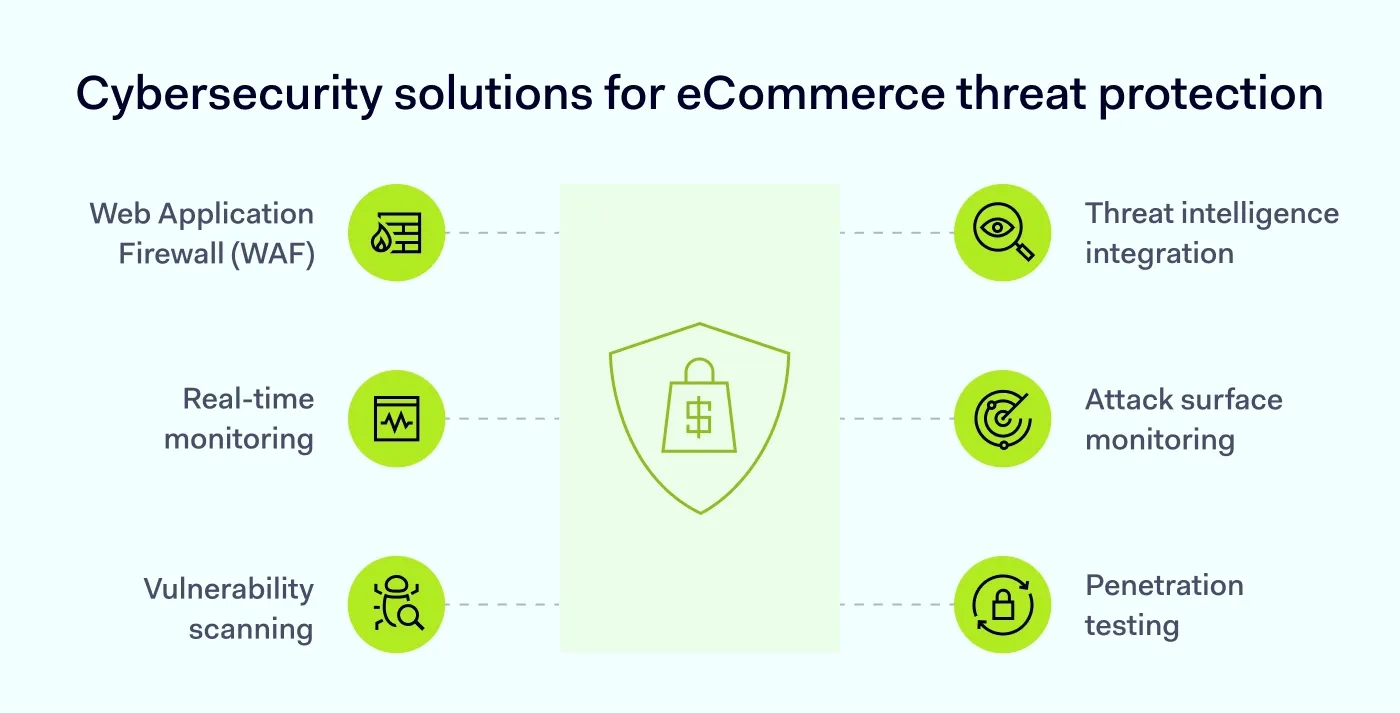
While basic network security practices are essential, advanced security measures are increasingly necessary to combat modern threats.
Consider:
Web Application Firewall (WAF)
A WAF sits between your website’s server and the internet, monitoring and filtering HTTP traffic. It acts as a shield, protecting your website from common attacks like SQL injection, XSS, and other web-based vulnerabilities before they reach your application.
Real-time monitoring
Continuous monitoring of your e-store for suspicious activity, unauthorized access attempts, and performance anomalies is crucial. This includes monitoring server logs, network traffic, and application logs. Real-time alerts allow for rapid response to potential threats.
Vulnerability scanning
Regularly scan your eCommerce platform, plugins, and underlying infrastructure for known vulnerabilities. Automated vulnerability scanners can identify weaknesses that attackers might exploit, allowing you to patch them proactively.
Penetration testing
Beyond automated scans, professional penetration testing involves ethical hackers simulating real-world attacks to uncover vulnerabilities that automated tools might miss. This provides a deep understanding of your eCommerce website security posture.
Attack surface monitoring
This involves continuously discovering, inventorying, and monitoring all internet-facing assets of your website (e.g., domains, subdomains, IP addresses, cloud instances) to identify potential entry points for attackers.
Threat intelligence integration
Using threat intelligence feeds can provide early warnings about new cyber threats and attack vectors targeting the eCommerce industry. This helps adapt your security measures before an attack happens.
Stay compliant with security standards
Following industry-specific and regional compliance standards is not just about avoiding fines; it’s about building a solid foundation for data protection and demonstrating a commitment to protecting customer data.
Understanding PCI-DSS requirements for eCommerce websites
The Payment Card Industry Data Security Standard (PCI DSS) is a set of security standards designed to ensure that all companies that process, store, or transmit credit card details maintain a secure environment. For eCommerce websites that handle online transactions, PCI DSS compliance is mandatory.
Key requirements of PCI DSS include:
Establishing a secure network, using firewalls to protect cardholder data, and changing all default system passwords.
Protecting cardholder data by encrypting its transmission across open, public networks and securing stored information.
Maintaining a vulnerability management program through regularly updating anti-virus software and developing secure systems and applications.
Implementing strong access controls to limit who can view cardholder data, assigning unique IDs for computer use, and restricting physical entry.
Regularly monitoring and testing networks, including tracking all access to network resources and cardholder data, and routinely testing security systems and processes.
Maintaining an information security policy that establishes guidelines addressing information security for all staff.
Achieving and maintaining PCI DSS compliance is a continuous process that involves regular assessments, remediation, and reporting. Failing to comply can result in severe penalties, including fines and the inability to process credit card payments.
GDPR and CCPA compliance for protecting customer data
Beyond financial data, general data privacy regulations like the General Data Protection Regulation (GDPR) in Europe and the California Consumer Privacy Act (CCPA) in the United States impose strict requirements on how eCommerce businesses collect, store, process, and protect personal data.
GDPR (General Data Protection Regulation). Applies to any business handling EU citizens’ data, requiring consent, rights to access and erase data, and breach reporting. Non-compliance can result in fines up to 4% of global annual revenue or €20 million, whichever is higher.
CCPA (California Consumer Privacy Act). Like GDPR, CCPA grants California consumers significant rights regarding their personal information, including the right to know what data is collected, the right to opt out of data sales, and the right to request deletion. While the penalties are not as steep as GDPR, the reputational damage and legal costs can still be substantial.
Complying with these privacy regulations is not just a legal obligation. It’s also a way to build trust by demonstrating a strong commitment to protecting customer data and respecting their privacy.
How NordLayer can help protect your eCommerce store
Securing your e-store requires more than just the basics—it demands a resilient, adaptable cybersecurity infrastructure. NordLayer delivers advanced eCommerce cybersecurity solutions designed for comprehensive, layered protection.
NordLayer can fortify your online store by:
Securing remote access: NordLayer ensures encrypted, authenticated connections for employees and admins accessing your e-store backend via NordLayer’s infrastructure, protecting sensitive systems from unauthorized entry. Bonus? It simplifies IP whitelisting: instead of managing multiple external IPs, you can grant access by creating a NordLayer user account—quick, secure, and configuration-free.
Implementing Zero Trust Network Access (ZTNA): Built on the principle of “never trust, always verify,” NordLayer authenticates and authorizes every user and device before granting access to your internal business systems via the NordLayer network. This granular control reduces your attack surface and defends against insider threats and credential compromise.
Providing Firewall-as-a-Service (FWaaS) capabilities:NordLayer’s Cloud Firewall filters malicious traffic, targeting the secure gateways to access internal business systems. This adds a powerful layer of defense against DDoS attacks and exploitation attempts on those access points (note: not the public-facing eCommerce website).
Enhancing data security: By encrypting network traffic between users connected to NordLayer and your internal applications or cloud resources, NordLayer keeps sensitive business data confidential and safe from interception, complementing, not replacing, existing SSL protections on your e-commerce site.
Simplifying security compliance: With built-in security measures for access control and data protection, NordLayer helps eCommerce businesses meet regulations like GDPR and PCI DSS with less complexity.
Reducing malware risks:NordLayer’s malware detection reduces the risk of malware infections, protecting your internal systems and customer data.
Take control of your eCommerce security and compliance with NordLayer. Build trust, reduce risks, and let your customers shop with confidence.
About NordLayer NordLayer is an adaptive network access security solution for modern businesses – from the world’s most trusted cybersecurity brand, Nord Security.
The web has become a chaotic space where safety and trust have been compromised by cybercrime and data protection issues. Therefore, our team has a global mission to shape a more trusted and peaceful online future for people everywhere.
About Version 2 Digital
Version 2 Digital is one of the most dynamic IT companies in Asia. The company distributes a wide range of IT products across various areas including cyber security, cloud, data protection, end points, infrastructures, system monitoring, storage, networking, business productivity and communication products.
Through an extensive network of channels, point of sales, resellers, and partnership companies, Version 2 offers quality products and services which are highly acclaimed in the market. Its customers cover a wide spectrum which include Global 1000 enterprises, regional listed companies, different vertical industries, public utilities, Government, a vast number of successful SMEs, and consumers in various Asian cities.
You’re managing 200+ applications across your organization. Users are signing up for new tools daily. Shadow IT is spreading faster than you can track it. Your CFO wants to know why software spending jumped 40% last quarter, and compliance is asking for an access review that would take weeks to complete manually.
This scenario plays out in organizations worldwide as SaaS adoption accelerates.
The solution?
A robust SaaS Management Platform (SMP) that provides visibility, control, and optimization across your entire software ecosystem.
In this comprehensive analysis, we’ll compare two leading SaaS management vendors: BetterCloud and Lumos. BetterCloud positions itself as a mature, all-in-one platform with deep automation capabilities. Lumos takes a modern approach with Slack-based workflows and continuous cost optimization.
Both promise to solve your SaaS sprawl challenges, but which delivers the best value for your organization?
Overview of BetterCloud
BetterCloud has been a leader in SaaS management for nearly 15 years. In G2’s Summer 2025 Report, it was recognized as a Leader in several categories, including SaaS Operations Management, User Provisioning and Governance Tools, and SaaS Spend Management.
The platform’s strength is its ability to automate IT tasks. BetterCloud helps businesses find underused SaaS apps, cut unnecessary subscriptions, and standardize software use. A recent update added smarter grouping for apps like Adobe and Atlassian in its Spend Optimization tool, making data easier to track.
BetterCloud’s automation goes beyond simple tasks. With its no-code drag-and-drop workflow builder, IT teams can automate complicated processes across multiple SaaS apps. This includes things like employee onboarding, offboarding, user provisioning, and license management.
Customers often highlight how BetterCloud reduces audit time and manages permissions in detail. The platform is also known for its strong security, including Zero Trust Networking and Data Loss Prevention features. Users like its simple interface and how it makes tough tasks easier, though some mention it takes time to learn advanced features.
Overview of Lumos
Lumos is a modern platform that helps businesses manage their apps, save money, and make IT work easier. It focuses on automating tasks and cutting down software costs by showing clear data on app usage, permissions, and spending.
One of Lumos’ best features is “Zero-Touch App Discovery.” This tool finds all the apps being used in your company, including both approved tools and hidden “shadow IT” apps that aren’t authorized. It puts all the usage and spending info into one simple dashboard, so you can make better decisions about your apps.
Lumos also helps save money with “Continuous Cost Efficiency.” It automatically takes back unused licenses, manages app renewals, and directs users to approved apps through its AppStore to avoid waste. AI tools handle renewals to make sure budgets stay on track.
Another standout feature is Lumos’ strong integration with Slack. Users can request app access and get approvals directly in Slack, making it easier for teams to stay productive and reducing IT workload.
Customers like Lumos for its user-friendly design and flexibility. It has a high rating of 4.7 out of 5 on G2 based on 54 reviews. Some users love the customer support, while others wish for faster responses.
Feature Comparison
Here’s a detailed comparison of BetterCloud and Lumos across key SaaS management capabilities:
BetterCloud offers three pricing plans: Discover+Platform at $3/user/month, Manage+Platform at $6/user/month, and Secure+Platform at $10/user/month. All plans require yearly commitments, with annual costs ranging from $17,000 to $111,111. On average, customers get a 23% discount.
Lumos uses custom pricing, meaning you need to contact their sales team for a quote. While this allows for tailored solutions, it doesn’t provide upfront cost details. One customer reported cutting IT ticket volumes by 20% and saving $230,000 within 90 days of using Lumos.
Winner: Tie – BetterCloud is more transparent, but Lumos gives flexibility with custom options.
Setup and User Experience
It takes about 2 months to fully set up BetterCloud. Users like its simple interface and tools that make complex tasks easier. Its no-code workflow builder is great for IT teams without programming skills.
Lumos focuses on easy design and smart features. However, some users say it has a learning curve and certain settings can be tricky. Many praise its Slack integration, which helps users feel at home.
Winner: Lumos – Despite a learning curve, its Slack-friendly design gives it an edge.
App Discovery and Visibility
BetterCloud offers detailed app discovery and can group related apps together. It’s great at finding underused apps and improving usage across teams.
Lumos has “Zero-Touch App Discovery,” which finds both approved and unapproved apps automatically. Its dashboard shows all app usage and spending in one place, helping teams make better decisions.
Winner: Lumos – The automatic discovery and clear dashboard make it the better choice.
Security and Compliance
BetterCloud offers top-notch security features like Zero Trust Networking and Data Loss Prevention. It helps manage apps, data, and user roles to meet compliance standards and cut down audit time.
Lumos uses “Advanced Access Protection,” with time-based controls to remove unused access automatically. It also uses AI to find and fix security issues, like role errors or access violations.
Winner: BetterCloud – It has a more established track record and reliable security tools.
Cost Management
BetterCloud helps manage software costs through license reclamation, preventing subscription overlaps, and comparing costs to industry standards. It has saved companies like Global Payments $3 million a year.
Lumos helps lower costs with automated license reclamation, renewal tracking, and better control of app use. It provides full visibility into spending and uses AI to avoid budget overruns.
Winner: Tie – BetterCloud offers proven ROI examples, while Lumos focuses on automation.
Automation Features
BetterCloud shines with its no-code drag-and-drop workflow builder. It has over 1,000 actions across 90+ integrations and includes Slack-based approval workflows. It’s great for handling complex enterprise needs.
Lumos offers lifecycle management with automated provisioning and self-service access requests. Its deep Slack integration supports quick access through tools like CLI, Teams, and ITSM systems.
Winner: BetterCloud – Its large workflow library and advanced automation give it the top spot.
Best Fit for Your Business
BetterCloud is great for large companies with complex software needs. Its pricing and features work well for managing big software portfolios.
Lumos is better for small to mid-sized organizations looking to simplify IT operations. It’s especially useful for companies that rely on Slack for communication.
Winner: Depends on business size – BetterCloud suits big companies, while Lumos fits smaller, modern teams.
G2 Reviews Analysis
BetterCloud Reviews:
“BetterCloud has transformed our IT operations by automating user lifecycle management across our entire SaaS stack. The time savings alone justify the investment.” – IT Director Review
“The workflow builder is intuitive and powerful. We’ve automated processes that previously took hours of manual work.” – System Administrator Review
“Great platform for large organizations, but the pricing can be steep for smaller companies.” – IT Manager Review
Lumos Reviews:
“The Slack integration is a game-changer for our team. Access requests that used to take days now happen in minutes.” – IT Operations Manager Review
“Lumos helped us discover shadow IT we didn’t know existed and saved us thousands in duplicate licenses.” – Security Manager Review
“User-friendly interface, but customer support could be more responsive.” – IT Administrator Review
JumpCloud as an Alternative to BetterCloud and Lumos
JumpCloud offers a unified open directory platform that combines SaaS management with comprehensive identity and access management capabilities. Unlike traditional SaaS management tools, JumpCloud provides complete visibility and control over both sanctioned and unsanctioned applications while delivering centralized user lifecycle management across all IT resources.
When evaluating BetterCloud and Lumos, organizations often face these common issues:
High Costs: BetterCloud’s pricing can be expensive for smaller businesses, and its limited options may lead to paying for features you don’t need. Lumos’ custom pricing isn’t transparent, meaning you might spend a lot of time just figuring out the costs.
Integration Problems: Both platforms offer many integrations, but users report issues with how well these actually work. Some key apps may need extra development or manual workarounds.
Customer Support: Feedback on support for both platforms is mixed, with some users experiencing slow responses or inconsistent help from different support channels.
Missing Features: Some organizations may notice gaps in areas like advanced analytics, compliance reporting, or tools for specific industries.
How JumpCloud Solves These Problems
JumpCloud addresses these challenges with an all-in-one platform:
Simplified Integrations: Instead of managing separate connections for every app, JumpCloud uses an open directory platform for managing all user identities and access. This reduces complexity and makes maintenance easier.
All-in-One Platform: JumpCloud combines SaaS management, identity and access controls, device management, and security tools. This means you don’t need to juggle multiple tools from different vendors.
Helpful Support: JumpCloud offers clear documentation, community forums, and responsive support for all users. Their platform includes unlimited remote help and self-service resources to solve issues quickly.
Tips for Choosing the Right Solution
When choosing between these platforms, follow these steps:
Identify Your Needs: Think about what matters most—cost, security, automation, or ease of use—and use that to guide your decision.
Review Integration Options: Check how well each platform works with your current tools like HR systems, identity providers, and key business apps.
Test Usability: Try out the platforms to see how easy they are to use, how hard they are to set up, and how well your team adapts to them.
Consider Total Costs: Look beyond subscription costs and think about implementation, training, and maintenance expenses.
Evaluate Support: Test each vendor’s support during your review to see how responsive and helpful they are.
Choosing the Right Solution for Your Business
To find the best platform, start by understanding your organization’s unique needs, goals, and challenges. This will help you align your choice with what your business actually requires to grow and improve. Talk to key stakeholders to identify pain points, must-have features, and desired outcomes, ensuring the solution you pick delivers real value.
Scalability is another major factor. Look for a solution that can grow with your organization, whether that means more users, expanded features, or compatibility with new technologies. Choosing a scalable option now can save time and money later.
Finally, create a clear implementation plan with specific goals and timelines. Include all relevant teams early on to ensure everyone is aligned and adoption goes smoothly. A well-planned approach will help your organization confidently choose a platform that drives better results and keeps you competitive.
The Clear Path Forward: JumpCloud for Comprehensive SaaS Management
While BetterCloud and Lumos offer strong SaaS management solutions for large enterprises and Slack-centric organizations respectively, modern IT demands a more holistic approach. Managing SaaS sprawl, shadow IT, and cost optimization requires a unified platform that combines robust SaaS management with comprehensive identity and access management (IAM).
This is where JumpCloud stands out as the superior choice.
JumpCloud goes beyond SaaS management by unifying your entire IT infrastructure. Its single, open directory platform eliminates the pain points of siloed tools. Transparent pricing makes it more accessible and scalable compared to custom-priced solutions like Lumos or the higher costs of BetterCloud for smaller teams.
JumpCloud simplifies integrations by centralizing user identities and access across all resources, reducing complexity and maintenance. Its multi-layered SaaS discovery, including a browser extension, outperforms BetterCloud and Lumos by uncovering even hard-to-detect shadow IT.
More than just discovery and cost management, JumpCloud excels in security and user experience. Features like conditional access, MFA, and device trust ensure a strong security posture, while its user-friendly interface and extensive support make it easy for IT teams to adopt and scale.
Choosing the right SaaS management platform means finding a solution that solves today’s challenges and prepares you for future growth. JumpCloud delivers the visibility, control, and optimization you need, all within a unified platform that simplifies IT operations and enhances security.
Ready to experience the JumpCloud difference for yourself?
The best way to truly understand how JumpCloud can transform your SaaS management and overall IT operations is to see it in action. We encourage you to:
Start a free trial today. Explore JumpCloud’s full functionality with zero restrictions and discover how easily you can gain control over your SaaS environment.
Take the next step towards a more secure, efficient, and cost-effective IT environment. JumpCloud is ready to help you unify and simplify.
About JumpCloud At JumpCloud, our mission is to build a world-class cloud directory. Not just the evolution of Active Directory to the cloud, but a reinvention of how modern IT teams get work done. The JumpCloud Directory Platform is a directory for your users, their IT resources, your fleet of devices, and the secure connections between them with full control, security, and visibility.
About Version 2 Digital
Version 2 Digital is one of the most dynamic IT companies in Asia. The company distributes a wide range of IT products across various areas including cyber security, cloud, data protection, end points, infrastructures, system monitoring, storage, networking, business productivity and communication products.
Through an extensive network of channels, point of sales, resellers, and partnership companies, Version 2 offers quality products and services which are highly acclaimed in the market. Its customers cover a wide spectrum which include Global 1000 enterprises, regional listed companies, different vertical industries, public utilities, Government, a vast number of successful SMEs, and consumers in various Asian cities.
2025-06-18 Clientless multi-monitor VDI, like Thinfinity Workspace, empowers MSPs to boost revenue by offering high-productivity solutions. It simplifies access, enhances security, and meets demands for advanced multi-display setups in professional environments.
The company specializing in corporate information protection attributes its results to the rise in regulations, a significant increase in the number of data leaks, and growing concern among organizations about keeping their sensitive data safe.
BILBAO, SPAIN, AUGUST 4, 2025 – The cybersecurity market continues to show remarkable momentum in 2025, and SealPath’s results reflect this. The company, which specializes in protecting and controlling permissions on sensitive documents, reported a 50% increase in revenue at the end of the first half of this year. This growth is directly related to the increase in attacks targeting key sectors such as finance, industry, and public administration, as well as regulatory pressure from regulations such as NIS2 and DORA.
SealPath, which has just celebrated 15 years offering specialized solutions in corporate data protection through digital rights management technology, has experienced an acceleration in demand for its solutions, especially from medium and large organizations seeking to secure access to their most critical information.
Growth driven by market developments
The company notes that the market is moving toward increasingly proactive data protection solutions focused on preventing information leaks before they occur. This represents a shift from traditional security technologies, which tend to be more reactive. According to SealPath’s CEO, the market is also consolidating the adoption of tools integrated with other cybersecurity technologies, which enable customers to identify and mitigate potential threats more effectively.
In addition, SealPath’s geographical expansion, with new operations in international markets, particularly in Europe, Latin America, and Asia, has been decisive in achieving these strong results. The company is thus responding to growing interest from customers and partners in regions where data protection is a strategic priority for businesses.
Greater focus on industrial property protection
SealPath has also detected an increase in companies investing in protection solutions for industrial designs, reinforcing the management of sensitive information throughout the supply chain. The company believes that proactive security remains critical in the fight against information theft and has therefore stepped up its offering of CAD design protection solutions for its customers.
Luis Ángel del Valle, CEO of SealPath, offers a positive take on the results: “It is very encouraging to see how companies are prioritizing data protection as a core part of their strategies. We have seen very rapid adoption of our solutions, and the market is demanding more comprehensive technologies to address today’s challenges. This motivates us to continue innovating and striving to lead the sector.”
With its growth figures and ability to adapt to the demands of a changing sector, SealPath consolidates its position as one of the leading companies in data-centric security, ready to face the challenges of the second half of the year and continue strengthening the security of its customers in around 30 countries.
About SealPath SealPath is the European leader in Data-Centric Security and Enterprise Digital Rights Management, working with significant companies in more than 25 countries. SealPath has been helping organizations from different business verticals such as Manufacturing, Oil and Gas, Retail, Finance, Health, and Public Administration, to protect their data for over a decade. SealPath’s client portfolio includes organizations within the Fortune 500 and Eurostoxx 50 indices. SealPath facilitates the prevention of costly mistakes, reducing the risk of data leakage, ensuring the security of confidential information, and protecting data assets.
About Version 2 Digital
Version 2 Digital is one of the most dynamic IT companies in Asia. The company distributes a wide range of IT products across various areas including cyber security, cloud, data protection, end points, infrastructures, system monitoring, storage, networking, business productivity and communication products.
Through an extensive network of channels, point of sales, resellers, and partnership companies, Version 2 offers quality products and services which are highly acclaimed in the market. Its customers cover a wide spectrum which include Global 1000 enterprises, regional listed companies, different vertical industries, public utilities, Government, a vast number of successful SMEs, and consumers in various Asian cities.