Skip to content

Is healthcare ready to switch to Dr. AI?

In 2022, a remarkable milestone was reached in the world of healthcare. According to the World Health Organization (WHO), global healthcare expenditures soared by a staggering $12 trillion. However, the impressive figure came with a burden. The health industry faced a dual challenge: staff shortages and the flood of patient data. Generative Artificial Intelligence (AI) emerges as a promising solution, offering revolutionary changes. Yet, alongside its potential, it also raises critical safety concerns. 

This article looks at the potential of generative AI in healthcare. It also explores the risks involved in its rapid adoption. Read on to understand how AI could reshape healthcare and what precautions are necessary for its responsible implementation.

The healthcare in crisis

Under pressure: the health industry

As the pandemic spread, it stretched global healthcare systems thin. The World Economic Forum warns of growing worker shortages, widening health differences, and unsustainable spending. Moreover, by 2030, a staggering shortfall of 10 million healthcare workers globally is anticipated, highlighting the urgency of addressing the gaps.

The digitization challenges: riding the data wave

As hospitals started their journey to digitalize their customer records and operations, they faced a surge in data. Efficiency was the goal, but this integration demanded equipment investment and staff training. It’s projected that global healthcare data will surpass 10 zettabytes, that is 1,024,000,000,000,000 gigabytes, by 2025. Perhaps more concerning is the revelation that over 70% of healthcare providers across various nations are struggling with the volume of patient data.

Embracing technological adaption

To maintain the highest standards of healthcare quality, hospitals must adapt swiftly to this digital transformation. Technologies, particularly generative AI, stand ready as potential game-changers. Consider the rise of AI-powered chatbots and call centers employing generative AI methodologies. These digital assistants are pivotal in patient education and assessment, especially in low- and middle-income countries with scarce healthcare resources.
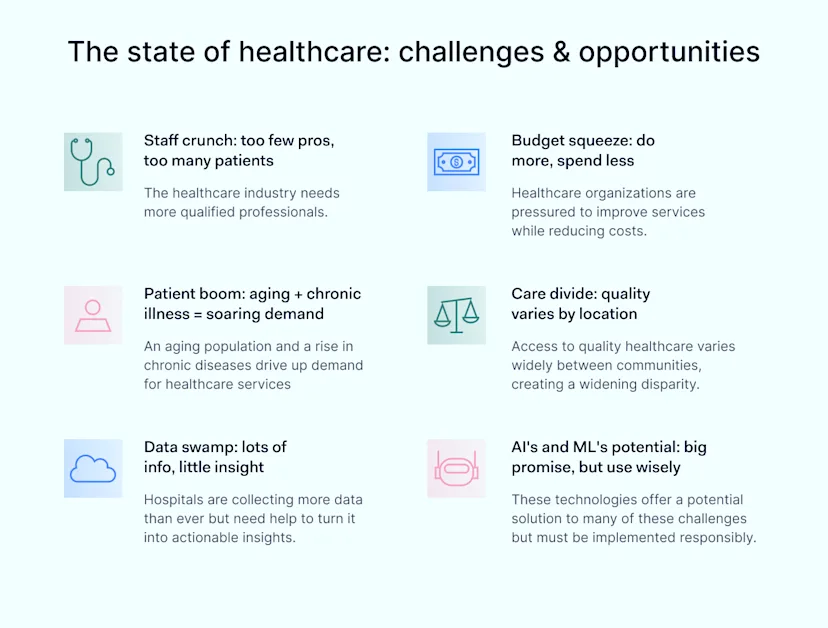
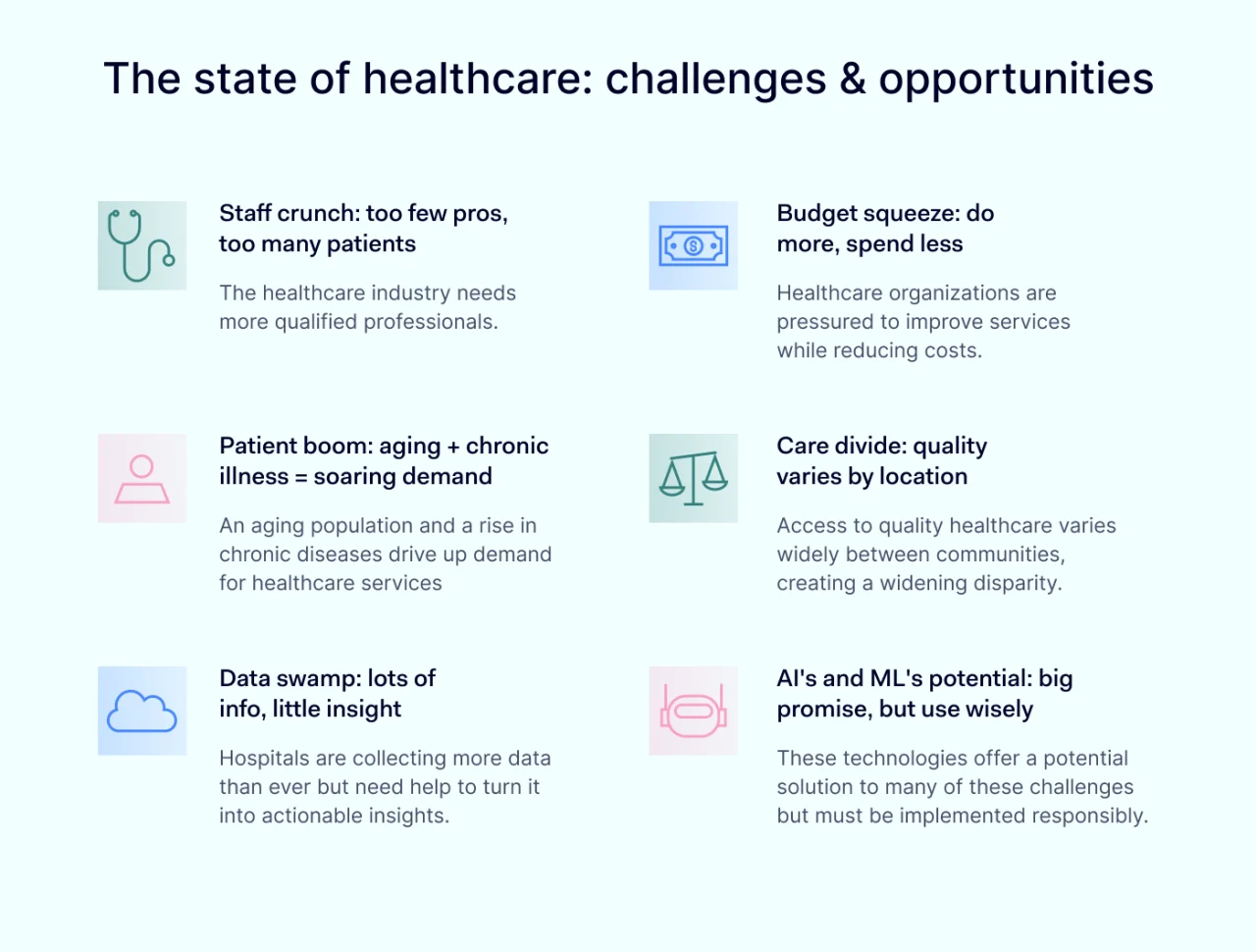
The state of healthcare: challenges and opportunities

AI in healthcare: a prescription for progress

Now, let’s examine AI’s role in healthcare, focusing on its applications and innovative potential. As we explore ethical considerations and potential drawbacks, we’ll gain a comprehensive insight into AI’s impact on the healthcare sector.

The potentials and pitfalls of AI: walking the tightrope

While AI promises to transform healthcare by accelerating diagnoses, managing patient data efficiently, and assisting in complex procedures, it’s essential to acknowledge the complexities of this transformation. For example, despite analyses suggesting that an ideal share should exceed 10%, in the US and Europe, a mere 3% of healthcare spending is allocated for preventive care. This discrepancy emphasizes the need for a cautious approach to integrating AI into healthcare.

The financial magnitude and growth of AI in healthcare underscore its transformative potential. The AI healthcare market, valued at $11 billion in 2021, is projected to skyrocket to $187 billion by 2030. This exponential growth indicates the increasing reliance and investment in AI technologies to innovate and enhance healthcare delivery and management.

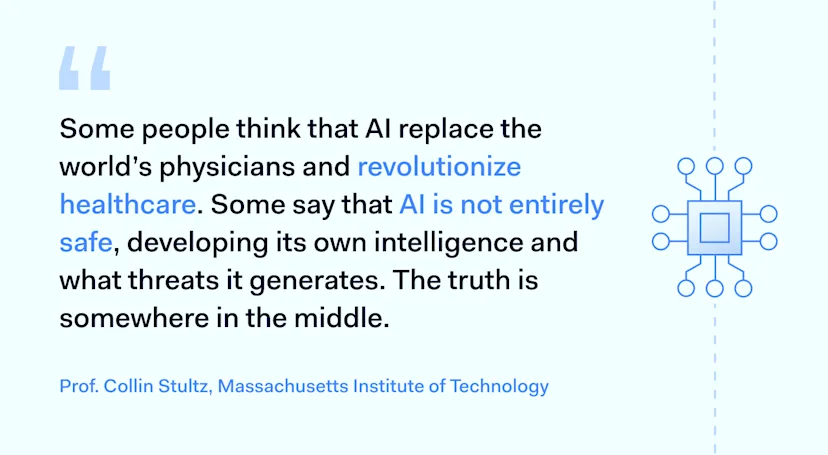
Yet, it’s crucial to navigate this path with caution. Professor Collin Stultz, a cardiologist from the Massachusetts Institute of Technology and an expert in machine learning for cardiovascular care, says that perspectives on AI in healthcare oscillate between viewing it as a panacea for numerous challenges and perceiving it as a potential threat. As is often the case, the truth likely resides somewhere between these extremes.
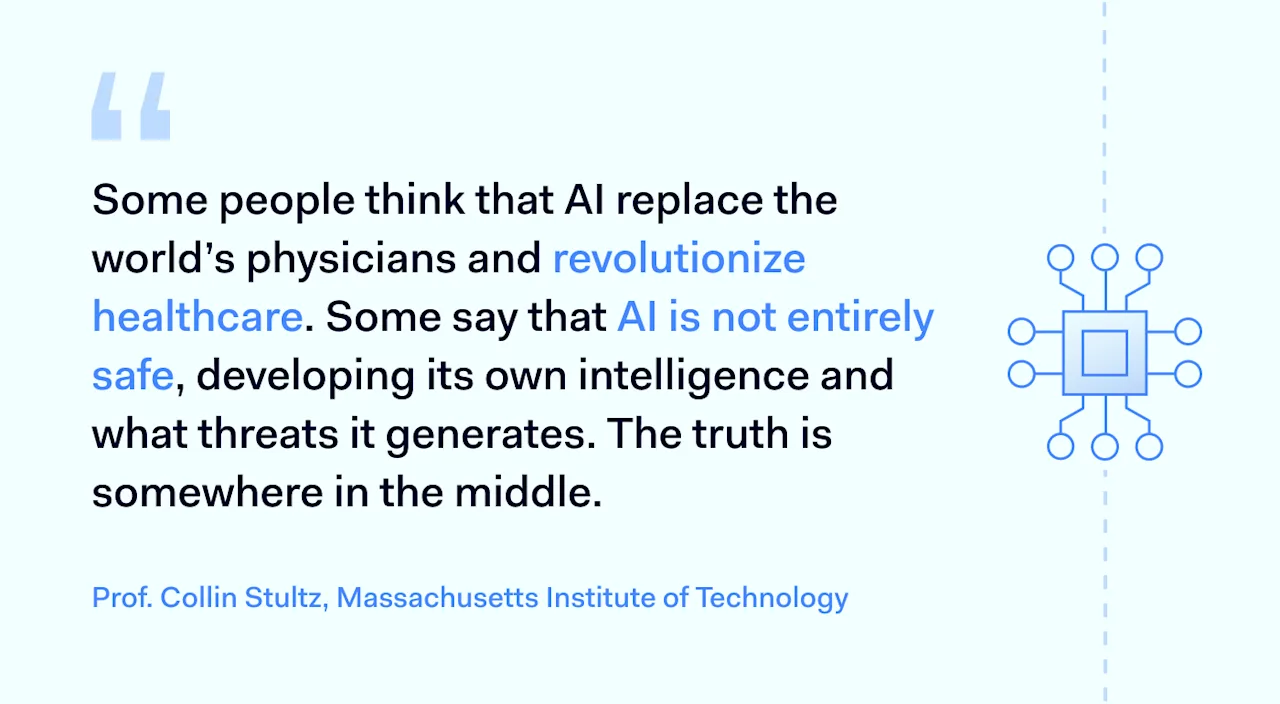
Quote 1400x853

Caution and security: protecting healthcare data

The World Economic Forum’s Breaking Barriers to Health Data program suggests creating a consortium where different organizations can share their health-related data, especially about genes. This way, they hope to fill the gap in available genetic information and also improve research and diagnostic capabilities.

For instance, the Mayo Clinic and Pramana’s collaboration to digitize pathology slides. This showcases the practical data usage in healthcare. With the rise of AI in the industry, it’s crucial to understand its capabilities and limitations, especially in the face of increasing data breaches.

Providing robust security measures for sensitive data is vital to maintaining patient trust and safeguarding information. Implementing AI must be approached cautiously, ensuring patient data and healthcare service integrity are uncompromised.

Addressing staff shortages: AI as a helping hand

The WHO estimates a global shortfall of 10 million healthcare workers by 2030, highlighting a critical need to address workforce gaps. AI can step in to alleviate pressure by handling routine tasks, enabling healthcare professionals to focus on complex patient needs. It’s important to note that AI isn’t here to replace human expertise but rather to enhance the efficiency of the human workforce.

AI’s ability to generate insights is also key in designing and executing efficient and inclusive clinical trials. This application enhances the efficiency of clinical trials and ensures they are robust and representative of many populations. For example, H1, a technology company, has used AI to streamline decision-making and accelerate patient recruitment in clinical trials, ultimately lightening the workload on existing staff.

AI in action: transformative cases in healthcare

Artificial Intelligence notably influences drug discovery and clinical trials in the pharmaceutical industry. Let’s now explore real-world examples that demonstrate its profound impact.

AI in drug discovery: unknown avenues

AI is ushering in a new era in drug discovery, offering new pathways to understand disease mechanisms and formulate targeted treatments. Consider Benevolent AI, a prime example, which applies AI to identify patient subgroups that respond most favorably to specific treatments. This approach enhances treatment precision and reveals new therapeutic possibilities by providing deeper insights into disease processes.

Also, tools based on deep learning uncover novel insights into the underlying disease mechanisms and identify new therapeutic assets. Companies like DeepMind and Benevolent AI are pioneering this innovative approach.

Streamlining clinical trials: faster, smarter, and more inclusive

The journey from drug discovery to patient benefit is usually lengthy, often stretching over 15 years. However, it can be shortened with AI stepping in and optimizing critical processes, such as site selection and participant recruitment, ensuring that life-changing treatments reach patients faster.

H1, a pioneering AI platform, is making waves in the pharmaceutical industry by facilitating quicker decision-making processes. It has successfully reduced site failures and accelerated patient recruitment in clinical trials, shaving off weeks, if not months, from the typical timeline.

Enhancing clinical trial design: a revolution in progress

AI is not only helping streamline clinical trials. It also revolutionizes their very design, ensuring that they both are efficient and representative of diverse populations.

One critical aspect of enhancing clinical trials is tailoring messages and recruitment strategies to attract the right patients. AI is bridging the gap by connecting doctors with clinics capable of recruiting suitable participants. This approach improves the efficiency of clinical trials.

For instance, Johnson & Johnson, the industry giant, uses AI-based data analysis to innovate how medicines are discovered and developed. By improving patient data, AI generates insights that empower clinical research teams to design and execute more targeted and inclusive clinical trials.

The potential of AI in pharmaceuticals

Integrating AI in drug discovery and clinical trials will revolutionize the pharmaceutical industry. This acceleration, combined with optimizing clinical trials, highlights AI’s transformative and innovative power in healthcare. It opens up a new horizon of possibilities and advancements that bring treatments to patients more swiftly than before.

The financial stakes of AI in healthcare are staggering. This market’s growth indicates a substantial investment and reliance on AI technologies to innovate healthcare delivery and management.

AI: optimism versus skepticism

The dialogue surrounding AI in healthcare is multifaceted, with both enthusiasts and skeptics presenting compelling arguments. Advocates highlight AI’s potential to revolutionize healthcare, emphasizing its capacity to enhance efficiency, improve diagnostic accuracy, and pave the way for personalized medicine.
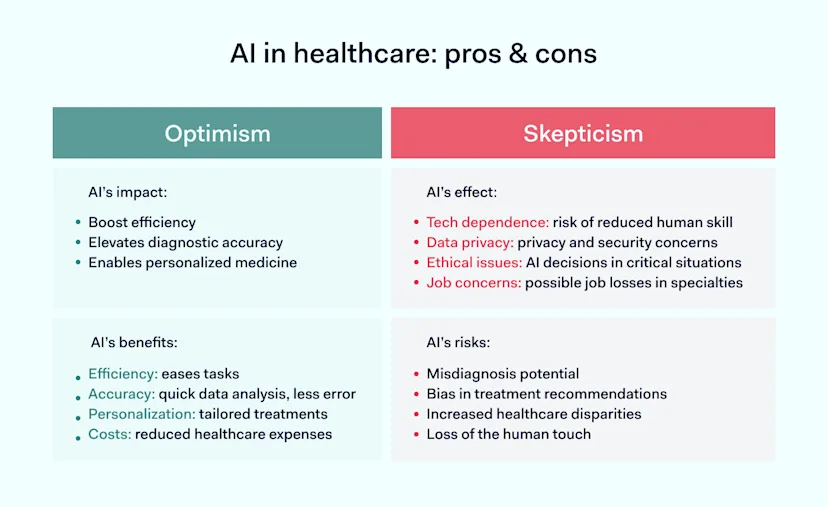
As Prof. Collin Stultz from MIT points out, the reality of AI’s role in healthcare likely lies somewhere between these extremes of optimism and skepticism. Striking a balance becomes essential, harnessing the potential benefits of AI and mitigating associated risks.

AI brings notable advancements in healthcare but also introduces ethical dilemmas, especially concerning data usage and algorithmic biases. The conversation often revolves around maximizing AI’s capabilities while ensuring ethical, transparent, and equitable use.

AI promises to revolutionize healthcare but also presents practical challenges, such as regulatory compliance, system interoperability, and algorithm efficacy validation.

The ongoing debate is between AI’s theoretical potential and the practical challenges of its implementation, calling for a pragmatic approach that acknowledges both its promises and pitfalls.

Also, the discussion about the human element in AI-driven healthcare focuses on augmenting professionals’ capabilities versus the risk of care dehumanization and technology over-reliance.

Potential risks of AI

As the integration of AI into healthcare continues to advance, it brings with it a set of challenges and concerns. From data privacy issues to ethical dilemmas, the healthcare sector must tread carefully to ensure that the adoption of AI enhances patient care without compromising safety or trust.
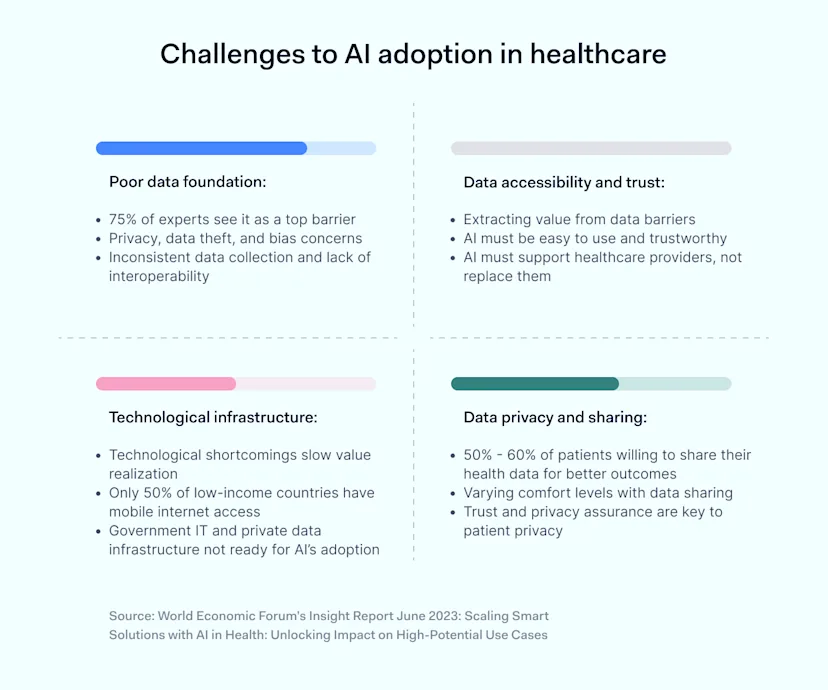
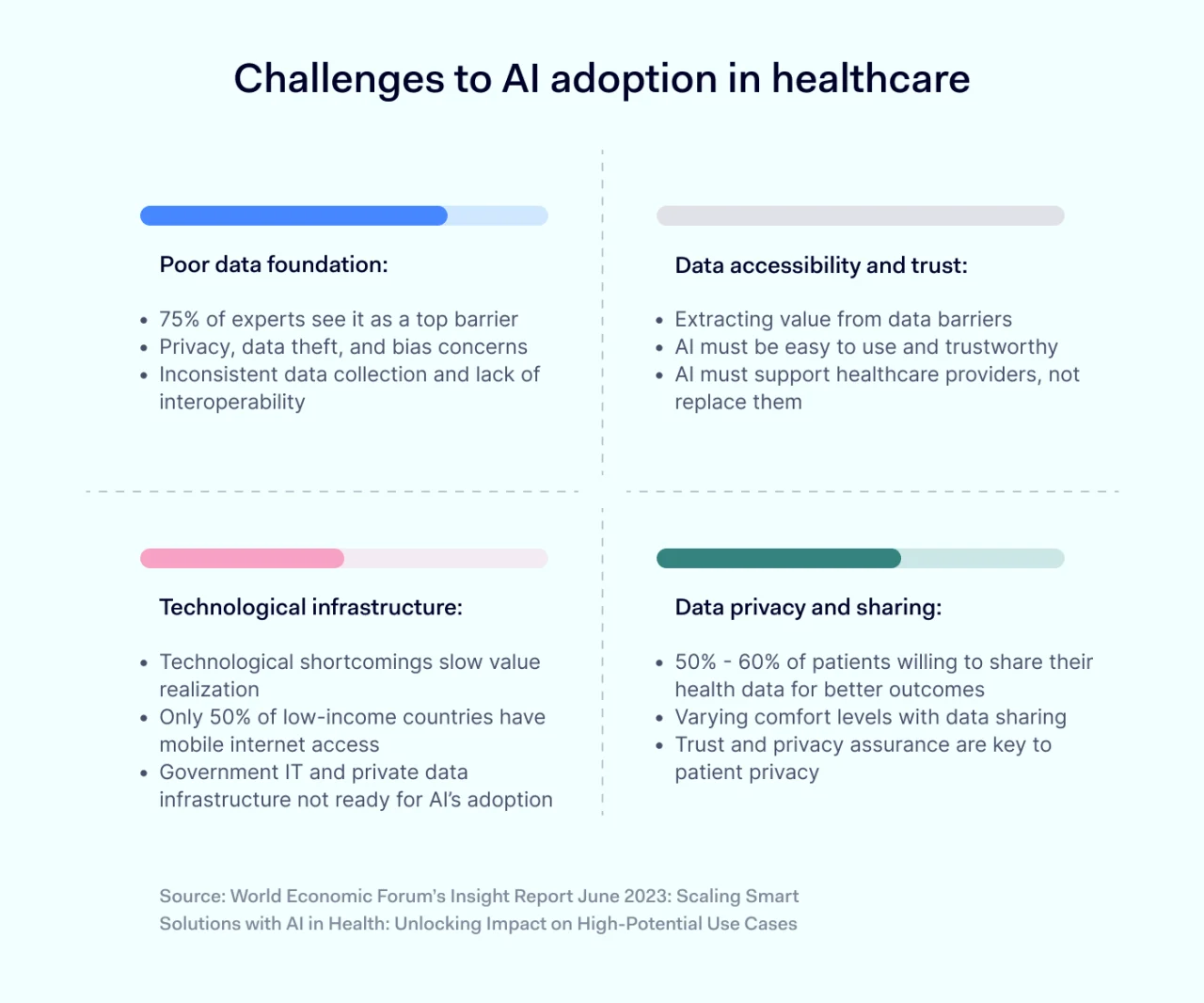
Challenges to AI adoption in healthcare

Data security and breaches

One of the biggest concerns with AI in healthcare is data security. Hospitals and clinics store highly sensitive information, like medical history and personal details.

Data breaches in healthcare are becoming more common, and that’s a big red flag when we’re talking about using AI to manage patient data. So, how can we make sure AI is safe to use?

First, any AI system has to meet strict security standards before it even gets near patient data. This means heavy-duty encryption and multiple layers of security checks. Also, regular audits and monitoring can help catch any unusual activity before it becomes problematic.

While AI has much potential to improve healthcare, it also comes with risks that must be managed carefully. Data security is at the top of that list, which healthcare providers and tech companies must take seriously.

Steps to ensure data safety

Best Practices for Secure AI Integration

Safety is a top priority for integrating AI into healthcare, especially concerning data security. There are still ways to ensure patient data remains secure when using AI systems.

  1. Strict access control: limit who can access the AI system and the patient data it uses. Only authorized personnel should have access, and even then, only to the extent necessary for their role.

  2. Data encryption: all data in transit should be encrypted; this can be achieved with a solution like NordLayer. This makes it much harder for unauthorized users to make sense of the data even if they manage to access it.

  3. Regular security audits: conduct regular security audits to identify any vulnerabilities. This should include both the AI system itself and the broader data infrastructure.

  4. Multi-factor authentication (MFA): MFA requires multiple verification forms before granting sensitive systems or data access. This adds an extra layer of security that can deter unauthorized access.

  5. In-house AI tools: while third-party solutions may not always meet your needs, developing in-house AI tools allows for customized security measures tailored to your organization’s unique requirements.

  6. User training: educate healthcare staff on the importance of data security and the best practices for using AI systems. A well-informed team is a crucial line of defense against potential breaches.

  7. Incident response plan: plan how to respond if a data breach occurs. Quick action can minimize damage and help restore system integrity.

By following these best practices, healthcare providers can take significant steps toward ensuring that the integration of AI into their systems is as secure as possible. While AI presents new challenges in data security, careful planning and stringent measures can mitigate these risks.

Conclusion

Reflecting on the need for AI in healthcare, it’s evident that AI presents promising solutions while the sector grapples with challenges such as staff shortages and intricate data management. Yet, with these advancements come inherent security risks. As we delve deeper into the digital transformation of healthcare, responsible AI implementation paired with stringent security measures becomes paramount. Consider NordLayer to protect your sensitive data for a secure digital future.


About Version 2 Digital

Version 2 Digital is one of the most dynamic IT companies in Asia. The company distributes a wide range of IT products across various areas including cyber security, cloud, data protection, end points, infrastructures, system monitoring, storage, networking, business productivity and communication products.

Through an extensive network of channels, point of sales, resellers, and partnership companies, Version 2 offers quality products and services which are highly acclaimed in the market. Its customers cover a wide spectrum which include Global 1000 enterprises, regional listed companies, different vertical industries, public utilities, Government, a vast number of successful SMEs, and consumers in various Asian cities.

About NordLayer
NordLayer is an adaptive network access security solution for modern businesses – from the world’s most trusted cybersecurity brand, Nord Security.

The web has become a chaotic space where safety and trust have been compromised by cybercrime and data protection issues. Therefore, our team has a global mission to shape a more trusted and peaceful online future for people everywhere.

If You’re Using a Network Security Key for WiFi Authentication. Stop Now.

As cyber threats evolve and proliferate around the globe, the importance of robust network security for enterprises cannot be overstated. As organizations grapple with an increasing number of sophisticated threats, the traditional reliance on a network security key for WiFi authentication is proving to be an Achilles’ heel. This article delves into the inherent vulnerabilities associated with network security keys and advocates for a paradigm shift towards the implementation of 802.1X network access control with digital certificates for WiFi authentication. By understanding the limitations of network security keys, enterprises can fortify their defenses against potential breaches and secure their networks effectively.

The Risk of Using a Network Security Key for WiFi

A network security key for WiFi, commonly known as a WiFi password, has long been the go-to method for securing wireless networks. However, as cyber threats become more advanced, it is crucial to recognize the vulnerabilities associated with this traditional approach.

Static and Easily Guessable Keys

One of the fundamental flaws of network security keys lies in their static nature. Once set, these keys seldom change, providing malicious actors with ample time to launch brute force attacks or employ sophisticated algorithms to crack the code. Weak or easily guessable passwords further compound this issue, making unauthorized access a genuine concern.

Limited Authentication

Network security keys only authenticate the user based on the correctness of the entered password. This limited form of authentication fails to account for the dynamic nature of today’s cyber threats. Without multifactor authentication, organizations expose themselves to the risk of unauthorized access by attackers who have acquired the key.

Lack of Granular Access Control

The traditional network security key for WiFi lacks the granularity required for effective access control. Once an individual possesses the key, they gain unrestricted access to the entire network. This all-or-nothing approach can lead to compromised security and potential data breaches.

The 802.1X Advantage: A Paradigm Shift in Network Security

In response to the vulnerabilities inherent in network security keys, enterprises are increasingly turning to 802.1X network access control as a more robust and secure alternative. This advanced authentication protocol, when coupled with digital certificates, addresses the shortcomings of traditional WiFi security methods.

Dynamic Authentication with EAP-TLS

Unlike static network security keys, 802.1X employs dynamic authentication through the Extensible Authentication Protocol (EAP). Specifically, the EAP-TLS (Transport Layer Security) protocol utilizes digital certificates to establish a secure connection between the client device and the network. This dynamic authentication process mitigates the risk of brute force attacks and enhances overall security.

Multifactor Authentication

802.1X supports multifactor authentication, adding an extra layer of security beyond a mere password. With digital certificates, users must present a unique cryptographic key, reducing the risk of unauthorized access even if the password is compromised. This significantly raises the bar for potential attackers.

Enhanced Access Control

Leveraging 802.1X allows for granular access control, ensuring that users only gain access to the resources they need. Through the use of digital certificates, administrators can define and enforce policies that restrict access based on user roles, device types, or other contextual factors. This fine-tuned control is instrumental in preventing lateral movement by malicious actors within the network.

Automatic Key Rotation

Unlike static network security keys, digital certificates support automatic key rotation. This feature enhances security by regularly changing the cryptographic keys used for authentication. Even if a key is compromised, the window of vulnerability is minimized, as the attacker must contend with a constantly evolving authentication mechanism.

Implementation Challenges and Best Practices

While the advantages of 802.1X with digital certificates are clear, it’s essential to acknowledge the challenges associated with its implementation:

  • Complexity of Deployment: Implementing 802.1X can be more complex than configuring network security keys. Organizations must invest time and resources to ensure a seamless transition. However, the long-term security benefits far outweigh the initial deployment challenges.
  • User Education: Users may find the new authentication process unfamiliar, leading to potential resistance. Comprehensive education and training programs are vital to ensure a smooth transition and to empower users with the knowledge required to navigate the updated security protocols.
  • Certificate Lifecycle Management: Proper management of digital certificates is crucial for the success of 802.1X implementation. This includes handling certificate issuance, renewal, and revocation efficiently. Automated certificate lifecycle management tools can simplify this process and reduce the burden on IT administrators.

Conclusion

As the cyber threat landscape continues to evolve, the reliance on traditional network security keys for WiFi authentication poses significant risks to enterprise security. The vulnerabilities associated with static keys can lead to unauthorized access, data breaches, and compromised network integrity. In contrast, embracing 802.1X network access control with digital certificates represents a forward-looking approach to security.

By adopting dynamic authentication, multifactor authentication, and enhanced access control, organizations can strengthen their defenses against sophisticated cyber threats. While the implementation of 802.1X may pose initial challenges, the long-term benefits in terms of security far outweigh the investment.

In conclusion, the time has come for network security teams to reassess their WiFi authentication strategies and embrace the robust security afforded by 802.1X with digital certificates. This paradigm shift will not only secure enterprises against current threats but also position them to face the challenges of the ever-evolving cybersecurity landscape.

About Version 2 Digital

Version 2 Digital is one of the most dynamic IT companies in Asia. The company distributes a wide range of IT products across various areas including cyber security, cloud, data protection, end points, infrastructures, system monitoring, storage, networking, business productivity and communication products.

Through an extensive network of channels, point of sales, resellers, and partnership companies, Version 2 offers quality products and services which are highly acclaimed in the market. Its customers cover a wide spectrum which include Global 1000 enterprises, regional listed companies, different vertical industries, public utilities, Government, a vast number of successful SMEs, and consumers in various Asian cities.

About Portnox
Portnox provides simple-to-deploy, operate and maintain network access control, security and visibility solutions. Portnox software can be deployed on-premises, as a cloud-delivered service, or in hybrid mode. It is agentless and vendor-agnostic, allowing organizations to maximize their existing network and cybersecurity investments. Hundreds of enterprises around the world rely on Portnox for network visibility, cybersecurity policy enforcement and regulatory compliance. The company has been recognized for its innovations by Info Security Products Guide, Cyber Security Excellence Awards, IoT Innovator Awards, Computing Security Awards, Best of Interop ITX and Cyber Defense Magazine. Portnox has offices in the U.S., Europe and Asia. For information visit http://www.portnox.com, and follow us on Twitter and LinkedIn.。

Passwordless Authentication For WiFi Security

As digital transformation accelerates, so do cyber threats. Across industries, business leaders are observing increasing cybersecurity risks, and it has become paramount for companies to adapt and evolve. The traditional use of passwords for WiFi security, once seen as robust, are now inviting a new breed of sophisticated threats. As modern networks expand in the wake of hybrid and remote work policies, enterprises face an array of security challenges. Leveraging passwordless authentication for WiFi security gives enterprises a secure alternative to address these security challenges.

The Cumbersome Nature of Passwords

While passwords have long served as the gateway to network access, they present various challenges which include:

  • Forgetfulness: Users frequently forget passwords, leading to operational delays and potential security breaches.
  • Password Reuse: The common habit of using identical passwords across platforms can spell disaster, especially if one platform is compromised.
  • Phishing Woes: Remote work has been coupled with a surge in phishing attacks, targeting unsuspected employees and leading to severe breaches.

Passwordless Authentication for the Modern Age

In the face of such challenges, passwordless solutions shine as the next logical step:

  • Strengthened Barriers: By eradicating passwords, a primary vulnerability is neutralized, helping to thwart unauthorized access & phishing attempts.
  • Reduced IT Costs: With the absence of password-related queries such as password resets, the volume of support requests diminishes.
  • Swift, Secure Connectivity: Without the hassles of password complications, users experience quicker, unobstructed access – helping to offer a smoother user experience.

The Mechanisms of Passwordless Authentication

Passwordless authentication methods can involve various techniques:

  • Biometrics: Unique biological features, such as fingerprints, facial patterns, or voice imprints have become one of the most common.
  • Certificate-Based Authentication: Beyond just validating the user, certificate-based authentication also ensures the accessed network’s authenticity, ensuring a two-fold security check.
  • Biometrics: Unique biological features, such as fingerprints, facial patterns, or voice imprints have become highly popular methods for passwordless access.
  • Physical Tokens: These tangible devices, when paired with a network, ensure swift and secure access, combining convenience with security.

These methods, individually or in combination, provide robust security without compromising on user convenience.

What Passwordless Brings to the Table

For organizations, the long-term benefits of transitioning to passwordless are noteworthy:

  • Leaner IT Operations: With the bulk of password-related issues eliminated, IT departments can focus on more pressing tasks, leading to cost and time efficiencies.
  • Increased Work Efficiency: Seamless access, especially crucial in remote or hybrid settings, allows undisturbed workflows.
  • Risk Reduction: These tangible devices, when paired with a network, ensure swift and secure access, combining convenience with security.

Passwordless Authentication For WiFi Security

In a world rapidly adopting remote work and BYOD policies, a strategic shift in security measures is imperative. Adopting passwordless authentication strategies presents a compelling case for organizations, ensuring robust defense mechanisms while fostering a culture of efficiency and user-centricity. As we look ahead, these strategies could very well define the gold standard in organizational security.

About Version 2 Digital

Version 2 Digital is one of the most dynamic IT companies in Asia. The company distributes a wide range of IT products across various areas including cyber security, cloud, data protection, end points, infrastructures, system monitoring, storage, networking, business productivity and communication products.

Through an extensive network of channels, point of sales, resellers, and partnership companies, Version 2 offers quality products and services which are highly acclaimed in the market. Its customers cover a wide spectrum which include Global 1000 enterprises, regional listed companies, different vertical industries, public utilities, Government, a vast number of successful SMEs, and consumers in various Asian cities.

About Portnox
Portnox provides simple-to-deploy, operate and maintain network access control, security and visibility solutions. Portnox software can be deployed on-premises, as a cloud-delivered service, or in hybrid mode. It is agentless and vendor-agnostic, allowing organizations to maximize their existing network and cybersecurity investments. Hundreds of enterprises around the world rely on Portnox for network visibility, cybersecurity policy enforcement and regulatory compliance. The company has been recognized for its innovations by Info Security Products Guide, Cyber Security Excellence Awards, IoT Innovator Awards, Computing Security Awards, Best of Interop ITX and Cyber Defense Magazine. Portnox has offices in the U.S., Europe and Asia. For information visit http://www.portnox.com, and follow us on Twitter and LinkedIn.。

Cyberview #3: Genetic data leak, cyberattack hits Clorox, and wearable AI

Welcome back to another episode of Cyberview! Learn about developments in the world of tech and cybersecurity with Gerald Kasulis, Frida Kreitzer, and Carlos Salas.

In this episode, the Cyberview team takes a look at some worrying data leaks at genetics testing giant 23andMe and a major cyberattack at Clorox that looks a lot like the ransomware-fueled casino shutdowns covered in. We’re also looking at the privacy implications of wearable AI, now majorly in the focus of industry heavy-hitters like Meta, OpenAI, and RayBan.

Genetic data leak, 23andMe point to credential stuffing

Hackers are selling genetic data stolen from users of the company 23andMe. The company itself says they weren’t breached, although their users’ data was used by what seems to be a single threat actor stealing personal details and genetic data. This data was then published or advertised online. 23andMe suggested that the threat actor(s) gained unauthorized access with “recycled login credentials”, a technique known as credential stuffing.

The logic is simple: Keep trying stolen username/password combinations, and eventually, they’ll work on another site. An easy solution to credential stuffing attacks? You guessed it: Multi-factor authentication (MFA). While 23andMe has offered an MFA feature since 2019, it was not made mandatory for users. With genetic and personal data at stake and up to 7 million users affected by these recent breaches, it might be time for a change in policy.

The Bleach Breach: Clorox revenue and supply chain hit

Clorox, the household cleaning giant, predicts a more than 20% drop in quarterly sales due to a cyberattack (thought to be ransomware) that caused product shortages and operational disruptions. Manufacturing, often kept running by legacy systems and sprawling workforces, suffers more cyberattacks than any other industry.

The Clorox incident is being linked to the same group responsible for the MGM and Caesars Palace hacks, discussed in our previous episode, which occurred around the same time in August 2023. “Scattered Spider” is notorious for using social engineering methods to gain access to internal systems. The Clorox Company’s share price has dropped by over 7 percent in the last month.

Wearable AI: Trendy or just trending?

Tech companies are rushing to secure the lead in wearable AI products. Meta has collaborated with Ray-Ban on a pair of high-tech glasses, enabling wearers to live stream directly from the glasses to Facebook or Instagram and voice activate Meta AI, “an advanced conversational assistant”. Jony Ive, Apple’s legendary former design lead, and OpenAI are reportedly teaming up to design the “iPhone of AI”.

Rewind.ai unveiled a neck-worn pendant that records conversations to your smartphone and creates a searchable database of life moments. Humane, imagining “a world where you can take AI everywhere”, have developed a smart device that resembles a badge or lapel pin.

The common goal here seems to be for technology to rely less on screens, to fade from view, and become all but invisible.

Stay tuned for the next episode of Cyberview.

About Version 2 Digital

Version 2 Digital is one of the most dynamic IT companies in Asia. The company distributes a wide range of IT products across various areas including cyber security, cloud, data protection, end points, infrastructures, system monitoring, storage, networking, business productivity and communication products.

Through an extensive network of channels, point of sales, resellers, and partnership companies, Version 2 offers quality products and services which are highly acclaimed in the market. Its customers cover a wide spectrum which include Global 1000 enterprises, regional listed companies, different vertical industries, public utilities, Government, a vast number of successful SMEs, and consumers in various Asian cities.

About NordLayer
NordLayer is an adaptive network access security solution for modern businesses – from the world’s most trusted cybersecurity brand, Nord Security.

The web has become a chaotic space where safety and trust have been compromised by cybercrime and data protection issues. Therefore, our team has a global mission to shape a more trusted and peaceful online future for people everywhere.

Keepit at Gartner IOCS 2023 in London: How AI capabilities take SaaS data protection to the next level

Keepit speaks in two sessions: With Porsche Informatik on how Europe’s largest car distributor works to ensure cyber resilience today; and a showcase on how to prepare for future data protection

COPENHAGEN, DENMARK, Nov. 16, 2023 – Keepit, the market leader in cloud data protection and management, announced today that it will be presenting and exhibiting at the Gartner IT Infrastructure, Operations & Cloud Strategies in London, UK, from November 20th to 21st.

On Monday, November 20th, Keepit’s Chief Technology Officer (CTO) Jakob Østergaard will co-present with Josef Perlinger, Lead Program Manager Resilience, Security & Cloud at Porsche Informatik GmbH, in the session: “Keepit: Real-World M365 Cyber Resilience – Insights from Porsche Informatik.” The two talk about how Porsche Holding Salzburg, Europe’s largest car dealership, deals with the increase in cybersecurity threats by strengthening the organization’s cyber resilience with Keepit’s independent backup and recovery for Microsoft 365.

Key takeaways from the session will include:

• How cloud backup is crucial to fortifying Microsoft 365 against cyber threats

• Why an independent cloud is pivotal in achieving operational resilience

• Case studies from Porsche Informatik highlighting challenges and solutions in implementing cloud backup

Session 2: Cyber resilience, AI and data protection

On Tuesday, November 21st, Keepit’s CTO Jakob Østergaard is on stage again – this time, with Keepit VP of Product Henrik Brusgaard, for an Exhibit Showcase session entitled: “Keepit: Accelerating Cyber Resilience with AI-Driven Data Protection Platforms.” In the session, they reflect on the challenges of applying AI to data protection and shed light on how Keepit works to assess and select which AI capabilities to adopt, in order to match future, next-level data protection needs while adhering to existing and coming regulatory controls.

“Harnessing the power of technological advancement while securing user activity and user data is a key charge for all SaaS platform providers, and we really look forward to discussing these questions with the audience in London. All businesses are becoming SaaS-powered. We’re seeing a continuous transition with companies typically using hundreds of SaaS apps – and IT’s biggest concern is how to secure those SaaS apps.” says Keepit CTO Jakob Østergaard.

Gartner IT Infrastructure, Operations & Cloud Strategies Conference 2023 in London brings the world’s technology leaders together to hear top trends, find objective answers and explore topic coverage in addition to best practices.

How’s the NIS2 readiness coming along?

One topic that will be central to the conversations for the Keepit team at IOCS is the upcoming Network and Information Security (NIS2) Directive being implemented across the EU from October 2024:

“NIS2 will be taking the urgency of adhering to regulatory standards on data and infrastructure protection to the next level: It effectively enables regulators to hold company executives personally liable if the company fails to comply with the regulation. As backup and disaster recovery capabilities are identified as critical for compliance with NIS2, I look forward to a lot of interesting discussions on how organizations are preparing themselves,” says Jakob Østergaard.

At the event, the Keepit team will also be sharing the latest insights on how to mitigate the impact of ransomware attacks by ensuring fast and complete recovery for enterprises. Research shows that a strong backup and recovery strategy can mean the difference between organizations being able to ignore extortionists and having to succumb to paying ransom again and again.

WHAT: Solution Provider Session, “Keepit: Real-World M365 Cyber Resilience – Insights from Porsche Informatik”

WHO: Jakob Østergaard, Keepit CTO, and Josef Perlinger, Lead Program Manager Resilience, Security & Cloud at Porsche Informatik GmbH

WHERE: Arcadia, Level 2, InterContinental London, The O2

WHEN: Monday, Nov 20, 1:15 – 2:15 pm.

WHAT: Theater Session, “Keepit: Accelerating Cyber Resilience with AI-Driven Data Protection Platforms.”

WHO: Jakob Østergaard, Keepit CTO, and Henrik Brusgaard, Keepit VP of Product

WHERE: Theater 1, Exhibit Showcase, Level 1, InterContinental London, The O2

WHEN: Tuesday, Nov 21, 10:00 – 10:20 am.

Keepit will be exhibiting for the duration of the conference at booth #301.

To arrange a product demonstration or meeting with a member of the Keepit team at the conference, book a meeting here.

About Version 2 Digital

Version 2 Digital is one of the most dynamic IT companies in Asia. The company distributes a wide range of IT products across various areas including cyber security, cloud, data protection, end points, infrastructures, system monitoring, storage, networking, business productivity and communication products.

Through an extensive network of channels, point of sales, resellers, and partnership companies, Version 2 offers quality products and services which are highly acclaimed in the market. Its customers cover a wide spectrum which include Global 1000 enterprises, regional listed companies, different vertical industries, public utilities, Government, a vast number of successful SMEs, and consumers in various Asian cities.

About Keepit
At Keepit, we believe in a digital future where all software is delivered as a service. Keepit’s mission is to protect data in the cloud Keepit is a software company specializing in Cloud-to-Cloud data backup and recovery. Deriving from +20 year experience in building best-in-class data protection and hosting services, Keepit is pioneering the way to secure and protect cloud data at scale.

×

Hello!

Click one of our contacts below to chat on WhatsApp

×