Skip to content

Understanding SaaS compliance: key standards and best practices

Software as a Service (SaaS) has become the backbone of many businesses, offering scalable and cost-effective solutions for various industries. However, with the convenience of SaaS comes the critical responsibility of ensuring SaaS compliance with industry standards and data protection laws. 

For those new to SaaS, understanding SaaS compliance can be daunting, but it is crucial for protecting sensitive data, building customer trust, and avoiding legal pitfalls. This guide will walk you through the basics of SaaS compliance, covering key standards, common challenges, and best practices to help you keep your business on the right track.

What is SaaS compliance?

SaaS compliance means that software-as-a-service providers have to follow various regulatory requirements, laws, and industry-specific standards. These standards are designed to protect sensitive data, ensure financial transparency, and maintain security protocols across cloud-based services. For SaaS providers, compliance is not just a legal obligation but is also about demonstrating their commitment to safeguarding customer data and upholding industry benchmarks.

For instance, consider a company that offers cloud-based solutions for managing healthcare records. To operate legally and securely, the company must comply with the Health Insurance Portability and Accountability Act (HIPAA), which sets strict standards for protecting sensitive patient information. Without HIPAA compliance, the company could face fines, lose customers, and suffer reputational damage.

Why is SaaS compliance important?

Understanding why SaaS compliance is important is crucial for any business operating in the SaaS space. Compliance serves two primary purposes: protecting data security and maintaining customer trust.

Data security

With data breaches becoming an everyday threat, robust SaaS compliance practices help SaaS providers safeguard their customers’ data against security risks. Compliance frameworks like the General Data Protection Regulation (GDPR) and the California Consumer Privacy Act (CCPA) impose stringent requirements on how companies collect, store, and process personal data. Failure to comply can lead to severe penalties and legal consequences.

For example, in 2023, Meta was fined $1.3 billion for GDPR violations. The company failed to ensure adequate protections for user data during transfers between the EU and the U.S. This shows how important it is to prioritize data security and compliance to avoid substantial legal penalties.

Customer trust

Compliance also plays a crucial role in building and maintaining customer trust. When customers know that a SaaS provider follows compliance frameworks like PCI DSS (Payment Card Industry Data Security Standard) or SOC 2 (Service Organization Control 2), they feel more confident that their data is secure. This trust is essential for long-term business relationships and customer retention.

Risks of non-compliance

The risks of non-compliance are significant. They include legal penalties, financial loss, reputational damage, and operational disruptions. Companies that fail to meet compliance standards may also find it challenging to attract and retain customers as trust in their services diminishes. In extreme cases, non-compliance can lead to business shutdowns, especially if the violations are severe.

Key compliance standards for SaaS providers

To effectively manage compliance, SaaS providers must understand the types of SaaS compliance relevant to their industry. These compliance standards vary depending on the nature of the service, the type of data handled, and the geographical location of the customers. Here’s an overview of some major compliance frameworks.

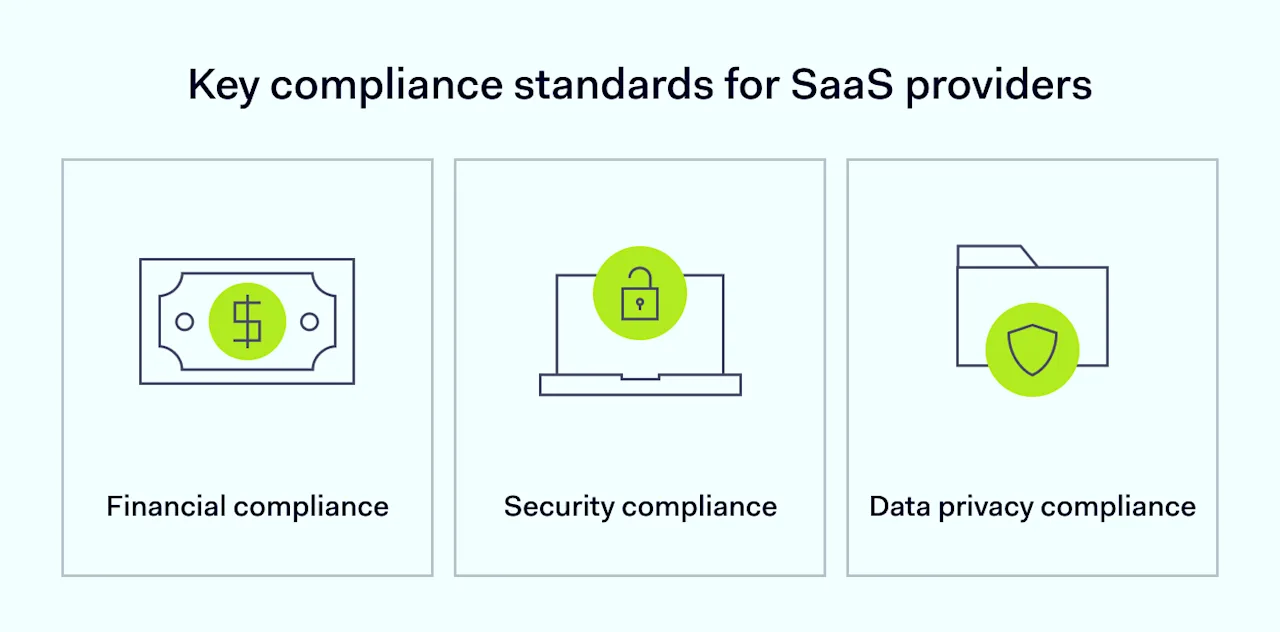
Key compliance standards for SaaS providers

Financial compliance

Payment Card Industry Data Security Standard (PCI DSS)

PCI DSS is essential for any SaaS provider that handles payment card transactions. This standard outlines security measures to protect cardholder data, including data encryption, secure storage, and regular monitoring. Implementing solutions to become PCI compliant is crucial for preventing data breaches and maintaining customer trust.

Accounting Standards Codification (ASC 606)

ASC 606 provides guidelines for revenue recognition, ensuring that companies report their financial performance accurately. SaaS providers must comply with ASC 606 to demonstrate financial transparency and avoid legal issues related to revenue reporting.

Sarbanes-Oxley Act (SOX)

SOX compliance is mandatory for publicly traded companies, including SaaS providers. It focuses on corporate governance and financial reporting, requiring companies to implement internal controls and report on their effectiveness. Non-compliance with SOX can lead to severe penalties, including fines and imprisonment for executives.

Security compliance

Service Organization Control 2 (SOC 2)

SOC 2 compliance is a critical standard for SaaS providers that handle customer data. It ensures the company’s information security management systems meet industry standards. SOC 2 audits evaluate controls related to security, availability, processing integrity, confidentiality, and privacy. Achieving SOC 2 compliance is essential for demonstrating that your SaaS solutions are secure and reliable.

ISO/IEC 27001

ISO/IEC 27001 is an international standard for information security management systems. It provides a framework for managing and protecting sensitive information through a systematic approach. Implementing an ISO 27001 compliance solution can help SaaS providers safeguard their data, meet customer expectations, and improve overall security.

Center for Internet Security (CIS) Controls

The CIS Controls are a set of best practices for cybersecurity. They provide a prioritized set of actions to protect organizations from cyber threats. SaaS providers can use these controls to strengthen their security posture and reduce security risks, including breaches.

National Institute of Standards and Technology Cybersecurity Framework (NIST CSF)

The NIST CSF is a voluntary framework that provides guidelines for managing and reducing cybersecurity risks. SaaS providers can adopt it to enhance their security practices and ensure they are aligned with industry standards.

Data privacy compliance

General Data Protection Regulation (GDPR)

GDPR is a European Union regulation that governs how companies handle personal data. It applies to any SaaS provider that processes data belonging to EU citizens, no matter where the company is based. Compliance with GDPR is essential for avoiding hefty fines and protecting customer privacy. Companies can explore GDPR compliance services for tailored support.

HIPAA (Health Insurance Portability and Accountability Act)

HIPAA sets the standard for protecting sensitive patient information in the healthcare industry. SaaS providers that handle health-related data must comply with HIPAA to avoid penalties and ensure that patient information is kept confidential. Implementing HIPAA compliance solutions is vital for any SaaS provider operating in the healthcare sector.

CCPA (California Consumer Privacy Act)

The CCPA is a state law that grants California residents rights over their personal data. It requires businesses to disclose what information they collect, allow consumers to opt out of data sharing, and delete personal data upon request. SaaS providers must comply with CCPA to avoid legal penalties and maintain customer trust.

Data security and privacy regulations

Data security and privacy are at the heart of SaaS compliance. Data protection laws like GDPR, HIPAA, and CCPA are designed to protect individuals’ data from misuse and unauthorized access. These regulations require SaaS providers to implement strict security measures, such as data encryption, access controls, and regular monitoring, to ensure that data is protected at all times.

For example, a SaaS provider offering cloud storage services must ensure that data is encrypted at rest and in transit. This means that even if a malicious actor gains access to the data, they would not be able to read it without the decryption key.

Complying with data security and privacy regulations can help SaaS providers protect their customers’ information and avoid legal consequences.

Challenges in achieving SaaS compliance

Achieving SaaS compliance can be challenging for SaaS providers, especially those just starting. Here are some common challenges and potential solutions:

Complexity of regulations

SaaS compliance requirements can be complex and vary by industry and region. For example, a global SaaS provider may need to comply with multiple regulations, such as GDPR, CCPA, and HIPAA, each with unique requirements. To manage this complexity, SaaS providers can use SaaS compliance management tools that automate tracking and implementing regulatory requirements.

Resource constraints

Small and medium-sized SaaS companies often lack the resources for compliance efforts. Hiring compliance experts or outsourcing SaaS compliance can be expensive. However, non-compliance can be even more costly in the long run. To handle this, SaaS providers can focus on implementing the most critical compliance measures first and gradually expand their compliance efforts as their business grows.

Keeping up with changes

Compliance standards and data protection laws are constantly evolving, and SaaS providers must stay up-to-date with the latest changes to remain compliant. This requires continuous monitoring of regulatory updates and adjusting compliance practices as needed. An effective compliance strategy includes subscribing to industry newsletters, attending webinars, and participating in compliance forums to stay informed.

Benefits of SaaS compliance

While achieving SaaS compliance can be challenging, the benefits far outweigh the effort. Here are some key benefits:

Improved security

SaaS compliance ensures that providers implement robust security controls to protect customer data. This reduces the risk of data breaches and cyber-attacks, safeguarding both the company and its customers.

Enhanced customer trust

SaaS security compliance demonstrates to customers that their data is in safe hands, building trust and loyalty and leading to long-term customer relationships.

Competitive advantage

Compliant SaaS companies can differentiate themselves from competitors who may not offer the same level of security and privacy protection. This can be a significant selling point in a crowded market.

Best practices for maintaining SaaS compliance

Maintaining SaaS compliance is an ongoing process that requires constant attention. Here are some best practices to help:

Regular audits

Conduct internal and external audits regularly as part of your compliance strategy. Audits help assess your compliance status and identify any gaps in your security practices. They can also help you stay on top of compliance requirements and ensure that your SaaS solutions remain secure.

Employee training

Regularly train employees on SaaS compliance requirements and their role in maintaining it. An informed team is better equipped to follow measures and avoid potential compliance risks.

Usage of compliance management tools

Leverage compliance management tools to automate tracking and implementing regulatory requirements. These tools help reduce human error and ensure all compliance obligations are met. Additionally, use only SaaS-compliant tools for daily operations to create a secure environment and minimize risks. The more secure your operational tools, the stronger your overall compliance posture.

Document compliance efforts

Keep detailed records of your compliance activities, including policies, procedures, and audit results. This documentation is crucial during an audit or regulatory inquiry.

SaaS compliance checklist

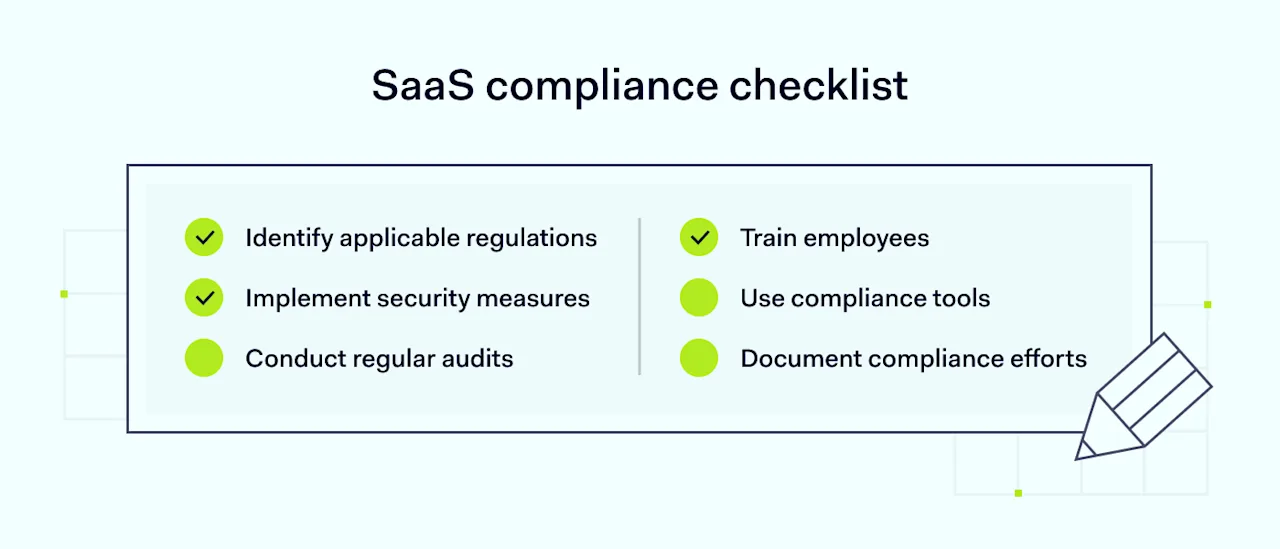
To help you get started, here’s the SaaS compliance checklist of key steps.

SaaS compliance checklist

  • Identify applicable regulations: Determine which compliance standards (like GDPR, HIPAA, or PCI DSS) apply to your SaaS business

  • Implement security measures: Ensure your platform meets all security requirements, such as encryption and access controls

  • Conduct regular audits: Schedule regular audits to assess your compliance and identify areas for improvement

  • Train employees: Provide ongoing training to ensure employees understand their compliance responsibilities

  • Use compliance tools: Implement tools to automate and streamline your compliance tasks

  • Document compliance efforts: Keep detailed records of your compliance activities, including financial compliance measures and the implementation of security controls.

How can NordLayer help companies stay compliant?

NordLayer itself meets multiple compliance standards for securing applications and services, including GDPR, HIPAA, ISO 27001, and PCI DSS. Compliance often requires specific network security measures, such as traffic encryption, advanced network access control, and multi-factor authentication.

NordLayer addresses these needs by providing robust security features designed to meet these requirements. By integrating NordLayer, you can enhance the security of your SaaS solutions, ensuring they align with compliance standards and protect sensitive data effectively.

Conclusion

SaaS compliance is a critical aspect of running a successful software-as-a-service business. By understanding and adhering to key compliance standards, SaaS providers can protect their customers’ data, build trust, and avoid legal pitfalls. While achieving compliance can be challenging, the benefits—including improved security, customer loyalty, and competitive advantage—make it well worth the effort.

By following best practices and leveraging tools like NordLayer, you can navigate the complex world of SaaS compliance with confidence and ensure your business’s long-term success.

About Version 2 Digital

Version 2 Digital is one of the most dynamic IT companies in Asia. The company distributes a wide range of IT products across various areas including cyber security, cloud, data protection, end points, infrastructures, system monitoring, storage, networking, business productivity and communication products.

Through an extensive network of channels, point of sales, resellers, and partnership companies, Version 2 offers quality products and services which are highly acclaimed in the market. Its customers cover a wide spectrum which include Global 1000 enterprises, regional listed companies, different vertical industries, public utilities, Government, a vast number of successful SMEs, and consumers in various Asian cities.

About NordLayer
NordLayer is an adaptive network access security solution for modern businesses – from the world’s most trusted cybersecurity brand, Nord Security.

The web has become a chaotic space where safety and trust have been compromised by cybercrime and data protection issues. Therefore, our team has a global mission to shape a more trusted and peaceful online future for people everywhere.

About NordLayer
NordLayer is an adaptive network access security solution for modern businesses – from the world’s most trusted cybersecurity brand, Nord Security.

The web has become a chaotic space where safety and trust have been compromised by cybercrime and data protection issues. Therefore, our team has a global mission to shape a more trusted and peaceful online future for people everywhere.

The Surge in Phishing Attacks: A Rising Threat for Enterprises

A surge in phishing attacks in recent years, presenting a formidable challenge for enterprise organizations. With cybercriminals continuously refining their tactics, businesses find themselves grappling with the pressing need to fortify their defenses against this evolving threat. The implications of successful phishing attacks can be devastating, resulting in data breaches, financial losses, and reputational damage. To navigate this increasingly treacherous landscape, organizations must adopt a proactive stance that not only prioritizes immediate response mechanisms but also implements long-term strategies to mitigate the risks associated with phishing.

Understanding the Evolving Nature of Phishing Attacks

Phishing attacks have evolved significantly, transforming from rudimentary email scams into complex operations leveraging social engineering. Today’s cybercriminals employ advanced techniques such as spear-phishing and whaling to target specific individuals or high-level executives within organizations. These attacks are meticulously crafted using personal information often sourced from social media or other online platforms, increasing their likelihood of success.

The rise of remote work has further complicated the landscape. Employees working from home are often more vulnerable to phishing attempts due to less secure environments and a potential lack of vigilance. This shift has necessitated a re-evaluation of cybersecurity protocols, focusing on ensuring that remote workers are equipped to recognize and respond to threats effectively.

Phishing tactics are also becoming more sophisticated through the use of advanced technologies. Cybercriminals now deploy machine learning algorithms to create convincing fake emails and websites, making it more challenging for traditional security measures to detect and block these threats. In phishing attacks, threat actors often use well-known brands’ names to gain a victim’s trust faster. Additionally, attackers are increasingly targeting cloud services and collaboration tools, exploiting their widespread use within enterprise environments.

The growing use of mobile devices for business operations has introduced another vector for phishing attacks. Cybercriminals exploit vulnerabilities in mobile applications and messaging platforms, aiming to deceive users into divulging sensitive information or installing malicious software. This trend underscores the need for comprehensive security strategies that encompass all devices used within an organization.

To stay ahead of these evolving threats, it is crucial for organizations to stay informed about the latest phishing techniques and trends. This includes understanding how attackers gather intelligence on their targets, the types of lures they use, and the channels they exploit. By keeping abreast of these developments, organizations can better tailor their defenses to address the specific tactics employed by cybercriminals.

Overall, understanding the dynamic nature of phishing attacks is essential for developing effective countermeasures. Organizations must continuously adapt their strategies to anticipate and mitigate the risks posed by increasingly sophisticated phishing campaigns.

Identifying Vulnerable Points in Enterprise Systems

Identifying vulnerable points within enterprise systems is essential to effectively combat phishing attacks. Cybercriminals often target common entry points such as email accounts, cloud storage services, and collaboration tools. These platforms typically house sensitive information and can be exploited through tactics like impersonating legitimate services or leveraging compromised accounts.

A thorough risk assessment can shed light on areas of vulnerability within an organization. By analyzing user behavior and access patterns, it’s possible to pinpoint weaknesses that attackers might exploit. For instance, employees who frequently handle sensitive data or manage financial transactions are often prime targets as 1 in 3 employees are likely to click the links in phishing emails. Understanding these vulnerabilities enables the implementation of targeted training and awareness programs to mitigate phishing risks.

In addition to analyzing user behavior, it’s crucial to examine the technical aspects of your systems. This includes scrutinizing the security settings of email gateways, cloud services, and collaboration platforms. Ensuring that these systems are configured to minimize exposure to phishing attacks can significantly reduce risk.

Another area to focus on is the use of mobile devices within the organization. With the increasing reliance on smartphones and tablets for business operations, these devices become attractive targets for phishing attacks. Cybercriminals exploit vulnerabilities in mobile applications and messaging platforms, aiming to deceive users into revealing sensitive information or installing malicious software. Organizations should ensure that mobile security solutions are in place to protect against such threats.

Lastly, consider the role of third-party vendors and partners. These external entities often have access to internal systems and data, making them potential vectors for phishing attacks. Conducting thorough security assessments of third-party partners and enforcing stringent access controls can help safeguard against breaches originating from external sources.

By thoroughly identifying and addressing these vulnerable points, organizations can strengthen their defenses and reduce the likelihood of falling victim to phishing attacks.

Best Practices to Prevent Phishing Attacks

While the threat landscape is constantly evolving, enterprise organizations can implement several best practices to mitigate the risk of phishing attacks:

  1. Employee Training and Awareness: The first line of defense against phishing is an informed and vigilant workforce. Regular training sessions should be conducted to educate employees about the latest phishing tactics and how to recognize suspicious emails. Phishing simulation exercises can be particularly effective in reinforcing these lessons.
  2. Email Security Solutions: Advanced email security solutions that leverage machine learning and AI can help detect and block phishing attempts before they reach employees’ inboxes. These solutions can analyze email metadata, content, and attachments to identify potential threats.
  3. Zero Trust Architecture: Adopting a Zero Trust approach to network security ensures that all users, devices, and applications are continuously authenticated and authorized. This approach reduces the risk of lateral movement within the network, limiting the damage a successful phishing attack can cause.
  4. Regular Software Updates and Patch Management: Keeping software and systems up to date is crucial in preventing attackers from exploiting known vulnerabilities. Organizations should have a robust patch management process in place to ensure that all applications and operating systems are regularly updated.
  5. Incident Response Plan: Despite the best preventive measures, phishing attacks can still occur. Having a well-defined incident response plan ensures that the organization can quickly respond to and contain the attack, minimizing its impact. This plan should include procedures for reporting phishing attempts, isolating affected systems, and communicating with stakeholders.
  6. Threat Intelligence Sharing: Participating in threat intelligence sharing communities can provide organizations with insights into emerging phishing threats and tactics. By staying informed about the latest trends in cybercrime, organizations can proactively adjust their defenses.

Prioritizing Cybersecurity Products to Mitigate Phishing Risks

Selecting the right cybersecurity products to mitigate phishing risks is a crucial task for any enterprise. The vast array of available solutions can be daunting, but the selection process should start with a deep dive into the organization’s unique needs and existing security gaps. This recent article by Denny LeCompte, Portnox CEO, published on VMBlog discuss the delicate balance between rapid security updates and potential risks.

Advanced email filtering solutions should be high on the priority list. These tools are designed to detect and block malicious messages before they even reach employees’ inboxes, significantly reducing the chance of a phishing attack being successful.

Threat intelligence platforms offer invaluable real-time insights into emerging threats and phishing tactics. By staying informed about the latest developments, organizations can adjust their defenses proactively. It’s also important to evaluate the integration capabilities of these products with your existing security infrastructure. A well-integrated suite of tools can streamline security operations, improve response times, and enhance overall effectiveness.

Endpoint detection and response (EDR) tools are also worth considering. These solutions monitor network and endpoint activities to identify suspicious behavior, offering an additional layer of protection against sophisticated phishing attempts that may slip through other defenses.

Investing in Security Information and Event Management (SIEM) systems can provide a centralized view of security events across the organization. SIEM solutions collect and analyze data from various sources, making it easier to identify and respond to potential phishing threats in real-time.

Finally, don’t overlook the importance of user education platforms. While technology plays a critical role in defending against phishing, well-informed employees are often the first line of defense. Automated training programs can keep the workforce updated on the latest phishing tactics and best practices, further reducing the risk of an attack being successful.

Optimizing Your Cybersecurity Budget for Maximum Impact

To make the most of your cybersecurity budget amidst the rising threat of phishing attacks, strategic allocation of resources is key. Begin with a comprehensive assessment of your current security posture to identify critical areas that need immediate attention. Focus on high-impact initiatives such as advanced email filtering solutions, which can prevent malicious messages from reaching employees and other zero trust activities to bolster access security.

Automation tools offer a cost-effective way to enhance your cybersecurity framework. By automating repetitive tasks, your security team can devote more time to strategic planning and incident response. Investing in endpoint detection and response (EDR) tools can also provide significant value, offering real-time monitoring and rapid threat mitigation.

Collaboration across departments is another essential factor. Work closely with IT, human resources, and executive leadership to ensure a cohesive and unified approach to cybersecurity. This cross-functional collaboration can uncover unique insights and opportunities for improvement that might otherwise be overlooked.

Regularly updating and patching security systems is a crucial, yet often cost-effective, measure to protect against known vulnerabilities. Consider allocating budget for ongoing employee training programs, including simulated phishing exercises, to keep staff well-informed and vigilant against potential threats.

Lastly, stay proactive by investing in threat intelligence services. These platforms provide real-time updates on emerging phishing tactics, enabling your organization to adapt its defenses promptly. A well-informed approach allows you to anticipate and counteract new threats before they can cause significant harm.

By strategically investing in these key areas, you can maximize the impact of your cybersecurity budget, ensuring robust defenses against the ever-evolving landscape of phishing attacks.


Conclusion

Phishing attacks represent a significant and growing threat to enterprise organizations. As cybercriminals continue to refine their tactics, it is essential for practitioners to stay vigilant and adopt a multi-layered approach to security. By combining employee education, advanced technology, and a proactive security strategy, organizations can reduce their vulnerability to phishing attacks and protect their critical assets.

In the end, cybersecurity is not just about technology—it’s about people. Empowering employees with the knowledge and tools they need to recognize and respond to phishing threats is the most effective way to build a resilient security posture.

About Version 2 Digital

Version 2 Digital is one of the most dynamic IT companies in Asia. The company distributes a wide range of IT products across various areas including cyber security, cloud, data protection, end points, infrastructures, system monitoring, storage, networking, business productivity and communication products.

Through an extensive network of channels, point of sales, resellers, and partnership companies, Version 2 offers quality products and services which are highly acclaimed in the market. Its customers cover a wide spectrum which include Global 1000 enterprises, regional listed companies, different vertical industries, public utilities, Government, a vast number of successful SMEs, and consumers in various Asian cities.

About Portnox
Portnox provides simple-to-deploy, operate and maintain network access control, security and visibility solutions. Portnox software can be deployed on-premises, as a cloud-delivered service, or in hybrid mode. It is agentless and vendor-agnostic, allowing organizations to maximize their existing network and cybersecurity investments. Hundreds of enterprises around the world rely on Portnox for network visibility, cybersecurity policy enforcement and regulatory compliance. The company has been recognized for its innovations by Info Security Products Guide, Cyber Security Excellence Awards, IoT Innovator Awards, Computing Security Awards, Best of Interop ITX and Cyber Defense Magazine. Portnox has offices in the U.S., Europe and Asia. For information visit http://www.portnox.com, and follow us on Twitter and LinkedIn.。

Open Source Programming Languages and Runtimes: Trends from the State of Open Source Report

All web development starts with the choice of programming language or runtime, which is why we always dedicate a section to them in the State of Open Source Report. We also know that using more than one runtime to build applications is not uncommon, so we allow survey respondents to select multiple technologies on this question.  

Keep reading to find out how the results shook out in this category! 

Python Surpasses JavaScript As Most Used Programming Language

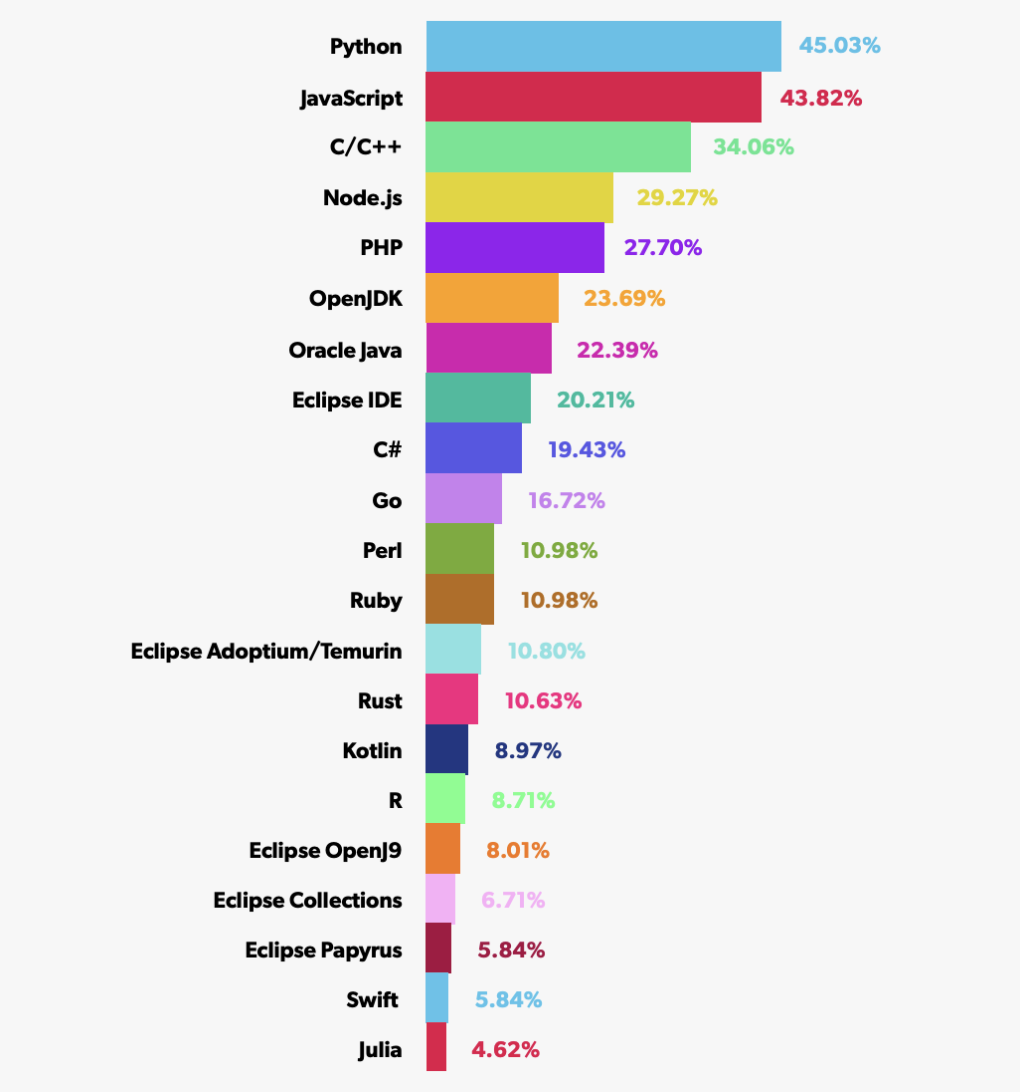
For the first time since we started publishing this report, Python claimed the top spot, barely edging out JavaScript by about one percentage point (45.03% vs. 43.82%). Python has been around for some time, but it’s still significant to see it become the most popular programming language.  

Which Technologies Does Your Organization Use to Build Applications Today?

Source: 2024 State of Open Source Report


Increased Python usage is largely coming from its usage in AI and data science, where Python provides some of the most mature and feature-rich tools for Machine Learning, mathematics, and data visualization.

We also expanded the list of options this year to include more Eclipse* tools as well as Eclipse IDE, which technically isn’t a runtime or language, but an integrated development environment used by 20% of our survey population. 

*Eclipse Foundation was a collaborating partner for the 2024 State of Open Source Report 

Back to top

Size and Region Impact Programming Language/Runtime Preference

When we filtered responses based on the size of the organization, it became apparent that while large and mid-size enterprises favor Python, smaller companies show an even split, and early-stage startups (which presumably have a modest headcount) are more likely to be using JavaScript. 

Organization SizeMost Used Programming Language/Runtime
More than 5,000 employeesPython (55%)
500 to 4,999 employeesPython (43%)
100 to 499 employeesTIE: Python, JavaScript (41%)
Under 100 employeesTIE: Python, JavaScript (45%)
Early-stage startupsJavaScript (44%)

Digging a little deeper into the data, we see that PHP and C/C++ are the second and third most popular among organizations of all sizes.

Organization SizeMost Used2nd Most Used3rd Most Used
More than 5,000 employeesPython (55%)JavaScript (47%)C/C++ (42%)
500 to 5,000 employeesPython (43%)JavaScript (41%)C/C++ (33%)
100 to 499 employeesTIE: Python, JavaScript (41%)PHP (32%)C/C++ (29%)
Under 100 employeesTIE: Python, JavaScript (45%)C/C++ (32%)PHP (31%)
Early-stage startupsJavaScript (44%)Python (40%)Node.js (27%)

Interested in PHP trends? Download the 2024 PHP Landscape Report >> 

By region, we see some interesting trends as well: in Europe, Python and JavaScript are tied in terms of usage at 48%, but JavaScript is still the most common programming language used by organizations in Asia, Latin America, Africa, and the UK. Python is the leading language in North America, Oceania, and the Middle East.  

These results are not hugely surprising. Python and Javascript are both often touted for how easy they are to learn, and are often taught in schools, universities, and code bootcamps. Javascript is often chosen by startups as they can hire developers who can pivot between server-side and UI/UX work, instead of having multiple teams using different technologies. When companies get larger, they often find they need to rewrite applications or specific application responsibilities in other languages more suited for specific tasks or more capable of scaling.

Back to top

OpenJDK Made Small Gains While Oracle Java Declined

In the Java development space, OpenJDK usage increased from 22% to a little under 24%. Oracle Java, on the other hand, dipped considerably, from 30% last year to just over 22% in this year’s survey. This aligns with the report’s finding that cost savings is currently the biggest driver for adopting open source software, as more organizations switch from commercial subscriptions to free, community versions to avoid paying licensing fees to companies like Oracle and Red Hat.   

Download OpenLogic’s free OpenJDK builds >>

Organizations using Oracle Java were also outliers in terms of what they reported as being challenging about working with open source in general. Here are some of the issues they ranked as challenging or very challenging in greater numbers compared to organizations using other languages/runtimes: 

  • Infrastructure stability and performance issues (36%) 
  • Lack of a clear community support policy (40%) 
  • Project team not responsive to suggestions or bug reports created by third parties (38%) 

Back to top

Final Thoughts

While we see Python claiming a top spot this year, one thing to keep in mind is that no language is a “silver bullet” that will solve all programming challenges. Python is a great language for systems automation, data science, and Machine Learning; however, if you are doing web-facing applications that have scaling needs, you might be better served by choosing PHP. Java remains a solid option for a variety of applications, including real-time processing and web services. In all cases, open source programming languages are dominating software development, providing opportunities for companies and developers alike.

About Version 2 Digital

Version 2 Digital is one of the most dynamic IT companies in Asia. The company distributes a wide range of IT products across various areas including cyber security, cloud, data protection, end points, infrastructures, system monitoring, storage, networking, business productivity and communication products.

Through an extensive network of channels, point of sales, resellers, and partnership companies, Version 2 offers quality products and services which are highly acclaimed in the market. Its customers cover a wide spectrum which include Global 1000 enterprises, regional listed companies, different vertical industries, public utilities, Government, a vast number of successful SMEs, and consumers in various Asian cities.

About Perforce
The best run DevOps teams in the world choose Perforce. Perforce products are purpose-built to develop, build and maintain high-stakes applications. Companies can finally manage complexity, achieve speed without compromise, improve security and compliance, and run their DevOps toolchains with full integrity. With a global footprint spanning more than 80 countries and including over 75% of the Fortune 100, Perforce is trusted by the world’s leading brands to deliver solutions to even the toughest challenges. Accelerate technology delivery, with no shortcuts.

Scale Computing Announces Call for Speaker Submissions for Upcoming Platform//2025 Event

INDIANAPOLIS – September 10, 2024 – Scale Computing, the market leader in edge computing, virtualization, and hyperconverged solutions, today announced that the company is accepting speaker submissions for the Scale Computing Platform Summit (Platform//2025), May 13-15, 2025, at Resorts World Las Vegas. All are welcome to attend the third annual conference, which captures the spirit of inclusion with the event’s tagline — “Let’s innovate and transform together.”  

The three-day event will feature live and on-demand sessions and offer exciting networking opportunities, educational and best practices sessions, an awards reception, and more. The themes for the Platform//2025 speaking sessions include virtualization and hybrid cloud computing, edge computing, and IoT, cybersecurity and data privacy, storage, networking and 5G, sustainable and green computing, and partners building a business with Scale Computing. Interested subject matter experts can submit proposals on these themes until October 31, 2024, at https://www.scalecomputing.com/platform-early-reg.

“Our annual event has quickly become a must-attend conference for IT professionals and partners, and last year, we welcomed over 700 attendees from more than 53 countries. We continue to see a high demand for thoughtful and leading-edge IT infrastructure solutions, and part of our mission for Platform//2025 is to draw on the collective expertise of our community and share best practices and innovative solutions. We look forward to welcoming everyone back to Las Vegas next spring,” said Jeff Ready, CEO and co-founder of Scale Computing.

Submissions will be reviewed by a content review committee composed of industry veterans who are experts in various IT infrastructure solution areas. Proposals will be considered based on their applicability to the audience, technical depth, and the balance of content in the overall program, with a preference for uniqueness, innovation, and thought leadership.

For more information about submitting a presentation for consideration and to receive early-bird pricing, please visit https://www.scalecomputing.com/platform-early-reg.

About Scale Computing

Scale Computing is a leader in edge computing, virtualization, and hyperconverged solutions. Using patented HyperCore™ technology, Scale Computing Platform automatically identifies, mitigates, and corrects infrastructure problems in real-time, enabling applications to achieve maximum uptime, even when local IT resources and staff are scarce. Edge Computing is the fastest-growing area of IT infrastructure, and industry analysts have named Scale Computing an outperformer and leader in the space, including being named the #1 edge computing vendor by CRN. Scale Computing’s products are sold by thousands of value-added resellers, integrators, and service providers worldwide. When ease-of-use, high availability, and TCO matter, Scale Computing Platform is the ideal infrastructure platform. Read what our customers have to say on Gartner Peer Insights, G2, and TrustRadius.

About Version 2 Digital

Version 2 Digital is one of the most dynamic IT companies in Asia. The company distributes a wide range of IT products across various areas including cyber security, cloud, data protection, end points, infrastructures, system monitoring, storage, networking, business productivity and communication products.

Through an extensive network of channels, point of sales, resellers, and partnership companies, Version 2 offers quality products and services which are highly acclaimed in the market. Its customers cover a wide spectrum which include Global 1000 enterprises, regional listed companies, different vertical industries, public utilities, Government, a vast number of successful SMEs, and consumers in various Asian cities.

About Scale Computing 
Scale Computing is a leader in edge computing, virtualization, and hyperconverged solutions. Scale Computing HC3 software eliminates the need for traditional virtualization software, disaster recovery software, servers, and shared storage, replacing these with a fully integrated, highly available system for running applications. Using patented HyperCore™ technology, the HC3 self-healing platform automatically identifies, mitigates, and corrects infrastructure problems in real-time, enabling applications to achieve maximum uptime. When ease-of-use, high availability, and TCO matter, Scale Computing HC3 is the ideal infrastructure platform. Read what our customers have to say on Gartner Peer Insights, Spiceworks, TechValidate and TrustRadius.

探索 Guardz 專為 MSP 設計的最新功能

為了不斷提升產品的功能和安全性, Guardz 宣布一系列重要的產品更新,這些更新專為管理服務供應商(MSP)設計,旨在提供更細緻的控制和更大的靈活性,幫助他們更好地管理客戶的網絡安全需求。

電郵文件類型過濾功能 

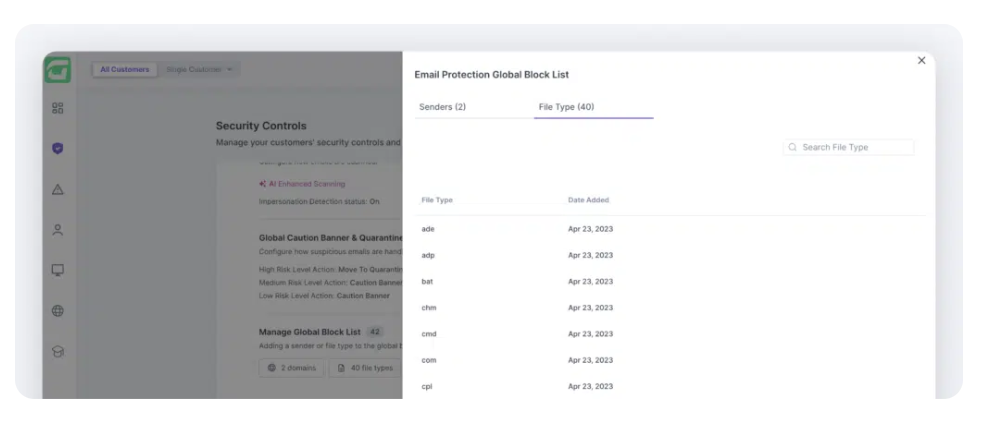
針對日益增長的客戶需求,Guardz 在電郵安全中推出了更靈活的文件過濾功能。此功能允許針對每位客戶自定義攔截或允許特定文件類型(如 WAV)。這項管理功能位於安全控制 > 電郵保護 > 阻擋列表中。

主要特色:

文件類型自定義過濾:用戶現在可以攔截或允許指定的文件類型,例如 WAV 文件,幫助企業根據客戶需求靈活制定電郵安全策略。
進階管理選項:在安全控制 -> 電郵保護中,管理員可以找到進一步配置選項,簡化設置電郵掃描規則的過程。
全局與客戶級別管理:此功能支援全局 MSP 設置,為所有客戶設置默認規則,但也允許管理員針對每個客戶進行個性化設置,提供更大的靈活性。

功能優勢:

提高安全性:通過阻擋潛在危險的文件類型,有效降低電郵攻擊風險。
靈活控制:根據企業需求調整電郵掃描規則,提升整體電郵安全管理效率。
簡易管理:集中的管理界面讓政策實施和調整變得更加輕鬆。

功能改進:

偵測警報更新
我們對偵測電郵警報進行了全面改進,以提升通知的清晰度、相關性和用戶體驗。
重點強調偵測嚴重性:警報將突出顯示偵測事件的嚴重性,幫助用戶迅速確定優先處理的問題。
詳細的用戶與設備信息:警報中提供了關於涉及用戶和設備的詳細信息,方便管理員快速了解問題範圍並採取行動。
即將推出:更多電郵通知功能即將迎來類似的改進,敬請期待。

隱藏演示數據功能
我們在客戶頁面新增了一個「演示數據」切換按鈕,方便管理員快速隱藏或顯示演示數據。MSP 現在可以使用演示數據來展示平台功能,而不必洩露實際客戶的敏感數據,這成為一種既安全又有效的銷售工具。當演示數據隱藏時,這些數據將不會計入匯總報告中,以確保數據報告的準確性。

這些更新進一步體現了我們致力於為 MSP 提供領先工具和功能的承諾,幫助提升安全性、控制力和用戶體驗。更多更新和功能改進即將推出,敬請期待!

關於 Guardz

Guardz 為管理服務提供商 (MSP) IT 專業人士提供一個人工智能驅動的網絡安全平台,專門設計來保護小型企業免受網絡攻擊。我們的統一檢測與響應平台能夠全面保護用戶、電子郵件、設備、雲端目錄和數據。透過簡化網絡安全管理,我們讓企業能夠專注於發展業務,同時減少安全管理的複雜性。Guardz 結合強大的網絡安全技術和豐富的專業知識,確保安全措施持續受到監控、管理和改進,預防未來的攻擊並降低風險。

關於 Version 2 Digital

Version 2 Digital 是亞洲最有活力的 IT 公司之一,公司發展及代理各種不同的互聯網、資訊科技、多媒體產品,其中包括資安、網絡、雲端、基礎設施、通訊系統、軟體開發運營、商業應用、多媒體、生產力及消費市場產品。透過公司龐大的網絡、銷售點、分銷商及合作夥伴,Version 2 Digital 提供廣被市場讚賞的產品及服務。Version 2 Digital 的銷售網絡包括台灣、香港、澳門、中國大陸、新加坡、馬來西亞等各亞太地區,客戶來自各行各業,包括全球 1000 大跨國企業、上市公司、公用事業、醫療、金融、教育機構、政府部門、無數成功的中小企及來自亞洲各城市的消費市場客戶。

×

Hello!

Click one of our contacts below to chat on WhatsApp

×