
Skip to content

ESET Research discovers the first UEFI bootkit for Linux

  • In November 2024, a previously unknown application, named bootkit.efi, was uploaded to VirusTotal, upon inspection ESET Research discovered it to be an UEFI application.
  • Further analysis confirmed that it is a UEFI bootkit, named Bootkitty by its creators; surprisingly, it’s the first UEFI bootkit to target Linux – specifically, several Ubuntu versions. The bootkit contains many artifacts, suggesting that this is more like a proof of concept than the work of a threat actor.
  • ESET Research also discovered a possibly related kernel module, which we named BCDropper, that deploys an Executable and Linking Format (ELF) Linux program responsible for loading another kernel module.

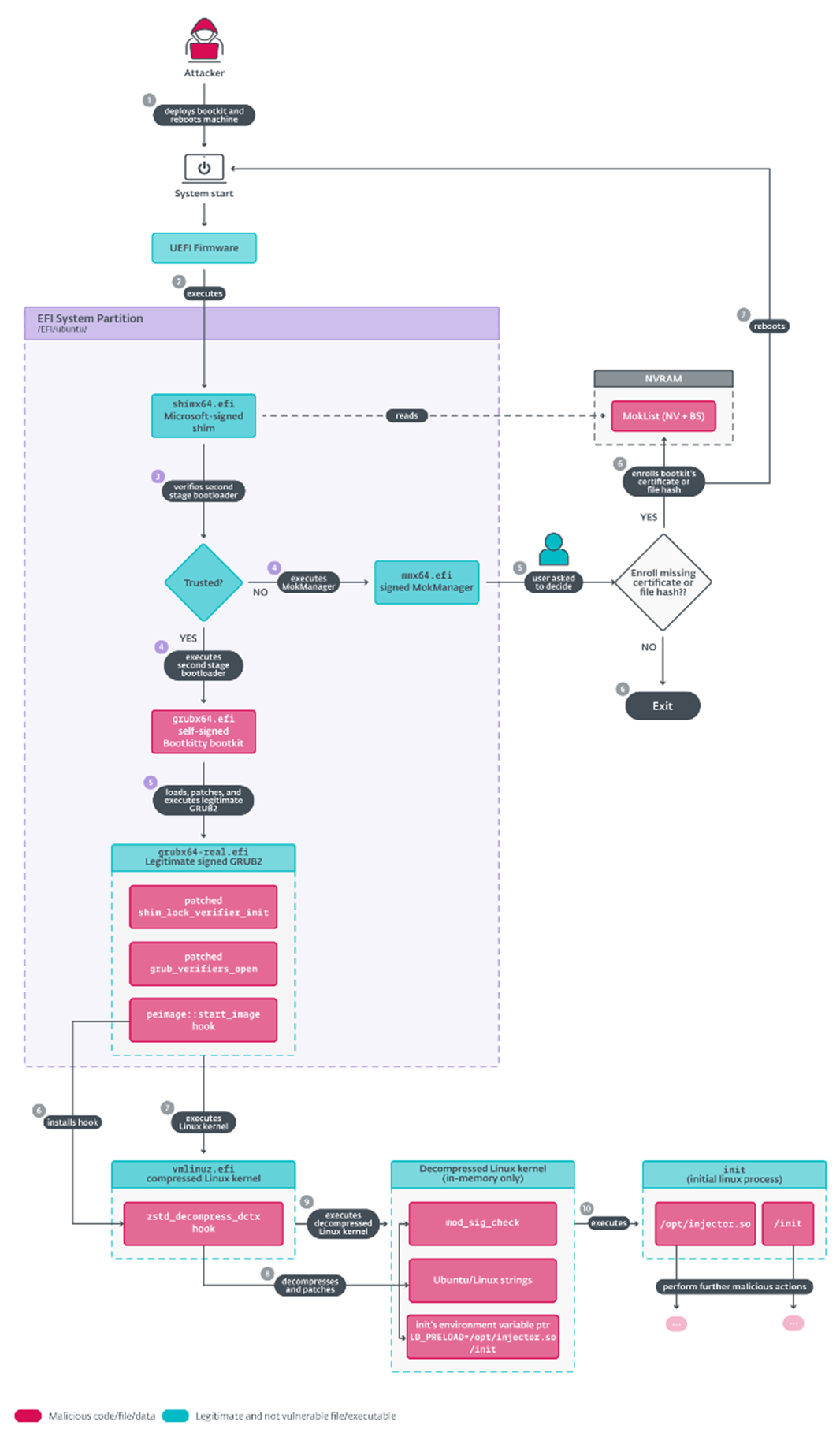
BRATISLAVANovember 27, 2024 — ESET research has discovered the first UEFI bootkit designed for Linux systems, named Bootkitty by its creators. ESET believes this bootkit is likely an initial proof of concept, and based on ESET telemetry, it has not been deployed in the wild. However, it is the first evidence that UEFI bootkits are no longer confined to Windows systems alone. The bootkit’s main goal is to disable the kernel’s signature verification feature and to preload two as yet unknown ELF binaries via the Linux “init” process (which is the first process executed by the Linux kernel during system startup).

The previously unknown UEFI application, named “bootkit.efi”, was uploaded to VirusTotal. Bootkitty is signed by a self-signed certificate, thus is not capable of running on systems with UEFI Secure Boot enabled by default. However, Bootkitty is designed to boot the Linux kernel seamlessly, whether UEFI Secure Boot is enabled or not, as it patches, in memory, the necessary functions responsible for integrity verification.

The bootkit is an advanced rootkit that is capable of replacing the boot loader, and of patching the kernel ahead of its execution. Bootkitty allows the attacker to take full control over the affected machine, as it co-opts the machine’s booting process and executes malware before the operating system has even started.

During the analysis, ESET discovered a possibly related unsigned kernel module that ESET named BCDropper – with signs suggesting that it could have been developed by the same author(s) as Bootkitty. It deploys an ELF binary responsible for loading yet another kernel module unknown at the time of analysis.

“Bootkitty contains many artifacts suggesting that this is more like a proof of concept than the work of an threat actor.  Even though the current version from VirusTotal does not, at the moment, represent a real threat to the majority of Linux systems since it can affect only a few Ubuntu versions, it emphasizes the necessity of being prepared for potential future threats,” says ESET researcher Martin Smolár, who analyzed Bootkitty. “To keep your Linux systems safe from such threats, make sure that UEFI Secure Boot is enabled, your system firmware, security software and OS are up-to-date, and so is your UEFI revocations list,” he adds.

After booting up a system with Bootkitty in the ESET testing environment, researchers noticed that the kernel was marked as tainted (a command can be used to check the tainted value), which was not the case when the bootkit was absent. Another way to tell whether the bootkit is present on the system with UEFI Secure Boot enabled is by attempting to load an unsigned dummy kernel module during runtime. If it’s present, the module will be loaded; if not – the kernel refuses to load it. A simple remedy to get rid of the bootkit, when the bootkit is deployed as “/EFI/ubuntu/grubx64.efi”, is to move the legitimate “/EFI/ubuntu/grubx64-real.efi” file back to its original location, which is “/EFI/ubuntu/grubx64.efi”.

Over the past few years, the UEFI threat landscape, particularly that of UEFI bootkits, has evolved significantly. It all started with the first UEFI bootkit proof of concept (PoC) described by Andrea Allievi in 2012, which served as a demonstration of deploying bootkits on modern UEFI-based Windows systems, and was followed with many other PoCs (EfiGuard, Boot Backdoor, UEFI-bootkit). It took several years until the first two real UEFI bootkits were discovered in the wild (one of those was ESPecter in 2021 by ESET), and it took two more years until the infamous BlackLotus – the first UEFI bootkit capable of bypassing UEFI Secure Boot on up-to-date systems – appeared (in 2023 discovered by ESET).  A common thread among these publicly known bootkits was their exclusive targeting of Windows systems.

For a more detailed analysis and technical breakdown of Bootkitty, the first bootkit for Linux, check out the latest ESET Research blogpost “Bootkitty: Analyzing the first UEFI bootkit for Linux” on WeLiveSecurity.com. Make sure to follow ESET Research on Twitter (today known as X) for the latest news from ESET Research.

Bootkitty execution overview
 

About ESET
For 30 years, ESET® has been developing industry-leading IT security software and services for businesses and consumers worldwide. With solutions ranging from endpoint security to encryption and two-factor authentication, ESET’s high-performing, easy-to-use products give individuals and businesses the peace of mind to enjoy the full potential of their technology. ESET unobtrusively protects and monitors 24/7, updating defenses in real time to keep users safe and businesses running without interruption. Evolving threats require an evolving IT security company. Backed by R&D facilities worldwide, ESET became the first IT security company to earn 100 Virus Bulletin VB100 awards, identifying every single “in-the-wild” malware without interruption since 2003.

About Version 2 Digital

Version 2 Digital is one of the most dynamic IT companies in Asia. The company distributes a wide range of IT products across various areas including cyber security, cloud, data protection, end points, infrastructures, system monitoring, storage, networking, business productivity and communication products.

Through an extensive network of channels, point of sales, resellers, and partnership companies, Version 2 offers quality products and services which are highly acclaimed in the market. Its customers cover a wide spectrum which include Global 1000 enterprises, regional listed companies, different vertical industries, public utilities, Government, a vast number of successful SMEs, and consumers in various Asian cities.

Click. Buy. Oops! How Small Businesses Can Avoid Cyber Traps This Black Friday


Key Takeaways:

  1. Cyber risks such as phishing, credential theft, and data breaches surge during shopping festivals, leaving small businesses particularly vulnerable.
  2. A lack of awareness and preparedness among small businesses makes them prime targets for cybercriminals.
  3. Managed Service Providers (MSPs) play a crucial role in securing these businesses but require robust tools and strategies to protect digital assets effectively.

The Holiday Season: A Goldmine for Cybercriminals

As Black Friday and Cyber Monday approach, consumers eagerly anticipate significant discounts, and businesses brace for increased sales. However, amidst this commercial excitement, cybercriminals are equally prepared to exploit the surge in online activity. The combination of heightened online transactions, distracted employees, and hurried decision-making creates an ideal environment for cyber threats. From phishing emails masquerading as legitimate invoices to malware-laden advertisements, attackers leverage the chaos to infiltrate systems.

A notable example is the 2013 Target data breach, where attackers accessed the retailer’s network through a third-party vendor, compromising the credit and debit card information of approximately 40 million customers. This incident underscores the importance of vigilance during peak shopping periods.


Small Businesses: The Unseen Targets of Cybercrime

While large corporations often dominate headlines following cyberattacks, small businesses are far from immune. In fact, their limited resources and less sophisticated security measures often make them more attractive targets for cybercriminals.

1. Phishing Scams

Phishing emails see a significant uptick during shopping festivals, with cybercriminals impersonating trusted brands or vendors. A single employee clicking on a malicious link can grant attackers access to sensitive business data. For instance, in 2020, a small manufacturing company in the U.S. fell victim to a phishing scam that resulted in a $100,000 loss, highlighting the severe impact such attacks can have on small enterprises.

2. Data Breaches and Leaks

Hackers often aim to steal customer information, such as credit card numbers or personal details. Small businesses, particularly those managing e-commerce transactions, are at significant risk if their systems aren’t secure. The 2018 breach of a small online retailer led to the exposure of thousands of customer records, resulting in financial loss and reputational damage.

3. Credential Theft

Weak passwords or reused credentials across platforms make it easier for attackers to infiltrate accounts, including cloud-based business tools and payment systems. In 2019, a small law firm experienced a data breach due to credential theft, compromising sensitive client information and leading to legal repercussions.

4. Ransomware

Once inside a system, attackers can deploy ransomware, encrypting vital data and demanding hefty sums for its release—crippling small businesses financially. The 2021 Colonial Pipeline ransomware attack, though affecting a large entity, serves as a stark reminder of the potential devastation ransomware can cause, emphasizing the need for robust security measures across businesses of all sizes.


The Role of MSPs in Fortifying Cyber Defenses

Managed Service Providers (MSPs) are on the frontlines, tasked with protecting small businesses from evolving cyber threats. Their responsibilities extend beyond implementing security solutions; they must also educate their clients.

Why MSPs Are Vital

  1. Expertise Across Platforms: MSPs possess a deep understanding of the complexities of modern IT environments, from endpoint devices to cloud-based systems.
  2. Proactive Monitoring: They can detect and neutralize threats before they escalate, ensuring continuous protection.
  3. Education and Awareness: By training small business employees to identify threats, MSPs help minimize human error—still the leading cause of breaches.

However, to succeed in this mission, MSPs require cutting-edge tools that provide comprehensive protection, visibility, and ease of management.


Practical Cybersecurity Tips for Small Businesses

Small businesses may lack extensive resources, but adopting these practical measures can significantly reduce their risk of falling victim to cyberattacks:

  1. Educate Employees
    • Train staff to recognize phishing attempts, suspicious links, and fraudulent websites.
    • Conduct regular cybersecurity awareness sessions.
  2. Use Strong, Unique Passwords
    • Avoid using the same passwords across platforms.
    • Implement multi-factor authentication (MFA) wherever possible.
  3. Secure Payment Processes
    • Only use trusted payment processors with end-to-end encryption.
    • Monitor transactions for anomalies during high-traffic periods.
  4. Update Software and Systems
    • Regularly update operating systems, browsers, and security software to patch vulnerabilities.
    • Use automatic updates to ensure timely protection.
  5. Limit Access to Sensitive Information
    • Implement role-based access controls.
    • Regularly review user permissions and revoke access for former employees.
  6. Partner With a Trusted MSP
    • Collaborate with an MSP to implement advanced cybersecurity measures and maintain ongoing protection.

How Guardz Helps MSPs Safeguard Small Businesses

Guardz is a purpose-built solution designed to empower MSPs in their mission to secure small businesses during peak shopping seasons and beyond. Here’s how Guardz delivers unmatched protection:

  1. Comprehensive Endpoint Security Guardz provides real-time threat detection and response for all connected devices, ensuring no vulnerability goes unnoticed.
  2. Cloud Security and Visibility With Guardz, MSPs gain full visibility into their clients’ cloud environments, identifying misconfigurations and preventing unauthorized access.
  3. Streamlined Management Guardz simplifies cybersecurity management, enabling MSPs to protect multiple clients efficiently through a single platform.
  4. Employee Training and Awareness Tools Integrated training modules help MSPs educate small business employees, reducing the risk of human error.
  5. Affordable and Scalable Solutions Guardz understands the budget constraints of small businesses, offering flexible plans that grow with their needs.

Closing Thoughts

Black Friday and Cyber Monday bring immense opportunities for businesses but also attract cybercriminals looking to exploit vulnerabilities. Small businesses must remain vigilant, investing in cybersecurity and working closely with MSPs to fortify their defenses.

With tools like Guardz, MSPs can not only shield their clients from cyber threats but also instill confidence in their ability to navigate an increasingly digital world safely.

About Guardz
Guardz is on a mission to create a safer digital world by empowering Managed Service Providers (MSPs). Their goal is to proactively secure and insure Small and Medium Enterprises (SMEs) against ever-evolving threats while simultaneously creating new revenue streams, all on one unified platform.

About Version 2 Digital

Version 2 Digital is one of the most dynamic IT companies in Asia. The company distributes a wide range of IT products across various areas including cyber security, cloud, data protection, end points, infrastructures, system monitoring, storage, networking, business productivity and communication products.

Through an extensive network of channels, point of sales, resellers, and partnership companies, Version 2 offers quality products and services which are highly acclaimed in the market. Its customers cover a wide spectrum which include Global 1000 enterprises, regional listed companies, different vertical industries, public utilities, Government, a vast number of successful SMEs, and consumers in various Asian cities.

Actiphy Inc. Launches “Actiphy Rapid Deploy,” a New OS Deployment Tool with Advanced PXE Deployment Features

Actiphy Inc. is proud to announce the launch of Actiphy Rapid Deploy, a powerful new OS deployment tool designed to simplify and accelerate the deployment of pre-configured operating systems with pre-installed applications across multiple client PCs. Tailored for system integrators, value-added resellers, and original equipment manufacturers, Actiphy Rapid Deploy provides an efficient solution for large-scale system rollouts across LAN, VPN, or manual USB drives. With the introduction of the innovative PXE Deploy feature, client PCs can now be quickly booted and imaged remotely via PXE.

Streamlining System Deployment for Modern IT Needs

In today’s dynamic IT environments, businesses, government agencies, and educational institutions face the challenge of quickly configuring new PCs to be ready for immediate use. With the scheduled end of Windows 10 support in October 2025 and the ongoing demands of telework and office relocations, IT administrators require efficient solutions to meet these needs, even amid labor shortages and restricted workspace.

About Actiphy Rapid Deploy

Actiphy Rapid Deploy addresses these challenges by creating a bootable image of a pre-configured source PC, allowing deployment to multiple new PCs through a network or USB. The tool leverages Actiphy’s proprietary TCP-SlideCast technology, enabling high-speed image deployment across numerous target PCs with minimal server and network load. Actiphy Rapid Deploy includes two essential components:

  • Deploy Media Creator: Aids in creating a bootable image of a pre-configured source PC.
  • ImageCast Server:Broadcasts the image across the network to multiple PCs simultaneously.

Key Features of Actiphy Rapid Deploy

  • PXE Boot for Client PCs: The new PXE Server feature in ImageCast Server allows network-based booting and deployment of the source image to client PCs. Using iPXE technology, Actiphy Rapid Deploy ensures faster PXE boot speeds than traditional TFTP protocols.
  • Redundant Deployment, Remote Boot, and Shutdown Capabilities: Administrators can redeploy source images to previously imaged PCs, ideal for classrooms or environments requiring periodic reinitialization. ImageCast Server’s console enables remote booting, redeployment, and shutdown of client PCs. The built-in DHCP server supports PXE Boot via Wake-on-LAN, even when a local DHCP server is unavailable.

Actiphy Rapid Deploy is now available for administrators, system integrators, value-add resellers, and original equipment manufacturers looking to enhance their deployment capabilities.


About Actiphy
Actiphy founded in 2007, focuses on developing and offering innovative backup and disaster recovery solutions for complete protection of all your systems and data. ActiveImage Protector backs up Windows, Linux machines on physical and virtual environments and restore systems and data fast for you to be up and running with minimal downtime and data loss. Today Actiphy hold 20% of the image backup market in Japan and are expanding our services in the Asia/Pacific and North American regions, as well as in Europe, the Middle East and Africa.

About Version 2 Digital

Version 2 Digital is one of the most dynamic IT companies in Asia. The company distributes a wide range of IT products across various areas including cyber security, cloud, data protection, end points, infrastructures, system monitoring, storage, networking, business productivity and communication products.

Through an extensive network of channels, point of sales, resellers, and partnership companies, Version 2 offers quality products and services which are highly acclaimed in the market. Its customers cover a wide spectrum which include Global 1000 enterprises, regional listed companies, different vertical industries, public utilities, Government, a vast number of successful SMEs, and consumers in various Asian cities.

Canonical OpenStack vs Red Hat OpenStack

OpenStack is a prominent platform used to build and manage cloud infrastructure through open-source. Today, there are several OpenStack distributions available. However, Red Hat OpenStack and Canonical OpenStack are the two most popular ones. Although both offer robust cloud solutions, their approaches, features, and support models differ significantly.

This article explores these variations in great detail, therefore guiding companies in choosing their cloud infrastructure.

Overview of Canonical OpenStack

Canonical OpenStack, also called Charmed OpenStack, is built on Ubuntu. Its goal is to make the OpenStack deployment and administration process more efficient.

It uses Canonical’s products, such as Juju for orchestration and MAAS, Metal as a Service for hardware provisioning to enable users to automate the whole lifecycle of their cloud infrastructure.

Key Features of Canonical OpenStack

  • Model-Driven Operations

Using a model-driven approach, Canonical OpenStack makes the management of cloud resources simpler and scaling them possible.

  • Automation

The heavily automated deployment procedure helps to save time and complexity in building an OpenStack cloud.

  • Flexible Deployment Options

Depending on organizational requirements for flexibility, they can choose between self-managed or Canonical-managed deployments pick depending on.

  • Integration with Kubernetes

Canonical lets one run virtual machines and containers on the same platform, therefore enabling a consistent method of workload management.

Overview of Red Hat OpenStack

Red Hat OpenStack Platform or RHOSP is deployed on top of Red Hat Enterprise Linux. This enables it to integrate tightly with other Red Hat products. Red Hat stresses stability, security, and enterprise-grade support. As a result, it has become a popular choice for companies seeking a robust cloud solution.

Key Features of Red Hat OpenStack

  • Enterprise Support

Red Hat offers extensive support options, including managed services that cover deployment, upgrades, and ongoing maintenance.

  • Integration with Red Hat Ecosystem

It integrates seamlessly with other Red Hat solutions like Ansible for automation and Satellite for systems management.

  • Comprehensive Monitoring Tools

RHOSP includes centralized logging, performance monitoring, and availability monitoring tools to ensure optimal cloud operation.

Simple Comparison Table

FeatureCanonical OpenStack (Charmed OpenStack)Red Hat OpenStack Platform
DistributionUbuntuRed Hat Enterprise Linux
Deployment MethodologyCharm-based, declarativeAnsible-based, procedural
Management ToolsJujuRed Hat CloudForms
Support ModelCanonical’s commercial supportRed Hat’s commercial support
Integration with Other ProductsTightly integrated with other Canonical products (e.g., Kubernetes, Ceph)Tightly integrated with other Red Hat products (e.g., Red Hat Enterprise Virtualization, Red Hat CloudForms)
PricingSubscription-based, per-node pricingSubscription-based, per-node pricing
FocusSimplicity, automation, scalabilityEnterprise-grade, stability, security
Target AudienceDevelopers, DevOps teams, cloud service providersLarge enterprises, IT departments
Community InvolvementStrong contributor to the OpenStack communityActive contributor to the OpenStack community


Comparing Canonical OpenStack vs Red Hat OpenStack

  • Release Cadence

Canonical OpenStack release cycle occurs every six months. However , its Long-Term Support (LTS) releases occur every 18 months. As a result,  customers can get new features and improvements more frequently. Red Hat release cycle is also every six-month release cycle, but while Canonical LTS is every 18 months Red Hat’s own is every two years. This provides stability, but it may cause delays in accessing new features when compared to Canonical’s approach.

  • Bare-Metal Provisioning Tool

For bare-metal provisioning, Canonical OpenStack uses MAAS, enabling customers to control physical servers inside their cloud environment effectively. Red Hat OpenStack uses Ironic as its bare-metal provisioning tool, which is also efficient but could require operating skills different from MAAS.

  • Maximum Support Timeline

Canonical OpenStack offers a maximum support timeline of five years for its releases. This shorter support period may require organizations to plan upgrades more frequently. However, Red Hat OpenStack has a longer maximum support timeline of ten years, which can appeal to enterprises looking for long-term stability and support without frequent upgrades.

  • Managed Services

Canonical offers managed services for OpenStack through its solution called BootStack. This fully managed service allows Canonical to use their expertise to build, monitor, and maintain your private cloud. They handle everything from initial deployment to operations management, including software updates, backups, and monitoring. However, there is also an option to self-manage your infrastructure with the help of Canonical.

Similarly, Red Hat OpenStack offers managed services. This gives organizations the option to outsource the management of their cloud infrastructure to Red Hat. This capability is especially useful for firms that lack in-house knowledge of the system. Red Hat also works with managed service providers (MSPs) to offer OpenStack as a managed private cloud solution. As a result, companies can experience minimized disruptions while maintaining operational control​.

  • Support Options

Selecting an OpenStack distribution requires much consideration including support. Canonical provides flexible support choices allowing users to select between fully managed services or self-managed configurations. This adaptability serves companies with different degrees of expertise in cloud infrastructure management. Red Hat, on the other hand, offers robust business support including thorough maintenance programs tailored for large-scale deployments.

  • Upgrade Process

Canonical’s method supports automated upgrades that can be scheduled, ensuring it is free from significant downtime. On the other hand, the Red Hat upgrading process is manual and could be complex. This could cause problems for companies during the maintenance window, therefore slowing down or stopping the workflow over that period.

  • Ecosystem Integration

Canonical OpenStack is designed to fit quite well with a variety of third-party components. It also leverages MAAS, Metal as a Service, for hardware provisioning and Juju for service orchestration. By means of OpenStack Interoperability Lab (OIL), Canonical examines hundreds of setups to guarantee interoperability with several hardware and software solutions.

Red Hat, on the other hand, is closely linked with its ecosystem. For companies now using Red Hat products, this connection offers a cohesive experience. Such integration could, however, restrict flexibility and perhaps lock customers into the Red Hat environment.

  • Cost Structure

For companies running several instances across different hardware configurations, Canonical offers a per-host pricing model, which can be more predictable and economical. Red Hat’s per-socket-pair price, on the other hand, can result in more expenses in settings with few sockets but many physical servers.

  • Monitoring Tools

Though both systems have monitoring features, their scope and complexity vary. Through its Landscape tool, Canonical offers basic monitoring. For sophisticated monitoring requirements, you may need other setups. Red Hat, on the other hand, offers a whole suite of monitoring tools so that companies may have a better understanding of their cloud operations without resorting to third-party solutions.

  • Subscription Model

Canonical OpenStack does require a subscription for its basic services. Users could thus utilize and control their cloud infrastructure totally free from ongoing licensing costs. However, Red Hat OpenStack depends on a per socket-pair model subscription, so it can be rather expensive (around USD 6,300 per socket-pair). This approach may result in greater costs for businesses with plenty of physical servers.

Data Protection for OpenStack

Storware backup and recovery provides comprehensive data protection for OpenStack environments, including both Red Hat and Canonical distributions. Its agentless architecture ensures seamless integration without impacting performance. Storware can protect a wide range of OpenStack components, including instances, volumes, and metadata. Additionally, it offers granular restore options, allowing you to recover specific files or entire instances as needed. With Storware, you can safeguard your critical OpenStack data and ensure business continuity in case of unexpected events.


Conclusion

Choosing between Canonical OpenStack and Red Hat OpenStack finally comes down to an organization’s particular needs. So you must consider that when looking at their differences. With customizable support choices appropriate for many contexts, Canonical’s Charmed OpenStack excels in automation and ease of use. Red Hat’s product, on the other hand, distinguishes itself for its enterprise-grade dependability and all-encompassing support system designed for big companies looking for robust cloud solutions.

Understanding these variations fully will help you choose the appropriate distribution that fits your operational needs and strategic objectives in creating a sustainable cloud infrastructure.

About Storware
Storware is a backup software producer with over 10 years of experience in the backup world. Storware Backup and Recovery is an enterprise-grade, agent-less solution that caters to various data environments. It supports virtual machines, containers, storage providers, Microsoft 365, and applications running on-premises or in the cloud. Thanks to its small footprint, seamless integration into your existing IT infrastructure, storage, or enterprise backup providers is effortless.

About Version 2 Digital

Version 2 Digital is one of the most dynamic IT companies in Asia. The company distributes a wide range of IT products across various areas including cyber security, cloud, data protection, end points, infrastructures, system monitoring, storage, networking, business productivity and communication products.

Through an extensive network of channels, point of sales, resellers, and partnership companies, Version 2 offers quality products and services which are highly acclaimed in the market. Its customers cover a wide spectrum which include Global 1000 enterprises, regional listed companies, different vertical industries, public utilities, Government, a vast number of successful SMEs, and consumers in various Asian cities.

ESET Threat Intelligence enhancing cybersecurity workflows with Filigran’s OpenCTI

  • ESET announces strategic integration with Filigran OpenCTI
  • The integration of ESET Threat Intelligence (ETI) with Filigran’s OpenCTI solution will enable the consolidation of threat intelligence, enhancing the analytical capabilities of cybersecurity teams
  • The enhanced interoperability of the two solutions will allow for seamless data exchange, and improved threat response workflows, greatly reducing the mean time of incident response

BRATISLAVA, PARIS (FR)November 27, 2024 — ESET, a global leader in cybersecurity solutions, has announced a key strategic integration with Filigran, a leading provider of open-source threat intelligence management, to integrate ESET Threat Intelligence with its OpenCTI solution.

To attain a strong and proactive security posture, organizations need to aggregate and correlate vast amounts of data from diverse sources. However, telemetry and threat data from one vendor isn’t enough to combat multiple sophisticated threats, and since there is an ongoing shortage of talent and a general lack of internal cybersecurity resources, businesses increasingly purchase services instead of, or on top of, cybersecurity products. As such, there is a demand for seamless integrations, because they simplify workflows, reduce manual effort, and enhance efficiency.

Staying on top of security requires you to be one step ahead by working to achieve enhanced situational awareness, an understanding of the threat landscape including TTPs, and to build strong early warning capabilities, which ESET’s highly curated and actionable threat intelligence helps provide.

This is why ESET is continuing its integration journey, now with Filigran’s OpenCTI, enabling the consolidation of its well-regarded threat intelligence data from ESET directly into OpenCTI. This enhances the analytical capabilities of cybersecurity teams by providing a single, comprehensive, and holistic view of potential threats, centralizing threat data.

“At ESET, integrations are crucial for our success going forward. ESET Threat Intelligence’s diverse telemetry and rich JSON/STIX 2.1 data feeds including: malicious files, botnets, APT IoCs, domains, URLs, and IPs (+ nine new sub-filters in Q4 2024), are seamlessly integrated into OpenCTI, complete with corresponding actionable research insights. Existing users of Filigran will be able to unlock a significant boost to the maturity of their organizational security via their threat-hunting and incident-response capabilities,” said Roman Kováč, Chief Research Officer at ESET.

“With hundreds or even thousands of malicious actors adapting rapidly, timely exploitation of threat intelligence feeds is a challenge. By combining ESET’s high-quality data with OpenCTI’s advanced processing, visualization, and automation capabilities, we make this possible.” – Jean-Philippe Salles, VP Product at Filigran.

The main benefits of the integration are:

  • Enhanced insights: ESET’s data feeds offer unique, high-value telemetry derived from its extensive endpoint protection network. This data includes real-time telemetry and detailed threat intelligence that are crucial for accurate threat detection and mitigation.
  • Enhanced Analysis: ESET’s data feeds provide advanced context and early-stage detection capabilities, helping analysts to identify and respond to threats more efficiently.
  • Interoperability: This partnership enhances interoperability between ESET’s Threat Intelligence and OpenCTI’s analytical tools. ESET’s utilization of TAXII 2.1 and STIX 2.1 standards allows for seamless data exchange and improved threat response workflows.
  • Actionable intelligence: ESET’s highly curated data feeds provide actionable intelligence that can be immediately utilized within OpenCTI, improving the overall efficiency and effectiveness of threat detection and response efforts.

Moreover, the unique value of this integration lies in the fact that it overcomes specific challenges related to incident response, as by leveraging ESET Threat Intelligence, users of OpenCTI will greatly enhance their mean time to detect (MTTD) and reduce their mean time to respond (MTTR), all thanks to ETI’s highly curated up-to-date feeds allowing organizations to stay one step ahead of the latest threats.

For more information about ESET integrations, visit our page here.

For more information about ESET Threat Intelligence, click here.

To discover more about Filigran and OpenCTI, visit here.


About ESET
For 30 years, ESET® has been developing industry-leading IT security software and services for businesses and consumers worldwide. With solutions ranging from endpoint security to encryption and two-factor authentication, ESET’s high-performing, easy-to-use products give individuals and businesses the peace of mind to enjoy the full potential of their technology. ESET unobtrusively protects and monitors 24/7, updating defenses in real time to keep users safe and businesses running without interruption. Evolving threats require an evolving IT security company. Backed by R&D facilities worldwide, ESET became the first IT security company to earn 100 Virus Bulletin VB100 awards, identifying every single “in-the-wild” malware without interruption since 2003.

About Version 2 Digital

Version 2 Digital is one of the most dynamic IT companies in Asia. The company distributes a wide range of IT products across various areas including cyber security, cloud, data protection, end points, infrastructures, system monitoring, storage, networking, business productivity and communication products.

Through an extensive network of channels, point of sales, resellers, and partnership companies, Version 2 offers quality products and services which are highly acclaimed in the market. Its customers cover a wide spectrum which include Global 1000 enterprises, regional listed companies, different vertical industries, public utilities, Government, a vast number of successful SMEs, and consumers in various Asian cities.

×

Hello!

Click one of our contacts below to chat on WhatsApp

×