Skip to content

The NIS2 Directive & Its Impact on Cybersecurity Across the E.U.

In response to an endless barrage of cyber-attacks targeting private, public and state-sponsored organizations across the European Union (E.U.), there has been a call to widen the scope of risk management requirements and to increase accountability with regards to security supervisory measures. As such, the E.U. has taken a decisive step forward with the introduction of the NIS2 Directive. This directive, which seeks to supersede its predecessor (NIS), aims to fortify the cybersecurity posture of organizations across the continent, ensuring that the digital infrastructure remains resilient against a backdrop of evolving threats. The NIS2 Directive aims to strengthen the security requirements, address the security of supply chains, streamline reporting obligations, and introduce more stringent supervisory measures and stricter enforcement. As we navigate through this comprehensive guideline, let’s delve into the essence of NIS2, its enforcement mechanisms, and what it signifies for organizations striving for excellence in cybersecurity.

Unveiling the NIS2 Directive: A Beacon of Cyber Resilience

The NIS2 Directive emerges as a landmark legislative endeavor by the European Union, setting a new horizon for cybersecurity norms across its member states. Recognizing the pivotal role of digital infrastructure in the contemporary socio-economic landscape, this directive not only aims to rectify the vulnerabilities identified in its predecessor but also endeavors to architect a robust cybersecurity framework capable of withstanding the ever-evolving cyber threats. By mandating an elevated baseline of security measures, NIS2 embodies the EU’s commitment to safeguarding its digital ecosystem against the backdrop of increasing cyber adversities.

This legislative framework is distinguished by its ambitious scope, encapsulating a diverse spectrum of sectors deemed critical for the EU’s functionality and prosperity. From energy and transport to banking and healthcare, NIS2 acknowledges the interconnected nature of these sectors and the paramount importance of their security in ensuring the seamless operation of the Union’s digital and physical infrastructure. It’s this comprehensive inclusivity that marks a significant advancement from its predecessor, aiming to weave a tighter security net across the EU’s vast digital landscape.

Moreover, NIS2 accentuates the imperative of stringent compliance, embedding enhanced obligations for entities within its purview. These include the adoption of advanced risk management protocols, the establishment of incident reporting mechanisms, and the implementation of cutting-edge cybersecurity measures. Through these provisions, NIS2 propels organizations towards not merely reacting to cyber incidents but fostering a proactive culture of cyber resilience, thereby elevating the cybersecurity stature of the European Union to new heights.

The Expanded Scope and Enhanced Obligations Under NIS2

The inception of the NIS2 Directive ushers in an era of elevated cybersecurity expectations, broadening its dominion to envelop an array of critical sectors and digital service providers. This strategic expansion reflects the European Union’s acute awareness of the ubiquitous nature of cyber threats and underscores a resolute commitment to fortifying every facet of its digital and physical infrastructures. The proposed expansion of the scope covered by NIS2 would effectively oblige more entities and sectors to take measures. The directive’s enhanced scope is not merely a quantitative increase but a qualitative leap forward, embodying a holistic approach to cybersecurity that acknowledges the intricate interdependencies within the EU’s socio-economic ecosystem.

With this expansion comes a suite of augmented obligations that entities must embrace. NIS2 mandates the implementation of rigorous risk management protocols, establishing a framework wherein proactive measures are not just encouraged but required. The essence of these obligations lies in their potential to transform reactive security postures into dynamic, anticipatory defenses, capable of not just withstanding but preempting cyber threats. This paradigm shift necessitates a comprehensive reevaluation of existing cybersecurity practices, pushing organizations to adopt not only advanced technologies but also to cultivate a culture of perpetual vigilance and resilience.

Incident reporting protocols, another cornerstone of the directive, serve a dual purpose: they ensure timely and effective responses to cyber incidents while fostering a climate of transparency and cooperation among EU members. This collective approach to cybersecurity is emblematic of the NIS2 Directive’s vision—a vision where collaborative effort and shared responsibility pave the way towards a secure and resilient digital Europe.

Enforcement Mechanisms and the Role of National Authorities

The NIS2 Directive’s ambitions for a cyber-resilient Europe are bolstered by a comprehensive enforcement framework, meticulously designed to ensure unwavering adherence to its mandates. At the heart of this framework stand the National Authorities, designated as the vanguards of implementation and compliance within their territories. These authorities are vested with the power to enact a wide array of enforcement actions, signifying the European Union’s resolute stance on cybersecurity discipline.

Empowered to conduct thorough audits, these entities delve into the operational intricacies of organizations, assessing their compliance with the NIS2’s stringent requirements. Their purview extends beyond mere evaluation; they are authorized to request detailed information, compelling entities to demonstrate their commitment to cybersecurity resilience through tangible evidence. This level of scrutiny underscores the directive’s focus on transparency and accountability, ensuring that organizations are not just compliant in theory but in practice as well.

Should discrepancies or lapses in compliance be uncovered, National Authorities are equipped to impose penalties that reflect the severity of the infraction. Non-compliance with the NIS2 Directive can result in significant financial penalties. This enforcement mechanism serves a dual purpose: it acts as a deterrent against non-compliance and motivates entities to proactively bolster their cybersecurity measures. The clear message sent by this rigorous approach is that the European Union will tolerate no compromise on the security of its digital landscape. Through this dynamic interplay between National Authorities and organizations, the NIS2 Directive is transforming the fabric of cybersecurity across the continent, fostering an environment where resilience is not just encouraged, but mandated.

nis2 directive portnox

The Implications of NIS2 for Cybersecurity Product Selection and Budget Optimization

In light of the NIS2 Directive’s rigorous mandates, the landscape of cybersecurity product selection and budget management is undergoing a pivotal transformation. The directive’s comprehensive security requirements compel organizations to critically assess and elevate their cybersecurity toolkits. This shift necessitates a strategic alignment of cybersecurity solutions with the NIS2 standards, underscoring the importance of integrating advanced technologies and scalable solutions that not only bolster cyber defenses but also ensure seamless compliance.

The value of the EU cybersecurity market is estimated at more than €130 billion. The directive champions a proactive stance on cybersecurity, thereby influencing organizations to prioritize investments in solutions that offer not just immediate protection but long-term adaptability to the evolving cyber threat landscape. This includes leveraging automation and artificial intelligence to enhance threat detection and response, as well as adopting cloud-based services that provide flexibility and scalability. As a consequence, budget allocation strategies must evolve to accommodate these sophisticated solutions, balancing the need for compliance with the imperative to remain vigilant against future cyber threats.

Moreover, the selection of cybersecurity products must be guided by a holistic understanding of the organization’s unique risk profile and operational requirements. This approach ensures that investments are not only NIS2-compliant but are also efficacious in addressing specific vulnerabilities and enhancing the overall security posture. In essence, the NIS2 Directive serves as a catalyst for organizations to reevaluate and optimize their cybersecurity budget, encouraging a strategic investment in technologies that drive not only compliance but also comprehensive cyber resilience.

The Role of Visionary Leadership in NIS2 Compliance

In the landscape shaped by the NIS2 Directive, the mantle of leadership carries with it an imperative to see beyond the horizon of current cybersecurity challenges. Visionary leaders stand at the vanguard of this new era, charged not only with navigating the complexities of compliance but also with cultivating an organizational ethos that prioritizes resilience and adaptability in the face of cyber threats. It is a role that transcends traditional expectations, demanding a forward-thinking approach that integrates strategic foresight with actionable intelligence.

The essence of visionary leadership in the context of NIS2 compliance lies in the ability to harness the collective strength and ingenuity of an organization. It involves championing the cause of cybersecurity across all echelons, advocating for the resources and technologies that align with the directive’s rigorous standards. It means inspiring a culture where every member understands their role in safeguarding the digital domain, fostering an environment where proactive security measures are ingrained in the fabric of daily operations.

Furthermore, visionary leaders recognize the value of cross-functional collaboration as a cornerstone of effective cybersecurity strategy. They seek to break down silos, fostering an integrated approach that leverages diverse perspectives and expertise in pursuit of a common goal: a resilient and secure digital infrastructure. Through their guidance, organizations are poised not only to meet the mandates of the NIS2 Directive but to set a standard for cybersecurity excellence that resonates throughout the European Union and beyond.

In this evolving digital landscape, the role of visionary leadership is not just to comply but to inspire, transforming the challenges posed by NIS2 into opportunities for innovation, growth, and enduring cyber resilience.

The NIS2 Directive as a Catalyst for Transformative Change

The NIS2 Directive heralds a significant shift in the European Union’s approach to cybersecurity, marking a pivotal moment in the collective endeavor to shield our digital ecosystem from the ever-present shadow of cyber threats. Its enactment is not merely a regulatory adjustment but a profound call to action, urging organizations across the EU to elevate their cybersecurity protocols, refine their strategic priorities, and fundamentally transform their operational ethos towards enhanced digital resilience.

This transformative framework demands more than mere compliance; it invites entities to reimagine their cybersecurity landscapes, integrating cutting-edge technologies and forward-thinking practices that extend beyond the immediacy of threat mitigation. It underscores the imperative for a holistic, anticipatory approach to cyber defense, emphasizing the necessity of strategic foresight and adaptability in an era characterized by rapid technological evolution and increasingly sophisticated cyber adversaries.

As organizations navigate this new directive, the impetus to innovate, to cultivate robust cyber resilience, becomes a defining challenge—and opportunity. The journey toward NIS2 compliance catalyzes a comprehensive reassessment of cybersecurity postures, propelling entities to not only fortify their defenses but also to champion a culture of continuous improvement and collaborative vigilance.

In essence, the NIS2 Directive serves as a formidable lever for transformative change, shaping a future in which the European Union stands as a paragon of cyber resilience. It is a future where the collective commitment to cybersecurity transcends regulatory compliance, embedding itself in the very DNA of organizational strategy and culture, forging a path toward a secure, resilient digital Europe for generations to come.

About Version 2 Digital

Version 2 Digital is one of the most dynamic IT companies in Asia. The company distributes a wide range of IT products across various areas including cyber security, cloud, data protection, end points, infrastructures, system monitoring, storage, networking, business productivity and communication products.

Through an extensive network of channels, point of sales, resellers, and partnership companies, Version 2 offers quality products and services which are highly acclaimed in the market. Its customers cover a wide spectrum which include Global 1000 enterprises, regional listed companies, different vertical industries, public utilities, Government, a vast number of successful SMEs, and consumers in various Asian cities.

About Portnox
Portnox provides simple-to-deploy, operate and maintain network access control, security and visibility solutions. Portnox software can be deployed on-premises, as a cloud-delivered service, or in hybrid mode. It is agentless and vendor-agnostic, allowing organizations to maximize their existing network and cybersecurity investments. Hundreds of enterprises around the world rely on Portnox for network visibility, cybersecurity policy enforcement and regulatory compliance. The company has been recognized for its innovations by Info Security Products Guide, Cyber Security Excellence Awards, IoT Innovator Awards, Computing Security Awards, Best of Interop ITX and Cyber Defense Magazine. Portnox has offices in the U.S., Europe and Asia. For information visit http://www.portnox.com, and follow us on Twitter and LinkedIn.。

Scale Computing Announces 2024 Scale Computing Platform Summit Awards Finalists

INDIANAPOLIS – March 19, 2024 — Scale Computing, a market leader in edge computing, virtualization, and hyperconverged solutions, today announced finalists for the 2024 Scale Computing Platform Summit Awards. Winners will be announced at the Scale Computing Platform Summit (Platform//2024), held April 16-18, 2024 at Resorts World Las Vegas. The second annual event is open to all Scale Computing customers, partners, and technology alliances.

The Scale Computing Platform Summit Awards recognize transformational leadership among Scale Computing Partners, Customers, and Technology Alliances. Finalists were placed into award categories based on demonstrated excellence in three key areas: innovation, collaboration, and growth.

A new category being introduced at the Scale Computing Platform 2024 is the “Customer Heroes Advocating Market Performance” CHAMP award. These Scale Computing customers partner with Scale Computing to share their SC//Platform use cases and success stories with the market at large. These Scale Computing CHAMP advocates leverage their collaboration with Scale Computing and its innovative technology to achieve results more accessible and faster, even when local IT resources are scarce. Scale Computing CHAMPS helps lead their organization to success by guaranteeing their IT infrastructure is highly reliable and available.

The 2024 Platform Summit Awards finalists include:

Partner Awards

Outstanding Partner Momentum Award

  • Five Star Technology Solutions
  • RMON Networks
  • Clear Sky Tech
  • Natrix Technologies
  • Mobius
  • Tarsus Distribution

Edge Pioneer Partner Of The Year

  • X10 Technologies
  • ePlus

Scale Computing Partner Of The Year – Domestic

  • KT Connections
  • Link Computer Corporation
  • EOS Systems
  • CDW
  • Elevity
  • Turn Key Solutions
  • AmeriTech Pro

Scale Computing Partner Of The Year – International

  • X10 Technologies – Philippines
  • Boston Server & Storage Solutions GmbH
  • Servix Informatica
  • ET Works
  • Digitec ICT Ltd.
  • Belvoir Valley Solutions Limited

Distribution Partner Of The Year – Domestic

  • Climb Channel Solutions
  • Ingram Micro

Distribution Partner Of The Year – International

  • Synetcom Philippines
  • Titan Data Solutions Limited
  • Portland Europe
  • Africa Plus Distribution Direct

MVP Sales

  • Greg Simmons, Five Star Technology Solutions
  • William Edwards, International Data Link
  • Scott Armitage, New Cyber Source
  • Dan Guelich, Link Computer Corporation
  • Eric Rivest, Natrix
  • Jon Moore, ET Works
  • Cali Manding, X10 Technologies – Philippines
  • Wolfgang Zugarav, Boston

MVP Technical

  • Matt Gaudu, International Data Link
  • Ryan Fackey, ProSource
  • Don Junker, Tiber Creek Consulting
  • David Van Remortel, CONNEX
  • Josh Moore, Elevity
  • Gary Beck, Beck Computer Systems
  • Mike Ross, Holistec
  • Lyndon Villas, Synetcom

MSP Leadership

  • KT Connections
  • PCS, Inc.
  • RBS Managed IT Services
  • Elevity
  • 365IT (UPONSCALE)
  • Enchacloud

Customer Awards

IT Leadership In Edge

  • In-N-Out Burger
  • Harrison Steel Castings Co.
  • Seaspan Ship Management
  • Delhaize

IT Leadership In Data Center

  • Central Bancorp
  • Central Florida Electric Cooperative Inc.
  • City of Woodstock
  • CKenergy Electric Cooperative
  • Community Health Connections
  • Elder Outreach Administrative Solutions
  • Infinity Natural Resources
  • Lakeland School Corporation
  • Lithion Battery, Inc.
  • Machen McChesney
  • Martell Sales and Service
  • PB2 Architects
  • Rhode Island Credit Union
  • State Bank of Southern Utah
  • Thompson IG
  • Town of Kennebunk
  • Virginia Tech

Scale Computing Champions

  • Anthony Horzempa, Senior Project Analyst, Syracuse University
  • Shane Rogers, IT Director, The Harrison Steel Castings Co.
  • Tim Bramham, Director of Technology, Kingston Police
  • Wally Wheadon, Director, IT Infrastructure, Ventura Foods
  • Kevin Moreland, Department of Information Technology, Summit County Board of Elections
  • John Stuplich, System Admin, Kolbe Windows & Doors

Technology Alliance Awards

Scale Computing added three new awards to honor its Technology Alliances this year. Those awards include:

Tech Leadership Award: Acknowledging the sponsor who has shown exemplary leadership and vision in the tech industry. Nominees include:

  • Opentext
  • Acronis
  • Mako Networks
  • Lenovo
  • Simply NUC
  • Eaton

Marketing Innovator Award: Honoring the sponsor who has demonstrated creativity and effectiveness in utilizing meet-in-channel strategies to drive business growth and engagement with partners. Nominees include:

  • Simply NUC
  • Eaton
  • Mako Networks
  • Lenovo

Partnership Excellence Award: Celebrating the sponsor who has formed outstanding partnerships and collaborations within the tech and partner community. Nominees include:

  • Eaton
  • Mako Networks
  • Lenovo
  • Simply NUC
  • Dell

Platform//2024 is an immersive three-day event featuring educational sessions, thought leadership panels, Scale Computing company updates and insights, advanced training opportunities, and ample networking. Discussions will explore the latest advancements in virtualization technology, edge computing, hybrid cloud, AI, automation, data security, and more. This year’s program includes a speaker lineup of technology leaders from key Scale Computing customers and partners who will offer expert insights around their direct experience with Scale Computing, including use cases and benefits of the infrastructure technology. Speakers include:

  • Jonny Smith — CEO, SimplyNUC
  • Flavio Bonomi — Digital Transformation Executive & Solutions Architect, Accenture
  • Brian Chambers — Chief Architect, Chamber of Secrets
  • Andy Brauer — CTO, Encha Cloud
  • Tim Bramham — Director of IT, Kingston Police
  • Simon Gamble — President and Co-Founder, Mako Networks
  • Steven Henshaw — Senior R&D Engineer, Large Fast Casual Restaurant Chain
  • Anthony Horzempa — Senior Project Analyst, Syracuse University
  • Frédéric Masson — CEO, UPONSCALE and 365IT
  • John Stuplich — System Administrator, Kolbe Windows and Doors

“At Scale Computing, the spirit of innovation, collaboration, and growth permeates everything we do, fueling both our internal culture and our partnerships,” said Jeff Ready, CEO and co-founder of Scale Computing. “The Platform Summit Awards finalists embody these values by consistently pushing boundaries and driving positive outcomes for their organizations. We’re thrilled to recognize and celebrate their achievements in Las Vegas this year. Platform Summit is more than a conference; it’s a catalyst for knowledge sharing, connection, and collective advancement. We look forward to welcoming and celebrating our community of customers, partners, and technology alliances at this year’s event.”

To learn more about the conference and to register for Platform//2024, please visit the Scale Computing Platform Summit event website.

About Version 2 Digital

Version 2 Digital is one of the most dynamic IT companies in Asia. The company distributes a wide range of IT products across various areas including cyber security, cloud, data protection, end points, infrastructures, system monitoring, storage, networking, business productivity and communication products.

Through an extensive network of channels, point of sales, resellers, and partnership companies, Version 2 offers quality products and services which are highly acclaimed in the market. Its customers cover a wide spectrum which include Global 1000 enterprises, regional listed companies, different vertical industries, public utilities, Government, a vast number of successful SMEs, and consumers in various Asian cities.

About Scale Computing 
Scale Computing is a leader in edge computing, virtualization, and hyperconverged solutions. Scale Computing HC3 software eliminates the need for traditional virtualization software, disaster recovery software, servers, and shared storage, replacing these with a fully integrated, highly available system for running applications. Using patented HyperCore™ technology, the HC3 self-healing platform automatically identifies, mitigates, and corrects infrastructure problems in real-time, enabling applications to achieve maximum uptime. When ease-of-use, high availability, and TCO matter, Scale Computing HC3 is the ideal infrastructure platform. Read what our customers have to say on Gartner Peer Insights, Spiceworks, TechValidate and TrustRadius.

How to find Fortra FileCatalyst installations with runZero

Fortra has disclosed a vulnerability in their FileCatalyst Workflow product. This vulnerability allows for attackers to write files to arbitrary locations in the filesystem and can lead to arbitrary remote code execution with the privileges of the vulnerable service.

This vulnerability has been assigned CVE-2024-25153 and is considered to be highly critical, with a CVSS score of 9.8.

Note that this vulnerability was reported and fixed in August of 2023, but has only recently been assigned a CVE.

What is the impact?

Successful exploitation of this vulnerability would allow attackers to execute arbitrary code with the privileges of the vulnerable service, potentially leading to complete system compromise.

Are updates or workarounds available?

Fortra has released a fix for this vulnerability and advises all users to upgrade if they have not already done so.

How do I find potentially vulnerable systems with runZero?

From the Service Inventory, use the following query to locate systems running potentially vulnerable software:

html.title:”FileCatalyst”

About Version 2 Digital

Version 2 Digital is one of the most dynamic IT companies in Asia. The company distributes a wide range of IT products across various areas including cyber security, cloud, data protection, end points, infrastructures, system monitoring, storage, networking, business productivity and communication products.

Through an extensive network of channels, point of sales, resellers, and partnership companies, Version 2 offers quality products and services which are highly acclaimed in the market. Its customers cover a wide spectrum which include Global 1000 enterprises, regional listed companies, different vertical industries, public utilities, Government, a vast number of successful SMEs, and consumers in various Asian cities.

About runZero
runZero, a network discovery and asset inventory solution, was founded in 2018 by HD Moore, the creator of Metasploit. HD envisioned a modern active discovery solution that could find and identify everything on a network–without credentials. As a security researcher and penetration tester, he often employed benign ways to get information leaks and piece them together to build device profiles. Eventually, this work led him to leverage applied research and the discovery techniques developed for security and penetration testing to create runZero.

Portnox Debuts Passwordless Zero Trust Conditional Access for Applications

Cybersecurity leader enables Unified Access Control within Portnox Cloud


Austin, TX – Mar. 19, 2024Portnox, a leading provider of cloud-native, zero trust access control solutions, today announced the availability of its Conditional Access for Applications solution. Available as part of the Portnox Cloud platform, Conditional Access for Applications delivers easy-to-implement passwordless authentication, endpoint risk posture assessment, and automated endpoint remediation for organizations seeking to harden their application security posture. This solution enables organizations to substantially improve data security through enhanced access control and risk mitigation for business-critical SaaS and on-premises applications.

“With the addition of Conditional Access for Applications, Portnox now delivers a single, unified solution for zero trust access control. Our fully cloud-native suite offers a one-stop shop for organizations looking to simplify the implementation of zero trust, make the shift to passwordless, and do it all affordably and at scale for their networks, applications, and infrastructure,” said Denny LeCompte, CEO at Portnox.

Portnox continues to expand its zero trust offerings for its cloud-native security platform for unified access, which now includes easy-to-deploy certificate-based authentication for all network access layers (wired, wireless, and VPN), as well as for applications and infrastructure. Using digital certificates and painless cloud-native public key infrastructure (PKI), Portnox is enabling organizations to do away with passwords, dramatically improve user and admin experiences, and employ a more secure approach to access control. With Conditional Access for Applications, Portnox helps resource-constrained IT teams combat the rise in device-based attacks against enterprise SaaS and on-premises applications through a risk-based approach that is in lockstep with infrastructure and network security efforts.

Research by Forrester predicts that in 2024, 90 percent of security breaches will include a human element, with traditional password compromise being a leading cause of initial access to critical data by cyber criminals.

“Passwordless authentication replaces the traditional password with a method that is more user friendly and more secure,” states another Forrester report coauthored by Andras Cser, Vice President and Principal Analyst at Forrester. “Passwordless authentication should be part of a trusted access ecosystem that is assessed continuously.”

“Employees and contractors aren’t just in the office anymore — they’re highly mobile and relying on business-critical applications from everywhere — including on networks that may not be secure,” said Portnox Chief Product Officer Jeremy Morrill. “Complete cybersecurity protection goes well beyond just controlling access; IT teams must meet ever-evolving security compliance requirements. That means they need to be able to monitor and mitigate the risk posed by every connected endpoint — including managed devices, unmanaged BYOD, and insecure IoT — 24/7/365. With Portnox, the endless list of enterprise applications no longer serves as a directory of easily targeted access attack vectors.”

Portnox’s Conditional Access for Applications is available as a standalone subscription or as a component of Portnox’s Unified Access Control subscription package, which offers all the features and functionality of the Portnox Cloud. Find more details on pricing and packaging, as well as product facts.

About Version 2 Digital

Version 2 Digital is one of the most dynamic IT companies in Asia. The company distributes a wide range of IT products across various areas including cyber security, cloud, data protection, end points, infrastructures, system monitoring, storage, networking, business productivity and communication products.

Through an extensive network of channels, point of sales, resellers, and partnership companies, Version 2 offers quality products and services which are highly acclaimed in the market. Its customers cover a wide spectrum which include Global 1000 enterprises, regional listed companies, different vertical industries, public utilities, Government, a vast number of successful SMEs, and consumers in various Asian cities.

About Portnox
Portnox provides simple-to-deploy, operate and maintain network access control, security and visibility solutions. Portnox software can be deployed on-premises, as a cloud-delivered service, or in hybrid mode. It is agentless and vendor-agnostic, allowing organizations to maximize their existing network and cybersecurity investments. Hundreds of enterprises around the world rely on Portnox for network visibility, cybersecurity policy enforcement and regulatory compliance. The company has been recognized for its innovations by Info Security Products Guide, Cyber Security Excellence Awards, IoT Innovator Awards, Computing Security Awards, Best of Interop ITX and Cyber Defense Magazine. Portnox has offices in the U.S., Europe and Asia. For information visit http://www.portnox.com, and follow us on Twitter and LinkedIn.。

NoSQL Databases: The ultimate Guide

Today, many companies generate and store huge amounts of data. To give you an idea, decades ago, the size of the Internet was measured in Terabytes (TB) and now it is measured in Zettabytes (ZB). 

Relational databases were designed to meet the storage and information management needs of the time. Today we have a new scenario where social networks, IoT devices and Edge Computing generate millions of unstructured and highly variable data. Many modern applications require high performance to provide quick responses to user queries.

In relational DBMSs, an increase in data volume must be accompanied by improvements in hardware capacity. This technological challenge forced companies to look for more flexible and scalable solutions.

NoSQL databases have a distributed architecture that allows them to scale horizontally and handle continuous and fast data flows. This makes them a viable option in high-demand environments such as streaming platforms where data processing takes place in real time.

Given the interest in NoSQL databases in the current context, we believe it is essential to develop a user guide that helps developers understand and effectively use this technology. In this article we aim to clarify some basics about NoSQL, giving practical examples and providing recommendations on implementation and optimization to make the most of its advantages.

NoSQL data modeling

One of the biggest differences between relational and non-relational bases lies in the approach we took to data modeling.

NoSQL databases do not follow a rigid and predefined scheme. This allows developers to freely choose the data model based on the features of the project.

The fundamental goal is to improve query performance, getting rid of the need to structure information in complex tables. Thus, NoSQL supports a wide variety of denormalized data such as JSON documents, key values, columns, and graph relationships.

Each NoSQL database type is optimized for easy access, query, and modification of a specific class of data. The main ones are:

  • Key-value: Redis, Riak or DyamoDB. These are the simplest NoSQL databases. They store the information as if it were a dictionary based on key-value pairs, where each value is associated with a unique key. They were designed to scale quickly ensuring system performance and data availability.
  • Documentary: MongoDB, Couchbase. Data is stored in documents such as JSON, BSON or XML. Some consider them an upper echelon of key-value systems since they allow encapsulating key-value pairs in more complex structures for advanced queries.
  • Column-oriented: BigTable, Cassandra, HBase. Instead of storing data in rows like relational databases do, they do it in columns. These in turn are organized into logically ordered column families in the database. The system is optimized to work with large datasets and distributed workloads.
  • Graph-oriented: Neo4J, InfiniteGraph. They save data as entities and relationships between entities. The entities are called “nodes” and the relationships that bind the nodes are the “edges”. They are perfect for managing data with complex relationships, such as social networks or applications with geospatial location.

NoSQL data storage and partitioning

Instead of making use of a monolithic and expensive architecture where all data is stored on a single server, NoSQL distributes the information on different servers known as “nodes” that join in a network called “cluster“.
This feature allows NoSQL DBMSs to scale horizontally and manage large volumes of data using partitioning techniques.

What is NoSQL database partitioning?

It is a process of breaking up a large database into smaller, easier-to-manage chunks.

It is necessary to clarify that data partitioning is not exclusive to NoSQL. SQL databases also support partitioning, but NoSQL systems have a native function called “auto-sharding” that automatically splits data, balancing the load between servers.

When to partition a NoSQL database?

There are several situations in which it is necessary to partition a NoSQL database:

  • When the server is at the limit of its storage capacity or RAM.
  • When you need to reduce latency. In this case you get to balance the workload on different cluster nodes to improve performance.
  • When you wish to ensure data availability by initiating a replication procedure.

Although partitioning is used in large databases, you should not wait for the data volume to become excessive because in that case it could cause system overload.
Many programmers use AWS or Azure to simplify the process. These platforms offer a wide variety of cloud services that allow developers to skip the tasks related to database administration and focus on writing the code of their applications.

Partitioning techniques

There are different techniques for partitioning a distributed architecture database.

  • Clustering
    It consists of grouping several servers so that they work together as if they were one. In a clustering environment, all nodes in the cluster share the workload to increase system throughput and fault tolerance.
  • Separation of Reads and Writes
    It consists of directing read and write operations to different nodes in the cluster. For example, read operations can be directed to replica servers acting as children to ease the load on the parent node.
  • Sharding
    Data is divided horizontally into smaller chunks called “shards” and distributed across different nodes in the cluster.
    It is the most widely used partitioning technique in databases with distributed architecture due to its scalability and ability to self-balance the system load, avoiding bottlenecks.
  • Consistent Hashing
    It is an algorithm that is used to efficiently allocate data to nodes in a distributed environment.
    The idea of consistent hashes was introduced by David Karger in a research paper published in 1997 and entitled “Consistent Hashing and Random Trees: Distributed Caching Protocols for Relieving Hot Spots on the World Wide Web“.
    In this academic work, the “Consistent Hashing” algorithm was proposed for the first time as a solution to balance the workload of servers with distributed databases.
    It is a technique that is used in both partitioning and data replication, since it allows to solve problems common to both processes such as the redistribution of keys and resources when adding or removing nodes in a cluster.

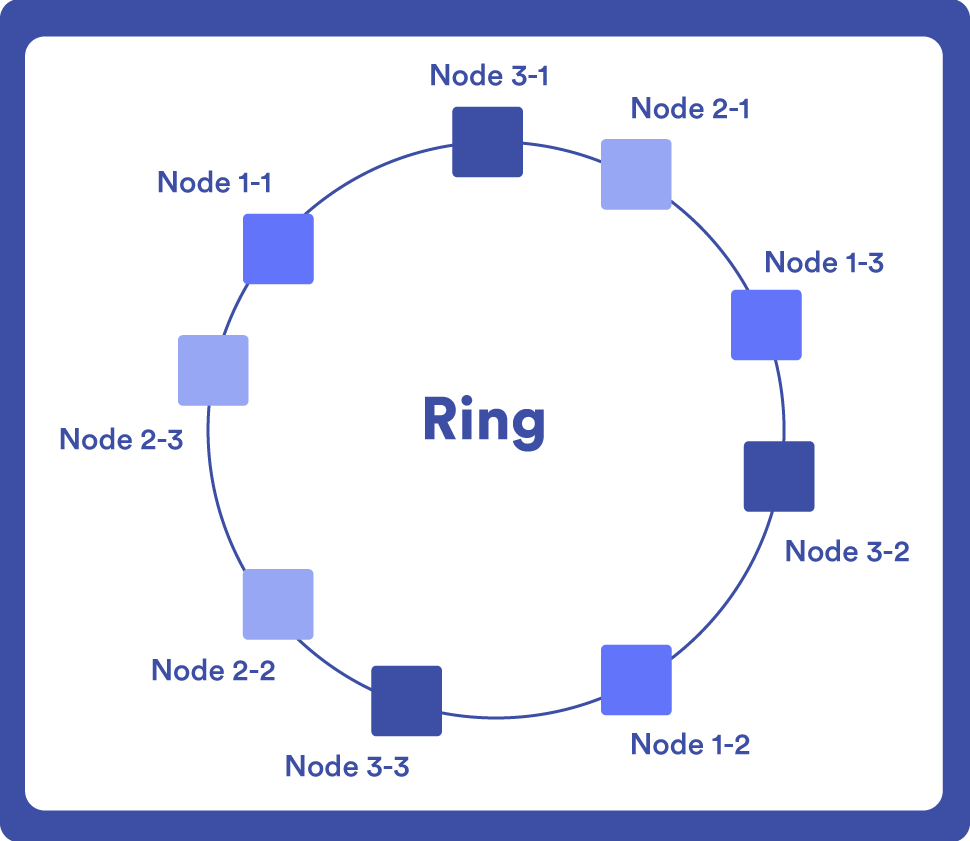
    Nodes are represented in a circular ring and each data is assigned to a node using a hash function. When a new node is added to the system, the data is redistributed between the existing nodes and the new node.
    The hash works as a unique identifier so that when you make a query, you just have to locate that point on the ring.
    An example of a NoSQL database that uses “Consistent Hashing” is DynamoDB, since one of its strengths is incremental scaling, and to achieve this it needs a procedure capable of fractionating data dynamically.

Replication in NoSQL databases

It consists of creating copies of the data on multiple machines. This process seeks to improve database performance by distributing queries among different nodes. At the same time, it ensures that the information will continue to be available, even if the hardware fails.
The two main ways to perform data replication (in addition to the Consistent Hashing that we already mentioned in the previous section) are:

Master-slave server

Writing is made to the primary node and from there data is replicated to secondary nodes.

Peer to peer

All nodes in the cluster have the same hierarchical level and can accept writing. When data is written to one node it spreads to all the others. This ensures availability, but can also lead to inconsistencies if conflict resolution mechanisms are not implemented (for example, if two nodes try to write to the same location at the same time).

CAP theorem and consistency of NoSQL databases.

The CAP theorem was introduced by Professor Eric Brewer of the University of Berkeley in the year 2000. He explains that a distributed database can meet two of these three qualities at the same time:

  • Consistency: All requests after the writing operation get the same value, regardless of where the queries are made.
  • Availability: The database always responds to requests, even if a failure takes place.
  • Partition Tolerance: The system continues to operate even if communication between some nodes is interrupted.

Under this scheme we could choose a DBMS that is consistent and partition tolerant (MongoDB, HBase), available and partition tolerant (DynamoDB, Cassandra), or consistent and available (MySQL), but all three features cannot be preserved at once.
Each development has its requirements and the CAP theorem helps us find the DBMS that best suits your needs. Sometimes it is imperative for data to be consistent at all times (for example, in a stock control system). In these cases, we usually work with a relational database. In NoSQL databases, consistency is not one hundred percent guaranteed, since changes must propagate between all nodes in the cluster.

BASIS and eventual consistency model in NoSQL

BASE is a concept opposed to the ACID properties (atomicity, consistency, isolation, durability) of relational databases. In this approach, we prioritize data availability over immediate consistency, which is especially important in applications that process data in real time.

The BASE acronym means:

  • Basically Available: The database always sends a response, even if it contains errors if readings occur from nodes that did not yet receive the last writing.
  • Soft state: The database may be in an inconsistent state when reading takes place, so you may get different results on different readings.
  • Eventually Consistent: Database consistency is reached once the information has been propagated to all nodes. Up to that point we talk about an eventual consistency.

Even though the BASE approach arose in response to ACID, they are not exclusionary options. In fact, some NoSQL databases like MongoDB offer configurable consistency.

Tree indexing in NoSQL databases. What are the best-known structures?

So far we have seen how data is distributed and replicated in a NoSQL database, but we need to explain how it is structured efficiently to make its search and retrieval easier.
Trees are the most commonly used data structures. They organize nodes hierarchically starting from a root node, which is the first tree node; parent nodes, which are all those nodes that have at least one child; and child nodes, which complete the tree.
The number of levels of a tree determines its height. It is important to consider the final size of the tree and the number of nodes it contains, as this can influence query performance and data recovery time.
There are different tree indexes that you may use in NoSQL databases.

B Trees

They are balanced trees and perfect for distributed systems for their ability to maintain index consistency, although they can also be used in relational databases.
The main feature of B trees is that they can have several child nodes for each parent node, but they always keep their height balanced. This means that they have an identical or very similar number of levels in each tree branch, a particularity that makes it possible to handle insertions and deletions efficiently.
They are widely used in filing systems, where large data sets need to be accessed quickly.

T Trees

They are also balanced trees that can have a maximum of two or three child nodes.
Unlike B-trees, which are designed to make searches on large volumes of data easier, T-trees work best in applications where quick access to sorted data is needed.

AVL Trees

They are binary trees, which means that each parent node can have a maximum of two child nodes.
Another outstanding feature of AVL trees is that they are balanced in height. The self-balancing system serves to ensure that the tree does not grow in an uncontrolled manner, something that could harm the database performance.
They are a good choice for developing applications that require quick queries and logarithmic time insertion and deletion operations.

KD Trees

They are binary, balanced trees that organize data into multiple dimensions. A specific dimension is created at each tree level.
They are used in applications that work with geospatial data or scientific data.

Merkle Trees

They represent a special case of data structures in distributed systems. They are known for their utility in Blockchain to efficiently and securely encrypt data.
A Merkle tree is a type of binary tree that offers a first-rate solution to the data verification problem. Its creator was an American computer scientist and cryptographer named Ralph Merkle in 1979.
Merkle trees have a mathematical structure made up by hashes of several blocks of data that summarize all transactions in a block.

Data is grouped into larger datasets and related to the main nodes until all the data within the system is gathered. As a result, the Merkle Root is obtained.

How is the Merkle Root calculated?

1. The data is divided into blocks of a fixed size.

2. Each data block is subjected to a cryptographic hash function.

3. Hashes are grouped into pairs and a function is again applied to these pairs to generate their corresponding parent hashes until only one hash remains, which is the Merkle root.

The Merkle root is at the top of the tree and is the value that securely represents data integrity. This is because it is strongly related to all datasets and the hash that identifies each of them. Any changes to the original data will alter the Merkle Root. That way, you can make sure that the data has not been modified at any point.
This is why Merkle trees are frequently employed to verify the integrity of data blocks in Blockchain transactions.
NoSQL databases like Cassandra draw on these structures to validate data without sacrificing speed and performance.

Comparison between NoSQL database management systems

From what we have seen so far, NoSQL DBMSs are extraordinarily complex and varied. Each of them can adopt a different data model and present unique storage, consultation and scalability features. This range of options allows developers to select the most appropriate database for their project needs.
Below, we will give as an example two of the most widely used NoSQL DBMSs for the development of scalable and high-performance applications: MongoDB and Apache Cassandra.

MongoDB

It is a documentary DBMS developed by 10gen in 2007. It is open source and has been created in programming languages such as C++, C and JavaScript.

MongoDB is one of the most popular systems for distributed databases. Social networks such as LinkedIn, telecommunications companies such as Telefónica or news media such as the Washington Post use MongoDB.
Here are some of its main features.

  • Database storage with MongoDB: MongoDB stores data in BSON files (binary JSON). Each database consists of a collection of documents. Once MongoDB is installed and Shell is running, you may create the DB just by indicating the name you wish to use. If the database does not already exist, MongoDB will automatically create it when adding the first collection. Similarly, a collection is created automatically when you store a file in it. You just have to add the first document and execute the “insert” statement and MongoDB will create an ID field assigning it an ObjectID value that is unique for each machine at the time the operation is executed.
  • DB Partitioning with MongoDB: MongoDB makes it easy to distribute data across multiple servers using the automatic sharding feature. Data fragmentation takes place at the collection level, distributing documents among the different cluster nodes. To carry out this distribution, a “partition key” defined as a field is used in all collection documents. Data is fragmented into “chunks”, which have a default size of 64 MB and are stored in different shards within the cluster, ensuring that there is a balance. MongoBD monitors continuously chunk distribution among the shard nodes and, if necessary, performs automatic rebalancing to ensure that the workload supported by these nodes is balanced.
  • DB Replication with MongoDB: MongoDB uses a replication system based on the master-slave architecture. The master server can perform writing and reading operations, but slave nodes only perform reads (replica set). Updates are communicated to slave nodes via an operation log called oplog.
  • Database Queries with MongoDB: MongoDB has a powerful API that allows you to access and analyze data in real time, as well as perform ad-hoc queries, that is, direct queries on a database that are not predefined. This gives users the ability to perform custom searches, filter documents, and sort results by specific fields. To carry out these queries, MongoDB uses the “find” method on the desired collection or “findAndModify” to query and update the values of one or more fields simultaneously.
  • DB Consistency with MongoDB: From version 4.0 (the most recent one is 6.0), MongoDB supports ACID transactions at document level. The “snapshot isolation” function provides a consistent view of the data and allows atomic operations to be performed on multiple documents within a single transaction. This feature is especially relevant for NoSQL databases, as it poses solutions to different consistency-related issues, such as concurrent writes or queries that return outdated file versions. In this respect, MongoDB comes very close to the stability of RDMSs.
  • Database indexing with MongoDB: MongoDB uses B trees to index the data stored in its collections. This is a variant of the B trees with index nodes that contain keys and pointers to other nodes. These indexes store the value of a specific field, allowing data recovery and deletion operations to be more efficient.
  • DB Security with MongoDB: MongoDB has a high level of security to ensure the confidentiality of stored data. It has several authentication mechanisms, role-based access configuration, data encryption at rest and the possibility of restricting access to certain IP addresses. In addition, it allows you to audit the activity of the system and keep a record of the operations carried out in the database.

Apache Cassandra

It is a column-oriented DBMS that was developed by Facebook to optimize searches within its platform. One of the creators of Cassandra is computer scientist Avinash Lakshman, who previously worked for Amazon, as part of the group of engineers who developed DynamoDB. For that reason, it does not come as a surprise that it shares some features with this other system.
In 2008 it was launched as an open source project, and in 2010 it became a top-level project of the Apache Foundation. Since then, Cassandra continued to grow to become one of the most popular NoSQL DBMSs.
Although Meta uses other technologies today, Cassandra is still part of its data infrastructure. Other companies that use it are Netflix, Apple or Ebay. In terms of scalability, it is considered one of the best NoSQL databases.

Let’s take a look at some of its key properties:

  • Database storage with Apache Cassandra: Cassandra uses a “Column Family” data model, which is similar to relational databases, but more flexible. It does not refer to a hierarchical structure of columns that contain other columns, but rather to a collection of key-value pairs, where the key identifies a row and the value is a set of columns. It is designed to store large amounts of data and perform more efficient writing and reading operations.
  • DB Partitioning with Apache Cassandra: For data distribution, Cassandra uses a partitioner that distributes data to different cluster nodes. This partitioner uses the algorithm “consistent hashing” to assign a unique partition key to each data row. Data possessing the same partition key will stay together on the same nodes. It also supports virtual nodes (vnodes), which means that the same physical node may have multiple data ranges.
  • DB Replication with Apache Cassandra: Cassandra proposes a replication model based on Peer to peer in which all cluster nodes accept reads and writes. By not relying on a master node to process requests, the chance of a bottleneck occurring is minimal. Nodes communicate with each other and share data using a gossiping protocol.
  • DB Queries with Apache Cassandra: Like MongoDB, Cassandra also supports ad-hoc queries, but these tend to be more efficient if they are based on the primary key. In addition, it has its own query language called CQL (Cassandra Query Language) with a syntax similar to that of SQL, but instead of using joins, it takes its chances on data denormalization.
  • DB Indexation with Apache Cassandra: Cassandra uses secondary indexes to allow efficient queries on columns that are not part of the primary key. These indices may affect individual columns or multiple columns (SSTable Attached Secondary Index). They are created to allow complex range, prefix or text search queries in a large number of columns.
  • DB Coherence with Apache Cassandra: By using Peer to Peer architecture, Cassandra plays with eventual consistency. Data is propagated asynchronously across multiple nodes. This means that, for a short period of time, there may be discrepancies between the different replicas. However, Cassandra also provides mechanisms for setting the consistency level. When a conflict takes place (for example, if the replicas have different versions), use the timestamp and validate the most recent version. In addition, perform automatic repairs to maintain data consistency and integrity if hardware failures or other events that may cause discrepancies between replicas take place.
  • DB Security with Apache Cassandra: To use Cassandra in a safe environment, it is necessary to perform configurations, since many options are not enabled by default. For example, activate the authentication system and set permissions for each user role. In addition, it is critical to encrypt data in transit and at rest. For communication between the nodes and the client, data in transit can be encrypted using SSL/TLS.

Challenges in managing NoSQL databases. How does Pandora FMS help?

NoSQL DBMSs offer developers the ability to manage large volumes of data and scale horizontally by adding multiple nodes to a cluster.
To manage these distributed infrastructures, it is necessary to master different data partitioning and replication techniques (for example, we have seen that MongoDB uses a master-slave architecture, while Cassandra prioritizes availability with the Peer to peermodel).
Unlike RDMS, which share many similarities, in NoSQL databases there is no common paradigm and each system has its own APIs, languages and a different implementation, so getting used to working with each of them can be a real challenge.
Considering that monitoring is a fundamental component for managing any database, we must be pragmatic and rely on those resources that make our lives easier.
Both MongoDB and Apache Cassandra have commands that return system status information and allow problems to be diagnosed before they become critical failures. Another possibility is to use Pandora FMS software to simplify the whole process.

How to do so?

If this is a database in MongoDB, download Pandora FMS plugin for MongoDB. This plugin uses the mongostat command to collect basic information about system performance. Once the relevant metrics are obtained, they are sent to Pandora FMS data server for their analysis.
On the other hand, if the database works with Apache Cassandra, download the corresponding plugin for this system. This plugin obtains the information by internally running the tool nodetool, which is already included in the standard Cassandra installation, and offers a wide range of commands to monitor server status. Once the results are analyzed, the plugin structures the data in XML format and sends it to Pandora FMS server for further analysis and display.
For these plugins to work properly, copy the files to the plugin directory of Pandora FMS agent, edit the configuration file and, finally, restart the system (the linked articles explain the procedure very well).
Once the plugins are active, you will be able to monitor the activity of the cluster nodes in a graph view and receive alerts should any failures take place. These and other automation options help us save considerable time and resources in maintaining NoSQL databases.

Create a free account and discover all Pandora FMS utilities to boost your digital project!

And if you have doubts about the difference between NoSQL and SQL you can consult our post “NoSQL vs SQL: main differences and when to choose each of them“.

About Version 2 Digital

Version 2 Digital is one of the most dynamic IT companies in Asia. The company distributes a wide range of IT products across various areas including cyber security, cloud, data protection, end points, infrastructures, system monitoring, storage, networking, business productivity and communication products.

Through an extensive network of channels, point of sales, resellers, and partnership companies, Version 2 offers quality products and services which are highly acclaimed in the market. Its customers cover a wide spectrum which include Global 1000 enterprises, regional listed companies, different vertical industries, public utilities, Government, a vast number of successful SMEs, and consumers in various Asian cities.

About PandoraFMS
Pandora FMS is a flexible monitoring system, capable of monitoring devices, infrastructures, applications, services and business processes.
Of course, one of the things that Pandora FMS can control is the hard disks of your computers.

×

Hello!

Click one of our contacts below to chat on WhatsApp

×