Skip to content

Synergizing WPA3 Security & NAC for Effective Wi-Fi Protection

Today, our reliance on wireless networks has soared to unprecedented heights and shows no signs of slowing. The convenience they offer comes hand in hand with a pressing need for security. As we move beyond the limitations of WPA2, the third iteration of Wi-Fi Protected Access (WPA3) has emerged as a stalwart guardian of wireless network security. Coupled with Network Access Control (NAC), these technologies form an impenetrable fortress, ensuring that our wireless communications remain private and shielded from malicious actors.

WPA3 Security: The Shield Against Attackers

WPA3 security represents a pivotal evolution in wireless protection, addressing vulnerabilities that were exposed in its predecessor, WPA2. One of the most notable improvements is the replacement of the outdated Pre-Shared Key (PSK) authentication with the Simultaneous Authentication of Equals (SAE) protocol. SAE significantly mitigates the risk of password cracking by using a secure key exchange process that resists offline attacks.

Moreover, WPA3 enhances security through its individualized data encryption. Unlike WPA2, where all devices on a network share the same encryption key, WPA3 security provides each device with a unique encryption key. This ‘forward secrecy’ prevents the compromise of one device’s key from affecting the security of others. Another crucial feature of WPA3 is the resistance to brute-force attacks. It enforces a rate-limiting mechanism that thwarts repeated login attempts, making it exceedingly difficult for attackers to exploit weak passwords.

NAC: Elevating Wireless Access Control

While WPA3 security marks a commendable leap forward, it is not a panacea. Network Access Control (NAC) steps in as a complementary layer of defense, fortifying wireless networks against a spectrum of threats. NAC’s fundamental premise revolves around controlling and managing device access based on various criteria before granting entry to the network. At its core, NAC verifies the identity and health status of devices seeking network access. It evaluates devices for compliance with security policies and checks for updated operating systems, security patches, and antivirus software. Any device failing these checks is either denied access or diverted to a remediation network where it can be updated and secured before accessing the main network.

One of the key advantages of NAC is its ability to enforce role-based access. Different users and devices can be granted varying levels of access based on their roles within the organization. This minimizes the attack surface by ensuring that only authorized personnel can access sensitive resources. Additionally, NAC excels in thwarting unauthorized device connections. Through its continuous monitoring and profiling capabilities, NAC can swiftly detect and block rogue devices attempting to gain entry. This feature is particularly critical in today’s world of IoT, where devices can be easily compromised and repurposed for malicious intent.

Synergizing WPA3 Security and NAC

The true strength of a security strategy lies in its layers. WPA3 and NAC, when combined, create a formidable barrier against cyber threats that individual solutions could hardly achieve. While WPA3 secures the communication channel itself, NAC extends its reach by ensuring that only authenticated and healthy devices gain entry. This synergy starts with a strong foundation: the impenetrable encryption offered by WPA3. Once devices pass through this first layer, NAC kicks in, scrutinizing them for compliance and identity verification. If a device fails any of these checks, NAC acts as a gatekeeper, preventing the device from accessing the network until the necessary security measures are taken.

Moreover, the integration of WPA3 and NAC facilitates robust user authentication. In combination with identity management systems, organizations can ensure that only authorized users can connect to the network, bolstering security against unauthorized access attempts.

As the world hurtles forward into an interconnected future, safeguarding our wireless networks is of paramount importance. The implementation of WPA3 addresses critical vulnerabilities and enhances encryption methods, but it is only part of the larger puzzle. Network Access Control, with its ability to enforce strict policies and monitor device health, provides the much-needed layer of protection that complements WPA3’s strengths.

The synergy between these technologies transforms wireless networks into resilient bastions against cyber threats. The days of relying solely on passwords and basic encryption are behind us; the age of WPA3 and NAC has dawned, promising a safer and more secure wireless landscape for organizations and individuals alike. As we continue to embrace innovation, let us not forget the vital role that security plays in ensuring a trustworthy and fortified digital world.

About Version 2 Digital

Version 2 Digital is one of the most dynamic IT companies in Asia. The company distributes a wide range of IT products across various areas including cyber security, cloud, data protection, end points, infrastructures, system monitoring, storage, networking, business productivity and communication products.

Through an extensive network of channels, point of sales, resellers, and partnership companies, Version 2 offers quality products and services which are highly acclaimed in the market. Its customers cover a wide spectrum which include Global 1000 enterprises, regional listed companies, different vertical industries, public utilities, Government, a vast number of successful SMEs, and consumers in various Asian cities.

About Portnox
Portnox provides simple-to-deploy, operate and maintain network access control, security and visibility solutions. Portnox software can be deployed on-premises, as a cloud-delivered service, or in hybrid mode. It is agentless and vendor-agnostic, allowing organizations to maximize their existing network and cybersecurity investments. Hundreds of enterprises around the world rely on Portnox for network visibility, cybersecurity policy enforcement and regulatory compliance. The company has been recognized for its innovations by Info Security Products Guide, Cyber Security Excellence Awards, IoT Innovator Awards, Computing Security Awards, Best of Interop ITX and Cyber Defense Magazine. Portnox has offices in the U.S., Europe and Asia. For information visit http://www.portnox.com, and follow us on Twitter and LinkedIn.。

It’s time to talk about cloud security

Reading about the cloud in 2023 has an almost nostalgic feeling to it, a bit like watching that HBO special for the 20th anniversary of the Harry Potter series. You suddenly realize how long it’s been since the whole conversation about cloud computing started.

The cloud has become such a common IT tool that today it is difficult to find an industry (or even a company) that does not use it to some extent. The chances are very high that you yourself are using it frequently.

So, we will not waste your time with generic information explaining the benefits and challenges of the cloud. Instead, we’ll get down to the nitty-gritty and discuss what’s really important — cloud data security.

First things first: What is cloud security?

Cloud data security could be explained as what organizations do to protect their cloud-based systems and applications — and the data they store in the cloud — against cyber threats.

You could also say that it is a set of strategies, procedures, and tools that, when properly applied, can help companies prevent unwanted data exposure or IT infrastructure damage caused by various internal or external factors.

Both explanations are correct. In fact, they complement each other and together provide more context — although they don’t give the whole picture.

Treating it more like a concept, we could say that cloud security is a complex and constantly evolving field in IT that requires attention from all organizations that have either fully or partially based their IT environment on the cloud. So, with that in mind, the question you may be asking yourself right now is…

Why is cloud security so important?

If we had to answer that in one sentence, it would probably be this: cloud security plays an essential role in ensuring the confidentiality, integrity, and availability of sensitive data stored in the cloud. But this only scratches the surface. So, allow us to elaborate a bit because there’s more to this matter than meets the eye.

Each year, more and more organizations start their digital transformation journeys and integrate cloud-based tools and services into their IT infrastructures. All of those companies — no matter if they are small businesses or large-scale enterprises — cannot afford to take any risks regarding the security of their digital assets.

This is why cloud security is one of the aspects that these companies must address if they decide to run even a tiny part of their activities in the cloud — or to keep their data inside one. If they don’t, they risk not only data loss or disruption of their business operations but also financial and reputational damage. They must be aware of the fact that keeping digital assets in the cloud doesn’t mean that they are unreachable to hackers.

This is to say that organizations should make every effort to ensure that their cloud cybersecurity is at the highest level at all times — after all, the success of their business endeavors depends on that.

Main risks associated with cloud security

Security issues in cloud computing often revolve around the potential for unauthorized access — but not only that. Below, you will find descriptions of some of the biggest threats that today’s companies must be aware of while developing their cloud security strategy. Whether a company will be able to address and manage these threats depends not only on the actions they take but also on its awareness of the emerging trends and disruptive forces shaping its industry.

  • Data breaches:

    Whenever an organization starts storing sensitive information in the cloud, it instantly becomes a target for cybercriminals — and they will try to find their way in. A successful breach could result in the exposure of the company’s confidential data including its financial records, customers’ personal information, or even intellectual property.

    In its “Cost of a data breach” report, IBM reveals that the global average cost of a data breach across all sectors in 2023 is almost $4.5 million — which is an amount that has increased by almost 15% over the last three years. This fact alone shows that companies cannot waste time, and they should introduce robust authentication mechanisms, encryption protocols, and access controls as soon as possible to protect themselves against this threat.

  • Insider threats and privilege abuse:

    It should be no surprise to anyone that employees with access to company data sometimes misuse their privileges or can be coerced into revealing sensitive information. This can lead to similar or even the same issues that arise due to data breaches.

    Hackers will use every vulnerability in security controls or protocols to gain unauthorized access to your systems and applications — and that is why companies must work on developing sound cybersecurity policies that, first, their employees will adhere to, and second, will help them mitigate the damage if one of their employees (whether intentionally or not) causes a potential cybersecurity threat.

  • Cloud service providers often operate on a global scale, helping customers from different parts of the world where different sets of data protection laws and regulations apply. It’s no rocket science to point out that complying with these diverse legal requirements can be a challenge for both cloud providers and their customers.

    Non-compliance with the standards may lead to serious financial or reputational losses. Thus, businesses must carefully navigate the regulatory landscape and choose cloud providers that meet the relevant criteria.

Best practices in cloud security

Before we discuss any cloud security best practices, we would like to point out that cloud security as a whole is a continuous process and, therefore, you should stay informed about the latest security trends and practices so that you can protect your cloud environment more effectively. In other words, do not think of the following examples as the only elements you should pay attention to when creating a cloud security strategy. Instead, treat them as a starting point.

  1. Encrypt your data: One of the foundational pillars of cloud security is encryption, which is the process of using combinations of sophisticated algorithms to make sure that no unauthorized party can access your data — whether at rest or in transit. Some cloud service providers offer built-in encryption features, which you can leverage to keep your data secure at all times. If they are not available to you from the get-go, consider using third-party encryption tools to protect your sensitive information.

  2. Implement and use identity and access management (IAM) tools: To manage user access and permissions effectively, you must implement a strong IAM strategy. For example, by following the principle of least privilege, you can ensure that only authorized users with specific roles can access your systems, applications, and data. In other words, you can use IAM tools to provide the right people with access to the right resources — and only them. This will help you protect sensitive information from being compromised.

  3. Carry out audits regularly and monitor all cloud activities: You can stay ahead of potential security risks if you conduct frequent security audits. That way, you will be able to identify cybersecurity areas that require improvement and take necessary measures to address them before any security breach occurs. If you pay close attention to what’s going on in your network, you’ll be able to detect and respond to any anomalies or potential threats before they cause damage.

  4. Find out what your provider does to ensure cloud security: When teaming up with a cloud service provider, you should take the time to understand their shared responsibility model and all the security features they offer. In other words, you should get familiar with your provider’s security practices and security to, first, double-check if their approach aligns with your organization’s specific security requirements, and second, to ensure that your sensitive data and applications are adequately protected in the cloud environment.

  5. Backup your data: You can enhance your organization’s cybersecurity by consistently backing up your business data in a highly secure location and rigorously testing the recovery process. If you take this proactive approach, you will be able to, in the unfortunate event of a security breach or data loss, quickly and seamlessly restore crucial data and applications. Not to mention that it will help you minimize downtime, safeguard your reputation, and ensure business continuity.

How does NordLocker fit into the context of cloud security?

To adequately answer this question, we need to start with a brief explanation of what NordLocker is, namely an end-to-end encrypted cloud storage platform that allows you to securely store, manage, and share your business data with company members and partners.

NordLocker was designed to help companies — no matter the size, location, and nature of their business — protect their digital assets in a highly secure, state-of-the-art cloud environment to which only they have access. Therefore, it is more than fair to say that NordLocker was created with cloud security in mind.

Thanks to its wide range of features — from end-to-end encryption, through multi-factor authentication (MFA), to zero-knowledge architecture (and everything in between) — NordLocker covers all the cybersecurity practices we discussed in this article to help its users create a much safer online business environment. It can help you do that as well.

That’s why we encourage you to go to NordLocker and learn more about the platform and get a 14-day free trial. That way, you will be able to see for yourself if NordLocker is the right fit for your business and if what we’re saying is true.

Enjoy the ride!

About Version 2 Digital

Version 2 Digital is one of the most dynamic IT companies in Asia. The company distributes a wide range of IT products across various areas including cyber security, cloud, data protection, end points, infrastructures, system monitoring, storage, networking, business productivity and communication products.

Through an extensive network of channels, point of sales, resellers, and partnership companies, Version 2 offers quality products and services which are highly acclaimed in the market. Its customers cover a wide spectrum which include Global 1000 enterprises, regional listed companies, different vertical industries, public utilities, Government, a vast number of successful SMEs, and consumers in various Asian cities.

About NordPass
NordPass is developed by Nord Security, a company leading the global market of cybersecurity products.

The web has become a chaotic space where safety and trust have been compromised by cybercrime and data protection issues. Therefore, our team has a global mission to shape a more trusted and peaceful online future for people everywhere.

The ever-evolving landscape of cloud security trends

In today’s business environment, cloud computing is the most flexible and cost-efficient method to set up operations. Yet, as businesses increasingly rely on cloud-based services to store, manage, and exchange data, this attracts unwanted guests.

Consequently, there has been a significant increase in data breaches, disrupting business operations and jeopardizing companies’ security and compliance worldwide. These breaches often stem from attackers exploiting vulnerabilities and misconfigurations in cloud systems.

This blog will cover the most recent cloud security trends that are shaping the industry. By keeping up with these developments, businesses can enhance the protection of their digital assets and reinforce the security of their cloud computing infrastructure to mitigate potential breaches.

Key takeaways

  • Cloud computing offers businesses cost-efficiency, flexibility, and scalability, but it also introduces security vulnerabilities and risks

  • The shared responsibility model requires cloud providers to secure the infrastructure while customers secure their data and applications

  • The cloud security landscape is constantly evolving and businesses need to keep up with new trends

  • Cloud security has progressed significantly with improvements in data protection, network security, and connectivity

  • The future of cloud security will see more integration of AI and machine learning

  • To keep up with the trends, organizations can regularly update security policies, implement advanced threat detection, embrace automation, and foster a culture of security awareness

Understanding the concept of cloud security and why it matters today

Cloud computing solves many business problems like scalability, cost-efficiency, and flexibility. At the same time, for most businesses, it also means stepping into unfamiliar territory where it’s easy to leave gaps that hackers could exploit.

The shared responsibility model is also something that needs to be established. In it, the cloud provider is responsible for securing the underlying cloud infrastructure, while the customer is responsible for securing their data and applications. Though it sounds simple, it’s not always easy to crystallize a comprehensive cloud security approach.

As more organizations embrace cloud adoption and rely on cloud services, the need for effective cloud security measures has never been greater.

Evolutions in cloud security

Cloud security has come a long way since its inception. Initially, concerns regarding data protection and network security limited cloud adoption (as well as a requirement for stable online connectivity). Fortunately, as cloud technology has matured, so has its security.

The concept of cloud computing emerged in 1950 with the development of mainframe computers, which could be accessed through thin or static clients. Since then, cloud computing has undergone several iterations, progressing from static clients to dynamic ones, from software-based systems to service-oriented solutions.

Security problems started cropping up when businesses began entrusting their data to major companies like Amazon. Despite the numerous benefits and efficiency improvements, storing critical data on servers that customers couldn’t physically access challenged the conventional notion of security. As data storage expanded in type and volume, hosting companies implemented more extensive precautions to safeguard the data.

The current state of cloud security

Today’s cloud service providers go to great lengths to protect the data stored on their servers. This includes thorough employee background checks to minimize the risk of insider attacks and isolation procedures that prevent one company from accessing another’s data. Yet, it’s still the user’s responsibility to ensure secure passwords and connections like they would have if the data were stored locally.

Encryption of data at rest and in transit, network segmentation, and adopting cybersecurity mesh architectures have all enhanced cloud security. As cloud environments become increasingly complex and multi-cloud adoption rises, ensuring consistent security across different platforms and providers becomes challenging. This emphasizes the need for ongoing security training and proactive new technologies adoption.

Security teams must be aware of the latest cloud security trends to stay ahead of the ever-changing threat landscape. Here are the main ones you should be aware of:

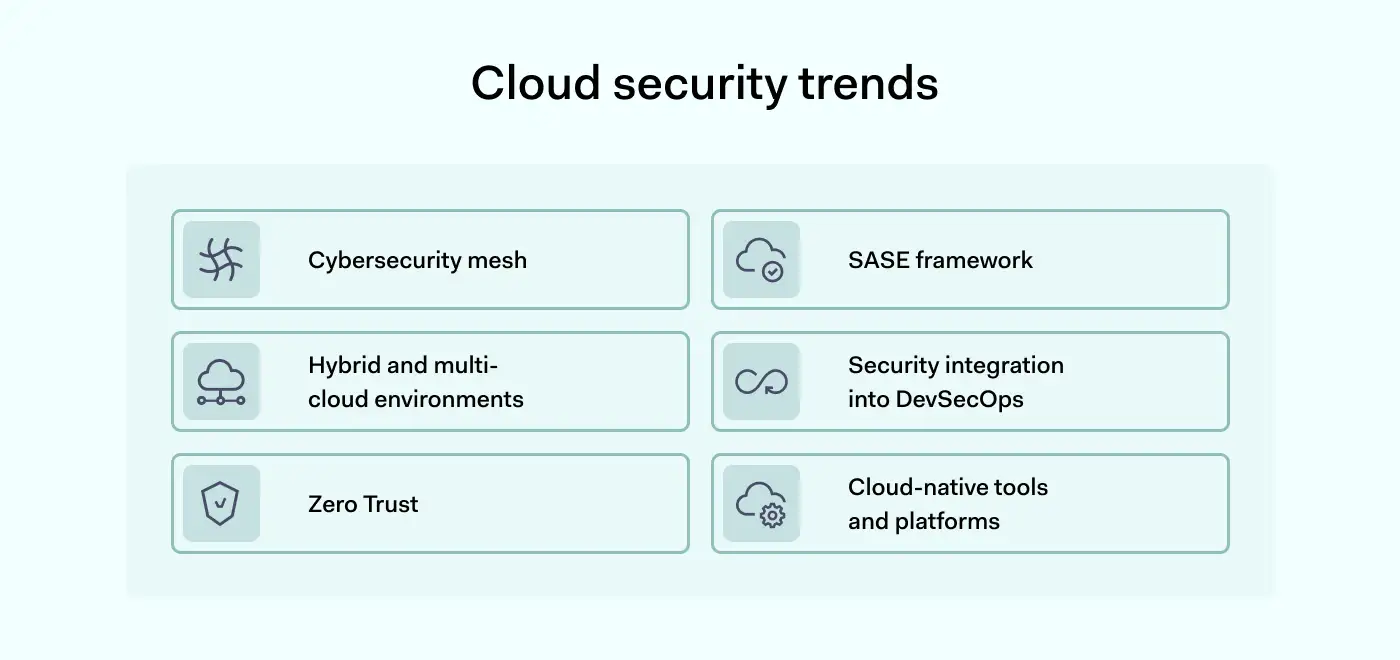
1. Cybersecurity mesh

Companies are adopting the concept of cybersecurity mesh to ensure the security of data and assets in the cloud. This approach involves creating a distributed network and infrastructure that forms a security perimeter around the individuals and devices connected to the network. By implementing cybersecurity mesh, companies can centrally manage data access and enforce security policies, aligning with Zero Trust architecture principles.

2. Hybrid and multi-cloud environments

The trend in cloud security involves adopting a hybrid approach or leveraging multiple cloud services. Organizations can migrate their data entirely to the cloud or keep some data and services hosted privately. The hybrid approach combines local and cloud-hosted services, allowing for more secure deployments. Additionally, using multiple clouds has gained popularity, with companies adopting a multi-cloud strategy. This approach allows for better utilization of security tools across different environments, such as SIEM and threat intelligence.

3. Zero Trust

The principle of Zero Trust emphasizes verifying rather than blindly trusting anything within or outside an organization’s perimeters. With the increasing reliance on cloud services, Zero Trust should be a priority for all organizations. Traditional perimeter security measures and firewalls are insufficient to protect valuable resources such as user data and intellectual property. Zero Trust enhances security around every device, user, and connection, enabling proactive threat management and comprehensive defense strategies.

4. SASE framework

Gartner has stated that the future of network security lies in the cloud. The Secure Access Service Edge (SASE) framework offers a cloud-based cybersecurity solution that supports digital enterprises’ dynamic and secure access needs. It combines wide area networking (WAN) capabilities with multiple security features such as anti-malware and security brokers to establish a comprehensive security environment within a cloud infrastructure. SASE is an essential framework for securely connecting users, systems, and endpoint devices to a unified cloud environment.

5. Security integration into DevSecOps

DevSecOps is a methodology that integrates security protocols throughout the software development lifecycle (SDLC). Organizations can address threats proactively rather than reactively by incorporating security measures early in the development process. DevSecOps is particularly effective in fast-paced, fully automated software development lifecycles, enabling secure innovation. Collaboration between DevOps and security teams is essential to implement strong security measures throughout the entire supply chain and make security a continuous process within the continuous integration/continuous delivery pipeline.

6. Cloud-native tools and platforms

Cloud-native applications designed specifically for the cloud environment are becoming increasingly prevalent. These applications take advantage of the speed and efficiency offered by cloud platforms. Traditional security tools designed for on-premises applications may not be adequate to protect cloud-based resources. Companies recognize the need to invest in cloud-based security tools and platforms to safeguard their cloud resources against potential attacks.

While cloud security progresses along with cloud computing, it’s crucial to acknowledge the dark side of trends that security teams must address. Attackers are finding new ways to exploit vulnerabilities, and organizations must be cautious. Here are the emerging threats directed at cloud computing security:

Slow patching leaves web services vulnerable

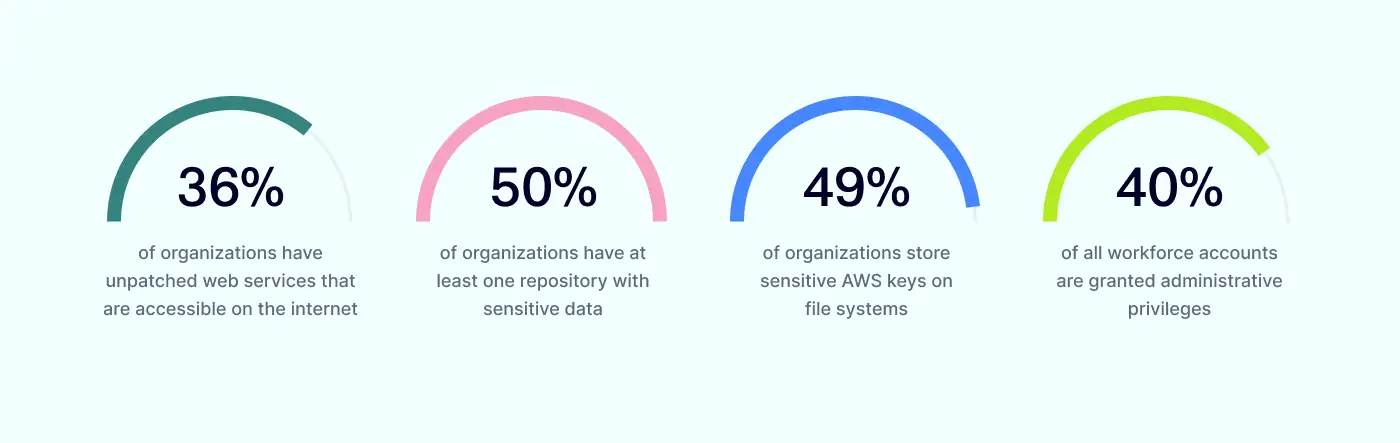
Based on the Orca Security report, 36% of organizations have web services in their cloud environment that are accessible to the Internet but remain unpatched. Such services pose a significant risk as they contain known vulnerabilities and bugs, which can serve as primary entry points for attacks on cloud environments. The absolute majority of cyber-attacks on cloud infrastructure begin with the exploitation of these known vulnerabilities.

Unpatched vulnerabilities provide malicious actors with easy access to cause service downtime, enable remote code execution, or facilitate unauthorized remote access in certain cases. Users must promptly apply fixes through updates or patches to contain potential risks.

Git repositories containing sensitive data

Storing sensitive data in Git repositories should be avoided at all costs. It may include information like database passwords, API keys, encryption keys, hash salts, and secrets, which can be mistakenly pushed into a Git repository. While it deviates from security practices, the inclusion of this data into the source code of an application might inadvertently leak it to hackers. Therefore, repositories must be checked for sensitive information, which should be removed from the repository and its history.

AWS keys storage on file systems

At least 49% of organizations store sensitive AWS keys on file systems within virtual machines. AWS keys can function as backdoors to your system. They can grant access to all your resources and the ability to perform any operation, like launching EC2 instances or deleting S3 objects. Therefore, it’s crucial always to store your AWS keys separately and avoid sharing them with external parties.

Instead of AWS, it’s a good practice to use temporary credentials. They include an access key ID and secret access key that would also include a security token specifying the expiration date of the credentials.

Too many administrators for a single organization

Single sign-on providers suggest putting limits on the administrative privileges. For instance, only 50% of admins should have super admins privileges, if you have more, you’re risking your organization’s security. This is much more than it would be advisable, as administrators have many permissions that directly relate to your information security.

As a rule of thumb, it’s generally inadvisable, except in exceptional circumstances, not to define an IAM role with full administrative privileges. Such a role grants anyone who assumes it the ability to perform any action on any resource within the account. This violates the Principle of Least Privilege (PoLP), significantly expands the attack surface, and increases the risk of a full account takeover.

The road ahead: future of cloud security

Looking ahead, the future of cloud security is full of challenges and opportunities. One of the most obvious courses for development is the continued integration of artificial intelligence and machine learning into cloud security operations. These technologies will enable autonomous threat detection, automated incident response, and adaptive security measures.

The speed at which these developments will reach the end-users depend on the service providers’ initiatives to invest in advanced technologies. Yet, it’s likely that the shared responsibility model will continue to be relevant, and while the user will be provided with more tools, it will still be needed to make sense of the provided data and act on it.

Conclusion

Cloud security is an ever-evolving landscape with new trends and challenges emerging regularly. For this reason, organizations must stay alert and recognize the importance of cloud security and its recent developments.

By adopting advanced technologies, adopting proactive security measures, and fostering collaboration with cloud providers, organizations can navigate the complex cloud environment while safeguarding their data, applications, and infrastructure against evolving security threats.

FAQs

What is the role of AI in cloud security?

AI can be used to enhance threat detection and response capabilities by analyzing vast amounts of data and identifying patterns that may indicate security threats or anomalies. In addition, AI can assist in automating security tasks, such as security patching, vulnerability management, and incident response. This can help prevent various types of attacks like malware, phishing attempts, and data breaches, reduce the workload on security teams, and improve overall efficiency.

What is a cloud access security broker (CASB), and how does it contribute to cloud security?

CASB is an intermediary between an organization’s premises infrastructure or network and cloud service providers. It helps organizations extend their security policies and controls to the cloud environment. Offering a range of security functionalities, it also helps to expand visibility into cloud storage, data loss prevention (DLP), access control, threat detection, encryption, and compliance monitoring.

How does the Zero Trust model enhance cloud security?

The Zero Trust model enhances cloud security by shifting the traditional perimeter-based security approach to a more dynamic and granular model. Instead of blindly trusting users or devices within a network, Zero Trust assumes that all network traffic, whether from inside or outside the network, is potentially malicious and must be verified before granting access. That way, organizations can reduce the risk of lateral movement within their cloud environment, mitigate the impact of compromised credentials, and improve overall security posture.

What strategies can organizations adopt to stay ahead of future cloud security trends?

To stay ahead of future cloud security trends, organizations can:

  • Regularly assess and update security policies

  • Implement advanced threat detection and response capabilities

  • Embrace automation and orchestration

  • Foster a culture of security awareness

All of these actions improve overall business security posture and help stay one step ahead of unauthorized access attempts.

How can NordLayer help?

As cloud computing is at the center of modern business operations building, its security is at the forefront of business priorities. A robust cloud security strategy must include access controls, encryption, firewalls, and auditing. However, finding a reliable partner isn’t always easy.

NordLayer can be a helpful ally when securing public and private cloud infrastructure setups. Using our Virtual Private Gateways, SaaS applications, and other resources can be reached efficiently but securely. With features like IP allowlisting, overall business network security posture is improved, allowing only authorized personnel to access your cloud environments.

Identity checks can be enforced using 2FA and SSO to ensure secure authentication. A tandem of all of these features makes cloud security management safer and easier to manage.

Contact the NordLayer team to learn more about how your cloud infrastructure could be secured.

About Version 2 Digital

Version 2 Digital is one of the most dynamic IT companies in Asia. The company distributes a wide range of IT products across various areas including cyber security, cloud, data protection, end points, infrastructures, system monitoring, storage, networking, business productivity and communication products.

Through an extensive network of channels, point of sales, resellers, and partnership companies, Version 2 offers quality products and services which are highly acclaimed in the market. Its customers cover a wide spectrum which include Global 1000 enterprises, regional listed companies, different vertical industries, public utilities, Government, a vast number of successful SMEs, and consumers in various Asian cities.

About NordLayer
NordLayer is an adaptive network access security solution for modern businesses – from the world’s most trusted cybersecurity brand, Nord Security.

The web has become a chaotic space where safety and trust have been compromised by cybercrime and data protection issues. Therefore, our team has a global mission to shape a more trusted and peaceful online future for people everywhere.

23.6.9 ‘Voyager’ released

Changes compared to 23.6.8

New Features

  • Added support for performing backups to a WebDAV based Storage Vault

Enhancements

  • Added support for macOS client notarization using notarytool (Xcode 13 or later) with a fallback to altool if not installed. Note: Apple’s notary service will not accept uploads from altool or Xcode 13 or earlier starting November 1, 2023. See this link for details
  • Added the ability to verify if versioning is enabled on the bucket when setting up Object Lock on supported S3-backed Storage Templates
  • Improved performance for accessing Storj.io Storage Vaults
  • Improved the documented types in the PHP SDK

Bug Fixes

  • Fixed an issue with WebAuthn logins for non-OIDC admins failing in the Comet Server web interface
  • Fixed an issue with jobs not appearing when clicking on segments on the Recent Activity page of the Comet Server web interface
  • Fixed an issue with the Application Aware Writer live picker in the Comet Backup desktop app not accurately displaying what is selected
  • Fixed a cosmetic issue with certain characters showing incorrectly in the Microsoft 365 Protected Item dialog in the Comet Server web interface
  • Fixed an issue with the Storage Vault “Test Connection” button crashing the Comet Server web interface when Storage Role is disabled

About Version 2 Digital

Version 2 Digital is one of the most dynamic IT companies in Asia. The company distributes a wide range of IT products across various areas including cyber security, cloud, data protection, end points, infrastructures, system monitoring, storage, networking, business productivity and communication products.

Through an extensive network of channels, point of sales, resellers, and partnership companies, Version 2 offers quality products and services which are highly acclaimed in the market. Its customers cover a wide spectrum which include Global 1000 enterprises, regional listed companies, different vertical industries, public utilities, Government, a vast number of successful SMEs, and consumers in various Asian cities.

About Comet
We are a team of dedicated professionals committed to developing reliable and secure backup solutions for MSP’s, Businesses and IT professionals. With over 10 years of experience in the industry, we understand the importance of having a reliable backup solution in place to protect your valuable data. That’s why we’ve developed a comprehensive suite of backup solutions that are easy to use, scalable and highly secure.

×

Hello!

Click one of our contacts below to chat on WhatsApp

×