





Closing the gap: Power your CMDB with cyber asset management for better ROI
A proactive security program begins with knowing what is on your network through a comprehensive asset inventory. Instead of searching for a fit-for-purpose solution, many organizations use their existing configuration management database or CMDB for asset inventory. On the surface, it makes sense. CMDBs are designed to track data relating to managed IT assets, such as routers, switches, or servers. CMDBs should contain all the configuration items (CIs) needed for IT service management (ITSM), IT asset management (ITAM), or IT operations management (ITOM).
The reality does not live up to the promise, though. According to Gartner, only 25% of organizations achieve meaningful value with their CMDBs. Let’s dig into why and how a cyber asset management solution can improve the accuracy and fullness of your CMDB data.
CMDBs store data, cyber asset management discovers assets #
CMDBs track CIs but do not discover anything themselves. CMDBs learn of these CIs through a companion discovery tool which is likely not getting the information you need. Examples of these discovery tools include ServiceNow Discovery, BMC Discovery, and Atlassian Insight Discovery.
On the other hand, a cyber asset management system discovers and maintains an accurate inventory of all assets on the network, not just IT but also IoT and OT devices. The rich data it stores on all types of assets goes beyond details relating to IT operational efficiency but also security controls, insecure configurations, vulnerabilities, and more. It’s not to be confused with ITAM, which manages the end-to-end lifecycle of assets, or ITSM, which strives to deliver IT services to end users efficiently.
Default CMDBs discovery tools cover only managed IT assets #
The majority of default CMDB discovery capabilities perform authenticated active scans against managed assets. These scans cover a limited range of devices across the IT infrastructure–including virtual machines, servers, and laptops, all managed IT. By taking the approach of relying on the CMDB’s discovery tools, you miss other critical asset types, including:
- Unmanaged devices:
These devices have slipped through the cracks due to scenarios ranging from staffing changes to updates to business strategy to mergers & acquisitions. Unmanaged devices can take many forms, including shadow IT, rogue devices, and orphaned devices. If you’re only monitoring managed devices, you’re completely overlooking unmanaged devices, so you can’t keep an eye on them. Additionally, they carry with them unknown exposure or risk. - Corporate IoT devices:
In recent years, the use of IoT devices has skyrocketed in the workplace. With this surge, organizations have even more devices to manage and secure from potential threats than ever before. From internet-connected camera systems and locks to the smart fridge in the break room and temperature and humidity management systems, these can all pose additional opportunities for hackers to fly under the radar to recon the rest of your network. With only a partial view into what’s on the network, you’re missing valuable insight for full protection. - OT devices:
Businesses in industries ranging from manufacturing and energy to government and healthcare all leverage operational technology (OT) devices. They can include field devices, programmable logic controllers (PLC), and human-machine interfaces (HMIs), vital to these businesses. These devices use real-time operating systems (e.g., Wind River VxWorks), often incompatible with the authenticated scans that log in via WMI or SSH, which you find on time-sharing operating systems like Windows and Linux. Additionally, IT and security teams often intentionally exclude OT devices from active scans because they are prone to disruption. By capturing only a portion of the assets on your network, you’re left with an incomplete asset inventory.
CMDBs aren’t trusted sources for all assets if the data is inaccurate #
Beyond incompleteness, data inaccuracy is also a major concern. If you are relying on your CMDB to be a source of truth, you need to be able to trust the information in it. The data in a CMDB will only be as good as its sources.
According to Gartner, nearly one-third of CMDB challenges stem from data completeness or quality concerns due to how data is entered into the system. There are a few input methods, but the most commonly used are manual entry and authenticated active scanning. While authenticated active scans are relatively accurate for managed IT devices, they often misidentify the hardware. Manual entry, on the other hand, does not scale and is prone to error. In fact, 60% of data manually input by employees is inaccurate.
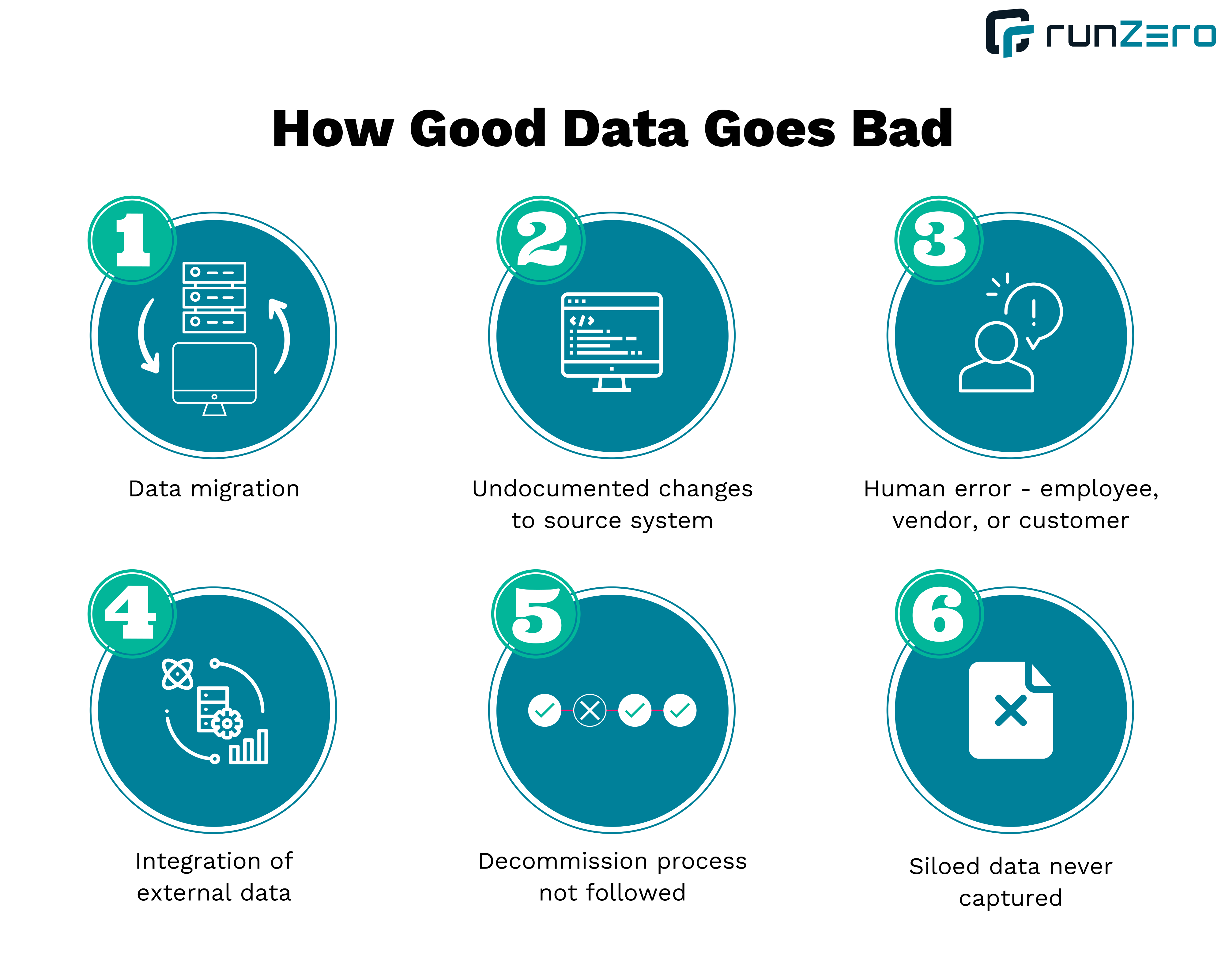
CMDBs’ challenges around completeness and accuracy compound as asset counts continue to rise. If teams struggle to keep their CMDBs up-to-date, accurate, and therefore beneficial, then it’s not a big surprise that, according to Gartner, 80% of CMDB projects have been shown to add no value to the business.
Discover the true cost of CMDBs in the infographic below.

CMDBs powered by runZero #
If your investment in a CMDB will come up short in value and ROI, how do we avoid some of these pitfalls and improve the outlook? Use a cyber asset management solution to inform and guide your CMDB. You can make the most of your investment with both solutions working together.
runZero was purpose-built to combat the challenges and requirements of cyber asset management, which is not what default CMDB discovery tools were designed to do and why they fall short. Below are the key areas where runZero can improve your CMDB accuracy:
Full Coverage #
While the default CMDB discovery tools are effective at only capturing managed IT devices, runZero performs unauthenticated active scans to safely and quickly provide a complete and accurate asset inventory of all IT, IoT, and OT devices, whether they are managed or unmanaged.
Accurate Data #
Default CMDB discovery tools rely on authenticated scanning or manual entry as their data source, which can misidentify and miss devices not on your corporate network. They are also not purpose-built for asset inventory, so their fingerprinting falls below expectations. runZero’s source of data comes from a combination of API integrations and unauthenticated active scanning, which allows for highly accurate fingerprinting and offers real-time updates and accurate data synchronization automatically for data you can trust.
Quick Time To Value #
Discovery for CMDBs typically requires large, specialized teams following a complex process consisting of many steps for successful implementation. Alternatively, getting started with runZero involves the deployment of Explorers, after which you can run initial scans. You can get started in minutes without the hassle and time of coordinating a large team effort.
An authoritative source of asset data, including IT, IoT, OT #
runZero is a cyber asset management solution that can help you build complete, comprehensive asset inventories of your managed and unmanaged assets on any network–corporate, cloud, or home–and in any infrastructure, IT, IoT, or OT. Since runZero combines APIs with active scanning, doesn’t require credentials, and has extensive fingerprinting capabilities, it can discover and identify a wider breadth of assets with far more depth. You can integrate runZero seamlessly with CMDBs, like ServiceNow, to enrich their data, or you can leverage runZero as a standalone asset inventory solution.
runZero scales up to millions of devices, but it’s easy to try. The free 21-day trial even downgrades to a free version for personal use or organizations with less than 256 devices. Find out what’s connected to your network in less than 20 minutes.
Data sources:

How Should AI Be Regulated To Ensure Cybersecurity Safeguards?

We’re living in an age where an algorithm could either help us buy the perfect gift for a loved one or potentially drain our bank account in a fraction of a second. As AI’s capabilities expand and increase, its impact on cybersecurity—both positive and negative—becomes more pressing, necessitating an urgent conversation about regulatory frameworks.
With this in mind, let’s dive into the complex relationship between AI and cybersecurity and explores how judicious regulation can turn the tides in our favor. How should AI be regulated? Should it be regulated at all? And what restrictions are countries around the world putting in place?
Should AI Be Regulated?
While AI is nothing new, its capabilities and popularity have rapidly expanded in the last few years. OpenAI’s ChatGPT, a natural language processing chatbot, has already massively disrupted workplaces, with the chatbot helping people write code, emails, and content. It set the record for the fastest user growth in January, reaching over 100 million active users just two months after launch. And its competitors, Microsoft Bing AI, Google Bard, Chatsonic, and others, and similarly gaining traction.
With this surge in popularity has come new conversations about the role of AI and whether we need to put on the breaks or quickly establish some rules and regulations surrounding it. And these concerns aren’t just coming from tech-skeptics. Google President of Global Affairs Kent Walker said that AI “is too important not to regulate.” And OpenAI’s CEO Sam Altman said, “I try to be upfront… Am I doing something good? Or really bad?”. In other words, the very people developing these tools are also keenly aware of the damage they can cause if left unchecked.
So far, much of the discourse surrounding AI regulation has focused on the following areas:
- AI Art and Copyright: AI can create artwork similar to human works, potentially infringing on copyrights. There’s also debate over who owns the copyright of AI-generated art.
- Natural Language Models: Advanced AI models can produce text that’s hard to distinguish from human-written content, leading to worries about disinformation, privacy invasion, and economic impacts.
- Academic Integrity: AI could be used to write essays or dissertations, challenging academic integrity and making plagiarism detection difficult.
- Ethics and Bias: AI can inadvertently amplify societal biases, which calls for regulations ensuring fairness.
- Privacy and Surveillance: Concerns about AI’s potential in violating privacy and enabling mass surveillance.
- Autonomous Decision Making: In areas like autonomous vehicles or weaponry, regulation is needed to ensure safety and accountability.
However, as our reliance on AI grows, more specific concerns are coming to light – like cybersecurity. With AI, hackers can craft human-like text, generate phishing emails, and automate the creation of malicious content. For example, an AI model trained on known vulnerabilities can generate new malware, making it a potent weapon in the hands of cybercriminals. And we’re already seeing this happen – AI cyber-attacks are here.
The ways in which cybercriminals can leverage AI for nefarious gains are as expansive as they are severe. Here are some of the ways cybercriminals can use AI to enhance the efficiency and effectiveness of their attacks:
- Automated Hacking: AI can be programmed to identify system vulnerabilities and exploit them much faster than a human hacker could. They can perform brute force attacks more efficiently, constantly altering their approach until they find a successful pathway.
- Spear Phishing: AI can gather and analyze vast amounts of personal data from social media and other online sources to create highly personalized phishing messages, making them more believable and increasing the likelihood of success.
- AI-Generated Deepfakes: AI can create realistic fake audio and video, known as deepfakes, that can be used for disinformation campaigns or to impersonate individuals for fraudulent purposes.
- Malware: AI can be used to create more sophisticated malware that can adapt and learn from the security measures it encounters, making it harder to detect and neutralize.
- Evasion: Advanced AI systems can learn to evade detection systems, making attacks harder to identify and respond to. They can also mimic normal user behavior, making their malicious activities blend in with regular network traffic.
- DDoS Attacks: AI can enhance Distributed Denial of Service (DDoS) attacks by learning to identify network weaknesses and optimizing the attack strategy.
For many, cybercriminals’ potential misuse of AI underscores the need for robust cybersecurity measures, including tighter regulation.
The Case Against AI Regulation
Despite the dangers of unregulated AI, some people prefer no or very little regulation. Put simply, opponents of AI regulation argue that it could stifle innovation and progress. Regulations are often slow to adapt and may fail to keep pace with the rapid evolution of AI technologies. Strict regulatory oversight could also create high barriers to entry, favoring established companies and hindering start-ups and smaller businesses.
Furthermore, overly prescriptive rules could limit AI’s creative and beneficial applications. Critics also note the global nature of AI development; if strict regulations are imposed in one country, research and development might shift to less regulated regions. Lastly, they argue that existing laws covering areas like copyright, defamation, and data protection are often sufficient to manage AI’s current level of sophistication and that we should address future concerns reactively as AI capabilities continue to advance.
A Wild West AI Landscape
While some people would prefer a more wild-west style AI landscape, those people are largely absent from the cybersecurity community. As we touched on, the potential misuse of AI for cybercrime is too great. In an increasingly severe threat landscape, cybersecurity professionals need all the help we can get.
And this is why we see reputable cybersecurity calling for tighter regulations or working independently to develop safer practices around AI. For example, NIST recently released a risk-management framework to combat malicious AI.
Cybersecurity Professionals Aren’t Anti-AI
Before we dive into some specifics around how we should regulate AI in cybersecurity, it’s important to understand the critical role AI plays in cybersecurity.
When cyber professionals call for more regulation, they’re not calling for AI bans – AI is a potent tool for cybersecurity. For example, experts increasingly believe that AI is key to ensuring IoT security in the digital age. Similarly, AI is making identity authentication safer and more robust, preventing unauthorized access to sensitive data and systems.
And the list goes on. Cybersecurity teams leverage AI to detect malware., recognize phishing attempts, automate threat hunting, predict attacks, mitigate DDoS attacks, and speed up incident response.
How Should AI Be Regulated? A Cybersecurity Perspective
In the next section, we’re going to dive into AI regulation around the world. That can tell us a lot about how governments think about AI and its continued role in our societies. However, these regulations are coming from a holistic perspective – they’re answering the question, “How should AI be regulated?” and not “How can we regulate AI to bolster cybersecurity.” Of course, a well-regulated AI landscape should also positively impact cybersecurity, but it’s not necessarily the first priority in making legislation.
With that in mind, here are some recommendations on how we could regulate AI to improve cybersecurity and safeguard our systems.
Legislation
First, we need to establish clear-cut legislation that determines what constitutes appropriate AI usage in cybersecurity. Governments should work alongside international organizations, AI experts, and industry stakeholders to create and adopt AI ethical guidelines. The legislation should articulate the rights, responsibilities, and liabilities of AI users and manufacturers. For instance, in case of a security breach due to faulty AI, who should be held accountable? The user, the manufacturer, or both?
Certification and Standards
Regulatory efforts should include establishing certification processes and standards for AI systems. These standards should guide the design, development, deployment, and maintenance of AI in cybersecurity. They should cover aspects such as data privacy, transparency, accountability, and robustness of the AI system. Organizations such as ISO and IEC can play a vital role in developing these standards.
- ISO 27001, the international standard for Information Security Management Systems, can be updated to incorporate AI-related cybersecurity risks.
- IEC 62443, the series of standards for Industrial Communication Networks, can incorporate guidelines for AI usage in industrial cybersecurity.
Privacy Laws
One key aspect of AI regulation is data privacy. Data fuels AI and an enormous amount of data is often needed to train effective AI models. Consequently, data privacy laws should be revised and strengthened to ensure they fit the AI era. These laws should dictate what data can be used, how it can be used, and for how long.
AI Transparency and Explainability
A significant issue with AI is the ‘black box’ problem – the lack of transparency about how AI makes its decisions. Regulation should necessitate AI systems to have some degree of explainability. This transparency can help cybersecurity professionals better understand and trust the AI’s decisions, particularly in detecting potential threats.
Public-Private Partnership
The public and private sectors should collaborate to combat cybersecurity threats effectively. Governments should incentivize private companies to invest in AI-driven cybersecurity measures. Similarly, private firms should aid governments by sharing their technical expertise and insights on the latest threats.
Education and Awareness
To create an AI-literate society, education and awareness about AI and its implications for cybersecurity are crucial. Governments should integrate AI and cybersecurity topics into educational curriculums. Businesses should also run regular training and awareness programs for their staff.
Mandatory Disclosure of AI Breaches
Governments could require that businesses disclose any data breaches within a specific timeframe. This transparency would keep organizations accountable and help identify and address potential flaws in AI security measures.
Independent Auditing
Regular third-party audits of AI systems could be a prerequisite for their use in cybersecurity. These audits would provide an external perspective on the organization’s AI usage, ensuring that it aligns with regulatory and ethical standards.
Global Cooperation
Given the borderless nature of the internet and cyber threats, international cooperation is essential for AI regulation. We can establish global forums to share best practices, discuss emerging threats, and propose collective responses. Cybersecurity threats are global and should be the response.
Regulating AI Supply Chain
Given that AI systems are often composed of various components sourced from different vendors, there should be regulations to ensure the security of the entire AI supply chain. Standards for the components, vendors’ security practices, and transparency about the origin of the components could be part of these regulations.
User Consent and Control
Regulations could give users more control over how AI uses their data, requiring explicit consent for data collection and usage. This user-centric approach can help create a balance between leveraging AI for cybersecurity and respecting individual privacy rights.
Responsible AI Development
Regulations should promote the development of AI systems with a built-in “safety-first” approach. This includes mechanisms to prevent unauthorized access, detect anomalous behavior, and limit the AI’s actions if it deviates from expected behavior.
AI Regulation Around the World
We’ve seen a recent surge in discussions around AI regulation worldwide. For example, Japanese Prime Minister Fumio Kishida headed into the recent G7 meeting signaling his desire to launch the Hiroshima AI Process – a coordinated approach to AI governance, especially generative AI, like ChatGPT.
The EU, the US, China, and other countries have already been developing their approaches to AI regulation, which often take different forms.
For example, one key decision policymakers have to make is choosing between a “horizontal” or a “vertical” method. A horizontal strategy entails crafting a single, all-encompassing regulation to address the multitude of impacts posed by AI. Conversely, a vertical strategy tailors specific regulations to manage distinct applications or varieties of AI.
We already see some differences here. For example, while neither the European Union nor China has chosen a strictly horizontal or vertical path for their AI governance, they do show preferences. The EU’s AI Act leans horizontally, aiming to create a broad and comprehensive regulatory framework. In contrast, China’s algorithm regulations tend to take a vertical stance, focusing on custom rules for specific AI applications.
EU AI Regulation
The AI Act, a landmark legislation in Europe, sets out to regulate artificial intelligence (AI) based on its potential harm. It received the green light from leading parliamentary committees of the European Parliament on May 11, 2023, preparing it for final approval in mid-June.
The Act prohibits specific AI applications like manipulative techniques and social scoring. And following the insistence of left-to-center MEPs, the ban was extended to include AI models for biometric categorization, predictive policing, and the harvesting of facial images for database creation. Additionally, emotion recognition software is now outlawed in law enforcement, border management, workplaces, and education.
Biometric identification systems, initially permitted under specific circumstances such as kidnapping or terrorist attacks, became a contentious point. Despite resistance from the conservative European People’s Party, Parliament ultimately passed a complete ban.
The original AI Act did not address AI systems without specific purposes. However, the rapid success of large language models, like ChatGPT, necessitated a rethink on how to regulate this kind of AI, resulting in a tiered approach. The Act does not cover General Purpose AI (GPAI) systems by default. Instead, it imposes most obligations on operators that incorporate these systems into high-risk applications.
The Act introduces stricter rules for high-risk AI applications. An AI system is considered high-risk if it significantly threatens people’s health, safety, or fundamental rights.
Critically, the EU AI regulation could see significant players in the AI game, like OpenAI, leaving the EU altogether. OpenAI’s CEO said, “The current draft of the EU AI Act would be over-regulating.”
US AI Regulation
While not as far along in the AI regulation journey as the EU, the US is taking deliberate steps toward regulation. The White House released a Blueprint for an AI Bill of Rights on October 4, 2022, establishing key principles for the design and use of AI. These guidelines include protections such as shielding individuals from algorithmic discrimination and enabling people to opt out of automated systems. The Blueprint builds on the Biden-Harris Administration’s mission to regulate big tech, protect American civil rights, and make technology work in favor of its people.
The Blueprint lays out five core protections for Americans:
- Safe and Effective Systems: Protection from unsafe or ineffective AI systems.
- Algorithmic Discrimination Protections: No individual should face discrimination from algorithms. Systems should be designed and utilized equitably.
- Data Privacy: Protection from abusive data practices with built-in safeguards. Individuals should have control over how their data is used.
- Notice and Explanation: Individuals should be made aware when an automated system is in use and understand how and why it impacts them.
- Alternative Options: Individuals should be able to opt out of automated systems when appropriate and have access to a person who can address and rectify any issues encountered.
In response to the bill, several federal agencies are drafting new rules. For example, The Federal Trade Commission (FTC) is preparing rules to restrict commercial surveillance, algorithmic discrimination, and negligent data security practices. And the Department of Labor is also protecting workers’ rights by enforcing surveillance reporting requirements.
More recently (May 4, 2023), Biden summoned CEOs of Google and Microsoft to the White House to discuss AI. It’s not yet clear what resulted from this meeting, but presumably, The White House wants to know what these companies are doing to manage the dangers surrounding AI.
China AI Regulation
China’s AI regulations, while on paper, seem more expansive than other nations, are pretty vague. This is actually by design. China’s central government tends to publish vague outlines so that local governments have a high-level view of what the central government wants but still have room to experiment. At the same time, it allows government regulators to flexibly control technology companies as needed.
But what do the regulations say? For AI-based recommendation algorithms, the regulation addressed their use in disseminating information, pricing, and worker deployment. It mandated that providers “vigorously disseminate positive energy” and avoid price discrimination or overworking delivery drivers. The second regulation, addressing deep synthesis algorithms (which generate new content like deepfakes), requires the providers to get consent from individuals if their images or voices are manipulated.
UK AI Regulation
Following its exit from the EU, the UK is now responsible for managing its own AI regulations and is somewhat behind the other nations on this list. No specific AI regulations are in place yet, but there are moves toward regulation.
For example, the Financial Conduct Authority (FCA) is currently consulting with several legal and academic institutions, including the Alan Turing Institute, to enhance its understanding of AI technology and its implications. And to investigate the impacts of AI, the UK’s competition regulator announced in May that it would initiate a comprehensive examination of the technology’s effects on consumers, businesses, and the overall economy.
Interestingly, the UK has decided not to establish a new, centralized body governing AI. Instead, in a statement made in March, the UK government expressed its plans to divide the responsibility among its existing regulators. The regulators for human rights, health and safety, and competition will each have a role in overseeing AI within their respective spheres. This approach is presumably to leverage the specialized knowledge and experience these regulators already have in their fields while adding the new responsibility of managing AI’s impact.
Final Thoughts
Here’s the bottom line. While fostering innovation in AI is essential, regulation is vital to ensuring robust cybersecurity safeguards. As AI technology continues to evolve, so does the threat landscape, with an escalating number of AI-based cyberattacks causing notable concern. This trend suggests that our systems will become increasingly susceptible to advanced AI-driven threats. The future of a secure digital world will largely depend on our ability to govern AI effectively and responsibly today. Let’s rise to the challenge and ensure we build a safe and secure cyber ecosystem for all.
Cloud Security Myths – Debunked!

Cloud computing has become an integral part of the modern technological landscape, offering numerous benefits such as scalability, cost-efficiency, and flexibility. However, there are several misconceptions and myths surrounding the security of cloud services that often lead to apprehension and doubts. Today, we’re here to debunk some common cloud security myths to provide a clearer understanding of the actual security measures implemented by reputable cloud providers. By dispelling these myths, we aim to help organizations make informed decisions and confidently embrace the potential of cloud computing while ensuring the protection of their data and applications.
Myth 1: Cloud is inherently insecure
One of the most common misconceptions about cloud computing is that it is inherently insecure. In reality, cloud providers invest significant resources into ensuring the security of their infrastructure. They employ advanced security measures, such as encryption, access controls, and regular security audits, to protect data stored in the cloud. However, the security of cloud services also relies on how well they are configured and used by their customers.
Myth 2: Cloud providers have access to all your data
Some people worry that by storing data in the cloud, they are surrendering complete control to the cloud provider. In reality, reputable cloud providers have strict data protection policies in place. They implement strong encryption techniques to ensure that only authorized users can access the data. The provider typically operates under a shared responsibility model, where they are responsible for securing the infrastructure, while customers are responsible for securing their own data and applications within the cloud.

Myth 3: Cloud services are more prone to data breaches
While it is true that high-profile data breaches have occurred in the past, these incidents are not exclusive to the cloud. Both cloud and on-premises environments can fall victim to security breaches. In fact, cloud providers often have more resources dedicated to security than individual organizations. Cloud services can provide robust security measures, including firewalls, intrusion detection systems, and advanced threat intelligence, which can enhance overall security when properly configured and managed.
Myth 4: Cloud services are not compliant with regulations
Another misconception is that using cloud services may violate industry-specific regulations and compliance requirements. In reality, many cloud providers comply with various regulatory frameworks, such as HIPAA, GDPR, and PCI DSS. These providers implement security controls and offer features that help customers meet their compliance obligations. However, it’s crucial for organizations to assess the compliance capabilities of a cloud provider and ensure they align with their specific requirements before migrating sensitive data to the cloud.
Myth 5: Cloud backups are not reliable
Cloud backups are often more reliable than traditional on-premises backups. Reputable cloud providers employ redundant storage systems, distributed data centers, and automated backup processes to ensure data durability and availability. They also perform regular integrity checks to verify the integrity of the backed-up data. However, organizations should still follow best practices, such as maintaining local backups and testing restoration processes periodically, to mitigate any potential risks.

Myth 6: Cloud computing eliminates the need for IT security measures
Transitioning to the cloud does not absolve organizations from implementing proper security measures. While cloud providers handle the security of the underlying infrastructure, customers are still responsible for securing their applications, configurations, access controls, and data within the cloud environment. Implementing strong authentication mechanisms, applying security patches, and employing encryption are some of the essential practices that organizations should follow to enhance cloud security.
While concerns regarding cloud security are understandable, many common myths surrounding cloud security are based on misconceptions. By understanding the shared responsibility model, evaluating cloud providers’ security capabilities, and implementing appropriate security measures, organizations can leverage the benefits of cloud computing while maintaining a strong security posture.

What is cloud network security?

Cloud network security is a general term for the measures needed to secure virtualized cloud environments. It covers policies, processes, controls, and technologies. And it applies to private, public, and hybrid cloud deployments.
Basics of cloud network security
Cloud network security resembles traditional on-premises network security but with important divergences related to defending virtualized environments.
Like on-premises security, cloud network security defends network assets against external threats. Security systems for the cloud assess access requests and authorize users to access resources. They provide visibility for security managers, including real-time alerts and audit logs. And they neutralize malware and illegitimate data transfers.
Unlike standard security solutions, cloud defenses are not based on-site. Cloud security systems function via software-defined networking tools. Virtual gateways reside in the cloud, where they can protect applications and data from access requests – wherever users may be.
The context: understanding cloud computing

The user’s apps and data reside off-site, removing the need for on-premises hardware. Instead, network resources are “virtualized”. Resources are accessible to the owner or user, but they are hosted by cloud providers.
Users can choose to access software-as-a-service (SaaS) apps. Or they can build customized cloud deployments via platform-as-a-service (PaaS). In all cases, security is a shared responsibility between users and cloud service providers (CSPs).
Providers must secure hardware used to host cloud apps or data. Users must protect any data passing through cloud environments. They are also responsible for managing access to cloud assets.
Elements of cloud network security
Cloud network security solutions vary, but could include:
Integrated cloud security stacks – Includes next-generation firewall protection, anti-virus and anti-bot tools, intrusion prevention systems, controls for individual apps, IAM, and data loss prevention tools.
Sanitization – Systems can filter low-level traffic and remove potential threats, without the need for full-scale inspection.
Exploit protection – Protection against known Zero Day Exploits, with data derived from the latest threat intelligence.
Traffic inspection – Inspection of SSL/TLS traffic passing throughout virtualized environments. Analyzes encrypted traffic without compromising speed.
Centralized security administration – Solutions cover all cloud applications and storage assets. They integrate seamlessly with existing resources (including on-premises networks), providing total awareness of network activity.
Segmentation – Cloud network security applies micro-segmentation to limit user permissions and guard confidential data.
Remote access – Ensures secure access for remote workers and third parties. Users can connect to cloud assets safely from any location.
Automation tools – Includes automated extension to newly installed cloud services. Automated workflows blend ease of use and security, allowing companies to harness the potential of the cloud.
Simple integration – Cloud security tools integrate with legacy applications, operating systems, and third-party security systems.
The importance of cloud network security
The cloud is everywhere in modern life. Businesses, non-profits, and government agencies all rely on cloud infrastructure to deliver services and host workloads. But the rise of the cloud has created new security vulnerabilities. This means that organizations need to rethink their network security policies.
Traditional on-premises networks have simple security architecture. Central resources are protected by the network perimeter. Endpoints are few in number and easy to monitor. Access patterns and user communities change slowly, if at all. In this context putting in place firewalls and threat detection systems is relatively simple.
Cloud network security presents a different set of challenges.
In the cloud, there is no standard network perimeter. Users can access cloud gateways anywhere. IT teams rarely manage on-premises resources. Instead, cloud assets are maintained by cloud providers on servers across the world.
A public cloud environment can change rapidly. Employees might spin up new SaaS instances or cloud APIs. Staff could bring online new cloud storage containers to backup data or handle overflows.
Security teams need to maintain awareness, track user activity, and neutralize threats. Organizations need a cloud network security strategy that locks down critical cloud assets while enabling users to take advantage of cloud computing.
Cloud network security benefits
Adopting a cloud network security strategy has many advantages. The benefits of retooling your security setup for the cloud include:
Improved data security
The most important benefit of cloud network security is enhanced protection for sensitive data.
Cloud security solutions encrypt data at rest on the cloud. If files are stolen, cybercriminals will not be able to read data easily. Encryption of data in transit also makes it harder to track information flows and launch targeted interception attacks.
Micro-segmentation separates confidential data from the rest of an organization’s cloud network. Data resides in software-defined compartments that are accessible with the right credentials. Cloud security systems can define these segments at a granular level.
Better visibility for administrators
IT teams need visibility to monitor threats and user activity. But legacy security solutions are not well-adapted to discovering cloud apps and tracking activity in a cloud environment.
Cloud-native network security systems bring together all virtualized assets. Admins can monitor network activity in real-time via a single pane of glass. And automated alerts deliver information about potential threats before they become critical.
Simplified cloud policy management
Security policies should reflect the security needs of network owners and be delivered to all users. But delivering security policies consistently in cloud settings is a complex task. Unified cloud network security systems solve this problem.
IT teams can automatically deliver updated security policies to endpoints. Cloud-native solutions also make it easier to deliver policies across hybrid or multi-cloud environments.
Threat analysis and neutralization
Cloud resources are vulnerable to data breach attacks. Compromised remote access devices, phishing emails, and credential theft are common entry methods. Cloud-native security controls are the only effective response.
Robust security systems detect, contain, and neutralize malicious threats before they cause damage.
Cloud network security uses threat intelligence to counter the latest threats. Intrusion detection systems guard cloud gateways and scan network traffic. Anti-bot scanners also track emerging DDoS attacks. This prevents downtime from traffic flood attacks.
Security automation
Automation allows IT teams to work efficiently and securely. Users can automatically extend access controls and threat detection to new cloud resources. There is no need for lengthy manual configuration processes. New services receive instant coverage, limiting the risk of human error.
Cloud network security challenges

Understanding shared responsibility
Under the shared responsibility model, CSPs and users share responsibility for securing cloud resources. This is accepted by users when they source cloud solutions. But determining areas of security responsibility can be difficult.
Cloud users must secure apps and data stored on the cloud. They must manage user access and monitor external threats.
CSPs are responsible for securing cloud infrastructure. They harden cloud servers to block data thieves or viruses.
This model leaves scope for overlap and confusion. For example, cloud users may rely on encryption provided by their cloud service provider. As a result, users may not apply encryption for data in transit or use Data Loss Prevention tools.
It’s essential to define areas of responsibility before activating cloud services. Most SaaS providers build security features into their products. But users always have a role to play, and this varies between different cloud contexts.
Managing dynamic cloud environments
Change is a core feature of cloud deployments. Apps come online constantly. Configurations may change to reflect developing workflows. New users connect from home or abroad. And individual employees can connect cloud containers with a few mouse clicks.
Automation can sometimes make this problem worse. For instance, companies may use autoscaling to build cloud deployments quickly. This boosts efficiency, but it also leaves security teams scrambling to catch up.
Cloud network security systems need to adapt to change. Admins must track access requests, respond to alerts, and discover threats if they infiltrate network infrastructure. This is even harder in hybrid environments that mix on-premises systems with extensive public and private cloud deployments.
Cloud network security best practices
Achieving cloud security can be challenging. But managing cloud security is far from impossible, even for small businesses. Follow these cloud network security best practices and build a security solution that meets your goals:
1. Apply Zero Trust principles
Zero Trust Network Architecture (ZTNA) is a security model that teaches users to trust no one. This is a good rule to apply when securing cloud infrastructure.
Avoid situations where users have global network privileges, and adopt a denial-by-default stance. Require more than one authentication factor when allowing user access. And segment cloud environments to limit east-west movement within the network.
Zero Trust changes the focus of security strategies to meet cloud computing needs. Instead of policing the network edge, admins concentrate on managing identities. This is a good fit for dynamic cloud environments. Deployments may constantly change. But user communities are easier to manage.
2. Lock down interfaces between the cloud and the internet
Internet-facing assets are a critical security risk. Access portals, web forms, and email accounts connect with the wider internet. This makes them common vectors for malware and data theft attacks.
Configure cloud apps to minimize contact with the internet. If necessary, leverage threat protection tools to guard vulnerable points. Web Application Firewalls (WAF) can deny access to suspicious network traffic. DDoS and intelligent detection systems handle malicious agents that breach the firewall.
Set automated alerts to inform admins about potential risks. When building cloud network security systems, prioritize internet-facing assets. Carry out enhanced risk assessments, log user activity, and test access controls to secure entry points.
3. Use micro-segmentation to protect critical data
Cloud security systems usually include the ability to micro-segment networks. Micro-segmentation lets you guard critical data with an additional layer of protection. This has security benefits, while also helping companies comply with relevant data security regulations.
4. Use private cloud solutions to enhance security
Private clouds allow users to communicate and collaborate without creating links to the external internet. This limits the scope for attackers, whether they use email phishing or malware injection.
Build networks that blend private and public cloud tools without compromising security. Determine which workflows require internet access. Switch everything else to private access technology that does not require external IP addresses.
5. Work with partners to establish security responsibilities
The principle of shared responsibility divides security functions between service providers and consumers.
Before commissioning new SaaS or IaaS products, be clear about security responsibilities. Create a security policy for each cloud service explaining your areas of responsibility and the security controls you will use. This should complement your cloud partner’s security policy. There should be no areas of ambiguity.
6. Write and deliver clear cloud security policies
Robust cloud network security rests upon good documentation and organization.
Cloud security policies define the controls used to secure cloud resources. This could include multi-factor authentication, Identity and Access Management, and data encryption. Policies also inform users about their security responsibilities.
Every SaaS app or cloud-hosted database should have a security policy. Store policies centrally. And use automated delivery to ensure that policies are implemented consistently and rapidly.
The role of AI and machine learning in cloud network security
Cloud network security is advancing all the time. And one of the most exciting research areas is the application of Artificial Intelligence to secure cloud environments.
AI harnesses machine learning to assess cloud security threats. Also known as User and Entity Based Analytics (UEBA), this technology scans user activity to detect malicious agents. AI engines compare real-time user behavior to logs of previous activity. In theory, this information helps to authenticate legitimate users and unmask intruders.
However, UEBA faces some challenges before becoming mainstream. For example, AI requires structured data sets and huge amounts of information to function properly. Generating useful data takes time and may also breach privacy regulations.
Attackers will also adapt to the use of machine learning. Expect to see Advanced Persistent Threats (APTs) that gather user activity data and build fake profiles to fool UEBA scanners. If IT teams rely too much on AI, this could become a security threat.
Cloud network security: key takeaways
Legacy security systems were designed for on-premises networking. Next-generation cloud security tools are built into the cloud, where they operate alongside SaaS apps and cloud infrastructure.
Threat detection systems neutralize malware attacks.
Access management tools block unauthorized users.
Segmentation keeps high-value assets safe behind additional barriers.
Encryption conceals data from external intruders
These features work together to mitigate security risks associated with the cloud. In a world where businesses depend on cloud infrastructure, robust cloud network security is essential.
Looking for a cloud network security solution?
NordLayer will help you build customized cloud network security architecture. Our products include a range of cloud-native features to protect data and enable secure collaboration. For example, users benefit from:
Seamless identity management.
Threat blocking tools to analyze network traffic and block cloud threats.
Secure gateways link remote workers to the cloud
Control access with IP allowlisting.
Achieve reliable, comprehensive cloud network security. Get in touch with NordLayer and discuss your options today.

