Skip to content

Use JumpCloud RADIUS for FortiGate Group Authentication

JumpCloud delivers single sign-on (SSO) to everything, including RADIUS authentication and authorization for network devices. Multi-factor authentication (MFA) is environment wide, delivering Push MFA for RADIUS. RADIUS is a core network protocol that’s widely used for Wi-Fi authentication, and it provides authentication, authorization, and accounting (AAA). 

JumpCloud Cloud RADIUS simplifies and secures privileged administrative access for network admins. It’s also an option to configure access to LANs for all of your SSL VPN users. JumpCloud eliminates the need to use Fortinet’s FortiTokens for MFA.

This two-part blog series explores two use cases with FortiGate next-generation firewall:

  • Option 1: Use existing local FortiGate groups that contain FortiGate remote users. This approach is ideal for existing appliances that already have settings and users.
  • Option 2: Use remote groups (JumpCloud) and attribute mapping to set up access control on a new Fortinet device. This approach spares admins the work of having to establish local groups using ACLs on the Fortinet appliance.

This article focuses on Option 1.

We’ll demonstrate how to bind the local user to the JumpCloud RADIUS server that is configured inside your FortiGate so that JumpCloud becomes the authentication authority without changing anything in the way the appliance is configured for network posture. 

Note: It’s also possible to accomplish this using a different brand of network appliance.

Configuring JumpCloud RADIUS and Groups

Follow this guide to get started with JumpCloud groups. You may also refer back to this previous tutorial on how to configure SAML access for Fortinet devices if it better suits your requirements. However, RADIUS has the advantage of also mapping groups and authorizations/permissions.

Establishing Groups and MFA

You may have MFA required for individual users or leverage groups with conditional access. Skip this step if you’ve already configured your access control policies.

To require MFA factors for the User Portal on an individual user account:

  1. Edit a user or create a new user in the Admin Portal. See Getting Started: Users.
  2. In the User Security Settings and Permissions section, select Require Multi-Factor Authentication for User Portal option. Note: The enrollment period only affects TOTP MFA. See Considerations
  3. Click save user.

To require MFA factors for the User Portal on existing users from the more actions menu:

  1. Select any users you want to require MFA for.
  2. Click more actions, then select Require MFA on User Portal.
  3. Specify the number of days the user has to enroll in MFA before they are required to have MFA at login. You can specify a number of days between 1 and 365. The default value is 7 days.
  4. Click require to add this requirement to the selected users.

To require MFA factors with a Conditional Access Policy: 

  1. Log in to the Admin Portal: https://console.jumpcloud.com/
  2. Go to SECURITY MANAGEMENT > Conditional Policies. 
  3. Click (+). 
  4. Enter a unique Policy Name.
  5. Optionally, enter a description for the policy.
  6. If you don’t want the policy to take effect right away, toggle the Policy Status to OFF and finish the rest of the configuration. When you’re ready to apply the policy, you can toggle the Policy Status to ON. 
  7. For users, choose one of the following options:
    • Select All Users if you want the policy to apply to all users. 
    • Select Selected User Groups if you want the policy to apply to specific user groups, then search for those user groups and select them. If you need to create user groups, see Getting Started: Groups
    • If there are User Groups you want to exclude from the policy, search for the user groups and select them in the search bar under Excluded User Groups.
  8. Optionally, set the conditions a user needs to meet. Note: Conditions is a premium feature available in the Platform Plus plan. Learn more about conditions in Getting Started: Conditional Access Policies
  9. In Action, select Allow authentication into selected resources, then select the Require MFA option. 
  10. Click create policy. 

Two JumpCloud groups were created for the purpose of this tutorial:

  • RADIUS-FortiGate_VPN_Users
  • RADIUS-FortiGate_Admins

Setting Up RADIUS

Create a RADIUS server in JumpCloud:

  1. Log in to the JumpCloud Admin Portal: https://console.jumpcloud.com/login.
  2. Go to RADIUS.
  3. Click (+). The new RADIUS server panel appears.
  4. Configure the RADIUS server:
    • Enter a name for the server. This value is arbitrary.
    • Enter a public IP address from which your organization’s traffic will originate.
    • Provide a shared secret. This value is shared with the device or service endpoint you’re pairing with the RADIUS server.
  5. Select an identity provider.

Now select an authentication method:

  • To use certificate authentication, select Passwordless.
    • Once Passwordless has been selected, the Save button will be disabled until a certificate has been successfully uploaded (or the authentication method has been changed back to Password).
  • If desired, select Allow password authentication as an alternative method.
    • If this checkbox is selected, admins can enable certificates for some users while allowing others to continue validating by username and password. Users will continue to have the option to validate by username and password, but once they choose to validate with certificates and a valid certificate is found, the password option will no longer be presented.
    • The MFA Configuration section will be available if using JumpCloud as the identity provider, and Passwordless is selected as the Authentication Method, and the Allow password authentication as an alternative method checkbox is selected.
  • Configuring multi-factor authentication (MFA).
    • ​​Toggle the MFA Requirement option to “enabled” for this server. This option is disabled by default.
    • Select Require MFA on all users or Only require MFA on users enrolled in MFA.
      • If selecting Require MFA on all users, a sub-bullet allows for excluding users in a TOTP enrollment period, but this does not apply to JumpCloud Protect™ (users in a TOTP enrollment period who are successfully enrolled in Protect will still be required to complete MFA).
      • If JumpCloud Protect is not yet enabled, users can select the Enable Now link.
  • Uploading a Certificate Authority (CA).
    • To upload your certificate, click on the Choose a File button, navigate to the file location, and select it for uploading.
    • Once the file has uploaded successfully the file name will display on the screen and options will change to replacing or deleting the file. There is also an option to view the full CA chain.
    • Clicking Save will return the user to the main RADIUS screen, where the Certificate badge will display in the Primary Authentication column.
      Note: For more information about where and how to find trusted certificates outside of JumpCloud, see RADIUS-CBA Tools for BYO Certificates.

Select Users for Access to the RADIUS Server (User Groups tab):

  • To grant access to the RADIUS server, click the User Groups tab then select the appropriate groups of users you want to connect to the server.
    • Every user who is active in that group will be granted access.
  • ​​​​​​​Click save.

Note: Users who are being granted access to a RADIUS server and leveraging delegated authentication (with Azure AD as their identity provider) must be imported into JumpCloud and assigned to a User Group.

FortiGate Settings

Follow these instructions to configure the RADIUS server(s) in your FortiGate appliance. Next, we’ll make it possible for your existing users to use JumpCloud’s identity and access management (IAM).

Local Groups with Remote Users

You may enter more than one JumpCloud RADIUS server IP for redundancy. The next section uses the FortiGate command line interface (CLI) to convert your existing local users into RADIUS users. Then, you’ll match the usernames with the respective JumpCloud usernames. Significantly, there will be no changes made from an access control list (ACL) perspective. Yet, you’ll increase your network security and easily meet compliance requirements. The steps are simple, and will spare a small and medium-sized enterprise (SME) the time and expense of allocating/billing blocks of hours with a network technician or MSP partner.

Converting Local Users Into RADIUS Users

The first step is to launch your CLI to convert users that already exist in FortiGate. 

screenshot of an existing user and user group
An existing user and user group

This may be scripted to streamline the process for a group of users. The steps include:

# config user local
(local # edit “USER NAME”
# show
# set type radius
# set radius-server YOUR SERVER
# end

screenshot of code

Checking Your Work

You may verify these settings by entering:

# config user local
(local) # edit USER NAME
# show
# end

The local user is looking at the remote RADIUS user for authentication

Ensure that the user is a member of the corresponding RADIUS group in JumpCloud with the exact same user name as on your appliance. JumpCloud now controls authentication, including enabling MFA without having to engage with FortiTokens or a third-party MFA solution.

This is an example of an existing FortiGate user:

This RADIUS user belongs to the appropriate JumpCloud Group

Reporting

JumpCloud’s Directory Insights captures and logs RADIUS authentications. It makes it possible to determine which user is attempting to access your resources and whether it was successful. Directory Insights is useful for debugging and testing your RADIUS configuration deployments.

screenshot of JumpCloud Directory Insights

Try JumpCloud RADIUS

JumpCloud’s full platform is free for 10 users and devices with premium chat support for the first 10 days to get your started. The open directory platform provides SSO to everything:

  • SAML
  • OIDC/OAUTH
  • LDAP
  • RADIUS

Attribute-based group access control, mobile device management (MDM), commands, and GPO-like policies are included in the platform for advanced identity lifecycle management. JumpCloud also features integrated remote assistance, reporting, and an optional password manager and cross-OS patch management. The directory platform works across Android (soon), Apple, Linux, and Windows devices, managing identities wherever the user is.

Need a Helping Hand? Reach out to professionalservices@jumpcloud.com for assistance to determine which Professional Service option might be right for you.

About Version 2 Digital

Version 2 Digital is one of the most dynamic IT companies in Asia. The company distributes a wide range of IT products across various areas including cyber security, cloud, data protection, end points, infrastructures, system monitoring, storage, networking, business productivity and communication products.

Through an extensive network of channels, point of sales, resellers, and partnership companies, Version 2 offers quality products and services which are highly acclaimed in the market. Its customers cover a wide spectrum which include Global 1000 enterprises, regional listed companies, different vertical industries, public utilities, Government, a vast number of successful SMEs, and consumers in various Asian cities.

About JumpCloud
At JumpCloud, our mission is to build a world-class cloud directory. Not just the evolution of Active Directory to the cloud, but a reinvention of how modern IT teams get work done. The JumpCloud Directory Platform is a directory for your users, their IT resources, your fleet of devices, and the secure connections between them with full control, security, and visibility.

Why use a managed services provider for your SASE implementation

As described by Gartner, Secure Access Service Edge (SASE) is a combination of networking and security services. Unifying both provides businesses with a streamlined and future-thinking approach to orchestrate their IT infrastructure. However, as a solution, it has its fair share of challenges in terms of deployment, administration, and management.

There are several routes that a business can take to transition to SASE: doing everything themselves or going to a vendor are just some of the options. For this reason, Managed Service Providers (MSPs) can be incredibly useful when making the leap more streamlined and convenient.

How do MSPs help enterprises migrate to SASE?

MSPs can reach out a helping hand to businesses that don’t want or can’t implement SASE by themselves. Enterprise as a client just picks what they need from MSPs, and everything is done for them. Though, it’s not unheard of to have a MSP provider choose the needed components for the organization. This converged approach is more effective and saves client organizations time.

general outline of SASE components

The external experts help businesses that may not have on-site specialists that could help them navigate various specific challenges associated with SASE. Choosing a SASE vendor is one of the most important IT decisions a business can make, so it’s very helpful to have someone to deal with product analysis, narrowing down the needed technologies, and planning network security schemes. It’s one of the most hassle-free methods to ensure optimal user experience when the transition to SASE is completed.


MSP benefits for SASE implementation

illustration of managed service provider benefits

Here is the list of principal benefits that MSPs bring to businesses moving to the SASE framework.

1. Experience

As MSPs provide their security and networking services in a very niche field, they have amassed considerable expertise in helping clients overcome various challenges associated with SASE. Dealing with various vendor platforms is something that MSPs deal with daily, so they already have all the necessary knowledge for in-depth consultations.

2. Scalability

One of the most important benefits that MSPs can provide is scale. Simultaneously they can support thousands of clients as their multi-tenant architectures are equipped to do just that. Most MSPs also invest resources to have multiple points of presence across the globe to provide service without interruptions for globally distributed workforces. A broad reach is paramount in ensuring stable connectivity when setting up SD-WAN elements of SASE infrastructure.

3. Time-saving

MSPs are often regarded as the quickest route to implement SASE. Going from the drawing board to operating infrastructure takes little time. As MSP has all bases covered, this means very rapid implementation of SASE services. In turn, this also cuts the time and creates a quick route to instant value.

4. Prioritization

As SASE is a complex service with many critical components, it can be difficult to wrap your head around what should be done first. MSPs can guide organizations through this minefield by clearly defining priorities that should be achieved. Not to mention that some SASE service components can be implemented only after completing some prerequisites. MSPs, therefore, streamline the whole rollout procedure by keeping it on track.

5. Execution

A typical business could be stuck at the proof of concept level when planning its SASE service approach, which can be costly and time-consuming. MSPs have an in-depth understanding of their client’s pain points, which makes them more equipped to tackle various practical issues. This saves the trouble of going the trial-and-error route when implementing SASE without external help.

How to choose the right MSP for SASE implementation

While MSPs help you to create SASE that works for you, you still need to pick an MSP provider that would be the right fit for you.

1. Know which MSP type is right for you 

The first decision you’ll have to make is to pick one of the main MSP types.

Build and operate — this type handles full SASE deployment, including software and hardware configurations, monitoring performance, and integrated response to incidents. This involves not only the setup but ongoing maintenance.

Build and transfer — MSP designs, configures, and deploys all needed equipment and transfers it to the client. From the handover, the customer is responsible for its maintenance.  

Takeover — after the organization creates and deploys its SASE solution, MSP makes strategic decisions for operations outsourcing.

Note that there still can be varieties and hybrids of these models. The agreements could be time-based, as the provider will maintain everything for a set duration, after which the organization agrees to take over.

2. Do background research on MSP capabilities

The second part of the equation is that MSP should match the organization’s requirements:

  • Can MSP match the enterprise’s scale?

  • Are necessary network security services provided?

  • Does MSP have the required expertise within the customer’s industry?

  • Are connectivity services provided along with security?

  • Is MSP providing an integrated product or combining different tools from separate providers?

A good match should align across the board with your setup requirements.

3. Check the price/value ratio

It’s essential to calculate whether relying on MSP makes sense financially. The return on investment can vary greatly depending on the used services, company size, and other agreements. This is a helpful exercise to rethink priorities and get the best solution that makes sense not only securely but money-wise.

4. Look into the SLA agreement

Finally, there is a question about legally binding contracts. MSPs heavily rely on Service Level Agreements to establish expectations with their clients. The document outlines the services that will be provided, the objectives, and any other relevant prerequisites. SLA metrics can vary greatly from one MSP to another, and it’s a client’s responsibility to ensure that their needs are addressed.

How can NordLayer help?

SASE and its network security component, Secure Service Edge, is an essential cornerstone of most enterprises’ digital transition. SSE combines cybersecurity technologies and concepts like ZTNA to deliver internet access security and network access management. This allows the development of a future-focused approach to an organization’s cybersecurity for growing modern businesses.

NordLayer helps to reduce risks associated with hybrid work or globally distributed workforces. As a complimentary addition to your IT infrastructure, it enhances network access control by segmenting the user base through Virtual Private Gateways and filtering out malicious websites from the employees’ browsing.

Get in touch with our experts today, and learn how NordLayer could improve your network security with a click of a button.

About Version 2 Digital

Version 2 Digital is one of the most dynamic IT companies in Asia. The company distributes a wide range of IT products across various areas including cyber security, cloud, data protection, end points, infrastructures, system monitoring, storage, networking, business productivity and communication products.

Through an extensive network of channels, point of sales, resellers, and partnership companies, Version 2 offers quality products and services which are highly acclaimed in the market. Its customers cover a wide spectrum which include Global 1000 enterprises, regional listed companies, different vertical industries, public utilities, Government, a vast number of successful SMEs, and consumers in various Asian cities.

These days, cybercrime is rampant. It’s no longer a matter of “if” you’re going to suffer an attack but “when” it will happen. All companies want to be ready for any crisis. And this is where a business continuity plan comes into play.

But what is a business continuity plan exactly? Why is it important? What should one include? Today, we’re exploring all these questions in-depth.

What is a business continuity plan?

A business continuity plan (BCP) is a document that sets guidelines for how an organization will continue its operations in the event of a disruption, whether it’s a fire, flood, other natural disaster or a cybersecurity incident. A BCP aims to help organizations resume operations without significant downtime.

Unfortunately, according to a 2020 Mercer survey, 51% of businesses across the globe don’t have a business continuity plan in place.

What’s the difference between business continuity and disaster recovery plans?

We often confuse the terms business continuity plan and disaster recovery plan. The two overlap and often work together, but the disaster recovery plan focuses on containing, examining, and restoring operations after a cyber incident. On the other hand, BCP is a broader concept that considers the whole organization. A business continuity plan helps organizations stay prepared for dealing with a potential crisis and usually encompasses a disaster recovery plan.

Importance of business continuity planning

The number of news headlines announcing data breaches has numbed us to the fact that cybercrime is very real and frequent and poses an existential risk to companies of all sizes and industries.

Consider that in 2021, approximately 37% of global organizations fell victim to a ransomware attack. Then consider that business interruption and restoration costs account for 50% of cyberattack-related losses. Finally, take into account that most cyberattacks are financially motivated and the global cost of cybercrime topped $6 trillion last year. The picture is quite clear — cybercrime is a lucrative venture for bad actors and potentially disastrous for those on the receiving end.

To thrive in these unpredictable times, organizations go beyond conventional security measures. Many companies develop a business continuity plan parallel to secure infrastructure and consider the plan a critical part of the security ecosystem. The Purpose of a business continuity plan is to significantly reduce the downtime in an emergency and, in turn, reduce the potential reputational damage and — of course — revenue losses.

Business continuity plan template

Password security for your business

Store, manage and share passwords.

30-day money-back guarantee

Business Continuity Plan Example

[Company Name]

[Date]

I. Introduction

  • Purpose of the Plan

  • Scope of the Plan

  • Budget

  • Timeline

The initial stage of developing a business continuity plan starts with a statement of the plan’s purpose, which explains the main objective of the plan, such as ensuring the organization’s ability to continue its operations during and after a disruptive event.

The Scope of the Plan outlines the areas or functions that the plan will cover, including business processes, personnel, equipment, and technology.

The Budget specifies the estimated financial resources required to implement and maintain the BCP. It includes costs related to technology, personnel, equipment, training, and other necessary expenses.

The Timeline provides a detailed schedule for developing, implementing, testing, and updating the BCP.

II. Risk Assessment

  • Identification of Risks

  • Prioritization of Risks

  • Mitigation Strategies

The Risk Assessment section of a Business Continuity Plan (BCP) is an essential part of the plan that identifies potential risks that could disrupt an organization’s critical functions.

The Identification of Risks involves identifying potential threats to the organization, such cybersecurity breaches, supply chain disruptions, power outages, and other potential risks. This step is critical to understand the risks and their potential impact on the organization.

Once the risks have been identified, the Prioritization of Risks follows, which helps determine which risks require the most attention and resources.

The final step in the Risk Assessment section is developing Mitigation Strategies to minimize the impact of identified risks. Mitigation strategies may include preventative measures, such as system redundancies, data backups, cybersecurity measures, as well as response and recovery measures, such as emergency protocols and employee training.

III. Emergency Response

  • Emergency Response Team

  • Communication Plan

  • Emergency Procedures

This section of the plan focuses on immediate actions that should be taken to ensure the safety and well-being of employees and minimize the impact of the event on the organization’s operations.

The Emergency Response Team is responsible for managing the response to an emergency or disaster situation. This team should be composed of individuals who are trained in emergency response procedures and can act quickly and decisively during an emergency. The team should also include a designated leader who is responsible for coordinating the emergency response efforts.

The Communication Plan outlines how information will be disseminated during an emergency situation. It includes contact information for employees, stakeholders, and emergency response personnel, as well as protocols for communicating with these individuals.

The Emergency Procedures detail the steps that should be taken during an emergency or disaster situation. The emergency procedures should be developed based on the potential risks identified in the Risk Assessment section and should be tested regularly to ensure that they are effective.

IV. Business Impact Analysis

The Business Impact Analysis (BIA) section of a Business Continuity Plan (BCP) is a critical step in identifying the potential impact of a disruption to an organization’s critical operations.

The Business Impact Analysis is typically conducted by a team of individuals who understand the organization’s critical functions and can assess the potential impact of a disruption to those functions. The team may include representatives from various departments, including finance, operations, IT, and human resources.

V. Recovery and Restoration

  • Procedures for recovery and restoration of critical processes

  • Prioritization of recovery efforts

  • Establishment of recovery time objectives

The Recovery and Restoration section of a Business Continuity Plan (BCP) outlines the procedures for recovering and restoring critical processes and functions following a disruption.

The Procedures for recovery and restoration of critical processes describe the steps required to restore critical processes and functions following a disruption. This may include steps such as relocating to alternate facilities, restoring data and systems, and re-establishing key business relationships.

The Prioritization section of the plan identifies the order in which critical processes will be restored, based on their importance to the organization’s operations and overall mission.

Recovery time objectives (RTOs) define the maximum amount of time that critical processes and functions can be unavailable following a disruption. Establishing RTOs ensures that recovery efforts are focused on restoring critical functions within a specific timeframe.

VI. Plan Activation

  • Plan Activation Procedures

The Plan Activation section is critical in ensuring that an organization can quickly and effectively activate the plan and respond to a potential emergency.

The Plan Activation Procedures describe the steps required to activate the BCP in response to a disruption. The procedures should be clear and concise, with specific instructions for each step to ensure a prompt and effective response.

VII. Testing and Maintenance

  • Testing Procedures

  • Maintenance Procedures

  • Review and Update Procedures

This section of the plan is critical to ensure that an organization can effectively respond to disruptions and quickly resume its essential functions.

Testing procedures may include scenarios such as natural disasters, cyber-attacks, and other potential risks. The testing procedures should include clear objectives, testing scenarios, roles and responsibilities, and evaluation criteria to assess the effectiveness of the plan.

The Maintenance Procedures detail the steps necessary to keep the BCP up-to-date and relevant.

The Review and Update Procedures describe how the BCP will be reviewed and updated regularly to ensure its continued effectiveness. This may involve conducting a review of the plan on a regular basis or after significant changes to the organization’s operations or threats.

What should a business continuity plan checklist include?

Organizations looking to develop a BCP have more than a few things to think through and consider. Variables such as the size of the organization, its IT infrastructure, personnel, and resources all play a significant role in developing a continuity plan. Remember, each crisis is different, and each organization will have a view on handling it according to all the variables in play. However, all business continuity plans will include a few elements in one way or another.

  • Clearly defined areas of responsibility

    A BCP should define specific roles and responsibilities for cases of emergency. Detail who is responsible for what tasks and clarify what course of action a person in a specific position should take. Clearly defined roles and responsibilities in an emergency event allow you to act quickly and decisively and minimize potential damage.

  • Crisis communication plan

    In an emergency, communication is vital. It is the determining factor when it comes to crisis handling. For communication to be effective, it is critical to establish clear communication pipelines. Furthermore, it is crucial to understand that alternative communication channels should not be overlooked and outlined in a business continuity plan.

  • Recovery teams

    A recovery team is a collective of different professionals who ensure that business operations are restored as soon as possible after the organization confronts a crisis.

  • Alternative site of operations

    Today, when we think of an incident in a business environment, we usually think of something related to cybersecurity. However, as discussed earlier, a BCP covers many possible disasters. In a natural disaster, determine potential alternate sites where the company could continue to operate.

  • Backup power and data backups

    Whether a cyber event or a real-life physical event, ensuring that you have access to power is crucial if you wish to continue operations. In a BCP, you can often come across lists of alternative power sources such as generators, where such tools are located, and who should oversee them. The same applies to data. Regularly scheduled data backups can significantly reduce potential losses incurred by a crisis event.

  • Recovery guidelines

    If a crisis is significant, a comprehensive business continuity plan usually includes detailed guidelines on how the recovery process will be carried out.

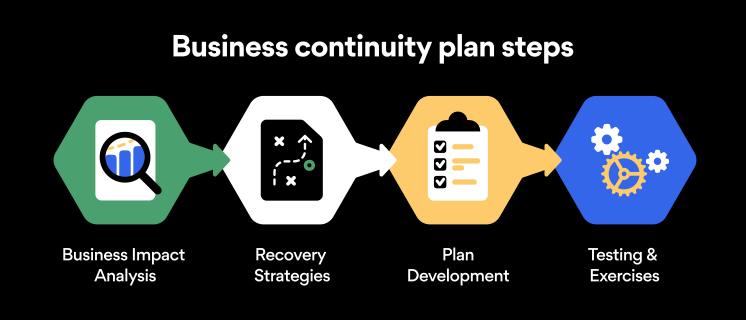
Business continuity planning steps

Here are some general guidelines that an organization looking to develop a BCP should consider:

Analysis

A business continuity plan should include an in-depth analysis of everything that could negatively affect the overall organizational infrastructure and operations. Assessing different levels of risk should also be a part of the analysis phase.

Design and development

Once you have a clear overview of potential risks your company could face, start developing a plan. Create a draft and reassess it to see if it takes into account even the smallest of details.

Implementation

Implement BCP within the organization by providing training sessions for the staff to get familiar with the plan. Getting everyone on the same page regarding crisis management is critical.

Testing

Rigorously test the plan. Play out a variety of scenarios in training sessions to learn the overall effectiveness of the continuity plan. By doing so, everyone on the team will be closely familiar with the business continuity plan’s guidelines.

Maintenance and updating

Because the threat landscape constantly changes and evolves, you should regularly reassess your BCP and take steps to update it. By making your continuity plan in tune with the times, you will be able to stay a step ahead of a crisis.

Level up your company’s security with NordPass Business

A comprehensive business continuity plan is vital for the entire organization’s security posture. However, in a perfect world, you wouldn’t have to use it. This is where NordPass Business can help.

Remember, weak, reused, or compromised passwords are often cited as one of the top contributing factors in data breaches. It’s not surprising, considering that an average user has around 100 passwords. Password fatigue is real and significantly affects how people treat their credentials. NordPass Business counters these issues.

With NordPass Business, your team will have a single secure place to store all work-related passwords, credit cards, and other sensitive information. Accessing all the data stored in NordPass is quick and easy, which allows your employees not to be distracted by the task of finding the correct passwords for the correct account.

In cyber incidents, NordPass Business ensures that company credentials remain secure at all times. Everything stored in the NordPass vault is secured with advanced encryption algorithms, which would take hundreds of years to brute force.

If you are interested in learning more about NordPass Business and how it can fortify corporate security, do not hesitate to book a demo with our representative.


About Version 2 Digital

Version 2 Digital is one of the most dynamic IT companies in Asia. The company distributes a wide range of IT products across various areas including cyber security, cloud, data protection, end points, infrastructures, system monitoring, storage, networking, business productivity and communication products.

Through an extensive network of channels, point of sales, resellers, and partnership companies, Version 2 offers quality products and services which are highly acclaimed in the market. Its customers cover a wide spectrum which include Global 1000 enterprises, regional listed companies, different vertical industries, public utilities, Government, a vast number of successful SMEs, and consumers in various Asian cities.

About NordPass
NordPass is developed by Nord Security, a company leading the global market of cybersecurity products.

The web has become a chaotic space where safety and trust have been compromised by cybercrime and data protection issues. Therefore, our team has a global mission to shape a more trusted and peaceful online future for people everywhere.

×

Hello!

Click one of our contacts below to chat on WhatsApp

×