Skip to content

Unearthing Meta’s Quarterly Adversarial Threat Report (Q2 2022)

Summary 

  • The report offers a comprehensive view of Meta’s risks across multiple policy violations like Coordinated Inauthentic Behavior (CIB), inauthentic behavior, cyber espionage, and other emerging threats, like mass reporting.

  • The report discusses various actions Meta’s security team took against two ongoing cyber espionage operations in South Asia.

  • As part of its campaign against new and emerging threats, the report discusses how Meta removed a mass reporting network in Indonesia, a brigading network in India, and coordinated violating networks (CVNs) in Greece, India, and South Africa.

  • Under its Inauthentic Behavior policy targeting artificially inflating distribution, the report says Meta took down numerous accounts, Pages, and Groups worldwide.

  • The report also discusses how Meta removed three networks engaged in CIB operations in Israel, Malaysia, and Russia.

Introduction

All of us are active Social Media users, which is exerting a greater influence on our lives in today’s technological age. But as the number of active users increases, so does the sophistication of threat actors, who continue to devise newer ways to compromise accounts, steal credentials, dictate their agenda, etc. For example, there are groups of people trying to flood comment streams and attack the post owner and other users to push forward their agenda and intimidate users with dissenting views. The evolving threat landscape compels social media giants like Meta to define robust security policies and take proactive steps to protect their communities. The Quarterly Adversarial Threat Report Q2 dives deeper into Meta’s actions against malicious activities.

Cyber Espionage Networks

Cyber espionage actors target internet users to collect intelligence, manipulate them to reveal sensitive information and compromise their accounts and devices. Some of them deploy advanced malware that incorporates exploits, while others use basic low-cost tools that require lesser technical expertise to deploy. Thus Meta believes, as per the report, it democratizes access to surveillance and hacking capabilities since the barrier to threat actors’ entry becomes lower. Furthermore, it allows the threat groups to gain plausible deniability and hide in the “noise” when security researchers scrutinize them.

Steps Meta Took:

Meta took down accounts, notified users targeted by malicious groups, and blocked the groups’ domain infrastructure from getting shared on Meta’s services. Furthermore, they shared findings with security researchers and industry peers to help them stay vigilant about the activity. 

Bitter APT (Advanced Persistent Threat) Group

Meta took action against a hacker group called Bitter APT, which operated from South Asia and targeted users in New Zealand, the United Kingdom, India, and Pakistan. While the group’s activity was low in operational security and sophistication, it was well-resourced and persistent. Bitter deployed various malicious tactics to target users with social engineering and injected malware into their devices. They used a mix of malicious domains, link-shortening services, third-party hosting providers, and compromised websites to distribute their malware. Security researchers at Meta discovered that their platform was used as an element of a wider cross-platform cyber espionage campaign. They found the following noteworthy TTPs (tactics, techniques, and procedures) used by the threat actors:

  1. Social engineering: Bitter threat actors created fictitious personas and posed as young women, activists, or journalists across the internet. They tried to build trust with users to trick them into visiting malicious links or downloading malware.

  1. iOS application: Meta’s recent investigation discovered Bitter deploying an iOS chat application for users, who could download it through Apple’s Testflight service for developers, ensuring that it will help beta-test their new applications.

  1. Android malware: The researchers discovered Bitter using a custom Android malware family they named Dracarys. It used accessibility services, the Android operating system feature, to assist users with disabilities, allowing them to automatically click and grant the application certain permissions.

  1. Adversarial adaptation: This Bitter group aggressively responded to Meta’s detection and blocking of its domain infrastructure and activity.

APT36

Meta discovered another threat group whose activity was low in sophistication, but it persistently targeted many services over the internet – from social media and email providers to file-hosting services. APT36 deployed various malicious tactics to target users with social engineering and injected malware into their devices. They used malicious and camouflaged links and fake Android and Windows-run apps to distribute their malware. Meta’s security team took action against the APT36 threat actors active in Afghanistan, Pakistan, UAE, India, and Saudi Arabia. They targeted government officials, military personnel, students, and employees of non-profit and human rights organizations. Furthermore, the report suggests that Meta’s investigation linked the activity to state-linked actors in Pakistan. They discovered the following noteworthy TTPs used by the threat actors:

  1. Social engineering: APT36 threat actors created fictitious personas and posed as recruiters for fake and legitimate organizations, military personnel, or women looking for romantic connections. 

  2. Real and spoofed websites: The report suggests that the APT36 threat actors used various tactics, including using custom infrastructure to inject their malware. Some domains masqueraded as generic app stores or photo-sharing websites, while others were spoofed domains of applications like Microsoft’s OneDrive, Google Play Store, and Google Drive.

  3. Camouflaged links: The group utilized link-shortening services and disguised malicious URLs. Furthermore, they used preview sites and social cards (the online marketing tools to customize the displayed image when a particular URL gets shared on social media) to mask the ownership and redirection of domains APT36 controlled.

  4. Android malware: APT36 did not directly share malware on Meta platforms but used the above tactics to share links to spoofed websites.

The “Emerging Harms” Networks

The report states that Meta’s threat disruption began by tackling inauthentic operations where users hide who’s behind them and advanced to authentic actors engaging in harmful and adversarial behaviors on its platform. This section of Meta’s report discusses how it is taking proactive steps to stay ahead in this adversarial space. 

Steps Meta Took:

Meta deployed control levers to enforce against networks having broadly varying aims and behaviors like:

  1. Groups that coordinated women’s harassment

  2. Decentralized movements that collaborate a call for violence against government officials and medical professionals

  3. An anti-immigrant group inciting harassment and hate

  4. An activity cluster focused primarily on spreading misinformation

Mass Reporting

Under its Inauthentic Behavior policies, Meta removes activity when it finds adversarial networks coordinating an abuse against its reporting systems to get content or accounts incorrectly taken down from the platform. Threat actors do it intentionally to silence others. In Q2 of 2022, the report states that Meta removed a network of 2,800 accounts, Pages, and Groups in Indonesia. They coordinated to report users for violations like impersonation, terrorism, hate speech, and bullying to get them wrongfully removed from Facebook. Meta researchers found that the reports mainly focused on Indonesian users, particularly the Wahhabi Muslim community. Factors considered while investigating Mass Reporting:

  1. Coordination Signals

  2. High Report volume

  3. Misleading and abusive nature of reports.

Brigading

Under its Bullying and Harassment policies, Meta removes activity when it discovers adversarial networks engaging in repetitive behavior, for mass-commenting on their target’s posts or sending them direct messages. The report suggests that the behavior intends to harass, overwhelm or silence the target. 

In Q2 of 2022, Meta took down a brigading network of 300 Facebook and Instagram accounts in India that collaborated to mass-harass people, including actors, activists, comedians, and other influencers. The network actively posted across the internet, including Instagram, Facebook, Twitter, YouTube, and Telegram. Factors considered while investigating Brigading:

  1. Repetitive targeting to silence or harass people, with unsolicited comments or messages

  2. Coordination Signals

  3. A high volume of activity

  4. Efforts to evade enforcement

Coordinated Violating Networks

Meta’s Account Integrity policies remove coordinated violating networks (CVNs) when it finds people (with authentic or fake accounts) coordinating to violate or evade its Community Standards. Hence, Meta removed two clusters of Pages and accounts on Facebook and Instagram in Greece that collaborated to repeatedly violate its policies against hate speech, misinformation, and incitement to overthrow the government violently. Factors considered while investigating Coordinated Violating Networks.

  1. Coordination signals showed an organized group directly working under centralized directions.

  2. Systematic violation of Meta’s community standards.

  3. Efforts to evade enforcement

Inauthentic Behavior

Meta defines Inauthentic behavior (IB) in its Community Standards as something that misleads the platform and the users about the popularity of the content, the people’s identity behind it, or the purpose of a community (i.e., Events, Groups, Pages). The report suggests that the behavior is centered around increasing and amplifying content distribution and is mostly (not exclusively) financially motivated. IB operators mainly focus on the quantity and not the quality of engagement. For example, they use many low-sophistication fake accounts for mass-posting or liking their content — commercial, social or political. 

Steps Meta Took:

In focus: Philippines

  1. Manual investigations and disruptions:

Ahead of the Philippines election, Meta’s investigative teams took down over 10,000 accounts for violating its IB policy. The accounts used IB tactics to increase the distribution of content like election-related posts, including others using politics as a spam lure when people showed interest in following these topics. The report states that Meta used threat intelligence and continued working on identifying repetitive behavior patterns showing characteristics of IB clusters in the region.

  1. Automated detection at scale:

Working on the actionable insights, Meta automated the detection of IB patterns and complemented the manual investigations. Consequently, the security teams consulted experts to identify numerous IB clusters in the Philippines and enforced quick action against 15,000 accounts. Meta researchers concluded that most IB clusters were not more than six months old when they got disabled. 

  1. Automated enforcement:

Complimenting automated detection and manual disruptions, Meta focused on automating enforcement against these IB patterns, relying on its rigorous election preparation in the Philippines. Hence, the security teams could tackle specific repetitive and high-confidence inauthentic behavior (IB) in the Philippines and worldwide.

Coordinated Inauthentic Behavior (CIB)

Meta views CIB as a coordinated effort to manipulate the public discourse for a strategic goal, having fake accounts at the center of the operation. The report says that in these cases, people coordinate and use fake accounts to mislead others about what they do and who they are. 

Steps Meta Took:

Meta’s security team investigated and removed the CIB operations by focusing on behavior rather than content. According to the report,  it did not matter who was behind them, what they posted, or whether they were foreign or domestic. 

Malaysia

Meta removed 596 Facebook accounts, 72 Instagram accounts, 180 Pages, and 11 Groups for violating their policy on coordinated inauthentic behavior. The network originated in Malaysia, targeting its domestic audiences.

Israel

Meta removed 259 Facebook accounts, 107 Instagram accounts, 42 Pages, and 9 Groups for violating its policy on coordinated inauthentic behavior. The network originated in Israel, targeting Nigeria, Angola, and the Gaza region in Palestine.

Russia

The report has a detailed sub-section on how the security researchers investigated the CIB in Russia. Meta took down an Instagram account network operated by a troll farm in Russia’s St. Petersburg that targeted global public discourse regarding the Ukraine war. The report underlines that the campaign was a poorly executed attempt and that threat actors publicly coordinated through a Telegram channel. They wanted to create a grassroots online support perception for Russia’s invasion and used fake accounts to upload pro-Russia comments on influencers and media content. The researchers linked the activity to a self-proclaimed entity, “Cyber Front Z,” and individuals associated with the Internet Research Agency (IRA). Meta has banned Cyber Front Z from its platforms. 

Conclusion

The Meta Quarterly Adversarial Threat Report Q2 offers insight into the risks Meta sees globally and across multiple policy violations. It covers Meta’s expanded threat reporting areas like cyber espionage, inauthentic amplification, mass reporting, brigading, and other malicious behaviors. Furthermore, It alerts people who Meta believes were targeted by these campaigns. Thus, it is a reliable guide for tech companies, governments, law enforcement, and security researchers in helping them understand the social media threat landscape and preventive measures that can be taken to limit the damage caused by malicious actors.

Reference

Ben Nimmo, David Agranovich, Margarita Franklin, Mike Dvilyanski, Nathaniel Gleicher. (2022, September 8). Quarterly Adversarial Threat Report. About.fb.com. Retrieved September 8, 2022, from  

https://about.fb.com/wp-content/uploads/2022/08/Quarterly-Adversarial-Threat-Report-Q2-2022.pdf

Photo by Dima Solomin on Unsplash

#meta #facebook #adversary #CIB #threats #security #espionage

About Version 2 Digital

Version 2 Digital is one of the most dynamic IT companies in Asia. The company distributes a wide range of IT products across various areas including cyber security, cloud, data protection, end points, infrastructures, system monitoring, storage, networking, business productivity and communication products.

Through an extensive network of channels, point of sales, resellers, and partnership companies, Version 2 offers quality products and services which are highly acclaimed in the market. Its customers cover a wide spectrum which include Global 1000 enterprises, regional listed companies, different vertical industries, public utilities, Government, a vast number of successful SMEs, and consumers in various Asian cities.

About VRX
VRX is a consolidated vulnerability management platform that protects assets in real time. Its rich, integrated features efficiently pinpoint and remediate the largest risks to your cyber infrastructure. Resolve the most pressing threats with efficient automation features and precise contextual analysis.

Secrets of Cyber Resilience

In recent years the world has considerably evolved, with organizations increasingly adopting digital initiatives, like Cloud, IoT, Big Data, Artificial Intelligence and Machine Learning. And the Covid-19 pandemic has forced organizations to accelerate the adoption of those initiatives. This process, called digital transformation, has impacted from startups to global consolidated enterprises in all corners of the globe. 

It is important to mention that this process can be considered more than a trend, it is a business imperative for companies to remain agile, productive, and competitive as the world becomes more digital. A study from SMB Group has indicated that Small and Medium Businesses (SMEs) that invest in digital transformation initiatives are almost 2 times more likely to increase their revenue. However, the risk involved for companies adopting a digital culture is considerably higher than those that still use manual processes and tools. This is mainly because of the increasing number of cyberattacks.

Cybersecurity has been in the spotlight for several years. According to a study from Ponemon, 82% of IT security and C-level executives have experienced at least one data breach when implementing new technologies, including those associated with the digital transformation process. This indicates the need for organizations to properly prepare, respond and recover from cyber attacks, which is called cyber resilience. This ensures that organizations are able to reduce the impact of an incident and ensure that they can continue to operate. And with cybersecurity risks increasingly associated with business risks, cyber resilience is an effective way to achieve enterprise resilience. 

In this aspect, cybersecurity vendors have evolved their solutions rapidly to keep up with malicious attackers. However, despite all technological advances, the number of cyberattacks continues to increase and organizations are still victims of cyber attacks. This is mainly because those malicious actors are constantly improving their attack techniques, with more sophisticated methods to engage in their malicious activities. But what are the most used techniques to compromise the cyber security of an organization?

One of the most common techniques is phishing. A phishing attack involves sending fake messages – usually via email – to make it seen as coming from a reliable source. The purpose in this case is to compromise sensitive information, like personal and financial data. Through this kind of attack, malicious attackers can steal privileged credentials and obtain unauthorized access to critical systems like an ERP or encrypt data through the execution of ransomware. 

Even though this is not a new technique, in the last few years, and with the spread of Ransomware-as-a-Service, this technique has become one of the favorite methods used by malicious attackers. This is especially because of the high return and low effort needed to compromise a company. A study from KnowBe4 indicates that the damages associated with ransomware have reached USD 11.5 billion in 2021, an increase of 73.9% compared to 2019. And the forecast is not good: it is expected that the costs associated with ransomware will reach USD 256 billion by 2031. 

It is important to mention that both phishing and ransomware explore the human aspect, also called social engineering. And according to the 2022 Verizon Data Breach Investigations Report (DBIR), 82% of researched breaches involve the exploitation of human behavior. In this kind of attack, cybercriminals use trickery and impersonation to make people perform actions that benefit them, like opening an attachment or clicking on a malicious link.

But how can organizations and cybersecurity leaders build an effective strategy to achieve cyber resilience?

Well, the first step to create cyber resilience is to improve security to prevent attackers from obtaining access to the infrastructure. This involves working on three aspects: 

  1. People, which involves investing in cyber awareness, education, and training.
  2. Processes, including policies and procedures.
  3. Tools, like Network Monitoring, Privileged Access Management and MFA

During this step, cybersecurity leaders must ensure that cybersecurity objectives are aligned with business objectives. This involves developing a cybersecurity program, structuring a cybersecurity governance process and implementing a continuous improvement process. 

The next step to improve cyber resilience is to be able to properly detect malicious activities so the cybersecurity teams can respond to cyber threats and minimize damages. This includes implementing systems to monitor suspicious activity and train the team to properly identify signs of cyber attacks.

After detecting those malicious activities, the cybersecurity team must be able to properly respond to the attack to minimize the damage and recover from those incidents. In this aspect, organizations must develop and test strategies, including who to contact and what steps to take to respond to the threat. This can be done with an Incident Response Plan (IRP).  

The fourth and last step is recovery. This means that, once the threat has been successfully addressed, the organization must be able to recover their infrastructure and data. The recovery process includes implementing backup strategies and a plan to restore them from the incident.  

With more cybersecurity risks associated with business risks, building cyber resilience is a business imperative for companies to remain competitive and increase revenue. By creating this culture, organizations are able to reduce financial losses, be compliant to legal and regulatory requirements, improve the security posture in the organization and increase trust from customers, partners and employees.

You had presented a webinar about the surprising secrets of cyber resilience with Steve Hunt, an inductee into the ISSA Hall of Fame. Watch now!

About Version 2 Digital

Version 2 Digital is one of the most dynamic IT companies in Asia. The company distributes a wide range of IT products across various areas including cyber security, cloud, data protection, end points, infrastructures, system monitoring, storage, networking, business productivity and communication products.

Through an extensive network of channels, point of sales, resellers, and partnership companies, Version 2 offers quality products and services which are highly acclaimed in the market. Its customers cover a wide spectrum which include Global 1000 enterprises, regional listed companies, different vertical industries, public utilities, Government, a vast number of successful SMEs, and consumers in various Asian cities.

About Segura®
Segura® strive to ensure the sovereignty of companies over actions and privileged information. To this end, we work against data theft through traceability of administrator actions on networks, servers, databases and a multitude of devices. In addition, we pursue compliance with auditing requirements and the most demanding standards, including PCI DSS, Sarbanes-Oxley, ISO 27001 and HIPAA.

How Keepit puts User Experience first

Keepit is known for delivering a certain quality of User Experience (UX), which is reflected in customer feedback examples, such as: 

Keepit’s user-friendliness is a financial win-win’ and ‘I like to call Keepit a Steady Eddie. I know it’s working; I know it’s running, and I don’t have to sweat it.’.

Behind Keepit’s simple design and ease of use lies a deliberate approach, rooted in the idea that our whole system, from the deepest backend layers to the user interface, is built to support a solid User Experience.

However, in the software field, UX has been interpreted in various ways and caused confusion in how it differs from User Interface Design. So, what is UX to Keepit? And how does Keepit go about all this in practicality?

Foundation

UX goes beyond the immediate visual impression and beyond isolated interactions within the product. It is a silent ambassador that ensures a seamless experience throughout any touchpoint. A journey sprinkled with an undefined X factor that leaves our user with instant recognition without the need for explanation -a quality that flows through every vein of Keepit.

An experience starts before the product is even used by our customers. As Don Norman, the inventor of UX, puts it, ‘No product is an island […] It is a cohesive, integrated set of experiences […] Make them all work together seamlessly.’

Leveled circulation

On both conscious and unconscious levels, a human experience is perceived and processed as a sum of different events. The more you know about people, the better experience you will be able to design. To translate such a complex sum into a consistent Keepit experience, we use our Design System as a single documented source.

Here all Keepers will find Design Principles, components, guidelines, patterns, and themes. However, the UX circulates on more levels. To grasp this in a software context, mapping out different levels of the experience can help.

Interaction level

On this level, we work with both look and feel when interacting with the product, from visual design to Information Architecture to navigation. The focus is to design the experience of a certain interaction that a user has with Keepit to perform a task, such as restoring data in Keepit’s application.

However, a user interaction can also exist outside the product interface. One example is receiving support. Each of these interactions are single strokes of experiences that play a role in the relationship with our customer.

On the interaction level, our Design Principles, guidelines, and patterns play a central role. We operationalize this with a pyramid logic in layers, with a theme on the top level and dos and don’ts on the bottom level. Here is an example:

Design Principle: Keepit Sets Me Free

  • What users should feel: In every interaction, I as a user should feel the freedom of being in control. This means being offered the most relevant choices at the right time. The choices should lower my cognitive load so that I feel enabled to effortlessly succeed at my tasks.
  • Examples of what users should think: ‘I control the situation’ – ‘This is unbelievably easy’- ‘Keepit makes me better at my job’- ‘I get what I need when I need it’
  • Examples of what users should see: Recognizable patterns – An easy first entry to the system – Understandable language
  • What designers should do: Always give feedback – Build a strong visual hierarchy – Know and understand the user – Always remember what problem we are solving for the user
  • What designers should not do: Don’t make the user wait, don’t speak in system language, don’t overload the user with information

Journey level

Zooming into the journey level, we recognize that putting UX first is not isolated in the product interaction itself. The key word here is ‘journey’. Mapping out journeys enables us to discover user needs and pain points, in the quest of providing seamless and consistent experiences across Keepit’s channels.

There are methods to identify key needs and transform them into design challenges. Apart from organized methods, such as usability tests, analytics, and organized customer interviews, there are also more organic user dialogues. From support, through live events, from sales, and so on. In all these touchpoints there are chances to identify key user needs and discover how the Keepit product can solve real user problems.

The key point here is to identify where the needs and pain points are rooted; define the root problem and translate this into design challenges. Further down the road, when ideating on design solutions, the user experience should be consistent in every chosen design solution. Again, this is where the User Experience pyramid, with its design principles at the top, plays its role as a foundation for the other experience levels.

A level connecting the dots

This means that UX is related to the spirit of Keepit, across the whole company. Throughout the different areas of expertise of Keepit, UX connects the dots and remembers to keep the users’ needs at the core of what we do: to deliver simple and safe backup solutions that can set our customers free from the worries of losing data. Keepit’s UX delivers this X factor in its tone of voice, the product’s look and feel, user touchpoints, and customer dialogues.

Keepit’s UX goal is to deliver a consistent heartbeat of look and feel throughout the user journey, anytime, anywhere – pumping it through Keepit’s veins.

UX metrics

As designers, we recognize the challenge in measuring UX, since we are dealing with human behavior and attitude. Here we use deliberate approaches such as confirmation bias. When working on improvements to Keepit’s UX, our main goal is to gather insight, combined with quantitative results.

We want to understand the context and situation that the user is in when encountering Keepit, as well as how this context affects the user.

We also want to know what works, what doesn’t, and why. These insights are gathered through activities such as user interviews and observations. The outcome should be an understanding of user values, supported by quantitative data on average numbers or rates. Additionally, usability metrics give value to the work of measuring. Our different approaches have the common mission of delivering an excellent User Experience, based on data-informed decisions.

About Version 2 Digital

Version 2 Digital is one of the most dynamic IT companies in Asia. The company distributes a wide range of IT products across various areas including cyber security, cloud, data protection, end points, infrastructures, system monitoring, storage, networking, business productivity and communication products.

Through an extensive network of channels, point of sales, resellers, and partnership companies, Version 2 offers quality products and services which are highly acclaimed in the market. Its customers cover a wide spectrum which include Global 1000 enterprises, regional listed companies, different vertical industries, public utilities, Government, a vast number of successful SMEs, and consumers in various Asian cities.

About Keepit
At Keepit, we believe in a digital future where all software is delivered as a service. Keepit’s mission is to protect data in the cloud Keepit is a software company specializing in Cloud-to-Cloud data backup and recovery. Deriving from +20 year experience in building best-in-class data protection and hosting services, Keepit is pioneering the way to secure and protect cloud data at scale.

Pandora FMS Named An Emerging Favorite In Capterra Shortlist For Server Monitoring Software and APM

The work is hard and there are high expectations, but we don’t give up! The fight goes on and every day we are happier with what we achieve and what we mean to our users.

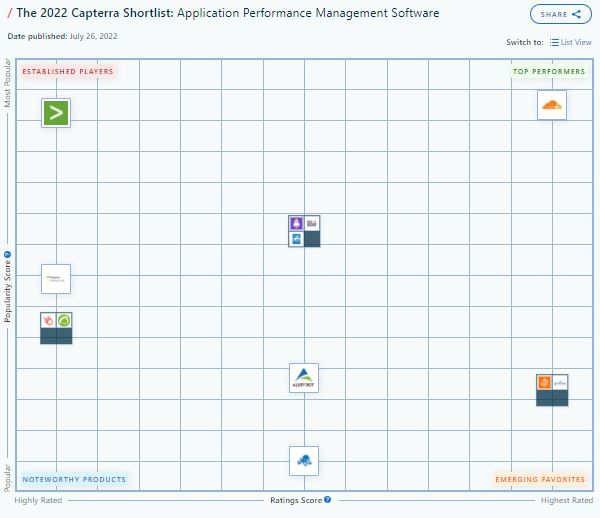
Therefore, Pandora FMS is proud to announce its mention as an  Emerging Favorite  in 2022 Shortlist for Server Monitoring Software and APM by   Capterra, a free online service that helps organizations find the right software.

Pandora FMS is always among the favorites. Capterra knows this

Capterra Shorlist

*As many of you may already know, Capterra Shortlist is an independent assessment that evaluates user reviews and online search activity to generate a list of market leaders in the software space that offer the most popular solutions. (Have a look at the Capterra Shortlist methodology here.)

As it could not be otherwise, our CEO and colleague Sancho Lerena has wanted to make some comments on this achievement:

“The first thing I would like to say is thank you. Sometimes it seems that one does not give enough thanks and there is much to thank, both to our coworkers and users, and even the Capterra platform itself. 

Especially because there are so many contributions and because it is absolutely always a huge honor to receive this kind of mention.”

Here is a sample of our recognition in table format:

APM

More achievements

Well, and that’s not all.

Pandora FMS is also recognized as a Noteworthy Product in Capterra Shortlist for Application Performance Management Software.

Our users have made it possible!

With an overall rating of 4.6 out 5, we received some stellar reviews on Capterra:

“For a long time, we were looking for a monitoring solution that could ensure the resiliency of our web applications and finally, with the help of the Pandora FMS team, we found the right tool. 

Pandora FMS is an out-of-the-box monitoring solution that allows you to monitor your applications and systems and has a very intuitive interface that allows you to build your dashboards in no time. We can not wait to see what the future holds for Pandora FMS.”

[Kumar B.]

“Pandora FMS is a very handy monitoring tool for daily use. Accurate with metrics and useful reporting function for analysis of server performance. 

We are planning to widely distribute the agent across more servers for our customers.”

[Neil W.]

“Pandora FMS the perfect balance between price and quality.”

[Oskar R.]

The question now is, do you want to be the only one not to get on board with such a popular, effective and acclaimed product as Pandora FMS? As you see, you will hardly regret it! We’re counting on you!

About Version 2 Digital

Version 2 Digital is one of the most dynamic IT companies in Asia. The company distributes a wide range of IT products across various areas including cyber security, cloud, data protection, end points, infrastructures, system monitoring, storage, networking, business productivity and communication products.

Through an extensive network of channels, point of sales, resellers, and partnership companies, Version 2 offers quality products and services which are highly acclaimed in the market. Its customers cover a wide spectrum which include Global 1000 enterprises, regional listed companies, different vertical industries, public utilities, Government, a vast number of successful SMEs, and consumers in various Asian cities.

About PandoraFMS
Pandora FMS is a flexible monitoring system, capable of monitoring devices, infrastructures, applications, services and business processes.
Of course, one of the things that Pandora FMS can control is the hard disks of your computers.

Enhancing OT Security Without Disrupting Operations

What is Operational Technology?

Cybersecurity has come a long way in the recent past. Its importance is felt in all aspects of modern life, both personal and industrial. The current digital and network advancements are steadily pushing Information Technology (IT) and Operational Technology (OT) towards integration. While IT systems interact with each other for data-centric computing, OT systems involve hardware and software that monitors or controls physical devices and processes to detect or cause changes in an industrial environment or enterprise.   

OT plays a significant role in Industrial Control Systems (ICS) and encompasses a wide variety of programmable systems such as Supervisory Control and Data Acquisition systems (SCADA) and Distributed Control Systems (DCS). These are found in many aspects of the environments we interact with daily, which makes keeping these systems secure a top priority.  

Industrial systems traditionally have relied on human monitoring and management through proprietary control protocols and software. Today, however, more industrial systems are automating these processes in a bid to boost efficiency and deliver better and smarter analytics through the convergence of OT and IT systems. This fills in the  gap that previously that isolated OT from IT. This bridge ensures that the information passed down to the people, sensors, devices, and machines is accurate and on time.  

How IoT Adoption Affects OT Systems

Anyone who has been around long enough to see how the internet and modern technology have changed the world can attest to its benefits. The shift to making most aspects of human life ‘smart’ has had both positive and negative effects. In a bid to make OT systems more efficient and reliable, most people have adopted integrated enterprise software and analytic data services. This makes processes and systems such as cooling efficient and also monitoring devices easy and more cost-effective. 

This action comes with one main downside; an increase in security risks. The connection of these systems leaves industrial networks and components vulnerable to OT security deficiencies such as lack of encryption, buffer overflow, backdoors and other tailored attacks on physical components. 

The digital attack surface also grows massively. For instance, in a configuration where things go through a switch, it would be difficult to monitor the traffic or detect changes. This makes the network vulnerable to targeted attacks. Some economies or communities could face utter devastation should their industrial systems be attacked due to the high cost of some of the industrial equipment.  

On the brighter side, industrial networks can be protected without risking non-compliance or disruption of operations. While IT security deals with data flow and its protection, OT security is focused on the safety and efficiency of industrial operations. By implementing proper security strategies and policies that ensure the visibility of all network control traffic, you can effectively reduce security risks and protect operations. 

Modern OT Security Approaches

The integration of OT and IT systems has led to the development of OT security. This is done in a bid to protect lives and assets and ensure that there is no operating downtime leading to production losses. The common standards and practices for secure OT systems are detailed by bodies such as The National Institute of Standards and Technology and the UK’s National Cyber Security Center. Their reports have detailed information on OT risk management, vulnerabilities, recommended practices and guidelines. These form the framework for different ways to secure OT systems.

When protecting OT systems, one must first understand the vulnerabilities that they face. Now that OT, IT, and IoT systems have become part of an indistinguishable system, any margins of error could mean a collapse in the whole network. Some of the ways OT networks are compromised by malignant elements include:   

  • Unauthorized Changes: This could consist of disabling safety sensors and alarms. This also increases the risk of bad actors inputting instructions that could lead to downtime. 
  • Interference With Critical Infrastructure: Access to sites and operational systems should only be granted to authorized personnel. Interference of control units and equipment protection systems could lead to irreparable damage, 
  • Manipulation or Modification of Sent Information: Hackers use this technique to disguise unauthorized changes and breaches as they penetrate the system. 

It is always essential to understand that attacks could come from within. It could be rogue employees with infected USBs or even poor coding. This means that industrial security has to be both preventive and offensive. Apart from the conventional security protocols, OT protection must be based on a fully visible IT/OT infrastructure. This means employing monitoring and analysis tools that can detect even the most minute anomalies.  

Best Practices for OT Security

An efficient OT security plan should incorporate three main levels of protection and include the following practices: 

Using Next-Generation Firewalls (NGFW) in OT Networks

Traditional firewalls had their drawbacks in terms of network speed, awareness limitations and their inability to adapt to new threats. Next-Generation Firewalls (NGFWs), on the other hand, offer the best security against threats by giving you complete control of the industrial systems. These firewalls are made to meet any configuration in the ICS for maximum visibility and monitoring. Organized architecture in terms of control ensures efficient and uninterrupted workflow.  

Having Efficient System Restore Plans

Should there be any breaches or failures of certain components within the OT network, there should be protocols to restore functionality without delaying operations. The SRP should take the least amount of time. Moreover, despite the conditions or challenges faced, the industrial environment should be designed in a way that ensures operations can continue running, awaiting restoration. This means enabling the workforce access to manual control and emergency operations.  

Risk-Based Vulnerability Management

The RBVM system provides comprehensive information on possible threats and the extent of their effects. In collaboration with network analytics such as mapping constant monitoring, it is possible to anticipate the risks that the threats pose and prepare the security team with efficient responses or possible SRP.  

These layers of protection also need to be coupled with other general security practices. For instance, access to OT network devices and systems should be restricted to unauthorized parties. This can be achieved by separating the cooperate network from the OT network. On the other hand, remote access solutions should be available.  

Remote access is a contentious security measure. One of the channels used by bad actors is the backdoors that remote access leaves. To counter this vulnerability, remote access sessions can be restricted and monitored by time and user activity. When it comes to safeguarding data, the best solution is encryption. Backups and restore points also need to be in place. Using these tools and security protocols means that the OT network remains secure while the industrial environment remains fully operational. 

What the Future Holds for OT Security

The best part of technology is its nature and tendency to evolve. This means that cybersecurity will only get better. At the moment, OT security faces a couple of minor setbacks primarily due to its nature. A fact that is evident in the design of these systems. Since they are meant to run for years, the focus is placed more on their reliability rather than security. As more OT systems are connected to a network, their lack of initial security and use of legacy protocols poses significant risks.  

As mentioned, however, the beauty of technology is adaptation. To maneuver these challenges, businesses are adding newer devices to their OT enterprises and taking OT cybersecurity seriously. It is clear that the future of OT security is bright due to the growing investment in OT security. Professionals in this sector are increasing in number every day after its necessity was realized.  

Cloud technology has also improved the industrial environment by connecting workplaces. This game-changer is poised to boost production and ensure efficiency while still maintaining low production costs. 

Controversial as it may sound, even hacking and other unauthorized breaches help increase OT security. This inverse effect is due to the fact that by revealing the gaps and vulnerabilities in the system, light is shed on the areas that require patching or even upgrading.

Final Thoughts on OT Security

In conclusion, every party involved in this industry must acknowledge the need for upgraded and efficient OT security solutions. There is a need to pool resources and specialize in OT Cybersecurity if its development is to be sustainable and future-proof.

About Version 2 Digital

Version 2 Digital is one of the most dynamic IT companies in Asia. The company distributes a wide range of IT products across various areas including cyber security, cloud, data protection, end points, infrastructures, system monitoring, storage, networking, business productivity and communication products.

Through an extensive network of channels, point of sales, resellers, and partnership companies, Version 2 offers quality products and services which are highly acclaimed in the market. Its customers cover a wide spectrum which include Global 1000 enterprises, regional listed companies, different vertical industries, public utilities, Government, a vast number of successful SMEs, and consumers in various Asian cities.

About Portnox
Portnox provides simple-to-deploy, operate and maintain network access control, security and visibility solutions. Portnox software can be deployed on-premises, as a cloud-delivered service, or in hybrid mode. It is agentless and vendor-agnostic, allowing organizations to maximize their existing network and cybersecurity investments. Hundreds of enterprises around the world rely on Portnox for network visibility, cybersecurity policy enforcement and regulatory compliance. The company has been recognized for its innovations by Info Security Products Guide, Cyber Security Excellence Awards, IoT Innovator Awards, Computing Security Awards, Best of Interop ITX and Cyber Defense Magazine. Portnox has offices in the U.S., Europe and Asia. For information visit http://www.portnox.com, and follow us on Twitter and LinkedIn.。

×

Hello!

Click one of our contacts below to chat on WhatsApp

×