Skip to content

The Iran Steel Industry Cyber Attack Explained

A Change In The Air

Iran’s steel Industry was hit by a hacktivist group calling themselves ”Goneshke Darande” [Predatory Sparrow] on June 27th, 2022. The attack focused specifically on three steel companies that are currently subject to international sanctions, Mobarakeh Steel Company, Hormozgan Steel Company, and Khuzestan Steel Industries. This blog will investigate the Khuzestan attack.

At 3:08:22 pm local time, a compromised internal plant camera at Khuzestan shows the loss of control and within 12 minutes the camera captured catastrophic failure. In the video it appears that there is a disruption in the vacuum degassing stage of the ladle metallurgy process where the molten steel in the ladle is under vacuum to remove dissolved gasses entrained in the steel before it gets poured. This is problematic because remnants of even a few parts per million of hydrogen gas remaining in the pour causes massive defects and drastic loss of structural integrity. 

The attackers posted images from the compromised ICS leading up to the event on their twitter account.

Screenshot posted by the threat actors before the attack

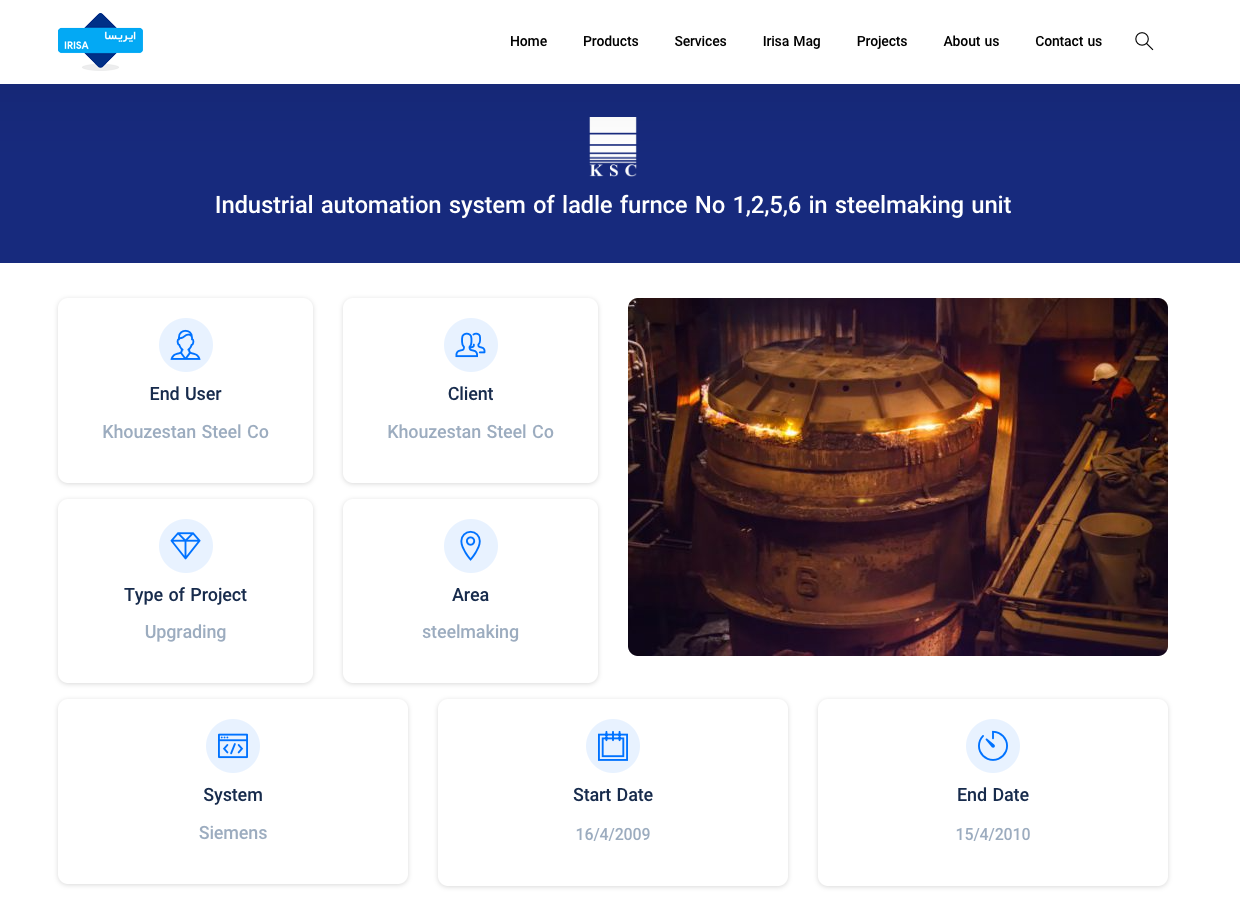
From this screenshot we can deduce that the Khuzestan Steel Factory was using a Siemens PCS7 Process Control System and based on the graphics it was most likely S7-400 controllers. Digging a little deeper into the OSINT (Open Source Intel) it appears that see that IRISA International Systems Engineering & Automation Company worked on designing and implementing various portions of the steel factory.

Industrial automation system of ladle furnace

In my book Pentesting Industrial Control Systems under section 2 – Understanding the Cracks Chapter 4 – Open Source Ninja, I elaborate on the fact that gaining insight to openly available data for a client’s industry, process, employees, equipment, and technology is absolutely essential. Throughout the chapter I go on to caution companies and specifically blue teamers that monitor social media posts of employees and 3rd party vendors, as they might innocently and non-maliciously publish critical information related to your company’s production environment. 

The silver lining of this cyber incident is that no one was hurt and it may open more discussions on industrial cyber security awareness.

To learn more about how the SCADAfence Platform can protect your OT network request a demo today.

About Version 2 Digital

Version 2 Digital is one of the most dynamic IT companies in Asia. The company distributes a wide range of IT products across various areas including cyber security, cloud, data protection, end points, infrastructures, system monitoring, storage, networking, business productivity and communication products.

Through an extensive network of channels, point of sales, resellers, and partnership companies, Version 2 offers quality products and services which are highly acclaimed in the market. Its customers cover a wide spectrum which include Global 1000 enterprises, regional listed companies, different vertical industries, public utilities, Government, a vast number of successful SMEs, and consumers in various Asian cities.

About SCADAfence
SCADAfence helps companies with large-scale operational technology (OT) networks embrace the benefits of industrial IoT by reducing cyber risks and mitigating operational threats. Our non-intrusive platform provides full coverage of large-scale networks, offering best-in-class detection accuracy, asset discovery and user experience. The platform seamlessly integrates OT security within existing security operations, bridging the IT/OT convergence gap. SCADAfence secures OT networks in manufacturing, building management and critical infrastructure industries. We deliver security and visibility for some of world’s most complex OT networks, including Europe’s largest manufacturing facility. With SCADAfence, companies can operate securely, reliably and efficiently as they go through the digital transformation journey.

ICS / OT Security News Update | SCADAfence – June 20

Our research team compiled the latest updates on newly announced CVEs, recent ransomware attacks and IoT security news. They also offer analysis of the potential impacts and their expert recommendations:

ICS

Siemens DoS Vulnerability (CVE-2022-24040)

A vulnerability affecting Siemens’ PXC4.E16 building automation controllers can be exploited to conduct a DoS attack (CVE-2022-24040).

Attack Parameters: The web application fails to enforce an upper bound to the cost factor of the PBKDF2 derived key during the creation or update of an account.

Impact: An attacker could make the device unavailable for days by attempting a login.

Recommendations: Siemens released a patch for this vulnerability.

SCADAfence Coverage: The SCADAfence Platform detects new connections, connections to and from external devices, connection to and from the Internet, and unauthorized connections to OT assets.

Open Automation Software Platform Vulnerabilities

Multiple vulnerabilities were found affecting Open Automation Software (OAS) platform, leading to device access, denial-of-service, and remote code execution. The OAS platform is a widely used data connectivity solution that unites industrial devices (PLCs, OPCs, Modbus), SCADA systems, IoTs, network points, custom applications, custom APIs, and databases under a holistic system.

Targets: OAS is used by Michelin, Volvo, Intel, JBT AeroTech, the U.S. Navy, Dart Oil and Gas, General Dynamics, AES Wind Generation, and several other high-profile industrial entities.

Attack Parameters: The most critical of these vulnerabilities, CVE-2022-26833, can be exploited by sending a series of HTTP requests. Most of the other vulnerabilities can be exploited using a variety of specific network requests.

Impact: Successful exploitation of these vulnerabilities may lead to DoS and RCE.

Recommendations: While patches are still unavailable for these vulnerabilities, they can be mitigated by disconnecting the OAS platform from the Internet and from Internet-facing devices.

SCADAfence Coverage: The SCADAfence Platform detects DoS attempts, such as HTTP flooding attempts. 

IT

Microsoft Office MSDT Vulnerability (CVE-2022-30190)

A new zero-day vulnerability, dubbed “Follina”, allows attackers to execute malicious PowerShell commands using Microsoft Office programs (CVE-2022-30190).
This is a new attack vector leveraging Microsoft Office programs as it works without elevated privileges, bypasses Windows Defender detection, and does not need macro code to be enabled to execute binaries or scripts.


Targets: Threat actors, such as Chinese APT groups, used this vulnerability to target organizations in Russia and in Tibet, and government entities in Europe and in the U.S.

Attack Parameters: The vulnerability leverages malicious Word documents that execute PowerShell commands via the Microsoft Diagnostic Tool (MSDT). It is triggered when an office application, such as Word, calls MSDT using the MS-MSDT URL protocol.

Impact: Attackers can exploit this vulnerability to remotely execute arbitrary code with the privileges of the calling app to install programs, view, change, or delete data, or create new Windows accounts as allowed by the user’s rights.

Recommendations:

    1. Microsoft has released a patch for this vulnerability. 
    2. Microsoft recommended that affected users disable the MSDT URL.
    3. An unofficial patch has been released, adding sanitation of the user-provided path to avoid rendering the Windows diagnostic wizardry inoperable.

SCADAfence Coverage: The SCADAfence Platform detects new connections, connections to and from external devices, connection to and from the Internet, and unauthorized connections.

Confluence Server and Data Center RCE Vulnerability (CVE-2022-26134)

A vulnerability affecting Confluence Server and Data Center was disclosed, which allows unauthenticated attackers to gain remote code execution on unpatched servers (CVE-2022-26134).


Attack Parameters: This vulnerability can be exploited without needing credentials or user interaction, by sending a specially crafted web request to the Confluence system.


Impact: Threat actors were observed exploiting this vulnerability to install BEHINDER, a web shell that allows threat actors to execute commands on the compromised server remotely and has built-in support for interaction with Meterpreter and Cobalt Strike.

A PoC exploit for this vulnerability has been published.

Recommendations: Atlassian released patches for this vulnerability.

SCADAfence Coverage: The SCADAfence Platform detects exploitation of this vulnerability, as well as the use of Meterpreter and Cobalt Strike. 

Ransomware

Foxconn Ransomware Attack by LockBit
Foxconn electronics manufacturer has confirmed that one of its Mexico-based production plants has been impacted by a ransomware attack. While the company did not provide information about the responsible group, LockBit gang claimed the attack.

Attack Parameters:

  1. Initial Access – LockBit operators often gain access via compromised servers, RDP accounts, spam email or by brute forcing insecure RDP or VPN credentials.
  2. Execution – LockBit is executed via command line or created scheduled tasks.
  3. Credential Access – LockBit was observed using Mimikatz to gather credentials.
  4. Lateral Movement – LockBit can self-propagate using SMB. PsExec and Cobalt Strike were used to move laterally within the network.

Impact: According to Foxconn, the impact on its overall operations will be minimal, and the recovery will unfold according to a pre-determined plan.

Recommendations:  Following are additional best practices recommendations:

  1. Make sure secure offline backups of critical systems are available and up-to-date.
  2. Apply the latest security patches on the assets in the network.
  3. Use unique passwords and multi-factor authentication on authentication paths to OT assets.
  4. Encrypt sensitive data when possible.
  5. Educate staff about the risks and methods of ransomware attacks and how to avoid infection.

SCADAfence Coverage: The SCADAfence Platform detects the creation of scheduled tasks, as well as the use of Mimikatz, PsExec, and Cobalt Strike.

RDP and SMB connections can be tracked with User Activity Analyzer.
SFP detects suspicious behavior, which includes LockBit’s, based on IP reputation, hash reputation, and domain reputation.

For more information on keeping your ICS/OT systems protected from threats, or to see the SCADAfence platform in action, request a demo now.

About Version 2 Digital

Version 2 Digital is one of the most dynamic IT companies in Asia. The company distributes a wide range of IT products across various areas including cyber security, cloud, data protection, end points, infrastructures, system monitoring, storage, networking, business productivity and communication products.

Through an extensive network of channels, point of sales, resellers, and partnership companies, Version 2 offers quality products and services which are highly acclaimed in the market. Its customers cover a wide spectrum which include Global 1000 enterprises, regional listed companies, different vertical industries, public utilities, Government, a vast number of successful SMEs, and consumers in various Asian cities.

About SCADAfence
SCADAfence helps companies with large-scale operational technology (OT) networks embrace the benefits of industrial IoT by reducing cyber risks and mitigating operational threats. Our non-intrusive platform provides full coverage of large-scale networks, offering best-in-class detection accuracy, asset discovery and user experience. The platform seamlessly integrates OT security within existing security operations, bridging the IT/OT convergence gap. SCADAfence secures OT networks in manufacturing, building management and critical infrastructure industries. We deliver security and visibility for some of world’s most complex OT networks, including Europe’s largest manufacturing facility. With SCADAfence, companies can operate securely, reliably and efficiently as they go through the digital transformation journey.

SCADAfence Named Winner of Three Prestigious InfoSec Awards During RSA Conference, 2022

SCADAfence Wins 3 Awards at RSA 2022 – 1. Most Innovative Governance, Risk and Compliance (GRC) 2. Next Gen ICS/SCADA Security  3. Most Innovative Internet of Things (IoT) Security  

San Francisco, California June 6, 2022 – SCADAfence, the global technology leader in OT & IoT cyber security, is proud to announce we have won the following awards from Cyber Defense Magazine (CDM), the industry’s leading electronic information security magazine:

  • Most Innovative Governance, Risk and Compliance (GRC)
  • Next Gen ICS/SCADA Security
  • Most Innovative Internet of Things (IoT) Security

SCADAfence has won the award for Most Innovative Governance, Risk and Compliance (GRC) in recognition of the governance portal, which provides a multi-site regulatory and policy compliance framework. The portal provides companies with OT networks increased readiness and compliance for organizational policies and regulations. The SCADAfence governance portal is unique in the marketplace, that allows organizations to audit compliance based on real traffic data across multiple sites, and provides ready-to-use compliance dashboard and reports. SCADAfence is currently the only vendor who offers this technology.

Additionally, SCADAfence has won the award for Next Gen Next Gen ICS/SCADA Security since they have a unique Micro Granular Baseline technology. This technology learns every device granularly, per asset and per traffic characteristics. This unique technology provides the most accurate detection mechanism, and dramatically reduces false-positives without the need to reconfigure the baseline upon any changes. Customers get baselining results in hours vs weeks and it keeps getting smarter with advanced AI capabilities.

SCADAfence has also won the award for Most Innovative Internet of Things (IoT) Security, for their ability to provide comprehensive protection to complex industrial IIoT networks comprising thousands of devices from various manufacturers with multiple vulnerabilities.

“We’re thrilled to receive one of the most prestigious and coveted cybersecurity awards in the world from Cyber Defense Magazine” said Elad Ben-Meir, CEO of SCADAfence. “We knew the competition would be tough and fierce. We couldn’t be more pleased to be recognized as Innovators and leaders in the OT security industry.”

“SCADAfence embodies three major features the judges look for to become winners: understanding tomorrow’s threats, today, providing a cost-effective solution and innovating in unexpected ways that can help stop the next breach,” said Gary S. Miliefsky, Publisher of Cyber Defense Magazine.

We’re thrilled to be a part of  this coveted group of winners, located here: www.cyberdefenseawards.com/

About Version 2 Digital

Version 2 Digital is one of the most dynamic IT companies in Asia. The company distributes a wide range of IT products across various areas including cyber security, cloud, data protection, end points, infrastructures, system monitoring, storage, networking, business productivity and communication products.

Through an extensive network of channels, point of sales, resellers, and partnership companies, Version 2 offers quality products and services which are highly acclaimed in the market. Its customers cover a wide spectrum which include Global 1000 enterprises, regional listed companies, different vertical industries, public utilities, Government, a vast number of successful SMEs, and consumers in various Asian cities.

About SCADAfence
SCADAfence helps companies with large-scale operational technology (OT) networks embrace the benefits of industrial IoT by reducing cyber risks and mitigating operational threats. Our non-intrusive platform provides full coverage of large-scale networks, offering best-in-class detection accuracy, asset discovery and user experience. The platform seamlessly integrates OT security within existing security operations, bridging the IT/OT convergence gap. SCADAfence secures OT networks in manufacturing, building management and critical infrastructure industries. We deliver security and visibility for some of world’s most complex OT networks, including Europe’s largest manufacturing facility. With SCADAfence, companies can operate securely, reliably and efficiently as they go through the digital transformation journey.

Interview With SCADAfence’s New Field CTO, Paul Smith

OT and ICS Industry veteran Paul Smith, author of “Pentesting Industrial Control Systems” has recently joined the SCADAfence team in the role of Field CTO. We interviewed Paul to get his thoughts on the current state of OT security, challenges that need to be addressed and his predictions for the future.

He was interviewed by content marketing manager, Joan Weiner Levin.

Joan Weiner Levin: Hi Paul. Welcome to SCADAfence! We’re so excited to have you on board. Can you start by sharing a little bit about your background and why you are particularly interested in OT security.

Paul Smith: I grew up in Calgary, Alberta, Canada. They call us ‘little Texas’ because the economy is so heavily influenced by oil and gas. After a number of years working in the oil and gas sector, it felt almost natural for my father and I to start our own consulting company. Leveraging his years of experience and my computer science background. We performed forensic audits inside of the measurement space in oil and gas, which is a very niche vertical where we had to solve many interesting technical problems. I had spent my entire career until then looking through data and how systems are interrelated inside oil and gas trying to find answers and solutions to “Red Herring” problems.

During a project that my father and I were working on, I met Austin Scott who presently works at Dragos, Austin at that time was working on a compressor upgrade project and he invited me out to a “CalSec” Calgary Security meetup. I was hooked, I started investing time in understanding how people formulated careers in this space. I then was invited to attend a “Red vs Blue” event that the Department of Homeland security was hosting out of Idaho National labs. While attending this event I met some of the industry’s finest people, I still stay in touch with a number of individuals. It was from this event that I was eventually offered a job to join Lockheed Martin.

 Shortly after this event I decided to attend a SANs conference in Orlando, it was really the only ICS related security course being offered. Justin Searle was the instructor and this is where I met Michael Assante and Rob Lee. Michael dropped in to give us a pep talk and welcome us to the industry as it was either the first class or second that had ever been presented. Rob Lee had just started Dragos at this time. When working at Lockheed Martin I had numerous discussions about buying two specific new startups in industry one being Dragos and the other was Indegy. Both companies were at a very early stage, Dragos hadn’t even commercially released CyberLens yet. Friends of mine were visiting Israel and got very excited by technology they saw created by a Team 8 foundry company, the product was called ICS Ranger, and that company would go on to come out of stealth mode and brand themselves as Claroty, shortly after this I met with one of the Nozomi founders and became enamored by the possibilities of the product and in the end started working for them for a period of time as well.

JL: What are some of your immediate goals in your new role as field CTO for SCADAfence? Like what do you hope to accomplish first?

Paul Smith: The first thing is making sure the SCADAfence Platform is the best performing product in the market.

We are now industry leaders, and I want to make sure that we always stay ahead of our competition. 

JL: Why did you choose to join SCADAfence? You’re a celebrity in our field. You’re a well published author. You’re also very well known in the industry. Why did you decide to be a part of the leadership in SCADAfence?

Paul Smith: I don’t know if I would say celebrity, maybe been around the block once or twice as for SCADAfence, it is a lean team, it’s got the right funding. I like working with a company when it’s small, hungry, scrappy, and people are wearing multiple hats. It’s on the cusp of blowing up to be big, and that’s something really alluring to me. I like it because now I can come in and put an idea on the table and we bat it around as a team and then we shape it, hone it, and finally we implement and run with it. We are in a constant state of innovation while exceeding customers expectations. 

JL: How do you want to work with SCADAfence’s customers? What is your ideal customer relationship? 

Paul Smith: I want to be a trusted advisor. I want our customers to know that they are first and foremost, we are addressing their concerns and features prior to chasing PR. I want SCADAfence to be the first thought in their heads. When they have a problem in their field or network, they can call us up. Queue up the shameful plug, but in all honesty I want the customers to know that they can call either our managed services team or professional service team and will get the answers they seek. Whether it is writing OT protocol rules, testing packet rules, writing yara rules, adding/removing firewall rules, performing firewall swap outs or whatever it happens to be, I want people to start thinking of us as unbiased experts in this field, the trusted advisors of OT Cyber Security.

JL: What are currently the biggest challenges in the world of OT Cyber security. 

Paul Smith: Number one is staff. It’s always been staff. Companies can’t find enough of the best, well-qualified people that they need to hire. 

 Next, I’d say it’s human error. A lot of the OT security issues we see out there are operator error. Someone who is not properly educated on how to execute changes in an environment can accidentally take down an entire facility. We see this all the time.

For the real cyber threats, if we look beyond human error and its operational impact, I would say it’s nation state threats. The threats and attacks that are happening inside of Ukraine as a result of the Russian attacks right now are pretty insane and indicative of what can happen.

JL: Let’s talk for a minute about the current situation in Ukraine. There have been a number of reported attempted cyber attacks against electrical stations and attempts to damage Ukraine’s fragile critical infrastructure. For those of us observing this from the west, from an OT perspective, what about this situation should alarm or concern us? 

Paul Smith: I’ve had this conversation multiple times with people and they think Russia has all this old military hardware, these bombs and tanks and infantry and it’s falling apart.

But what you don’t see is the cyber warfare going on in the back-end. The next world war isn’t going to be fought with guns and traditional weaponry, it’s going to be fought in cyberspace. You can cause a country to essentially implode just by knocking out their critical infrastructure. 

People have asked me, why isn’t Russia just sending more people in on the ground. And I tell them, it’s because you don’t see what’s happening on the back-end. That’s a major part of the war. If you take down a city like New York, and they can’t get power back up in under two weeks, you don’t even have to shoot a single bullet. People will turn on each other, they’ll figure out ways to survive at all costs. Remember no power means no pumps, no pumps no fresh water, and even worse… no Twitter! I’ll say this, you take down critical infrastructure, you can take down a country.

JL: Is this nightmare scenario preventable?

Paul Smith: To a certain degree, yes. But the problem with technology, the beauty and the problem, is that it’s always evolving. And we’re always innovating. But the cost of innovation is security. To be new and leading is great, but it doesn’t always mean it’s new, leading, and secure. Security is usually an afterthought. 

A lot of engineering companies are trying to change that and put security in the design, but you can’t always do that. You don’t know what you’re securing, because if you’re trying to engineer to be secure, then it is near impossible to innovate at the same time.

JL: You mean security is an afterthought of design?

Paul Smith: Yes. But from a technology perspective, I don’t see this as a problem. Because if you try to put security into your engineering design, it will actually stifle innovation. For example, if an organization tried to create certain things to be completely secure, they would never be able to build them. Because they could have never innovated past the security boundaries that would have to be put into place. If you always put boundaries there, and say you can’t go past these boundaries then you’ll never innovate past the boundaries.

We haven’t invented the next thing that you have to secure yet. If you don’t innovate past that, then there’s no chance of ever seeing what the next wave of security is going to have to be, and that’s why I say it’s a mixed bag. Can we secure things? Absolutely. But as we innovate we have this lag until we find the security gaps. So we invent a new thing, and then, there’s the gaps. Now we have to invent something to secure that, because we’ve never had to secure this before.

A good example is self-driving cars with AI. There is this vision of what those self-driving cars need to be. But if someone puts some obstacle there, like a little orange dot, extended symbols on signage or something no one ever considered, it throws the whole self-driving car off course or can change a stop sign into a 45 m/hr speed sign, this is called adversarial ML attacks. No one could have predicted this because the fundamental technology for ML vision models had never been invented before.

JL: Let’s talk about legacy equipment, the older technology that is still running in manufacturing plants and critical infrastructure facilities. Is there technology still in place that is just too old to be secure, or is the older technology more secure because we’ve had more time to make it secure?

Paul Smith: I talk a lot about this topic, because I say the people who could actually fix the older technology are no longer with us and that is a major risk. So it’s so archaic, that it’s secure by nature. But just don’t look at it, don’t touch it, because if it falls down, we’ll never be able to fix it again. The old legacy stuff is hyper vulnerable. But more from an obsolescence perspective. Now if we talk moderate to old equipment, this is where you will find the highest most vulnerable assets. This technology was first/second generation adoption of ethernet cards, moving away from serial communications. It has become a major issue in industry where companies feel that if it is producing, don’t mess with it. The cost benefit analysis isn’t there for them to justify implementing new technologies yet. This is why we haven’t seen solutions such as GE predicts and Siemens Mindsphere eclipse the market, new technologies just come with price tags that executive teams feel aren’t warranted.

JL: Why aren’t more people choosing an OT cyber security career?
Paul Smith: The reason people don’t go into OT is because really OT security is two, maybe two-and-a-half different roles. Often, companies put up a job posting with a certain salary rate. My reaction is, “well, that’s an interesting salary. The rate is lower than either an automation specialist or an IT specialist.” So they’re trying to pay someone who has to know both job roles less than either singular job.

If you combine the salary for both, then you could have more interesting opportunities for people to grow into. Someone would say to themselves, I’ve had to learn all the OT background, and now I have to learn all the IT cyber elements, like all the networking gear, all the endpoint technology, all the frameworks and security standards, and you only want to pay me same or even less than this other person, I’m just gonna do that other job, because I’ll get paid the exact same.

 The market still hasn’t adjusted salary rates for what it really means to do the job of OT cyber security.

JL: Let’s talk about the relationship between IT and OT. How should those two sides be working together, and what are they currently missing in that relationship?

Paul Smith: We’ve been talking about IT-OT convergence for a long time. And I think the gaps are slowly fading. I always said that it’s easier to take an automation person, and maybe it’s biased because I come from that side, and teach them the security side. As opposed to taking an IT security individual and teaching the automation side, because the automation side is more finicky, it’s not straightforward programming and implementation. Every decision being made inside the controllers can cause millions of dollars of impact.

There has to be more open conversations. For more mature companies, I would say, take one of your automation guys and put him right in your SOC and have him talk directly with all the IT staff there. A lot of these products feeding up data into a SOC use language that the IT analysts don’t fully understand. Whereas if you put an automation guy there, he will be able to translate it. One of the value points for all this technology is we need to change the language to make sure we can communicate both to an automation specialist and an IT security specialist. Because if we put both languages in a security alert, it’s easier for them to communicate and talk to each other.

JL: What is the role of governments in securing the OT? What is the ideal collaboration between the government and the private sector in securing public critical infrastructure?

Paul Smith: When it comes to private companies securing public critical infrastructure, there should be a lot of vetting and a lot of oversight, especially as it relates to major city centers. So if we’re discussing water treatment plants, or electrical facilities, if you’re a third party vendor, you need to be subject to governance. Governments should have a big stick to use for enforcement because one bad incident can impact millions of lives. 

There needs to be a heavier influence of government mandates and sanctions on third parties. And I know for a company like SCADAfence as an Israel-based company, selling into critical infrastructure in North America, that would put a little bit of a hamper on some sales, but it would also force us to comply with standards. Then everyone would feel safe, and there would be full transparency. And then once you have that stamp of approval facilities would be more comfortable working with approved third party vendors. 

JL: What about governments encouraging private companies to do more for their OT security. Should the government be telling private manufacturers that they should do more to protect their OT?

Paul Smith: Yes. I do feel that the government needs to have more say in the manufacturing of  products that impact people on a whole. Pharmaceuticals are a great example. If you have a disruption in drug supply, how many people is that impacting? If a company manufactures insulin pens for diabetics and their production goes down because of an OT security incident, and people miss their shots, you’re killing people because of that cyber incident. So anything that can critically impact people’s lives needs to have a little bit more government oversight. I don’t like a lot of government controls. But I do feel in the case where people’s lives can be impacted, government enforcement for companies to maintain a dedicated level of security practice is necessary.

JL: What is the future of OT security? What do the next three to five years look like?

Paul Smith: Oh, yes, that crystal ball stuff. Where we are now is still pretty immature in terms of OT security. From an industrial OT security perspective there were companies that were ahead of their time, and they owned the market share and then they just stopped innovating, and they fell apart. But I think we’re coming full circle.

If you look at the way our technologies evolved, passive detection became super hot, super silver bullet, we’re all in that market. Venture capital money was just being dumped into it. And now executives are concerned that they don’t get full visibility that way. So we needed to add an active component, but everyone was staying away from active at that time. Now people are more open to active. Ten years ago, that’s how companies were doing this, and they had a massive install base. And they lost market share to passive companies. Now passive companies are supplying an active component/device as part of their product offering, which is where these other guys were 10 years ago. So it comes full circle.

I think you’re gonna see a lot of IT implementations like XDR, and SOAR. Customers are going to start utilizing and coordinating their various security tools. There is a shortage in experienced individuals and the only way to offset that is more intelligence and more automation. Also companies are going to be a lot more open to agents installed out there in their OT environment, telling them what they see so they can be more secure. Agents in OT doesn’t sound very sexy to me, because it’s been done forever ago, but it’s how the industry is maturing and evolving. So that is what I see in the next 3ish years, I predict that in the next 5 years there will be an adoption of AI at the edge providing interesting ML model solutions. I don’t want to give away too much of our secret sauce! 

JL: Finally, because we always need to know. Do you have any pets?

Paul Smith: I do. I have a very sweet German Shepherd. Her name is Bailey, like the Irish cream, we named her because she is the same color as Baileys.

About Version 2 Digital

Version 2 Digital is one of the most dynamic IT companies in Asia. The company distributes a wide range of IT products across various areas including cyber security, cloud, data protection, end points, infrastructures, system monitoring, storage, networking, business productivity and communication products.

Through an extensive network of channels, point of sales, resellers, and partnership companies, Version 2 offers quality products and services which are highly acclaimed in the market. Its customers cover a wide spectrum which include Global 1000 enterprises, regional listed companies, different vertical industries, public utilities, Government, a vast number of successful SMEs, and consumers in various Asian cities.

About SCADAfence
SCADAfence helps companies with large-scale operational technology (OT) networks embrace the benefits of industrial IoT by reducing cyber risks and mitigating operational threats. Our non-intrusive platform provides full coverage of large-scale networks, offering best-in-class detection accuracy, asset discovery and user experience. The platform seamlessly integrates OT security within existing security operations, bridging the IT/OT convergence gap. SCADAfence secures OT networks in manufacturing, building management and critical infrastructure industries. We deliver security and visibility for some of world’s most complex OT networks, including Europe’s largest manufacturing facility. With SCADAfence, companies can operate securely, reliably and efficiently as they go through the digital transformation journey.

×

Hello!

Click one of our contacts below to chat on WhatsApp

×