
Skip to content

VPN vs. proxy: which should your business choose?

Are you worried about employees leaking private information as they browse the web? If so, you’re probably considering setting up a Virtual Private Network (VPN) or proxy server.

Both technologies mask traffic and conceal your location. But there are significant differences between proxies and VPNs that users need to know. Let’s explore the VPN vs proxy contest in more detail and help you find the ideal privacy solution.

What is a VPN and how does it work?

VPNs are networks that route traffic through private servers before sending it to its destination. When users log onto their VPN client, the service uses special protocols to create a “tunnel” connecting data sources and destinations.

VPNs offer a couple of important security and privacy services:

  • Anonymization. Traffic routed through Virtual Private Network servers is assigned a new IP address. This anonymizes the data source, making it hard for outsiders to track online activity. Outside observers may know you’re using a VPN connection, but your original IP address will be inaccessible.

  • Encryption. VPNs encrypt data from the user device to the virtual private gateway. Any web traffic passing through a remote access VPN server is basically unreadable to outside observers while it is encrypted. Users can still browse the web or access streaming content. But their information and activity will remain private. This is very useful when dealing with financial data.

VPNs are usually paid services. A third-party VPN provider will maintain servers around the world and manage encryption. Users log on via clients, which can be integrated into web browsers if desired.

VPNs also work at the operating system level. This means they cover all traffic leaving or entering a network. They are not restricted to single apps.

What is a proxy and how does it work?

Proxies also use external servers. These proxy servers route traffic from user devices and give each data packet a new IP address. As far as outsiders are concerned, user traffic comes from the proxy’s remote server. This is a major benefit when accessing geo-restricted web content.

On the downside, proxies do not feature data encryption. They can anonymize the identity of a user but not the data they send. Sensitive data remains exposed to attackers, making proxies unsuitable for a business internet connection.

Proxies also tend to be associated with individual applications. They process traffic from web browsers or streaming games. But proxies do not provide all-around privacy at an operating system level.

Understanding the main proxy types

There are various different types of proxy servers, and each has its own use cases:

  • HTTP proxies. Designed to work with web pages and browsers. You can configure Chrome or Edge to route all HTTP traffic through a proxy, or just assign proxy routing to specific websites.

  • SOCKS5 proxies. SOCKS proxies work on the application level and route traffic from specific apps. For example, a SOCKS5 proxy could be assigned to route Skype conversations securely. SOCKS5 proxies are flexible but tend to be slower than HTTP versions.

  • Transparent proxies. Generally invisible to network users. A transparent proxy can filter web traffic and monitor activity. This makes them useful in settings like schools and libraries. Parents could also use them to filter the content available to children.

  • Private proxies. Private proxies provide a dedicated IP address for each user. This does not provide as much privacy as VPNs. However, it can help unblock geo-restricted websites and improve proxy speeds.

Key differences between proxy and VPN

We now know the main features of proxies and VPNs. But here’s the all-important question. How do VPNs and proxies differ, and which one should you choose?

1. VPNs provide encryption

Encryption is the most important difference between VPNs and proxies and probably the key consideration for business users. When you use a VPN, all of your internet traffic is encrypted.

The best paid providers use AES-256 encryption that has no known weaknesses. Encrypted data will be off-limits to thieves, limiting the risk of leaking commercial data. A remote work VPN will also lock down connections between home workers and central offices. So you can establish a secure connection between workloads and user devices.

Proxies never encrypt traffic. All they do is re-route packets and provide IP address anonymization. That can be useful when accessing blocked web pages. But data security will be relatively weak.

2. VPNs handle all traffic, proxies work with individual apps

VPNs function at the operating system layer. They apply encryption and anonymization to all data passing across network boundaries. Businesses do not have to install software on individual apps or configure settings for each service. Privacy controls apply over-the-top – a more convenient solution.

Because they work on the application level, proxies are used with specific software or services. They won’t cover all network connections, potentially leaving security gaps.

3. Proxies may be faster

Proxies don’t need to encrypt data as they route it worldwide. VPNs do. This imposes extra bandwidth overheads. VPNs may be slower, as a result, sometimes making them unworkable for streaming tasks.

However, the best VPNs match proxies in terms of speed. Free proxies generally use cheaper, less extensive infrastructure. So while they use more basic technology, they may be slower than VPN alternatives.

4. You’ll usually pay for VPNs

Proxies have low maintenance costs for providers and are usually free for users. At least, they are free at the point of use. As with most free services, proxy customers are the product. Expect your data to be stored and sold to third parties for marketing purposes.

There are free VPNs as well. However, paid services are recommended for business customers. Paid VPNs charge small fees and provide higher-quality encryption, speed, reliability, and anonymization. They also have stricter anti-logging policies. Your data should remain private and won’t be resold.

Unlike most proxies, good VPNs combine these services with customer support. All-in-all, they deliver much better online privacy for high-end users.

5. VPNs are more reliable

As a general rule, VPNs are more reliable. Your connection will drop less frequently. Speeds will be more regular. A host server around the world should be available at all times.

Proxies can be very reliable but do not have such a strong reputation. Expect connections to drop every now and then, especially when using free proxy services.

VPNs also offer more reliable DNS leak protection. Poor-quality proxies will likely leak DNS information to your internet service provider or the websites you visit. This completely compromises the privacy service.

Similarities between proxies and VPNs

As you can see, there are plenty of divergences between VPNs and proxies. But it’s important to remember the similarities as well.

  • Both proxies and VPNs allow anonymous web browsing. Customers use them to change their IP address. This enables access to previously blocked online services.

  • VPNs and proxies use third-party routers. While you can set up an in-house VPN server or proxy, both services are generally sourced from external partners.

  • Both can be used to control network access. Proxies are often used to block access for employees to certain websites. VPNs can also blacklist websites.

  • Neither represents a complete privacy solution. VPNs are more effective when anonymizing network traffic but are not completely watertight. Both proxies and VPNs can have technical flaws that expose your location. They may collect data to share with commercial partners or governments.

When should you use VPN and when proxy?

A basic rule is that VPNs should be used wherever users need security and privacy. VPNs combine reliable IP anonymization with encryption. This means company data will be protected twice as it passes over the internet. Proxies provide very little protection at all.

VPN connections can be used to enable secure remote work. Employees can install VPN clients on work devices at home and use an encrypted tunnel to join the central company network. Without VPN protection, any data sent from workers to the network will be exposed to attackers.

Site-to-Site VPNs can connect different work locations securely. They extend the main network to other sites, allowing every department or branch to access data safely.

VPNs are also used to transfer sensitive financial data. Companies can use them to make transactions or discuss commercial arrangements. Without encryption, using proxies for these tasks is extremely risky.

Proxies can play a role in some situations. Transparent proxies are often used to prevent access to undesirable websites. Companies could use HTTP proxies to wall off social media during working hours.

A proxy server may also be handy for researching content worldwide, assuming security concerns are secondary. You can use a proxy server to pose as a buyer from different countries and see how prices vary. Or you might access videos and bypass content restrictions.

VPN vs proxy: which is better for your business?

By now, you probably have an idea of which privacy solution to choose. Most businesses should opt for virtual private networks over proxies. A proxy server offers minimal security features. The service may be free of charge and fast, but data sent via a proxy server is always vulnerable.

By contrast, VPNs encrypt data – usually at levels that protect information from attackers. The best VPNs use military-grade encryption. Some offer add-ons like Double VPN protection that makes it hard to tell whether users are even employing a VPN.

VPNs come in business-friendly forms. You can set them up for remote workers, link departments, and integrate VPNs with cloud computing. If you choose a reliable provider, you can talk to support staff and optimize security and privacy. This just isn’t available with any proxies.

How can NordLayer help?

NordLayer can help you implement a secure, fast, and business-friendly VPN solution. Our software-based products include VPN services powered by the NordLynx protocol. This combines speed and cutting-edge encryption.

Create site-to-site setups to cover every workstation. Cater for remote workers, and implement Single Sign On that extends protection to all network assets. To find out more, get in touch with the NordLayer team today.

FAQ

Is a proxy server the same as a VPN?

No. Proxy and VPN servers both route internet traffic and assign anonymous IP addresses. VPNs add encryption to data transfers. They act at OSI layers 3 or 4, while proxies operate at layers 5 to 7.

Do you need a proxy server if you have a VPN?

Probably not. VPNs deliver the same services as proxy servers, with better security, performance, and support. In some cases, you could use a VPN to work around a transparent proxy if you use one to regulate internet activity. But this is relatively rare.

Are proxy servers safe?

Maybe, but how can you be sure? Free proxy services are notorious for leaking and selling data. Users should assume that someone is tracking their activity. A proxy server should never be used to send sensitive data.

Which is faster, VPN or proxy?

Proxies are often faster than VPNs as they do not require encryption. However, speeds also depend on the number of proxy server users, available servers, and the quality of those servers. In many cases, a well-managed VPN will be faster than a cheap, poorly run proxy.

Is Tor a VPN or a proxy server?

Neither. Tor is a network of nodes located around the world. These nodes are free to access. They act as a relay, bouncing traffic between nodes until it reaches its destination. It has some VPN features, such as encryption. However, Tor traffic can often be seen by volunteers, and its exit nodes are often blacklisted. Tor speeds also tend to be slower than proxies and VPNs.
About Version 2 Digital

Version 2 Digital is one of the most dynamic IT companies in Asia. The company distributes a wide range of IT products across various areas including cyber security, cloud, data protection, end points, infrastructures, system monitoring, storage, networking, business productivity and communication products.

Through an extensive network of channels, point of sales, resellers, and partnership companies, Version 2 offers quality products and services which are highly acclaimed in the market. Its customers cover a wide spectrum which include Global 1000 enterprises, regional listed companies, different vertical industries, public utilities, Government, a vast number of successful SMEs, and consumers in various Asian cities.

These days, cybercrime is rampant. It’s no longer a matter of “if” you’re going to suffer an attack but “when” it will happen. All companies want to be ready for any crisis. And this is where a business continuity plan comes into play.

But what is a business continuity plan exactly? Why is it important? What should one include? Today, we’re exploring all these questions in-depth.

What is a business continuity plan?

A business continuity plan (BCP) is a document that sets guidelines for how an organization will continue its operations in the event of a disruption, whether it’s a fire, flood, other natural disaster or a cybersecurity incident. A BCP aims to help organizations resume operations without significant downtime.

Unfortunately, according to a 2020 Mercer survey, 51% of businesses across the globe don’t have a business continuity plan in place.

What’s the difference between business continuity and disaster recovery plans?

We often confuse the terms business continuity plan and disaster recovery plan. The two overlap and often work together, but the disaster recovery plan focuses on containing, examining, and restoring operations after a cyber incident. On the other hand, BCP is a broader concept that considers the whole organization. A business continuity plan helps organizations stay prepared for dealing with a potential crisis and usually encompasses a disaster recovery plan.

Importance of business continuity planning

The number of news headlines announcing data breaches has numbed us to the fact that cybercrime is very real and frequent and poses an existential risk to companies of all sizes and industries.

Consider that in 2021, approximately 37% of global organizations fell victim to a ransomware attack. Then consider that business interruption and restoration costs account for 50% of cyberattack-related losses. Finally, take into account that most cyberattacks are financially motivated and the global cost of cybercrime topped $6 trillion last year. The picture is quite clear — cybercrime is a lucrative venture for bad actors and potentially disastrous for those on the receiving end.

To thrive in these unpredictable times, organizations go beyond conventional security measures. Many companies develop a business continuity plan parallel to secure infrastructure and consider the plan a critical part of the security ecosystem. The Purpose of a business continuity plan is to significantly reduce the downtime in an emergency and, in turn, reduce the potential reputational damage and — of course — revenue losses.

Business continuity plan template

Password security for your business

Store, manage and share passwords.

30-day money-back guarantee

Business Continuity Plan Example

[Company Name]

[Date]

I. Introduction

  • Purpose of the Plan

  • Scope of the Plan

  • Budget

  • Timeline

The initial stage of developing a business continuity plan starts with a statement of the plan’s purpose, which explains the main objective of the plan, such as ensuring the organization’s ability to continue its operations during and after a disruptive event.

The Scope of the Plan outlines the areas or functions that the plan will cover, including business processes, personnel, equipment, and technology.

The Budget specifies the estimated financial resources required to implement and maintain the BCP. It includes costs related to technology, personnel, equipment, training, and other necessary expenses.

The Timeline provides a detailed schedule for developing, implementing, testing, and updating the BCP.

II. Risk Assessment

  • Identification of Risks

  • Prioritization of Risks

  • Mitigation Strategies

The Risk Assessment section of a Business Continuity Plan (BCP) is an essential part of the plan that identifies potential risks that could disrupt an organization’s critical functions.

The Identification of Risks involves identifying potential threats to the organization, such cybersecurity breaches, supply chain disruptions, power outages, and other potential risks. This step is critical to understand the risks and their potential impact on the organization.

Once the risks have been identified, the Prioritization of Risks follows, which helps determine which risks require the most attention and resources.

The final step in the Risk Assessment section is developing Mitigation Strategies to minimize the impact of identified risks. Mitigation strategies may include preventative measures, such as system redundancies, data backups, cybersecurity measures, as well as response and recovery measures, such as emergency protocols and employee training.

III. Emergency Response

  • Emergency Response Team

  • Communication Plan

  • Emergency Procedures

This section of the plan focuses on immediate actions that should be taken to ensure the safety and well-being of employees and minimize the impact of the event on the organization’s operations.

The Emergency Response Team is responsible for managing the response to an emergency or disaster situation. This team should be composed of individuals who are trained in emergency response procedures and can act quickly and decisively during an emergency. The team should also include a designated leader who is responsible for coordinating the emergency response efforts.

The Communication Plan outlines how information will be disseminated during an emergency situation. It includes contact information for employees, stakeholders, and emergency response personnel, as well as protocols for communicating with these individuals.

The Emergency Procedures detail the steps that should be taken during an emergency or disaster situation. The emergency procedures should be developed based on the potential risks identified in the Risk Assessment section and should be tested regularly to ensure that they are effective.

IV. Business Impact Analysis

The Business Impact Analysis (BIA) section of a Business Continuity Plan (BCP) is a critical step in identifying the potential impact of a disruption to an organization’s critical operations.

The Business Impact Analysis is typically conducted by a team of individuals who understand the organization’s critical functions and can assess the potential impact of a disruption to those functions. The team may include representatives from various departments, including finance, operations, IT, and human resources.

V. Recovery and Restoration

  • Procedures for recovery and restoration of critical processes

  • Prioritization of recovery efforts

  • Establishment of recovery time objectives

The Recovery and Restoration section of a Business Continuity Plan (BCP) outlines the procedures for recovering and restoring critical processes and functions following a disruption.

The Procedures for recovery and restoration of critical processes describe the steps required to restore critical processes and functions following a disruption. This may include steps such as relocating to alternate facilities, restoring data and systems, and re-establishing key business relationships.

The Prioritization section of the plan identifies the order in which critical processes will be restored, based on their importance to the organization’s operations and overall mission.

Recovery time objectives (RTOs) define the maximum amount of time that critical processes and functions can be unavailable following a disruption. Establishing RTOs ensures that recovery efforts are focused on restoring critical functions within a specific timeframe.

VI. Plan Activation

  • Plan Activation Procedures

The Plan Activation section is critical in ensuring that an organization can quickly and effectively activate the plan and respond to a potential emergency.

The Plan Activation Procedures describe the steps required to activate the BCP in response to a disruption. The procedures should be clear and concise, with specific instructions for each step to ensure a prompt and effective response.

VII. Testing and Maintenance

  • Testing Procedures

  • Maintenance Procedures

  • Review and Update Procedures

This section of the plan is critical to ensure that an organization can effectively respond to disruptions and quickly resume its essential functions.

Testing procedures may include scenarios such as natural disasters, cyber-attacks, and other potential risks. The testing procedures should include clear objectives, testing scenarios, roles and responsibilities, and evaluation criteria to assess the effectiveness of the plan.

The Maintenance Procedures detail the steps necessary to keep the BCP up-to-date and relevant.

The Review and Update Procedures describe how the BCP will be reviewed and updated regularly to ensure its continued effectiveness. This may involve conducting a review of the plan on a regular basis or after significant changes to the organization’s operations or threats.

What should a business continuity plan checklist include?

Organizations looking to develop a BCP have more than a few things to think through and consider. Variables such as the size of the organization, its IT infrastructure, personnel, and resources all play a significant role in developing a continuity plan. Remember, each crisis is different, and each organization will have a view on handling it according to all the variables in play. However, all business continuity plans will include a few elements in one way or another.

  • Clearly defined areas of responsibility

    A BCP should define specific roles and responsibilities for cases of emergency. Detail who is responsible for what tasks and clarify what course of action a person in a specific position should take. Clearly defined roles and responsibilities in an emergency event allow you to act quickly and decisively and minimize potential damage.

  • Crisis communication plan

    In an emergency, communication is vital. It is the determining factor when it comes to crisis handling. For communication to be effective, it is critical to establish clear communication pipelines. Furthermore, it is crucial to understand that alternative communication channels should not be overlooked and outlined in a business continuity plan.

  • Recovery teams

    A recovery team is a collective of different professionals who ensure that business operations are restored as soon as possible after the organization confronts a crisis.

  • Alternative site of operations

    Today, when we think of an incident in a business environment, we usually think of something related to cybersecurity. However, as discussed earlier, a BCP covers many possible disasters. In a natural disaster, determine potential alternate sites where the company could continue to operate.

  • Backup power and data backups

    Whether a cyber event or a real-life physical event, ensuring that you have access to power is crucial if you wish to continue operations. In a BCP, you can often come across lists of alternative power sources such as generators, where such tools are located, and who should oversee them. The same applies to data. Regularly scheduled data backups can significantly reduce potential losses incurred by a crisis event.

  • Recovery guidelines

    If a crisis is significant, a comprehensive business continuity plan usually includes detailed guidelines on how the recovery process will be carried out.

Business continuity planning steps
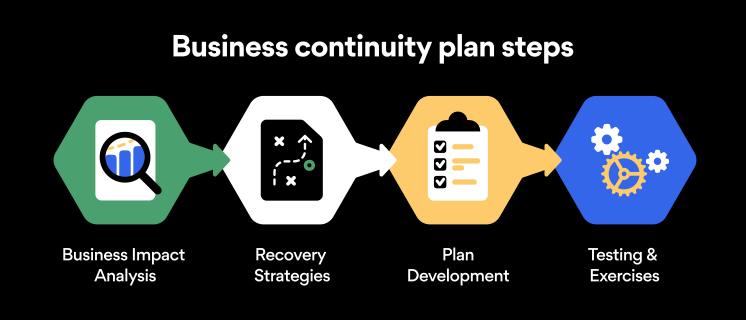
Here are some general guidelines that an organization looking to develop a BCP should consider:

Analysis

A business continuity plan should include an in-depth analysis of everything that could negatively affect the overall organizational infrastructure and operations. Assessing different levels of risk should also be a part of the analysis phase.

Design and development

Once you have a clear overview of potential risks your company could face, start developing a plan. Create a draft and reassess it to see if it takes into account even the smallest of details.

Implementation

Implement BCP within the organization by providing training sessions for the staff to get familiar with the plan. Getting everyone on the same page regarding crisis management is critical.

Testing

Rigorously test the plan. Play out a variety of scenarios in training sessions to learn the overall effectiveness of the continuity plan. By doing so, everyone on the team will be closely familiar with the business continuity plan’s guidelines.

Maintenance and updating

Because the threat landscape constantly changes and evolves, you should regularly reassess your BCP and take steps to update it. By making your continuity plan in tune with the times, you will be able to stay a step ahead of a crisis.

Level up your company’s security with NordPass Business

A comprehensive business continuity plan is vital for the entire organization’s security posture. However, in a perfect world, you wouldn’t have to use it. This is where NordPass Business can help.

Remember, weak, reused, or compromised passwords are often cited as one of the top contributing factors in data breaches. It’s not surprising, considering that an average user has around 100 passwords. Password fatigue is real and significantly affects how people treat their credentials. NordPass Business counters these issues.

With NordPass Business, your team will have a single secure place to store all work-related passwords, credit cards, and other sensitive information. Accessing all the data stored in NordPass is quick and easy, which allows your employees not to be distracted by the task of finding the correct passwords for the correct account.

In cyber incidents, NordPass Business ensures that company credentials remain secure at all times. Everything stored in the NordPass vault is secured with advanced encryption algorithms, which would take hundreds of years to brute force.

If you are interested in learning more about NordPass Business and how it can fortify corporate security, do not hesitate to book a demo with our representative.


About Version 2 Digital

Version 2 Digital is one of the most dynamic IT companies in Asia. The company distributes a wide range of IT products across various areas including cyber security, cloud, data protection, end points, infrastructures, system monitoring, storage, networking, business productivity and communication products.

Through an extensive network of channels, point of sales, resellers, and partnership companies, Version 2 offers quality products and services which are highly acclaimed in the market. Its customers cover a wide spectrum which include Global 1000 enterprises, regional listed companies, different vertical industries, public utilities, Government, a vast number of successful SMEs, and consumers in various Asian cities.

About NordPass
NordPass is developed by Nord Security, a company leading the global market of cybersecurity products.

The web has become a chaotic space where safety and trust have been compromised by cybercrime and data protection issues. Therefore, our team has a global mission to shape a more trusted and peaceful online future for people everywhere.

Total Cost of Ownership of Azure AD

Editor’s Note: Given the fast-paced nature of technology, it is possible that some of the information presented in this article is out-of-date, or incomplete, in some fashion. The author periodically reviews and revises this article to ensure information contained within is as accurate as possible.


Microsoft® Azure® is an umbrella for a variety of cloud services, including Azure Active Directory (AAD). On its face, Azure AD might seem like a replacement for on-prem Active Directory (AD) or a cloud-based solution for organizations in need of a directory service, but more factors come into play for IT admins making purchasing decisions, including complicated SKUs and licensing. This article examines the total cost of ownership (TCO) of AAD for the type of configuration that a small and medium-sized enterprise (SME) would require for its identity management lifecycle.

AAD was created to extend on-prem AD identities to Azure in order to provide user management for Microsoft Office applications, and now single sign-on (SSO) for service providers (SP). It’s available as a standalone product, but is also bundled with Microsoft 365 (M365) subscriptions. Microsoft has positioned AAD as the connective tissue within a broader identity and access management (IAM) ecosystem. That extends from users and devices to its security portfolio. Add-ons and integrations are almost inescapable, because AAD is very interwoven with those products. It’s not even possible to implement Microsoft’s best practices for AAD without paying more.

A Codependent Approach

Significantly, Microsoft manages endpoints separately from identities even though experts recommend making identity the new perimeter in cybersecurity. Device management (outside of AD) is only bundled with some of its premium M365 SKUs, but not AAD. Organizations that aren’t using M365 will have to purchase a separate subscription to manage their devices.

Microsoft’s reference architecture suggests an array of Microsoft-based tools to fully leverage AAD, so even Microsoft-heavy IT shops will encounter more IT infrastructure and maintenance costs. You’ll have limited administrative capabilities if you use AAD without on-prem AD, or aren’t subscribed to premium tiers and add-on services. For example, you won’t be able to employ the suite of group policy objects (GPOs) to on-prem Windows devices, and you’ll struggle with authenticating local IT resources such as applications and file servers. 

AAD is also not an open directory, so working with external identities from other identity providers (IP) and connecting users to IT resources (RADIUS, LDAP) requires even more solutions. Some are cloud-based, but others expand its footprint on-premise, and are reliant on AD.

Costs of Azure Active Directory

To fully assess the TCO of Azure AD, it’s necessary to account for tangential, but necessary, costs. Fortunately, we’ve developed an equation to help you understand the TCO of AAD:

Costs of Azure Active Directory = Azure AD Premium Package + Add-Ons for device management + External Identities + Azure AD DS + Active Directory + LDAP Server + RADIUS Server + Integration/Management Time for your implements

Let’s begin by assessing AAD’s pricing and then branch outward to the other components.

Standalone Azure AD and M365

Standalone AAD has three SKUs:

  • AAD Free – AAD Free provides SSO to Microsoft apps and federation to other SAML/OIDC services. This version is feature-limited with no group management, limited MFA configurations, limits on directory objects per user, and various other restrictions.
  • Premium 1 (P1) – P1 introduces SSO sign-in page customizations, conditional access rules, role-based group assignments to applications, end-user self-service for passwords and MFA, additional cloud security, and options for authenticating users into local Windows apps. 
  • Premium 2 (P2) – P2 adds risk-based identity protection, more self-service capabilities, as well as identity governance and compliance such as privileged access and entitlements management. Logging and reporting is also more comprehensive.
Azure Ad pricing
capabilities and use cases for Microsoft
Image credit: learn.microsoft.com

M365 subscriptions also bundle AAD. It’s not even possible to use M365 without AAD, which serves as its substrate for managing your users. Some admins encounter AAD through Office.

Its directory features are gated off into multiple tiers:

  • M365 Business Premium – This includes device management and security services to protect identities.
  • M365 E1 – Device management isn’t included and AAD is limited.
  • M365 E3 – This edition includes device management and AAD P1.
  • M365 E5 – This edition includes device management and AAD P2.
  • M365 F3 – This edition includes device management and AAD P1.
  • Enterprise Mobility + Security (EMS) E3 – This edition includes device management and AAD P1.

EMS E5 – This edition includes device management and AAD P2.

Microsoft 365 pricing
Image credit: Microsoft

Device Management

AAD sounds a lot like AD, but it doesn’t perform the same role; for example, it won’t manage your devices. Microsoft established its Intune product lineup to manage Android/Chrome, Apple, Linux, and Windows endpoints. It uses AAD to manage identities, Configuration Manager (formerly SCCM), in addition to Windows Defender for security and Autopilot for onboarding Windows devices. Intune may be bundled with M365, depending upon your subscription level. However, Intune is not included with AAD P1 or P2, and that omission will increase your monthly costs per user.

compared pricing
availability of Basic Mobility and Security and Intune

Intune includes enterprise-grade features and can be a useful tool for compliance and managing non-Windows devices for organizations that have many remote workers. However, it also has documented downsides. SMEs that are accustomed to AD may be unfamiliar with its quirks:

  • Unpredictable time spent importing the provisioning of devices, assigning profiles, and deploying apps.
  • Simple mistakes can cause actions to fail, such as a Registry key requirement rule filtering out devices.
  • Problems with assigning available licenses to new users.
  • Configuration changes taking a long time to go into effect.
  • Debugging events and sync logs requiring additional third-party tooling.
  • Loss of internet connectivity causing Windows Autopilot to fail.

The cost of learning, implementing, and supporting Intune is another TCO consideration.

Azure Active Directory Domain Services

Intune is not the only option for Microsoft shops. Azure Active Directory Domain Services (Azure AD DS) is billed as a domain controller-as-a-service for virtual machines and legacy applications. It’s charged for the hour, and the price is based on the number of directory objects.

Per Microsoft, “Azure AD DS provides a managed domain for your users, applications, and services to consume. This approach changes some of the available management tasks you can do, and what privileges you have within the managed domain.”

Azure AD DS differs from on-prem AD in a number of ways, including its lack of domain or enterprise administrator privileges. You also cannot add on-prem domain controllers to the managed domain.

If you use AAD and Azure AD DS in conjunction with on-prem AD — which is necessary if you want full AD capabilities — you’ll have to factor in the associated costs for that as well.

Managing External Identities

Microsoft Entra is necessary to manage external (non-Microsoft) identities and devices. There’s a charge for every single MFA authentication for non-Microsoft identities such as Google Workspace. In addition, AAD P1 or P2 licenses are necessary to work with external identities.

compared pricing for identities

Complex Licensing

If you think that AAD is the right solution for your organization, you’ll have to dig through the pricing and SKUs outlined above. It goes without saying that the pricing model is complicated, and non-system access needs may also obligate you to purchase more CALs. You should begin by understanding your current situation. If you have a Microsoft Enterprise Agreement, Open Volume agreement, or are part of the Cloud Solutions Program, you will have a right to certain functionality (Basic and Premium depending upon your specific agreement).

If your IT organization isn’t a part of any of those programs, yet you’ve purchased Azure or M365, you can purchase the right Premium Azure AD services. It’s possible for SMEs to overspend on AAD or be upsold by a Microsoft partner due to the complexity of its licensing, so it’s important to take the time to understand your requirements versus what you’re paying for.

reddit feed
Image credit: Reddit

Complicated Setup and Migrations

The breadth of potential configurations, critical need to understand security best practices, and overall complexity can make adopting AAD a major initiative. Most SMEs aren’t experts in Microsoft licensing and seek assistance for their implementations. For instance, AAD’s default settings can place your users at risk of phishing attacks that can even bypass MFA. IT teams that are migrating from products such as AD FS or have multiple domains in a forest will face some technical considerations that may be unclear and unfamiliar. Microsoft’s guidance states:

“If you have multiple on-premises domains in a forest, we recommend storing and synchronizing information for the entire forest to a single Azure AD tenant. Filter information for identities that occur in more than one domain, so that each identity appears only once in Azure AD, rather than being duplicated. Duplication can lead to inconsistencies when data is synchronized. For more information, see the Topology section below.” 

That can be significant work for an SME.

The realization that adopting AAD can be very cumbersome has given rise to a cottage industry of consultants, and many organizations purchase blocks of hours to support their deployments. In-house resources may not be enough. Factor implement costs into your TCO calculations.

Cost of Active Directory

Active Directory represents a number of costs for organizations, including servers, software, and licensing. SMEs will also have to maintain a server room, which can add significant costs.

Servers: Domain Controllers

If you use Azure AD with on-prem AD, servers are an obvious cost. You either need to maintain a server room or spin up AD in a virtual environment, both of which must factor into the TCO of Azure AD. You need to budget for the costs of redundant servers, too, in case your primary domain controller (DC) fails. High availability (HA) is automatic whenever there’s more than one DC. That makes it possible to shut down a server for maintenance without impacting your end users.

A task from an IT department’s project to set up high availability

Objects are automatically replicated throughout the server cluster and administration is more complex: e.g., add-on apps must be installed and updated on each DC. Adding additional servers to achieve HA may increase licensing, management, and other infrastructure costs.

Software: Windows Server

Beyond the cost of the servers themselves, you’ll need to purchase the software to be installed on them. Since 2016, Windows Server licensing has been on a per CPU core pricing structure, rather than the previous per socketed CPU structure. Admins can purchase those licenses in 2- or 16-packs. You may need to stand up multiple servers for all of the required server roles.

Licensing: Client Access Licenses

Another important cost to consider is client access licenses (CALs), which you purchase based either on user count or device count. Core licensing has become even more expensive.

An example of new CALs being required without Software Assurance volume licensing

Hardening AD for Security

It can take more than a work week to secure AD to recommended best practices. Maintaining AD alongside AAD could dramatically increase IT overhead and administrative costs.

A statement of work to harden a domain controller
A statement of work to harden a domain controller — the total cost was $6,485.95

Advanced Identity Lifecycle Management

AD isn’t Zero Trust and identity lifecycle management is a manual process unless SMEs develop automations or use third-party solutions. That increases the risk that users may be over or under-provisioned, or that inactive accounts remain in use. Managing users in AD can be a disjointed, error-prone process. The risk of data exfiltration is higher with manual processes, which creates a financial risk as laws and regulations are treating violations more seriously. AAD’s advanced identity management policies can extend AD and improve upon it, but only with P1, P2 subscriptions. Azure AD Connect is required to sync identities between AD and AAD.

Server Rooms

An accumulation of hardware, servers, and network equipment means you’ll be spending more for your server room. Eventually, you’ll require a more powerful core switch or better firewall. “Better” translates to more expensive and potentially unplanned downtime on your network as well as new annual support costs, change management, and backups of your configurations.

Support renewal costs for upgraded firewalls at a manufacturing company

Then, you’ll have to establish physical security controls and ideally, fire suppression. An inert gas system requires sealing a room and having dedicated HVAC. Other solutions for special hazards, including in-rack fire suppression, are also costly. See here for an example:

Part of a quote for a server room’s fire suppression upgrade

Microsoft promises consolidation, but its solutions can be a wellspring of added administration.

This next section explores non-systems requirements and challenges AAD creates for SSO.

LDAP Server

AAD and AD lack SSO to everything, especially the core protocols that network devices or Wi-Fi networks use. This can lead to identity silos and duplicate authentication flows. Microsoft promises consolidation, but its solutions can be a wellspring of added administration.

If you aren’t hosting all your server infrastructure in Azure, you’ll also need to manage the associated identity management costs to manage user access to other cloud infrastructure providers such as AWS® and GCP. Some of these platforms offer their own managed Active Directory services, so you can potentially leverage those managed AD services, but you’ll need to make sure that they can connect back to your other AD infrastructure and/or with Azure. None of this work is easy, and it can add a great deal of fragility to your IAM environment.

Azure AD doesn’t come with cloud LDAP functionality, so you’ll need to maintain an LDAP server, as well as service on-prem LDAP applications and MFA solution, if required. Azure AD DS is also required to sync passwords and group memberships from Active Directory. Azure AD DS allows organizations to migrate legacy applications to Azure entirely, but that service represents an additional cost as well as the work around the migration of applications which is not an easy task in most instances.

Image credit: Microsoft

RADIUS Server

Azure AD does not come with cloud RADIUS functionality either. Instead, you’ll need to spin up a RADIUS server, use the NPS server role or another cloud service to have the capability of managing Wi-Fi and VPN access. You’ll also require a secondary authentication method. JumpCloud makes it possible to leverage AAD credentials for delegated authentication. Many network devices use RADIUS for authentication, and the lack of support makes initiatives such as compliances more difficult. Auditors often want devices, down to switches, protected by MFA.

Vendor Lock-In

This level of platform integration may be beneficial for “all Microsoft and Azure” organizations. However, the lack of interoperability through an open directory and continued reliance on AD adds costs, complexity, and administrative overhead. That level of monoculture and high dependence on a single vendor makes it more difficult to adopt “best-of-breed” solutions.

With the changing IT landscape, the good news is that IT organizations are leveraging a wider range of platforms. This requires a different set of IT management tools, and specifically, it involves the core identity provider. Using Azure AD encourages the use of Azure throughout your entire environment. AAD, like AD, obligates the use of Microsoft infrastructure and services/applications. This strategy has been successful for Microsoft in the past, and the company is employing it again to work to lock-in customers into Microsoft platforms.

Microsoft’s promotion of IT consolidation has been successful from a sales perspective, but it doubles down on vendor lock-in. In contrast, an open directory platform provides value lock-in.

Evaluating Azure Active Directory

Azure AD might be the solution for a Microsoft shop that already has AD established and needs to extend their IT resource management to the cloud. However, organizations should assess their existing stack and whether Azure AD will address all their needs before making the purchase. Beyond Azure AD, organizations will likely need to purchase Intune for device management. Azure AD DS is also necessary to maintain Azure AD Connect (along with their on-prem AD instance), as well as RADIUS and LDAP instances and other add-ons. These all represent cost centers. Azure AD is not an all-in-one solution, but does meet certain use cases.

Resource to Calculate TCO

JumpCloud released a TCO Guide and TCO Calculator to help IT admins understand the complete costs of different solutions used in their environment. We also invite you to try JumpCloud, which is free and full-featured for 10 uses and devices. It may help extend AD in the way that your organization needs to adapt to change or meet compliance requirements without hassle. JumpCloud is 

JumpCloud’s open directory platform delivers select features found in AAD, Entra, and Intune with an emphasis on what’s best for SMEs. Those capabilities are available without gated licensing, tethering your team to legacy systems, or complicated workarounds. It’s priced to enable workflows, versus charging more for advanced identity lifecycle management. JumpCloud enables IT unification, as opposed to consolidating with a single vendor.

Its benefits include:

JumpCloud also offers a variety of Professional Services to help ease the load your employees face. Learn more or schedule a free 30-minute technical consultation.

Software renewals come out of the capital expenditures (CAPEX) budget, which is a major long-term expenditure versus operating expenses (OPEX), the day-to-day operational budget. Accounting makes a distinction between software and services. Using services helps your organization to lower its income taxes and free up cash. Services may make it easier to budget when you already know what the ongoing costs will be.

About Version 2 Digital

Version 2 Digital is one of the most dynamic IT companies in Asia. The company distributes a wide range of IT products across various areas including cyber security, cloud, data protection, end points, infrastructures, system monitoring, storage, networking, business productivity and communication products.

Through an extensive network of channels, point of sales, resellers, and partnership companies, Version 2 offers quality products and services which are highly acclaimed in the market. Its customers cover a wide spectrum which include Global 1000 enterprises, regional listed companies, different vertical industries, public utilities, Government, a vast number of successful SMEs, and consumers in various Asian cities.

About JumpCloud
At JumpCloud, our mission is to build a world-class cloud directory. Not just the evolution of Active Directory to the cloud, but a reinvention of how modern IT teams get work done. The JumpCloud Directory Platform is a directory for your users, their IT resources, your fleet of devices, and the secure connections between them with full control, security, and visibility.

Attacks on WebSockets

WebSocket connections are vulnerable to numerous attacks. In July 2022, security researchers found a vulnerability in Apache Tomcat CVE-2022-25762. The flaw allows a threat actor to compromise the data of victims.

In another incident, researchers found a WebSocket vulnerability in the infamous Log4j CVE-2021-44228, where an attacker can exploit the vulnerable log4j version using a JavaScript WebSocket connection.

The reports indicate that attackers can target the WebSocket to exploit the application. This article will help you to understand the functionality and the exploitation methods used against WebSocket connections.

What are WebSockets?

WebSockets are full-duplex and bi-directional communication protocols that require HTTP for connection.

The WebSockets operates on the application layer (OSI model – 7), which allows the client and server to deploy dynamic and real-time applications such as live gaming and chatting.

How does WebSockets handshake work?

In most cases, Javascript establishes WebSocket connections on the client side. 

The ‘wss’ protocol initiates encrypted communication over TLS, while ‘ws’ uses an unencrypted channel.

Initially, the client established a WebSocket handshake by sending a request to the server over HTTP.

  • The ‘Connection’ and ‘Upgrade’ headers specify the WebSocket connection.
  • The ‘Sec-WebSocket-Version’ indicates the WebSocket protocol version. If the server is incompatible with the specified one, it responds with the supported version.
  • The ‘Sec-WebSocket-Key’ is a randomly generated base-64 encoded value, which is unique for each handshake.

The server accepts the handshake and returns an “HTTP status 101 Switching Protocol” response status. 

  • The ‘Sec-WebSocket-Accept’ header value uses an algorithm that includes the SHA-1 hash of the “Sec-WebSocket-Key” and GUID (Globally Unique Identifier) concatenated strings. This process helped to mitigate ambiguous responses caused due to misconfigured servers or cached proxies.

In the lateral part, the handshake is completed, which means that the server and client can communicate via WebSockets in either direction.

WebSocket message format

The client-side browser uses javascript to craft a simple message, which looks like this:

ws.send("John Doe");

As modern applications require work on JSON, WebSocket messages are compatible with the transit of structured data.

{"user":"John Doe","content":"Follow VSociety for amazing Cybersecurity content"}

WebSocket versus HTTP

When a browser and a server communicate, they mostly use a half-duplex stateless protocol known as HTTP. While using HTTP, the client generates the request and then waits for the response from the server. 

While WebSockets use a full-duplex mode for communication initiated over HTTP, the connection stays alive as long as the application is running. 

Vulnerabilities in WebSocket

A threat actor can target the WebSocket in a multitude of ways. Some of the most common flaws and exploitation methods are:

  • Improper Authorization and Authentication 

The WebSocket does not have a pre-defined method to check the integrity of the user. The Application-level protocol performs a separate check for identification.

  • Sniffing attack

The data transmitted over the ‘ws’ protocol is vulnerable to sniffing attacks, which means an attacker can perform a man-in-the-middle attack and leak the sensitive information. For protection against attacks like sniffing, it is encouraged to use the ‘wss’ protocol, which transmits the data over TLS.

  • Denial-of-Service attack

The WebSocket allows a large amount of connection to reach the server. A hacker can take advantage of this and launch a Denial-of-Service or DoS attack by flooding the server with unwanted data.

WebSocket exploitation

For a clear understanding of WebSocket exploitation, let’s comprehend multiple attacks by picking an excerpt from the Mr. Robot series.

Elliott Alderson, the main protagonist, is preparing to tackle the biggest hacking group in the world called the Dark Army.

Manipulating WebSocket messages

The initial step is to visit the website (darkarmy.com) and analyze the workflow to find the potential break-in ways.

Elliot finds a chat option. The next step is to fire the Burpsuite and intercept the traffic between the server and his browser. Elliot scrutinizes the intercepted data and figures that the application is running WebSockets for communication.

After transmitting and inspecting the messages, Elliot understood the encoding method performed on the client side. The final step is to prepare the payload, which looks like this.

The ‘onerror’ event in the payload is triggered when the ‘img’ tag fails to load the image from its source.

Elliot modifies the request, forwards the payload, and observes the alert trigger in the browser. The attacks prove that the Dark Army live chats are susceptible to WebSocket manipulation attacks.


Exploiting the WebSocket handshake

The Dark Army has patched the previous vulnerability, but Elliot still ponders and finds another way to target the application.

Elliot first uses the previous payload in the ‘Repeater’ tab of Burpsuite. According to portswigger, “Burp Repeater is a tool that enables you to modify and send an interesting HTTP or WebSocket message over and over.”

Upon careful observation, Elliot figures that his attack is blocked, and the Dark Army has banned his IP address, which means he cannot initiate further communications with the server.

Elliot spoofs the IP address by adding an XFF (X-Forwarded-For) header to the handshake request. The XFF request header identifies the originating IP address of a client while connecting to a web server through a proxy.

The header request looks like this, and the IP address (1.1.1.1) is the fastest DNS resolver used by Cloudflare.

Now Elliot can reconnect with the Dark Army chat as he has spoofed the IP address successfully. In the lateral part of the attack, he creates an obfuscated XSS payload inside an iframe to bypass any limitation placed by the enemy.

The iframe is an HTML element that embeds another document inside the current HTML document. 

Security methods and mitigations 

To minimize the security threats against WebSockets, follow the pivotal guidelines. 

  • The application should use the encrypted ‘wss://’ protocol over the unencrypted ‘ws://’ to protect against the man-in-the-middle attack.
  • The anti-CSRF tokens, such as X-CSRF-Token, protect the WebSockets against cross-site hijacking attacks.
  • The origin header detects the source of the request. The request header warns the server if the origin is not trustworthy. The server takes necessary action and protects the application against cross-origin attacks.
  • Sanitizing the user input adverts the input-based attacks such as XSS, SQL injections and 

Conclusion

The usage of WebSockets among various applications is prolific due to its dynamic and agile nature. But the recent CVE and the security incident warn that the WebSocket vulnerability is a severe threat and proper remediation is required.

#CVE-2022-25762 #vicarius_blog #exploitation

About Version 2 Digital

Version 2 Digital is one of the most dynamic IT companies in Asia. The company distributes a wide range of IT products across various areas including cyber security, cloud, data protection, end points, infrastructures, system monitoring, storage, networking, business productivity and communication products.

Through an extensive network of channels, point of sales, resellers, and partnership companies, Version 2 offers quality products and services which are highly acclaimed in the market. Its customers cover a wide spectrum which include Global 1000 enterprises, regional listed companies, different vertical industries, public utilities, Government, a vast number of successful SMEs, and consumers in various Asian cities.

About VRX
VRX is a consolidated vulnerability management platform that protects assets in real time. Its rich, integrated features efficiently pinpoint and remediate the largest risks to your cyber infrastructure. Resolve the most pressing threats with efficient automation features and precise contextual analysis.

How to Install and Secure MariaDB in RHEL 9

Jump to Tutorial

MariaDB is an open source and community-developed fork of MySQL. It is a widely used relational database management system (RDMS) used to store data both in production and for personal and experimental projects. It was designed by the original developers of the MySQL database server, with the objective of remaining open source under the GNU GPL license.

Some of the advantages of using MariaDB over MySQL include:

  1. Strong security thanks to additional security features such as user roles, PAM and LDAP authentication, data encryption, and role-based access control (RBAC).
  2. High performance thanks to more and better storage engines such as Aria and XtraDB. The former replaces MyISAM in MySQL and offers better caching. XtraDB replaces InnoDB and improves performance.
  3. Galera clustering which ensures scalability, high availability, and zero loss of data through replication.
  4. Integrated monitoring using microsecond precision and extended user statistics.

In this guide, we will demonstrate how to install and secure MariaDB on RHEL 9.

Step 1: Upgrade Software Packages

To get started, log into your server as a sudo user via SSH. Next, upgrade all the packages and refresh the repositories as follows:

$ sudo dnf update

screenshot of code

The MariaDB Server package is provided by the official AppStream repositories. You can confirm this by searching for the package on the repositories as shown:

$ sudo dnf search mariadb-server

The following output confirms that MariaDB is hosted on the default repositories.

screenshot of code

Step 2: Install MariaDB Server on RHEL 9

The next step is to install the MariaDB Server. To do so, run the following command:

$ sudo dnf install mariadb-server -y

The command installs the MariaDB server alongside other dependencies and additional packages required by the database server.

screenshot of code
screenshot of code

Once the installation is complete, confirm that MariaDB is installed using the following command:

$ rpm -qi mariadb-server

Running this command displays comprehensive details about the MariaDB Server package including the name, version, architecture, installation date, and installed size to name a few.

screenshot of code

Step 3: Start and Enable MariaDB Server

Up to this point, we have successfully installed the MariaDB Server. By default, the MariaDB service does not start automatically. As such you need to start it by running the following command:

$ sudo systemctl start mariadb

In addition, set it to start automatically on system startup.

$ sudo systemctl enable mariadb

screenshot of code

To verify that MariaDB is up and running, run the command:

$ sudo systemctl status mariadb

screenshot of code

MariaDB listens on TCP port 3306. You can confirm this using the command:

$ sudo ss -pnltu | grep mariadb

screenshot of code

Step 4: Secure MariaDB Server

The default settings for the MariaDB database server are considered weak and not robust in the face of a breach or intrusion. As such, you need to go an extra step and secure the database server. To do this, run the mysql_secure_installation script as shown:

$ sudo mysql_secure_installation

Running the script will present you with a series of prompts.

First, you will be required to provide the root password. Next, switch to unix_socket authentication which allows the user to use operating system credentials when connecting to the MariaDB database server.

You can then decide to change the root user or let it remain exactly the way it is.

screenshot of code

For the remaining prompts, press “Y” in order to secure MariaDB to the recommended standards. This does the following:

  1. Removes anonymous users from the database server. This prevents the risk of having anyone log into MariaDB without having a user account.
  2. Disallows remote root login. This ensures that only the root user is allowed to connect from ‘localhost’ or the server on which MariaDB is installed. This prevents brute-force attacks using the root user password.
  3. Removes a test database called test which can be accessed by anyone and is only used for testing. Its removal is recommended before transitioning to a producing environment.
  4. Reloads the privilege tables. Hence, saves all the changes made.
screenshot of code

MariaDB is now secured using the recommended security standards after installation.

Step 5: Log Into MariaDB Server

To log in to the MariaDB database server, run the command:

$ sudo mysql -u root -p

Provide the root password for MariaDB and press ENTER. This ushers you to the MariaDB shell.

To check the version of MariaDB installed, run the command:

SELECT VERSION();

From the output, you can see that we are running MariaDB 10.5.16.

screenshot of code

To list all the databases, run the command:

SHOW DATABASES;

screenshot of code

Step 6: Create Database and Database User (Optional)

This step illustrates how to create a database and a database user.

To create a database in the MariaDB Server, run the following command where test_db is the database name:

CREATE DATABASE test_db;

Next, create a database user on the system with a password. Here, test_user is the name of the database user and P@ssword321@ is the user’s password. Be sure to provide a stronger password for your user.

CREATE USER 'test_user'@'localhost' IDENTIFIED BY 'Password321@';

Next, grant privileges to the database user on the database. This determines the rights that the user has on the database, e.g., ALTER, CREATE, DELETE, DROP, SELECT, UPDATE, etc. This command will grant user rights to the database.

GRANT ALL ON test_db.* TO 'test_user'@'localhost' WITH GRANT OPTION;

Lastly, reload the grant tables in order to save the changes made as follows:

FLUSH PRIVILEGES

screenshot of code

To confirm the creation of the database, again, run the following SQL query:

SHOW DATABASES;

This time around, an additional database named test_db appears on the list.

screenshot of code

To view a list of all the users in the database server, run the following query:

SELECT User, Host FROM mysql.user;

screenshot of code

Conclusion

In this guide, you learned how to install and secure the MariaDB database server on RHEL 9. For more information about MariaDB, check out the official documentation.

Looking for more ways to secure your Linux servers and devices? Learn how to improve Linux security posture with JumpCloud’s MDM policies. 

About Version 2 Digital

Version 2 Digital is one of the most dynamic IT companies in Asia. The company distributes a wide range of IT products across various areas including cyber security, cloud, data protection, end points, infrastructures, system monitoring, storage, networking, business productivity and communication products.

Through an extensive network of channels, point of sales, resellers, and partnership companies, Version 2 offers quality products and services which are highly acclaimed in the market. Its customers cover a wide spectrum which include Global 1000 enterprises, regional listed companies, different vertical industries, public utilities, Government, a vast number of successful SMEs, and consumers in various Asian cities.

About JumpCloud
At JumpCloud, our mission is to build a world-class cloud directory. Not just the evolution of Active Directory to the cloud, but a reinvention of how modern IT teams get work done. The JumpCloud Directory Platform is a directory for your users, their IT resources, your fleet of devices, and the secure connections between them with full control, security, and visibility.

×

Hello!

Click one of our contacts below to chat on WhatsApp

×