
Skip to content

How to Guarantee a Completely Secure Migration to M365

Many organizations are now choosing to migrate to Microsoft 365 for a number of reasons including collaborative working options and Microsoft 365. Doing so has a number of advantages, but the movement of data can be difficult. A main consideration during the migration process can be maintaining data integrity whilst securing the data throughout the migration. Here are some migration security measures to consider to ensure a secure migration to Microsoft 365.


Encryption of Data
End-to-end encryption is the most secure way to communicate securely and with privacy online. The messages are encrypted at both ends of the conversation which prevents anybody in the middle from reading the private communications. Neither hackers nor unwanted third parties can access the encrypted data on the server.

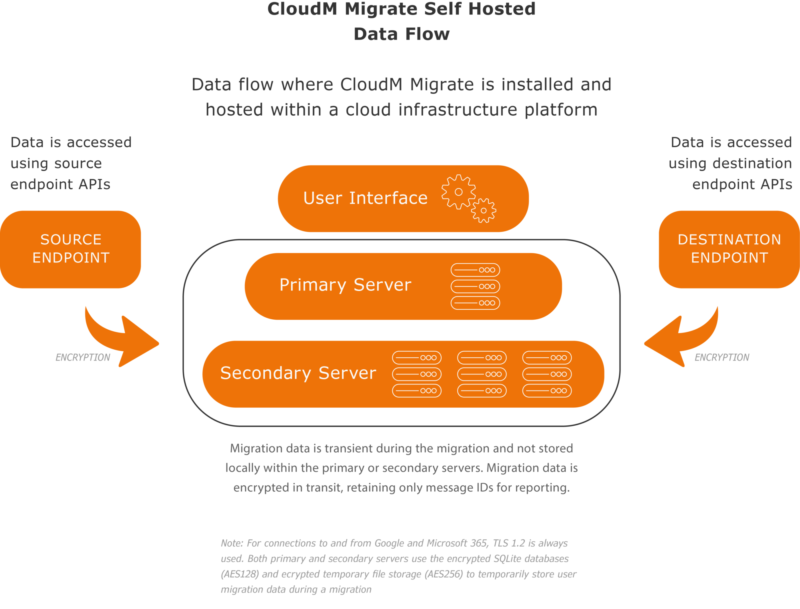
CloudM Migrate has end-to-end encryption between migration endpoints. The option to Self Host CloudM Migrate will completely isolate your migration data from your source environment to the destination cloud tenant.

Both primary and secondary servers use the following components to temporarily store migration data during a migration.

  • Encrypted SQLite databases (AES256)
  • Encrypted temporary file storage (AES256)

Where CloudM Migrate requires a username or password to interact with a system, and stores sensitive data like this, that data is stored encrypted within SQL Server (AES256). SQL Server 2019 Express is installed by default but you can specify your own SQL instance.

Know your source data
Before you start migrating data, you need to know exactly what it is you’re moving. Ensure you know the format of the data, where it is in the system, and if it does actually need to be migrated. Ensure the data is clean and any data that does not need to be kept, can be disposed of to reduce costs and decrease the chance of security risks.

Know your destination
Knowing everything about where the data is coming from is half the battle, the other half is knowing where it’s going.

Ensure that you know the exact destination your data will be going to. From simple things like username conflicts to license fees, the new system will have its own set of rules and regulations.

For example, if you are moving from a legacy endpoint to Microsoft 365, you need to know that all data will be working as expected and the appropriate security compliances are in place. It is also important to ensure everything will be compatible
Back up data
Before the migration begins, ensure all data has been backed up, especially the files you will be migrating. If there are any issues or problems during the migration, such as corrupt or missing files, then you can always restore from the backup.

Get us to help
Migrations are a specialized area, bringing with them their own challenges and solutions, and the right advice from experts like us can make things go a lot smoother. It’s important to understand your limitations, as mishandling a migration can have disastrous consequences.

We know how important security is during migrations. Move to the cloud with confidence with guaranteed data integrity with zero downtime for users with our secure cloud migration tool.
About Version 2 Digital

Version 2 Digital is one of the most dynamic IT companies in Asia. The company distributes a wide range of IT products across various areas including cyber security, cloud, data protection, end points, infrastructures, system monitoring, storage, networking, business productivity and communication products.

Through an extensive network of channels, point of sales, resellers, and partnership companies, Version 2 offers quality products and services which are highly acclaimed in the market. Its customers cover a wide spectrum which include Global 1000 enterprises, regional listed companies, different vertical industries, public utilities, Government, a vast number of successful SMEs, and consumers in various Asian cities.

About CloudM
CloudM is an award-winning SaaS company whose humble beginnings in Manchester have grown into a global business in just a few short years.

Our team of tech-driven innovators have designed a SaaS data management platform for you to get the most from your digital workspace. Whether it’s Microsoft 365, Google Workspace or other SaaS applications, CloudM drives your business through a simple, easy-to-use interface, helping you to work smarter, not harder.

By automating time-consuming tasks like IT admin, onboarding & offboarding, archiving and migrations, the CloudM platform takes care of the day-to-day, allowing you to focus on the big picture.

With over 35,000 customers including the likes of Spotify, Netflix and Uber, our all-in-one platform is putting office life on auto-pilot, saving you time, stress and money.

Introduction to CloudM Migrate Self Hosted

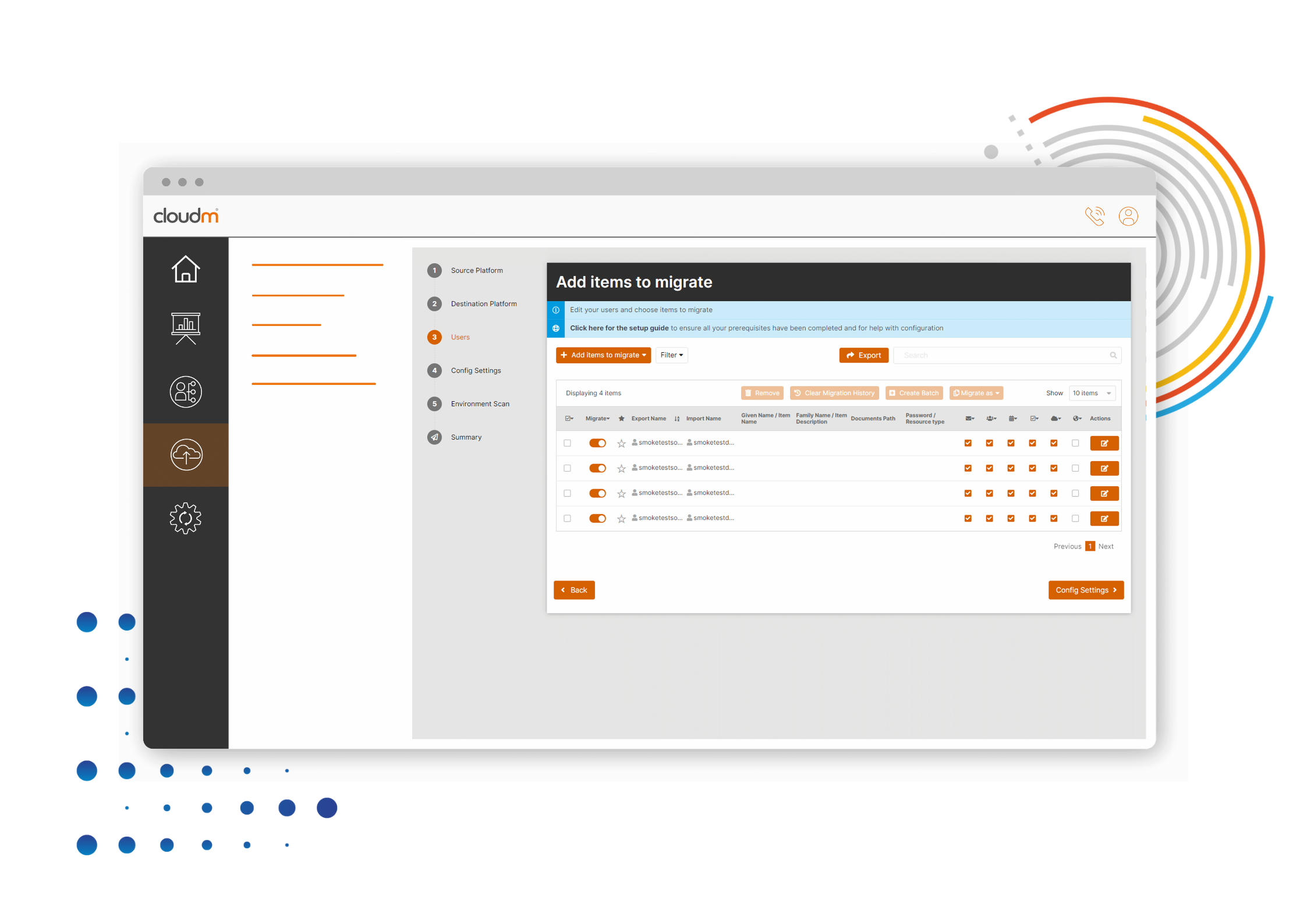
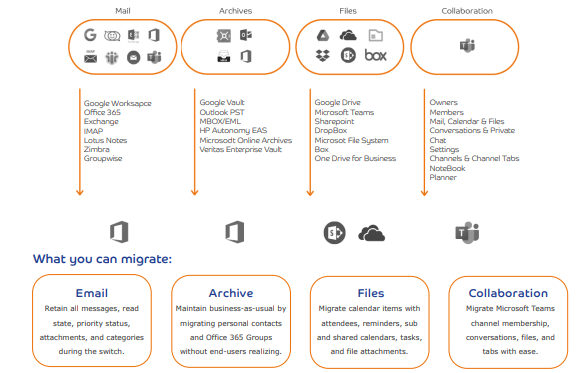
Cloud migrations are complex, always changing, and unique to every organization. You need the flexibility and control to tackle your project in the way that suits you best. This is why we have multiple migration deployment options to suit all businesses. In this blog, we break down exactly what CloudM Migrate Self-Hosted is as well as explain security, endpoint, and installation information so you have more guidance when selecting a deployment option. Definition CloudM Migrate Self-Hosted is the downloadable version of CloudM Migrate, ideal for large and complex migrations. Migrate (Self-hosted) is highly configurable, allowing you to complete the most complex and demanding migrations seamlessly. Using our web interface, you can run a multitude of virtual machines to complete your self-hosted migration to Microsoft 365. Once set up in your environment, Migrate (Self-hosted) can securely migrate your mailboxes, files, SharePoint sites, mailbox archives, and more to Microsoft 365. Security If the organization has compliance obligations that do not permit you to use a third-party service, Migrate Self-Hosted is most appropriate. The software can be run behind your own organization’s firewall, critical data is kept internally and no other party has access to it. CloudM Migrate already has end-to-end encryption between migration endpoints. The option to Self Host CloudM Migrate will completely isolate your migration data from your source environment to the destination cloud tenant. CloudM has adopted the ISO 27001 standard as its framework and is externally certified. ISO27001 is one of the most popular information security standards in the world, focusing on protecting three key aspects of information; confidentiality, integrity, and availability. Installation Basic installation will install all components to a single machine and is suitable for performing migrations from a single server or as the main server in a multi-server migration. If you have specialized requirements, have a pre-existing SQL Server instance you would like to use, or will be performing multi-server migrations using a server farm, you should also review the advanced installation documentation. The following components makeup and are used by CloudM Migrate:
  • Web Application and Primary Service
  • Secondary Service
  • SQL Server Express 2017
  • Redis
Clustering With Self-Hosted the option to create a cluster of CloudM Migrate servers can be leveraged to increase migration velocity. Each CloudM Migrate cluster node can handle processing 20 migration threads. While this does increase velocity, more nodes do have ever-decreasing returns in overall velocity as destination throttling ramps up. Legacy Endpoints Moving legacy applications to the cloud can help to address multiple concerns businesses have regarding their data storage needs. Every business wants to be agile, flexible, up-to-date & adapt quickly to demand. CloudM helps businesses achieve these goals by supporting a wide range of source and destination endpoints, enabling migrations from almost any platform including various legacy endpoints. We’re here to help inform you about the most compatible deployment options for your business. Get in touch today to discuss your available options with one of our experienced solutions architects.

About Version 2 Digital

Version 2 Digital is one of the most dynamic IT companies in Asia. The company distributes a wide range of IT products across various areas including cyber security, cloud, data protection, end points, infrastructures, system monitoring, storage, networking, business productivity and communication products.

Through an extensive network of channels, point of sales, resellers, and partnership companies, Version 2 offers quality products and services which are highly acclaimed in the market. Its customers cover a wide spectrum which include Global 1000 enterprises, regional listed companies, different vertical industries, public utilities, Government, a vast number of successful SMEs, and consumers in various Asian cities.

About CloudM
CloudM is an award-winning SaaS company whose humble beginnings in Manchester have grown into a global business in just a few short years.

Our team of tech-driven innovators have designed a SaaS data management platform for you to get the most from your digital workspace. Whether it’s Microsoft 365, Google Workspace or other SaaS applications, CloudM drives your business through a simple, easy-to-use interface, helping you to work smarter, not harder.

By automating time-consuming tasks like IT admin, onboarding & offboarding, archiving and migrations, the CloudM platform takes care of the day-to-day, allowing you to focus on the big picture.

With over 35,000 customers including the likes of Spotify, Netflix and Uber, our all-in-one platform is putting office life on auto-pilot, saving you time, stress and money.

Google Cloud Identity vs. AAD

Microsoft and Google have been locked in a battle for the heart of the IT community for years now. This technological arms race has brought about a number of cloud innovations, including in identity and access management (IAM). Both contenders understand that by controlling user identities, they can lock you into their respective ecosystems and sell you additional services. 

In one corner, we have Microsoft Azure Active Directory (AAD), a cloud-based IAM solution for hybrid or cloud-only implementations. In the other corner, we have Google Cloud Identity, a cloud-based solution for managing user identities and access to Google resources. Both organizations seek to control your identities. The interesting problem is that if you are looking to replace your on-prem Active Directory instance or leverage directory services, then neither of these options can provide a solution.
In this article, we’ll compare Google Cloud Identity and Azure Active Directory, before explaining why neither is the best replacement for on-prem solutions.

What is Google Cloud Identity?

If you have ever used Google Workspace, you’re already familiar with Google cloud identities. Google identity management services enable users to connect to various applications and platforms delivered through Google. Google identity management allows for easy integrations to Google’s catalog of SaaS services and SSO applications but it does not offer support for legacy applications or on-prem resources. It also offers some authentication services via OAuth and SAML. An organization’s systems, on-prem applications, and network are outside of the scope of G Suite directory.

Unfortunately, this means that a lot of users will remain locked into their on-prem identity provider instance, namely Active Directory. While Google IDaaS is an excellent cloud user management system for Google Workspace, it is not a stand alone cloud-delivered directory service.

What is Azure Active Directory?

Microsoft’s version of the user management system is called Azure Active Directory (also called AAD, or Azure AD). The name confuses many people, because it makes it seem like Microsoft has moved their on-prem directory to the cloud. But that’s not the case. 

Rather, Azure AD works on top of Active Directory to provide single sign-on (SSO) access to a variety of SaaS applications like Office 365, Salesforce, DropBox, and many others. In essence, it is designed as a bridge between your existing legacy Active Directory instance and Microsoft’s catalog of compatible cloud-delivered services. While it is possible to sync your Active Directory instance with Azure AD, in of itself Azure AD is not a complete cloud-based directory service.

This is because Azure AD does not act as the authoritative source of truth of user identities (unless you are just using Office 365 or Azure resources). This role is still within the domain of Active Directory for many organizations, thus requiring traditional on-prem devices and dedicated IT staff to create and maintain. While Azure AD is meant to be a cloud identity platform, unfortunately, the true source of identity management is still firmly grounded with the legacy directory service, Active Directory.

The Problem with Google Cloud Identity and AAD 

As hinted above, the most glaring weakness of both of these platforms is that neither can truly function as the core identity provider for an organization. Instead, they’re user management systems designed only for their respective platforms.

Google Cloud Identity only organizes identities for Google Workspace and other Google cloud-hosted applications. It isn’t designed to be used for on-prem systems, AWS cloud servers, Azure, Office 365, and a wide range of other web and on-prem applications and networks. 

Azure Active Directory isn’t an Active Directory replacement, either. It’s a user management system for Azure, Office 365, and a web application SSO platform. If you want a core directory service, you won’t find it with either Google Cloud Identity or Azure Active Directory.

Instead, both of these platforms leave it to the IT department to figure out how to build a central, authoritative directory service for the organization. Having multiple user management platforms can create a significant amount of work and a great deal of security risk. 

Thankfully, there’s a better solution. An open directory platform can be your single authoritative source for user identities and authentication – across all platforms and operating systems. 

Open Directory Platform – the best Active Directory Replacement 

A new generation of cloud identity management is here. This independent solution, called an open directory platform, doesn’t rely on a single vendor, but works across platforms and operating systems to support authentication on Windows, Mac, Linux, Google Workspace, and more – all from the cloud, all at the same time. 

JumpCloud’s open directory platform provides the stability and authentication of Azure Active Directory and the flexibility and cloud nativity of Google workspace. You’ll also get many features, like SSO, multi-factor authentication (MFA), and password management you typically have to get from a third-party provider. 

Ready to learn more about why JumpCloud is the best replacement for active directory? Drop us a note to get a live demo, or sign up for your free account today.

About Version 2 Digital

Version 2 Digital is one of the most dynamic IT companies in Asia. The company distributes a wide range of IT products across various areas including cyber security, cloud, data protection, end points, infrastructures, system monitoring, storage, networking, business productivity and communication products.

Through an extensive network of channels, point of sales, resellers, and partnership companies, Version 2 offers quality products and services which are highly acclaimed in the market. Its customers cover a wide spectrum which include Global 1000 enterprises, regional listed companies, different vertical industries, public utilities, Government, a vast number of successful SMEs, and consumers in various Asian cities.

About JumpCloud
At JumpCloud, our mission is to build a world-class cloud directory. Not just the evolution of Active Directory to the cloud, but a reinvention of how modern IT teams get work done. The JumpCloud Directory Platform is a directory for your users, their IT resources, your fleet of devices, and the secure connections between them with full control, security, and visibility.

Same Integrations, Different (& Better) Views

The New integration screen just got published. The screen’s rework includes much simpler and intuitive navigation between all integrations options. Check it out now!

About Version 2 Digital

Version 2 Digital is one of the most dynamic IT companies in Asia. The company distributes a wide range of IT products across various areas including cyber security, cloud, data protection, end points, infrastructures, system monitoring, storage, networking, business productivity and communication products.

Through an extensive network of channels, point of sales, resellers, and partnership companies, Version 2 offers quality products and services which are highly acclaimed in the market. Its customers cover a wide spectrum which include Global 1000 enterprises, regional listed companies, different vertical industries, public utilities, Government, a vast number of successful SMEs, and consumers in various Asian cities.

About VRX
VRX is a consolidated vulnerability management platform that protects assets in real time. Its rich, integrated features efficiently pinpoint and remediate the largest risks to your cyber infrastructure. Resolve the most pressing threats with efficient automation features and precise contextual analysis.

The Rise of Iran-Sponsored Threat Actors

In mid-summer of 2022, Albania accused the Iranian government of targeting them with a series of major cyberattacks. The attacks, which targeted government servers and online portals, raised alarms about the increasing expertise and audacity of Iranian-sponsored advanced persistent threat (APT) actors. Although many specifics about the attacks are still unknown, the FBI and other international observers believe that the Iranian government first breached the networks of the Albanian government by using phishing emails and malware as early as 14 months before launching the full attack. After gaining access, the attackers were able to penetrate deeper into the systems to obtain sensitive information and cause disruption to government operations.

Continue reading
×

Hello!

Click one of our contacts below to chat on WhatsApp

×