Skip to content

Google Chrome and ESET collaborate in fight against online threats

BRATISLAVA – ESET, a global leader in cybersecurity, announced today it is continuing to partner with Google to protect Google Chrome users. ESET’s award-winning technology is used by Google to scan, identify and remove unwanted software encountered by users of Chrome for Windows. The extension of the cooperation on Chrome Cleanup, part of Chrome’s Safe Browsing feature, continues the close collaboration between the world’s most popular browser and the leading EU-based IT security vendor’s technology.

As applied in Chrome Cleanup, ESET’s technology is used by Google to alert users about unwanted or potentially harmful software attempting to get on users’ devices through stealth, for example, by being bundled into the download of legitimate software or content. Google Chrome, using ESET’s security technology, then provides users with the option to remove the unwanted software. Chrome Cleanup operates in the background, without visibility or interruptions to the user. It deletes the unwanted software and notifies the user once the cleanup has been successfully completed.

The two companies enjoy a broad relationship that also includes a collaborative role in which ESET works closely with Google to ensure the safety of the Google Play Store as a partner in the App Defense Alliance. ESET also provides data for users of Chronicle, Google Cloud’s security analytics platform, to surface verdicts on malicious files.

“We are proud to partner with Google in helping Chrome users enjoy safer technology,” said Juraj Malcho, ESET Chief Technology Officer. “The ongoing collaboration with Google and Chrome Cleanup demonstrates the importance that both companies place on keeping users safe and secure. With Chrome being the browser of choice for most Windows users, ESET’s technology and engineers are providing frontline protection.”

For additional information about Google Chrome Cleanup, please click here

About Version 2 Digital

Version 2 Digital is one of the most dynamic IT companies in Asia. The company distributes a wide range of IT products across various areas including cyber security, cloud, data protection, end points, infrastructures, system monitoring, storage, networking, business productivity and communication products.

Through an extensive network of channels, point of sales, resellers, and partnership companies, Version 2 offers quality products and services which are highly acclaimed in the market. Its customers cover a wide spectrum which include Global 1000 enterprises, regional listed companies, different vertical industries, public utilities, Government, a vast number of successful SMEs, and consumers in various Asian cities.

About ESET
For 30 years, ESET® has been developing industry-leading IT security software and services for businesses and consumers worldwide. With solutions ranging from endpoint security to encryption and two-factor authentication, ESET’s high-performing, easy-to-use products give individuals and businesses the peace of mind to enjoy the full potential of their technology. ESET unobtrusively protects and monitors 24/7, updating defenses in real time to keep users safe and businesses running without interruption. Evolving threats require an evolving IT security company. Backed by R&D facilities worldwide, ESET became the first IT security company to earn 100 Virus Bulletin VB100 awards, identifying every single “in-the-wild” malware without interruption since 2003.

訊連科技發表全新FaceMe® eKYC & Fintech智慧金融解決方案 打造安全、快速、可靠且流暢的金融eKYC應用

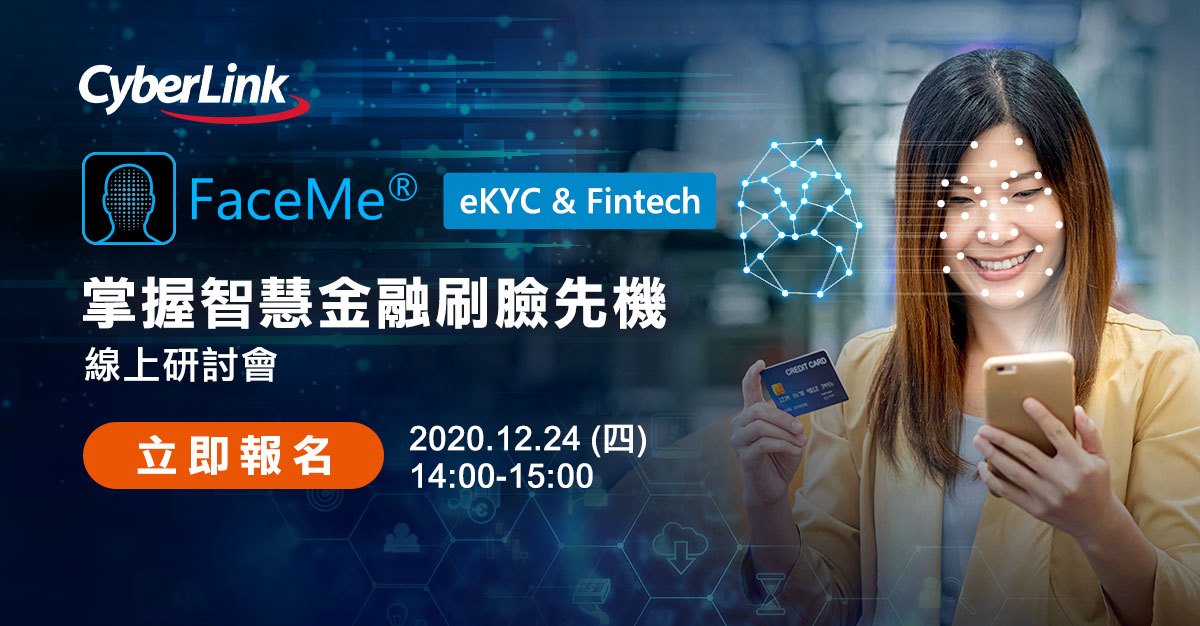
【2020年12月8日,台北訊】 全球頂尖AI臉部辨識領導廠商訊連科技(5203.TW)發表新版FaceMe® eKYC & Fintech智慧金融解決方案,透過臉部辨識eKYC,即可進行人證比對、身分辨識等應用,提升各式服務申辦的效率與安全。訊連科技亦將於12月24日舉辦 「FaceMe® eKYC & Fintech 掌握智慧金融刷臉先機」線上研討會,分享金融科技最新趨勢與eKYC等重點應用項目。

訊連科技發表全新FaceMe® eKYC & Fintech智慧金融解決方案 打造安全、快速、可靠且流暢的金融eKYC應用

金融科技(Fintech)是近年來金融業數位轉型的一大趨勢,而透過臉部辨識進行的eKYC ( Electronic Know Your Customer)更是金融科技的重點應用項目,臉部辨識與其他生物辨識技術相比,其易用、辨識率高與快速之優勢,可相容於行動裝置及電腦上的攝影機,無須另外搭配指紋掃描、虹膜掃描等專屬硬體。

FaceMe®是全球頂尖的臉部辨識引擎,於全球知名的NIST FRVT臉部辨識1:1及1:N評比中,名列全球頂尖開發團隊體之列。透過FaceMe®高精準度的臉部辨識技術,可為智慧金融提供高達99.7%的辨識率,除了可準確進行人證比對及身分辨識外,亦可提供有效的防偽技術,杜絕透過臉部相片、影片或3D模型等方式攻擊系統,避免有心人士透過相片或臉部影片進行破解及身分盜用。

「金融科技是金融產業數位化轉型的第一步,這項技術節省大量時間和成本,並提高金融機構的服務水準。其中採用生物辨識的eKYC應用,可大幅提升金融認證之易用性。」訊連科技黃肇雄執行長表示:「在新冠疫情影響下,臉部辨識擁有非接觸性的優勢,為最適合金融機構導入之生物辨識技術。FaceMe® eKYC & Fintech智慧金融解決方案不僅提供高達99.7%的辨識率,更支援高精準度2D/3D臉部防偽,解決以往民眾須經常往來臨櫃辦理冗長程序的困擾,使金融服務更加安全、簡單、快速。」

全新升級的FaceMe® eKYC & Fintech 智慧金融解決方案 ,同時提供1:1 人員核身 (人證比對)與1:N 身分辨識等功能,可應用於行動網銀、ATM無卡交易、行動投保與人員進出管理等,透過臉部辨識可更快速、安全的核實用戶身分,同時將臉部特徵存放至伺服器建檔,供作後續服務使用,不僅大幅提升了客戶體驗,也減少了金融業大量尋求客服協助的問題。

訊連科技將於12月24日舉辦 「FaceMe® eKYC & Fintech 掌握智慧金融刷臉先機」線上研討會,分享金融科技最新趨勢與eKYC等重點應用項目,讓台灣客戶可即時掌握金融科技的脈動。

「FaceMe® eKYC & Fintech 掌握智慧金融刷臉先機」線上研討會

更多關於FaceMe® eKYC & Fintech的訊息,請至: https://tw.cyberlink.com/faceme/solution/Fintech_eKYC

About Version 2

Version 2 Digital is one of the most dynamic IT companies in Asia. The company distributes a wide range of IT products across various areas including cyber security, cloud, data protection, end points, infrastructures, system monitoring, storage, networking, business productivity and communication products. Through an extensive network of channels, point of sales, resellers, and partnership companies, Version 2 offers quality products and services which are highly acclaimed in the market. Its customers cover a wide spectrum which include Global 1000 enterprises, regional listed companies, different vertical industries, public utilities, Government, a vast number of successful SMEs, and consumers in various Asian cities.

關於CyberLink
訊連科技創立於1996年,擁有頂尖視訊與音訊技術的影音軟體公司,專精於數位影音軟體及多媒體串流應用解決方案產品研發,並以「抓準技術板塊,擴大全球行銷布局」的策略,深根台灣、佈局全球,展現亮麗的成績。訊連科技以先進的技術提供完美的高解析影音播放效果、以尖端的科技提供完整的高解析度擷取、編輯、製片及燒錄功能且完整支援各種高解析度影片及音訊格式。產品包括:「威力導演」、「PowerDVD」、「威力製片」、「威力酷燒」等。

ESET earns top prize in SE Labs’ Enterprise Endpoint Protection awards

BRATISLAVA – ESET, a global leader in cybersecurity, has earned the AAA award, the highest possible prize, for its ESET Endpoint Security solution in SE Labs’ Q3 Enterprise Endpoint Protection awards. This is the second time that ESET has been recognized with SE Labs’ top award in 2020, after receiving the same rating in Q1.

SE Labs is an independently run testing company that aims to improve information technology security by assessing products and services designed to detect attacks, protect against intrusions or both. It tested nine endpoint security solutions between July and September 2020 to evaluate how effective the products were at detecting and protecting against threats in real time. ESET Endpoint Security received a total accuracy rating of 1,135, the second highest score of any security solution tested.

ESET Endpoint Security, which combines robust antivirus and network security software to protect businesses, was exposed to a mixture of targeted attacks and real-world public email and web-based threats in the testing process. The results demonstrate that the solution is effective at blocking malicious URLs, handling exploits, and correctly classifying legitimate applications and websites.

ESET was also recognized with the highest prize in SE Labs’ Q1 report earlier in the year, receiving the same AAA rating.

Jiri Kropáč, Head of Threat Detection Labs at ESET, commented: “ESET Endpoint Security provides customers with the best level of protection possible, and receiving this AAA rating from SE Labs is testament to that. We are constantly adapting and advancing our technology to provide a balance of cutting-edge detection and prevention and optimum performance, and this is reflected in the report’s recognition of the solution’s ability to block malicious URLs and classify applications. We are proud to be continually recognized for our offerings, and are dedicated to protecting our customers from cybersecurity threats.”

About Version 2 Digital

Version 2 Digital is one of the most dynamic IT companies in Asia. The company distributes a wide range of IT products across various areas including cyber security, cloud, data protection, end points, infrastructures, system monitoring, storage, networking, business productivity and communication products.

Through an extensive network of channels, point of sales, resellers, and partnership companies, Version 2 offers quality products and services which are highly acclaimed in the market. Its customers cover a wide spectrum which include Global 1000 enterprises, regional listed companies, different vertical industries, public utilities, Government, a vast number of successful SMEs, and consumers in various Asian cities.

About ESET
For 30 years, ESET® has been developing industry-leading IT security software and services for businesses and consumers worldwide. With solutions ranging from endpoint security to encryption and two-factor authentication, ESET’s high-performing, easy-to-use products give individuals and businesses the peace of mind to enjoy the full potential of their technology. ESET unobtrusively protects and monitors 24/7, updating defenses in real time to keep users safe and businesses running without interruption. Evolving threats require an evolving IT security company. Backed by R&D facilities worldwide, ESET became the first IT security company to earn 100 Virus Bulletin VB100 awards, identifying every single “in-the-wild” malware without interruption since 2003.

How SCADAfence Defended a DoD Supplier from Over 50 Cyber-Attackers

The ’85 Bears of Cyber Physical Security

A few days ago, our elite cybersecurity team of defenders, faced over 50 of the world’s top hackers and security practitioners in the Hack the Building event. 

The event was born from a joint partnership between MISI (Maryland Innovation and Security Institute) and USCYBERCOM (the United States Cyber Command), is an unrivaled, hands-on live facilities critical infrastructure cybersecurity challenge. 

Hackers, federal labs, building automation companies, academia and government agencies all competed to infiltrate, disrupt or take over a connected smart building and the computing systems and data inside of a government-owned building. 


A Real-World Target

The event is built around a specially-designated, real-world target: A live, fully-equipped 150,000 square-foot “smart” office building near Annapolis, Maryland that teams on-site and remote are challenged to attack through its diverse IT, control systems, Internet of Things (IoT), access control, surveillance camera, building automation and other systems.


The Attack Scenarios

The event was split into two parts, two days each. On the first part, 13 pre-planned attack scenarios took place, and on the second part, the network was open to any type of attack, allowing attackers and defenders to play in a more chaotic cyber war zone.

The building was equipped with many types of assets, such as PLCs, BAS controllers, industrial robots, power distribution units (PDU), IoT controllers, IP cameras & NVRs, serial to ethernet converters, and many other devices.

Each scenario targeted different assets and required different methods to reach the targets. For example, in one scenario the attackers broke into the data center’s cooling system, shutting it down, resulting in server shutdown. In another scenario, the fire alarm system has been disabled.

The full list of scenarios is available here

To simulate a real scenario, many details about the network were unknown to the defensive team. Moreover, some details that were provided were plain wrong, due to outdated network maps. These missing details made the defender’s job more difficult.


Vulnerabilities Discovered by SCADAfence 

The network had a number of common security issues:

  • The network map was inaccurate and had missing information.
  • The network was protected by firewalls, but many known and unknown connections between segments were possible.
  • Some network segments had a mix of devices in them, for example a conference room camera and engineering stations resided in the same network.
  • Some Windows/Linux devices had monitoring/security agents on them, but many devices weren’t covered by monitoring.

The SCADAfence Platform was deployed on a NPB (network packet broker) that was monitoring multiple SPAN ports and network taps. Using the Platform, we were able to monitor the network in real time, and a SOC team was provided by SCADAfence to monitor the Platform and detect attacks.


Over 50 Hackers Attacked the Network at the Same Time

This event is a rare opportunity to stress-test your security product. It’s a lot harder to defend than a normal cyber attack. Over 50 hackers attacked the network at the same time, with each team targeting different assets and arrived from a different place in the network. Some attackers came from the internal network and took over legitimate hosts, then used them to attack other assets. Some came from the company’s VPN, and from other places.

They used a large variety of attack tools and tactics, including physical attacks – hacking an access control system with badge readers.

We were happy to see that the SCADAfence Platform was able to detect the broad spectrum of attacks over the course of these 4 days.

The findings from the SCADAfence Platform were presented to the audience in two live streaming sessions (the full videos will be shared as soon as they become available to us). We were interviewed by Armando Seay, Co-Founder of MISI, and together explained the attack tactics used by the attackers.


Adversaries Play Dirty Using Social Engineering

At one point, one of the red team members was able to infiltrate the blue team live discussion channel, and alerted the red team about our actions. He was able to infiltrate the channel using social engineering, by identifying as a member of one of the blue teams.

When we (the blue team) found out we have a mole in our channel, we started a mole hunt and finally figured out who the adversary was. We’re not sure if it was part of the planned surprises in the exercise, but regardless – it was an important drill that can happen in real life.

This has been a wonderful event, and a rare opportunity to showcase our product and exercise attack/defense scenarios on real industrial hardware, running real processes. We want to thank MISI (Armando, Mark, Alexander, Karissa, Joseph) and USCYBERCOM for planning and executing this event.

We want to thank the red team for the creativity and for the interesting challenges and surprises they had for us, and to the blue team (which we were part of) for the collaboration.


To learn more about SCADAfence’s advanced capabilities, you can watch some short product demos here: https://l.scadafence.com/demo

About Version 2 Digital

Version 2 Digital is one of the most dynamic IT companies in Asia. The company distributes a wide range of IT products across various areas including cyber security, cloud, data protection, end points, infrastructures, system monitoring, storage, networking, business productivity and communication products.

Through an extensive network of channels, point of sales, resellers, and partnership companies, Version 2 offers quality products and services which are highly acclaimed in the market. Its customers cover a wide spectrum which include Global 1000 enterprises, regional listed companies, different vertical industries, public utilities, Government, a vast number of successful SMEs, and consumers in various Asian cities.

About SCADAfence
SCADAfence helps companies with large-scale operational technology (OT) networks embrace the benefits of industrial IoT by reducing cyber risks and mitigating operational threats. Our non-intrusive platform provides full coverage of large-scale networks, offering best-in-class detection accuracy, asset discovery and user experience. The platform seamlessly integrates OT security within existing security operations, bridging the IT/OT convergence gap. SCADAfence secures OT networks in manufacturing, building management and critical infrastructure industries. We deliver security and visibility for some of world’s most complex OT networks, including Europe’s largest manufacturing facility. With SCADAfence, companies can operate securely, reliably and efficiently as they go through the digital transformation journey.

Sometimes it is as much psychology as IT, says about the development of DLP Zbyněk Sopuch, CTO of Brno’s Safetica

Leaking sensitive data costs the companies in average of more than 3.25 million euros. Thanks to the Data Loss Prevention program, which it develops and integrates deep into the system, Safetica Brno provides companies around the world protection against the loss of their sensitive data.

According to CTO of Safetica Zbyněk Sopuch, data protection does not mean only the development of a perfect solution, but also communication with the user and their education. He says: “They need feedback on what they are doing and what they intended, and they need to learn it prudently. We are actually educating them in safety.”

What technologies can developers in Safetica encounter?  

Safetica is developing a solution that protects authorized users from data handling errors. It solves the possible problems “between the chair and the keyboard”, and therefore it needs to be in the place where the data and the user meet – on the end device, on the mobile phone, in the cloud service, etc. The technological domain is so broad that it is easier to define what we do not do there than the other way around. Our solution is not just a mobile application, or the website with databases, as other services are. We are on all platforms. We are integrated deep in the system, we are solving drivers, we are interfacing with the user, doing data analytics. For fun, I’m saying that we are doing everything but the production of hardware, although we thought about that actually for a short time, for example in the sense of encrypted flash drives.

What exactly is your technology stack? 

Our technology stack was initially strongly influenced by Microsoft. We are their Gold partner and where it made sense, we built it using their technologies. Which meant the whole Windows platform (C++, C#) and cloud backend on Azure. Generally speaking, however, we choose native technologies, we are building the web tier in Angular, on Mac we use Objective C, C++ and Swift. On a mobile phone Swift, and Java on Android. And data analytics in Python, for example.

We are not working with Java and PHP which would bring additional platform dependencies and security risks to the customer environment.

You are involved directly in the operating system. Can you describe it in more detail? 

For example, many companies create applications for macOS. But we are going deeper and see how the system works. Where it has its weaknesses and how they can be addressed. Most developers didn’t realize that when Apple released macOS Catalina, the entire security system around the kernel changed and they essentially banned using your own drivers and the like. We knew it.

We know how the system works with files and what the user is doing on the network, and we are trying to give them a helping hand when necessary. We need to know what they are doing when, for example, sending data into the Apple Ecosystem or Office 365, which are features that are more and more integrated with the operating system. Getting back to macOS, this means practically the Linux level, so we are recruiting “linuxers” for macOS as well.

How do you approach different versions of operating systems? 

We have to support not only all mainstream versions of operating systems but also third-party applications. Because of that, we are forced to defensive coding, but most of all it demands QA. We wouldn’t be able to do it manually, everything is running under a robust automation, which does most of the work for us alone overnight. But sometimes we just run into a problem in the field that surprises us. For example, we have found a bug in Adobe that worked badly with files; we have found a bug in the printing API from Microsoft, or even in YSoft’s drivers. Sometimes it is enough to report the bugs and they will correct them, but sometimes the companies neglect it up and we have to deal with it. The customer expects it from us.

What are your technologic differences from mainstream antivirus companies like Avast or ESET? 

We have a similar technology stack, but simply put, they watch what goes inside. We deal primarily with the authorized users, i.e. with the way out. It’s about inspecting the outgoing data, detecting the file content, integrating with email clients and web browsers. We deal with the relation between the outgoing data and the company or legislation, such as GDPR. We are working deep in the network, we are decrypting SSL and watching what is flowing there to make sure that company data does not go out.

Another thing that makes a difference is the focus on user behavior. Nobody cares that on the disk thousand of operations have been performed. Antivirus doesn’t care. It checks the essentials, omitting the rest. And we are expected to tell the system behavior from the user’s intention and check it contextually. Alternatively, we explain to the user what is wrong. Can you imagine confronting users with what the corporate backup software does, or that you have found sensitive data in the temporary application files? The user does not understand this, and most importantly did not cause it. That is why we regard the end-user and communication with them at the top of our corporate priorities. Sometimes it’s as much about psychology as it is about IT.

Are you supervising traffic at the end stations, or in cloud services as well? 

We are doing the same in the cloud, but it’s far more challenging because ninety percent of what you do at the end station cannot be done there. In addition, the scaling is much more a sudden increase. If we install our solutions on end stations, they can be installed gradually and they take the power directly from the station. Imagine Office 365, where thousands of users can appear in the cloud at once by turning it on.

We monitor the impact on users a lot. When copying data from one server to another, it’s fast. When we have to check it, and the check takes place on a cloud service, then it takes ten times longer. The check itself is fast, but the data are traveling a different way. Then it’s a question of how to solve it. Caching, components in place, launch dialogs from the operating system and the like.

How is your approach to QA? 

With a great emphasis. On the one hand, we are directly influencing the work of each customer’s employee and we can very easily stop them. And then there’s the security aspect. We must not fail in that. We are working with the client’s most sensitive data, and if we don’t think of consequences, we could expose their data. We are working for clients with extreme security requirements, such as banks or security services.

Therefore, our release process is thoroughly elaborated, with an emphasis on eliminating the risk of human error. This allows us to react and release quickly even under such strict conditions. We also have a mandatory code review for everything that goes out and we are striving to share information and experience as much as possible. Basically, it can be said that every one of us is involved in QA, from the product manager to the developer. They write their unit tests and do the mentioned code reviews. The QA engineers are responsible for how the function is designed from a concept perspective, but also for the entire automation architecture and team DevOps. They are not any “clickers”, but full-fledged engineers who have developed our entire automation product.

How are your teams organised?  

They are organized in business agile teams and the related areas are joined. For example, one team is focused on the data security for Windows, so it does integration with Office 365 as well and is responsible for the entire security model with the end-user. Another team handles the cloud backend, endpoint communication and data processing, and is therefore responsible for reporting and interacting with the admin. For example, the Mac team also takes care of data detection and analysis, which is a separate business area.

Our intent is that our people grow not only in the sense of their technical skills but also as humans and in terms of competencies. Our guys have a very broad overview. They are doing things across the business vertical: networks, low-level stuff, cloud, front end. But they go very deep in their favorite expertise. We need a balance between substitutability and high-end experts.

Which technological challenges are you expecting to face? 

I will start from the bottom, where specific challenges are lying for us. Concerning the end-station technology, we already have the necessary integration with all OS except Linux. This will come later. The big challenge is the cloud. There are several approaches, but it is a raging area. And then there are the more expected areas – we are building a robust cloud SaaS system (really native) and we are going to automate gradually more with machine learning and data analysis. The only trend for which we do not have any use yet is perhaps blockchain. But if anyone has a good idea, come here with it!

Author Petra Voženílková

About Version 2 Digital

Version 2 Digital is one of the most dynamic IT companies in Asia. The company distributes a wide range of IT products across various areas including cyber security, cloud, data protection, end points, infrastructures, system monitoring, storage, networking, business productivity and communication products.

Through an extensive network of channels, point of sales, resellers, and partnership companies, Version 2 offers quality products and services which are highly acclaimed in the market. Its customers cover a wide spectrum which include Global 1000 enterprises, regional listed companies, different vertical industries, public utilities, Government, a vast number of successful SMEs, and consumers in various Asian cities.

About Safetica
Safetica is to provide small and mid-sized companies with the same quality data protection that corporations have – affordably, and without any additional IT administration or disruptions in operation.

×

Hello!

Click one of our contacts below to chat on WhatsApp

×