Graylog 的基於資產的風險建模功能,能夠跨攻擊面關聯相關安全事件,並依據漏洞狀態、異常 變化和 API 風險等因素,優先處理重要威脅。此功能將每日數以千計的警報整合成以用戶和系統 為單位的高風險事件,幫助安全分析師快速鎖定優先調查對象,並加速處理流程。
此外,Graylog 的 2024 年秋季版本還新增事件時間線視覺化功能,並運用生成式 AI (GenAI) 將 關鍵細節彙整為事故回應報告,包含影響分析,進一步簡化調查流程,節省分析師時間。
關於 Graylog Graylog 通過完整的 SIEM、企業日誌管理和 API 安全解決方案,提升公司企業網絡安全能力。Graylog 集中監控攻擊面並進行深入調查,提供卓越的威脅檢測和事件回應。公司獨特結合 AI / ML 技術、先進的分析和直觀的設計,簡化了網絡安全操作。與競爭對手複雜且昂貴的設置不同,Graylog 提供強大且經濟實惠的解決方案,幫助公司企業輕鬆應對安全挑戰。Graylog 成立於德國漢堡,目前總部位於美國休斯頓,服務覆蓋超過 180 個國家。
關於 Version 2 Digital Version 2 Digital is one of the most dynamic IT companies in Asia. The company distributes a wide range of IT products across various areas including cyber security, cloud, data protection, end points, infrastructures, system monitoring, storage, networking, business productivity and communication products.
Through an extensive network of channels, point of sales, resellers, and partnership companies, Version 2 offers quality products and services which are highly acclaimed in the market. Its customers cover a wide spectrum which include Global 1000 enterprises, regional listed companies, different vertical industries, public utilities, Government, a vast number of successful SMEs, and consumers in various Asian cities.
Everyone remembers that one required writing class they needed to take. If you’re like a lot of other security analysts, you assumed that your job would focus on using technology, not writing research papers. However, in today’s business environment, cyber incidents are critical business events, especially as governments and agencies create more reporting requirements.
A cyber incident report is a key element for your incident response process, especially when your organization reviews activities to identify areas of improvement during the lesson’s learned phase. When implementing a structured incident response plan, you should know what an IT security incident response report is, why you need one, and what it should contain.
What Is Cyber Incident Reporting?
Cyber incident reporting involves documenting the details of incidents like:
Cyber attacks
Data breaches
Unauthorized access
The IT security report typically details an incident’s timeline, including:
Date of incident
Attacker activities and timing
Accounts, resources, and/or data affected
Remediation steps taken
Cyber reporting is a critical part of the incident response process because organizations can use the documents as part of:
Lessons learned: Assessing incident detection and response to identify areas of improvement
Implementing controls: Developing new controls to prevent a similar incident from occurring in the future
Notification requirements: Communicating with affected parties or others as required by law
Why Are IT Security Reports Important?
Documenting an incident’s details and notifying relevant stakeholders promptly provides various benefits.
Maintain Compliance
Most legal and regulatory frameworks require organizations to report cybersecurity incidents to various involved parties, including:
Law enforcement
Cybersecurity agencies
Affected parties, like individuals or companies whose data was compromised
Laws have varying timelines for providing notification. For example, the General Data Protection Regulation (GDPR) mandates that organizations report a data breach within 72 hours. Meanwhile, under the Health Insurance Portability and Accountability Act (HIPAA), covered entities must notify affected parties within 60 days.
Failure to comply with these notification requirements can lead to fines or other penalties.
Improve Risk and Threat Awareness
A detailed cyber security incident report provides insight into potential weaknesses. By analyzing the incident’s underlying causes, security teams can improve their risk models and close security gaps. The organization can use this information to address new threats then implement new security controls to mitigate risk.
Build Trust With Clients, Customers, and Stakeholders
Transparency during data breaches builds trust with stakeholders by demonstrating professionalism and urgency. Open communication about incidents reinforces that no organization is immune to cyber threats, showcasing commitment to data protection. While the organization will remove sensitive information related to its own security, the IT security incident report provides a timeline that can act as the foundation for these communications.
Cyber Reporting Challenges
Reporting, like compliance, is a process that can become overwhelming, especially for understaffed security teams.
Gathering Information
Under the pressure of an ongoing incident, security teams need to investigate quickly. Isolation and recovery are the critical steps. They document their activities, but they have no time to organize their documentation. Once they contain the threat and recover systems, they spend time putting the puzzle pieces together.
Creating a timeline
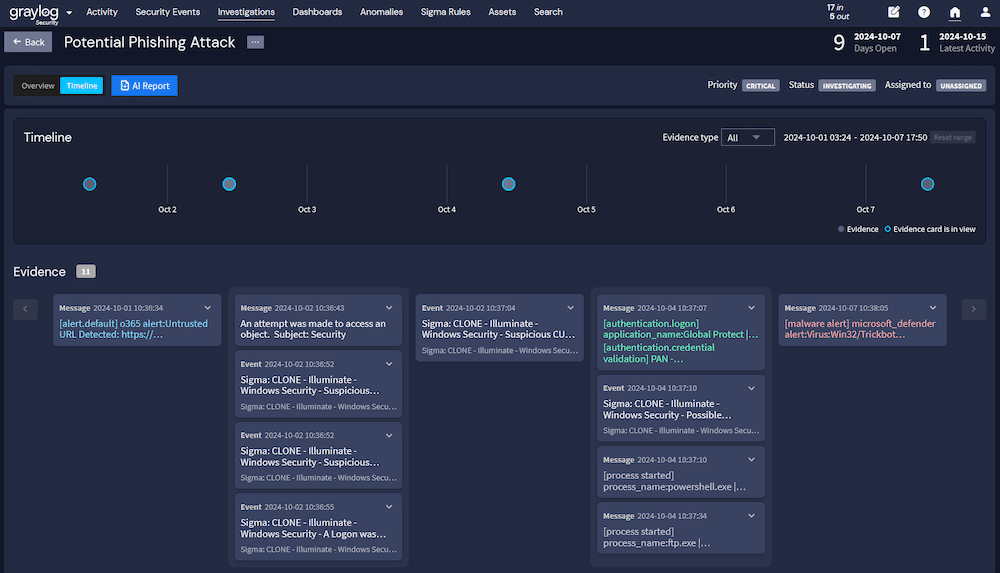
In a perfect world, incident investigations start with the first alert that the attackers trigger. Across complex, interconnected systems, the activity that initiates an investigation may not be that first alert. Additionally, many alerts only provide a quick glimpse into a moment in time. For example, Sigma rules provide insight that an event occurred but often lack context, like previous or follow up events.
Turning data into a narrative
Alerts and ticketing system notes are simply data points. They provide insight into discrete actions. For a cybersecurity incident report, analysts need to turn these events into a narrative. For example, the system may have sent a Windows Event alert with the ID 4625, “attempt made to logon with unknown user name or bad password and failed.” However, the security analyst needs to translate that “what happened” into the “why it matters.”
Using sensitive environment data
Although large language models (LLMs) can turn raw data into a narrative, cyber incident report data contains sensitive information, including user IDs or internal identifiers. Unfortunately, feeding data into a public LLM makes that information part of the technology’s database, creating a data leak issue.
What Needs to Be in a Cyber Security Incident Report?
Since organizations use IT security reports to document and learn from incidents, reports need to include technical and non-technical information that outlines various event details.
Executive summary
The executive summary provides a clear, concise overview of the cybersecurity incident for a broad audience, highlighting:
Key finding
Actions taken
Impact on stakeholder
Incident ID
Incident summary, with type, time, duration, and affected systems/data
Potential Phishing Attack Timeline
Incident details
This section captures critical information about the incident, including:
Nature of threat
Business impact
Immediate actions taken
When/how incident occurred
Who/what was affected
Overall scope
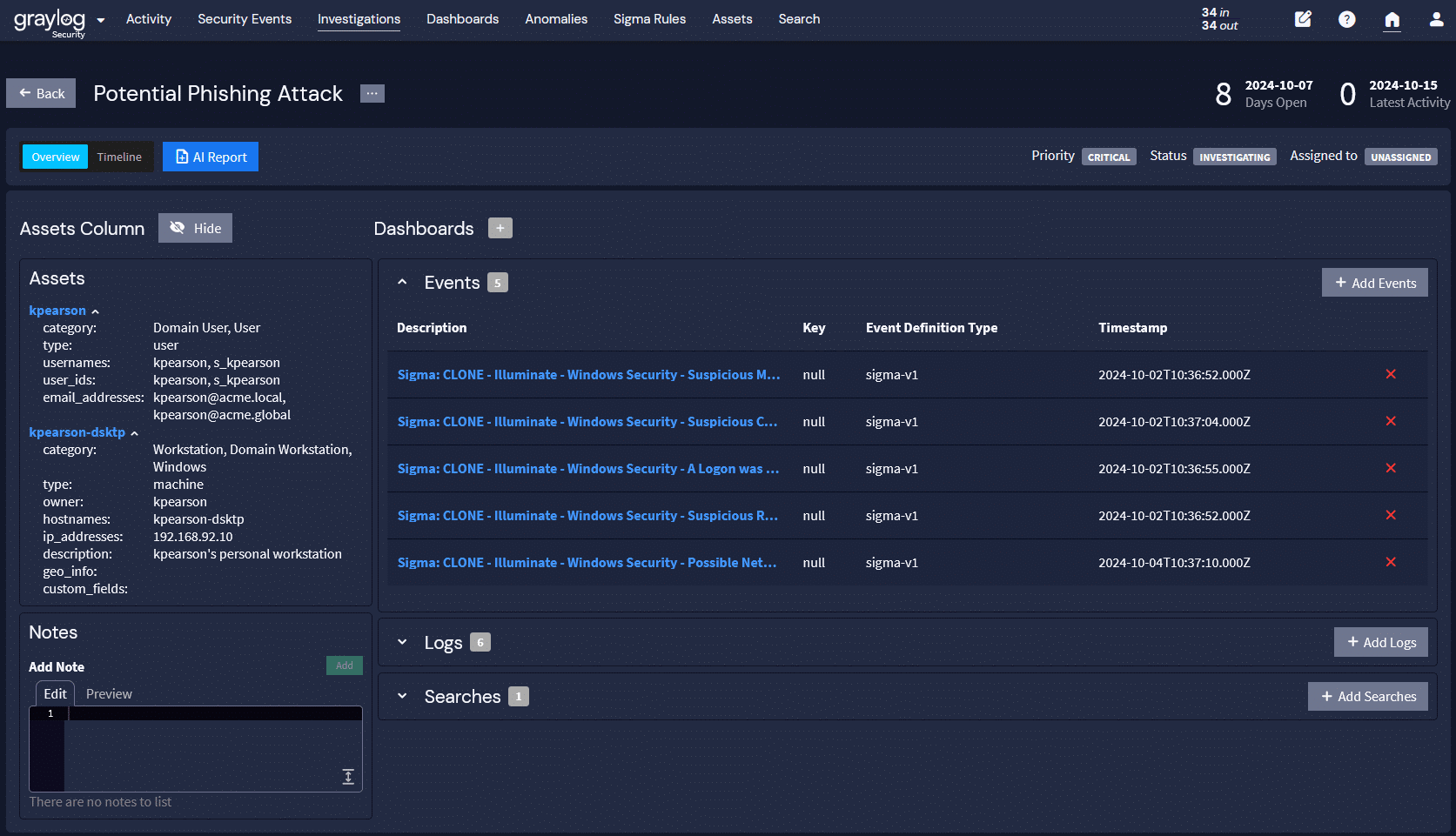
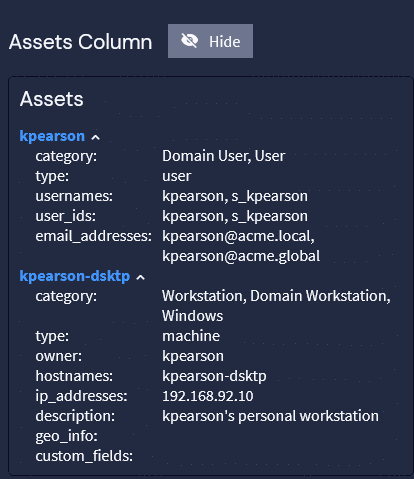
Critical Events, Logs, and Assets Impacted by this Potential Phishing Attack
Attack vector details
Attack vector details identify the specific vulnerabilities that attackers exploited, including technical details like:
Open ports
Weak credentials
Phishing URLS
Source IP addresses for Distributed Denial of Service (DDoS) attacks
Systems and assets affected
This section outlines the technology assets impact, including:
Servers
Storage
Network device
User devices
Additionally, it details the damage that the incident causes, like data corruption, to evaluate the impact on business operations.
Business impact assessment
A business impact assessment evaluates the operational disruptions and data compromises resulting from the cyber incident. It reviews any
Financial losses
Regulatory implications
Long-term consequences
Incident response actions
Incident response actions highlight the steps taken from detection to remediation, including
Preparation
Containment
Recovery
Detailing these activities can identify areas of improvement that enable the organization to update controls.
Communication and notification logs
Communication and notification logs show how the organization shared information about the incident for compliance and accountability purposes. These logs detail communications with all affected parties informed, including
Internal teams
External stakeholders
Regulatory authorities
Conclusions
In the conclusions, the cybersecurity incident report provides a comprehensive overview of the event, its impact, and insights for future prevention.
Graylog Security: Responsible AI for Automating IT Security Incident Reporting
Reading every log generated during a security incident is overwhelming, but the individual logs are only limited pieces of discrete information. To gain full visibility into an incident, you need to aggregate the data and understand the timeline.
With Graylog Security, you can create AI-generated incident reports using your organization’s log data while maintaining control and security over the information in the logs. At the click of a button, our AI interface analyzes all the logs and provides a report based on what it found, what it sees happening based on the data, and recommendations for mitigating the issue. Since all data you need remains in your Graylog deployment or in Data Warehouse, you maintain control, security, and privacy over your most sensitive environment data.
About Graylog At Graylog, our vision is a secure digital world where organizations of all sizes can effectively guard against cyber threats. We’re committed to turning this vision into reality by providing Threat Detection & Response that sets the standard for excellence. Our cloud-native architecture delivers SIEM, API Security, and Enterprise Log Management solutions that are not just efficient and effective—whether hosted by us, on-premises, or in your cloud—but also deliver a fantastic Analyst Experience at the lowest total cost of ownership. We aim to equip security analysts with the best tools for the job, empowering every organization to stand resilient in the ever-evolving cybersecurity landscape.
About Version 2 Digital
Version 2 Digital is one of the most dynamic IT companies in Asia. The company distributes a wide range of IT products across various areas including cyber security, cloud, data protection, end points, infrastructures, system monitoring, storage, networking, business productivity and communication products.
Through an extensive network of channels, point of sales, resellers, and partnership companies, Version 2 offers quality products and services which are highly acclaimed in the market. Its customers cover a wide spectrum which include Global 1000 enterprises, regional listed companies, different vertical industries, public utilities, Government, a vast number of successful SMEs, and consumers in various Asian cities.
“Aren’t you a little short for a Stormtrooper?” In this iconic Star Wars moment, Princess Leia lazily responds to Luke Skywalker, disguised as one of her Stormtrooper captors and using authentication information to open her cell.
In other words, Star Wars acts as an analogy for a cross-site request forgery (CSRF) attack. In a CSRF attack, malicious actors use social engineering so that end-users will give them a way to “hide” in their authenticated session. Disguised as the victim, the attackers can make changes and engage in transactions based on the account’s permissions.
With a cross-site request forgery cheat sheet, you can learn the basic principles underlying these attacks and some best mitigation practices.
What is Cross-Site Request Forgery (CSRF)?
A cross-site request forgery (CSRF) attack involves inheriting the victim’s identity and privileges so that the attacker can perform actions within the site. Typically, browser requests include credential information, like a user’s:
Session cookie
IP address
Windows domain credentials
After a user authenticates into the site, the attackers target functions that allow them to make changes, like:
Changing an email address
Creating a new password
Making a purchase
Transferring funds
Elevating privileges
The site treats these forged, authenticated requests as legitimate and authorized. The attacks focus on making changes within the site because any data requested would go to the victim.
CSRF attacks can also be called:
XSRF
Sear Surf attacks
Session Riding
Cross-Site Reference Forgery
Hostile Linking
Three Types of CSRF Attacks
Malicious actors can deploy three types of CSRF attacks.
LOGIN CSRF Attack
In a login CSRF attack, malicious actors:
Get the user to log into an account the threat actor controls
Victim adds personal data to the account
Attackers log into the account to collect data and victim activity history
Stored CSRF Flaws
Attackers can store an attack on a vulnerable site using fields that accept HTML using:
IMG tag
IFRAME tag
This increases the damage of the attack for two reasons:
Victims may “trust” the compromised site.
Victims may already be authenticated into the site.
Client-side CSRF
The client-side CSRF attack manipulates the client-side JavaScript program’s requests or parameters, sending a forged request that tricks the target site. These attacks rely on input validation issues so the server-side has no way to determine whether the request was intentional.
How does a CSRF attack work?
At a high level, attackers do two things:
Create the malicious code
Use social engineering to trick the victim
CSRF attacks rely on:
Web browsers handling session-related information
Attackers’ knowledge of web application URLs, requests, or functionality
Application session management only using browser information
HTML tags that provide immediate HTTP[S] resource access
By clicking on the malicious URL or script, the victim sets up the attacker’s ability to exploit:
GET requests: Browser submits the unauthorized request.
POST requests: Victim clicking on a link or submit button executes the action.
HTTP methods: APIs using PUT or DELETE could have requests embedded into an exploit page, but same-origin policy restrictions in browsers can protect against these unless the website explicitly allows these requests.
How is Cross-Site Request Forgery Different from Cross-Site Scripting (XSS)?
These attacks exploit different aspects of web interactions:
Cross-Site Request Forgery: leverages use identity to take state-changing actions without victim consent
Cross-site scripting: inject malicious code into web pages to manipulate user input and access sensitive data
Best Practices for Mitigating CSRF Attack Risk
A successful CSRF attack exploits specific application vulnerabilities and a user’s privileges. Following some best practices, you can mitigate these risks.
Use Synchronizer Token Patterns
As the most effective mitigation, many frameworks include CSRF protection by default so you may not have to build one yourself. The server-side-generated CSRF tokens should be:
Unique per user per session
Secret
Unpredictable
The server-side component verifies the token’s existence and validity, comparing it to the token in the user session and the site should reject the request without it.
The mitigation uses per-session tokens because they offer the end-user a better experience. A per-request token would be more secure by limiting the available time frame for using them. However, for every user interaction, the site would need to generate a new token.
Alternative: Signed Double-Submit Cookie Patterns
In cases where you can’t use the synchronizer token, you could substitute the easy-to-implement, stateless Double-Submit Cookie pattern. With the Signed Double-Submit Cookie, you have a secret key that only the server knows to mitigate injection risks that would compromise the victim’s session.
While the Naive Double-Submit Cookie methods may be easier to implement and scale, attackers can bypass the protection more easily through:
Subdomain exploitation
Man-in-the-middle (MitM) attacks
Disallow Simple Requests
Simple requests are cross-origin HTTP requests that can be sent directly from the browser to the target service without getting prior approval. If the site uses <form> tags that allow users to submit data, the application should include additional protections. Some examples of additional protections include:
Ensuring servers or APIs do not accept text/plain content types
Implementing custom request headers for AJAX/APIs to prevent usability issues that using a double-submit cookie would create
Implement Client-side CSRF Mitigations
Since client-side CSRF attacks bypass traditional mitigations, you should implement the following:
Input validation: Ensure that input formats and request parameter values only work for non-state-changing operations
Predefined Request Data: Store safe request data in the JavaScript code
SameSite (Cookie Attribute)
The browser uses this attribute to determine whether to send cookies with cross-site requests and has three potential values:
Strict: prevents the browser from sending the cookie to the target site in all cross-site browsing contexts that involve following a regular link
Lax: maintains a logged-in session when the user follows an external link, but blocks high-risk request methods
Verify Origin with Standard Headers
This method examines the HTTP request header value for:
Source origin: where it comes from
Target origin: where it’s going to
When these match, the site accepts the request as legitimate. If they do not match, it discards the request.
Involve the User
Involving users means they have to take action that mitigates risks from unauthorized operations. Some examples include using:
Re-authentication mechanisms
One-time tokens
While CAPTCHA requires user interaction, it does not always differentiate user sessions. While it would make attacker success more difficult, it isn’t a suggested mitigation technique.
Graylog Security: Mitigating CSRF Risk with High Fidelity Alerts
Graylog Security provides prebuilt content that maps security events to MITRE ATT&CK so organizations can enhance their security posture. By combining Sigma rules and MITRE ATT&CK, you can create high-fidelity alerting rules that enable robust threat detection, lightning-fast investigations, and streamlined threat hunting. For example, with Graylog’s security analytics, you can monitor user activity for anomalous behavior indicating a potential security incident. By mapping this activity to the MITRE ATT&CK Framework, you can detect and investigate adversary attempts at using Valid Accounts to gain Initial Access, mitigating risk by isolating compromised accounts earlier in the attack path and reducing impact.
Graylog’s risk scoring capabilities enable you to streamline your threat detection and incident response (TDIR) by aggregating and correlating the severity of the log message and event definitions with the associated asset, reducing alert fatigue and allowing security teams to focus on high-value, high-risk issues.
About Graylog At Graylog, our vision is a secure digital world where organizations of all sizes can effectively guard against cyber threats. We’re committed to turning this vision into reality by providing Threat Detection & Response that sets the standard for excellence. Our cloud-native architecture delivers SIEM, API Security, and Enterprise Log Management solutions that are not just efficient and effective—whether hosted by us, on-premises, or in your cloud—but also deliver a fantastic Analyst Experience at the lowest total cost of ownership. We aim to equip security analysts with the best tools for the job, empowering every organization to stand resilient in the ever-evolving cybersecurity landscape.
About Version 2 Digital
Version 2 Digital is one of the most dynamic IT companies in Asia. The company distributes a wide range of IT products across various areas including cyber security, cloud, data protection, end points, infrastructures, system monitoring, storage, networking, business productivity and communication products.
Through an extensive network of channels, point of sales, resellers, and partnership companies, Version 2 offers quality products and services which are highly acclaimed in the market. Its customers cover a wide spectrum which include Global 1000 enterprises, regional listed companies, different vertical industries, public utilities, Government, a vast number of successful SMEs, and consumers in various Asian cities.
關於 Graylog Graylog 通過完整的 SIEM、企業日誌管理和 API 安全解決方案,提升公司企業網絡安全能力。Graylog 集中監控攻擊面並進行深入調查,提供卓越的威脅檢測和事件回應。公司獨特結合 AI / ML 技術、先進的分析和直觀的設計,簡化了網絡安全操作。與競爭對手複雜且昂貴的設置不同,Graylog 提供強大且經濟實惠的解決方案,幫助公司企業輕鬆應對安全挑戰。Graylog 成立於德國漢堡,目前總部位於美國休斯頓,服務覆蓋超過 180 個國家。
關於 Version 2 Digital Version 2 Digital is one of the most dynamic IT companies in Asia. The company distributes a wide range of IT products across various areas including cyber security, cloud, data protection, end points, infrastructures, system monitoring, storage, networking, business productivity and communication products.
Through an extensive network of channels, point of sales, resellers, and partnership companies, Version 2 offers quality products and services which are highly acclaimed in the market. Its customers cover a wide spectrum which include Global 1000 enterprises, regional listed companies, different vertical industries, public utilities, Government, a vast number of successful SMEs, and consumers in various Asian cities.
Upcoming Graylog GO User Conference to Showcase Graylog’s Award-Winning SIEM Solution
HOUSTON – October 10, 2024 — Graylog, a leader in Threat Detection, Investigation, and Response (TDIR), today announced it has won CyberSecurity Breakthrough’s ‘SIEM Innovation of the Year’ Award. Graylog’s SIEM solution, Graylog Security, is recognized as an innovative, integrated, and user-friendly security solution that delivers exceptional value.
Graylog’s platform provides a unified approach to threat detection, incident response, and log management. The integration simplifies security operations and enhances efficiency and effectiveness. Graylog’s SIEM solution stood out for its enriched AI/ML capabilities and ability to provide advanced threat detection and real-time monitoring, allowing organizations to stay ahead of sophisticated cyber threats.
SIEM strategy will be a theme throughout the fourth annual Graylog GO User Conference, a two-day virtual event on Wednesday, October 23 and Thursday, October 24. TheGraylog GO opening keynote, ‘The Future of SIEM & Log Management – Industry Trends, M&A Activity, and the Role of AI,’will be presented by renowned EMA cybersecurity industry analyst Chris Steffan. Chris will deliver a comprehensive overview of the state of the SIEM and Log Management industries.
Graylog GO attendees will also be treated to a closing keynote by Prof. Dr. Marco Gercke, adistinguished entrepreneur, scientist, and advisor, recognized globally as an authority on digitalization and cybersecurity.
“We are honored to receive the ‘SIEM Innovation of the Year’ Award from the CyberSecurity Breakthrough organization and are excited to highlight our SIEM innovations at Graylog GO 2024,” said Andy Grolnick, CEO of Graylog. “We have demonstrated that our SIEM solution breaks through the crowded cybersecurity industry to meet the security needs of the modern enterprise. Our SIEM is at the forefront in providing innovation, usability, and scalability – cost-effectively.”
Graylog was also named a leader and fast mover in GigaOm’s 2024 SIEM Radar Report. Graylog Security was applauded for innovation, flexibility, and comprehensive Threat Detection. Additional 2024 Graylog award wins for SIEM include:
The Global InfoSec Awards: Editor’s Choice SIEM Award
The Globee Awards for Cybersecurity: Gold SIEM Award Winner
Cybersecurity Excellence Awards for SIEM
To learn more about Graylog’s award-winning SIEM during the Graylog GO User Conference register at Graylog GO.
About Graylog At Graylog, our vision is a secure digital world where organizations of all sizes can effectively guard against cyber threats. We’re committed to turning this vision into reality by providing Threat Detection & Response that sets the standard for excellence. Our cloud-native architecture delivers SIEM, API Security, and Enterprise Log Management solutions that are not just efficient and effective—whether hosted by us, on-premises, or in your cloud—but also deliver a fantastic Analyst Experience at the lowest total cost of ownership. We aim to equip security analysts with the best tools for the job, empowering every organization to stand resilient in the ever-evolving cybersecurity landscape.
About Version 2 Digital
Version 2 Digital is one of the most dynamic IT companies in Asia. The company distributes a wide range of IT products across various areas including cyber security, cloud, data protection, end points, infrastructures, system monitoring, storage, networking, business productivity and communication products.
Through an extensive network of channels, point of sales, resellers, and partnership companies, Version 2 offers quality products and services which are highly acclaimed in the market. Its customers cover a wide spectrum which include Global 1000 enterprises, regional listed companies, different vertical industries, public utilities, Government, a vast number of successful SMEs, and consumers in various Asian cities.