Skip to content

Cybersecurity in the gaming industry: a business-centric approach

Summary: Cyber threats to gaming companies are growing fast. Discover why cybersecurity is essential for protecting player trust, revenues, and gaming operations.

The gaming industry is booming—and it’s easy to see why. With exciting innovations in online gaming and global player engagement soaring, revenues keep climbing. Experts estimate the industry will hit over $300 billion in annual revenue by 2028. That’s more than double its value back in 2019.

As gaming continues to grow, cybercriminals see opportunities too. Online gaming platforms handle enormous amounts of sensitive information, from payment details to login credentials and personal player data. With so much valuable information stored digitally, gaming companies have become prime targets for cyber threats.

Now more than ever, cybersecurity in gaming isn’t just an IT issue—it’s a fundamental business concern. Game developers and gaming companies must invest in strong security measures to protect data, maintain player trust, and secure their financial futures.

The biggest cybersecurity threats to gaming companies

The variety and frequency of cyber threats are increasing rapidly, presenting serious challenges for gaming companies. Attackers constantly refine their tactics, searching for new ways to breach defenses and compromise gaming accounts. Let’s break down the biggest threats the gaming industry faces today.

Threats to game delevopers

DDoS attacks and service disruption

One common threat is distributed denial of service attacks—or simply, DDoS attacks. These cyber-attacks flood gaming servers with excessive traffic, forcing them offline.

For example, in 2020, Blizzard Entertainment faced severe disruptions during major tournaments due to relentless DDoS attacks. In April 2025, they experienced a DDoS attack again. These disruptions don’t just frustrate gamers—they also lead to significant financial losses for gaming companies.

Credential stuffing and account takeovers

Many players reuse passwords across different online gaming platforms, making gaming accounts easy prey for attackers. Cybercriminals launch brute force attacks using automated tools that systematically try millions of username and password combinations.

In 2019, Epic Games had to warn Fortnite players after attackers successfully compromised millions of accounts. Securing player accounts with multi-factor authentication (MFA) significantly reduces this threat.

Phishing scams and social engineering

Attackers frequently use clever social engineering tactics, especially phishing scams, to trick gamers into revealing their login credentials or other sensitive information. Fake promotions offering in-game rewards or currency entice players to click malicious links. Falling victim may expose sensitive data or financial details to cybercriminals.

Ransomware attacks on game developers

Ransomware—malicious software designed to encrypt data and hold it hostage—also threatens the gaming industry. In 2021, CD Projekt Red suffered a massive ransomware attack, halting game development and causing serious financial and reputational damage. Companies need strong backup plans and endpoint protection to proactively guard against ransomware.

Cheating software as malware carriers

Illegal cheat programs often come bundled with hidden malware, infecting thousands of gaming devices without the user’s knowledge. Games like Call of Duty have seen cheats used to install spyware and other malicious programs, exposing players to identity theft and fraud. The gaming industry must educate players about these hidden risks.

Supply chain vulnerabilities

The modern gaming ecosystem depends on third-party providers and external tools for game developers. Unfortunately, these outside tools can introduce hidden vulnerabilities. The SolarWinds breach showed how attackers can exploit vulnerabilities in supply chains and impact industries like online gaming.

Insider threats to gaming companies

Sometimes threats come from within the organization itself. Employees or contractors with privileged access may accidentally or deliberately cause security breaches. Zynga once faced a situation where former employees stole proprietary game data, threatening both the company’s intellectual property and its reputation.


Why cybersecurity is critical for gaming businesses

Cybersecurity isn’t just about avoiding threats—it directly contributes to a gaming company’s overall success and profitability. Here’s why robust cybersecurity practices are essential for the gaming industry.

Cybersecurity benefits for gaming companies

Protecting revenue streams

Downtime is costly. Every minute gaming platforms remain offline, companies lose potential revenue.

DDoS attacks interrupting major tournaments or game launches can be devastating. Strong security measures, including VPNs and real-time DDoS mitigation, keep gaming services stable and protect revenue streams.

Maintaining brand reputation

The gaming industry depends on player trust. Serious security breaches can permanently damage a company’s brand. Strong cybersecurity practices prevent these disasters, preserving consumer trust and loyalty.

Enhancing player experience

Players want secure, fair, and uninterrupted gaming experiences. Malware infections, account theft, or cheating disrupt the fun, driving players away. Implementing effective cybersecurity—such as endpoint protection and proactive anti-cheat measures—maintains a positive gaming environment, encouraging player retention.

Avoiding regulatory fines

Globally, laws like GDPR impose strict penalties for mishandling sensitive data—fines can reach up to 4% of annual revenue. Compliance with data protection regulations isn’t just smart—it’s mandatory. The gaming industry must adopt stringent cybersecurity practices to stay compliant and avoid expensive penalties.

Attracting investments and partnerships

Investors and partners favor companies with secure, well-managed cybersecurity frameworks. Demonstrating a commitment to protecting data and infrastructure enhances credibility. Adopting principles like Zero Trust further strengthens security and makes companies more attractive to potential investors and partners.

Best practices for cybersecurity in the gaming industry

With cyber threats constantly evolving, gaming companies need comprehensive cybersecurity strategies. Here are some proven best practices every gaming company should adopt:

Protecting user data and privacy

Gamers trust companies to protect their personal data. Implement robust measures such as:

Cybersecurity best practices for the gaming industry

Preventing account takeovers

Protecting gaming accounts is crucial for player retention and security. Account theft can permanently drive loyal players away—preventing it ensures your gaming community thrives.

  • Multi factor authentication (MFA): MFA prevents unauthorized access even if login credentials are compromised.
  • Player education: Inform players about phishing, social engineering, and the importance of strong, unique passwords.

Maintaining service availability

Reliable gaming services build player loyalty and satisfaction. Just one prolonged service interruption can damage your reputation—stable services keep your players happy and engaged.

  • DDoS mitigation: Implement real-time traffic monitoring to neutralize attacks quickly.
  • Cloud security: Regularly audit cloud infrastructure to prevent vulnerabilities.
  • Cloud firewall and VPN gateways: Use strong perimeter defenses and encrypted VPN connections to secure remote gameplay, especially during high-traffic events.

Protecting against malware and ransomware

Even a single malware infection can halt game development, so defensive measures are your best line of protection. Proactively defend your infrastructure against malware:

  • Endpoint protection: Deploy antivirus and Endpoint Detection and Response (EDR) solutions across every gaming device.
  • Regular backups: Store backups separately to quickly recover after ransomware attacks.
  • System updates and patches: Regularly update software and security configurations to eliminate vulnerabilities.

Minimizing insider and supply chain risks

Trusting third-party providers blindly is risky. Vigilant security keeps your game development pipeline secure. Protect against threats from insiders and third-party providers:

  • Least privilege principle: Limit access rights to necessary functions, reducing potential internal risks.
  • Network segmentation: Separate sensitive areas to contain threats.
  • Vendor security assessments: Regularly audit third-party providers for secure coding and compliance practices.
  • Zero Trust architecture: Continuously verify all users and devices, preventing unauthorized lateral movements within networks.

Meeting compliance and regulatory requirements

Complying with regulatory standards like GDPR, COPPA, and PCI DSS is crucial for gaming companies. Strict compliance helps avoid costly fines and maintains player trust. Companies should clearly document data handling practices to ensure transparency. Regular compliance audits and risk assessments are essential. It’s important to continuously encrypt payment details and sensitive player data. Monitoring regulatory changes closely helps avoid unexpected compliance issues. Holding third-party vendors to consistent data protection standards strengthens overall security. Ultimately, transparency and strict compliance build long-term credibility with players and regulators.

Technology advances quickly, and cybercriminals continuously evolve their methods. This makes cybersecurity an ongoing challenge for the gaming industry.

Cybersecurity trends in gaming

Artificial intelligence is becoming both a weapon and a defense. Attackers use AI-driven tools to evade traditional security measures. Gaming companies respond with real-time analytics to rapidly spot these threats. Blockchain technology provides secure and transparent transactions, safeguarding digital assets from theft. Automated threat intelligence platforms help gaming companies swiftly identify cyber threats. Bug bounty programs and regular penetration testing proactively uncover vulnerabilities. These measures keep gaming platforms secure and resilient.

Enhancing gaming cybersecurity with NordLayer

NordLayer provides specialized cybersecurity solutions designed for the gaming industry. Its comprehensive offerings include:

  • Zero Trust Network Access (ZTNA) features
  • Secure VPN with NordLynx (based on WireGuard) and Site-to-Site connections
  • Advanced network segmentation
  • User identity management with popular identity providers like Okta and Google
  • Secure Web Gateway (SWG) features
  • Real-time network visibility and monitoring

For instance, Eldorado Games successfully leveraged NordLayer’s solutions to protect its remote workforce, secure critical data, and maintain smooth processes for game developers.

To learn more, explore the detailed Eldorado Games case study or check our resource on cybersecurity in software development. NordLayer helps the gaming industry effectively safeguard its operations, secure gaming platforms, and deliver reliable gaming experiences that players trust and enjoy.


About NordLayer
NordLayer is an adaptive network access security solution for modern businesses – from the world’s most trusted cybersecurity brand, Nord Security.

The web has become a chaotic space where safety and trust have been compromised by cybercrime and data protection issues. Therefore, our team has a global mission to shape a more trusted and peaceful online future for people everywhere.

About Version 2 Digital

Version 2 Digital is one of the most dynamic IT companies in Asia. The company distributes a wide range of IT products across various areas including cyber security, cloud, data protection, end points, infrastructures, system monitoring, storage, networking, business productivity and communication products.

Through an extensive network of channels, point of sales, resellers, and partnership companies, Version 2 offers quality products and services which are highly acclaimed in the market. Its customers cover a wide spectrum which include Global 1000 enterprises, regional listed companies, different vertical industries, public utilities, Government, a vast number of successful SMEs, and consumers in various Asian cities.

Storware Partners with GigaCloud

Storware and GigaCloud announce strategic partnership to deliver secure, scalable data protection

We’re happy to announce our cooperation with GigaCloud, a prominent European cloud service provider with Ukrainian roots. Through this partnership, the companies aim to deliver a robust and resilient cloud infrastructure tailored to the European market’s increasing demand for secure, sovereign and highly protected digital solutions.

GigaCloud, a proven and trusted industry leader on the Ukrainian market, provides a full-service cloud ecosystem in full compliance with European data protection regulations like GDPR, NIS 2 or DORA. The company has Premier tier VMware Cloud Service Provider status and is trusted by government agencies, state-owned enterprises, as well as large, medium and small businesses alike, showing their ability to handle mission-critical workloads and be flexible in dealing with various tasks.  The integration of Storware Backup and Recovery with cloud services, provided by GigaCloud, can provide European customers with a digital infrastructure that meets the highest standards of data protection against any type of ransomware.

Partnership highlights:

  • The joint commitment between Storware and GigaCloud aims to strengthen the provision of reliable cloud solutions, providing enterprise-grade backup and recovery protection.
  • The solution is designed to meet all requirements of European data privacy and data sovereignty standards.
  • The seamless integration of Storware Backup and Recovery with cloud services ensures business continuity and zero data loss in case of emergencies. Integrated immutable backup technology and advanced encryption provide a strong defense against cyber threats, including any type of ransomware.
  • The partnership ensures a customer-focused experience, showing a commitment to transparency and building trust.


The demand remains strong for protected cloud solutions that combine agility with scale infrastructure and proofed data protection. And here we are excited to have such a trusted and capable partner as GigaCloud on board as we move forward together. This collaboration reflects the growing importance of technology, designed to safeguard critical data and operations. Working with GigaCloud allows the customers to meet requirements of businesses and government in protected against ransomware attack environment. – comments Jan Sobieszczanski, CEO of Storware.

The provider’s most popular products are Enterprise Cloud and Managed Private Cloud. Enterprise Cloud is a VMware-based IaaS computing resource rental service, which can be ordered as a classic Public cloud or a Dedicated cloud with separate hosts and disk groups. Managed Private Cloud is a cloud infrastructure customized for each client separately and provided for exclusive use, which could be based on VMware or Hyper-V.

Among its extra services, GigaCloud also offers VDI, GPU Cloud, BaaS, DRaaS.


Our partnership with Storware is significant for delivering secure, reliable cloud solutions tailored to the evolving needs of the European market. By combining our scalable infrastructure with Storware’s reliable backup and recovery technology, we’re empowering organizations of all sizes to protect their most valuable asset — data. Together, we’re not just responding to modern security challenges; we’re staying ahead of them, says Nazariy Kurochko, GigaCloud CEO.


About Version 2 Digital

Version 2 Digital is one of the most dynamic IT companies in Asia. The company distributes a wide range of IT products across various areas including cyber security, cloud, data protection, end points, infrastructures, system monitoring, storage, networking, business productivity and communication products.

Through an extensive network of channels, point of sales, resellers, and partnership companies, Version 2 offers quality products and services which are highly acclaimed in the market. Its customers cover a wide spectrum which include Global 1000 enterprises, regional listed companies, different vertical industries, public utilities, Government, a vast number of successful SMEs, and consumers in various Asian cities.

About Storware
Storware is a backup software producer with over 10 years of experience in the backup world. Storware Backup and Recovery is an enterprise-grade, agent-less solution that caters to various data environments. It supports virtual machines, containers, storage providers, Microsoft 365, and applications running on-premises or in the cloud. Thanks to its small footprint, seamless integration into your existing IT infrastructure, storage, or enterprise backup providers is effortless.

Network segmentation: what it is and how to implement it

What is network segmentation, exactly?

Network segmentation is the practice of dividing a computer network into smaller subnetworks (also called “segments,” hence the term “segmented network”), each of which can function as a separate unit.

By following this architectural approach, you can define how traffic will flow between different parts of the network. This can be achieved by establishing specific security controls and policies for each segment.

The purpose of all this is to improve network performance, simplify management, and contain potential threats within a specific part of the network, preventing them from spreading to other areas.

How does network segmentation work?

Dividing a network into smaller, manageable parts is no simple task, especially when the network itself is quite expansive—it takes careful planning, IT know-how, and the right resources. The idea is to have elements like the client database, email servers, company website, guest Wi-Fi, and internal applications as independent parts of the network.

Enterprise network segmentation starts with figuring out how to divide the network based on criteria like function, security needs, or business requirements. After that, you use a mix of hardware (routers, switches, and firewalls) and software (virtual LANs, cloud technologies) to break the network into segments and control how traffic flows between them.

Once you’ve got the segments set up, the next step is to monitor and manage each of them, which can be made easier with tools like security information and event management (SIEM) solutions.

Network segmentation and zero trust

Network segmentation is key to how companies manage access to their digital resources. Back in the day, companies used to follow the “assumed trust” principle—the idea that everyone in the company was a good guy, and therefore, could be trusted with access to all company data and services.

However, after thousands of human errors and security breaches caused by bad actors, companies have shifted to the zero-trust model. This approach assumes that no one should automatically have full access to the company’s network and virtual assets. Instead, they must be verified and granted access only to the resources they actually need.

To make this a reality, companies use a few different strategies, with network segmentation being one of them. How so? Zero-trust network segmentation refers to IT teams creating dedicated subnetworks for specific groups of users, ensuring they cannot move beyond their designated limits. This adds an extra layer of defense and aligns with the “never trust, always verify” motto of zero trust. Each subnetwork functions as a secure zone, with access protected by authorization protocols.

And if you combine all of this with identity and access management (IAM) solutions to securely manage user credentials, and network access control (NAC) tools that restrict access based on user or device authentication, you’ve got yourself a solid system for keeping the network running smoothly while minimizing risk.

The benefits of network segmentation

At this point, you’ve probably got a good idea of the advantages that come with dividing your company network into smaller segments. However, if you’re not sure you’ve caught all of them, here’s a rundown of the best examples of network segmentation benefits for you:

Enhanced cybersecurity

Network segmentation helps prevent cyberattacks from spreading across the entire company network. For example, if malware infiltrates a subnetwork, it cannot easily spread to other parts of the network, thereby reducing the potential damage and facilitating a quicker response. Similarly, if someone makes an error and accidentally puts systems at risk, the problem remains confined to the parts of the network they had access to. This makes it much easier to identify the issue and resolve it.

Improved compliance

Complying with policies and regulations like HIPAA and GDPR can feel like a lot of work, but network segmentation can make things easier. By breaking up the network into smaller, more secure sections, businesses can isolate sensitive data in specific virtual environments—only accessible to the right people. Plus, by controlling how data moves between these subnetworks, it becomes a lot easier to demonstrate that you’re meeting compliance requirements during audits.

Increased performance

By dividing the network into smaller segments, a company can avoid network congestion, which occurs when a network carries more data than it can handle. This can lead to slow internet speeds, buffering during streams, video call glitches, and difficulty accessing company resources when needed—ultimately affecting employee performance. Keeping network congestion low helps ensure smoother online operations and prevents downtime.

Facilitated incident response

When dealing with smaller segments of the network, it becomes much easier to spot where an incident is happening. From there, that specific area can be isolated to keep the issue from spreading. Since the rest of the network stays secure and there’s a smaller scope to investigate, IT security teams can focus on the affected area and get to the root of the problem much faster.

How to implement network segmentation in your organization

Before you start breaking your company network into smaller segments, it’s a good idea to get familiar with some network segmentation best practices. That way, you’ll head into the project with confidence and a solid game plan—setting yourself up for a smoother process and better results. Here are a few key things to keep in mind.

Don’t oversegment or undersegment your network

As you read this article, you might get the impression that the more you segment your network, the better. But that’s not quite true. If you go too far, your employees will end up dealing with too many access points, leading to user fatigue, slower workflows, and traffic bottlenecks.

On the other hand, if you don’t segment enough—say, only into 3 or 4 subnetworks—you won’t get the security benefits we talked about. This means your attack surface will still be pretty wide. So, the key here is finding the right balance. Effective network segmentation is about finding that sweet spot in how many parts your company network really needs.

Follow the zero–trust principle

Like we mentioned earlier, keeping your network segmentation secure means sticking to a strict zero-trust policy. In simple terms, no one gets an easy pass—regardless of their role or how long they’ve been with the company. Everyone needs to go through proper authentication before accessing any resources. It may sound tough, but it’s one of the best ways to protect your network segmentation operations and stay in control of who can access what.

Minimize third-party entry points

Chances are, your organization relies on at least a few third-party tools and services to keep things running smoothly. Since these platforms are part of your IT ecosystem, they can also become entry points for cybercriminals if compromised. That’s why it’s important to keep their access limited. Don’t give third-party solutions more reach than they really need. A good way to do this is by setting up dedicated access points that connect them only to specific segments of your network. That way, even if something goes wrong on their end, the issue will not spread easily into your company network.

Protect all endpoints

As an employer, you’re providing your team with devices, business accounts, and access to company data. With that comes the responsibility of making sure what you provide can’t be used against your company, and that each employee’s device and account are properly protected.

That includes giving employees access to the right subnetworks—but it doesn’t stop there. You also need to use antivirus software and monitoring tools to ensure only authorized devices get through—so that, much like in Homer’s Iliad, you’re not inviting in modern-day Trojan horses, which could bring chaos once inside.

Monitor all your subnetworks

Segmenting your network is just the beginning—the real work begins after that. You’ve got to manage and monitor all those subnetworks carefully, making sure you have a big-picture view of the whole network while also keeping an eye on how each part is doing individually. For that, it’s a good idea to use modern monitoring tools to spot any unusual user behavior or get alerted if there’s a data breach, so you can quickly figure out which part of the network needs to be shut off.

How NordPass can help

While it is not software dedicated strictly to network segmentation, NordPass is a tool that can help your organization control access to company resources and secure multiple endpoints to minimize the risk of a cyberattack.

NordPass is more than just an encrypted password manager that allows teams to securely store, manage, and share business credentials, credit card details, and sensitive information—it is also a cybersecurity solution for managing user access to company resources and monitoring data breaches to determine if they involve company data. If you run a large enterprise, you can use NordPass to see what was shared, with whom, and for what purpose, and revoke access with ease when necessary.

The best part is that you can try NordPass before making any commitments—just use the free 14-day trial to see how it can improve your company’s cybersecurity and performance. It would be a shame not to use this opportunity.

About NordPass
NordPass is developed by Nord Security, a company leading the global market of cybersecurity products.

The web has become a chaotic space where safety and trust have been compromised by cybercrime and data protection issues. Therefore, our team has a global mission to shape a more trusted and peaceful online future for people everywhere.

About Version 2 Digital

Version 2 Digital is one of the most dynamic IT companies in Asia. The company distributes a wide range of IT products across various areas including cyber security, cloud, data protection, end points, infrastructures, system monitoring, storage, networking, business productivity and communication products.

Through an extensive network of channels, point of sales, resellers, and partnership companies, Version 2 offers quality products and services which are highly acclaimed in the market. Its customers cover a wide spectrum which include Global 1000 enterprises, regional listed companies, different vertical industries, public utilities, Government, a vast number of successful SMEs, and consumers in various Asian cities.

ESET launches integration with Wazuh

  • This integration provides seamless ingestion of ESET PROTECT, ESET Inspect, and ESET Cloud Office Security data into Wazuh’s security platform.
  • Wazuh’s open-source security platform is easy to deploy, and it offers cost-effective benefits, which the integration of ESET’s solutions boosts to further heights, benefiting our mutual customers.
  • The integration between ESET’s solutions and Wazuh helps SMBs and enterprises meet most of their security needs, irrespective of their maturity levels.

BRATISLAVA, SlovakiaApril 14, 2025 — ESET, a global leader in cybersecurity solutions, is continuing to increase its number of integrations, this time, by connecting with Wazuh, a popular open-source security platform.

Cybersecurity is becoming more complex and difficult. B2B organizations might find obstacles in adjusting to this new reality. Therefore, interoperability has become crucial, which is also why ESET has adopted an API-first approach. As a result, the provision of strong security is easier than ever, as those organizations that need to correlate vast amounts of data from multiple sources, across several vendors, can create more efficient security workflows.
The ESET Endpoint Management Platform (ESET PROTECT), including its Detection and Response capabilities (ESET Inspect), as well as ESET Cloud Office Security, integrates seamlessly with Wazuh, enabling organizations to consolidate security alerts, telemetry, and incidents in a single pane of glass. The integration works by using API-based integration – ESET provides REST APIs, allowing Wazuh to query and pull relevant security events, incidents, and telemetry directly.

Consequentially, this integration should empower any security-conscious organization or professional with cost-effective, open-source security monitoring and compliance solutions. For example, security analysts or incident responders can use Wazuh’s dashboards to correlate ESET’s endpoint detection events with other logs, perform threat hunting, and develop comprehensive incident response playbooks. In the same vein, IT administrators can utilize Wazuh to generate summary reports, do compliance checks, and monitor operational metrics across their entire security stacks, including ESET-supplied data. Effectively, with this integration, security teams can do more with fewer tools and less manual work.

“ESET provides security solutions that can protect one’s tomorrow today. With our integrations, we aim to lessen security burdens, and empower security operators with tools that create natural efficiencies, relieving many of their workflows. With data from ESET PROTECT, ESET Inspect, and ESET Cloud Office Security in Wazuh, they can cover the needs of an entire business environment from a single pane of glass,” said Michal Hájovský, Global Sales Lead at ESET.

Visit our ESET integrations page for more information.

Find out more about Wazuh’s open-source security platform.

Discover more about the power of comprehensive security on the ESET PROTECT Platform page.


About ESET
For 30 years, ESET® has been developing industry-leading IT security software and services for businesses and consumers worldwide. With solutions ranging from endpoint security to encryption and two-factor authentication, ESET’s high-performing, easy-to-use products give individuals and businesses the peace of mind to enjoy the full potential of their technology. ESET unobtrusively protects and monitors 24/7, updating defenses in real time to keep users safe and businesses running without interruption. Evolving threats require an evolving IT security company. Backed by R&D facilities worldwide, ESET became the first IT security company to earn 100 Virus Bulletin VB100 awards, identifying every single “in-the-wild” malware without interruption since 2003.

About Version 2 Digital

Version 2 Digital is one of the most dynamic IT companies in Asia. The company distributes a wide range of IT products across various areas including cyber security, cloud, data protection, end points, infrastructures, system monitoring, storage, networking, business productivity and communication products.

Through an extensive network of channels, point of sales, resellers, and partnership companies, Version 2 offers quality products and services which are highly acclaimed in the market. Its customers cover a wide spectrum which include Global 1000 enterprises, regional listed companies, different vertical industries, public utilities, Government, a vast number of successful SMEs, and consumers in various Asian cities.

Medical device cybersecurity: safeguarding patient safety in a digital age


Summary: Healthcare devices are targets for attacks that can disrupt care or expose data. Protect them with updates, strong access controls, and Zero Trust security.

As patient data becomes a prime target for data thieves, healthcare organizations are scrambling to counter numerous critical threats. Medical devices are now a cybersecurity frontier.

The medical devices we rely on to keep us healthy can fall victim to ransomware, identity theft, and DDoS botnets. Meanwhile, strict privacy regulations punish companies that don’t take data security seriously.

Healthcare providers, device manufacturers, insurers, and third-party service providers are all part of the healthcare cybersecurity challenge. This article will explore how to secure medical devices and safeguard patient safety in an increasingly dangerous environment.

Key takeaways

  • Proactive approaches are vital when securing medical devices. Companies must assess risks, monitor threats, and fix vulnerabilities before attacks occur.
  • Critical medical device risks include remote hacking, ransomware, data breaches, unpatched vulnerabilities, insider threats, and botnet attacks.
  • Regulatory compliance is essential. Device manufacturers must meet FDA standards, while users should comply with HIPAA and GDPR. NIST and ISO frameworks provide a roadmap to compliance.
  • Device security best practices include inventorying devices, segmentation, vendor collaboration, monitoring threats, and applying regular updates.
  • Medical device security is evolving. Expect advances in AI and machine learning to detect threats while 5G delivers speed and reliability improvements. New technology also enables the deployment of Zero Trust concepts to verify every device activity.

Why proactive cybersecurity is essential for patient safety

When we think about patient safety, medical competence, affordable care, and safe hospitals all come to mind. Cybersecurity risks aren’t always a top priority until data breaches expose private information to malicious actors.

However, Protected Health Information (PHI) breaches cause serious harm. Data thieves can use confidential details to steal identities or blackmail individuals. Data tampering can falsify records and lead to improper treatments, while information about health conditions can influence the decisions of employers or insurers.

The bottom line is that health data should always be secure. This includes data from medical devices like heart rate trackers, diabetes monitors, and wearable technology. These devices gather confidential data about the patient’s condition. They must also operate reliably – without downtime caused by cyberattacks.

Protecting medical devices demands a proactive cybersecurity approach. Security teams must assess each security risk and fix vulnerabilities before cyberattacks occur. Reactive security is too late. Healthcare providers need robust medical device cybersecurity systems that anticipate threats.

The cybersecurity risks medical devices face

Many people are not familiar with medical device cybersecurity risks. Let’s dive a bit deeper and explore how cyber criminals target consumer and professional healthcare devices.

6 cybersecurity risks for medical devices

Remote hacking

Many medical devices depend on network connectivity to transmit data, but these networks are not always secure. Hospital and home networks are vulnerable to remote hacking via unpatched software or weak passwords.

Criminals with unauthorized network access can theoretically control medical devices, adjusting dosages or pacemaker settings. That’s a terrifying prospect for professionals and patients.

Ransomware attacks

Medical devices, like all devices connected to the external internet, are vulnerable to ransomware infections. A quick exploration of the top ransomware attacks in 2024 shows that the infection risk is severe and growing.

These attacks deploy malicious software which encrypts devices and prevents legitimate access. This can have dangerous care implications if ransomware affects heart rate monitors or scanning equipment, although criminals usually relent when targets make crypto payments.

However, even if healthcare organizations make payments they may lose the data held by medical devices. Ransomware is a triple threat: affecting financial health, compromising critical systems, and exposing patient data.

Data breaches

Ransomware is not the only data breach risk linked to medical device cybersecurity. Cyber attackers may target monitoring tools and apps, gaining access to medical histories and current treatment programs.

Information about treatment is extremely valuable in the wrong hands. Criminals use it to launch insurance fraud scams, craft targeted phishing attacks, and even extract blackmail payments.


Exploits due to unpatched vulnerabilities

Medical device manufacturers may not update firmware or apps to address cybersecurity risks. This is a common issue with IoT technology that opens the door to exploit attacks leveraging outdated software.

Even worse, manufacturers often use proprietary software that is hard to update independently. And they sometimes delay patches due to complexity issues and concerns about compromising device functionality.

Healthcare providers often neglect updates in medical device cybersecurity strategies. However, when a single unpatched scanner can act as a network gateway, updating devices should be a priority.

Insider threats

Accidental errors and malicious employee activity can also compromise medical device security. For example, disgruntled staffers could use external drives to install malware on hospital systems or steal patient data for illegal purposes.

Negligent activity is equally damaging. Staff may ignore security protocols by sharing passwords, failing to encrypt laptops, or misusing physical access controls.

Botnet activity

Botnets pool large numbers of connected devices for criminal activities. For instance, bad actors could install malware on medical devices and use their computing power to mine cryptocurrency.

Lax medical device security also exposes healthcare organizations to DDoS attacks where attackers flood medical networks with traffic. These attacks take devices offline, disrupt care, and compromise security systems, opening the way to secondary attacks.


Medical device cybersecurity: What the regulations say

Governments have reacted to the growth in cyber threats against medical devices, passing many regulations to enforce data security. Organizations in the health sector must understand relevant regulations and use them to design security strategies.

Regulation or framework

Who must comply

Key requirements or recommendations

FDA

All medical device manufacturers in the US

Monitoring risks;
Ensuring device security and providing post-market patches

HIPAA

All healthcare providers in the US

Protection of patient data confidentiality, integrity, and availability

GPDR

All medical device companies operating in the EU

Protection of patient data and the need for a patient’s consent before using their data on medical devices

NIST

  • Not mandatory
  • Security guidelines for medical device manufacturers and patients

Suggests how to secure networks, manage cloud data risks, and ensure security measures meet healthcare professionals’ needs.

ISO/IEC 80001

Best practice for managing IT risks in medical devices

  • In the U.S., it’s not a legal requirement
  • In the EU, it aligns with MDR (Medical Device Regulation) requirements for risk management but is not explicitly required

It emphasizes risk management in medical IT networks to balance cybersecurity and patient data safety

FDA regulations for medical device manufacturers

Firstly, medical device manufacturers must comply with Food and Drug Administration (FDA) guidelines. The FDA regulates the safety of anything that “diagnoses, cures, mitigates, treats, or prevents [a] disease or condition.” In practice, FDA rules cover most medical devices.

Specifically, section 524B of the Federal Food, Drug, and Cosmetic Act requires medical device manufacturers to:

  • Create a plan to monitor and address medical device security risks (including exploits)
  • Ensure devices are “cybersecure” and provide post-market patches as appropriate
  • Submit a software bill of materials to the FDA detailing firmware and other components of medical device software

HIPAA and GDPR rules on safeguarding patient data

The Health Insurance Portability and Accountability Act (HIPAA) and the EU’s General Data Protection Regulation (GDPR) regulate how medical devices protect patient data.

HIPAA requires healthcare providers to protect data confidentiality, integrity, and availability. The law also suggests encrypting data on medical devices, controls on accessing patient data, and comprehensive audit logs.

GDPR protects patient privacy. It requires organizations to gain consent before using medical devices to gather data and the anonymization of patient data. Like HIPAA, GDPR’s “privacy-by-design” model encourages encryption and data minimization (only collecting essential medical data).

Both HIPAA and GDPR levy significant penalties for data breaches. Device security is a core aspect of both frameworks.

For instance, the University of Rochester Medical Center received a $3 million fine from the Department of Health and Human Services for losing a hard drive containing protected health data. In 2015, the Lahey Hospital and Medical Center was penalized for failing to secure a CT scanner workstation.

NIST cybersecurity frameworks

The National Institute of Science and Technology (NIST) offers cybersecurity guidelines for device manufacturers and users. While not enforceable by law, NIST’s cybersecurity framework explains how to:

  • Create secure and interoperable medical networks
  • Manage cybersecurity risks when storing medical data in the cloud
  • Apply quality control procedures in device manufacturing
  • Secure network communications within health settings
  • Ensure security measures meet the needs of healthcare professionals

ISO/IEC 80001: Managing device security risks

Similarly, ISO/IEC 80001 sets out an IT risk management framework for medical devices and is a valuable complement to NIST documents.

ISO recommends collaboration between device vendors and end users to assess and mitigate security risks. Device users should assess cybersecurity risks before deploying devices and apply continuous risk assessment throughout the product lifecycle. The risk management process includes proactively identifying and mitigating emerging data security threats.

The ISO approach works well because it balances cybersecurity standards with patient safety and performance. Systems should meet user needs while securing data and complying with relevant regulations.

Best practices for securing medical devices

The size of compliance penalties and the reputational harm caused by data breaches make cybersecurity solutions essential. But how should you secure medical devices against cybersecurity threats?

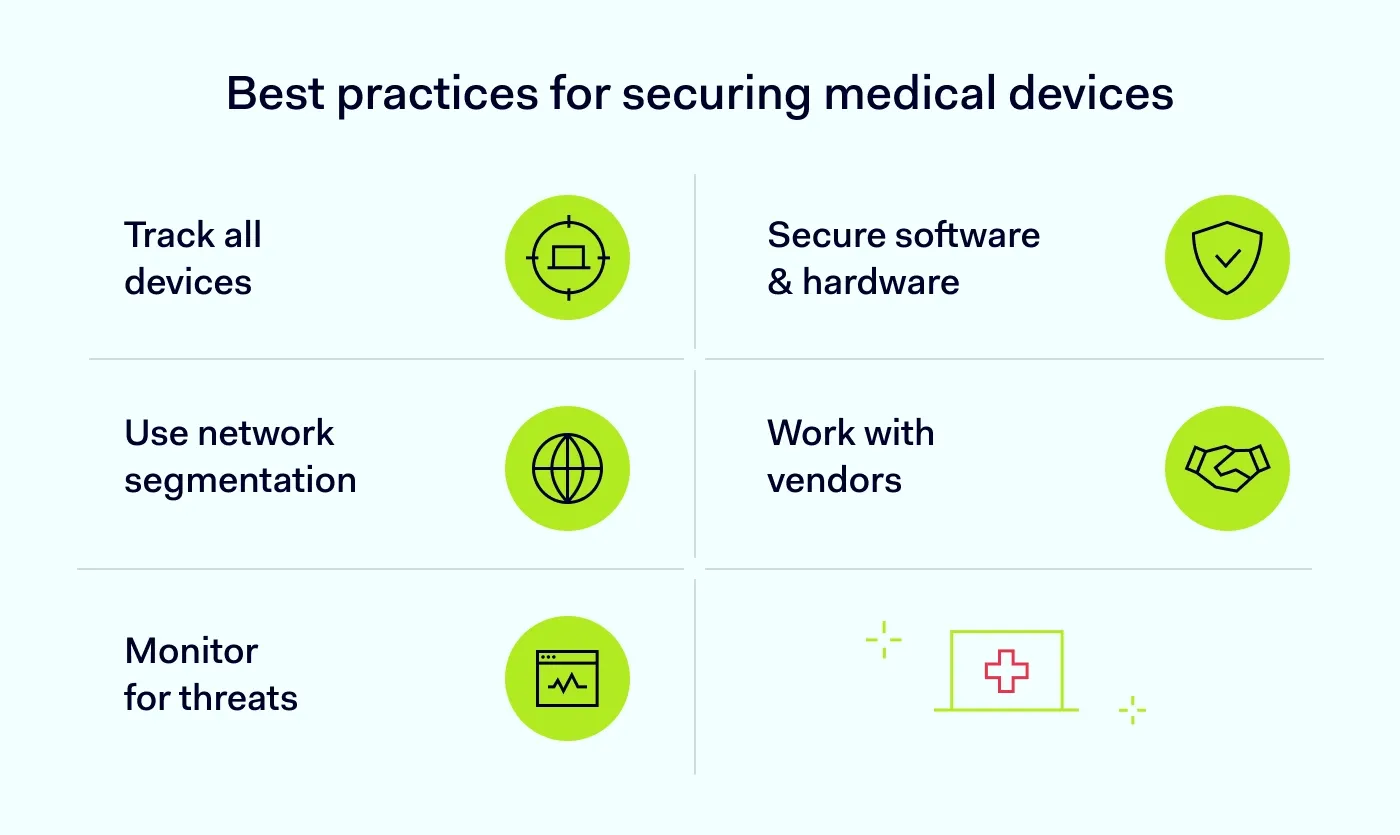
Best practices for securing medical devices

Security solutions vary between medical contexts. However, here are some general best practices for cybersecurity in medical devices:

Understand your device landscape

The number of medical devices used by a healthcare provider can rapidly grow, especially when patients take monitoring devices home. Every device is a potential endpoint and security risk. Each device needs security protection.

Start by creating a comprehensive device inventory. Create processes to update and audit the inventory, bringing all devices under your security umbrella.

Inventory software and hardware

Medical devices must be physically secure, with measures to prevent theft and unauthorized access. However, cybersecurity measures must also secure device firmware. Log current software versions and use automated tools to update medical device software as needed.

Check for end-of-life devices as well. Medical devices become obsolete as new technology appears. Older versions often create security risks and require prompt replacement.

Carry out a comprehensive risk assessment

When you have an accurate inventory, it’s vital to assess the risks posed by cyber threats. In this context, third-party risk assessment makes sense.

Cybersecurity experts with medical device experience understand the threats faced by healthcare organizations, how to prioritize risks, and suitable mitigation options.

Secure sensitive assets with network segmentation

Segmentation creates barriers between network assets. Placing sensitive data within protected segments ensures that attackers cannot access patient records if they gain access to devices.

Additionally, access controls and multi-factor authentication should protect patient information. Users should not be able to access protected information with just a username and password combination.

Work closely with vendors to understand device security

When sourcing medical devices, ask vendors to disclose security features and potential vulnerabilities. Consult vendors to execute a risk assessment for new devices and request a software bill of materials. This assists IT teams when securing device software and makes it easier to manage updates.

Monitor devices and detect threats

Apply intrusion detection systems (IDS) across all medical devices. Deploy continuous monitoring to detect malware or malicious user activity, and feed security alerts into a streamlined incident response plan.

The future of medical device cybersecurity

Medical device security is a dynamic field. Technology is evolving rapidly as medical internet-of-things (MIoT) devices proliferate, providing new ways to detect and counter cyber threats.

For instance, AI and machine learning can analyze network activity to track anomalies and identify attacks at an early stage. Speed increases offered by 5G connectivity supplement AI, enabling real-time activity tracking and reliable data transmission.

Our models for thinking about medical device security are also changing. Forward-thinking healthcare organizations now focus on Zero Trust concepts. Devices request verification for each user action and limit user capabilities according to least-privilege principles.

AI, 5G, and Zero Trust approaches are part of tomorrow’s cybersecurity toolkit. These technologies also reflect a trend toward enhanced collaboration between vendors, users, and regulators.

Work with NordLayer to secure your medical devices

Companies benefit from cloud-connected medical devices to learn about patients and deliver personalized treatment. But, as we’ve seen, medical devices bring security risks. Healthcare cybersecurity solutions are critical.

NordLayer can help you secure devices and serve patients securely and efficiently. Prevent unauthorized access with Identity and Access Management solutions and transfer data safely via Secure Remote Access. Conceal data in transit from attackers via AES 256 or ChaCha20 encryption, monitor 2FA adoption, and Share Gateway access in a centralized Control Panel dashboard.

Balance medical technology, ease of use, and cybersecurity. Contact the NordLayer team and solve your medical device security worries.


About NordLayer
NordLayer is an adaptive network access security solution for modern businesses – from the world’s most trusted cybersecurity brand, Nord Security.

The web has become a chaotic space where safety and trust have been compromised by cybercrime and data protection issues. Therefore, our team has a global mission to shape a more trusted and peaceful online future for people everywhere.

About Version 2 Digital

Version 2 Digital is one of the most dynamic IT companies in Asia. The company distributes a wide range of IT products across various areas including cyber security, cloud, data protection, end points, infrastructures, system monitoring, storage, networking, business productivity and communication products.

Through an extensive network of channels, point of sales, resellers, and partnership companies, Version 2 offers quality products and services which are highly acclaimed in the market. Its customers cover a wide spectrum which include Global 1000 enterprises, regional listed companies, different vertical industries, public utilities, Government, a vast number of successful SMEs, and consumers in various Asian cities.

×

Hello!

Click one of our contacts below to chat on WhatsApp

×