Skip to content

How to Keep Rocky Linux Up to Date

Jump to Tutorial

Keeping Rocky Linux up to date is crucial to maintaining optimal security, stability, and performance of your distribution. These updates ensure that you have the latest technology and solutions to keep your server secure against various threats and vulnerabilities. Any given update may include improvements in the following areas. 

  • Security: Many updates include patches that will enhance your security by addressing known vulnerabilities, strengthening the security posture of your server, or reducing the risk of unauthorized access and system compromises.
  • Bug Fixes: Bugs can lead to system crashes, unexpected behavior, or even data corruption. With each update, developers from the Rocky Linux community work to identify and fix these bugs, improving the overall stability and reliability of the system. 
  • Performance Optimization: Updates often include performance improvements, optimizations, and enhancements to your Rocky Linux system. These improvements result in faster execution times, reduced resource usage, and improved responsiveness. 
  • Compatibility: Compatibility is crucial when switching from other Linux distributions like Red Hat Enterprise Linux (RHEL) or CentOS to Rocky Linux. Rocky Linux is a community-driven distribution that’s built on RHEL’s source code and aims to maintain binary compatibility with RHEL. This means that applications and packages developed or tested on RHEL or CentOS should work smoothly on Rocky Linux without any issues.

How to keep your Rocky Linux Up to Date

Keeping a Rocky Linux server up to date is essential for maintaining optimal security, stability, and performance. In this tutorial, we will explore the best practices to ensure your system is regularly updated, providing you with the latest bug fixes, security patches, and feature enhancements.

Step 1: Log in to your Rocky Linux system

First, make sure that you have a terminal or SSH client installed on your local machine. If you’re using Linux or macOS, you can use the built-in terminal application. For Windows users, you will most likely use the Putty SSH client.

Open the terminal and type the following command replacing username and server_ip_address with your own:

ssh username@server_ip_address

If it’s your first time connecting to the server, you will see a security warning about the authenticity of the host. You can verify authenticity by typing ‘yes’ in the terminal.

tutorial code screenshot

Then, enter the password so you can log in to the system:

tutorial code screenshot

Step 2: Enable automatic updates

In Rocky Linux, the package manager dnf offers two primary methods for performing a comprehensive system upgrade. 

The first method is by using a utility called dnf-automatic, designed to automate the installation of security patches and other crucial upgrades for your server. To install this tool, you can utilize the dnf package manager with the appropriate command. 

The second method is executing the upgrade command without specifying a particular package, which upgrades all packages on the system. Alternatively, the upgrade-minimal command can be used to update packages solely to the latest bug fix or security patch release. This approach ensures necessary maintenance, while minimizing the risk of encountering disruptive changes from upstream sources. 

In order to set up the automatic update process, you’ll first need to install the dnf-automatic since it’s not available by default on your Rocky Linux server. 

This command requires either sudo or root privileges in order to be executed.

sudo dnf install dnf-automatic

Type ‘yes’ to install the package.

tutorial code screenshot

After that, the installation is complete.

Step 3: Configure the dnf-automatic service

Once the installation is complete, edit the configuration file using your preferred text editor.

sudo vi /etc/dnf/automatic.conf

In the configuration file, locate the line that starts with upgrade_type, then press the ‘i’ key in order to enter the edit mode. Replace the value from ‘default’ to ‘security.’

tutorial code screenshot

By default, this option in this .conf file is set to ‘default’. If your intention is to enable automatic upgrades in a proactive manner, it is advisable to modify the default behavior to only include security upgrades. This ensures that unexpected changes in functionality are avoided. 

In order to write the changes and exit the file using Vi editor, press ‘Shift + :’ then type ‘wq’ and press ‘Enter’. 

Step 4: Enable the service and check the update schedule

You want to make sure that the dnf-automatic service is enabled when you start or reboot your system. To do that, open Systemd on your server and run the following command:

sudo systemctl enable dnf-automatic-install.timer

tutorial code screenshot

In contrast to certain Systemd services, dnf-automatic operates as a timer rather than a continuously running background service. Consequently, it is normal for the status to appear as ‘Active: inactive (dead)’ as long as the service is loaded and the logs indicate successful executions.

You can check the current status of dnf-automatic by running the following command:

sudo systemctl status dnf-automatic-install

As an output, you will see that the service is currently inactive.

tutorial code screenshot

Next, check when your security updates are usually performed on schedule. Again, you’ll use Systemd to check your timer unit:

sudo systemctl cat dnf-automatic-install.timer

tutorial code screenshot

Based on the output, you can see that dnf-automatic-install.timer is a Systemd timer unit that triggers the dnf-automatic-install service. It is scheduled to activate every day at 6:00 AM, with a randomized delay of up to 1 hour.

Step 5: The manual update process

There are certain times when you may need more control and oversight over the update process. Manually updating packages on your Rocky Linux system allows you to carefully review and test updates before applying them to your system, ensuring compatibility and stability. 

This is beneficial in scenarios where you have certain custom configurations, critical applications, or specific dependencies that require careful consideration. In that way, you can minimize the risk of breaking packages or data corruption on your system.

In order to check available updates on your system, run the following command:

sudo dnf check-update

You will get a similar output:

tutorial code screenshot

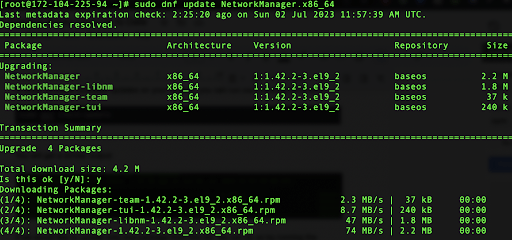
If you want to update only one package from this list, you can do so by running the following command:

sudo dnf update NetworkManager.x86_64

Type ‘yes’ for the confirmation. This will start the upgrade process.
tutorial code screenshot

You can also use the upgrade-minimal command to only install important bug fixes and security patches without the risk of introducing potentially damaging changes.

sudo dnf upgrade-minimal

When executed, this command performs the following tasks:

  • Retrieves the package metadata from the configured repositories
  • Compares the installed packages on the system with the available updates
  • Installs the latest bug fix or security patch releases of the packages while avoiding any major updates or changes that could potentially cause compatibility issues
tutorial code screenshot

If you want to update all, without any package selection, you can do so by running the following command:

sudo dnf update

tutorial code screenshot

Carefully review the list and type ‘yes’ in the terminal prompt. This will install new packages (in this case, a new kernel version or upgrade version of existing packages).

Review the output of the update command to ensure that the desired packages were successfully updated without encountering any errors.

tutorial code screenshot

You can also verify package updates by running the rpm command:

rpm -q package_name

Replace package_name with the name of the package you updated. This command verifies the updated package’s version. When executed, the command will display the version, release, and other relevant details of the specified package if it is installed on the system. If the package is not found, the command will return an error message.

In this example, you can verify one of the packages:

rpm -q avahi-libs-0.8-12.el9_2.1.x86_64

and you should get the following format:

tutorial code screenshottutorial code screenshot

If you try to search for a package that doesn’t exist, you will get an error message:

rpm -q nginx

tutorial code screenshot

Learn More about Managing Rocky Linux 

If you found this tutorial helpful and you’re interested in more Rocky Linux how-tos, check out our other tutorials on this distro: 

About Version 2 Digital

Version 2 Digital is one of the most dynamic IT companies in Asia. The company distributes a wide range of IT products across various areas including cyber security, cloud, data protection, end points, infrastructures, system monitoring, storage, networking, business productivity and communication products.

Through an extensive network of channels, point of sales, resellers, and partnership companies, Version 2 offers quality products and services which are highly acclaimed in the market. Its customers cover a wide spectrum which include Global 1000 enterprises, regional listed companies, different vertical industries, public utilities, Government, a vast number of successful SMEs, and consumers in various Asian cities.

About JumpCloud
At JumpCloud, our mission is to build a world-class cloud directory. Not just the evolution of Active Directory to the cloud, but a reinvention of how modern IT teams get work done. The JumpCloud Directory Platform is a directory for your users, their IT resources, your fleet of devices, and the secure connections between them with full control, security, and visibility.

SafeDNS Receives SourceForge Top Performer Award

We are thrilled to announce that SafeDNS has been bestowed with the prestigious recognition of being a Category Top Performer by SourceForge! This acknowledgment is a testament to the hard work, dedication, and innovation of the entire SafeDNS team.

This accomplishment is not only a source of pride for SafeDNS but also a reaffirmation of the trust and confidence our users place in us. Our commitment to providing seamless, comprehensive, and cutting-edge DNS filtering services has consistently driven us to deliver excellence.

Great support and very effective system. Easy to setup for a multi-site company with many simple to use features and good written support materials. [Frank V.]

SafeDNS has always been driven by a customer-centric approach, striving to create an internet experience that is not only safer but also more efficient and tailored to individual needs. This recognition further motivates us to continue pushing the boundaries of what our service can achieve, constantly improving and adapting to the ever-evolving landscape of online threats.

Thank you once again for your unwavering support, and we look forward to bringing you even more groundbreaking innovations and enhancements in the future. Together, we will make the internet a safer place for all!

About Version 2 Digital

Version 2 Digital is one of the most dynamic IT companies in Asia. The company distributes a wide range of IT products across various areas including cyber security, cloud, data protection, end points, infrastructures, system monitoring, storage, networking, business productivity and communication products.

Through an extensive network of channels, point of sales, resellers, and partnership companies, Version 2 offers quality products and services which are highly acclaimed in the market. Its customers cover a wide spectrum which include Global 1000 enterprises, regional listed companies, different vertical industries, public utilities, Government, a vast number of successful SMEs, and consumers in various Asian cities.

About SafeDNS
SafeDNS breathes to make the internet safer for people all over the world with solutions ranging from AI & ML-powered web filtering, cybersecurity to threat intelligence. Moreover, we strive to create the next generation of safer and more affordable web filtering products. Endlessly working to improve our users’ online protection, SafeDNS has also launched an innovative system powered by continuous machine learning and user behavior analytics to detect botnets and malicious websites.

WormGPT: The New Face of AI-Powered Cybercrime

Imagine this. An email lands in the inbox of a diligent financial officer at a mid-size company. It appears to be from the CEO – the email address checks out, the tone is spot on, and it’s filled with specific references only the CEO would know. The email urgently requests a wire transfer to a new vendor, providing convincing reasons for the sudden change.

A little puzzled but not suspecting foul play, the financial officer initiates the transfer, unknowingly diverting funds straight into a cybercriminal’s pocket. It’s only when she later speaks to the CEO about the strange request that she realizes they’ve been scammed.

No, this wasn’t the work of a sophisticated human con artist, spending countless hours understanding the company and its CEO. This was the handiwork of WormGPT, an advanced AI module. Its frightening ability to craft personalized and compelling business email compromise (BEC) attacks is driving a new wave of cybercrime that’s increasingly harder to detect and prevent. The arrival of WormGPT in the cybercrime scene offers a chilling reminder of the potential misuse of AI, underscoring the urgent need for robust cybersecurity measures.

While the example above is hypothetical, it highlights the dangers of the new era of cybersecurity we’re entering – AI is now just as dangerous as the criminals wielding it.

What is WormGPT?

The rise of WormGPT as a tool for cybercrime has severe implications for digital security. This technology breaches laws on hacking, data theft, and other illicit activities. The potential for harm is significant, from crafting malware and orchestrating phishing attacks to enabling sophisticated cyberattacks that can cause extensive damage to systems and networks.

WormGPT equips cybercriminals with the ability to easily execute illegal activities, thus jeopardizing the safety of innocent individuals and organizations.

Some key points to understand about WormGPT are:

  • It’s a blackhat alternative to GPT models, explicitly crafted for malicious activities.
  • The tool uses the open-source GPT-J language model developed by EleutherAI.
  • WormGPT allows even novice cybercriminals to launch attacks swiftly and at scale without having the technical knowledge.
  • WormGPT operates without any ethical guardrails, which means it doesn’t restrict any malicious requests.
  • The developer of WormGPT is selling access to the tool on a popular hacking forum.

But how does WormGPT work? The tool generates human-like text, complete with flawless grammar, coherent structure, and contextual understanding. It can take a simple input—such as a prompt to create a BEC email—and churn out a detailed, personalized, and highly convincing output. What makes WormGPT truly alarming is its ability to produce content virtually indistinguishable from text written by a human.

The core of WormGPT’s operations lies in the power of generative AI. Generative AI models are built to create new, unique outputs, from coherent text to realistic images. They take in vast amounts of data and learn patterns, styles, and nuances. Once trained, they can generate their own content, mirroring the complexity and creativity of the input data.

Now, think of generative AI in the context of WormGPT. When fed diverse data sources, especially malware-related data, WormGPT learns and mimics the style, context, and technical details needed to craft convincing malicious emails. It’s like giving a scam artist the ability to impersonate any individual or style of communication, which is precisely why WormGPT is deeply concerning. It takes the potential of generative AI and twists it into a tool for streamlined, effective cybercrime.

AI: A New Weapon for Cybercriminals

AI is becoming a game-changer for cybercrime. Why? Here’s the breakdown:

  • Ease of Use: AI eliminates the need for expert-level skills. Now, even a novice cybercriminal can launch sophisticated attacks with the help of AI tools.
  • Deception: With AI, cybercriminals can create highly personalized and seemingly legitimate emails, increasing the chances of deceiving the recipient.
  • Scalability: AI can carry out attacks on a massive scale. Cybercriminals can target thousands, even millions, of individuals or systems simultaneously, which would be impossible for humans to do manually.
  • Speed: AI systems can operate at a much faster pace than humans. This speed makes it possible for cybercriminals to execute large-scale attacks in a fraction of the time it would take a human attacker.
  • Reduced Risk: Using AI distances the criminal from the crime, making it harder to trace back to the original perpetrator. This added layer of anonymity can embolden cybercriminals to carry out more audacious attacks.
  • Cost-effective: Over time, using AI can be more cost-effective for cybercriminals. While there may be an initial investment to acquire or develop the AI, the automation of attacks can lead to higher returns in the long run.

We’ve already seen a surge in cybercriminals using AI to launch a variety of cyberattacks. For example, hackers leveraged AI to modify the Lockbit 3.0 ransomware. This ransomware, dubbed one of the most notorious threats worldwide, targets computers across industries. Notably, numerous semiconductor firms in Taiwan have fallen victim to its ransom demands. And more generally, hackers are leveraging AI in Advanced Persistent Threats (APTs), Deepfake Attacks, AI-Powered Malware, phishing attacks, and more.

So, how does WormGPT fit into this picture? Unlike ethical generative AI models like ChatGPT, WormGPT doesn’t have safeguards. It’s a tool with no leash, no brakes, explicitly designed for malicious intent. While ChatGPT is programmed to refuse to generate content encouraging harmful or illegal activities, WormGPT faces no such restrictions.

How Are Cybercriminals Using WormGPT?

Bad actors are primarily using WormGPT to create highly compelling BEC phishing emails, but its uses go beyond this. SlashNext, the firm blowing the whistle on WormGPT, found that WormGPT can also produce malware written in Python and provide tips on crafting malicious attacks.

However, there’s a bright side: WormGPT isn’t cheap, potentially limiting its widespread misuse. The developer is selling access to the bot for 60 Euros per month or 550 Euros per year. It’s also been criticized for weak performance, with one buyer noting that the program is “not worth any dime”.

WormGPT FAQ

Now, let’s have a quick fire round of everything else you need to know about WormGPT.

How concerned should we be about WormGPT?

The rise of WormGPT represents a new and concerning era for cybercrime, indicative of the increasing sophistication of tools used for illicit activities. Over time, WormGPT and similar tools will likely evolve, becoming more capable and versatile. While it’s difficult to predict the exact scale and nature of the threat posed by WormGPT, its potential for facilitating large-scale, rapid, and sophisticated cyberattacks means we should approach it seriously.

Does WormGPT have any uses beyond cybercrime?

No, WormGPT was explicitly designed and optimized for malicious activities, primarily in cybercrime. While technically, it could be repurposed, its original design and current use focus on unethical and illegal actions, making it unlikely to be employed for legitimate purposes.

What is the most harmful aspect of WormGPT?

The most harmful aspect of WormGPT lies in the speed and volume of malicious content it can generate. Given the ability of language models to create text rapidly, this tool equips even novice cybercriminals with the capability to execute extensive cyberattacks such as phishing emails. This automation and ease of use significantly increase the scale and reach of potential attacks, making WormGPT particularly dangerous.

How Did WormGPT come to be so dangerous?

WormGPT’s potency stems from its roots in the open-source GPT-J model developed by EleutherAI in 2021. The developer took this already powerful language model and trained it specifically on data concerning malware creation. The resultant WormGPT is a specialized, maliciously focused tool that leverages advanced AI capabilities to aid in cybercrime.

How popular will WormGPT become?

Predicting the popularity of WormGPT is complex. While its capabilities could appeal to cyber criminals, the high cost of access may deter many. Moreover, we’re witnessing a rise in “jailbreaks” for mainstream generative AI tools like ChatGPT and Google’s Bard. These “jailbreaks” are specialized prompts that disable the safeguards on these tools, enabling them to generate malicious content. For instance, a “jailbreak” might manipulate ChatGPT into developing phishing emails or harmful code. Therefore, some cybercriminals may prefer these cheaper or free alternatives to a dedicated tool like WormGPT.

Why Phishing Emails Continue to Fuel BEC Attacks

  • Human Vulnerability: Despite technological advances, the human element remains a weak link in cybersecurity. Phishing emails often exploit basic human traits such as trust and curiosity, luring individuals into clicking on malicious links or sharing sensitive information.
  • Widespread Email Usage: Email remains one of the most prevalent modes of business communication, offering cybercriminals a broad attack surface. Every employee with an email account represents a potential entry point for attackers.
  • Profitable for Cybercriminals: Phishing is a lucrative business for cybercriminals, especially BEC attacks where the financial returns can be substantial. This profitability ensures that such attacks continue to be a favored strategy for cybercriminals.

Wrapping Up

WormGPT signifies a distressing advancement in cybercrime, weaponizing AI to automate malevolence. Its rise highlights the urgent need for a transformative shift in cybersecurity strategies. In this relentless race against AI-driven threats, proactive defenses, continuous learning, and cutting-edge technological adaptation are no longer optional but crucial.

About Version 2 Digital

Version 2 Digital is one of the most dynamic IT companies in Asia. The company distributes a wide range of IT products across various areas including cyber security, cloud, data protection, end points, infrastructures, system monitoring, storage, networking, business productivity and communication products.

Through an extensive network of channels, point of sales, resellers, and partnership companies, Version 2 offers quality products and services which are highly acclaimed in the market. Its customers cover a wide spectrum which include Global 1000 enterprises, regional listed companies, different vertical industries, public utilities, Government, a vast number of successful SMEs, and consumers in various Asian cities.

About Portnox
Portnox provides simple-to-deploy, operate and maintain network access control, security and visibility solutions. Portnox software can be deployed on-premises, as a cloud-delivered service, or in hybrid mode. It is agentless and vendor-agnostic, allowing organizations to maximize their existing network and cybersecurity investments. Hundreds of enterprises around the world rely on Portnox for network visibility, cybersecurity policy enforcement and regulatory compliance. The company has been recognized for its innovations by Info Security Products Guide, Cyber Security Excellence Awards, IoT Innovator Awards, Computing Security Awards, Best of Interop ITX and Cyber Defense Magazine. Portnox has offices in the U.S., Europe and Asia. For information visit http://www.portnox.com, and follow us on Twitter and LinkedIn.。

Quantum encryption: a new era of cybersecurity innovations

As we embrace the digital world, the threat of cyber-attacks grows, and so does our need for robust cybersecurity measures. Innovative and powerful solutions like quantum encryption are carving out their cybersecurity niche.

This groundbreaking technology leverages the complex principles of quantum mechanics to offer seemingly impregnable security. But what is quantum encryption, and how does it impact our digital security? Let’s find out.

What is quantum computing?

Quantum computing is a key principle underpinning quantum encryption. Traditional computers use bits (0s and 1s) to process information. However, quantum computers use quantum bits, or “qubits”.These “qubits’ can exist in multiple states at once thanks to a quantum phenomenon known as superposition. This allows quantum computers to process an astronomical amount of data at mind-boggling speeds, far beyond the capabilities of traditional computers.

Let’s use quantum computing in a light switch analogy to understand the superposition better.

classic computing and quantum computing comparison💡 If a regular bit is like a light switch that can be either on (1) or off (0), then “a qubit” is like a dimmer switch that can blend different levels of on and off at the same time. This superposition property allows a qubit to hold and process an enormous amount of information compared to a classical bit.

When a quantum system is in a superposition state, it is in multiple states at once, each with its probability. However, once a measurement is made, the “qubit” collapses from this superposition into one of the probable states and gives an output accordingly.

This unique characteristic of “qubits”—being in multiple states at once—enables quantum computers to process countless outcomes simultaneously, providing them with potentially immense computational power.

What is quantum encryption?

🔑 Quantum encryption is a cutting-edge approach to securing information transfer, built on principles of quantum mechanics. This method utilizes quantum bits, or “qubits”, rather than traditional binary bits, to encrypt and decrypt data.

Click to tweet

Quantum encryption uses another quantum concept – entanglement. Entanglement is a phenomenon where two particles, regardless of distance, are linked so that the state of one immediately influences the other.

This principle is applied in Quantum Key Distribution (QKD), where the key for encrypted data decryption is shared through entangled particles. Any attempt to intercept the particles triggers a change in their state, thus alerting the intended recipients to a possible breach.

Benefits of quantum cryptography

The invulnerability to interference provides quantum encryption with an unprecedented level of security. Because of the complexity, traditional cryptographic systems can’t match the new upcoming standard.

Instant detection of breaches

Eavesdropping, or man-in-a-middle attacks, concerns current encryption methods, become nearly impossible in a quantum encryption setup.

👂 Eavesdropping, in the context of encryption and cybersecurity, refers to an attack where a malicious actor intercepts and listens in on private, encrypted communication without the knowledge or consent of the communicating parties.

Click to tweet

The ultimate goal is to steal sensitive information, such as personal details, login credentials, or encryption keys. Interruption of a third party alters the status of the particles and alerts the sender and receiver about the attempted attack because it’s impossible to observe a quantum system without disturbing it.

The complex power of physics

The sheer computational power of quantum computers could be used to break traditional encryption algorithms, making the development of quantum-resistant algorithms necessary.

Mathematics-based and Physics-based cryptography comparison

Pioneering research is currently underway to develop these quantum-resistant algorithms. The aim is to create encryption techniques robust enough to withstand attacks from quantum computers.

Many organizations, including prominent tech corporations and government entities, invest significantly in these cutting-edge initiatives, preparing for the quantum computing revolution.

Challenges of quantum encryption

The implications of quantum encryption for the cybersecurity industry are profound. It could revolutionize how data is secured when fully realized, making some of today’s most sophisticated cyber-attacks obsolete.

Business adoption to change

Quantum cryptography sets a new security standard, compelling organizations worldwide to adapt or risk becoming easy targets for quantum-powered attacks. Flexibility and easy transition to new technologies become essential requirements.

Early stages of technological development

The path to universal quantum encryption is full of challenges. Quantum computers are still in their developmental stages, with only a handful of operational prototypes. Underdeveloped concepts keep encryption in a premature, almost theoretical stage, meaning quantum cryptography isn’t available any time soon.

Extreme storage conditions

Quantum computers also require frigid environments and careful handling of “qubits” to prevent decoherence – a premature loss of quantum states. Additionally, creating a global network of quantum computers for widespread quantum encryption is a mammoth task requiring substantial investment and technical breakthroughs.

Quantum cryptography and NordLayer

While quantum encryption holds great promise for the future of cybersecurity, its implementation is a significant undertaking. The journey is riddled with technological challenges and substantial costs. However, given the immense potential benefits, pursuing quantum encryption is critical in this ever-evolving digital age. Get ready to witness a quantum leap in cybersecurity innovation.

In the meantime, NordLayer offers services utilizing AES 256-bit encryption, the industry’s highest cryptographic standard. This approach is more accessible as it’s widely implemented, mature and can be operated on existing digital infrastructures. Combined with other network access securing features, AES 256-bit encryption minimizes the risk of a data breach. Reach out to learn more about NordLayer’s security solutions for your organization.

About Version 2 Digital

Version 2 Digital is one of the most dynamic IT companies in Asia. The company distributes a wide range of IT products across various areas including cyber security, cloud, data protection, end points, infrastructures, system monitoring, storage, networking, business productivity and communication products.

Through an extensive network of channels, point of sales, resellers, and partnership companies, Version 2 offers quality products and services which are highly acclaimed in the market. Its customers cover a wide spectrum which include Global 1000 enterprises, regional listed companies, different vertical industries, public utilities, Government, a vast number of successful SMEs, and consumers in various Asian cities.

About NordLayer
NordLayer is an adaptive network access security solution for modern businesses – from the world’s most trusted cybersecurity brand, Nord Security.

The web has become a chaotic space where safety and trust have been compromised by cybercrime and data protection issues. Therefore, our team has a global mission to shape a more trusted and peaceful online future for people everywhere.

Why business device management should keep green practices in mind

For anyone looking to delve into the sphere of green, environmentally friendly practices, it is of utmost importance to consider their habits.

Among the habits we humans commit ourselves to daily is the use of phones and other electronic devices. These create a measurable impact on the environment, whether due to the way they were constructed, their purpose and use, or just thanks to general user habits.

For individuals and companies looking to curb their environmental impact, a wise move is to introduce a responsible disposal and recycling policy for electronic devices. With the number of devices in the world, any and all disposal has to be taken seriously, due to potentially hazardous components inside.

However, this also goes hand in hand with the idea that any devices on the chopping block have to undergo a proper decommissioning process first, so as to not leave potentially confidential information on them.

Digital detox for electronic devices

First of all, asset management and refurbishment are the most important. IT departments usually have lists of devices as well as information on who uses those machines and how. Whether a device is used in the office or at home, it produces a footprint, most often in the form of energy used. Hence this should be kept in mind when purchasing newer ones. In all cases, energy efficiency is not to be dismissed as a selling point for new pieces of gear, but with refurbishment practices, anyone can maximize the usability and life cycle of devices to minimize their impact and e-waste generation.

Secondly, if a device is to be disposed of or sold, secure data destruction has to be performed. Before we dispose of any piece of electronics, especially computers or phones, sensitive data deletion has to be ensured. In this case, a wipe of the hard/flash drive, magnetic erasure, or complete physical destruction of the storage to prevent unauthorized access to confidential data is advised.

To underline why this is important, feel free to read a finding by ESET Research on the data they found on secondhand devices they purchased. Research revealed the extent to which said devices had not been properly wiped and could have led to unauthorized access and even a data breach.

Flame on – handling faulty device batteries

Even though the current iteration of batteries in devices makes them safer, they can still pose a fire hazard, especially faulty or old batteries that have been left unused for a time.

For a company managing tens or hundreds of devices that run on batteries, it should be of utmost importance to check their state, as a swollen battery can very well start a fire, costing you more than a potential replacement. For this purpose, having an established battery recycling program for work phones, laptops, and other devices makes sense given that said batteries could cause environmental contamination due to the hazardous materials they are made of.

This point is also coupled with proper e-waste management and recycling. Some manufacturers and retailers usually have take back programs accepting old devices for responsible disposal, sometimes even offering a new device with a discount for your old one.

What about server infrastructure?

This is a bit more complicated for many reasons; chiefly among them is the fact that any company with a large enough collection of servers inevitably faces the conundrum of whether upkeep is worth it at all, largely due to the associated costs that come with this decision.

Servers are the backbone of any IT operation, so their proper use can lead to significant cost savings. Obviously, having energy-efficient hardware that runs on efficient power supplies, low-power CPUs, and other advanced power management features can significantly reduce power consumption and maintain performance.

But in the context of recycling and asset maintenance, it is wise to consider sound lifecycle management, including planning for end-of-life disposal. Regularly assessing and upgrading servers can ensure that they would work efficiently and optimally.

Another option would be to eliminate the need for servers, or a reduction in their amount by outsourcing some of your server needs. For example, by offloading some of your on-prem cybersecurity needs in exchange for an identical cloud solution like ESET PROTECT, you can save server management and security costs. For more information, check out ESET’s cloud management cost calculator.

Top tip: The cloud brings costs down and lets you go green

In a previous blog, we discussed how cloud solutions can be both environmentally and wallet-friendly, meaning that they both help nature by reducing your footprint and help you by bringing some of your costs down. These measures allow any company to transform to greener practices (eclipsing certifications and future requirements), save costs and retain human expertise, instead of opting to save costs by letting go of your professionals and staying true to rigid, outdated business practices.

A blog on how energy security and green solutions have become key cybersecurity considerations. Find it here.

Further reading:

Some top tips from our Chief Security Evangelist, Tony Anscombe, on the safe disposal of old devices. Find them here.

About Version 2 Digital

Version 2 Digital is one of the most dynamic IT companies in Asia. The company distributes a wide range of IT products across various areas including cyber security, cloud, data protection, end points, infrastructures, system monitoring, storage, networking, business productivity and communication products.

Through an extensive network of channels, point of sales, resellers, and partnership companies, Version 2 offers quality products and services which are highly acclaimed in the market. Its customers cover a wide spectrum which include Global 1000 enterprises, regional listed companies, different vertical industries, public utilities, Government, a vast number of successful SMEs, and consumers in various Asian cities.

About ESET
For 30 years, ESET® has been developing industry-leading IT security software and services for businesses and consumers worldwide. With solutions ranging from endpoint security to encryption and two-factor authentication, ESET’s high-performing, easy-to-use products give individuals and businesses the peace of mind to enjoy the full potential of their technology. ESET unobtrusively protects and monitors 24/7, updating defenses in real time to keep users safe and businesses running without interruption. Evolving threats require an evolving IT security company. Backed by R&D facilities worldwide, ESET became the first IT security company to earn 100 Virus Bulletin VB100 awards, identifying every single “in-the-wild” malware without interruption since 2003.

×

Hello!

Click one of our contacts below to chat on WhatsApp

×