Skip to content

The best free network scanners for security teams in 2023

Knowing what’s connected to a network is important for securing your organization. There are a fair amount of free and commercial options out there. We see security teams using a mix of runZero, Nmap (sometimes with Zenmap), Angry IP and Masscan. 

In this article, we compare and contrast several free tools and provide our take on why we believe runZero is best suited for corporate security teams – particularly teams that are looking to gain continuous visibility into their asset inventory for risk management, incident response, and penetration testing purposes.

Best free network scanners compared (2023) #

 runZero
(Recommended)
Nmap & ZenmapAngry IPMasscan
Best forContinuous and scalable cyber asset managementAd-hoc network discovery and security auditingEasy scan of a local network to see which IPs are upResearch scans of the entire Internet
Graphical user interface
Internal database
Scalable deployment (distributed architecture)
Scan by IP range (internal & external)
Scan by domain
Scan by ASN
Identifies hardware platform
Covers managed on-premise assets
Covers unmanaged / IoT assets
Safely scans OT assets
Covers cloud assets
Covers remote assets
On-premise deployment
SaaS deployment
Free option available
Paid option available
Supported platformsWindows, Linux,
macOS, BSD
Windows, Linux, macOS, BSDJVMWindows, Linux, macOS, BSD
Programming languageGoCJavaC

runZero

runZero was founded in 2018 by HD Moore, the creator of Metasploit, to help solve the problem of discovering both managed and unmanaged devices on the network. The product has grown to a full cyber asset management solution that covers managed and unmanaged IT/IoT, OT environments, cloud assets, and remote devices. runZero offers a free enterprise trial that downgrades to the free Starter Edition, which is used by more than 20,000 individuals and organizations.

runZero is enterprise grade in terms of its user interface, query language, and ability to collect an inventory even in highly distributed environments without having to write scripts or maintain a custom database. Like all of the other scanners in this article, its scans are unauthenticated but yield a surprising amount of depth of information, such as fully searchable attributes for all services, hardware and firmware details, as well as layer 2 and 3 network topologies. In addition, the solution can use SNMP credentials as well as integrations with vulnerability scanners, EDR, MDM, directories and other solutions to provide deeper insights into cyber assets and their security posture. runZero also provides integrations with CMDB and SIEM solutions to enrich asset inventory on other platforms.

runZero’s scanning technology is safe to use in many OT environments, making it an ideal passive discovery option for critical infrastructure OT environments.

Best for
  • Continuous and scalable cyber asset management
Advantages
  • Easy to deploy and scalable for larger organizations
  • Free Starter Edition for up to 256 assets (including commercial use)
  • Safe to use on fragile OT & IoT devices
  • Accurate OS & hardware fingerprinting
  • Paid editions offers integrations with security and IT infrastructure as well as coverage of cloud & remote assets in addition to on-premise devices
Drawbacks
  • Use above 256 assets requires paid license (free trial available)

Nmap and Zenmap

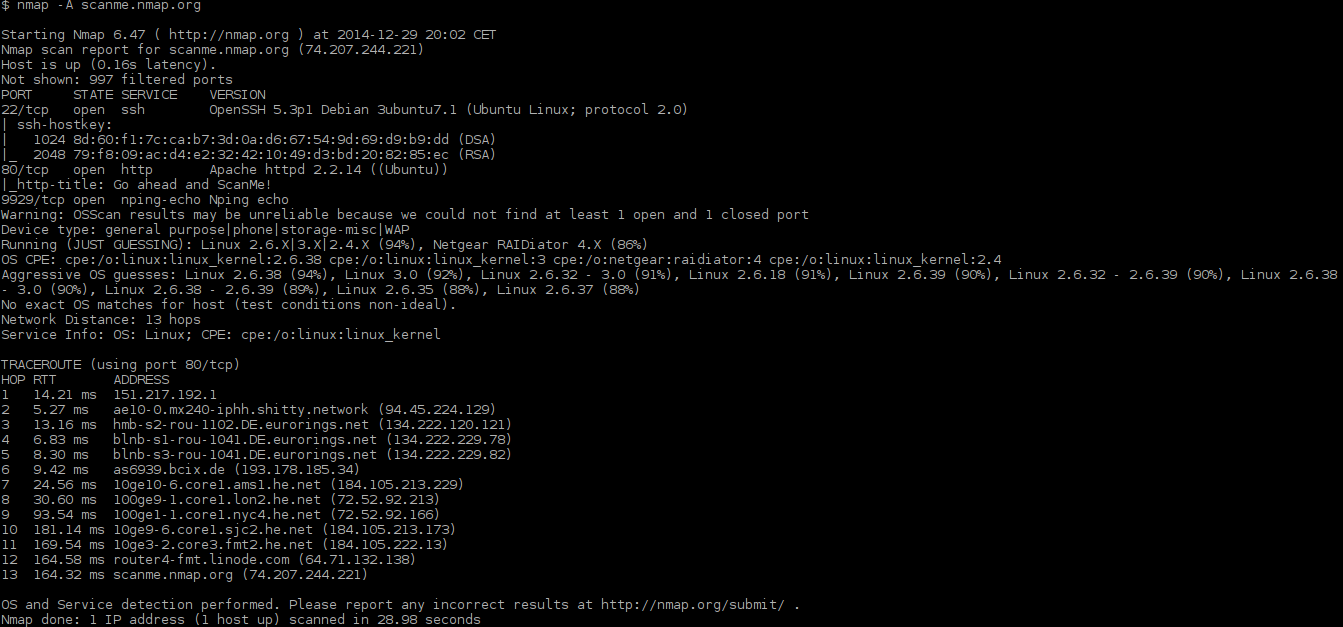
Nmap has been around for 25 years and is the gold standard for ad-hoc network scanning. The free and open source utility is most often used for network discovery and security auditing. It integrates with many other security auditing tools, such as Metasploit.

Many systems and network administrators also find it useful for tasks such as network inventory, managing service upgrade schedules, and monitoring host or service uptime.

In addition to the classic command-line Nmap executable, the Nmap suite includes an advanced GUI and results viewer (Zenmap).
The Nmap Scripting Engine (NSE) is one of Nmap’s most powerful and flexible features. It allows users to write simple scripts for network discovery, more sophisticated version detection, and vulnerability detection. NSE can even be used for vulnerability exploitation.

Best for
  • Ad-hoc network discovery and security auditing
  • Security researchers that want to write nmap scripts for custom projects
Advantages
  • Very well known and documented
  • Most flexible option of all tools due to configurability
  • Extensible through the Network Scanning Engine
  • Free for private and commercial use
Drawbacks
  • Command line can be complex to use
  • Can disrupt fragile OT/IoT devices
  • Paid license required for hardware and software vendors that wish to distribute Nmap with their solution
  • Must be scripted for continuous use

Angry IP

Angry IP Scanner is an open-source network scanner designed to be fast and simple to use. It scans IP addresses and ports. It is widely used by network administrators.

Angry IP is a good solution for teams that are looking for the fastest and easiest way to see which IPs are in use on a network. However the solution doesn’t provide a lot of information about each device, limited to IP, ping time, hostname, ports, TTL, MAC address, filtered ports, NetBIOS.

Best for
  • Easy scan of a local network to see which IPs are up
Advantages
  • Very quick and easy to get going for an an ad-hoc scan
Drawbacks
  • Little information about each asset
  • Not scalable for larger or distributed environments
  • Can disrupt fragile OT/IoT devices

Masscan

Masscan is a port scanner that can cover the entire Internet in under 5 minutes by using asynchronous transmission, sending 10 million packets per second from a single machine. It is purely a command-line tool and its usage is similar to Nmap. While Nmap is more often used to scan individual machines and smaller IP ranges, Masscan is primarily used for very large IP ranges.

Best for
  • Research scans of the entire Internet on a small handful of ports
Advantages
  • Lightning-fast scans of large IP ranges
Drawbacks
  • Command-line only
  • Very little information on each asset
  • Not suitable for internal asset inventory
  • Can disrupt fragile OT/IoT devices
  • Must be scripted for continuous use

Most free network scanners don’t scale easily out of the box, often requiring custom databases and scripts to make them suitable for continuous monitoring and collecting inventory from multiple segments or sites. Out of the mix of tools, only runZero comes with a central repository and a distributed system of Explorers to scan all parts of a network, from inside and outside the firewall.

While all of the scanners we looked at are robust and suitable for their specific use cases, runZero is the best option for corporate security teams. runZero wins on flexibility of deployment, ease of use, and scalability for larger organizations. If your security team consists of more than one person or your organization operates at more than one physical location, runZero is for you.

About Version 2 Digital

Version 2 Digital is one of the most dynamic IT companies in Asia. The company distributes a wide range of IT products across various areas including cyber security, cloud, data protection, end points, infrastructures, system monitoring, storage, networking, business productivity and communication products.

Through an extensive network of channels, point of sales, resellers, and partnership companies, Version 2 offers quality products and services which are highly acclaimed in the market. Its customers cover a wide spectrum which include Global 1000 enterprises, regional listed companies, different vertical industries, public utilities, Government, a vast number of successful SMEs, and consumers in various Asian cities.

About runZero
runZero, a network discovery and asset inventory solution, was founded in 2018 by HD Moore, the creator of Metasploit. HD envisioned a modern active discovery solution that could find and identify everything on a network–without credentials. As a security researcher and penetration tester, he often employed benign ways to get information leaks and piece them together to build device profiles. Eventually, this work led him to leverage applied research and the discovery techniques developed for security and penetration testing to create runZero.

A complete guide to WordPress security best practices in 2023

Most of the web content that you come across online is made possible by a content management system (CMS). WordPress is probably one of the best-known CMS platforms, which powers a staggering 43% of all websites globally

Its scalability, user-friendly interface, and robust customization options have catapulted it to the forefront of content management systems. However, as its popularity has grown, so has the interest of cybercriminals.

This article guides you through best security practices for your WordPress site. By adopting beginner-friendly practices such as secure hosting, regular updates, strong usernames/passwords, and two-factor authentication, you can significantly bolster your site’s defenses against threats.

Assessing WordPress security

Just like any other system, WordPress isn’t immune to security vulnerabilities. The distinction should be made between two things: the security of WordPress as a product and various factors like third-party plugins and extensions. While the majority of them are developed by reputable sources, the sheer volume of plugins means that some may have exploitable loopholes.

As an open-source platform, WordPress boasts a vibrant community dedicated to the ongoing mission of patching vulnerabilities and enhancing security. Yet, over the years, numerous threats have emerged, from cross-site scripting (XSS) attacks to SQL injections, placing WordPress security at the top of user priorities.

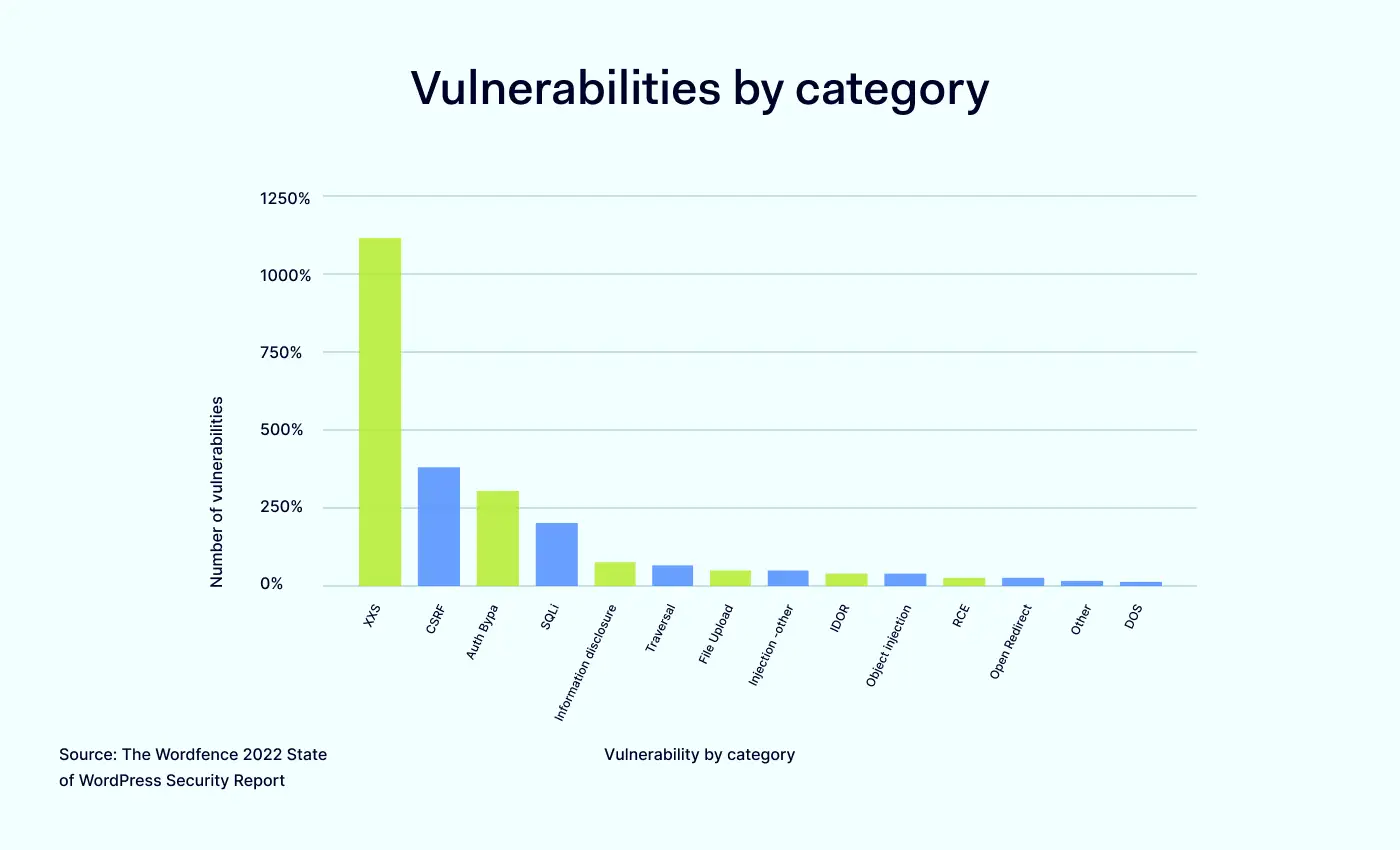
The bad news is that these vulnerabilities aren’t theoretical, and they can bring actual harm, resulting in data breaches and severe reputational damage. A study conducted in 2022 by Wordfence shows that XSS and CSRF vulnerabilities have significantly increased in volume. These statistics are alarming enough to be a wake-up call for network administrators to prioritize comprehensive website protection.

Main WordPress vulnerabilities

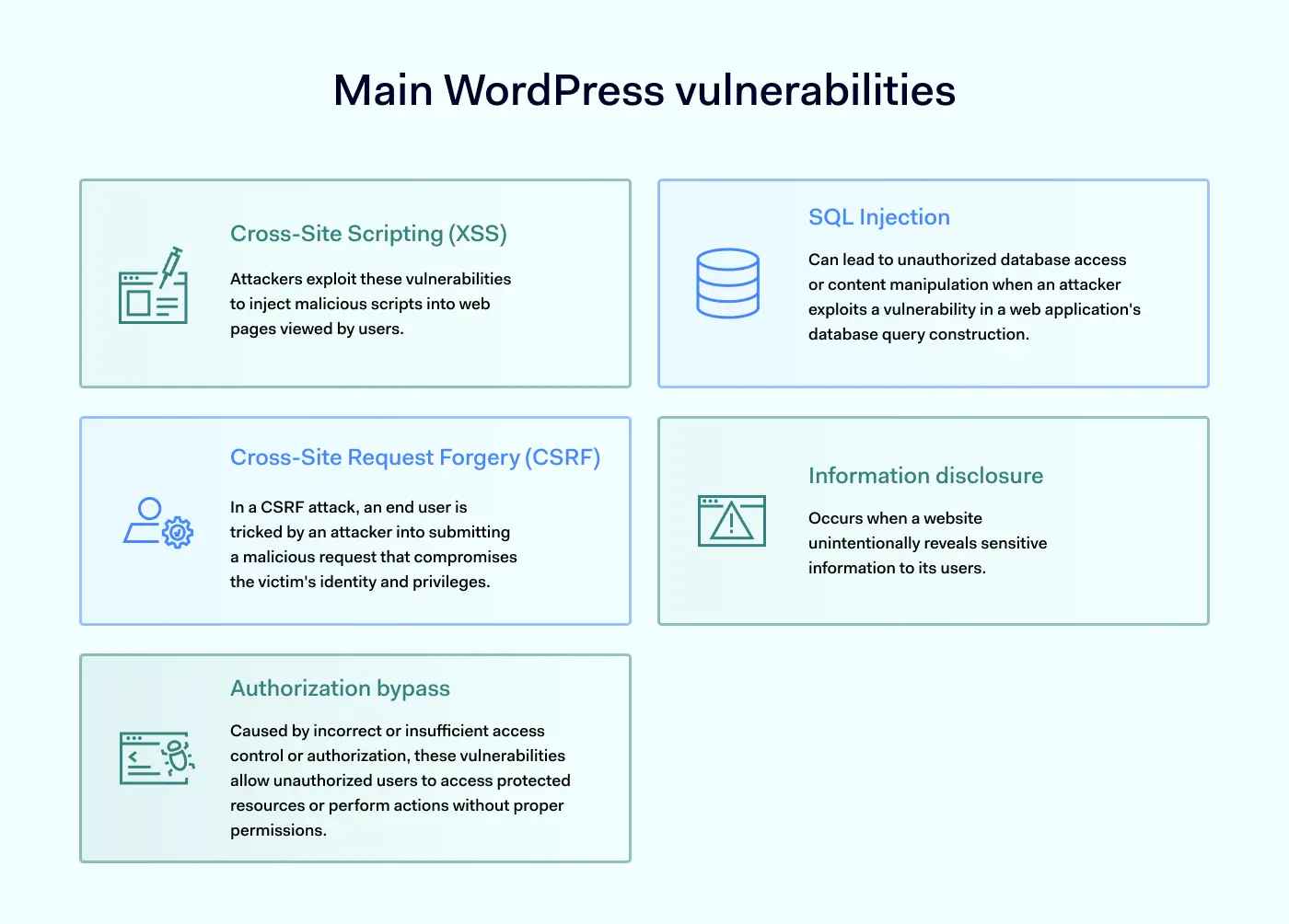
To ensure your WordPress site’s security, it’s important to have a basic understanding of common vulnerabilities. In 2022, several types of vulnerabilities were prominent, and it’s essential to delve deeper into each of them to prepare ourselves against possible threats.

Cross-site scripting (XSS)

Cross-site scripting, or XSS, accounted for nearly half of all vulnerabilities disclosed in 2022, with 1,109 submissions. These types of vulnerabilities can allow attackers to inject malicious scripts into web pages viewed by users. However, it’s worth noting that a significant number of these vulnerabilities, 408 to be exact, required administrative permissions to exploit, making them less severe than typical XSS vulnerabilities.

Cross-site request forgery (CSRF)

The second most common vulnerability was cross-site request forgery (CSRF), with 377 disclosed vulnerabilities. In a CSRF attack, an innocent end user is tricked by an attacker into submitting a malicious request. It inherits the victim’s identity and privileges to perform an undesired function on its behalf.

Authorization bypass

Authorization bypass vulnerabilities ranked third in the list of common vulnerabilities for 2022. This category includes vulnerabilities primarily caused by incorrect or insufficient access control or authorization. They could potentially allow unauthorized users to access protected resources or perform actions without proper permissions.

SQL injection

SQL Injection vulnerabilities were the fourth most common, with 200 cases disclosed. In these types of attacks, an attacker exploits a vulnerability in a web application’s database query construction, leading to unauthorized database access or content manipulation.

Information disclosure

Finally, rounding out the top five is Information Disclosure, with 73 disclosed vulnerabilities. It refers to instances where a website unintentionally reveals sensitive information to its users. This could range from technical details of the web application to users’ personal information.

Understanding the significance of WordPress security

Every WordPress user, from individual bloggers to multinational corporations, must understand what compromised website security means. For businesses, it translates into massive financial losses, a dent in customer trust, and potential compliance penalties. Individuals are also at risk of having their personal information stolen and used by cybercriminals, so the stakes are equally high.

In an era defined by digital connectivity, website security is an absolute necessity, not a luxury. It is time to shift our mindset from reactive to proactive. By taking the initiative and implementing robust security measures, we can significantly lower the risk of our websites falling victim to cyberattacks.

WordPress security best practices

Navigating through the labyrinth of WordPress security can seem daunting at first. This is due to the fact that overall security tips can be categorized into practices involving plugins and without plugins. As a third-party software that can be installed on a WordPress site to extend its functionality, they can provide various additional security measures. However, like any software, security plugins themselves can have vulnerabilities or backdoors that hackers could exploit.

On the other hand, security tips without plugins focus on manual implementation or modifying the WordPress installation directly. Both approaches have their own advantages and disadvantages. Therefore, striking a balance between relying on security plugins and following general security practices is crucial.

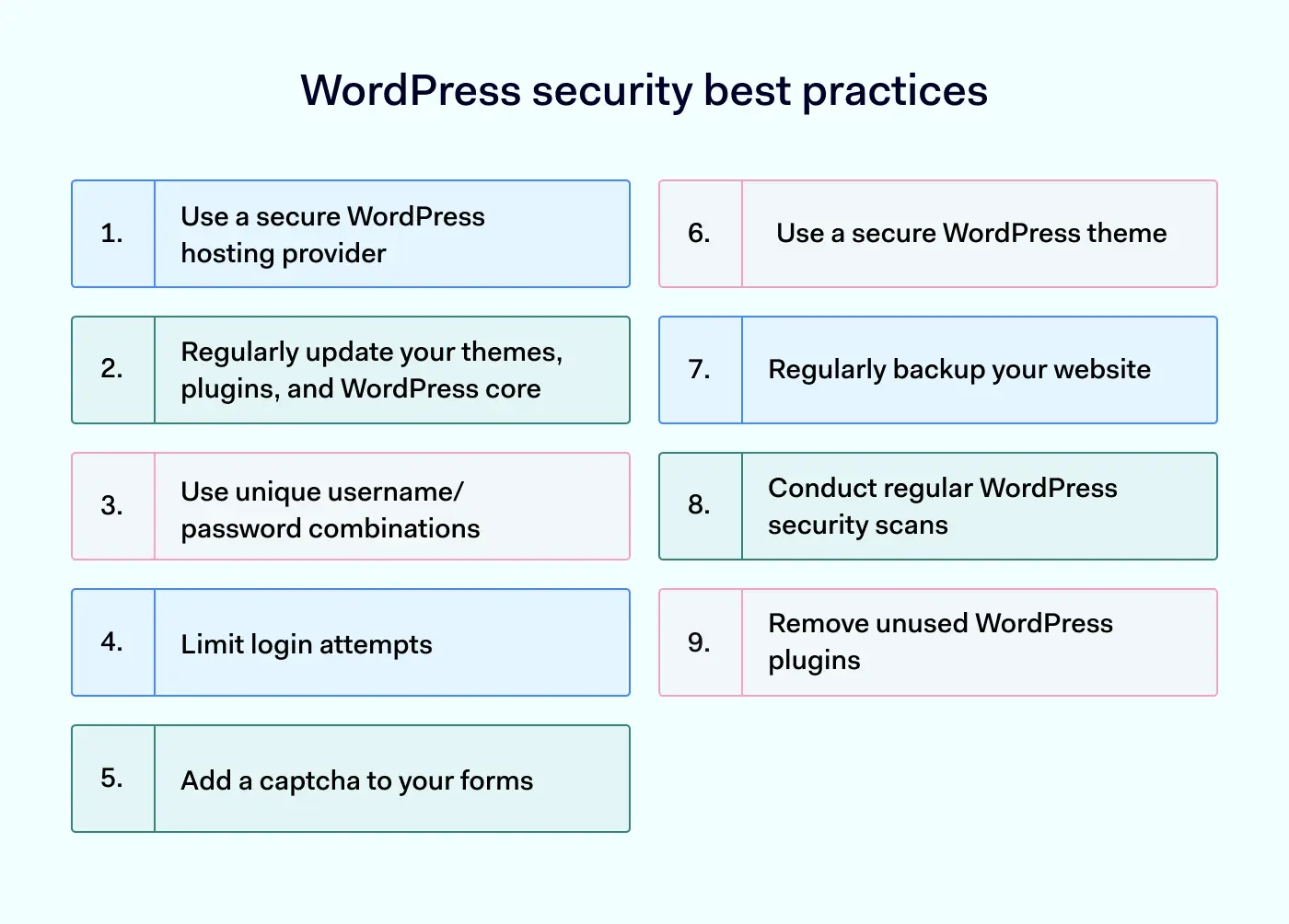
Use a secure WordPress hosting provider

Choosing a WordPress hosting provider is the first line of defense against potential cyber threats. A reputable hosting provider prioritizes data security and implements measures to safeguard your website’s data, including backups, encryption, and secure data storage. A good host ensures that your website is well-protected at the server level.

Regularly update your themes, plugins, and WordPress core

Software, including WordPress themes, plugins, and the core itself, can contain vulnerabilities. Updates often include patches for known security vulnerabilities, so updating all the mentioned components is crucial. This is the only way to ensure that you have the latest security patches and fixes, reducing the risk of your website being exploited by hackers or malware.

Use unique username/password combinations

Simple login credentials can be an open door for hackers. Avoid using ‘admin’ as your username, and ensure your passwords are complex and unique. A good password includes uppercase and lowercase letters, numbers, and special characters. A password manager like NordPass can help you create strong passwords and store these safely.

Limit login attempts

Limiting the number of failed login attempts can prevent brute-force attacks. WordPress offers various plugins that can lock out a user’s IP address after a certain number of failed login attempts is reached. This makes it more difficult for hackers to try username/password combinations to log in.

Add a CAPTCHA to your forms

Adding CAPTCHA (Completely Automated Public Turing test to tell Computers and Humans Apart) to WordPress can help prevent spam and bot submissions on your forms. Bots are often used to launch various types of attacks, such as submitting spam comments, brute-forcing WordPress login page, or submitting malicious code. CAPTCHA makes it harder for automated systems to engage with your site and potentially cause harm.

Use a secure WordPress theme

Not all themes are created equal. Choose themes from reputable sources that prioritize security. Opt for themes that have well-structured, clean, and secure code. Themes that follow coding best practices reduce the likelihood of security vulnerabilities. Always check ratings, reviews and update frequency before deciding on a theme.

Regularly backup your website

Regularly backing up a WordPress website is a safety net. If something goes wrong, you can always revert to a previous WordPress version of your site. Regular backups ensure that your website’s content, including posts, pages, images, and databases, are securely stored and can be recovered. Remember, it’s important to store backups securely, preferably off-site or in a separate location from your live website.

Conduct regular WordPress security scans

Regular security scans help detect vulnerabilities and malware that have slipped through the cracks. Once identified, vulnerabilities and other weaknesses in your website’s security can be addressed with fixes. This process provides a pace of mind and knowledge that proactive measures are being taken to protect not only the website, but also its visitors.

Remove unused WordPress plugins

Like most, you probably have tried different WordPress plugins but didn’t remove them after you tried them out. Yet, outdated or unused plugins can pose a security risk to your website. If a plugin is not regularly updated by the developer, it may contain vulnerabilities that can be exploited by hackers. Going through them and removing unused ones will reduce the number of openings a malicious actor can use to access your site.

How to secure access to WordPress

WordPress security best practices provide a solid foundation for improvements. However, it’s also a good idea to implement a wider range of security features beyond WordPress itself. While plugins and built-in control can help a lot, more sophisticated solutions may sometimes be required. Here are actionable steps you can take when securing your digital environments.

Secure Access with a VPN

WordPress site security can be improved by using a Virtual Private Network (VPN). A VPN encrypts exchanged data traffic, making it difficult for hackers to intercept your information between your user devices and WordPress servers. By routing your traffic through a VPN, you add a layer of security to your WordPress access, protecting your site from potential attacks.

Implement SSO and MFA

Implementing single sign-on (SSO) and multi-factor authentication (MFA) SaaS access control solutions can significantly enhance the security of your WordPress website. SSO allows users to authenticate once and gain access to multiple systems or applications without needing to log in separately. Meanwhile, MFA adds an extra layer of security by requiring users to provide additional verification factors beyond a password to access their accounts. These solutions make it much more difficult for unauthorized users to gain entry into your WordPress resources.

Allow connections only from trusted IP addresses

Restricting access only to allowed connections helps to enhance the security of your WordPress website. By limiting connections only to trusted IP addresses, you prevent unauthorized individuals or bots from gaining access to the WordPress administrative area. IP Allowlisting can play a significant role in adopting a Zero Trust security posture. However, it’s essential to carefully assess your specific security requirements, user base, and potential limitations as not to introduce additional limitations for your user base.

Segment your network into smaller parts

Consider implementing network segmentation, which involves dividing your network into smaller parts. By segmenting the network (for instance, with a web application firewall), you can separate different components of your WordPress infrastructure, such as the web server, database server, and application server. This isolation ensures that if one component is compromised, the attacker’s access is limited to that specific segment, reducing the potential impact on other parts of the network.

Encrypt your held data

Data encryption plays a crucial role in enhancing WordPress security by providing a layer of protection for sensitive information. By encrypting the data, it becomes scrambled into an unreadable format that can only be deciphered with the appropriate decryption key. This prevents unauthorized individuals from intercepting and understanding the data, significantly enhancing the overall security posture.

Implement access management controls

Access management controls allow you to define who can access your WordPress website and what level of access they have. By properly assigning roles, you can limit access to critical functions and sensitive areas of your website. For example, you can have administrators who have full control over the site, editors who can manage content, and subscribers who only have basic access. With such tools you gain granular control over who has access to what within your WordPress site, enhancing your site’s security profile.

FAQ

Can I secure my WordPress website without technical expertise?

Yes, implementing basic security practices like using strong passwords, keeping WordPress updated, and enabling two-factor authentication can be done without extensive technical knowledge. However, for advanced security measures, it is advisable to seek assistance from a professional.

How often should I update my WordPress website?

Regular updates are crucial for maintaining security. Update your WordPress installation, themes, and plugins as soon as new versions become available. Aim to check for updates at least once a week.

Are free themes and plugins safe to use?

Not all free themes and plugins are unsafe, but caution is advised. Stick to reputable sources like the official WordPress repository or trusted third-party marketplaces. Always review user ratings, read reviews, and ensure they receive regular updates and support.

What should I do if my WordPress website is hacked?

If your WordPress website is hacked, take immediate action. Change all passwords, restore your website from a recent backup, and scan your site for malware using security plugins. Consider consulting with a professional to ensure all vulnerabilities are addressed.

Can a security plugin alone protect my website?

While security plugins provide valuable features, they should be seen as part of a comprehensive security strategy. Combine security plugins with other practices, such as regular updates, strong passwords, and secure hosting, to create a robust defense against threats.

How can NordLayer help?

Securing your WordPress site involves an ongoing effort and frequent upgrades. It means taking care of your WordPress core and installing strong protections like IP allowlisting to enhance your resistance against potential cyber-attacks. However, this is only the start, since the security environment is enormous and difficult to traverse alone.

This is where NordLayer can help. One of the features we offer is IP allowlisting, which enables organizations to control access to internal resources by specifying trusted IP addresses. Simultaneously, we also provide fixed IP addresses, ensuring that you can implement IP allowlisting effectively and maintain a more secure environment.

Additionally, we understand the importance of network segmentation to enhance security further. By dividing your network into smaller, isolated segments, we help create barriers limiting potential threats from spreading laterally within your infrastructure. We also offer the ability to provide exclusive access rights for those who specifically need to access your WordPress work environment within your organization.

However, we don’t stop there. We go the extra mile to secure your WordPress environment by implementing a robust two-factor authentication (2FA) process. With 2FA, even if someone has access rights, they will need to undergo an additional layer of verification beyond the standard login credentials.

Contact us now to discover how we can boost the security of your WordPress site while ensuring simplicity of use and seamless operations.

About Version 2 Digital

Version 2 Digital is one of the most dynamic IT companies in Asia. The company distributes a wide range of IT products across various areas including cyber security, cloud, data protection, end points, infrastructures, system monitoring, storage, networking, business productivity and communication products.

Through an extensive network of channels, point of sales, resellers, and partnership companies, Version 2 offers quality products and services which are highly acclaimed in the market. Its customers cover a wide spectrum which include Global 1000 enterprises, regional listed companies, different vertical industries, public utilities, Government, a vast number of successful SMEs, and consumers in various Asian cities.

About NordLayer
NordLayer is an adaptive network access security solution for modern businesses – from the world’s most trusted cybersecurity brand, Nord Security.

The web has become a chaotic space where safety and trust have been compromised by cybercrime and data protection issues. Therefore, our team has a global mission to shape a more trusted and peaceful online future for people everywhere.

Futurespective 2033: cyber threats in 10 years, according to AI

Knowing what will happen in the future is rather a balance between a guessing game and precise algorithmic estimations.

Driven by curiosity about technology advancements, Ray Bradbury’s “Fahrenheit 451” predicted earbuds, Douglas Adams’ “The Hitchhiker’s Guide to the Galaxy” hinted at audio translating apps, and William Gibson’s “Neuromancer” foresaw cyberspace and computer hackers. Then science fiction, now a reality – it’s human nature to speculate on what will happen next.

Let’s embrace a paradox, and just like in a sci-fi setup, ask Artificial Intelligence (AI), a technological evolution staple defining our era, how cyber threats will look in the future.

The cyber threat landscape in 10 years

The cyber threat landscape in 10 years

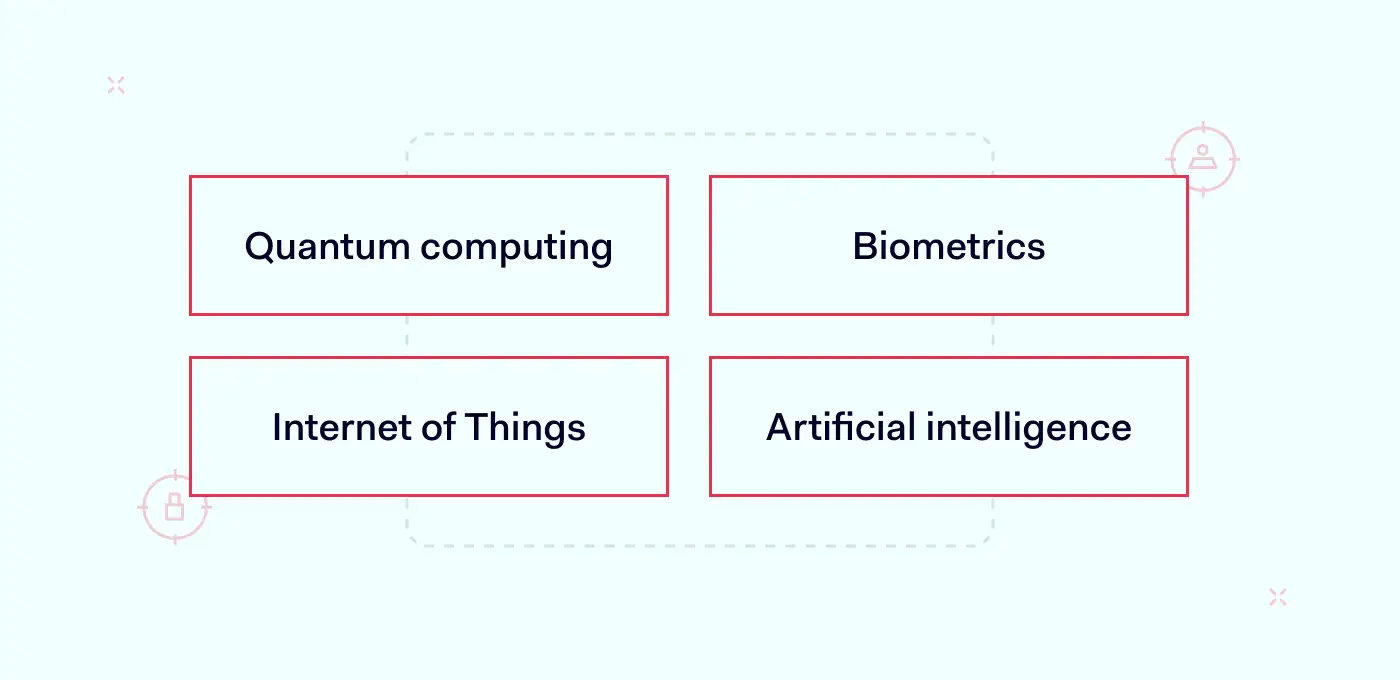
The types of cyber threats will likely evolve with the advancement of technology. As new technologies such as quantum computing, artificial intelligence, the Internet of Things (IoT), and advanced biometrics become more widespread, they will likely become targets for cyber threats.

Quantum computing

With quantum computers potentially on the horizon, we might see the advent of quantum-based cyber-attacks that could render current encryption methods obsolete.

Quantum computers use principles of quantum mechanics to process information. If they become practical and widespread, they could potentially break the cryptographic algorithms that secure online communication today.

Just last November, IBM revealed its 433 qubits quantum computer Osprey news to the public. This hyper-powerful machine is a successor to the last 2021’s attempt to develop a quantum computer, which was 3 times less effective than the latest device.

Today science reached only the brink of quantum computing due to technological limitations. But cybersecurity would necessitate new encryption methods once the quantum computing revolution potential is released.

A quick check on definitions 

💡 Quantum computing is a new type of computation that uses the principles of quantum mechanics.

💡 Quantum mechanics is the theory that explains how the smallest particles in the Universe behave.

💡 Quantum computers use quantum bits (qubits), which, unlike classical bits (that can be either 0 or 1), can be in a state of superposition, where they can be both 0 and 1 simultaneously.

💡 Because of superposition, quantum computers perform many calculations in parallel and solve certain types of problems faster than classical computers.

Click to tweet

Artificial intelligence

The growth in AI could lead to AI-generated attacks. AI-backed threats could involve machine learning algorithms to navigate to security measures, making them harder to prevent or detect.

Automated attacks and methods to create malware that can learn and adapt to its environment pose huge risks to the cybersecurity landscape. As AI technology advances, these threats will likely become more sophisticated and harder to mitigate.

Among these AI-projected risks are AI-enhanced phishing attacks. By using natural language processing, deep-fake technology, and machine learning algorithms, attackers can craft personalized and context-aware phishing emails that are difficult to identify as malicious. This can increase the success rate of phishing attacks and social engineering, leading to potential compromise of sensitive information.

Artificial intelligence can also enable the creation of botnets. AI algorithms can help botnets evade detection, automate attack techniques, and dynamically adapt to defenses. This can lead to larger and more resilient botnets that can carry out coordinated and sophisticated attacks.

Internet of Things (IoT)

As more devices connect to the internet, each becomes a potential vulnerability. Sophisticated large-scale attacks on infrastructure could become more common.

IoT devices are notoriously lacking in security, often being designed for convenience over safety. The IoT ecosystem lacks universal standards and regulations, leading to inconsistent security practices across devices and platforms, making them easy targets for malicious actors to exploit.

Data privacy concerns fall under the scope of IoT devices that collect vast amounts of personal and sensitive data. Location information, health data, and behavioral patterns under improper handling or unauthorized access to this data can lead to privacy breaches and potentially enable identity theft or targeted attacks.

IoT devices integrated into critical infrastructure, such as smart grids, healthcare systems, or autonomous vehicles, introduce the risk of physical harm if compromised. An attacker gaining control over such systems could cause disruptions, accidents, or even loss of life.

Biometrics

The increased use of biometric data, which involves using unique biological or behavioral characteristics for identification and authentication purposes, could lead to new types of identity theft, where hackers target biometric databases to impersonate individuals.

Potential biometric data tampering is another high-risk threat if biometric data is not securely stored or transmitted. An attacker gaining unauthorized access to the stored biometric data could modify it, leading to authentication failures or unauthorized access to secured systems.

Ultimately, gained biometric data can lead to cross-matching attacks that involve combining stolen biometric data from different sources to impersonate individuals across multimodal systems. If one modality is compromised, an attacker could use another modality to gain unauthorized access.

Distinctive changes in cybersecurity threats

The integration of cyber-physical systems and increasing digitization of everyday life will likely lead to a broader scope for unseen cyber threats. Cybersecurity could become a more significant concern in sectors that previously didn’t prioritize it as much, like manufacturing, agriculture, and healthcare.

Cyber-physical systems

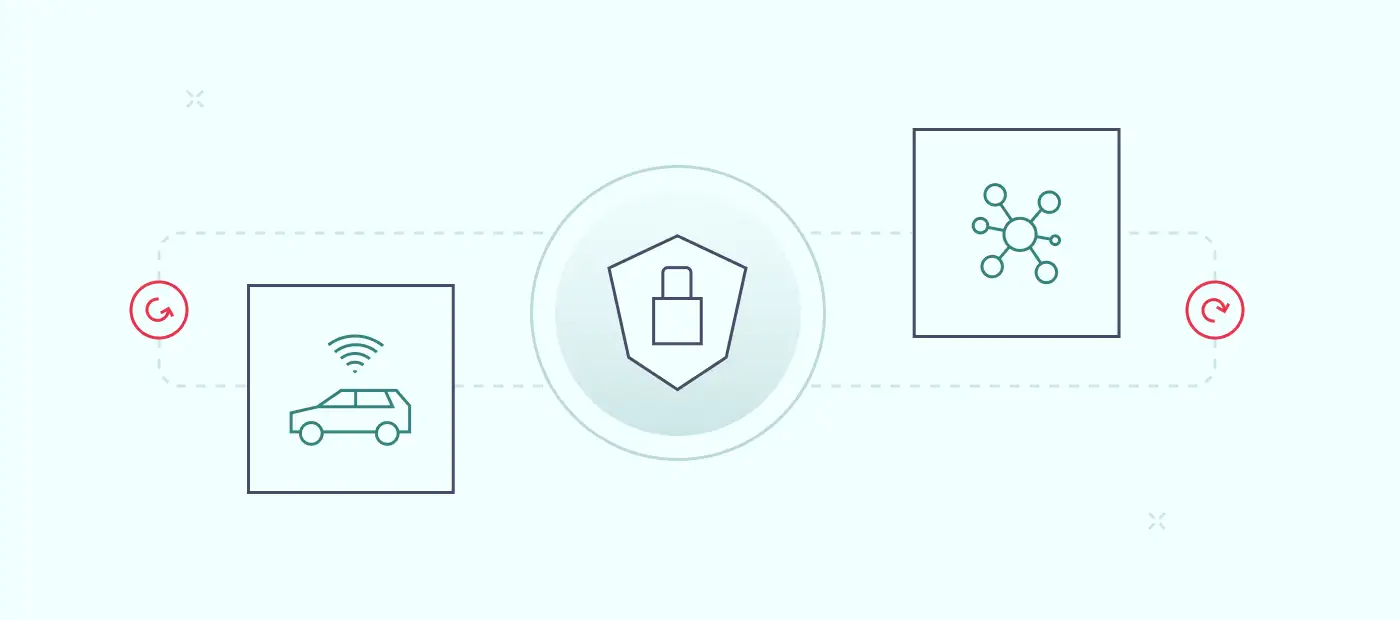
Cyber-physical systems blend physical infrastructure with digital controls. Cyber threats could thus directly affect physical reality, for example, tampering with self-driving vehicles or smart city infrastructure. Integrating physical and digital systems is becoming increasingly common in the manufacturing, energy, and transportation sectors. This is creating new opportunities for cyber threats.

An attacker compromising a cyber-physical system could cause real-world harm. For instance, if an attacker could take control of a self-driving car’s system, they could cause an accident. Similarly, threats to smart grids could disrupt power supplies, and threats to smart manufacturing systems could disrupt production or cause physical damage.

As cyber-physical systems increase, we can expect cybersecurity threats to become more physical and potentially more dangerous. This trend will necessitate a greater focus on securing our data and the digital systems interacting with the physical world.

Greater interconnectedness

The continued growth of global connectivity means an attack in one place can quickly spread elsewhere. This may lead to more coordinated global responses to cyber threats.

The digital world is becoming more interconnected, making it easier for cyber threats to spread. This interconnectedness can also amplify the impact of attacks. For instance, a single successful attack on a cloud service provider could impact thousands of businesses that use that service.

In an increasingly interconnected world, it’s also more likely that threats will cross national borders. This could lead to greater international cooperation on cybersecurity, with countries working together to defend against threats and to track down and prosecute cybercriminals. We may also see the development of international norms and regulations related to cybersecurity.

The trends suggest that the cybersecurity landscape will become more complex and potentially more dangerous over the next decade. Protecting against future threats will require technological advances, better cybersecurity practices, and possibly increased international cooperation.

Unchanged aspects of cyber threats

While the specifics of cyber threats will change, several underlying principles will likely remain constant. The shared tendency is not purely technological fundaments of the threats but more on personal motivation and individual mindset.

Human error

Many cyber threats, even sophisticated ones, rely on exploiting human error or human psychology. For example, phishing attacks trick people into revealing sensitive information, such as passwords.

Similarly, ransomware often infiltrates systems because someone clicks on a malicious link or attachment.

Despite technological advances, the human element is often the weakest link in cybersecurity. This is unlikely to change in the foreseeable future. Human nature is a constant, and cybercriminals will likely continue to exploit this to their advantage.

Basic principles

Some basic principles of cybersecurity are timeless. For example, the principle of least privilege, which says that users should be given the minimum levels of access necessary to perform their tasks, is a fundamental principle of cybersecurity that helps to limit the potential damage if a system is breached.

Similarly, keeping software up-to-date is crucial for cybersecurity, as updates often include patches for known security vulnerabilities. These principles will likely remain important regardless of how the specifics of cyber threats evolve.

Economic motivations

Cybercrime will continue to be driven by financial gain. Where there’s value (like in personal data or corporate secrets), individuals or groups will seek illicit ways to acquire it.

Cybercriminals often seek to steal data they can sell, such as credit card numbers, or extort money directly from their victims, such as through ransomware. As long as money is to be made from cybercrime, and the perceived risk of getting caught is low, people will likely continue to engage in it. Therefore, the economic drivers of cybercrime are unlikely to disappear.

These factors underline the ongoing need for cybersecurity awareness, education, and robust security policies. While technology and specific threats will evolve, the human element, basic cybersecurity practices, and the motivations behind cybercrime will likely remain constants in the cybersecurity landscape.

Technology to mitigate and handle cyber threats

Advancements in technology will also shape cybersecurity measures. Or, as people say, fight fire with fire.

AI and machine learning

These technologies will become crucial in identifying and responding to threats, potentially in real-time. They can also help predict and mitigate future threats based on pattern recognition.

The role of AI and Machine Learning in enhancing cybersecurity defenses is key. AI is a powerful tool to detect abnormal behavior and identify threats in real-time based on patterns and irregularities that might be too subtle for a human to notice. Machine learning, a subset of AI, continuously learns from each attack and improves detection algorithms, enabling defenses to evolve along with the threats.

Moreover, AI could potentially be used for predictive threat intelligence, foreseeing cyber threats before they happen using historical data to predict future attack patterns.

Quantum cryptography

In response to potential quantum threats, quantum cryptography and post-quantum cryptography methods may become common to secure data.

With the potential arrival of quantum computers, current cryptographic algorithms could become obsolete. Quantum cryptography, particularly Quantum Key Distribution (QKD), offers a possible solution.

QKD allows two parties to generate a shared secret key that can be used to encrypt and decrypt messages. According to quantum mechanics principles, if an eavesdropper tries to measure the quantum particles used to form the key, their state will be changed, alerting the parties involved to the breach

Decentralized systems

Blockchain and other decentralized systems could provide more secure data storage and transmission alternatives.

A blockchain is essentially a distributed ledger that records transactions across multiple computers so that the record cannot be altered retroactively. This makes it resistant to tampering, which is why it could significantly improve cybersecurity.

Blockchain can provide improved security for IoT devices, supply chain security, secure private messaging, identity verification, and more.

Cybersecurity skill development

While not a technology in itself, the importance of human expertise in cybersecurity is paramount. Therefore, educational and training programs that equip people with the necessary skills to handle evolving cyber threats will be crucial. This might involve traditional educational programs, online courses, simulation tools, and AI-driven personalized learning platforms.

Remember that while these technologies will certainly help enhance cybersecurity defenses, there is no magic solution that can solve all challenges. The cyber threat landscape continuously evolves, and defending against these threats requires technological solutions, sound cybersecurity practices, robust policies, and a well-educated user base.

Summary

After exploring potential future scenarios in the evolving cybersecurity landscape, one thing is clear – staying ahead of the game is important.

To be completely sure, we asked if the future ahead was bright. The AI being an AI, couldn’t provide a Yes or No answer, yet it referred that the future ahead is in a grey area.

“The future will likely be a mix of remarkable advancements and challenging issues. It will be shaped by our ability to manage these opportunities and challenges, policy decisions, cultural shifts, and many other variables. The key lies in harnessing the benefits of technological progress while minimizing its potential negative impacts.”

Thinking strategically about business cybersecurity is crucial to prepare for upcoming challenges. NordLayer is designed to grow with your organization’s network security needs. Ensure authorized-only connections, enable threat-blocking features, and make cybersecurity user-friendly by implementing integral and easy-to-assess network access for all ways of working.

About Version 2 Digital

Version 2 Digital is one of the most dynamic IT companies in Asia. The company distributes a wide range of IT products across various areas including cyber security, cloud, data protection, end points, infrastructures, system monitoring, storage, networking, business productivity and communication products.

Through an extensive network of channels, point of sales, resellers, and partnership companies, Version 2 offers quality products and services which are highly acclaimed in the market. Its customers cover a wide spectrum which include Global 1000 enterprises, regional listed companies, different vertical industries, public utilities, Government, a vast number of successful SMEs, and consumers in various Asian cities.

About NordLayer
NordLayer is an adaptive network access security solution for modern businesses – from the world’s most trusted cybersecurity brand, Nord Security.

The web has become a chaotic space where safety and trust have been compromised by cybercrime and data protection issues. Therefore, our team has a global mission to shape a more trusted and peaceful online future for people everywhere.

Scale Computing Named a Winner for CRN’s 2023 Tech Innovator Award

Industry-First Cloud-Based Fleet Management Solution, Scale Computing Fleet Manager, Wins in Edge Computing/Internet of Things Category

INDIANAPOLIS – July 17, 2023 – Scale Computing, the market leader in edge computing, virtualization, and hyperconverged solutions, today announced that CRN®, a brand of The Channel Company, has chosen Scale Computing a winner for the 2023 CRN Tech Innovator Awards. The company is being recognized for its Scale Computing Fleet Manager (SC//Fleet Manager) in the Edge Computing/Internet of Things category.

Available as part of the award-winning Scale Computing Platform, SC//Fleet Manager is the industry-first cloud-based fleet management solution with both zero-touch provisioning (ZTP) and Secure Link features. The solution allows users to see and manage their entire fleet at once from an intuitive cloud-based console. ZTP provides cloud-like simplicity for administrators, allowing them to centrally configure clusters in SC//Fleet Manager prior to nodes arriving on-premises, decreasing the installation time by 90% or more. Secure Link enables cloud-like simplicity for administrators, allowing them to access the HyperCore UI for in-depth cluster management with the click of a button, without needing expensive or complex remote access solutions. Edge deployments are just a click away on any browser, on any device, anywhere.

“We pride ourselves on continuing to deliver innovative, intelligent, and simple edge computing solutions that enable customers to successfully and reliably deploy applications at the edge. SC//Fleet Manager consolidates real-time conditions for a fleet of clusters, including storage and compute resources, allowing MSPs and IT leaders to quickly identify areas of concern using a single pane of glass, for over 50,000 clusters,” said Jeff Ready, CEO and co-founder of Scale Computing. “Scale Computing is thrilled to be honored by CRN and remains committed to providing our partners and customers with solutions that bring simplicity and scalability together, replacing existing infrastructure and providing high availability for running workloads, regardless of any hardware requirements. We’re excited to be named a CRN Tech Innovator again this year.”

This annual award showcases innovative vendors in the IT channel across 37 different technology categories, in key areas ranging from cloud to storage to networking to security. To determine the 2023 winners, a panel of CRN editors reviewed hundreds of vendor entries—including solution provider testimonials—using multiple criteria, including key capabilities, uniqueness, technological ingenuity, and ability to address customer and partner needs.

“CRN’s annual Tech Innovator Awards acknowledge technology vendors committed to new and updated products that are creating the biggest opportunities for the solution providers and strategic service providers working on the front lines with customers.” said Blaine Raddon, CEO of The Channel Company. “Congratulations to each one of this year’s CRN Tech Innovator Award winners. We are proud to recognize these best-in-class vendors that are driving transformation and innovation in the IT space.”

The Tech Innovator Awards will be featured in the August issue of CRN and can be viewed online at crn.com/techinnovators. For more information on SC//Fleet Manager, visit scalecomputing.com/sc-fleet-manager.

About Version 2 Digital

Version 2 Digital is one of the most dynamic IT companies in Asia. The company distributes a wide range of IT products across various areas including cyber security, cloud, data protection, end points, infrastructures, system monitoring, storage, networking, business productivity and communication products.

Through an extensive network of channels, point of sales, resellers, and partnership companies, Version 2 offers quality products and services which are highly acclaimed in the market. Its customers cover a wide spectrum which include Global 1000 enterprises, regional listed companies, different vertical industries, public utilities, Government, a vast number of successful SMEs, and consumers in various Asian cities.

About Scale Computing 
Scale Computing is a leader in edge computing, virtualization, and hyperconverged solutions. Scale Computing HC3 software eliminates the need for traditional virtualization software, disaster recovery software, servers, and shared storage, replacing these with a fully integrated, highly available system for running applications. Using patented HyperCore™ technology, the HC3 self-healing platform automatically identifies, mitigates, and corrects infrastructure problems in real-time, enabling applications to achieve maximum uptime. When ease-of-use, high availability, and TCO matter, Scale Computing HC3 is the ideal infrastructure platform. Read what our customers have to say on Gartner Peer Insights, Spiceworks, TechValidate and TrustRadius.

ESET adds Vulnerability and Patch Management capability to ease the pressure on overloaded IT teams

As any IT admin would tell you, patching vulnerabilities is one of the most time-consuming tasks they must contend with. Plus, it is getting more difficult. The increasing appetite for workers to work remotely and the growing adoption of cloud services have led to the attack surface being more diversified and difficult to monitor than ever before.

Unfortunately, when resources are stretched, patching tends to get postponed. However, it is imperative that teams do not cut corners. The timely patching of applications and operating systems remains critical to help prevent potentially crippling security breaches.

Updates activated without delay

Overloaded IT teams struggling with the management of patches across their network can benefit from the fully automated ESET Vulnerability and Patch Management functionality now available in the ESET PROTECT Complete and ESET PROTECT Elite tiers. With it, business-critical software updates can be activated without delay. This timely patching is fundamental to increasing an organization’s overall security posture.

ESET Vulnerability and Patch Management enables businesses to benefit from advanced prioritization and automation techniques. It can be used to set optimal scan frequencies and synchronize them with patching setups to address relevant and exploitable vulnerabilities without overloading IT teams. Plus, vulnerabilities can be filtered based on their severity so that those vulnerabilities that pose the most significant business risks can be prioritized.

Close infrastructure blind spots

Growing IT complexity has led to degraded coordination between cross-functional teams, gaps in inventory, and a blurred view of the threat landscape. Luckily, help is at hand. With ESET Vulnerability and Patch Management, IT teams can centralize and automate multiple IT security and management tasks. This means they can maintain an up-to-date inventory and close any infrastructure blind spots that might have existed previously, allowing businesses to better safeguard themselves against the constantly evolving threat landscape and simplify their compliance with the likes of GDPR, HIPAA, and PCI DSS.

A superstar new recruit

ESET Vulnerability and Patch Management is like a superstar new recruit to your team. It scans thousands of popular applications, such as Adobe Acrobat, Mozilla Firefox, and Zoom Client, for over 35,000 common vulnerabilities and exposures (CVEs). Vulnerabilities can then be filtered and prioritized based on exposure score and severity.

As the threat landscape evolves, we evolve too. The ESET Vulnerability and Patch Management inventory is constantly updated with the patch name, version of the app, CVE, patch severity, and affected applications. With it, patches can be launched automatically without delay or manually once identified, depending on what the business prefers. Organizations can simplify the patching process further by prioritizing critical assets and scheduling the remainder to off-peak times to avoid disruption.

A unified cybersecurity platform

ESET’s unified cybersecurity platform, ESET PROTECT, is a single-pane-of-glass cloud console that provides centralized visibility, management, and insight. It is a simple, modular, adaptable, and continuously updated solution built with the benefit of our customers in mind. ESET PROTECT Platform integrates balanced breach prevention, detection, and response capabilities with our industry-leading managed and professional services and threat intelligence. With the launch of ESET PROTECT Elite, there are now five subscription tiers in the ESET PROTECT Platform:

  • ESET PROTECT Entry – an entry-level solution with competitive pricing that includes endpoint protection, server security, and the ESET PROTECT Cloud console.
  • ESET PROTECT Advanced – providing first-class endpoint protection with advanced threat defense technology and full disk encryption.
  • ESET PROTECT Complete – including the new ESET Vulnerability and Patch Management capability, cloud application protection, and mail security to reduce cyber risks to the minimum.
  • New ESET PROTECT Elite – providing increased visibility and decreased cyber risks, ESET Vulnerability and Patch Management, ESET’s native extended detection and response (XDR) capability, plus robust multifactor authentication.
  • ESET PROTECT MDR – an enterprise-grade solution that provides complete cyber risk management, robust threat hunting, and world-class ESET expertise on call. ESET PROTECT MDR combines the capabilities of the ESET PROTECT Elite tier with ESET managed security and professional services.

For more information on the ESET PROTECT Platform, please click here.

Mitigate your exposure

With IT teams struggling with the myriad of tasks made ever more difficult in this era of hybrid working, ESET helps decrease the complexity of cybersecurity. This allows time-sapped teams to focus on other business-critical areas of interest. With ESET PROTECT, we help IT teams mitigate their business’s exposure to new and emerging threats, whilst benefitting from full prevention, detection, and response functionality.

The brand-new ESET Vulnerability and Patch Management functionality within ESET PROTECT can better safeguard businesses that struggle to keep up with a constantly evolving threat landscape by ensuring they are correctly patched to help keep out the bad guys. Not only does this help minimize their exposure to attacks, but it also ensures that they can adhere to increasingly stringent cybersecurity insurance or regulatory requirements. To learn more about ESET Vulnerability and Patch Management, please click here.

About Version 2 Digital

Version 2 Digital is one of the most dynamic IT companies in Asia. The company distributes a wide range of IT products across various areas including cyber security, cloud, data protection, end points, infrastructures, system monitoring, storage, networking, business productivity and communication products.

Through an extensive network of channels, point of sales, resellers, and partnership companies, Version 2 offers quality products and services which are highly acclaimed in the market. Its customers cover a wide spectrum which include Global 1000 enterprises, regional listed companies, different vertical industries, public utilities, Government, a vast number of successful SMEs, and consumers in various Asian cities.

About ESET
For 30 years, ESET® has been developing industry-leading IT security software and services for businesses and consumers worldwide. With solutions ranging from endpoint security to encryption and two-factor authentication, ESET’s high-performing, easy-to-use products give individuals and businesses the peace of mind to enjoy the full potential of their technology. ESET unobtrusively protects and monitors 24/7, updating defenses in real time to keep users safe and businesses running without interruption. Evolving threats require an evolving IT security company. Backed by R&D facilities worldwide, ESET became the first IT security company to earn 100 Virus Bulletin VB100 awards, identifying every single “in-the-wild” malware without interruption since 2003.

×

Hello!

Click one of our contacts below to chat on WhatsApp

×