Skip to content

Everything You Need to Know About Certificate-Based Authentication

No ID? No Entry.

Certificate-based authentication is a way for a computer system to verify your identity using a digital certificate instead of a traditional username and password. Think of it like a driver’s license. When you go to a bar or a liquor store, you need to prove that you’re old enough to buy alcohol. The bouncer or cashier checks your ID to make sure it’s really you, and that you’re of legal age. In the same way, when you connect to a secure website or network, your computer presents a digital certificate to prove that you are who you say you are.

This certificate contains a unique code that identifies you and your computer, and it’s signed by a trusted authority like a certificate authority (CA). The CA vouches for your identity, and the website or network can trust that you are who you say you are. So, instead of typing in a username and password, you just present your digital certificate and the system verifies it. It’s a more secure way of authenticating because it’s harder to steal or guess a digital certificate compared to a password.


The Secret Handshake

Certificate-based authentication is like having a secret handshake that only you and the system you’re trying to access know. You can think of it as a VIP club, where only the cool kids with the special wristbands can get in. In this case, your digital certificate is your wristband, and the certificate authority is the bouncer at the door.

Now, let’s say you’re trying to sneak into the VIP club without a wristband. You might try to guess the password or use some other sneaky trick to get past the bouncer. But with certificate-based authentication, you can’t cheat your way in. Your digital certificate is unique to you and your computer, and it’s signed by a trusted authority. So, even if someone intercepts your certificate, they won’t be able to use it to gain access to the network.

It’s like having a secret superpower that only you possess. And because it’s harder to steal or guess a digital certificate, certificate-based authentication is like having a bulletproof vest for your network. It’s the most secure way to authenticate because it’s nearly impossible for hackers to break in without your digital certificate. So, if you want to protect your network from the bad guys, certificate-based authentication is the way to go!


What’s Stopping You?

Certificate-based authentication can be a bit more complicated to set up and manage than traditional username and password authentication. It requires companies to have their own certificate authority or to purchase certificates from a trusted third-party CA, which can be expensive. And depending on the size of the company, managing all those certificates can be a bit of a headache.

Plus, not all systems and applications support certificate-based authentication, so companies may need to make changes to their infrastructure to enable it. And even if they do make those changes, employees may need to be trained on how to use certificate-based authentication, which can take time and resources.

That being said, many companies are starting to see the benefits of certificate-based authentication, especially for highly sensitive systems and data. It’s a more secure method of authentication that can help prevent cyberattacks and data breaches. So, while it may not be the easiest option, it’s definitely worth considering for companies that take security seriously.


Roll it Out Faster

If companies want to speed up the adoption of certificate-based authentication, they need to make it easy and appealing for their employees.

Firstly, they can simplify the process of getting started with certificate-based authentication by providing user-friendly guides and tutorials. They should explain the benefits of certificate-based authentication in a way that’s easy to understand and make it clear how to use it.

Secondly, companies can incentivize employees to use certificate-based authentication by offering rewards such as bonuses, promotions, or recognition for those who make the switch. It’s like getting a gold star for doing well in school, but cooler because it’s for network security!

Thirdly, they can make it a company-wide policy to use certificate-based authentication for all employees. This helps establish a culture of security and demonstrates to employees the importance of protecting sensitive information.

Lastly, companies can invest in training programs and workshops to educate employees on the benefits of certificate-based authentication and how to use it effectively. They can make it fun and interactive, like a game show where employees can win prizes for correctly answering security questions.

By making certificate-based authentication easy, incentivizing its use, establishing it as a policy, and educating employees, companies can accelerate its adoption and improve their network security. It’s all about making security simple and accessible for everyone.

About Version 2 Digital

Version 2 Digital is one of the most dynamic IT companies in Asia. The company distributes a wide range of IT products across various areas including cyber security, cloud, data protection, end points, infrastructures, system monitoring, storage, networking, business productivity and communication products.

Through an extensive network of channels, point of sales, resellers, and partnership companies, Version 2 offers quality products and services which are highly acclaimed in the market. Its customers cover a wide spectrum which include Global 1000 enterprises, regional listed companies, different vertical industries, public utilities, Government, a vast number of successful SMEs, and consumers in various Asian cities.

About Portnox
Portnox provides simple-to-deploy, operate and maintain network access control, security and visibility solutions. Portnox software can be deployed on-premises, as a cloud-delivered service, or in hybrid mode. It is agentless and vendor-agnostic, allowing organizations to maximize their existing network and cybersecurity investments. Hundreds of enterprises around the world rely on Portnox for network visibility, cybersecurity policy enforcement and regulatory compliance. The company has been recognized for its innovations by Info Security Products Guide, Cyber Security Excellence Awards, IoT Innovator Awards, Computing Security Awards, Best of Interop ITX and Cyber Defense Magazine. Portnox has offices in the U.S., Europe and Asia. For information visit http://www.portnox.com, and follow us on Twitter and LinkedIn.。

TikTok Security Concerns in the Workplace

TikTok, the viral social media app centered around short videos and owned by the Chinese company ByteDance, is coming under intense scrutiny. By now, many of us have seen a TikTok video filmed in someone’s workplace—those “day in the life” clips or rants about coworkers, supervisors, or customers. Or you may have seen a video of someone discussing an unrelated subject while sitting at their desk. It’s safe to say that TikTok has found its way into many workplaces, for better or for worse. But the issue goes deeper than catching unsanctioned glimpses into the workplace environment. Many organizations are worried about TikTok itself, the data it gathers, and which hands that data ends up in.


Does TikTok Pose a Security Risk to Corporate Networks?

TikTok, like any other social media app, can pose a potential security threat to a corporate network if used by employees. The app may collect personal information and usage data that could be exploited by cybercriminals, and the app’s security protocols could be compromised.

There have been concerns raised about TikTok’s data collection practices, which include tracking user behavior, location, and contacts. Additionally, TikTok’s parent company, ByteDance, is based in China, which has led to concerns about potential government access to user data.

If employees use TikTok on a corporate network, it could potentially compromise the network’s security. Hackers could exploit vulnerabilities in the app to gain access to sensitive corporate data or use the app as a vector to distribute malware to other devices on the network.

To mitigate these risks, companies may choose to restrict or ban the use of TikTok on their corporate networks. They could also implement security protocols and software to monitor and control access to social media apps and other potentially risky applications. Additionally, it’s essential to educate employees about the potential risks associated with using social media apps on company devices and networks.


TikTok Security Concerns Are Mounting

Many states have growing TikTok security concerns. These concerns have led 18 Republican-led states to ban the use of the app on government devices. Federal agencies also bar staffers from using TikTok on their government phones and devices, including the Pentagon, the State Department, and the Transportation Security Agency.

Moreover, Europe is taking a similar approach to TikTok risk, with the European Parliament banning the app on staff phones. This move came just one day after the White House gave federal agencies 30 days to remove TikTok from all government devices. Canada has also followed suit, banning TikTok from government devices over security concerns.

But what TikTok security concerns are at play here? More generally, officials believe that the app could collect sensitive data from users, which the Chinese government may then access. In addition, they’re equally worried that the app may pose a threat to network security and endpoint security. For example, could the app be used to access sensitive information on government devices or to infiltrate government networks (an attack vector)?

The concern here stems from a lack of trust in ByteDance and fears over how much access and control Beijing has over the company and, subsequently, the app. ByteDance denies allegations that the Chinese government is involved in its operations, but these denials are largely falling on deaf ears.


Assessing the Seriousness of the Risk

There have been some reports of cybersecurity incidents involving TikTok, but it’s not clear if any companies have specifically experienced a cyber attack involving the app.

For example, in 2020, TikTok was found to be accessing users’ clipboards on iOS devices, which raised concerns about the app’s data collection practices. However, there have been no reports of TikTok being used as a vector for a cyber attack specifically targeting a corporate network.

That being said, it’s important to note that the threat landscape is constantly evolving, and new threats can emerge at any time. Companies should remain vigilant and take steps to mitigate potential risks associated with the use of social media apps on their networks, including TikTok.


TikTok Security Strategies Are Evolving

Government agencies banning TikTok is noteworthy, but what does it mean for everyone else? Some argue that governments are being a little paranoid, especially in assessing TikTok’s risk to endpoint security and network security. Still, others argue that governments have a duty to take stringent security measures regarding government data and systems.

But what should private companies do? First, it’s important to note that TikTok poses other significant concerns. For example, employees may unintentionally share confidential company information by filming a video with visible employee screens. They may also give the company a bad reputation by sharing negative stories about the workplace on the platform.

The less popular app BeReal is also coming under scrutiny for similar reasons. BeReal takes a less sensationalist approach than TikTok (it has no filters, hashtags, or followers) and is aimed at users showing an unfiltered view of their everyday life. Since this app requires you to be someone’s friend before you view their BeReal, it may create a false sense of security where users feel less inclined to censor confidential information.

Companies will have to determine their own risk tolerance, but it’s telling that organizations most focused on cybersecurity believe that TikTok is a significant security risk. More widely, companies should update their social media policies to define whether TikTok is allowed on company devices and how (and if) its use is sanctioned in the workplace – don’t leave your security up to chance!

About Version 2 Digital

Version 2 Digital is one of the most dynamic IT companies in Asia. The company distributes a wide range of IT products across various areas including cyber security, cloud, data protection, end points, infrastructures, system monitoring, storage, networking, business productivity and communication products.

Through an extensive network of channels, point of sales, resellers, and partnership companies, Version 2 offers quality products and services which are highly acclaimed in the market. Its customers cover a wide spectrum which include Global 1000 enterprises, regional listed companies, different vertical industries, public utilities, Government, a vast number of successful SMEs, and consumers in various Asian cities.

About Portnox
Portnox provides simple-to-deploy, operate and maintain network access control, security and visibility solutions. Portnox software can be deployed on-premises, as a cloud-delivered service, or in hybrid mode. It is agentless and vendor-agnostic, allowing organizations to maximize their existing network and cybersecurity investments. Hundreds of enterprises around the world rely on Portnox for network visibility, cybersecurity policy enforcement and regulatory compliance. The company has been recognized for its innovations by Info Security Products Guide, Cyber Security Excellence Awards, IoT Innovator Awards, Computing Security Awards, Best of Interop ITX and Cyber Defense Magazine. Portnox has offices in the U.S., Europe and Asia. For information visit http://www.portnox.com, and follow us on Twitter and LinkedIn.。

Are Passwords a Threat to Enterprise Security?

Enterprise security attackers are growing in number and sophistication. Organizations are only one password away from it being their worst day. To that point, is it time to ditch all those annoying, hackable passwords and live in a passwordless society?

Passwords have been the primary method of authentication for decades. While they have served their purpose and served it well, there may be better alternatives for protecting your mission-critical data and digital resources. As technology advances, cybercriminals find new ways to steal corporate credentials, making password security less effective.

In fact, according to a recent study, 81% of company data breaches were due to poor passwords. Password reuse is of particular concern as it could lead to credential stuffing attacks where threat actors take advantage of reused credentials by automating login attempts against systems using known emails and password pairs.

The same report revealed that 80% of hacking incidents were caused by stolen or reused login information.

These attacks weren’t on small companies with limited resources and weak cybersecurity protocols. They were on household name enterprises such as Ticketmaster, GoDaddy, Microsoft, SolarWinds, and even the New York City Law Department. In the case of SolarWinds, the hackers could get in with a weak password an intern had been using (“solarwinds123”), which was publicly accessible via a misconfigured GitHub repository.

Not only are passwords less secure, but they are also productivity inhibitors. In another recent report on passwordless security, 45% of respondents indicated that a passwordless approach to security would increase productivity.

In addition to weak passwords and credential reuse, passwords can be a hindrance to enterprise security in several ways:

  1. Passwords can be easily compromised: Bad actors can steal or hack credentials using various methods, such as phishing, brute force attacks, or social engineering.
  2. Password Sharing: Employees may share their passwords with others, which can put enterprise data at risk. Password sharing is especially problematic when employees leave the company or change positions, as they may be disgruntled or their old passwords remain active.
  3. Human Error: Employees may inadvertently reveal passwords through phishing scams or other social engineering tactics, which gives attackers access to enterprise data even if they do not have the correct login credentials.
  4. Lack of Two-Factor Authentication: Passwords alone may not be enough to secure enterprise accounts. Two-factor authentication can add an extra layer of security.
  5. User frustration: Password policies can frustrate users who must remember multiple passwords, adhere to strict complexity rules, and change them frequently.
  6. Cost of password management: Organizations need to invest in password management systems, such as password policies, training, and resets. These systems can be costly and time-consuming.

Given these reasons, enterprises should consider more secure alternatives to password security, such as Zero Trust, biometrics, multi-factor authentication, and certificate-based authentication. As compromised credentials continue to be a common attack vector, it only takes one nefarious login to bring a company to its knees. Of course, enterprises can’t just suddenly pull the plug on passwords altogether, but it is an option worthy of consideration.

About Version 2 Digital

Version 2 Digital is one of the most dynamic IT companies in Asia. The company distributes a wide range of IT products across various areas including cyber security, cloud, data protection, end points, infrastructures, system monitoring, storage, networking, business productivity and communication products.

Through an extensive network of channels, point of sales, resellers, and partnership companies, Version 2 offers quality products and services which are highly acclaimed in the market. Its customers cover a wide spectrum which include Global 1000 enterprises, regional listed companies, different vertical industries, public utilities, Government, a vast number of successful SMEs, and consumers in various Asian cities.

About Portnox
Portnox provides simple-to-deploy, operate and maintain network access control, security and visibility solutions. Portnox software can be deployed on-premises, as a cloud-delivered service, or in hybrid mode. It is agentless and vendor-agnostic, allowing organizations to maximize their existing network and cybersecurity investments. Hundreds of enterprises around the world rely on Portnox for network visibility, cybersecurity policy enforcement and regulatory compliance. The company has been recognized for its innovations by Info Security Products Guide, Cyber Security Excellence Awards, IoT Innovator Awards, Computing Security Awards, Best of Interop ITX and Cyber Defense Magazine. Portnox has offices in the U.S., Europe and Asia. For information visit http://www.portnox.com, and follow us on Twitter and LinkedIn.。

How social networks put your biometric data at risk

Social networks have become integral to our lives, enabling us to share photos, videos, and audio to connect with others, build our social presence, and even generate income. However, by sharing this content, we may unintentionally expose our faces, irises, fingerprints, voices, and other biometric patterns to hackers, who can exploit them for malicious purposes.

In this blog post, together with Andrius Januta, Cybersecurity Technical Manager at Nord Security, we’ll explore how content shared online can be used to steal our biometrics and discuss ways to protect ourselves from this threat. Let’s dive in.

Biometric data: What is it?

Biometric data, or biometrics for short, are body measurements and calculations related to an individual’s biological, physical, and behavioral characteristics. This can range from DNA, blood type, signature, and walking gait to the more commonly known fingerprints, face, iris, and voice patterns.

Each person’s biometrics are unique, so they offer a superior alternative to passwords for ease of use and enhanced privacy and security. As a result, biometric identification has become increasingly widespread, not only in high-security facilities but also in people’s everyday lives.

Today, over 80% of smartphones offer biometric capabilities for their users, enabling device unlocking, user authentication for purchases, and confirmation of sensitive actions within various applications.

Social networks: An endless source of biometrics

Our digital lives are dominated by biometric features that can be exposed on social media platforms like Facebook, Twitter, Instagram, YouTube, TikTok, and others. So by posting seemingly innocent-looking eye makeup, unboxing or live-painting videos, profile photos, stories featuring our daily life, and voicemails, we’re also sharing our unique identifiers with the world.

Rapidly advancing technology and media platforms supporting high-resolution image and video can inadvertently expose our face, iris, fingerprints, and voice patterns that can be cloned and used by threat actors.

How can biometric recognition systems be fooled?

Face, iris, fingerprints, and voice patterns are the four most common biometrics that can easily be harvested from social networks.

Andrius Januta, Cybersecurity Technical Manager at Nord Security, says that while, in general, biometric data offers greater security than passwords, several cases also demonstrate its inherent vulnerabilities.

  • Facial recognition systems can be fooled by gathering high-quality images or videos of an individual, which can then be utilized to craft makeup that mimics another person’s facial features, produce hyper-realistic masks, generate 3D renderings, fabricate full-size head replicas, and even employ deepfake technology.

  • Fingerprint recognition systems, designed to permit authorized users to unlock or access applications, can be compromised by silicone fingerprint replicas or even crafted duplicates made from wood glue.

  • Iris recognition systems are generally more challenging to falsify compared to facial and fingerprint equivalents. Nevertheless, A. Januta highlights that a few years ago, a high-resolution photograph of the iris, in combination with a contact lens, was sufficient to mimic an eye for unlocking personal devices.

  • Voice recognition systems are widely used in smart home devices, banking, and finance. However, voice cloning AI software can replicate the voice captured from video or audio messages. Important to highlight is that today, even a short three-second recording is enough to create a high-quality replica of someone’s voice.

Malicious use cases

While it’s possible that biometric data can be extracted from social networks, the majority of it doesn’t leak directly from these platforms. Rather, the greater risk for biometric data leaks is from poorly secured databases. In both cases, exposed biometric data can be exploited in various malicious cases.

Accessing devices and accounts

With access to your personal devices and a convincing replica of your facial features, fingerprint, or iris, a cybercriminal can bypass authentication requirements to unlock your device. As a result, they can gain full access to your private information, including contact lists, personal photos and videos, work files, financial data, login credentials, and other sensitive documents.

They can access online shopping portals and financial accounts and make unauthorized withdrawals, transactions, or purchases. They could install malicious software on your device to extract data or monitor your activities. A compromised device may even be used to distribute spam or malware to others.

Accessing services or committing fraud

Exposed biometric data can also enable fraudsters to impersonate you when accessing various services and facilities. This may include unauthorized entry to restricted areas and accessing financial, educational, governmental, or medical services. A.Januta adds that in some countries, biometric data already enables people to withdraw money from ATMs, enter sports events, and even pay for goods in supermarkets.

Equipped with your biometric data, threat actors can impersonate you while committing crimes. Examples of this include wearing hyper-realistic masks to take loans, accessing bank accounts using AI-synthesized voice clones, or scamming contacts with deepfakes, which according to A. Januta is one of the most common cases today.

He mentions that in one of the cases, threat actors impersonated a Binance executive, copying his image during video meetings and compromising multiple crypto projects. In another case, fraudsters created a deepfake video of one American in which he encouraged his friend to invest in Bitcoin mining.

Compromising your reputation

Deepfake videos or AI-generated images can falsely portray you participating in inappropriate activities or experiencing emergencies. Additionally, this data could be employed to fabricate your fingerprints at crime scenes or impersonate your voice in vishing schemes aimed at your family members.

How to protect biometric data?

Biometric system spoofing is like a cat-and-mouse game. Once cybersecurity specialists or threat actors find a vulnerability in biometric recognition systems that can be exploited, biometric system providers and tech companies quickly fix them. While it’s less likely to happen to average people, high-profile individuals like celebrities, businesspeople, or politicians remain vulnerable, so we cannot overlook the potential risks associated with the exposure of biometric data on social media,” warns A. Januta.


To address these concerns, A. Januta offers a range of practical suggestions for safeguarding our biometric information and preventing its extraction from social networks.

  • Be cautious about sharing biometrics on social media: Stay vigilant when posting videos or images that may expose your unique biometric features, such as fingerprints, face, or iris patterns.

  • Modify media quality and cover sensitive areas: Reduce the resolution of videos and images featuring you, and consider editing or blurring sensitive biometric information before sharing.

  • Opt for less exposed biometric factors: Choose biometric authentication methods that are less commonly exposed publicly or have a lower risk of being compromised, such as iris or retina.

  • Review shared media thoroughly: Scrutinize any media featuring your biometrics before sharing it on social networks, ensuring that no unintended exposure occurs.

  • Conduct regular media searches: Periodically search for your own image online and assess the context in which your images appear, taking necessary actions to remove any unwanted or potentially harmful exposure.

  • Prioritize multi-factor authentication (MFA): Use biometrics that are less exposed for single-factor authentication, or better yet, incorporate biometrics as part of a multi-factor authentication process rather than relying solely on a single biometric factor.

  • Use an additional hardware authentication device: Enhance security with a FIDO-enabled hardware device, providing an extra layer of protection against unauthorized access via standardized protocols.

  • Instead of biometrics, use complex and unique passwords: For less important accounts, use strong passwords, just don’t forget to update them regularly and securely store them in a reputable password manager.

  • Exercise caution with new services and technologies: Be vigilant when providing your biometric data to emerging services or technologies, and ensure that these entities have robust security measures in place to protect your sensitive information.

About Version 2 Digital

Version 2 Digital is one of the most dynamic IT companies in Asia. The company distributes a wide range of IT products across various areas including cyber security, cloud, data protection, end points, infrastructures, system monitoring, storage, networking, business productivity and communication products.

Through an extensive network of channels, point of sales, resellers, and partnership companies, Version 2 offers quality products and services which are highly acclaimed in the market. Its customers cover a wide spectrum which include Global 1000 enterprises, regional listed companies, different vertical industries, public utilities, Government, a vast number of successful SMEs, and consumers in various Asian cities.

About NordLayer
NordLayer is an adaptive network access security solution for modern businesses – from the world’s most trusted cybersecurity brand, Nord Security.

The web has become a chaotic space where safety and trust have been compromised by cybercrime and data protection issues. Therefore, our team has a global mission to shape a more trusted and peaceful online future for people everywhere.

How Board of Innovation manages security to protect its teamwork & client data

Board of Innovation is a global innovation firm imagining tomorrow’s products, services, and businesses – and creating them today. The company joins forces with the world’s most ambitious businesses to make what life needs next.

Working with prospects and new ideas requires creative flexibility that the company initially doesn’t want to block with security restrictions and limitations. On the other hand, protecting business and client data remains one of the company’s top priorities. Hence, Mehdi Lahmamsi Pinel, Global Operations & IT Manager at Board of Innovation tells how juggling those equally important things in the context of cyber threats aligns with the right security approach. 

The challenge

Trust over control within client confidentiality

The company culture at Board of Innovation is based on trust and employee enablement. These are critical elements for a creative industry. To succeed, the company is remote-first, and collaboration with freelancers and consultants of different backgrounds supplements full-time employees to generate new-of-the-kind products and services.

“Board of Innovation team is diverse as we have around 100 people of about 30 different nationalities in 60 places varying in cities, countries, and continents.”

Click to tweet

Yet, with a dynamic network of company innovators, consultants who move to client facilities, and third-party partners, IT managers face many challenges maintaining high levels of security that don’t interfere with team workflow.

“Business with client companies makes data security and confidentiality imperative, balancing it with the IT Manager’s responsibility to ensure the team works efficiently and effectively.”

Click to tweet

Board of Innovation works with high-profile companies and industry leaders. High traffic of changing projects, collaborators, and partners also requires precise supervision to mitigate the risks.

Since employees are unrestricted with their choices of how they want to work, self-awareness of the entire organization must be on board to achieve security goals. But how does one define the proper data protection standards and make security implicit yet not dominant? It’s a tough and subtle challenge for the IT manager to tackle.

The solution

Depicting minimums of must-security

With evaluation of team setup, work environments, and the need for flexibility, a VPN solution was the most straightforward tool for Board of Innovation. It enables many different security protocols defined in the company. One of the policies is establishing a safe connection to the company network — this is where NordLayer comes into play.

A newly assigned IT manager started by reviewing the then-current cybersecurity strategy applied in the organization. Deployed by the previous responsible manager, Board of Innovation already had an ongoing NordLayer subscription. Yet, it needed a strategy that fits company culture to its benefit.

“I’ve started by revisiting and improving the existing cybersecurity setup. NordLayer was there but not utilized to its fullest potential.”

Click to tweet

So what needed to be added to create a sound cybersecurity strategy that works?

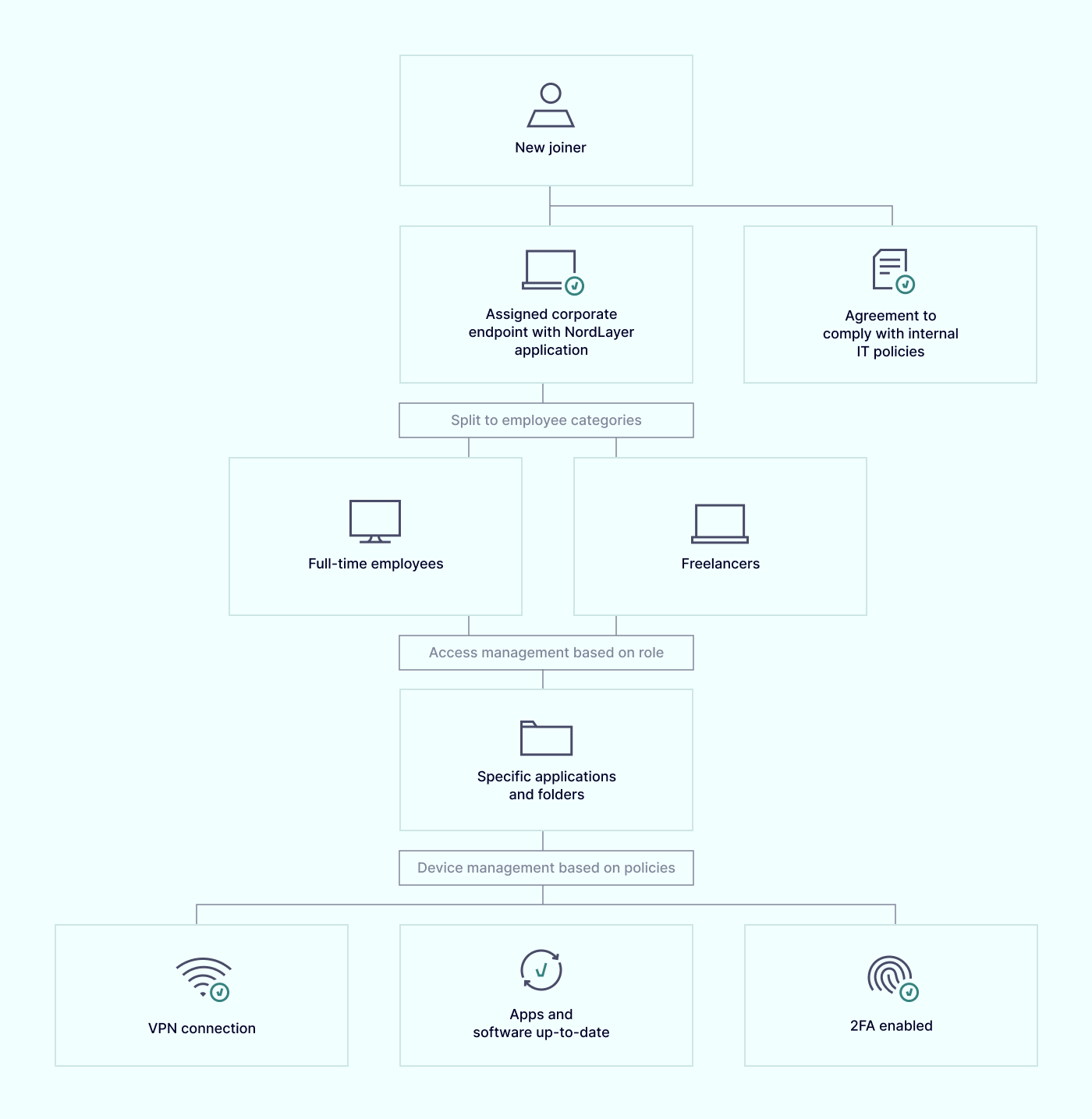
The company has a secure network access solution in place. VPN is a mandatory factor of encrypted connection, and every organization member has to familiarize themselves and agree to data protection policies.

“Whether our collaborators and employees use personal or corporate devices for the job, they must acknowledge internal IT security policies to follow.”

Click to tweet

Board of Innovation follows a streamlined approach to managing its workforce — company policies define access levels to internal data. To put policies into force, corporate devices became a connecting point for every user with access to company resources.

“Mandatory apps like NordLayer and tools for password management, specific internet navigation, and work organization are pre-installed by default. That’s how we enforce security via device management on corporate devices.”

Click to tweet

Having the tools that fulfill internal and client data security requirements relieves the security manager from dependency on employees. And having those corporate devices set up and readily distributed to the hands of the workforce is half the job done.

Users have to launch VPN once connecting to untrusted networks wherever and whenever they work, and the admin can supervise the whole process if the rules are followed.

Why choose NordLayer

Creative freedom and trust are the foundation of the Board of Innovation culture. Thus, any tools and solutions used to keep up with the security requirements must be convenient and simple, enabling and not disrupting the workers.

The organization decided to keep the NordLayer solution due to its user-friendliness. Moreover, the well-known service provider has to sustain being a reputable vendor of a safe and efficient solution.

Role and endpoint management leaves more space for protecting digital company assets by enforcing authenticated user identities. More granular network access segmentation enables careful supervision over the organization members. 

How NordLayer enables data security on different network layers

Systems and policies allow the IT manager to achieve consistency in business processes and operations. Having an overview on the NordLayer dashboard makes it easier to see who complies with the rules, like having the 2FA enabled. Moreover, or get a report of the connection history.

The outcome

Streamlined consistency aligned with internal policies 

Now, Board of Innovation has all workforce onboarded to the NordLayer solution. The solution present in every corporate device and combined with two-factor authentication makes it easier for the IT manager to ensure policies are up and running.

“We distribute NordLayer licenses to all organization members and contributors as a basic rule in our company. We aim to reinforce security policies in as many places as possible.”

Click to tweet

The remote network access solution enables the organization to collaborate with various clients, partners, and freelancers. Managing access to internal resources and project information creates barriers to stopping data leaks and breaches. And importantly, security policies don’t overcome and interrupt innovators’ creativity and workflow.

“Using NordLayer is so easy — simply open the user interface, choose a gateway, get connected, and here you go.”

Click to tweet

All that is left for the IT manager is to distribute access and privileges to internal resources according to the company policies and check that everyone is on board with the process. 

Pro cybersecurity tips

Sharing best practices is what helps businesses of any industry innovate in their own way of security. Creating a strategy for protecting the company network and securing information of different levels can be based on the most unconventional and unexpected advice. Thus, this time just like every time, we asked Mehdi Lahmamsi Pinel, the Global Operations & IT Manager at Board of Innovation, to share his professional insights on business cybersecurity:

Have you ever hesitated to impose security policies because they might overcrowd business operations and disrupt employees’ daily work? Creative freedom and simplicity can remain a priority since cybersecurity doesn’t have to become dominant yet effective and efficient.

NordLayer solution secures and enables every way of working, even if you want to prioritize trust and flexibility. The application, running in the background, simply does its job encrypting connections and segmenting the teams wherever the employees are. They can combine organization-provided devices with personal endpoints securely enabling BYOD policy within the company and IT managers can attend to their work stress-free. Sounds good? Reach out to learn more about NordLayer possibilities.

About Version 2 Digital

Version 2 Digital is one of the most dynamic IT companies in Asia. The company distributes a wide range of IT products across various areas including cyber security, cloud, data protection, end points, infrastructures, system monitoring, storage, networking, business productivity and communication products.

Through an extensive network of channels, point of sales, resellers, and partnership companies, Version 2 offers quality products and services which are highly acclaimed in the market. Its customers cover a wide spectrum which include Global 1000 enterprises, regional listed companies, different vertical industries, public utilities, Government, a vast number of successful SMEs, and consumers in various Asian cities.

About NordLayer
NordLayer is an adaptive network access security solution for modern businesses – from the world’s most trusted cybersecurity brand, Nord Security.

The web has become a chaotic space where safety and trust have been compromised by cybercrime and data protection issues. Therefore, our team has a global mission to shape a more trusted and peaceful online future for people everywhere.

×

Hello!

Click one of our contacts below to chat on WhatsApp

×