





Multi-factor authentication (MFA) requests more than one identification factor when users log into network services. These factors could be one-time codes delivered by secure third-party providers. Or they could be biometric identifiers.
The aim of MFA is to verify user identities and strengthen network protection beyond the level provided by traditional passwords. But how should you achieve this goal?
This blog will explain some core MFA best practices. It will also lead you through a step-by-step guide to implementing multi-factor authentication. The result should be an MFA system that ensures rock-solid network protection where it matters most.
MFA best practices
Multi-factor authentication is an essential addition to cybersecurity setups. Properly configured, MFA allows workers to relocate to their homes, connect remotely as they travel, and use cloud resources anywhere.
These MFA best practices will help you create an authentication system that meets your needs.
1. Plan the right MFA solution for your business
Multi-factor authentication is not a one-size-fits-all technology. Choose the right authentication system for your business needs. For instance, types of MFA to think about include:
Biometric scanning, such as retinal scans and fingerprints.
One-time passwords (OTP) delivered by tokens, email, or SMS.
Hardware devices such as security badges, cards and tokens.
Contextual factors such as keyboard behavior, location data, and the network are used to make a connection.
Workers could benefit from biometric scanning if your business relies on mobile devices. Quick, user-friendly biometrics can provide secure access away from the office. Smartphones are well-suited to techniques like fingerprint scans.
Workforces where remote working is routine, might prefer hardware tokens or tags. These small devices are easy to carry between work and home. The tokens will still be required to access network resources if devices are lost or stolen. So they are a good extra defense measure.
Whatever solution you choose, it must comply with network infrastructure. Find an MFA system that is compatible with critical apps and employee devices.
2. Create an enterprise-wide MFA solution
Multi-factor authentication solutions must cover all access points to network resources.
Carry out a device audit before sourcing any technologies. This will help you understand which types of MFA tech to choose and how to train employees to use authentication systems.
Cloud assets and on-premises resources should all be included. Protect all cloud endpoints with more than one authentication factor, with additional protections for high-value assets.
3. Manage change to bring users on board
The biggest problem with multi-factor authentication is ensuring employees use authentication tools consistently and safely. Workers may lapse into unsafe behavior if MFA is too time-consuming or complex. That’s why change management is all-important.
Plan a staged introduction that makes every user feel part of the process. Extra authentication methods will disrupt working practices, at least for a while. But if you approach employees as participants in the process, they will respond positively.
Inform users about upcoming changes at the start of the project. Explain how MFA will benefit workers and how user identification works. Answer any questions as the project unfolds. Workers need to know exactly what is required and how to comply with security policies.
Change managers can isolate areas of potential resistance. Focus on chokepoints like using third-party devices, managing biometrics, and password management. Provide training and refresh user knowledge after MFA comes online.
4. Create user-friendly MFA systems
When mainstreaming MFA, companies need to craft user-friendly solutions. Systems should minimize friction and maximize speed while remaining secure.
Explore ways to reduce the work of users. Adaptive authentication can remove the need for passwords and use device or location information alongside biometrics. Single sign-on portals can bring services together and make logging on easier.
Where possible, provide multiple options for users. Some workers will embrace retina or fingerprint scanning. For others, it could be impractical or intrusive. They might prefer hardware tokens.
When people choose their own solutions, they are more likely to feel in control. When they “own” their authentication choices, workers will be less likely to back-slide and abandon MFA.
5. Combine MFA with single sign-on (SSO)
As hinted above, one common solution for MFA is single sign-on (SSO). SSO creates a single identity security portal. This gateway allows users to access core resources according to their individual privileges.
SSO fits neatly with MFA. You can combine standard password portals with biometrics and one-time passwords. Using a single portal and extra identity verification factors balances user experience and network security.
SSO reduces employee workloads, providing instant system access to all relevant resources. That’s particularly useful when connecting remote workers to cloud assets.
MFA supplements password security. This solves some problems associated with SSO, including the repeated use of passwords or the reliance on weak passwords that are easy to hack.
6. Make use of contextual factors
Multi-factor authentication systems use more than biometric scanners and hardware tokens. MFA can also leverage contextual information about individual users and their devices.
Contextual information is passive. Users do not need to provide information consciously. Instead, agents detect data about the user’s device or location. Agents on user laptops can tell whether the computer is in the owner’s home or connected to insecure public wifi. Blacklisting screens out unknown devices or those accessing from unsafe locations.
Users move. They won’t always be located at home. And if employees request access from elsewhere, MFA systems ask them for additional information. That complicates matters for laptop or smartphone thieves with access to worker devices.
More advanced authentication factors are also available for extremely high-security situations. Techniques like liveness testing and biometric keyboard verification provide maximum information about user identities. These contextual factors represent an extremely strong barrier against data thieves when used with physical tokens.
7. Think about passwordless solutions
In some cases, MFA allows companies to remove traditional password access from their network perimeter. Passwords are clumsy to use. Few employees use strong passwords or store them safely. Going passwordless can make a lot of sense from a security perspective.
MFA can use contextual information about mobile devices, user locations, or even user behavior. These factors may be sufficient to allow access when combined with biometric data. This saves time while providing a degree of security. However, strong passwords should be retained to access sensitive data and critical workloads.
8. Implement the least privilege to secure network assets
MFA can apply uniformly to all users, but it’s also better to implement role-based MFA to enforce the principle of least privilege. Part of Zero Trust Network Access (ZTNA), this principle states that users should only have access to essential data and applications. All non-essential resources should be off-limits.
Identity and Access Management and network segmentation are core ZTNA technologies, but MFA also plays a role.
MFA systems can ask for additional information when users try to exercise administrative functions. MFA can also apply conditional access to high-security databases and request additional user credentials at regular intervals.
9. Use provisioning protocols for cloud compatibility
Companies can combine MFA systems and critical cloud assets by using provisioning protocols. For instance, Microsoft Azure Active Directory supports protocols like RADIUS and Oauth 2.0.
Standard protocols like RADIUS make it easier to combine legacy network tools and cloud applications. MFA systems must operate across all network devices and resources. Adopting an approach based on standard protocols makes this possible.
10. See MFA as an ongoing process
Deploying MFA doesn’t end when users start to apply biometrics or hardware tokens. Companies must see authentication as an ongoing challenge requiring constant attention and regular audits.
The threat landscape does not stand still. New phishing techniques emerge monthly. Novel malware threats can compromise previously secure endpoints. Network managers must be aware of these developments. Security teams must update MFA systems to reflect real-world cybersecurity risks.
Regularly assess MFA systems to ensure they are delivering effective security. Are workers using them properly? Do you need to use more or different authentication factors? Are any gaps not covered by authentication processes?
Companies also need to be persistent and determined when deploying MFA. Most MFA solutions experience problems. Users regularly report difficulties, which can cause IT teams to roll back authentication projects. Resist this urge.
Provide support to any departments or individuals experiencing issues. Drill down into the concerns reported by users. They may detect technical issues that were not apparent to security professionals.
Above all, don’t expect overnight success. MFA eventually becomes embedded in everyday work, but this won’t happen immediately.
Step-by-step MFA implementation strategy
When implementing MFA, here are the steps to follow:
1. Train users in how MFA works
Employee education is critical when implementing MFA. Every process must be centered around upskilling and reassuring users.
Poorly informed workers may resist authentication techniques or back-slide to unsafe practices. Here are some things to bear in mind when training staff:
Regularly communicate via email from the start of the project. Timely emails will ensure staff are aware of timescales and security policies. They can include contact details for project leaders.
Create ways for staff to engage with project managers. Messaging apps like Slack are a good option here. Make staff available to field any queries and provide updates if requested.
Stress the positive aspect of MFA. Always focus on why you are introducing MFA and how it will help individuals.
2. Design an MFA system to suit your needs
Choosing the right form of multi-factor authentication is critically important. Some companies find that biometric scanners like facial recognition are appropriate. This works well when end users have access to smartphones with reliable cameras and fingerprint scanners.
Other companies prefer to distribute hardware tokens to remote workers. Tokens provide one-time passwords and can be tracked remotely by security managers.
Questions to ask when choosing an MFA solution:
What kind of devices will use your MFA system?
Is there a mixture of work-from-home and on-premises end users?
Is ease of use more important than pure identity security?
Do you need sophisticated solutions with fine-grained MFA controls?
Is cost an overriding factor, or can you afford to spend more?
What apps and services will your MFA solution interact with? Compatibility is essential to avoid friction and improve the user experience.
3. Apply privileges to roles and individuals
Create privilege levels for different access requests. This allows individuals to access core resources while keeping sensitive data off-limits to those who do not need it.
You might want to request extra identity data when accessing customer records or executing admin commands on cloud platforms. MFA requests every few hours may also be needed when accessing financial records.
Some resources may not need MFA at all. Contextual controls and passwords could be sufficient to protect low-sensitivity resources. However, risk assesses each asset to avoid leaving confidential data exposed.
4. Make sure your MFA implementation is compliant
Authentication is a core aspect of major data security regulations, including HIPAA, GDPR, and PCI-DSS. Sectors like health care or financial processing have specific requirements absent from other business areas. Knowing which regulations affect your business is absolutely vital.
For example, PCI-DSS requires:
Strong encryption of all customer data
Three-factor MFA for any servers handling customer data
Identity management to ensure customer records can only be accessed by authorized individuals
Third-party authentication providers should possess the accreditation. Look for an Attestation of Compliance (AOC) with PCI-DSS or HIPAA. This means the provider has been independently assessed as meeting compliance standards.
5. Create a streamlined way to request backup factors
Sometimes employees lose authentication hardware or business laptops. In these cases, they will probably also lose MFA data. Security best practice involves resetting the user’s account with a backup factor and creating a new set of authentication information.
One option is to enable multiple devices on a single account. If users have more than one authorized device, they can use it to request backup factors and reset their accounts.
Security teams should also be prepared to remove authentication factors from user accounts when thefts occur. There should be a clear process for quarantining compromised factors, making it tough for thieves to use stolen identity credentials.
6. Plan to on-board new remote workers
All work-from-home equipment must be audited and authorized with MFA software installed. But setting up MFA with remote workers can be time-consuming. It may leave security vulnerabilities if staff is left to their own devices.
Many companies provide work laptops for new hires. If you take this route, take time to lead staff through the MFA onboarding process. If necessary, schedule video meetings to explain the process. That way, you can verify that staff properly follow every step.
7. Configure adaptive MFA controls
Before MFA goes live, explore additional security controls your provider offers. This should include adaptive systems to detect anomalies and meet threats proactively.
At this stage, you can blacklist certain access locations. For instance, you may blacklist all public wifi hotspots. But you could even limit access from entire continents.
8. Plan to audit your MFA solution
Plan to reassess your authentication setup regularly. Every MFA implementation experiences some problems. They are generally not deal-breakers and tend to involve easing users into the authentication process.
Check that users are following MFA practices. And make sure privileges match up with risk assessments. Do multiple factors protect confidential data, or can general users access databases?
As new threats emerge, authentication systems can become outdated. Be prepared to update software or add new factors if the situation changes.
How can NordLayer help with MFA implementation?
NordLayer offers a suite of security tools allowing companies to create secure SSE architecture at the network edge. Guard cloud assets, on-premises data centers, and remote work laptops. And make life easy for workers to carry out their tasks.
Our products include 2FA or MFA for authentication to increase security levels while connecting to company networks. NordLayer caters to apps like Google Authenticator or Authy and USB devices to deliver security keys.
Adding MFA is quick and easy, especially when you combine authentication and SSO. The result is all-around security for critical business assets. To find out more, get in touch with the NordLayer team today.
These days, cybercrime is rampant. It’s no longer a matter of “if” you’re going to suffer an attack but “when” it will happen. All companies want to be ready for any crisis. And this is where a business continuity plan comes into play.
But what is a business continuity plan exactly? Why is it important? What should one include? Today, we’re exploring all these questions in-depth.
What is a business continuity plan?
A business continuity plan (BCP) is a document that sets guidelines for how an organization will continue its operations in the event of a disruption, whether it’s a fire, flood, other natural disaster or a cybersecurity incident. A BCP aims to help organizations resume operations without significant downtime.
Unfortunately, according to a 2020 Mercer survey, 51% of businesses across the globe don’t have a business continuity plan in place.
What’s the difference between business continuity and disaster recovery plans?
We often confuse the terms business continuity plan and disaster recovery plan. The two overlap and often work together, but the disaster recovery plan focuses on containing, examining, and restoring operations after a cyber incident. On the other hand, BCP is a broader concept that considers the whole organization. A business continuity plan helps organizations stay prepared for dealing with a potential crisis and usually encompasses a disaster recovery plan.
Importance of business continuity planning
The number of news headlines announcing data breaches has numbed us to the fact that cybercrime is very real and frequent and poses an existential risk to companies of all sizes and industries.
Consider that in 2021, approximately 37% of global organizations fell victim to a ransomware attack. Then consider that business interruption and restoration costs account for 50% of cyberattack-related losses. Finally, take into account that most cyberattacks are financially motivated and the global cost of cybercrime topped $6 trillion last year. The picture is quite clear — cybercrime is a lucrative venture for bad actors and potentially disastrous for those on the receiving end.
To thrive in these unpredictable times, organizations go beyond conventional security measures. Many companies develop a business continuity plan parallel to secure infrastructure and consider the plan a critical part of the security ecosystem. The Purpose of a business continuity plan is to significantly reduce the downtime in an emergency and, in turn, reduce the potential reputational damage and — of course — revenue losses.
Business continuity plan template
Password security for your business
Store, manage and share passwords.
30-day money-back guarantee
Business Continuity Plan Example
[Company Name]
[Date]
I. Introduction
Purpose of the Plan
Scope of the Plan
Budget
Timeline
The initial stage of developing a business continuity plan starts with a statement of the plan’s purpose, which explains the main objective of the plan, such as ensuring the organization’s ability to continue its operations during and after a disruptive event.
The Scope of the Plan outlines the areas or functions that the plan will cover, including business processes, personnel, equipment, and technology.
The Budget specifies the estimated financial resources required to implement and maintain the BCP. It includes costs related to technology, personnel, equipment, training, and other necessary expenses.
The Timeline provides a detailed schedule for developing, implementing, testing, and updating the BCP.
II. Risk Assessment
Identification of Risks
Prioritization of Risks
Mitigation Strategies
The Risk Assessment section of a Business Continuity Plan (BCP) is an essential part of the plan that identifies potential risks that could disrupt an organization’s critical functions.
The Identification of Risks involves identifying potential threats to the organization, such cybersecurity breaches, supply chain disruptions, power outages, and other potential risks. This step is critical to understand the risks and their potential impact on the organization.
Once the risks have been identified, the Prioritization of Risks follows, which helps determine which risks require the most attention and resources.
The final step in the Risk Assessment section is developing Mitigation Strategies to minimize the impact of identified risks. Mitigation strategies may include preventative measures, such as system redundancies, data backups, cybersecurity measures, as well as response and recovery measures, such as emergency protocols and employee training.
III. Emergency Response
Emergency Response Team
Communication Plan
Emergency Procedures
This section of the plan focuses on immediate actions that should be taken to ensure the safety and well-being of employees and minimize the impact of the event on the organization’s operations.
The Emergency Response Team is responsible for managing the response to an emergency or disaster situation. This team should be composed of individuals who are trained in emergency response procedures and can act quickly and decisively during an emergency. The team should also include a designated leader who is responsible for coordinating the emergency response efforts.
The Communication Plan outlines how information will be disseminated during an emergency situation. It includes contact information for employees, stakeholders, and emergency response personnel, as well as protocols for communicating with these individuals.
The Emergency Procedures detail the steps that should be taken during an emergency or disaster situation. The emergency procedures should be developed based on the potential risks identified in the Risk Assessment section and should be tested regularly to ensure that they are effective.
IV. Business Impact Analysis
The Business Impact Analysis (BIA) section of a Business Continuity Plan (BCP) is a critical step in identifying the potential impact of a disruption to an organization’s critical operations.
The Business Impact Analysis is typically conducted by a team of individuals who understand the organization’s critical functions and can assess the potential impact of a disruption to those functions. The team may include representatives from various departments, including finance, operations, IT, and human resources.
V. Recovery and Restoration
Procedures for recovery and restoration of critical processes
Prioritization of recovery efforts
Establishment of recovery time objectives
The Recovery and Restoration section of a Business Continuity Plan (BCP) outlines the procedures for recovering and restoring critical processes and functions following a disruption.
The Procedures for recovery and restoration of critical processes describe the steps required to restore critical processes and functions following a disruption. This may include steps such as relocating to alternate facilities, restoring data and systems, and re-establishing key business relationships.
The Prioritization section of the plan identifies the order in which critical processes will be restored, based on their importance to the organization’s operations and overall mission.
Recovery time objectives (RTOs) define the maximum amount of time that critical processes and functions can be unavailable following a disruption. Establishing RTOs ensures that recovery efforts are focused on restoring critical functions within a specific timeframe.
VI. Plan Activation
Plan Activation Procedures
The Plan Activation section is critical in ensuring that an organization can quickly and effectively activate the plan and respond to a potential emergency.
The Plan Activation Procedures describe the steps required to activate the BCP in response to a disruption. The procedures should be clear and concise, with specific instructions for each step to ensure a prompt and effective response.
VII. Testing and Maintenance
Testing Procedures
Maintenance Procedures
Review and Update Procedures
This section of the plan is critical to ensure that an organization can effectively respond to disruptions and quickly resume its essential functions.
Testing procedures may include scenarios such as natural disasters, cyber-attacks, and other potential risks. The testing procedures should include clear objectives, testing scenarios, roles and responsibilities, and evaluation criteria to assess the effectiveness of the plan.
The Maintenance Procedures detail the steps necessary to keep the BCP up-to-date and relevant.
The Review and Update Procedures describe how the BCP will be reviewed and updated regularly to ensure its continued effectiveness. This may involve conducting a review of the plan on a regular basis or after significant changes to the organization’s operations or threats.
What should a business continuity plan checklist include?
Organizations looking to develop a BCP have more than a few things to think through and consider. Variables such as the size of the organization, its IT infrastructure, personnel, and resources all play a significant role in developing a continuity plan. Remember, each crisis is different, and each organization will have a view on handling it according to all the variables in play. However, all business continuity plans will include a few elements in one way or another.
Clearly defined areas of responsibility
A BCP should define specific roles and responsibilities for cases of emergency. Detail who is responsible for what tasks and clarify what course of action a person in a specific position should take. Clearly defined roles and responsibilities in an emergency event allow you to act quickly and decisively and minimize potential damage.
Crisis communication plan
In an emergency, communication is vital. It is the determining factor when it comes to crisis handling. For communication to be effective, it is critical to establish clear communication pipelines. Furthermore, it is crucial to understand that alternative communication channels should not be overlooked and outlined in a business continuity plan.
Recovery teams
A recovery team is a collective of different professionals who ensure that business operations are restored as soon as possible after the organization confronts a crisis.
Alternative site of operations
Today, when we think of an incident in a business environment, we usually think of something related to cybersecurity. However, as discussed earlier, a BCP covers many possible disasters. In a natural disaster, determine potential alternate sites where the company could continue to operate.
Backup power and data backups
Whether a cyber event or a real-life physical event, ensuring that you have access to power is crucial if you wish to continue operations. In a BCP, you can often come across lists of alternative power sources such as generators, where such tools are located, and who should oversee them. The same applies to data. Regularly scheduled data backups can significantly reduce potential losses incurred by a crisis event.
Recovery guidelines
If a crisis is significant, a comprehensive business continuity plan usually includes detailed guidelines on how the recovery process will be carried out.
Business continuity planning steps
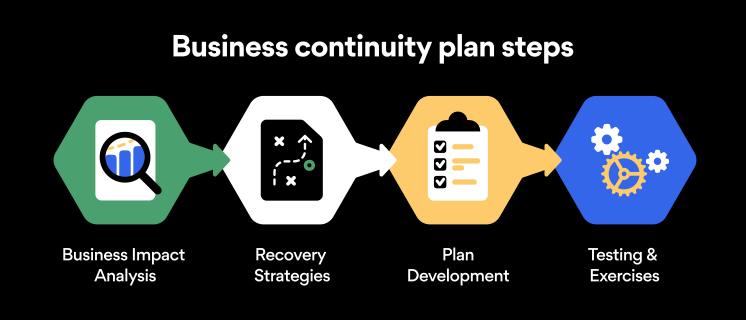
Here are some general guidelines that an organization looking to develop a BCP should consider:
Analysis
A business continuity plan should include an in-depth analysis of everything that could negatively affect the overall organizational infrastructure and operations. Assessing different levels of risk should also be a part of the analysis phase.
Design and development
Once you have a clear overview of potential risks your company could face, start developing a plan. Create a draft and reassess it to see if it takes into account even the smallest of details.
Implementation
Implement BCP within the organization by providing training sessions for the staff to get familiar with the plan. Getting everyone on the same page regarding crisis management is critical.
Testing
Rigorously test the plan. Play out a variety of scenarios in training sessions to learn the overall effectiveness of the continuity plan. By doing so, everyone on the team will be closely familiar with the business continuity plan’s guidelines.
Maintenance and updating
Because the threat landscape constantly changes and evolves, you should regularly reassess your BCP and take steps to update it. By making your continuity plan in tune with the times, you will be able to stay a step ahead of a crisis.
Level up your company’s security with NordPass Business
A comprehensive business continuity plan is vital for the entire organization’s security posture. However, in a perfect world, you wouldn’t have to use it. This is where NordPass Business can help.
Remember, weak, reused, or compromised passwords are often cited as one of the top contributing factors in data breaches. It’s not surprising, considering that an average user has around 100 passwords. Password fatigue is real and significantly affects how people treat their credentials. NordPass Business counters these issues.
With NordPass Business, your team will have a single secure place to store all work-related passwords, credit cards, and other sensitive information. Accessing all the data stored in NordPass is quick and easy, which allows your employees not to be distracted by the task of finding the correct passwords for the correct account.
In cyber incidents, NordPass Business ensures that company credentials remain secure at all times. Everything stored in the NordPass vault is secured with advanced encryption algorithms, which would take hundreds of years to brute force.
If you are interested in learning more about NordPass Business and how it can fortify corporate security, do not hesitate to book a demo with our representative.
