Skip to content

Passwordless Authentication: A Paradigm Shift in Security

Passwordless authentication appears to be the new belle of the ball amongst tech experts. Of course, the reasons all bother on the general challenges experienced by security companies and businesses.

The security and tech world continue to advance in scope and sphere – through developing efforts to improve existing structure. These changes are prompted by the ongoing surge in security breaches in which no industry is spared.

Security issues surrounding weak passwords serve as a driving factor for these breaches — and a nightmare for IT departments. As secure as some might believe them to be,, passwords remain the weakest link in today’s workplace security network. Stolen credentials are costly to resolve and come with many negative impacts.

As organizations rethink the future of the workspace, passwordless authentication seems to be a way out.

What is Passwordless Authentication?

Passwordless authentication is any method that eliminates the reliance on passwords to provide a a smoother user experience, stronger security posture, and reduced costs.

Passwordless authentication uses methods of identity proof to replace the use of passwords, passphrases, and other shared secrets. The replacements take OTPs as an alternate means. Authenticator apps, biometrics, hardware, and software tokens make up other forms.

Businesses encourage the adoption of passwordless authentication because it removes all vulnerabilities associated with secret-based passwords. But, there’s a constraint – the market is not fully ready for its adoption. Business enterprises struggle to cover the various use cases with a single solution.

Challenges of Password Authentication

Security Limitations

Passwordless authentication is not entirely foolproof, although it’s better than a password. Hackers can use malware to intercept one-time passwords. They also insert trojans into a browser to gain access.

Costs of Deployment

The implementation of passwordless authentication requires high costs. It comes with new software, hardware, trained employees, and more. Passwordless authentication also entails a change in management plans and projects.

The deployment also comes with hardware installations and the purchase of gadgets. In addition, the choice of software comes with hidden costs, software administration, maintenance, and migration.

Passwordless Authentication Methods

Biometric Authentication

It is a method that requires using biological characteristics such as facial features and fingerprints. This authentication method allows users to instantly log into their devices .

One-Time Passcodes (OTP)/PIN

The OTP is a method that puts the responsibility of generating dynamic codes on the service provider. As a result, it eliminates having to remember passwords or downloading apps.

Foremost in this category is the time-based one-time password (TOTP). The TOTP is a transient method and must be in sync with the time zone. It works with algorithms that generate passwords on a server and client whenever there’s system authentication. A major drawback is that a user may mistakenly tap multiple times to generate a token. When this happens, they have to restart the process.

Push Notifications Authentication

Push notifications work with an installed app on the user’s phone. The user receives a notification on a registered device containing the logins date, time, and location that allows them to accept or deny access.

Magic Links Login Authentication

Magic links require a user to enter an email address into the login box. An email is then sent with a link that requires clicking to log in. A user receives this magical link to ensure safety whenever there’s a login.

The Benefits of Passwordless Authentication

Reduced Costs

Password management and storage require a lot of resources. Resetting passwords and frequently changing password storage laws are also costly. Passwordless authentication helps to remove long-term costs.

Stronger Cybersecurity Posture

Passwords no longer provide a stalwart defense as many people repeat them multiple times.

Once a password gets breached, leaked, or stolen, it’s much easier for s hacker to gain access to your other applications. This allows malicious actors to then commit financial fraud or sell trade secrets to rival companies. Passwordless authentication takes care of these challenges by offering protection against the most prevalent cyberattacks.

Better User Experience and Greater Productivity

Users often have to generate and memorize multiple passwords, and because of this they sometimes forget them, forcing the task of then resetting them. For this reason, users use simple and uncomplicated passwords, Often using the same ones for numerous applications, with an addition of an extra character. The challenge here is that hackers find it easy to access these accounts.

Passwordless authentication eliminates these challenges, as users do not have to create or memorize their passwords. Instead, they only authenticate using emails, phones, or biometrics.

Scalability

Passwordless solutions work with technology and factors that end users already possess. Therefore, it becomes easier for mobile devices and laptops to infuse the various methods. Some passwordless authentication easily integrated includes biometrics and authenticator apps, Windows Hello, and fingerprints.

Top 10 Use Cases of Passwordless Authentication

Passwordless authentication can apply to a variety of use cases including:

  • Customer payments authentication
  • Remote logins
  • Logins for financial services
  • Call center authentication
  • Personal logins
  • Customer balance access
  • Record access
  • Mobile banking
  • Wire transfers
  • Push notifications

Changing the Security Paradigm: The Big Step

Businesses that integrate passwordless authentication have a strong concern for security. Organizations now realize that many security breaches result from the use of passwords. For them, the one-time cost of implementing passwordless authentication is more rewarding.

While it’s true that passwords are still quite common, the security risks are enough reason to make a switch. With the technology quickly gaining traction, there’s no better time to integrate passwordless authentication.

Indeed, passwordless authentication is the next digital breakthrough that offers key advantages over the traditional password including:

  • It helps to lower costs while also increasing revenue. Customers tend to gravitate towards such products and services that provide trust and security.
  • Providing a smooth user experience is preferrable to any customer.
  • The presence of the technology and its adoption is a vital element for trusted security.

Nonetheless, passwordless authentication remains in its early stages. While many businesses have yet to adopt the technology, there’s a strong sentiment that its adoption will help change the face of security in the near-term.

About Version 2 Digital

Version 2 Digital is one of the most dynamic IT companies in Asia. The company distributes a wide range of IT products across various areas including cyber security, cloud, data protection, end points, infrastructures, system monitoring, storage, networking, business productivity and communication products.

Through an extensive network of channels, point of sales, resellers, and partnership companies, Version 2 offers quality products and services which are highly acclaimed in the market. Its customers cover a wide spectrum which include Global 1000 enterprises, regional listed companies, different vertical industries, public utilities, Government, a vast number of successful SMEs, and consumers in various Asian cities.

About Portnox
Portnox provides simple-to-deploy, operate and maintain network access control, security and visibility solutions. Portnox software can be deployed on-premises, as a cloud-delivered service, or in hybrid mode. It is agentless and vendor-agnostic, allowing organizations to maximize their existing network and cybersecurity investments. Hundreds of enterprises around the world rely on Portnox for network visibility, cybersecurity policy enforcement and regulatory compliance. The company has been recognized for its innovations by Info Security Products Guide, Cyber Security Excellence Awards, IoT Innovator Awards, Computing Security Awards, Best of Interop ITX and Cyber Defense Magazine. Portnox has offices in the U.S., Europe and Asia. For information visit http://www.portnox.com, and follow us on Twitter and LinkedIn.。

A Summary of the Palo Alto Networks Ransomware Threat Report 2022: Key Points You Must Know

2021 has shattered economies of almost every sector with the pandemic wreaking havoc worldwide. On top of it, most industries have had to contend with malicious cyber activities, as ransomware threats are some of the most challenging cyber threats organizations worldwide have to deal with. Almost every industrial sphere, including government departments, the education sector, the retail sector, and manufacturing establishments, has felt the impact of ransomware at some point.

Unit 42, the threat research team of Palo Alto Networks, has compiled a comprehensive 2022 Ransomware Threat Report highlighting ransomware activity worldwide. The report can help organizations perceive the seriousness of the situation and take remedial steps to prevent becoming victims of such cyber attacks and therefore jeopardizing the confidentiality, integrity, and availability of valuable information assets.

Source of the Report

Unit 42 relied mainly on the following two sources while generating the report:

  1. Actual cases handled by the unit that provided a realistic view of the extensive range of threat actors.
  2. Analysis of leak sites that included malicious activities like multi-extortion to coerce or even threaten victims to pay the ransom.

Crucial Statistics from the Report

Before going into the detailed summary of the 2022 Ransomware Threat Report, here are some important statistics to better understand the scope of this matter.

  • The average ransom demand grew 144%, from $900K in 2020 to 2.2M in 2021.
  • Simultaneously, the average ransom payment grew to $541K, a 78% increase from 2020.
  • The US remains the most targeted country with 60% of ransomware cases in 2021, followed by the European, Middle lEast, and African (EMEA) countries with 31%. The Asia-Pacific region was in the third position with 9% of ransomware cases.
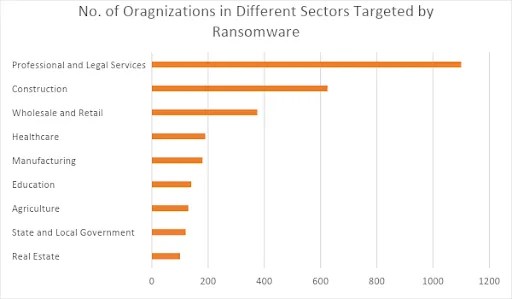
  • Professional and legal services were the most targeted sectors, with 1,100 victim organizations, followed by the construction sector, with nearly 600.

(Data Source: Palo Alto RansomwareThreat Report 2022)

Understanding Ransomware 

Ransomware is a specialized malware used to paralyze organizational functioning by encrypting its data to extort money. They usually demand ransom in cryptocurrency to prevent establishing a trail. When the ransom is received, , the malicious actors provide the decrypting code, allowing the organization to retrieve its information assets.

Usually, threat actors use social engineering tactics like phishing emails to introduce malware into the target’s information systems. This scheme relies on the victims clicking on the malicious links, and therefore accidentally downloading the ransomware into the information system. Once the malware is installed, it takes over the functioning and stops access to critical data by encrypting it.

Change in Tactics

Malicious actors employed more sophisticated tactics, such as the ones mentioned below, in 2021 compared to 2020, as they widened their scope of attacks.

  • Ransomware-as-a-Service: Malicious actors started offering RaaS packages to anyone interested in launching an attack. It lowered the technical barrier for non-experts to access information systems and thus enhanced the speed of cyberattacks.
  • Multi-Extortion: Besides asking for the regular ransom, malicious actors started blackmailing their victims, threatening to leak critical information and launching DDoS attacks to extort ransom quickly.
  • The Exploitation of Zero-Day Vulnerabilities: Threat actors started taking advantage of zero-day vulnerabilities such as Log4Shell to launch ransomware and continued to exploit organizations that failed to patch them properly.

The Overall Ransomware Landscape

Below are the critical emerging trends concerning the transformation of the overall ransomware landscape over the years, according to the Palo Alto Networks Report. It can help organizations formulate effective defense and incident-response strategies.

Ransomware Actors’ Psychology

Ransomware has evolved over the years. Here are some latest psychological traits observed among ransomware actors.

  • Exploit Shortcuts: Today, ransomware actors hire the services of brokers who provide access to information systems, as it saves them time and effort. It has increased the scope of attacks as non-expert attackers can easily drop malware into an already compromised environment.
  • Go to Extremes: They have started using anonymized services like TOR (The Onion Router) to make it challenging for law enforcement authorities to track their activities and identify the indicators of compromise (IoC).
  • Innovation: Ransomware groups now use updated ransomware variants instead of standalone malware. For example, HelloKitty uses Linux and BlackCat uses Rust to launch attacks quickly.

Ransomware Trends for 2022

Consequent to the innovative tactics used by ransomware actors, the trends for 2022 have changed considerably, as is evident below.

  • Increase in Victim Shaming: Ransomware actors have increasingly started using techniques like double-extortion to prevent organizations from restoring data from backup alternatives and resuming operations. Threat actors like Black Matter, Grief, and Hive used such tactics. BlackCat and Suncrypt even use triple extortion tactics like threatening to launch DDoS attacks besides leaking confidential and sensitive information. Over 2,500 victims were publicly shamed in 2021.
  • Increase in RaaS: Malicious actors have now started offering Ransomware-as-a-Service to anyone who wants to hire them. Thus, it has widened the scope for ransomware attacks as individuals with little knowledge of ransomware can launch cyberattacks. Nearly 56 RaaS groups have been identified, and the number is expected to grow in 2022.
  • Exploiting Zero-Day Vulnerabilities: Ransomware actors have increased, exploiting zero-day vulnerabilities as an initial compromise vector. Malicious operators used nearly 42 such instances in 2021. Unpatched vulnerabilities are serious, as observed in the Kaseya attacks by REvil. Organizations should take note and act accordingly to plug such gaping holes instantly.

The Emergence of Ransomware Gangs 

2021 was the year of ransomware gangs, and thirty-five have been identified recently. Trends show that some groups lie low for a while before resurfacing to launch more powerful attacks. Conti was the most active ransomware gang, responsible for 15.5% of ransomware activity. REvil was the second with 7.1%, followed by HelloKitty and two others, each with a 4.8% share of the attacks.

(Data Source: Palo Alto RansomwareThreat Report 2022)

Below passages will give a brief idea of the major gangs and their activities:

  • Conti: Conti was the most active ransomware gang in 2021, with an initial ransom demand of $50K. It rose substantially to an average of $1.78M for the year, with the highest ransom demanded at $3M. The gang has affected more than 600 organizations since 2020, including law enforcement agencies, construction projects, emergency services, and hospitals.
  • REvil: REvil, also known as Sodinokibi, had the highest activity in 2020. But it dropped down to second place in 2021. However, their average ransom has increased to approximately $2.2M, and their highest demand has been $5.4M. REvil is a major provider of RaaS.
  • BlackCat: BlackCat is another main RaaS provider notorious for observing and soliciting affiliates in cybercrime forums. It allows affiliates to retain 80% to 90% of the ransom while keeping only the remaining 10 to 20% to themselves. The group attacked various sectors, including construction, retail, insurance, transport, professional services, automotive establishments, and pharmaceuticals.
  • Other Ransomware Actors: Other big ransomware names include AvosLocker, Hive, HelloKitty, LockBit 2.0, Mespinoza, and eChOraix.

Initial Ransom Amount Vs. Payment Amount

Generally, there is a difference between the initial ransom amount demanded and the payment amount due to various negotiations between the attackers and the victims. In one instance, BlackCat demanded a payment of $9M and even received $8.5M. On average, the ransom payout in 2021 was around 42.87% of the initial ransom demand.

(Data Source: Palo Alto RansomwareThreat Report 2022)

Multi-Extortion Techniques

Earlier, ransomware actors used to launch their attacks and send the ransom note to the victim. Once the victim pays the ransom, the attackers provide the decryption key enabling the target to access its data and resume its operations. However, this method had its shortcomings. The ransomware attacks do not exfiltrate data but only encrypt them. So, organizations having a separate backup could always restore the data and avoid paying the ransom.

Now, the ransomware actors have upgraded their modus operandi by exfiltrating data and threatening the victim about releasing it in the public domain, which could lead to massive data breaches and loss of reputation. Thus, there is a double extortion demand. One is the regular ransom for obtaining the decryption key, and the other is for the attackers’ refraining from exposing the data to the public. Such a scenario is known as double extortion. Maze popularized this method in 2019.

As mentioned earlier, Suncrypt and BlackCat threatened the victims to launch DDoS attacks on their organizations’ infrastructures if the ransom negotiation failed. Besides, they threatened to leak critical information on the dark web and taint their reputation. This type of extortion is known as triple extortion.

Critical Insights from Ransomware Leak Sites

Conti and LockBit 2.0 were the two most significant ransomware gangs to indulge in leaking critical information and leveraging double-extortion threats. Compared to 2020, there is an 85% increase in public postings involving 2,566 victims. Conti accounted for 511 postings, and LockBit, for 406.

Most Targeted Sectors

Ransomware actors did not spare any sector in 2021. The most targeted sector was the Professional and Legal Services industry, followed by the Construction industry. One reason is that many organizations in these sectors do not run on up-to-date software, becoming more prone to cyberattacks.

Besides, the malicious actors know that these industries lose their reputation quickly if their information systems are compromised, as they often provide services using their dedicated software. These sectors also work on tight deadlines, increasing the chances of paying the ransom amounts.

(Data Source: Palo Alto RansomwareThreat Report 2022)

Rebranding of Ransomware Gangs

Many ransomware gangs vanished from the scene following failures due to flaws in their ransomware. Many resurfaced later as new brands with more sophisticated technology. Attacker groups also lie low due to pressure from law enforcement agencies, internal struggles, and peer competition.

Ransomware in the Cloud

Today, organizations increasingly store their data and function in a cloud environment. However, the dynamic workloads in a multi-cloud environment can be challenging. Though there were no major instances of ransomware attacks on the cloud, it is only a matter of time, considering the valuable information assets stored there. The example of Log4j vulnerability highlights the need to secure the cloud environment and maintain a robust vulnerability management program.

Trends show that ransomware actors use cloud APIs to access and encrypt crucial information assets. Therefore, organizations should strengthen these aspects and use strict IAM (Identity and Access Management) practices to secure access to these APIs.

Ransomware Costs

Besides the financial loss of paying the ransom, the affected organizations suffer from other collateral damage, such as downtime, disruptions, reputational loss, time loss in recovery, legal expenses, and loss of information assets. The Palo Alto report states that 58% of organizations preferred paying the ransom, whereas 14% spent money more than once.

Recovery Time

Studies show that 41% of organizations recovered within one month of the ransomware attack, whereas 20% of victims recovered within three months. And while 29% took more than three months, 9% even took more than five to six months for recovery.

(Data Source: Palo Alto RansomwareThreat Report 2022)

Recommendations to Remain Resilient to Ransomware Attacks

Finally, Unit 42 recommends the following actions for organizations to stay more resilient to ransomware attacks.

  • Keep your information systems updated to take care of the evolving threat landscape.
  • Evaluate and analyze the impact of compromising your information assets.
  • Assess your readiness levels and have a clear incident response plan.
  • Implement and follow a Zero Trust policy.
  • Identify your exposed information assets.
  • Protect your systems from known and unknown threats.
  • Automate your systems and use secure cloud workloads.
  • Use IR retainers (contracts with incident response experts) to reduce response time.

Final Words

Ransomware has gradually become one of the worst cybersecurity threats in recent times. The situation can worsen in the forthcoming years, especially with more organizations working online. However, one can take remedial measures and enhance vigilance to prevent becoming a victim of a ransomware attack. The 2022 Ransomware Threat Report from Palo Alto Networks provides comprehensive information on ransomware trends and highlights the significance of treating this cyber threat with utmost seriousness.

Today, ransomware actors don’t just target bigger organizations, but everyone, including small businesses and even individuals, is on their radar. Thus, one needs to have adequate preventive measures to ensure threat actors cannot get their hands on the organization’s information assets in the first place. Besides, there must be a business recovery and continuity plan in place for the worst-case scenario when ransomware actors are able to infiltrate the information systems.

References

  1. Minutes, 10. (2021, December 12). Update: Prisma Cloud addresses Log4Shell: CVE-2021-44228, CVE-2021-45046 mitigations. Palo Alto Networks Blog. https://www.paloaltonetworks.com/blog/prisma-cloud/log-4-shell-vulnerability/
  2. Santos, D. (2022, June 3). Understanding REvil: REvil threat actors may have returned (updated). Unit 42. https://unit42.paloaltonetworks.com/revil-threat-actors/
  3. (N.d.). Paloaltonetworks.com. Retrieved August 6, 2022, from https://www.paloaltonetworks.com/content/dam/pan/en_US/assets/pdf/reports/2022-unit42-ransomware-threat-report-final.pdf

#ransomware #unit42 #threat #cybersecurity

About Version 2 Digital

Version 2 Digital is one of the most dynamic IT companies in Asia. The company distributes a wide range of IT products across various areas including cyber security, cloud, data protection, end points, infrastructures, system monitoring, storage, networking, business productivity and communication products.

Through an extensive network of channels, point of sales, resellers, and partnership companies, Version 2 offers quality products and services which are highly acclaimed in the market. Its customers cover a wide spectrum which include Global 1000 enterprises, regional listed companies, different vertical industries, public utilities, Government, a vast number of successful SMEs, and consumers in various Asian cities.

About VRX
VRX is a consolidated vulnerability management platform that protects assets in real time. Its rich, integrated features efficiently pinpoint and remediate the largest risks to your cyber infrastructure. Resolve the most pressing threats with efficient automation features and precise contextual analysis.

LockBit Ransomware Targets OT


LockBit Overview

The first known ransomware attacks using what would come to be known as LockBit were reported back in 2019. Organizations that were infected with the malicious software had their files encrypted and in order to decrypt them they were forced to pay a large sum for a decryption key. 2021 saw the emergence of LockBit 2.0, featuring a faster encryption software. In one of the most widely reported ransomware attacks of 2021, LockBit attacked the consulting group Accenture and claimed to have stolen six terabytes of data.

Continue reading

Common SD-WAN Challenges & How to Avoid Them

A Software-Defined Wide Area Network (SD-WAN) enables organizations to rely on a combination of transport services. The increasing use of SD-WAN for connecting enterprise networks improves productivity, reduces cost, and increases application performance.  

It is a feature-packed technology that centralizes security, management, networking, and more. Consequently, organizations with cloud solutions view SD-WAN as an infrastructure upgrade to operations. 

Wrong Approaches

A frequent occurrence with businesses is the focus on individual technical elements. Unfortunately, many such enterprises fail to realize  the need to address end-to-end solutions. 

Selection should encompass all available approaches with the choice that best suits the company’s needs, budget, and savviness. Another aspect to  consider is the fact that IT teams often fixate on price. Unfortunately, most of them misinterpret prices, opting for cheaper options resulting in  poor network performance .  

Such 0rganizations often soon encounter issues with high latency, prolonged downtimes, less supportive service-level agreements, and more. As enticing as cost savings can appear, ensure it never poses serious risk to your network connectivity or SD-WAN designs. 

Responding to this Challenge:

  • Ensure that all choices and approaches produce maximum results for the company’s network. 
  • Consider platforms with built-in cloud and security vendor access for appliances. 
  • Ensure to prioritize necessary performance features over novel ones. 
  • Technology evolves at a rapid pace, so plan accordingly with future long-term growth in mind.

Overlooking the Quality of Service (QoS) Concept for SD-WAN

One attribute that should never get overlooked is the QoS. An equally important aspect is the quality of experience. However, SD-WAN service providers never seem to offer end-to-end prioritization. Although it provides an efficient traffic segmentation and path selection, traffic movement often gets delayed. Therefore, seeking an SD-WAN approach with ‘fail safe’ technology features is crucial. 

These options must offer superior performance to MPLS across all applications. MPLS itself comes with end-to-end QoS via six settings for service-level categories, though also with delayed traffic movement.  

Responding to this Challenge:

  • Never compromise on the quality of service and quality of experience with network connectivity.  
  • Be sure to purchase local site-by-site internet underlay with low-cost service that provides high QoS and QoE along with various available features.Consult with experts to get the best-customized recommendations. 

SD-WAN Security Requirements

Some SD-WAN technology lacks security capabilities. Unfortunately, these security lapses often open the door to cyber threats. 

 For instance, there’s usually an edge security change with SD-WAN features such as virtual private network (VPN) deployment. In other scenarios, data get transferred with every migration to cloud solutions. Therefore, deploying hardware and virtualized instances with accessed security policies still comes with risks. 

 Responding to this Challenge 

  • Organizations should take time to research all vendor claims and ensure all security functions meet  company criteria. 
  • Strategize the integration of cyber security and networking solutions instead of separating the two. 
  • Make it a habit to add new layers of security systems where and when necessary. 
  • Try integrating existing security with SD-WAN solutions. 

SD-WAN Management Issues

Today’s SD-WAN solutions help to blur the lines between DIY and the type of management structure in place. Organizations never get to pick the management level traditionally. One of the drawbacks of the SD-WAN model is that it breaks most businesses’ existing centralized security inspections.  

Organizations often build hub network architectures designed around the consolidation of data streams. The idea is to backhaul traffic through a centralized channel into data centers. Firewalls are used to create  single security inspection points  so that packets get examined before making it into the data center. The presence of an SD-WAN architecture makes this method ineffective. 

By default, SD-WAN solutions lack integrated security that allows routing all traffic through a full security stack for inspection. There’s also the task of threat prevention before proceeding to its destination. 

 With SD-WAN,  lots of traffic moves outside the data center perimeter. As such, connections to the cloud from external sources like remote workers never go through the traditional inspection process. 

The outcome for organizations is a forced decision. They have the choice of forgoing the benefits of SD-WAN by backhauling traffic to the data center for inspection, or simply not securing traffic on the WAN at all. 

Responding to this Challenge:

  • Give the required training to the IT team and staff members  
  • Get dedicated staff that can oversee the end-to-end SD-WAN implementation 
  • Infuse post-implementation monitoring and management into the company’s activity. 

Cloud Connectivity Requirements

When it comes to selecting SD-WAN projects, vendors and the IT team require cloud connectivity to either AWS, Google, or Microsoft Azure. Therefore, SD-WAN vendors typically belong to one of three categories based on their cloud access capabilities. 

  • Native Cloud Access: This category includes built-in access to the vendor’s SD-WAN architecture . It involves using the cloud’s backbone infrastructure for connecting to branch office sites. For vendors that adopt the cloud as a global backbone, this is an everyday occurrence. However, this option is better for connecting to  local cloud data centers since the deployment of cloud gateway architecture is a unique system. 
  • Vendor Access Provision: This category entails vendors delivering SD-WAN appliances to a cloud environment through public gateways or private backbones. Such an option comes with more flexibility regarding  vendor features. Public gateways and private backbones route traffic more efficiently than the Internet. 
  •  Customer Access Provision: Here the customer is responsible for deploying the appliances in the local cloud-based data center with this option. This option offers cloud access in a more ad hoc and  simplified architecture. 

Responding to this Challenge:

  • Normalize analyzing deployment needs and internal application performance. 
  • After implementation, monitor application performance. It ensures that the business takes timely actions and prevents any form of disruption. 
  • It’s crucial to decide the bandwidth requirements and latency policies in a multi-cloud environment. An excellent way to achieve this is by evaluating service dependency on several micro-service segments.

These shortcomings aside, SD-WAN offers numerous benefits for organizations  looking to optimize and transform their corporate networks.

About Version 2 Digital

Version 2 Digital is one of the most dynamic IT companies in Asia. The company distributes a wide range of IT products across various areas including cyber security, cloud, data protection, end points, infrastructures, system monitoring, storage, networking, business productivity and communication products.

Through an extensive network of channels, point of sales, resellers, and partnership companies, Version 2 offers quality products and services which are highly acclaimed in the market. Its customers cover a wide spectrum which include Global 1000 enterprises, regional listed companies, different vertical industries, public utilities, Government, a vast number of successful SMEs, and consumers in various Asian cities.

About Portnox
Portnox provides simple-to-deploy, operate and maintain network access control, security and visibility solutions. Portnox software can be deployed on-premises, as a cloud-delivered service, or in hybrid mode. It is agentless and vendor-agnostic, allowing organizations to maximize their existing network and cybersecurity investments. Hundreds of enterprises around the world rely on Portnox for network visibility, cybersecurity policy enforcement and regulatory compliance. The company has been recognized for its innovations by Info Security Products Guide, Cyber Security Excellence Awards, IoT Innovator Awards, Computing Security Awards, Best of Interop ITX and Cyber Defense Magazine. Portnox has offices in the U.S., Europe and Asia. For information visit http://www.portnox.com, and follow us on Twitter and LinkedIn.。

Windows Registry Forensics – pt. 3

Intro


Continuing where I left off, I will look at some more tools you can use to look at the Registry of your Windows host, as well as some useful keys.


Tooling


I am sure there are many tools out there, created specifically for this purpose, and please feel free to search for them. I will cover the ones that I’ve used or know.

From previous parts, you know that the Registry Editor works only with live systems and can’t load exported hives, so keep that in the back of your mind.

When you need that offline functionality, you can use some of the following tools.


Zimmerman’s Registry Explorer


The author of this tool has created a bunch of tools that can be extremely handy for performing Digital Forensics. (Check out the stuff here)

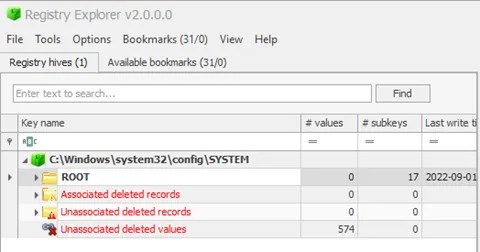
One of those tools is his Registry Explorer. Registry Explorer has the ability to load multiple hives at the same time, while it can also use/add data from the transaction logs into the hive, enriching it with more accurate data. It also has the Bookmarks functionality which will contain forensically valuable keys. You can use the bookmarks to immediately pull up some interesting keys and/or values.

Above, I just loaded one hive (SYSTEM) from my live system, and I already have 31 recommendations (bookmarks) from Registry Explorer. As a very simple demo, when I switch over to that tab, I can immediately glean some interesting information. For example, I can immediately pick up the hostname of the device.

I filtered out the bookmarks here, showing only the Device Name. As you can see, you even have a small window below with the category, name, path, and description of the key.

On the righthand side of this view, I can see my hostname.

Under Data, I can see the name of my device – 4w.

I will circle back to the Registry Explorer, but let me briefly introduce another tool, for the sake of your awareness.


RegRipper


A useful utility that can take the have as input and spit out a report which will try to extract data from (forensically) important keys/values within that specific hive. However, note that RegRipper doesn’t take transaction logs into consideration, which is also stated it in the repo’s readme file:

This tool does NOT automatically process hive transaction logs. If you need to incorporate data from hive transaction logs into your analysis, consider merging the data via Maxim Suhanov’s yarp + registryFlush.py, or via Eric Zimmerman’s rla.exe which is included in Eric’s Registry Explorer/RECmd.

Luckily, you can use the Registry Explorer for this.


SYSTEM – Registry Explorer

As you can see, Registry Explorer will even give you the ControlSet – Control Set is basically the hive that keeps the device configuration data that’s used for the control of the system startup.

From the image above, Registry Explorer apparently has some knowledge about the USB devices I’ve been plugging in these days…

Let’s check it out.

The first USB device on the list is an external DVD/Optical drive that I plugged in to transfer some stuff from a CD. (don’t @ me please, they still have some uses 😊)

And, as you can see, I’ve also plugged in four different USB devices, two of them being Kingston made flash drives. All with the timestamps, etc. (I really did this, as I was transferring/cleaning up some old stuff.)

All this goes to show how simple and useful the Bookmarks option that Registry Explorer has can be.


Specific Registry Keys


Here, I’d like to mention some specific keys/values that might be of interest to you. This can pertain to system, recently used apps, or even a user. That doesn’t matter.


OS Version


For the OS version, I just view the SOFTWARE\Microsoft\Windows NT\CurrentVersion key.

From Registry Explorer, one could ascertain that the device I’m doing this demo from is running Windows 11 Pro.

Current Control Set


As I mentioned before, this hive will have the device config data that is used for the control of the system startup. There are (usually) two sets – ControlSet001 and ControlSet002, within the SYSTEM hive.

Generally, ControlSet001 points to the Control Set your device used to boot. ControlSet002 will be what’s known as last known good config.

They can be found at SYSTEM\ControlSet001 and SYSTEM\ControlSet002.

Do note that there’s also a volatile Control Set, created by Windows, when the device is live, and it’s called CurrentControlSet – location: HKLM\SYSTEM\CurrentControlSet.

This is an important hive, and the one you will probably end up referring to for the most part of your investigation.

In the screenshot above I checked the SYSTEM\Select and within I’ve found the last known good entry which tells me that the ControlSet001 holds the last known good config.

SYSTEM\Select\LastKnownGood – key that will hold the last known good config, regarding the Control Sets.


Computer Name


This one is always important during the investigation, and you will look it up by checking the

SYSTEM\CurrentControlSet\Control\ComputerName\ComputerName

From Registry Explorer. On the righthand side of the app, you’ll see the keys and their values/data.

Timezone Information


This one is usually used to figure out the time zone of the device i.e., where it is located. It can help you figure out that timeline of events, which is of great importance to you – the investigator!

You would want to start here:

SYSTEM\CurrentControlSet\Control\TimeZoneInformation


Devices


This is all about tracking the USB devices that were plugged into the system. It will usually contain the vendor id, version of the USB device, and product id. This is cool as it can help you to identify devices themselves. These locations will also store timestamps for the devices that were plugged in.

 
SYSTEM\CurrentControlSet\Enum\USBSTOR
SYSTEM\CurrentControlSet\Enum\USB


(I already added this screenshot above, where I mentioned the USB I recently plugged in)

It’s also important to know when this USB was plugged in for the first and last time, and you can find that out by checking the

SYSTEM\<CurrentControlSet>\Enum\USBSTOR\<vendor_prod_version>\<serial>\Properties\<some_GUID>\<value>

The values you are interested in are – 0064, 0066, and 0067. 64 is the first connection time, 66 last connection time, and 67 the last removal time.


It would look something like this:

And, on the right hand side, I can see the timestamp associated with my Kingston USB that I’ve used.

For 0067 – when I removed the USB device:

It was on 28th of August, at 17:05. (Which I know is true)

Note that Registry Explorer already parses this data, and you can get it if you select the USBSTOR key.


USB Name


The name of the plugged in USB can be found here:


SOFTWARE\Microsoft\Windows Portable Devices\Devices

Under data, an investigator would figure out that the USB I used to be named – GADFLY.


Conclusion


And there you have it! More registry stuff. I’ve been focusing a bit more on the tooling, as it can really save you a lot of time and trouble. But, I will (sometime in the near future) also make a ‘compilation’ of sorts, regarding more of these interesting keys. Even though I covered some here, there’s a lot more stuff that will be of interest to an investigator.

Stay tuned!

Cover image by Immo Wegmann

#registry_forensics #windows #registry_explorer #regripper

About Version 2 Digital

Version 2 Digital is one of the most dynamic IT companies in Asia. The company distributes a wide range of IT products across various areas including cyber security, cloud, data protection, end points, infrastructures, system monitoring, storage, networking, business productivity and communication products.

Through an extensive network of channels, point of sales, resellers, and partnership companies, Version 2 offers quality products and services which are highly acclaimed in the market. Its customers cover a wide spectrum which include Global 1000 enterprises, regional listed companies, different vertical industries, public utilities, Government, a vast number of successful SMEs, and consumers in various Asian cities.

About VRX
VRX is a consolidated vulnerability management platform that protects assets in real time. Its rich, integrated features efficiently pinpoint and remediate the largest risks to your cyber infrastructure. Resolve the most pressing threats with efficient automation features and precise contextual analysis.

×

Hello!

Click one of our contacts below to chat on WhatsApp

×