Skip to content

Why NAC is Critical to Stopping APT Attacks

The rise of Advanced Persistent Threat (APT) attacks has become a significant concern for organizations across the globe. These highly sophisticated and targeted cyber threats can persist undetected within a network for extended periods, posing severe risks to sensitive data, intellectual property, and overall organizational security. To counter the growing threat of APT attacks, organizations must adopt comprehensive cybersecurity measures, and one essential component in this defense arsenal is Network Access Control (NAC). In this article, we will delve into the critical role that NAC plays in thwarting APT attacks and why its implementation is indispensable for modern cybersecurity strategies.

Understanding Advanced Persistent Threats (APTs)

Before delving into the role of NAC, it’s crucial to understand the nature of APT attacks. Unlike traditional cyber threats, APTs are highly targeted, well-funded, and persistent. These attackers aim to infiltrate a network covertly, remaining undetected for extended periods to extract sensitive information or launch more damaging attacks. APTs often involve multiple stages, including reconnaissance, initial compromise, privilege escalation, lateral movement, and data exfiltration.

Common Characteristics of APT Attacks

  • Stealth and Persistence: APT attackers employ sophisticated techniques to avoid detection and maintain a persistent presence within the compromised network. They may use advanced malware, rootkits, and other evasion tactics to bypass traditional security measures.
  • Targeted Approach: APTs are specifically tailored for a particular target, often with the goal of gaining access to sensitive information, intellectual property, or valuable assets. This targeted nature makes them more challenging to detect using generic security solutions.
  • Advanced Techniques: APT attackers leverage advanced techniques, such as zero-day exploits and advanced social engineering, to exploit vulnerabilities in systems and gain unauthorized access.
  • Lateral Movement: Once inside a network, APT attackers move laterally, escalating privileges and compromising additional systems. This allows them to navigate through the network and access valuable resources.

The Role of NAC in APT Mitigation

Network Access Control (NAC) is a crucial component of cybersecurity that focuses on controlling and managing access to a network based on the identity and security posture of devices seeking to connect. By enforcing policies at the entry points of a network, NAC helps organizations prevent unauthorized access and ensures that only compliant and secure devices are allowed onto the network. Here are key reasons why NAC is critical to stopping APT attacks:

  • Device Visibility and Authentication: NAC provides organizations with comprehensive visibility into the devices connected to their networks. Through device profiling and authentication mechanisms, NAC ensures that only authorized devices with valid credentials can access the network. This is particularly crucial in the context of APT attacks, where unauthorized or compromised devices may attempt to gain entry.
  • Endpoint Security Posture Assessment: APT attackers often exploit vulnerabilities in endpoint devices as an entry point into the network. NAC solutions assess the security posture of devices before granting access, checking for updated antivirus software, security patches, and adherence to security policies. By ensuring that endpoints meet predefined security standards, NAC acts as a frontline defense against APTs attempting to exploit vulnerabilities.
  • Dynamic Policy Enforcement: NAC allows organizations to define and enforce dynamic access policies based on various factors, including user roles, device types, and location. In the context of APT attacks, dynamic policy enforcement becomes crucial in responding to evolving threats. For example, if a device’s security posture changes or if suspicious behavior is detected, NAC can dynamically adjust access permissions or isolate the device from the network.
  • b In the event that a device is identified as compromised or potentially malicious, NAC can isolate it from the network to prevent further lateral movement. This containment capability is vital in stopping APTs from spreading across the network and limiting the potential damage caused by the attack.
  • Continuous Monitoring and Threat Detection: APTs thrive on remaining undetected for extended periods. NAC complements traditional security measures by continuously monitoring devices on the network and detecting anomalous behavior that may indicate a potential APT attack. By integrating with threat intelligence feeds and security information and event management (SIEM) systems, NAC enhances the organization’s ability to identify and respond to APTs in real-time.
  • Compliance and Auditing: Many industries have regulatory requirements that mandate specific security standards and controls. NAC helps organizations demonstrate compliance by ensuring that devices adhere to these standards before gaining network access. Regular audits and reporting provided by NAC solutions contribute to a proactive cybersecurity posture, reducing the risk of APT attacks.
  • Integration with Other Security Solutions: NAC does not operate in isolation; it integrates seamlessly with other cybersecurity solutions, such as firewalls, intrusion detection/prevention systems, and endpoint security solutions. This collaborative approach enhances the overall security posture and increases the likelihood of detecting and mitigating APT attacks.
  • Adaptive Response to Threats: APTs are known for their adaptive nature, evolving to bypass traditional security measures. NAC, with its adaptive response capabilities, ensures that the organization can keep pace with the changing threat landscape. This adaptability is essential for addressing the persistent and evolving nature of APT attacks.

Case Studies: Real-World Impact of NAC in APT Mitigation

Mandiant’s APT1 Report

In 2013, cybersecurity firm Mandiant released a groundbreaking report on APT1, a Chinese cyber espionage group. The report highlighted how APT1 had successfully infiltrated numerous organizations over several years. In several cases, Mandiant identified the use of NAC as a critical factor in detecting and mitigating APT1’s activities. NAC solutions played a pivotal role in limiting the lateral movement of APT1 within compromised networks.

Sony Pictures Entertainment Breach

The 2014 Sony Pictures Entertainment breach, attributed to North Korean hackers, demonstrated the devastating impact of APT attacks. In the aftermath of the breach, it was revealed that the attackers gained access to the network by exploiting weak credentials and using destructive malware. NAC, if properly implemented, could have prevented unauthorized access by enforcing strong authentication policies and identifying suspicious behavior.

Implementation Challenges and Best Practices

While the benefits of NAC in APT mitigation are evident, organizations may face challenges during implementation. Here are some common challenges and best practices to address them:

  • Integration Complexity: NAC implementation often involves integration with existing infrastructure, which can be complex. To address this, organizations should carefully plan the deployment, ensuring compatibility with existing security solutions and minimizing disruption to normal operations.
  • User Education and Awareness: Users play a crucial role in the effectiveness of NAC. Organizations should invest in user education and awareness programs to ensure that employees understand the importance of adhering to security policies and the role they play in preventing APT attacks.
  • Scalability: As organizations grow, the number of devices and users on the network increases. Scalability is a critical consideration in NAC implementation. Choosing a scalable solution that can handle the expanding network infrastructure is essential for long-term success.
  • Continuous Monitoring and Updates: APTs are dynamic, and their tactics evolve over time. Continuous monitoring and regular updates to NAC policies are essential to adapt to emerging threats. Organizations should establish a process for reviewing and updating policies based on the latest threat intelligence.
  • Collaboration with Threat Intelligence: NAC is more effective when integrated with threat intelligence feeds. Organizations should establish collaboration with threat intelligence providers to receive timely updates on emerging threats, allowing NAC solutions to proactively respond to new APT tactics and techniques.

Conclusion

In the face of the escalating threat posed by Advanced Persistent Threats (APTs), organizations must adopt a multi-layered cybersecurity approach that includes advanced technologies and robust policies. Network Access Control (NAC) emerges as a critical component in this defense strategy, offering unparalleled visibility, dynamic policy enforcement, and adaptive response capabilities. By implementing NAC, organizations can significantly enhance their ability to detect, prevent, and mitigate APT attacks, safeguarding sensitive data and preserving the integrity of their networks. As APTs continue to evolve, NAC remains a cornerstone in the ongoing battle to secure the digital landscape against persistent and sophisticated cyber threats.

About Version 2 Digital

Version 2 Digital is one of the most dynamic IT companies in Asia. The company distributes a wide range of IT products across various areas including cyber security, cloud, data protection, end points, infrastructures, system monitoring, storage, networking, business productivity and communication products.

Through an extensive network of channels, point of sales, resellers, and partnership companies, Version 2 offers quality products and services which are highly acclaimed in the market. Its customers cover a wide spectrum which include Global 1000 enterprises, regional listed companies, different vertical industries, public utilities, Government, a vast number of successful SMEs, and consumers in various Asian cities.

About Portnox
Portnox provides simple-to-deploy, operate and maintain network access control, security and visibility solutions. Portnox software can be deployed on-premises, as a cloud-delivered service, or in hybrid mode. It is agentless and vendor-agnostic, allowing organizations to maximize their existing network and cybersecurity investments. Hundreds of enterprises around the world rely on Portnox for network visibility, cybersecurity policy enforcement and regulatory compliance. The company has been recognized for its innovations by Info Security Products Guide, Cyber Security Excellence Awards, IoT Innovator Awards, Computing Security Awards, Best of Interop ITX and Cyber Defense Magazine. Portnox has offices in the U.S., Europe and Asia. For information visit http://www.portnox.com, and follow us on Twitter and LinkedIn.。

Notifications Telegram: Pandora FMS

Content:

For environments where you have the need to know immediately if any issues arise, such as production environments, security or critical resources of your company, this Pandora FMS integration with Telegram is absolutely perfect, as it is the answer to that required immediacy, as well as the possibility of offering exact information about the location and cause of the problem, thanks to the powerful Pandora FMS system of alerts and macros.

Likewise, being a messaging service based on telephone communications through the data network, it guarantees your technicians, managers and on-call operators that they will find out aboutany problem at the exact moment it appears, without the need to access a computer or manually check their email.

Thanks to the plugins of your library and the flexible alert system offered by Pandora FMS, we will show you how to configure your monitoring tool to send instant messages whenever a problem is detected.

First of all, you must start from the necessary environment, whose requirements are:

  • Pandora FMS environment running on Linux, in this case we will use Rocky Linux 8, the distribution recommended by the manufacturer.
  • Our library plugin: Telegram bot CLI.
  • Telegram account available to be used as a broadcaster for alert messages.

Bot creation

First of all, create the Telegram bot that will be in charge of sending messages. From the Telegram account you wish to use, you will have to interact with the user BotFather using the “/start”command:

Then use the comman “/newbot” to create your bot.

It will ask you for the name you wish your bot to have. Here specify the name you wish for your bot. It is important for the name to end with “bot”, for example Pandora_FMS_telegram_bot.

By sending you the name, if it is not in use, it will confirm that the bot was properly created, with a link to your chat and give you a Token that is important for you to save to set up the alert later.

Group Setup

Now enter the bot that you just created in an existing group you may have or a new one that you create, to receive your alerts.

The next step is to add another bot called GetIDs Bot to the same group in order to get the group identifier. By adding it, it will leave you a message with the ID of your group, and you should also take note of that for later.

With all of this you will already have your Telegram ready to receive alerts.

Integration with Pandora FMS (versions 773 and earlier)

First you should start by downloading our plugin Telegram bot CLI.

It will download a zip file called telegram-bot-cli.zip, which you should decompress.
Inside, you will find a file called “pandora-telegram-cli.py” which must be added to your Pandora FMS server in the path “/usr/share/pandora_server/util/plugin”.

Now, from the terminal of your server, install the Python3 dependencies (if you do not already have them) by means of the command “dnf install python3”:

Once installed, run the plugin to verify that it is running, through the command “python /usr/share/pandora_server/util/plugin/pandora-telegram-cli.py”:

We will now move on to Pandora FMS server console.
Go to the “Management > Alerts > Commands” section and click “Create”:

And set up your alert command as follows:

On command, type in the following:

python3
/usr/share/pandora_server/util/plugin/pandora-telegram-cli.py -t _field1_ -c _field2_ -m “_field3_”

The command that we will use is for executing the plugin that you downloaded, with the arguments -t, -c and -m. It is important for the argument -m to be enclosed in quotation marks “”.

  • In the field of argument -t, Bot Token, enter the token of your bot.
  • In the field of argument -c, Chat ID, enter the ID of the group that bot “GetIDs Bot” provided you with.
  • And in the -m field, Alert Message, enter the alert message that you want your bot to send to the group. You may use all the alert macros you need, some examples are:
    • _module_: Name of the module that triggered the alert.
    • _agentalias_: Alias of the agent that triggered the alert.
    • _modulestatus_: Status of the module when the alert was triggered.
    • _agentstatus_: Status of the agent when the alert was triggered.
    • _data_: Data of the module that triggered the alert.
    • _timestamp_: Time and date the alert was triggered.

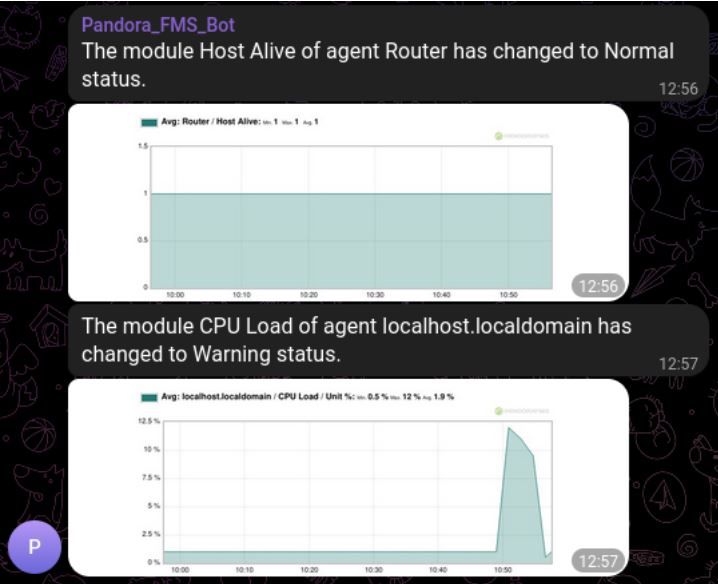
For example, you could use this message (which we will enter in field3): “The module _module_ of agent _agentalias_ has changed to _modulestatus_ status”

.

Once all this is filled in, click “Create”.

Now access the “Management > Alerts > Actions” section of your Pandora FMS console and click “Create” to create your action.

Enter the name you want your action to have, select the group, the alert command that you created previously and choose a Threshold. All the fields will be filled in automatically and click “Create”:

Now access the “Management > Alerts > List of Alerts” section and configure the alert for the Agent and Module you want.

In this case select that when the “Host Alive” Module of the “Router” agent goes into critical state, your previously created “Telegram Message” action will be executed:

If your module goes into critical state, you will receive this message to your Telegram group:

When your alert recovers you will receive a message like this:

Integration with Pandora FMS (versions 774 and later)

In version v7.0NG.774, the Telegram plugin of your library has been added by default to Pandora FMS alert, with a standard basic configuration.

If you access the Management > Alerts > Commands section, you will have a command called “Pandora Telegram”:

When accessing it, you will see that the command that will execute your alert is already configured.
Fill the -t “TOKEN” parameter of the command with the token given to you by BotFather and save the command:

After this, access the Management > Alerts > Actions section and access Pandora Telegram action.
At the bottom, add the Chat ID of your group that gave you the bot “GetIDs Bot” In the Triggering and Recovery sections, you may modify the message to your liking using the alert macro as you saw previously, and click “Update”:

Once saved, enter the Alert List menu from Management > Alerts > List of Alerts and create a new alert.
Select the agent and module, the action you updated “Pandora Telegram”, the template you want and create the alert:

Once your alert is triggered, you will receive your message by Telegram:

Sending alerts with data graphs

In our integration of Pandora FMS alerts and Telegram, you may add to the message a graph with the latest data of the module that triggered the alert, this applies both for version 773 and earlier and for 774 and later. You will be able to send graphs in your alerts by adding a call to the API of your Pandora FMS server to the script you used previously.

The first step that you must configure on your server is access to Pandora FMS API in the “Setup > Setup > General Setup” section, in the “API password” field you will have the API password and in the “IP list with API access” enter the IPs that need access or you may provide access to any IP (*).

Now edit the command that you had previously created to add the necessary data to send the graph. You need to add the following parameters:

  • –api_conf: Here indicate the configuration parameters of the API of your server, it is important to fill in the fields ” < >“:
    “user=,pass=,api_pass=,api_url=http:///pandora_console/include/api.php”.
    Example: “user=admin,pass=pandora,api_pass=1234,api_url=http://10.0.5.100/pandora_console/include/api.php”
  • –module_graph: Parameters of the module from which you will retrieve the graph, in this case there is two of them:
    • module_id: Where the ID of the module that triggered the alert is entered. In this case use the alert macro_id_module_ so that it is always filled in with the module ID of the alert.
    • interval: Total time interval shown in the graph, in seconds. We will use 3600 seconds by default, the equivalent of 60 minutes or 1 hour but you may configure the interval that best suits you.

The resulting full command will be as follows:

Command:

And field configuration:

And save the changes.

When the alert is triggered, you will receive the message with the data graph of your module:

El equipo de redacción de Pandora FMS está formado por un conjunto de escritores y profesionales de las TI con una cosa en común: su pasión por la monitorización de sistemas informáticos.

Pandora FMS’s editorial team is made up of a group of writers and IT professionals with one thing in common: their passion for computer system monitoring.


About Version 2 Digital

Version 2 Digital is one of the most dynamic IT companies in Asia. The company distributes a wide range of IT products across various areas including cyber security, cloud, data protection, end points, infrastructures, system monitoring, storage, networking, business productivity and communication products.

Through an extensive network of channels, point of sales, resellers, and partnership companies, Version 2 offers quality products and services which are highly acclaimed in the market. Its customers cover a wide spectrum which include Global 1000 enterprises, regional listed companies, different vertical industries, public utilities, Government, a vast number of successful SMEs, and consumers in various Asian cities.

About PandoraFMS
Pandora FMS is a flexible monitoring system, capable of monitoring devices, infrastructures, applications, services and business processes.
Of course, one of the things that Pandora FMS can control is the hard disks of your computers.

An optimal technology stack for SMBs: fortifying your business in today’s world

In today’s fiercely competitive business environment, small and mid-sized businesses (SMBs) must be agile and resilient— and fortify themselves against security risks. Crafting the right technology stack is critical to achieving these objectives. In this blog post, I’ll explore an optimal technology stack for SMBs, encompassing cutting-edge solutions like remote browser isolation (RBI), cloud computing, Zero Trust Network Access (ZTNA), and more. loud computing, Zero Trust Network Access (ZTNA), and more. I’ll also delve into how these technologies address today’s major threat vectors, including phishing, weak passwords, remote work, and lateral movement by threat actors. Discover how Parallels RAS can help your business — download your free trial now!

Cloud computing: the foundation of security

Building your technology stack on cloud computing provides a solid foundation for addressing various threat vectors. Cloud service providers like Amazon Web Services (AWS), Microsoft Azure, and Google Cloud Platform (GCP) offer robust security measures, including data encryption, threat detection, and identity access management. Here are some of the most common threat vectors and how cloud computing addresses them:
  • Phishing: Cloud-based email security solutions can identify and filter out phishing emails, preventing employees from falling victim to these attacks.
  • Bad passwords: Implementing multi-factor authentication (MFA) within your cloud environment enhances security by requiring additional verification beyond passwords.
  • Remote work: Cloud-based applications and data allow for secure remote access, and cloud providers ensure data encryption and security in transit.
  • Lateral movement: Proper cloud configuration and access controls reduce the risk of unauthorized lateral movement within the cloud environment.

Zero Trust Network Access (ZTNA)

In the era of remote work and evolving threats, the Zero Trust model is indispensable. ZTNA or Zero Trust Network Access models assume that no one, whether inside or outside the organization, can be trusted until their identity and device are verified. This approach is pivotal in safeguarding against the lateral movement of threat actors. Here is how ZTNA addresses various common threat vectors:
  • Phishing: ZTNA ensures that even if an employee’s credentials are compromised, access is only granted after further verification, reducing the risk of phishing attacks.
  • Bad passwords: Strong authentication policies enforced by ZTNA mitigate the impact of weak passwords.
  • Remote work: ZTNA secures remote access by requiring verification for each session, regardless of the user’s location.
  • Lateral movement: By segmenting access and verifying users and devices at every step, ZTNA reduces the risk of lateral movement by threat actors.

Remote Browser Isolation (RBI)

Phishing attacks often target web browsers, making remote browser isolation a game-changer. RBI or remote browser isolation technology keeps web browsing activities away from the local device, preventing malware and malicious code from infiltrating your network. How remote browser isolation addresses today’s major threat vectors:
  • Phishing: Remote browser isolation ensures that even if an employee clicks on a malicious link, the threat remains isolated in a remote environment, unable to access your network.
  • Bad passwords: Remote browser isolation can also protect against keyloggers, which are often used to steal passwords.
  • Remote work: With employees working from various locations, remote browser isolation provides an added layer of security for web browsing, reducing the risk of malware infections.
  • Lateral movement: Isolating web browsing activities further mitigates the risk of lateral movement via compromised web content.

Business digitization and collaboration

To effectively combat threats, SMBs must embrace digitization and collaboration tools. Modern collaboration platforms like Microsoft Teams and Slack, integrated into your technology stack, facilitate secure communication and collaboration among remote teams. Here’s business digitation and collaboration technologies can protect you against various common threat vectors:
  • Phishing: Collaboration platforms enable employees to verify suspicious emails with colleagues before taking any action, reducing the chances of falling for phishing attempts.
  • Bad passwords: Encourage the use of password managers and MFA within collaboration tools to fortify password security.
  • Remote work: Collaboration platforms centralize communication, making it easier for remote teams to collaborate securely.
  • Lateral movement: With centralized communication and access controls, collaboration platforms limit the potential for lateral movement by threat actors.
In conclusion, constructing an optimal technology stack for SMBs is a strategic move in today’s digital landscape. Cloud computing, ZTNA, remote browser isolation, and collaboration tools collectively address major threat vectors, fortifying your business against phishing attacks, weak passwords, remote work challenges, and the lateral movement of threat actors. By adopting these technologies, SMBs can not only protect their assets but also position themselves for growth and resilience in an ever-evolving threat landscape. See how you can protect your business and set yourself for success in 2024 (and beyond) with Parallels RAS. Try it now Did you enjoy this post? Check out Dr. Zero Trust’s previous blog posts on Zero Trust strategies, remote browser isolation, and more.

About Version 2 Digital

Version 2 Digital is one of the most dynamic IT companies in Asia. The company distributes a wide range of IT products across various areas including cyber security, cloud, data protection, end points, infrastructures, system monitoring, storage, networking, business productivity and communication products.

Through an extensive network of channels, point of sales, resellers, and partnership companies, Version 2 offers quality products and services which are highly acclaimed in the market. Its customers cover a wide spectrum which include Global 1000 enterprises, regional listed companies, different vertical industries, public utilities, Government, a vast number of successful SMEs, and consumers in various Asian cities.

About Parallels 
Parallels® is a global leader in cross-platform solutions, enabling businesses and individuals to access and use the applications and files they need on any device or operating system. Parallels helps customers leverage the best technology available, whether it’s Windows, Linux, macOS, iOS, Android or the cloud.

23.9.11 ‘Voyager’ released

New Features

  • Support new “Latest VM State (Changed Block Tracking)” option for Hyper-V for improved backup performance.
  • Added support for VMware ESXi hosts running on a free license. Comet now supports both the free and paid versions of VMware for backups and restores.
  • Added the ability to enforce policies created by a top-level administrator onto tenant administrators and tenant users. This allows top-level administrator to enforce settings and preferences across an entire Comet Server.

Enhancements

  • Improved the admin accounts dialogue to have a separate Policies tab in the Comet Server web interface.

Bug Fixes

  • Fixed an issue with the Comet Backup desktop app not refreshing the Job History when a new backup job is started.
  • Fixed an issue with hourly scheduler where it failed to adjust correctly to the USA Daylight Savings Time (DST)
  • Fixed an issue with the Comet Backup desktop app jumping to a different Protected Item view when there is a Protected Item being edited. This usually occurred when a scheduled backup was run.
  • Fixed an issue where VMware snapshots created in CBT mode had incomplete chunks.
  • Fixed an issue with the My Devices chart on the Comet Server web interface failing to render.

About Version 2 Digital

Version 2 Digital is one of the most dynamic IT companies in Asia. The company distributes a wide range of IT products across various areas including cyber security, cloud, data protection, end points, infrastructures, system monitoring, storage, networking, business productivity and communication products.

Through an extensive network of channels, point of sales, resellers, and partnership companies, Version 2 offers quality products and services which are highly acclaimed in the market. Its customers cover a wide spectrum which include Global 1000 enterprises, regional listed companies, different vertical industries, public utilities, Government, a vast number of successful SMEs, and consumers in various Asian cities.

About Comet
We are a team of dedicated professionals committed to developing reliable and secure backup solutions for MSP’s, Businesses and IT professionals. With over 10 years of experience in the industry, we understand the importance of having a reliable backup solution in place to protect your valuable data. That’s why we’ve developed a comprehensive suite of backup solutions that are easy to use, scalable and highly secure.

Web Security Challenges in Hospitality Business: A Case for Cloud Web Filtering

In the fast-paced world of hospitality, where customer satisfaction is of utmost importance, the digital landscape presents both opportunities and risks. Nowadays, hotels and restaurants experience a huge amount of online challenges: they become targets for cybercriminals due to their handling of sensitive data and face reputational risks associated with guests’ online experiences.

Understanding the evolving digital problems landscape and taking preventative measures such as content filtering is paramount to protecting businesses from potentially catastrophic outcomes.

The Allure of Hospitality for Hackers

Hospitality organizations store a lot of valuable information, making them attractive targets for cybercriminals. Installing malware on POS systems allows hackers to steal customers’ credit card information, causing significant reputational and financial damage to businesses. Moreover, the growing trend of ransomware attacks, where hackers paralyze systems and demand large ransoms for restoration, can result in million-dollar losses and occupancy declines of 80–90%.

Alarming Statistics: A Wake-Up Call for the Hospitality Industry

Recent research emphasizes the severity of the issue, revealing that 67% of accommodation and food businesses have fallen victim to cyberattacks. This places the industry in third place, behind only the education and arts, entertainment, and recreation sectors. Despite this alarming statistic, many businesses focus their investments on only traditional security systems and practices, often overlooking the critical human factor.

The Human Element: A Vulnerability Exploited

Latest ransomware attacks on the HoReCa sector (е.g., MGM and Caesar cases) emphasize that people might be the weakest link in the cybersecurity chain. Hackers can identify, for instance, a random tech employee of the target company and here we are: within 10-15 minutes they get access to the systems. The simplicity of many attacks usually relies on such tactics as tricking people into clicking on suspicious links and inputting credentials. This is reason enough to reflect on the critical need for employee training and measures that can prevent users from accessing potentially malicious resources.

Battles Against Explicit Content

Apart from cyberattacks, the restaurant and hospitality industry frequently faces a distinct online challenge — the potential for reputational harm in case guests encounter explicit content during their stay. Given that hotels and restaurants are typically chosen as venues for family outings or holidays, the expectation is that their networks should remain free from inappropriate content.

SafeDNS: Elevating Cybersecurity for Hospitality

Discover SafeDNS, a security beacon in the ever-changing digital landscape. The cloud web filtering solution offered by SafeDNS provides a multifaceted approach to cybersecurity, addressing challenges faced by hotels and restaurants. Besides, our web filtering assists the HoReCa sector in creating a safe environment free of inappropriate content, so that neither guests nor their children encounter anything disturbing while browsing the Internet.

Key Features of SafeDNS


  1. Cloud-Based Advantage: SafeDNS eliminates the need for physicial security concerns and complex hardware infrastructure, making our solution perfect for industry giants and small businesses.
  2. User-Friendly Interface: The account interface is highly intuitive, ensuring that everyone, regardless of technical skills, can easily install and navigate through the system.
  3. Comprehensive Categories: With 66 categories of websites available, SafeDNS empowers businesses to customize their web access policies, from blocking explicit content to restricting access to timewasters to enhance employee productivity.
  4. Advanced Scheduling: Unlike many other web filtering services, SafeDNS introduces a unique scheduling feature, allowing users to set up schedules that can adapt web filtering to the dynamic nature of the hospitality industry.
  5. Detailed Reports: You can gain valuable insights into users’ web activities with a detailed report. The best part here is that the service cannot be deceived by clearing the browser history or surfing the internet in incognito mode.
  6. Unmatched Support: SafeDNS built an exceptional support team available 24/7 to ensure any issues that arise are quickly resolved.
  7. Free Cybersecurity Awareness Training: We offer a course on the basics of online security to help increase employee cybersecurity knowledge.


As the hospitality industry navigates the digital landscape, prioritizing cybersecurity is non-negotiable. Make the proactive choice to stay protected with SafeDNS and strengthen your reputation against the ever-present threat of cyberattacks.

About Version 2 Digital

Version 2 Digital is one of the most dynamic IT companies in Asia. The company distributes a wide range of IT products across various areas including cyber security, cloud, data protection, end points, infrastructures, system monitoring, storage, networking, business productivity and communication products.

Through an extensive network of channels, point of sales, resellers, and partnership companies, Version 2 offers quality products and services which are highly acclaimed in the market. Its customers cover a wide spectrum which include Global 1000 enterprises, regional listed companies, different vertical industries, public utilities, Government, a vast number of successful SMEs, and consumers in various Asian cities.

About SafeDNS
SafeDNS breathes to make the internet safer for people all over the world with solutions ranging from AI & ML-powered web filtering, cybersecurity to threat intelligence. Moreover, we strive to create the next generation of safer and more affordable web filtering products. Endlessly working to improve our users’ online protection, SafeDNS has also launched an innovative system powered by continuous machine learning and user behavior analytics to detect botnets and malicious websites.

×

Hello!

Click one of our contacts below to chat on WhatsApp

×